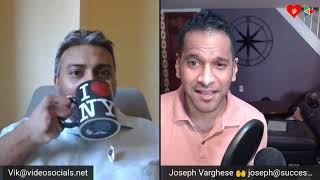
Maximize Your Productivity w/ Joseph Varghese
Joseph Varghese built Success Circles in 2005 and later created the 90 Day Year program. He argues energy management beats time management, and uses weekly reviews, accountability partnerships, and the 5 Day Thrive framework to track progress and stay aligned with high performers.
Chapters
Foreign.
Welcome back to the Pursuit. I'm your host, Ben Spangle. Excited for another great episode for you today. I think you're gonna love today. You know what the Pursuit we're all about helping you in your best body, mind, spirit and life. And today I have with me Joseph Vargis. He's a certified neuro strategist. I'm excited to talk a bit about that stuff. Peak Performance coach and created what's called Success Circles which you're going to learn all about. And a little bit of time we've spent together, I've gotten to know that not only is he successful entrepreneurially that way, but also a big time family man. I know that's a huge priority for you so I think we'll get to talk about some of that stuff too today. So Joseph, I appreciate the time and glad to have you today.
My pleasure to be here. Thank you Ben for having me.
Yeah, I'm excited too. So I want to, I want to talk to you lots about peak performance and productivity today because I know everybody listening wants to get more done in less time. They want to be more, more effective with the time that they have. And I believe, I'm sure you've noticed it too, that since the pandemic I think people are evaluating more that idea of free time and what they're doing outside of just professionally. So this topic is a huge one. But before we jump into that, tell us a bit about Success Circles. And I, I know a bit about it, but I'd like our audience to hear about it.
Of course, Ben. So I launched Success Circles back in 2005 after attending an event. The idea initially was about how do we stay engaged in the purpose wide, the values that we engage in. After the event and over the years it just, it just grew and grew and it became a community for entrepreneurs, corporate leaders specifically around making 1% progress per day, which James Clear talks about the Kaizen Principle or Tony Robbins calls it Can I. And how do we kind of break out of deja vu each day? How do we make progress happen? How do we really make shift things each day where we. It's measurable. And we're also enjoying the journey too as well. I wasn't raised to be an entrepreneur. My dad was an engineer, my mom was a nurse. They came to this country, they grew up in poverty. They figured out a way to get this country back in the 60s. And when I declared that I was going to be an entrepreneur and basically leave everything I did behind me, including the corporate world, consulting World. This framework was very useful because it helped me model people. It helped me build a system where people can model each other around making progress, really modeling someone else's strategies and doing it in a very sustainable, fun way.
Awesome. And so that started back in 2005. I think it's international now too, isn't it?
It's quite all over.
Yeah.
Yes, it is.
Amazing. That's incredible. I love it. And so when as people are listening to that too, I don't know the answer to this. Would you consider that like a mastermind group? Is there a difference you would describe between the two?
There's a component of Mastermind in it. We play what's called the 90 day year. So this came out when my daughter was born. Back in 2015 we launched that program. So we have a framework which is a bit of a mastermind. We call it the team program. Now we call it inner circle. The core program in success circles involves accountability and it's one on one partnerships. And we frame accountability a bit differently from other organizations that deal with accountability. One of our competitors commit action. I also know the founder of Accountability Works, another organization. Kind of know each other in the space. Yeah. The way we frame accountability is about putting what's important in front of you, like being, being reminded what you're up to. Most entrepreneurs, they forget, they get distracted if so many shiny objects, things that come to them and they get distracted where they're not really compounding them the goals, the dreams of things that are important to them.
Yeah.
So we basically built the system where people are reminded each day how awesome they are. They're reminded about the game you're playing. We do a lot of things with gamification and that's the basis for what we do. We're just really playing with games like life is a game. How do we embrace today being a game? Tomorrow is another game. How do we really enjoy that game? Enjoy it being the best game ever and knowing that we're going to play again tomorrow and it could be even better tomorrow.
I love that. I think that's so great. Really great. Well, yeah, let's jump into some productivity stuff and some performance stuff. So I know many people listening are entrepreneurs or executives. And you know, they've got like we talked about things they want to get done and they want to get it done better and faster. Before we talk about productivity, what are you seeing nowadays in your work? What are you seeing as some of the major obstacles to people becoming more productive?
Yeah, I think there are quite, quite a few People getting stuck in their own ways, maybe overusing technology, hence dopamine highs from social media, from having access to a pocket computer in their hands. Because the phones these days are fast, as fast as computers from three years ago, if not faster, that's probably one thing. And also just not disconnecting, like not untethering themselves once in a while. I know you mentioned before earlier that we talked about slightly the importance of like shifting energy. That's a big part of our lives. Recognizing that we managing energy is much more impactful than managing time. I find a lot of entrepreneurs in our community, people I engage with, they're just stuck. They have a lot of stuck energy in their systems. They're not moving their bodies, they're not shifting spaces, their environment every once in a while. And that causes a bit of friction, you can say, because they need to be disrupted. Right. And we as all individuals need to be interrupted often. So those are a few things I'd say that stand out around environment. I also think proximity is a big part of this as well. Sometimes we get comfortable with certain people around ourselves. It's important that we're continually finding ways to uplevel or find people we can connect with who are playing a bigger game. And that internally can cause us to rise up as well. Also, we truly believe that we rise to the quality of expectations of our peer group. And we also fall to our training. Training being how we kind of manage our minds and our mindset and so forth on a daily basis.
Yeah, that's phenomenal. I think so too. Can you expand on the idea when you talk about managing energy is more important than managing your time. Can you talk a bit more about that?
Yeah, of course. So a number of years ago, a book called the Powerful Engagement came by Jim Lore and Tony Schwartz. And in that book they make a distinction that that book is written to corporate leaders. They frame corporate leaders as being now corporate athletes.
Yeah.
And when we realize that, when we can manage our energy, energy could be how much fuel we feel in our body, how much we're being hydrated. It could be also being getting a workout in the cadence for how we perform shifts because we're able to go from one task to another task. Being in high energy and the things that I do. Personally, I sit on a Pilates ball when I'm working. Sometimes I stand my desk. I often work. I often wear sports shirts when I work to remind me that I'm an athlete. And it's just that recognizing that we're all athletes, I consider every Member of success circles with communities, at least to be an athlete, a peak performance athlete. And that one distinction allows us to bend time, get more done. And being an athlete also can mean managing energy. It can also mean stepping outside, doing a power walk, doing a gratitude walk. It could mean taking a powered nap, but doing all the things that an athlete would do to win the game. If you watch this top performer of Michael Jordan or a baseball player, favorite hockey player, as they play the game, they play it in a unique way. And it's very likely that for a portion of their year, a portion of their month, or take time off to disconnect. And athletes do that. Maximum engagement demands maximum relaxation.
Yeah.
So when you can model athletes and top performers that way, and really, Owen, being an athlete yourself, you're able to essentially really maximize on your energy each day. And my belief is that you can get more done, more done being able to do that than just simply having a calendar, managing tasks and things of that sort of.
That makes a lot of sense. A lot of sense. I read that book a number of years ago and you reminded me I need to revisit it for sure. Yeah. I was at the gym the other day. I was talking with a guy, plays pretty high level rugby up here and he was talking about the importance as an athlete, how we were actually in the sauna and I said, how was the workout? He said, well, I actually didn't. I just came, did some stretching and then going to do this. And he was talking about how recovery in terms of training is equally as important as, you know, the weight training is for him. And I think that's a lot of what you're talking about too is as a business athlete, a corporate athlete, is that that actual recovery time is so important. I notice for myself that because of technology, I mean, pretty much any business you run, you can be on 24 7.
Right.
So what are tips that you actually give people? You did talk about those. A power walk, gratitude walk, a power nap. What are tips that you coach people if they're stuck in that Maybe they are 24, 7 in their business, if you will. Where do you start them with in terms of starting to have some of that recovery time?
I'd say managing sleep is a big thing. Putting their devices away from the room before they sleep, maybe having a sort of container or safe they can put their phone devices in. Realizing that by disconnecting from these things, they can be even more productive the next day. Getting seven hours sleep is a very useful thing. Sometimes it might be a Matter of getting to sleep about 10 minutes earlier, 10 minutes earlier the next day. Kind of compounding that idea of five or ten minutes earlier, maybe waking up earlier to that inspires them, I think, being around people also who kind of have these areas down. So when people. Some years ago, my dad had a stroke. This is in 1999, 2004, he passed away. And I made it a point realizing a number of things. Number one is that genetically, I'm inclined to have a lot. My parents have. My mom actually had a heart transplant many years ago too, as well. And they diagnosed me with the same condition she had. And I realized that I could shift these things for myself by being around people who were playing at that level, were balancing their minds, eating healthy. So I made some choices around that time, particularly after my dad had his. After he passed away, to be around people who are very healthy. And just simply by doing that, my mind started shifting too as well. Also. I started seeing opportunities to be better and to do the basic things to be better. And I reversed my heart condition because of that. And I'd say a simple thing that people can do is just simply find people who are out there, that they can model, that they can connect with, that they can engage with. And just being in proximity to emergent people will make a huge difference. So those are some basic things. I think reading is always a good thing. And, you know, I think anything that inspires execution on these things is very important for me. The pain of seeing my parents suffer at a young age helped me to realize that I didn't want to go down that path. So whatever inspires you to execute on things. Sometimes I even tell people that it's okay to meditate on death. Idea of momentum Ori when we know that our time is short in life and that in realizing that there's an opportunity now to basically pause, to take more pauses, to be able and to reflect and to journal and do all those things that'll help us to navigate that journey more. Yeah, I'm also a big believer in. What helped me early on in the game is journaling as well. I mentioned that just now, the idea of rewiring the reticular system of the brain. It's a part of the brain, the prefrontal cortex. You can train it to be able to see certain things. Like, I'm wearing a gray shirt now, and because I'm wearing a gray shirt now, people can see me. Perhaps if you're watching some video, they might see gray around the room, more gray around the room. And simply we can train ourselves to be able to see and to be able to win and see opportunities to be healthier by proximity, by reshifting our environment, maybe putting things near ourselves that inspire us to be healthier. At home, I have a kettlebell near me, I've got weights near me. Sometimes I wear these shirts, sports shirts, because it inspires me to get, be an athlete. But so the idea is that environment is stronger than willpower. And Benjamin Hardy talks about this. There's a quote from Bucky Fuller talks about this as well also. Environment is stronger than willpower. And those are some basic things that I really believe that people take and take on that'll make a difference.
I think that's awesome. I think that stuff is so good. I'm a big fan of sleep. I wasn't in the early part of my career and then as I studied it more and more, I realized how important it was. I kind of grew up business wise where it was, hey, you can sleep later, it's time to, you know, time to go and kind of that old ethic of that. And then once I realized that, you know, I was getting up early and I was staying up late and I was doing all these things, but then I was drained in the middle of the day often or drained at the end of the night. And so now I'm a big fan. Seven, eight hours a night and love it. I just, it made such a massive difference.
It's awesome. I'm sure you feel better. I'm sure your kids and your wife are happier. They can connect with you and more.
Yeah, 100%. Yeah. I couldn't agree more. You know, everyone that's listening, we all know the power of being optimistic and being positive, right? I mean, no one's, no one's doubting that, that when you are thinking on that level, your life is working better. Right. You're able to react better to everything, respond better, all of that. And what I've noticed significant is that if I'm not getting enough sleep, it becomes significantly harder to maintain that optimism, to maintain just even that alone, let alone all the other side benefits too. Yeah, I think that stuff's so good. So, hey, let's talk a bit about. Oh, I have one more question for you too. So you talked about just managing your sleep a bit better. That's an area to start. What do you recommend for people? So say, do you have a protocol of where they're completely disconnected because you brought up just, hey, turn the device off at night, put them away, do you have a protocol you recommend in terms of once a week, do this or any. Any of those kind of ideas.
So I'm playing more with the idea of the Shabbat. So in success circles, we have members of community who are Jewish, Orthodox, Jewish. And one thing I appreciate about the rituals that really allow them to harness their power of being productive for themselves. They take a day off. They basically take Friday evening to Saturday evening off. I think being able to, whether we're religious or spiritual or however it is just being able to disconnect, having a reason to disconnect and enjoy those meals with family can make a huge difference. But it's also finding the accountability to be able to do those things, to be able to disconnect those devices. Sometimes our spouse, my wife, she's a physician, she's on call sometimes, sometimes she has to look at her devices for a reason. Sometimes we give our kids devices just to distract, attract them so we can focus on doing housework and chores. It can be a little challenging. I think the key thing is also just embracing how good does it feel not having these devices. How deeply can we connect more, how much can we appreciate each other more? So I think the practice of anchoring, when I learned NLP years ago, you mentioned before, I'm a neurostrategist, and that taught me the power of kind of anchoring. And the idea of anchoring is basically, is when something happens, you can establish something or set something so you feel good afterward after the experience. So it's in like embracing the sense of being grateful, being fully present, enjoying that moment to spend with our kids, our family or loved ones, maybe with ourselves, that allows us to make these things better habits.
So great. Yeah, I'm a big fan of. Again, it wasn't always this way, but a big fan of my phone's off from pretty much Saturday afternoon till Monday morning.
And that's amazing. I'm working on it and it hasn't happened yet. And I'm learning that when I do, when I put in another room, I have a laundry room, my phone's there. I just feel great. It's really fantastic.
Yeah. And trust me, it's a project for me too, still too. But even when I come up for dinner, I. I don't do it every day. But I'm working on leave the phone. So my home office is downstairs. Leave the phone down there and then I can actually be present and not constantly checking the thing for sure.
We can also train others too, so we can train people how to respond to Us. So we let people know in our voicemail, hey, I check my messages three times a day. Please leave a messenger or send me a text message or check emails these times. Basically we define the rules of engagement. Just like any game has certain rules, we define what those rules are. And if people appreciate who we are and the work we do out there as leaders, as executives, then they'll respect those rules too as well. Particularly if you're willing to communicate and share those rules. Put them on their website, put them onto a calendar page, as far as our scheduler, our voicemail, little things of that sort.
Yeah, it's a great point. It's a really great point. And I think with that too is that being willing to have those where you're teaching other people how you respond. But being willing to have those kind of boundaries I think is important for your own sanity and, and then you have to be willing, I think for a lot of people is the willingness to, I mean people learn, but to not worry too much about people pleasing in that sense. Right, Is that so? Let's switch gears a bit. I mean, we are talking about this subject overall with all of these things in terms of increased productivity. So I want to get maybe a little granular in terms of my business day. So I've got my business day before me, right. Maybe I'm working on my sleep already. I'm doing that. What are some ideas or things that you're noticing? Hey, productivity. The people that I'm watching that are the most productive. Here's some of the things they're doing.
So when we built the community I lead, we looked at two systems initially. One of them was David Allen's getting things done. Second one was that Tony Robbins had a program called Rapid Planning Method.
Right.
I find that a lot of systems embrace some of the best facets of these programs. Tony Robbins system is basically a top down approach, basically having a vision the why and working from there and being pulled into action. David Allen's system is basically about having a clear Runway, being able to take off, knowing that the things around you are managed. There's systems around these things that exist. So I encourage people to kind of embrace both sides of that. And some people are different, some people are more visionary based, some people are more integrators based. So they like having stuff in front of them for whatever reason. They like that. They like that. So what I'd recommend for most people is to envision what a successful day looks like, what an ideal day looks like for themselves running their business. Envision that and basically create a system on what that looks like for themselves. And it could be even based on a certain day of the week. Right. So basically visioning that before I go to bed at night, sometimes when I wake up in the morning, after I do my prayer, my gratitude, those little things, I envision what a successful day looks like for myself, that's one thing. I often also recommend people design their morning the night before or the evening before, the day before. And all that means is that when we get to our desk to work, we know what we're working on. It's clear, it's on our minds, it's on paper, we're working on that. It's basically putting what's important in front of you. Insight in mind, in action, out of sight, out of mind, no action of sorts. So that's, that's a simple thing too as well also that I recommend people do and the more they can plan out their week. David Allen talks about the idea of the week review. When we embrace that one concept, we're able to potentially create about a thousand percent more productivity by really closing out a week, recognizing what projects are next for a week, and so forth. I do recommend getting in dialogue as well. Sometimes when we think these things out on our, on ourselves, or journal these things, it can be a little challenging. When we're able to speak these things out loud with another colleague, a team player, it can make a difference because now you have another perspective that's there, or you're able to speak things out loud. And when we speak things out loud, we're able to clarify things, even the minor things that allow for us to make that 1% progress per day. Hence what we do in success circles. I really do believe in the idea of huddles. And if you're in a corporate space, maybe you can create huddles for your team. Important, whether it be one on one or a small group, just to give people a chance to have the experience. I see you, I hear you. What you see matters. And this is my intention. This is what I'm working on. This is what drives me today. Every Thanksgiving we do an event called the Bass Brigade. We can feed thousands of people here in New York City. We had a huddle a few days ago and it got very techy for a while. Like, it got into place of like doing things is the list of 50 things need to get done and so forth. And eventually on the call I said, well, let's get grounded here. What's our why? Why are we doing this? Why don't we each speak that out for ourselves and allow it to really connect with your heartstrings. And we did. And then all of a sudden the call got grounded and then people got very clear about as far as what actions they need to do next based on their strengths. So those are some basic things. I also encourage people to really focus on their strengths. There are many ways we can figure this out. There are different tests out there. There's disc, there's strengths finder. I did Cobia last year, Kobe's by Katherine Kobe, I think she's from Canada as well. And these things, these, these tests, basically they're simple. They might take 10, 20 minutes to do. The feedback around it though what it tells us can be priceless because now we know our zone of genius. We know what lane to swim in, to be successful, to really get hit our end goal or how to leverage more effectively, how to find the right team players around ourselves who have the strengths that allow us to catapult the mission, the business, what we're working on. So those are some. That's a lot to consume. Which people can rewind this of course and hear this again, the different tests and so forth.
Yeah, no, that, that makes a lot of sense. I know certainly everyone's got different personality types as you're talking about. Right. And kind of figure figuring out who are you, what are your strengths. And I think, you know, how do you create systems around that to maybe shore up some of the parts that aren't. I, I want to talk about because there's the more what I would call, I guess like a type. Really organized, structured. They've got it. And then I'm not sure what the other type would be but where they're more free spirited, free, free will. Just go and do it. I'm curious what your thoughts are. So for people that are already quite organized, a lot of this stuff may, may or may not come very naturally to them. But the terms of pre planning their week, envisioning their day, everything on paper. Where do you start with someone if they're the opposite side of that, where they almost feel like that structure ties me down too much. But I do want to increase my performance. What would, what would you answer to something like that?
Yeah. Perhaps the creative type. Maybe they're an artist in some way, some form. Yeah, it's. It's basically honoring that in oneself and finding ways to build. Well, first of all, ask yourselves a question. Questions are a great thing, the basis for everything we do and the business. I'M involved with are quality questions. Quality questions lead to a quality of life. Maybe even ask have somebody else ask you these questions. Maybe even a coach to asking these questions to be helpful. Are you making progr progress going, doing, doing what you're doing? Are things progressing? Being an artist, being a creator, that things are and things are managed, then maybe nothing needs to get changed. In most cases I find some things do need to get changed shifted because systems do help quite a bit. Having a better organization does help quite a bit. Sometimes it's a matter of just bringing the right people on board. Maybe having a productivity consultant on board helping you with your list. Maybe having a hiring a chief of staff, basically an executive assistant. Someone who's there who's able to kind of manage your inbox. I'm personally not an inbox person. People think that Joseph is ultra organized. He's got all this going on. I've got great people who work with me who are able to go through my inboxes, see things I've missed on LinkedIn communications and then they message me in slack and from there we're able to respond accordingly. In some cases they have a checklist of things that they respond to and it frees me up because I like being creative. And for the longest time I didn't see myself being creative. I believe when I talk about personality types as well, there are different stages of life too as well. There's a point in my life when I was studying engineering, I was a technologist where I was very cerebral, very left brained, very much about strategizing what was in front of me. Then I went through a stage of my life which I'm very grateful for, where I started acting, performance, improv. Only because I needed to rewire myself because I found myself being very too left brained.
Yeah.
And then all I went through that phase of my life about three, four years where it was very creative, where I was an artist and I could do things and I fell in love with improv.
Yeah.
And then at some point when I realized I was very too right brained, I had to find the middle ground. That's where I built success circles. That's kind of a way of kind of honing in both realizing that by getting in dialogue and by having a system toward checking in, making that 1% progress per day, I could personally progress faster than if I stayed with that creative community or stayed with that very cerebral community of technologists that I was with. If that makes sense.
It does. Yeah. 100% it does. I want to switch gears. And we talked briefly about gamification earlier and I have my understanding of what that is. Before we jump into some ideas on it, why don't you tell people that are not aware of that word. How would you describe gamification?
I describe gamification as making life more fun, engaging in more play. Right.
I think we all want that.
We all want. Exactly. It's not sustainable unless we're able to see that life is being a sport, a dance or a game of sorts of. So it's also using the language that serves you. So in my case, I like games, I like sports, I talk about that word, sports clothing members. I spoke to one of my clients a little while ago, she's a dancer. And I'm like, well, life is a dance. Each day is a dance. When we see life this way, it helps us to minimize friction. It helps us to get detached. We are able to recognize as a day ends, as we hit the pillow at nighttime, I get to bed with my four year old son. Like he sleeps next to me with the same pillow. It's the cutest things, this stage of life. And the moment I do, the moment we passed out, I know the day's over. Did I give him my all that I show up powerfully, the questions I ask myself. But the day's over and I know that whatever didn't get complete, I have another day, a new game to play. So each day I see as a game or a dance, if someone's a dancer, whatever metaphor serves for them. And I find that when we embrace gamification, things really progress a lot better. They're more fun. It's just basically recognizing how do we apply the rules of sports or games to our lives. Even for my day we have a program called basically Inner Circle Program Success Rules. It's basically the idea is that the 90 day year. One of the ideas in 90 day year is that each day's imagine each day is being a game of let's say football or football or let's say basketball. You have four, four innings or four sections you can have for the game itself. And if you can break your day into those four, those four quadrants you're able to kind of shift energy and end of each quadrant each quarter you're able to basically measure the progress from the previous quarter. And that helps quite a bit too. And I have kind of systems in my life where I've been able to measure those things. It's putting those things even next to me. I haven't got a scoreboard next to me, I've got this whiteboard says scoreboard. Right. It's basically. Basically having a. You check on the things like check off sales calls you're making. Right. The things that are important you want to measure.
Yeah.
There's a law out there that we adopt a lot in success circles and the projects I'm involved with, that which is measured improves exponentially. Pearson's. Pearson's law. Yeah. So how do we have fun measuring these things? Right. How do we have fun? I find personally having a scoreboard, having these check ins repeatedly, hence the idea of having games makes a difference. Those are some basic ideas. A lot more to it. It's just recognizing for you what serves you. You know, the audience member listening to this, whether it's a sport, it's a dance, then basically creating your own game, creating your own rules of engagement, training others what those rules of engagement are and making it fun. Because if it's not fun, then at some point it creates friction and it gets upset. You get upset over things. Maybe you want to play different games.
Yeah.
In success circle. So our tagline is dare to play bigger games. So play is a big factor there too as well. Also, it's embracing more play. Whatever play means for you. Play for me means. Play for me means playing in the moment, means playing characters with my kids sometimes, like showing up. Playing play for me means making calls, like make client calls, sometimes sales calls. For me, that's bit of play too as well. So defining what play is for you and how to engage in more play each day.
I like that. I think that's really great. I was a big. Growing up, I was not a sports guy, but I was a big video gamer.
Awesome.
And so I think there's a lot of cool stuff you could do even with that as well too. Reaching different levels. Progress. Right. It. Progress is fun. You feel good when you're progressing. Yeah. And I think a big part of what you're teaching is exactly that, is that if I'm measuring it daily and then weekly and then quarterly, I'm able to see am I drifting off course a lot quicker and readjust. And also though I'm able to see that progress. And I think progress is in a healthy way, I think it is addictive in a positive way that we. I see it, I feel it, I want more of that.
Right?
Yeah.
Yes. And getting a dialogue also helps too because sometimes we don't see the progress. People remind us, well, hey, well, you know, you've done this, it's really great. You've progressed, you're doing this race or you're showing up for your family this way or just getting feedback is very useful thing. Particularly people on the same playing field as you, other colleagues who understand you, who appreciate you and who can encourage you.
Yeah, it's so true. So true. I was with a, talking with a friend of mine the other day on the phone and we were talking about the seminar I had just done and how the first one went and it was a big success and everything. And then she was asking some questions how the numbers all finished out. And I told her, I said, you know, it was okay, it was this. And, and I told her stuff. She goes, that's amazing. You know, that was. And it was funny to hear her perspective in such a different way of. But that idea of dialogue and having other perspective. I want to switch gears and then we're going to come close to wrapping up here. First things first, if people want to connect more with you, I think the website is success. SuccessCircles.com is that the best one?
That's right, yeah. We also do a challenge. Well, it's recommendations shortly called 5 Day Thrive.
Yes please.
5 Day Thrive.com it's a monthly challenge we do for 5 days lessons around automation, lessons around gamification, lessons around leverage and outsourcing. Check it out.
That's awesome. That'll be a great one to check out on there. Five day thrive.com we'll have those in the show notes for sure. And that. And you do that every month. You run that?
I do, yeah. Okay. Much, much. Everything I've built, I built myself. I'm the biggest guinea pig. Of course. We've served hundreds of thousands of people over the years and I think every master was once a disaster. I certainly was a disaster many times. I almost went bankrupt, you know, a couple of points in my life I didn't.
Yeah.
But we built systems to basically get better and I think every business, every mastermind, every community came that way and grateful that I was once a disaster, I'm no longer a disaster.
Yeah, that's great. Okay, I like it. And then are you on social media? Do you use many of the platforms?
Yeah, yeah. So if you go to search for Joseph Varghese, my name, you can find me on most platforms, LinkedIn and much more. If you go to josephjv.com it forwards right to my LinkedIn profile. Hence Joseph, my middle name, John Joseph jv.com okay, perfect.
Awesome. That's great. Well, thank you for that. I look forward to everybody Learning from this and one you want to listen to multiple times, especially some of the more detailed strategies Joseph was giving you. Just in closing, Joseph, we've covered a lot of stuff right in different areas. And if you were to leave our audience today with one thought in terms of if they got nothing outside of our time together today, this is the one thing I'd want to make the impression with you. What would you say that is for you?
It's something I said earlier. We rise to the quality of expectations of our peer group. We also fall to our training. So when you get that concept, it really makes a difference whether you're giving a presentation, you're leading on stage, you're speaking to a corporate group, there's training that gets involved. Being able to do it, being able to show up a certain way, to be able to speak a certain way. It's really embracing that training on a consistent basis. Then also being and community of people who expect you to be your best. For me, that's one of the greatest hacks. You know, years ago I spent time with a lot of the same people and I wasn't really rising. And when I learned that even the idea of reflecting too much on the past, you know, experience people I was working with, high school and so forth, didn't necessarily serve me versus actually forecasting a better future. Being around people who are playing a bigger game. And if you aim each day to make each day better, you will thrive in life. You aimed also in every conversation to make the person you're connecting with better. As Ben and I are doing here, some. Some richness will expand out of it as well, where things progress faster as well. Also for both of you, I think.
That'S such an incredible life philosophy right there. Aim to make each day better and aim to make each person better. When you're with them. Can't help but succeed in their lives. And the byproduct is yours too. So, Joseph, this has been awesome. I really appreciate the time. I love these ideas. I want you to know you've actually inspired me to get back to some of the things I was doing around my tracking and measuring. I'm more just so you know, I'm more that kind of creative. All my schedule is there, I do it and I have systems. I got my assistant that does a lot for me. But I go, I go do my schedule and I like to be free. And I also know how much I excel when I've got some of those other pieces in place. So I'm excited about getting back to them. Thanks for that. My pleasure, everybody. I know you love the episode. Do us a favor today. First and foremost, if you're new to the show, make sure you click, subscribe and then share this with just at least one person that you know would benefit from Joseph's message today. If you're sharing on social media, make sure to tag Joseph. Tag myself. Great to have you at the Pursuit here and look forward to seeing you at the next episode. Thanks for the time.
Just thank you.
More from Joseph
Empowering Entrepreneurs: Joseph Varghese on Transformative Peer Accountability