People ❤ Clapping with Joseph Varghese of Success Circles
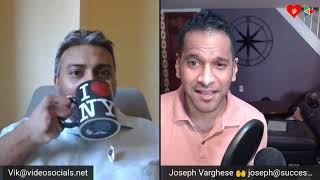
A recorded interview (YouTube/podcast) between Vikram Rajan and Joseph Varghese about building and running business communities, centered on Varghese’s 15-year-old community Success Circles. The conversation covers the community’s origin (peer momentum after a Tony Robbins ‘Date with Destiny’ event), member profile (growth-minded entrepreneurs), daily/weekly rituals (buddy huddles, momentum huddles, Saturday brag calls), repeatable cultural elements (gongs, “1,2,3 you rock”, acronym ‘SPICE’), and operational tooling (Airtable, ClickUp, automation).
Chapters
Hello and welcome to another episode of People Love how business groups and communities grow. Today I have a longtime friend and colleague, Joseph Varghese. But before we get to Joseph, I want to make sure that everyone knows this is more or less weekly as a Facebook Live and a LinkedIn Live Fridays, 1pm Eastern. You can also subscribe to the podcast through Apple Podcasts to Stitcher, which is what I use Google Podcasts, SoundCloud, I believe. So it's really, really easy to get a hold of it. Likewise find prior episodes on YouTube as well. I'm looking forward to learning from Joseph because I run a business community. I'm the co founder of Video Socials and we are a community of attorneys and accountants, coaches and consultants who are video blogging together. Fun and done. And then we use our Brander automation app to get our videos branded and captioned and then posted automatically on YouTube, LinkedIn, Facebook, WordPress. And then we have an automation that can automatically repost videos, essentially keeping our members top of mind, top of feed with their referral relationships and potential clients. But as much as the app is really cool, I think the community is even better because it's an opportunity for our members to get to know one another, support one another during the club, after the club become referral relationships, even clients of one another. And I'm looking forward to learning from Joseph and his success circles and other communities that he belongs to of how it grows and thrives and interacts. So Joseph, welcome to People Love clapping.
Beck. It's great to be here, brother.
Before I even jump into what you're currently doing in your current community and all that, I'd love to hear a story, an anecdote. I'm putting you on the spot, but maybe you can recollect a time growing up as a young kid, a young adult, maybe in your professional life. Was there ever a time that a community, obviously not necessarily a business community, but any kind of community, helped you? Was there a turning point in your life that you can now think of that belonging to something larger was an impact on you and your life, personally or professionally?
Absolutely. There's so many levels of community in my life. The biggest one of course is family. And I grew up in a South Indian structure similar to yourself. My family's a very connected. My dad has is one of 10 siblings. So growing up initially me and my sister in the 70s growing up, we were the only kids our age, you know, growing up. Then at some point something shifted. My dad brought his brother to his country and then he brought his Next brother and his next sibling and family. So yeah, I know that story. Having a large community for me is integral to who I am. And I wouldn't be who I am if it weren't for having multiple parents and uncles and aunts in our household around us. Christmas holidays, much more. So that's a big part of who I am. It's why I do what I do. That I would say is the initial community. Then over the years there are other communities as well, also playing sports, being in the fencing team, being active in other activities in school and clubs and chess clubs and you name it. So community is everything.
So what prompted you. Now you're part of a number of different communities. Is the main community Success Circles or how do you see all the different endeavors? And is that the community you started? And I'd love to hear kind of creation story, if you will, like how and why you created that. I mean, it's not all easy, right? So there must be a real resounding why you put so much time and effort into making it successful. How did that happen?
So this is idea called Peer Momentum. And the word peer is peers, overall, peers, colleagues, leaders and momentum. We're all making progress. So I wholeheartedly believe in this idea. I actually own the brand Peer Momentum. So everything I do flows under that idea of peer momentum. Basically the idea that we're all winning, thriving together. You win, we win together as a community, as leaders. So that vein, that thought, that action, that verb, pure momentum runs through everything I do. So I lead a community called Success Circles. We launched Success Circles 15 years ago. It launched after an event called Date with Destiny. It was a community birthed out of the idea of that, you know what, having a coach is great. Having coaching is expensive. I had the top coach in the Tony Robbins organization. I work with Cost.
Destiny is one of his flagship programs.
Tony Robbins, it is probably his top flagship program. It's a seven day event, six, seven thousand dollar event depending on how you get into it. It's also an event where people clarify their purpose in life, their why, their values, what they're moving toward. For me, when I went to this event and several of us who attended, we asked ourselves, how do we keep this momentum going? How do we progress and not have this event be a memory of sorts, which happens to a lot of people. I meet people over the years where it's like you blink your eyes and they blink their eyes and a decade goes by without much progress. So we asked ourselves, how do we keep this going? So we Created a community focusing on accountability, momentum, progress, winning, realizing life is a game. I'm a fan of playing sports. I don't watch sports, but we took a lot of sports ideas into what we do. So it's. It's Success circles birth that way. Over the years I also lead a community called the six called the Power Team New York Power Team, the largest peak performance meetup community in New York. And so there are a number of other communities I'm part of. And going back to what I mentioned before, it all kind of chunks down from this idea of peer momentum. If I didn't see all of us winning, even this vein being my family, peer momentum, then all this, all these community ideas would come, would be overloading. Right. It would be overwhelming. But when I see it all connecting together, we're all winning together as a team, playing this game of life, then, then it's easily manageable and fun too as well, because games are fun too. So we play a lot of games. Successful Success Circles is all about playing games. Every day is a game and much more. And anybody can check out successcircles.com to learn about what we do and how we've been doing it. For 15 years.
We've seen a, a profile emerge of the kind of person or professional who should be part of Success Circle. And even corollary, not that you want to exclude anyone necessarily, but is there a profile even of the opposite of someone who you know really wouldn't be a good fit? You know, they, they may nonetheless be professional and be good at what they do, but. But they're not necessarily a fit for Success Circles. Can you speak to both aspects of who's a good fit? And maybe Success Circle is not for them. Not that they're a bad person, but you can get.
So Success Circles is not for everyone, it's for a specific type of person. Hence it's for a growth minded entrepreneur. An entrepreneur who really gets the idea of making comp. Tapping into compound growth, maybe even the Kaizen factor. That's a word they've used over the years.
Continually improvement. Yeah, continuous improvement. Sure.
Exactly. Exactly. So I'm addicted to continual improvement. I want to be better than I am today than I was yesterday. So anyone who is passionate about that idea will thrive in our program, our community. It's not for people who are playing small. It's mainly for entrepreneurs. Growth minded entrepreneurs who may have invested in coaching in the past, who now want more glue, more connection, more community access to keep that momentum going. We have a whole formula on how that works and has to do with questions, having direct questions to you in a way that, where you're invited to think differently, embrace critical thinking, seeing, you know, an opportunity to raise your standards each and every day, for example. And having fun too as well also. So also we cater to people who like playing games or sports. And not all sports, but just the idea of playing sports, realizing that in the sport of life or the game of life, when we play sports, when we're out to win, we hit a gong each day we have a group huddle call each day we hit a gong. Someone has a sale or creates a partnership, we hit a gong. It's fun. So just really the ideas around.
Is it an actual gong? Do you have that gong handy or.
I do, yeah. It's probably over here somewhere. It is over here. So it's like, it's like a meditation gong, you know, and it's, it's, it's cool. So, so we have a couple of these and it's okay. All right. It's, it's as simple as, you know, even I, I've had the opportunity over the years to build out a sales floor.
Sure.
And salesforce. We, we had two gongs. We had like a smaller gong. You kind of hit somebody, someone gets a sale and then, and then when, when you, when, when someone had a huge partnership, joint venture of sorts, then we hit the massive gong. You know, it's like you hit the thing and it anchors that. It. Yeah, it anchors it in. It's fun, it's engaging. Everybody claps. So I think entrepreneurs working from home, we all deserve something about sort too as well.
So.
Yeah, so just a way of adding playing games, making progress. If you look behind me, I've got, I've got a giant compass in the wall and it's a reminder to me of making one person progress each day. One person progress each day over the course of a year is 37, over 37 times the level of progress as possible. So. And I believe that's possible. We believe we built a community. I'm the biggest guinea pig in the community. I've been part of it for 15 years. Of course we have members who've been along in it almost as long as I have. And it's fun, man, it's a lot of fun.
So you know, you mentioned growth minded entrepreneur. Are there any entrepreneurs that's going to admit that they're like, yeah, no, I don't want to improve every day. I don't want to grow like. So when you say the Opposite of that doesn't really belong. How does that really fit in? Like who? Like maybe they wouldn't readily admit that, but are there symptoms where they're not voicing that but they're nonetheless showcasing it by behavior or mindset? How do you determine that when someone wants to be a member, you're like yeah, this isn't really going to work out.
And yeah, so let's say they like being comfortable. They watch a lot of Netflix, let's say on a regular basis. My wife and I have one show we watch every once in a while and it's called Wandavision. So we watch that season. Season to season has ended and. But we spend most of our time, my wife and I and people on community just basically winning, like finding every opportunity, our day maximizing our day winning. So it's really for someone who has a mindset of just winning. Right. Making progress. And I believe in life. You know, I used to be bodybuilder in college that all muscles atrophy over time. So someone who is comfortable, maybe overly comfortable and they're comfortable in their environment and their peer group and so forth, then they may not be the ideal fit for our community. People who are ideal tend to be people who've invested in coaching, who invested into high ticket programs of past because of that commitment they had maybe being in a mastermind before and realizing that they need daily connection. They need to have a daily huddle to start their day with where the idea of winning the morning, getting traction in their day or building successes in the first three or four hours of the morning could lead to a lot more success into the day, into the week and so forth.
What time in the morning is it that you guys do your huddle?
So it's a one on one huddle. It's based on the person. So it depends on what coast they're in. East coast, west coast. It could be 6 o', clock, 7 o', clock, 7:30. So we pa on their availability for that half 45 minute window of time they're available. I'm. We have two kids as you two kids also. So I. My day starts at 5 in the morning so for me my calls are anywhere from 5am to let's say 6:45. If I go beyond that stretching days, the kids wake up at that point. Right?
Yeah, I get that. That's really neat. So how do you. So you just alluded to kind of my next area, my next question that I think about it in terms of interaction. There's a difference between a fan Club where they're a Joseph Varghese fan. I'm sure they all are. But then there's the community, the peer community aspect where they're interacting with one another. How do you facilitate that? How do you foster that? You mentioned one example of where you're pairing them up. Is that a lifelong pairing or membership? Lifelong pairing. Or do they swap or what are other examples of that interaction where you're making and developing and nurturing that community?
Great, great question. The pairings are two weeks at a time.
Yeah.
Buddy for two weeks and they get a new buddy. They have a whole roster, team roster. They can choose from members based on values, personality. So they can choose. They don't choose. And we help choose for them based on their needs or challenge what they're dealing with. So it's two weeks at a time. They extend the two weeks to four weeks, four weeks max. After four weeks, people get comfortable. We have other. Other. We have a team program too, as well. Also. The team program is 10 of us together, plus playing, winning the game. We meet together as a team once a week. It's like a mastermind, but more in depth, more direct, I'd say. Then we ask people, go through the program. They get buddy after buddy after buddy. They create what's called their Circle 5, basically the first draft pick. So basically, it's like a team playing dodgeball. You choose your top five favorite buddies, and then we may create a separate structure for you and those buddies, or we may just have a resource pool to know and recognize who to pair you up with in the future.
And those are the top five draft pick, if you will, of other members.
Your. Your top draft picks. Exactly.
So now. So. Well, my question is, is it among the members of the people picking their five other members, or is it like these are the five that make an impact in my life or business outside of success circles inside.
Success circles inside.
Okay, that's really neat.
Exactly. So people are able to see that on the roster. They're able to see who those people are. So let's say you, you and I connect. We're buddies for two weeks like this. This really rock was amazing for you, let's say it was a so so experience for me. You know, it really pushes the person to step up and show up so they can really be on the draft pick or the circle five for the person so that there may be possibility in the future of butting up again. And so it's. It's about accountability. We make accountability fun.
So. Yeah, well. And as you Know like fun and done. It's very much part of video socials. And you know, we're not really a networking group, we're not really a peer group in that sense. But nonetheless, people are helping each other, pushing each other in a good way. And you know, we love our members when they meet outside the club environment. And we've had the concept of a blog buddy and they could brainstorm topics with one another to keep kind of on point and on purpose of video socials, how do you help with or do you not help with like the calendaring issue? Where is it you're leading the horses to water and you're helping. You know, it's up to them to figure out when to drink together, so to speak, to extend that metaphor. Or do you provide any kind of facility for them to actually get together outside of the meetings, which I want to talk to you about as well. Do you facilitate that at all? Like how do you make sure, help them make sure that they meet?
Well, first of all, my experience, it was very positive, the whole nature of people coming together, helping each other and really rooting for each other and cheering each other on, especially as they're delivering their elevator component, elevator pitch of sorts. And it's really great to have that level of reaction support, applause that comes forward.
Thank you. I appreciate the plug what you were saying. Yeah. So how do you help with the calendarization?
Yeah, so the calendar days is pretty simple. So we have on the roster people. It's clear where people are available. So as we prepare them together, they know when to connect. And ideally it's a consistent time each day. If they're looking to meet outside of it, that's up to them. So it's a one on one call or it could be a triad or three people since it's only just two people or three people in that container. Choosing a time to connect afterwards. So a lot of our members do meet, they meet in person. They send us pictures to them for coffee. In some cases we've members drive to Baltimore to meet with their buddy. Happened before because it's one on one. It's a relationship. People feel that they can trust and open up. Sometimes people do that and they report back how that encounter went. And there's some cases people are strangers. I had a gentleman on the west coast in Washington state for years. It was a buddy of mine, one of my favorite buddies and it was Evan Lenz. I've never met the guy and I invited him to my wedding eight years ago because we had so much There was so much opportunity and growth, both of us in that relationship. I'd never met her in person, but our relationship was such that I felt that he would be extraordinary. My wedding. One of my other groomsmen actually was a buddy. Also one of my favorite buddies in successor roles eight years ago as well.
That's cool. Yeah. I always feel as if, do we really need to create that infrastructure of calendaring? And is it something that we've shied away from that? Like, oh, my goodness, what a big undertaking that that would be? So, yeah, I'm curious about that. So thank you for kind of helping me understand that a little bit more.
That's easy. It's easy when you have two people, three people. When you go beyond that, it becomes a bit of a challenge. And sometimes we've done that with the mastermind, the Circle five. We've done that. And some cases it was a little challenging. Sometimes a facilitator would have to be in the mix, can coordinate the specifics around. That's when you available. Let's get. Make sure we set time.
And that coordinator, is that someone on staff or is that a volunteer, so to speak, or how does that happen?
Typically, it's myself or we may assign a leader in that community of the five. The person stands out, saying, you're the leader. You're like the facilitator. You're the Yoda here. So the word we use is a Yoda in our community. So as a Yoda, it's up to you to rile the forces other four people to get people together.
Yeah. All right. That's really neat. Okay, good. Actually, now you're making this easy for me, Joseph. So the next thing I try to think about is that every community, yes, they've got some story. They've got people that are in or out. They've got that interaction component, of course, and the lack of a better word. I'm just using the word repeatables, meaning there's always stuff. And you mentioned a couple of them already, that there's kind of inside jokes, inside jargon, repeatables by visual audio. And you've got all of that, right? So you've got the gong. That's a repeat. And that's very much all right. Not a lot of groups are banging the gong and celebrating wins that way, let alone clapping. I mean, I think that happens a lot. But, you know, we do a lot of clapping at video socials. It's. It's. It's physical, it's visual, it's auditory. So It. I like the concept of clapping, obviously. And you got the gong and you have some inside jargon, so to speak, like the Yoda, which I'm assuming you borrowed from Star wars, unless it's some acronym. Don't understand that. That's cool. Is there any other repeatables that you can point to that really kind of is a cohesive aspect of your membership where, you know, every member can repeat it? Like every member of ours, you know, they. They know fun and done. Like, they, you know, we've got that stuff. But what about you?
So our favorite is 1, 2, 3, Uroc. So, all right. There's a community I lead called Power Team. I was part of it for many years before I became leader of it going back in 2003, 2004. And I've carried this forward into everything we do. So after every share breakthrough, people share, whether it be a success service call or in the Power Team, when we lead, we have people do a kind of a one, a two, a three uroc. Right? And we'll all do this in unison. People are conditioned to do this. And I've done this on Clubhouse where there was no visual component. It worked great. Raised energy up. This is all managed the energy. Right. The greatest breakthrough I think, over the years around time management is recognizing that it's not about time management, but energy management. The powerful engagement talks about this. So being able to do a 1, 2, 3, you rock. Kind of shifts energy, wakens people up, anchors it in also as a celebratory factor and makes things fun, like in sports, you know, to be able to do that. That's the one thing we do actually own that domain. 1, 2, 3, the letter you rock. I own that domain just for the hell of it. Yeah.
Yeah, that's cool. Anything else that comes to mind that brings us into your world and brings us into your community, things that you repeat words, phrases, obviously you mentioned some of them already. Any other things that come to mind?
Yeah, I mean, I mean, the basic things that are empowering statements, you got this, we got this. I love you when we win. Like, I grew up with that idea that you win, we win. Most every conversation I have. It's so natural for me to end that conversation with that statement, you win, we win, or you win, I win, we win. And it's the team spirit. We bring team spirit into everything we do. It's so vital and it's also intention. So when we establish context, container. So success circles as a container for two weeks. There are certain things we say to Ensure that there's safety. So, for example, the start of a buddy call context is created. I will tell my buddy or buddy will tell me. Just so you know, I'm 100% committed. Running value in this call as your momentum buddy, are you committed to playing full out of being transparent, getting that agreement, it sets the container strong. And then from there to close a container, it's, you win, we win, let's win together. I find that's important. Anything we do, there's got to be a safe container. Language is a big part of it. Context is a part of it. Context is basically, what are the components that hold the sentence together? What's the intention on the sentence? At a seminar, a program, let's say, go to Tony Robbins seminar. If you walk into a seminar, three Tony Robbins event three minutes late, it's a cult. If you end up in it from the beginning, where he talks about the rules, about playing full out, giving, giving it all your all, it's like the greatest rock concert motivational rock concert in the world. And this applies to any sort of container interaction about that sort. Its context is everything. Being able to define what this is all about is everything.
That's great. That was a good insight that that context, right? Where you know, from the outside, you know, is it. Is it hokey? Is it corny, is it stupid? Is it cult like? Or once you're in the experience, are you. Does it really actually spice it up? Is it like the salt on the food that actually enhances the flavor of the experience perfectly.
So, yeah.
Yeah. So just came to me as that example. But I like that I translated things into analogies and metaphors. So for me, that context is that salt on the food. So that's really cool. I like that. Can I say something? Yeah.
So years ago in 2013, when my wife and I, we got engaged, Shirley and I got engaged, I would get these buddy calls. And each day my buddy call, you know, we would say our why. So sometimes we align a few more things to our why too. So I say my why is this? And then it's after my why. Making a difference to the world, creating impact. And I'd say my core values are steadfastness. Playfulness. No, steadfastness. Passion to serve. Integrity, courage and excellence. Spells the word spice. Steadfastness of passion to serve. Integrity, courage and excellence. But I was strategic about it, the way I would say it. And then my buddy at the time, she's in Canada, her name is Kay, she called me on it. She's like, so, dude, you know, there's no plan there. You're engaged, this beautiful woman. You're like, you're talking about getting married, having family, but you're so serious all the time. Just simply by taking that word, spice, right, Those. That acronym and adding the word play in there. Steadfast, playfulness, passionate serve, integrity, courage and excellence. The two P's now, of course. And now it shifted everything, right? You talk about spice. You know, this nature of that. But it's basically how we create our day. Where focus goes, energy flows. So the matter of focusing on progress, sometimes declaring our values, our virtues, putting light to it, sharing our why as we say these things, our day now falls in line of these values, falls in lines of our why. And I mean, particularly through Covid. I think it's so important that we wake up and have a means to be pulled into our day, be pulled, be inspired in our day, take inspired action. And I find a key part of that is really owning our why, knowing our why, declaring our why, getting in dialogue. Because otherwise we're all overthinking things, being in monologue, just thinking and rationalizing and strategizing. And sometimes those thoughts are repetitive, where eventually people procrastinate and they have too many deja vu days. Deja vu being repeated, days where not much progress is made.
Yeah. So it enables you to focus your time or focus your energy, in this case, and thus pull you forward, hence momentum. So it all fits together. It all works together.
It all works out perfectly.
Talk to me about the invitation process. Right. So every community has to grow to some extent. They may have an invitation culture, they may have an invitation system. How do you work that? Like, how does that happen? Do you encourage members to invite others? Do you not? Some. Some purposely don't. They want to kind of be closed circuit. How does that work within success circles? Yeah.
So we're working on optimizing it right now. We do huddles. Group huddles. We've been doing group huddles every Saturday for the past 15 years. They've had a call pretty much at the same time, 9am to go to Momentum Buzz. You can access it for free. It's. And be a guest. Basically. Members come forward, they brag about their week. It's called a bragging call. That's a group huddle. It's more of a positively spun huddle. We're specifically focused on closing out the week, sharing our wins, our brags. Each day, 12 noon, we do a momentum huddle. Momentum huddle.com Basically it's 20 minutes. We also do it, we're doing clubhouse too as well. People invite guests. It's a positive experience, basically realizing that life is a game. Most games have four quarters with the exception of maybe hockey, the three, the third three, three sections on hockey and potentially seeing that if life of each day is a game, Q1 might be from 7 to 12 noon. So we come on board on a group huddle, momentum huddle. We share specifics to how we're winning our morning. We might hit the gong if there's a sale was rung. And this is also an opportunity for people to tell people in their network about what we're doing to all share that with their friends. We've had a few members, several members join success circles and out of that experience, it's like a streamlined version of their buddy call that they have. So those are two things we do then I mean most.
So momentum calls that happen Saturday mornings. Right. So that's an opportunity for members to invite outsiders to come check it out.
Yes.
Yeah.
Yes. As well as each day 12 noon as well. So those are the two structures we have currently because of the power team community as well. People invite people to power team events. We have speakers on our stage. That also becomes a something it's great to. We're working on, we're working on improving things. We had a gentleman yesterday who runs a franchise, physical therapy franchise. He wants all 40 of his leaders coming on board, joining successor because we're in process to making it happen. We are referral based. 80% of our community, maybe 90% are people who came through referrals.
Talk to me about that. How many members and is it global, is it national? Like what, what's that structure like?
We have 70 right now. Over the years we've had upwards of 3, 400 in our community and we are processed to compound that. By the end of the year I expect to be hitting a thousand people, particularly doing what we're doing. Hence, for example, the gentleman who's bringing his community, his leaders from franchises, 40 into success circles. We're partnered with community called Unblinded. Unblinded. So we're in conversation to bring their whole network into success circles. So it's a conversation I've talked about, talk to their top accountability officer. So that's likely going to happen. And there are a few others too as well. Also we're in process to compound apply what we're doing as far as the strategy into growing our community too as well.
That's exciting. How do you manage it systematically. Do you use a CRM? Do you use spreadsheets? Automation? Like what's, there's a culture of it, right? The people that they're inviting, they know the times and stuff like that. And it's part of the nature of the community. And then of course you got to manage it and actually make sure that it all happens. How do you manage it all?
Well, it helps to be an engineer. So I have a background in process computer engineering and I'm passionate automation. So there's a lot of automation in the back end that goes into this. We use certain platforms, including airtable. We're in process in commerce is to build the whole platform. Like a dating platform?
Yeah.
So we met with two developers on that. The idea of having a profile based community where that already exists, but to actually have it be such that you log in and you basically see who's available and it pairs you up, it connects you with that buddy. We're in the conversation toward building that, but in the meantime we have a lot of automation that glues it all together or works pretty well.
Do you use a CRM to manage the invitations and the guests and all that?
We do.
We haven't needed that yet.
We do, we use airtable.
We use Airtable as your CRM essentially for our members.
We do. And then we're also. We're getting on ClickUp now. So we moved to ClickUp, hired a ClickUp consultant weeks ago. So we're starting to click up and pass. Use pipedrive.
Yeah, I don't know. ClickUp. ClickUp is like a CRM, like pipedrive.
ClickUp is. It's not, it's, it's, it's, it's got a, it has a serum built into it.
Okay.
Pipedrive is basically built as a serum system where to hold a pipeline.
I know it. Yeah.
ClickUp is a project manager with a CRM system built into it as well as other things. It's like an all in one platform.
Yeah, yeah. I don't get too lost in the weeds in terms of the system, the technology, but I geek out on that stuff. So I like hearing, I like hearing that stuff and, and then I like to hear about the timetable and I think about the timetable of like, what's the agenda like of a meeting, like a particular day or meeting and then what's the timetable kind of going forward? What's on the horizon? Are there repeated events, things of that nature to kind of tie it all together? It's like, all right, stuff happens. How does it happen? Within that meeting, is that structured at all? And then what happens over the course of a month or a year, whatever, that gets kind of repeated as a cycle. So how does it. How does a meeting go? Do you have a structured agenda of like, all right, 10 minutes for this, etc.
So with the buddy program, two programs. Buddy program is scheduled time, two people, they coordinate that, ideally the same time per day. It's a period peer coaching call. And so the other calls is instruction to it. So we have a team program. The team program we meet every Tuesday. So each person shares specifics on how they're scaling, elevating what challenge you're dealing with. And then the end of it, we have 20 minutes where one person gets to be in the hot seat. So that's a structure we formulate over the years, testing it out. And then the other calls is certain structures and people sharing their wins, bragging calls, three minutes or four minutes at a time. We have a whole process and how we do that.
Do you have any ceremonial beginning or end to meetings?
We probably should. I mean, we're more curiosity. We have a member who's passionate about video, so he plays the video. Sometimes we do the whole gratitude. So ceremonial. Every group call we do ends in gratitude. So each person shares a few, four or five things they say they're grateful for in the moment. A buddy call can end with gratitude. The buddy also has the opportunity of acknowledging, like deep acknowledgment, 30 seconds for their buddy, saying that, Vic, you know, I acknowledge you for being an awesome dad for really showing up, for really tapping into the power of community and growth and really build on this amazing platform on clapping and celebrating. People like that, deep, authentic acknowledgement, they can bring that forward into at the end of the call. It grounds experience and it makes it really. It also expands the heart connection too, as well.
Summarize it all in terms of the timetable, because you mentioned a lot of different opportunities where people can kind of plug in and get to know success circles as well as power team is a power team and momentum buzz. And there's something else.com like momentum something else.com that you mentioned. Can you summarize it? Of what are all the instances of a timetable within the course of a week or a course of a month? How does it all play out in terms of different events that people can get to know you and get to know the community?
Of course. So the easiest thing for people to do is go to successcircles.com. everything I mentioned before forwards to a page on successcircles.com momentum buzz forwards to a bragging page where we have our events. You go to momentumhuddle.com it forwards to a page around the group huddle we do each day. Momentum Buddy talks about the buddy program. So it's all on our site successcircles.com pretty clearly laid out. And then we have internal calendars members for members who can access only the private to our members specifically so only they are able to clarify.
As far as it sounds like there's something happening every day and sometimes multiple things happening every day between the buddy program and the other group program.
Yeah, there are a lot of choices and we're also adding more too. And we're also looking at co working calls where people can co work together. We're looking at a bunch of opportunities as well.
Yeah. Does that feel overwhelming for people or it does it get like a paralysis of analysis, so to speak, where it's looking at too many of a menu of choices and how do you combat that at all if that is a challenge?
Well, it's rarely a challenge. The most important thing is a huddle call. That's the biggest thing. Yeah, and I think that's the most important. People get so much value out of the one call. It taps into what Tony Robbins calls the six human needs 20, 30 minute call. Everything else is optional. Not everyone participates in everything else. I mean the intention behind everything to do is about magnifying focus, most, most important skill. Michael Gerber is one of my mentors. I was on stage with him years ago. He many of his books, the E Myth especially talks about the most important skill we can develop as leaders is concentration or focus. So everything we do is about maximizing focus, turning things off, using the call, the buddy call to leverage our ability to focus, focusing on specific wins. So my commitment with success circles is that people are winning that game. They're mastering the ability to focus. And all these containers are in alignment to that basically shifting energy. Twelve noon, for example, to focus once again on winning. How they're winning, for example.
That's excellent. I appreciate the summary as we're concluding. I always like to hear that story of a community that impacted you and kind of understand the spirit. And that's the acronym I use to think about these questions as a framework of your community and how it's growing. So thank you for sharing with that. And then as we part, can you share? You may or may not belong to their community, but is there another business leader who runs a community that you're a raving fan of and the impact that they're making on its members on the world. Someone that you could share a community about.
Yeah. So it's very easy. The community is called Unblinded. Sean Gallagher, he's a blind lawyer. You're familiar with it also.
I was able to chat with him.
It's. For me, it's a massive acceleration. We've grown by 30%. We're in process to join forces in a lot of ways. And a lot of the same language we use in success circles, they use as well. Also the idea of playing sports, being a sports is the game of the sport of selling, let's say, and making it fun. Or sport influence. Sure. So there's. And these word huddle as well also. We use the word huddle a little differently. They have a huddle in the morning as well. They have multiple huddles. So that probably that community. This community has probably been one of the best choices I've made in the past five, six months. Thank you.
Nice. Well, that's tremendous. I'm happy. I'm already connected there.
That's.
That's tremendous. I'm looking forward to going deeper with Sean. And I want to say, is it Fernando, if I'm getting his name correct.
Fernando. And Adam.
Yeah, and Adam. Yeah, sure. So I'm looking forward to getting to know them even better. So thank you for your time, Joseph. This was great. I hope you enjoyed it.
My pleasure. Yeah, I appreciate great questions. And the audience remember, focus and intention go. Energy flows in this time with COVID Covid's ending, all of that just. It's about focus. And what I'm also present to is the world's changing and I was on abundance. 360 and 4 years from now, 5 years from now, augmented reality will become a big thing. So we have to prepare for that. We have to keep innovating. I know you're innovating with video socials all the time. I'm innovating with success circle. So potentially in the future we might have to have. We might be having a call or an interaction where we're able to see each other in the same room and still be in different places, still being able to connect and engage and have fun in so many ways.
And I will see you before then. And so thank you for taking the time. And I'm looking forward to everybody who listened to this and watched this. Fridays, 1pm Eastern. LinkedIn Live, Facebook Live, obviously, Stitcher, Apple podcasts, other podcast channels, and looking forward to another episode of people love how business groups and communities grow.
More from Joseph
Empowering Entrepreneurs: Joseph Varghese on Transformative Peer Accountability