a16z Partner: The Strategy Behind $1 Billion Consumer Apps
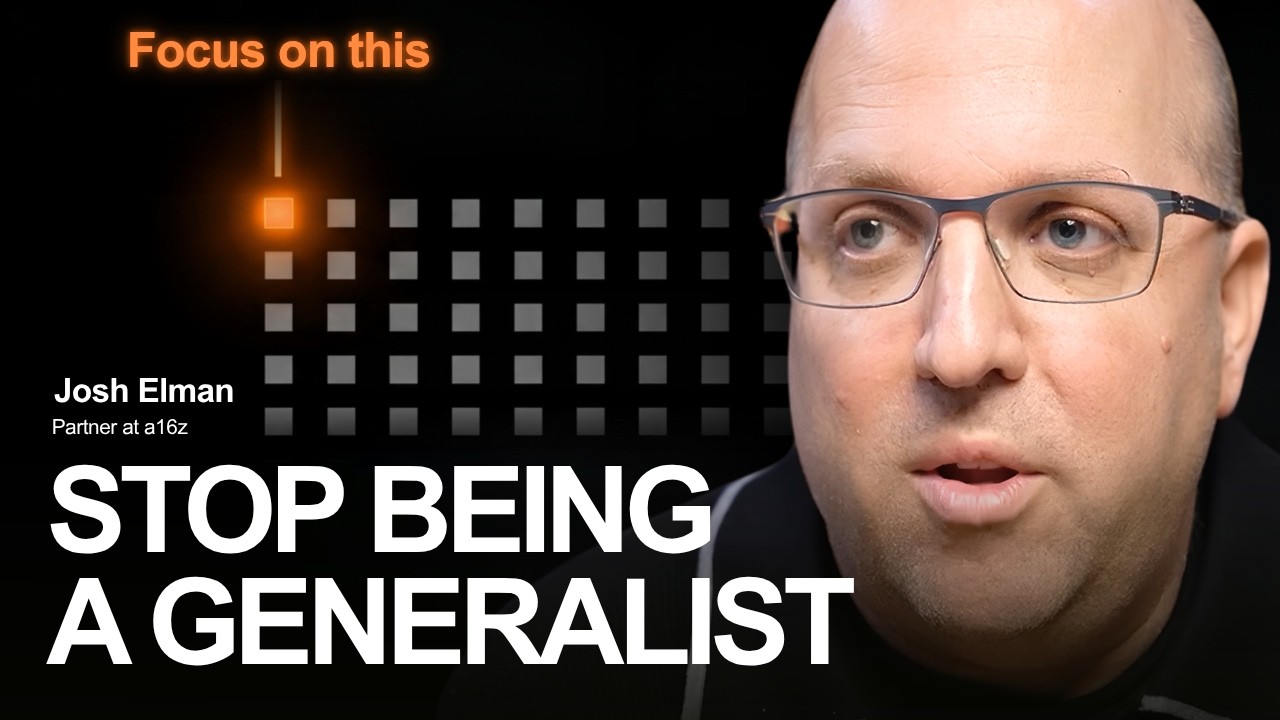
a16z partner Josh Elman breaks down what makes consumer apps hit $1 billion. You need a single clear benefit that makes users stop doing something else, plus network effects that stick. He sees AI powering personal agents for schedules and health, but warns that trust and personality matter more than raw capability.
Chapters
It's never been easier to get consumers' attention. What's harder, I think, is getting me not just to try something, but to actually stick. It has to be such a good product doing that one thing really well out of the box that I either stop doing something else or I turn more behaviors over to it. And we have a lot that we already have in our digital life. So now as a product, you have to figure out some new wedge into somebody's digital life and then becoming so good that it becomes a habit and that you can pull other people in. The things that I look for in a product are where it has a really clear value that you can describe to somebody. If you If you want to become a very big company, you have to start by doing—
This is Josh Elman, partner at Andreessen Horowitz. He's worked with some of the biggest companies and is now backing the next generation of consumer startups. And today, he's sharing exactly what he looks for in winning products and how founders can build consumer experiences that keep customers coming back.
I mean, I think in these early days of adoption, utility often trumps trust. People will try new things and they'll experiment with it, but if you truly wanna break into the mainstream and really get to the hundreds of millions or billions, Trust ends up becoming paramount. The hardest part now is going to be less about the creation. It's still going to be the things that resonate: finding an audience, figuring out how to build a relationship with the audience where they come back to you. You can't start by trying to do everything, but you have to start by doing a few things really, really well and earn the right to do more. If you just say, "Hey, I'm a general thing. I can take care of everything," you don't earn the right to be really trusted for getting me a few things done. And once we learn to turn to it for one thing, it now earns the right for something else and something else. So I'm always looking for these opportunities where the The product you were building can make us have better human experiences and more human experiences. And so I always like to ask people, what did you stop doing when you started using this new thing? So if they've adopted a new product, what are you no longer doing? And if you can get a good answer to that question, now you know it can intrigue people. And then I look for why will people stay retained? And one of the best ways to keep somebody using something is with a little bit of an—
Welcome to New Economies. Hey, Josh, welcome to New Economies. Thank you so much for being here.
Ollie, thanks so much for having me. I can't wait.
I'm super excited to have you here today, as you are our 5th partner from a16z to join the show. We've had the likes of Jocelyn Moore, Anisha Acharya, Ali Yaha, David Haber, and now you. So I'm super excited to have you here. So thank you so much for joining us. You know, when I was thinking about the title for today's episode, there is so much happening in consumer tech, and can't wait to dive in more with you. But let's start off with the basics. You've actually been on the investor side, you've been on the founder side, the operator side. Now it's kind of like come full circle. Why are you back in investing mode?
You know, when I think about a lot of my career, when I got started in the late '90s, it was the dawn of the internet and this idea that we could make products that could change the world, that could get into hundreds of millions of people's hands and help them have a better life was so exciting to me. And I've kind of had this amazing career of doing it, and I've always tried to find the right place. Sometimes it's been diving in and working on something that I was so passionate about that I wanted to help bring to the world. Sometimes it was, you know, in 2011, I had already worked at LinkedIn, Facebook, and Twitter, and I thought, wow, maybe there's a great opportunity for me to help the next wave of companies. And so I became a VC and got to invest in a lot of the next wave of the mobile internet. and the social internet. About 8 years ago, I was like, maybe my best times will be spent helping build companies again. And I went back and I joined Robinhood, and then I spent the last many years at Apple. And then starting this year, I was so excited for what we were doing at Apple, and we were kind of bringing out this new version of Siri, Siri AI. But at the same time, I was like, we're about at the beginning of a Cambrian explosion of new consumer experiences around AI. Now is the time I really believed it could happen. And I felt like in my career, I have one more path. I want to get back on the side of founders. I want to help founders create incredible companies. And I thought, at this point, what better firm to do this in the consumer world than Andreessen Horowitz? And was lucky enough to have known people like Aneesh for a very, very long time and brought me in to help kind of get excited about this next wave.
The rules of consumer tech have changed so much now. And you mentioned a little bit there around the different types of experiences that consumers are now experiencing versus maybe even 5 years ago. Can we maybe do a comparison? What are the new consumer experiences 5 years ago versus what they are today?
5 years ago is a really interesting time because that was the heart of COVID 5 or 6 years ago. And I like to say in the period of COVID we realized just how much time we can spend online and where our limits are because we had nothing else to do. We were on video calls, which normalized video calls. That used to be kind of a weird thing for someone to propose, getting on a video call. It's become something that makes sense when it makes sense, when we can't be physically in person. We had so much sharing going on. We saw massive rises in gaming, both mobile gaming, social gaming where we all play together. Roblox has been an incredible phenomenon that's continued growing through that. And we saw so many companies, but I almost say they kind of hit a cap and we realized that we still need time for ourselves in the world. And as COVID sort of relaxed and people felt more comfortable getting out in the world, we've kind of seen this, this rebalance where a lot of things that happened, we're still spending time on. But now we want to be more in the world. And we actually, with this incredible rise of AI, we want things to help us actually be more present in the world. What's incredible about AI right now is there's all these new tools that can help us get things done so we can do more of what we want to do, whether those are agents, whether those are personal agents, obviously a lot of work and productivity tools. And we're just at the cusp of what I think we're going to be able to use AI for. And I think all of it's going to be like this period of coming out of COVID giving us more time to experience things and do the things we really want to be doing.
I think AI has obviously changed completely how we're going to work and live in the future forever. But honestly, sometimes I think we're actually pretty far ahead with AI already. Some people I speak to, we're just scratching the surface. Where are we on this incredible journey for AI, especially for consumers?
I mean, I think there's 3 different buckets of people. I think for early adopters, what people are exploring and seeing in Silicon Valley, we've got people who are truly living at the edge. They have AI managing their lives, managing their work. You know, developers who are used to writing lines of code manually don't have to do that anymore. They get direct swarms of agents to write things for them. And, you know, with OpenCLAW and Hermes agents and other things like that that have come out over the past, you know, year, 6 months or 8 months, really, people are now getting things done in ways and their tasks done that they could never imagine. If you then go to the workforce, we're seeing a whole bunch of tools truly enter the workforce. Obviously AI coding is a massive phenomenon, but we're seeing people use AI to help them build spreadsheets, analyze documents, do research, and it's truly making work more and more productive. But when I look at consumers, we are very, very early. Most consumers are, a lot of people are using ChatGPT and, you know, Gemini and other things, and they've used them to kind of run searches more effectively. Instead of running a search and clicking on every single link to read the pages, you can get a better synthesized answer. People use this for homework. Some of them use them to consult and brainstorm on things for either financial problems or financial opportunities or legal challenges or simple things they're working through. Just if you want to write a hard email, AI is this great new consultant to do that. But in terms of really transforming their lives in this new wave of either productivity or experiencing more things, we're barely scratching the surface. And then on the same time, on the entertainment side, there's a lot of questions about where does AI fit in? to the future of entertainment. People want great stories, and they want to just consume them wherever they come from. But we're seeing a lot of interesting things happen as AI becomes either a tool for that or creates some challenges with the way that we're traditionally telling stories.
I'd love to get your take here. I actually love all of those points. I kind of think this year has been the main breakthrough year for AI, especially for consumers. GPT now, 900 million weekly active users. This thing only launched 4 and a half years ago. And if we're just scratching the surface here, It can now do code for us. All the things you just mentioned, like writing emails, giving it our transcripts, figuring out what to cook. Got a bunch of things in the fridge, what can I do useful? Where to go on cool spots on the weekends. This is just scratching the surface. What do you think comes next if we've already experienced this in the last 4 and a half years? I kind of think of these iterations as product updates. You're at Apple, so I'd love to obviously hear how you spend your time there. Have a new iPhone once a year.
Yeah.
We can't do that with AI. Updates happen every few weeks.
I think we're in this really interesting moment in time where the people who've been living and breathing this AI world wonder why everybody else isn't on that cycle and cadence of updating. But I really think it started at the beginning of this year, late last year. The models got so much better towards the end of last year that they could do long-running tasks. They could actually have loops of improvement. Agentic tasks finally started to work, and the coding and envisioning of something got so much better. And that class of models resulted in something like OpenCLAW that one person wrote by himself, almost in his, his apartment, and came up with a whole new way of interacting with models and ways that models could remember things in skills files and put all of that together in this modern experience that showed the people who were very deep in AI how different it could be. And since then, we've obviously been on this race to try to bring this to so many people. But you talked about this cycle of adoption, and we sometimes, when we're living in this AI world, it's breathless and you can keep trying new things. And every week a new model comes out and you wanna see how that compares to the other ones. And a new incredible app comes out that everybody wants to try and see what it can agentically do for you. There's been a few hot ones even in the past couple weeks that people are having incredible experiences in the tech world that weren't possible before. But to really bring this to consumers, it's going to take a more measured pace. We have to bring people step by step into understanding, what does it mean to have AI doing things for you? What does trust mean here? You're asking it to have my credit card, take care of things, understand my life. How do we build trust and privacy in? And you talk about how Apple ships a new version of the software and the hardware yearly. And it's incredible motion to bring people along on this journey. And sometimes I always wonder how much faster are people really ready to keep changing their lives up and they bet on one thing and then they're wrong 2 months later and they have to change everything. A lot of regular consumers who are just trying to get through their lives, their jobs, maybe things that aren't as immediately impacted by AI aren't necessarily at that same pace. So I'm looking for those companies and those founders that can bring people really on that journey.
I love you mentioned trust. Do you think trust is a new big mode for consumer AI?
I mean, I think in these early days of adoption, utility often trumps trust. People will try new things and they'll experiment with it. But if you truly want to break into the mainstream and really get to the hundreds of millions or billions, trust ends up becoming paramount. And the seriousness of a company and how it doesn't want your data to make itself better and trade that with other people, but wants your data only in order to help give you a better experience becomes important dividing lines. I think the things that will break into the mainstream will have a fundamental tenet of trust.
Just the way we search for items or things online now for research, I don't know when the last time you Googled something, but I haven't Googled something in ages. I go to Claude or I go to GPT Gemini sometimes for different things. The fundamental way we search online now has radically, I think, changed forever.
It's a great point. I think Google for a search when I kind of know what I want, but I don't quite know and I want to describe it, is, it's hard to get exactly what I want outta that. And I personally find myself going to ChatGPT or Gemini as a starting point for a lot of these conversations. I was recently looking for a keychain that makes it really easy to split for when I have to park at a valet garage and then put it back together. And I was having so much trouble on Google trying to find something, on Amazon trying to find something. And I went to ChatGPT and started having this great conversation, and it found me a bunch of— it kind of described to me a bunch of the different attachments and the way that they could connect and easily break, a bunch of the ways that those either had maintenance problems or the ones that were most likely to be durable over the years. And then I said, and I really want one that's made in America, and helped me find just the right one that was made by a store in Michigan. And so it was kind of this incredible journey that it was a conversation about shopping, not Googling, clicking on links and having to do all the work myself. And I think, you know, that experience is just one of so many, but there's still so many ways that I could have productized that to be a lot better experience. And still, I kind of still wanted a chance to browse at the end of my journey. And ChatGPT had kind of helped me narrow on like one option, and I really still wanted now that shopping browse experience, but with all of my conditions laid out. So then I could really kind of explore from like the perfect set of options.
When we think about those new experiences for shopping online, especially through these AI models, what would you like to see that still hasn't emerged yet? You spent 10 years at Apple, so you've probably got a whole bunch of ideas on how you can make this product so much better, because right now it is still pretty basic.
It's only 6 and a half, or not quite 6 years at Apple, but it was an incredible time there. But when I think about shopping, what's really interesting is the best experience is when you can have a concierge experience at a store. And you have somebody who's a true expert there guiding you, commenting on maybe what looks great, helping you try different things on. And even better is when you know that their only incentive is your success. Their incentive is not to get you to spend the most money or buy something where they get a kickback, but it's truly that guidance in helping you. And I'm really excited to find the companies that can sort of bring us that experience, but using AI to actually simplify from the vast array of options. But it's truly on our side, and it's something that we learn to trust because it has our best interests and all of our questions. And I'm very happy to try something on, take a picture, take a picture of stuff I have that I want to upgrade and have AI comment on that and make it better. This thing I'm wearing, I actually designed completely with AI, where I said I wanted a new black polo sweater, and it actually helped me figure out the design and went and actually had it manufactured for me in China. And so I'm so excited by sort of All of these ways that we can improve the experience, but it truly has to be something that's on my side.
There you go, Josh. If VC doesn't work out for you, I'm sure it will, but you could always become a fashion designer. That looks pretty good.
I treat it all to the tool. I just described what I wanted and it did an amazing job for me.
But I think it goes to show, you know, this is how far we have come in 4 and a half years. The next even 12 months, I think, is going to be incredibly exciting. What are some of the trends you're really excited about coming from a consumer lens that you're really excited to see in startups and hopefully back them?
There are so many ways that AI is going to reinvent the experiences that we do every day. I mean, it almost goes from anything. You know, I start with being really excited about the personal agent that is sort of the thing in my corner that I can rely on when I'm trying to figure out what to do this weekend, maybe scheduling appointments or helping me monitor my health, whether it's helping me think about my finances and whether there's opportunities I'm missing out. Whether it's just simply checking in and making sure I've had a good day and seeing if there's anything I need to just do that's on my mind. That moment of something, even just checking in with you, can either be naggy if done poorly, but amazing when done right. And it feels like it's really on your side and it's helping you think through things. So, so this area of personal agents, and I went through a few of the verticals too, things like health and finances and setting your goals and Helping you kind of get through your day better. Maybe it's helping you shop and make sure you have the right amount of food at home that you need. Maybe it's helping you plan something fun because it can notice, hey, this weekend you have a lighter weekend and maybe it's time to go out and there's amazing weather and, or this incredible festival is happening. That's one area of just these, these personal agents that become part of our lives that are very, very different than all the work agents. that are helping us work more productively. The second area I get really excited about is the future of entertainment. Right now, there's so many things to watch and things to experience, but you end up having to just consume and absorb. And what's really fun is when media is interactive and exciting and it's your world. And when you're watching a story, one of my favorite shows is on Apple TV. It's called For All Mankind. And there's so many times that I'm like, I would love to go deeper on the backstory here, or I would love to imagine if this happened instead. Now with AI, you can imagine that any world that you're in, you can go much deeper. You can have these experiences. And even so, I want to then be able to share them with somebody. And that's sort of in the fan fiction world. But you can do this even for new worlds and worlds that somebody else creates and lets me start to experience and explore and add into. I think of what Roblox has become as just an incredible phenomenon of all of these games and all these shared experiences. people have. And I think that there's, you know, it's, it's still very much kind of in the game world and has a certain group that really enjoy Roblox. And I think that opportunity is even bigger for so many more types of generated experiences. And we're gonna have a world of creators that can imagine these worlds that we then get to participate in and interact in. I think in terms of, you know, verticals, I mentioned travel, or I mentioned health and finance, but I also believe in travel. You know, right now, when you want to go somewhere, you are spending some of your hardest-earned time and money to have a great experience. And yet you don't always have full visibility in what's there, and you can't always express your own personal interests. Having an expert that can actually help bridge that gap is an incredible opportunity. I think the same thing is true for, you know, shopping, for fashion, for setting up your home, for upgrading your home life in ways that You don't think about. So this, this whole world of kind of vertical services that are much more powered by AI and very different interaction model and very, very personalized to you. Those are just some of the things I get really excited about. I mean, there's so many more. You know, we talked about fashion and being able to actually have something made for you that you've designed in your mind, being able to connect with people in ways that AI facilitates. So it's like, hey, I want to ask this question. But you can roleplay it with AI and then it might actually do some of the work to go reach out on your behalf to some things and bring you back answers before you actually then go have the human connection. I don't want AI to replace human connection, but anything it can do to get me closer to having even better, more impactful human moments is going to be incredible.
You know, I love all of these trends. One you mentioned there, shopping. One of your companies, Whatnot. I'll be very honest, like when I saw these live shopping companies, you know, in Europe and in the US, I was like, They work super well in China, where I spent some time. They work super well in Asia, but to adopt that in the US or Europe is obviously very different. Whatnot just raised a massive round, I think a few weeks ago. What have they done so well that maybe consumers just didn't quite see, and investors as well?
I mean, I think live shopping is just an incredible category, and I think Whatnot as a company has done a fabulous job really expanding their marketplace and expanding all the ways in which people can buy things. But what's really fun with something like live shopping is that it's much more about participation. You know, I can go to the store, I can go to a static store and just click on a few things. But when I'm actually on Whatnot, I'm hearing the story behind the products. I can actually ask questions. I can interact with the people who are presenting that. I can explore different things and different products and have just so much more depth and story And we're not just buying a flat thing that does something in our lives. We're actually buying a whole story in a way that some new product comes into our lives. And whether that's fashion where you're talking to the designer or fashion where you're talking to a curator who's done so much work where they're telling their story of why they think these are the best, Whatnot has really facilitated so many new ways for that interaction to happen. And it makes the shopping— when you make your purchase, you feel much more both confident, engaged, And have a connection to what you're buying. So I've just been, I've been blown away by their execution over the number of years. You know, they were, again, one of those companies that, like you said at the beginning, is live shopping ever really going to work in the US? You know, there were clearly some evidence of it working in China. And when it starts to really flourish, you see massive new behavior and you see people buying and selling things in a way that, that is again, much more real and much more about a human connection.
I think live shopping and also entertainment, right? You mentioned kind of live entertainment with interactions. There's this whole new trend happening now, AI microdramas. I think that's going to be a really interesting category to watch.
I mean, I think that microdramas are a huge part of the next wave of entertainment. You know, and it kind of started with TikTok and actually even Musical.ly, which I had backed it when I was at Greylock. We found the team that was building Musical.ly and they had an idea that Short-form video, again, with initially with even like a music soundtrack, can create a whole different experience that you watch and you have a meaningful connection before you go on to the next one. And that as they learn which ones you have meaningful connections, it becomes this really wonderful feed of content that speaks to you and lets you both connect with the creators and connect with the content in a new way. And as that was sold to ByteDance and became TikTok, it has flourished in a way that it truly has some of the richest, best content anywhere. But now what happens is those are all these nice short videos, and often you want to go deeper, and often you want a richer story. And so the microdramas have come in and, and people have been able to create these, these perfect vignettes, and they fit really well into places like TikTok and YouTube help first discover them. But then you're like, you're immediately hooked and you want to finish the story. Now we can only make so many of those, and each of these companies has done a great job making a lot of different stories in a lot of categories. But with AI, we can open up this creativity to so many more people, people who might not have a studio or a cast or sets to go film something, but they can still imagine what is truly a great story and have that made. And what I'm excited about is how do we find those writers, those creators, those people with brilliant ideas, give them the tools to express them, help that get in front of more people. I think there might be incredible new marketplaces where people come together to see the creations from others. read those, engage in those stories, and be entirely new media channels. Right now, a lot of the distribution might still be driven through existing social media channels, but I think there's room for massive new marketplaces that become the first place you go when, hey, I want a story, I just want to engage.
Super interesting. So guess what? We actually just created our first AI microdrama.
You did? What is it?
So it's on the Nike story. So an idea I had was how cool would it be to go and interview all of these incredible founders The Jack Ma's, the Phil Knight's of the world in person. Slightly difficult though. But hang on, why don't we tell these stories in 4 to 5 minute microdramas on how the most incredible companies got started, their origins? Obviously, there's always a bit of a romanticized love element part of each microdrama. So we collaborated with this company called Plot Party, which is like an early stage startup. And yeah, we published it, our first one, A couple days ago. I'll send it to you afterwards. But super interesting, you know, we do all the storytelling, they, they do a lot of the creating. But it just goes to show like the different types of entertainment you can create. I'm not a movie director, just hopefully a good storyteller. And we can now create dramas and get millions of views from it.
Oh, that's amazing. I can't wait to watch it. And I mean, you're a great storyteller. I've seen you through these podcasts be able to put together just amazing stories. Now I can't wait to see how you did that. I remember the Nike movie from a couple years ago. I think it was Air, if I remember. And I mean, that, and that was like an incredible movie. And it, it's always hard to take a corporate story and actually bring drama into it and make it feel cinematic. But now that anybody can have access to these tools, I'm sure you did the same in just a short little microdrama. And I think so many people have that talent. And, you know, the hardest part now is gonna be less about the creation. We can have a lot of people with talent. But it's still going to be the things that resonate, finding an audience, figuring out how to build a relationship with the audience where they come back to you. If you— the Nike one's great. Now I might want to hear the Amazon story or the Microsoft story because I think about great companies from the Pacific Northwest. Or you might go around the whole world and keep telling these stories that people don't know, but in a way that, that, you know, I'll love your style of truly creating the drama and interest.
And it's all about taste, right? But I think, you know, as we enter this new era for media creators, it's also just what can you do so differently that you can own? You know, I kind of feel like creators should be building products that they can own and obviously like just build hopefully into incredible companies. Now's the time to be doing it.
Yeah, and I think for creators, there really is an identity that they build, and they build a relationship through the content that they produce. Through the stories they tell directly, through the stories that they bring out from other people, through the stories that they might, you know, create through AI. But it, it still becomes an identity and a relationship over time. It's not that you can slop lots of things in lots of different categories, but it's really that relationship with the creator that is what's powered the, the most recent wave of these incredible, you know, user-generated content companies. And that I think even as we move into an AI world, It's not just like some Borg AI is going to be making things. It's still going to be people making things to tell stories that they have. And those relationships you make with those storytellers, those creators, is still going to be very important. And for each person, it's building that set of relationships.
If you're enjoying today's episode, hit subscribe at the bottom of your screen. The guests on the show are getting bigger and bigger, and we need your help to grow this channel. So if you're enjoying today's guests or any previous episodes, hit subscribe and I promise you it'll be worth it. Now back to today's episode. You know, one thing I've been super surprised about, to be honest, is we've had all of this amazing technology emerge in the last couple of years, but we haven't seen any new social media networks, sites emerge. You've worked at LinkedIn, you worked at Facebook, You've been at Discord on their board. You've also been at X, and maybe a bunch of others I'm missing. Why haven't we had a new social network emerge in the last few years?
It's a great question. And I think, you know, in some ways we haven't needed to. Like, the social networks we have are at billions and billions of users, you know, or hundreds and hundreds of millions. You know, you mentioned Discord and Musical.ly, which, you know, Musical.ly became TikTok. Both really started growing in 2015. That was the year that I got to invest in both of them in those early days. And we had to navigate this question even in 2015. Well, we already had Instagram and Facebook and WhatsApp and Twitter and LinkedIn in 2015. Why would we even need things like Discord, Musical.ly? And they both solved a very different problem in our lives. Discord was great for people who were trying to come together to play games and engage. Musical.ly was great for people who wanted to actually tell stories and view stories from other people. So much of Instagram, I used to say, was the back-facing camera. Look at the incredible place I'm in or the incredible latte I'm having. Musical.ly was the, I'm just going to create something. I'm going to put some music behind it, do a dance. I might have my piles of laundry behind me in my room, but because of my dance and because of this song, it's going to feel like a great creation I'm proud to share. And it's obviously grown up a ton from there. And we need something that feels new, that feels different. I've got a story I want to tell. I'm going to bring everyone together who's telling these kinds of stories, and this becomes the place you go to read those stories. Maybe that looks more like a marketplace than a social network, but I think there's a huge opportunity for that. But I think a lot of the attempts at social media between then and now were things that felt derivative, that felt like, well, I'm already doing it elsewhere, come and do it here slightly differently. You know, there's a lot of variants of X and Twitter that actually feel very similar to X and Twitter, which is a slightly different group of people. It's hard for those to catch and truly become mainstream. But I think we're on the cusp of seeing some things get invented that have us thinking in new ways, asking questions of very large groups and seeing information that isn't actually available and that people wouldn't otherwise be sharing in social media that can become a whole new network. I think we might see these creator marketplaces where people are actually creating new stories and publishing them for other people. I think, still think, you know, as we talked about coming outta COVID, there's room for networks that really help us get back out in the world and do more in the world and kind of bridge that online to, you know, IRL life. You know, Partiful's one example in Andreessen Horowitz portfolio that I think is a really exciting thing that if you're going to different events, Partiful actually is the places you really want to be. And it becomes a great way to go out and explore the world much more with the community that you have.
In real life though, it's super hard. Do you remember Bebo?
I do.
Yeah. So I spoke to the founder for the first time. It's the first podcast he's done in about 10 years.
Is it Michael Birch? He's incredible.
Yeah, Michael Birch. We spoke on Monday and I asked him the same question. Why hasn't there been a new social network emerge? But I also just think the appetite and the consumer appetite on how we engage with these social networks has massively changed. You know, we don't post on our Facebook timelines as much anymore. X is our go-to maybe consumer app for all things content. Clubhouse back in the days, which was an awesome app, you know, Substack, another a16z portfolio company. There's just different appetites, right? But again, I kind of just wish there was a new social network which emerges. You know, we haven't had any new apps in a few years.
I mean, I've heard a lot of people kind of say that and want it to emerge. But I also say, you know what, we have great ones and maybe we're pretty satisfied. And after I've checked out the people who are sharing on Instagram and talked to some of my friends who are still on Facebook and seeing what they're up to and commented on their posts and went to TikTok, I'm no longer going, what else do my friends have to say? But I do think we're going to see things about what are people creating, where can I go co-experience things with people. You know, one of the amazing things with Discord was it was one of the rare places you could really easily game and talk at the same time. And it was actually a new behavior that brought people together that then became a place people stayed and chatted. And so I think about what are those things that are those new behaviors that bring us together, that then once we're together now, we'll also stay and do other things. We, we also talk a lot about AI, and right now a lot of AI is very single player. I interact with the AI to help it do things in my life, but I don't yet have it plugged into our group and understanding our group nuances. And when I have it join a group, it's not helping me do other things with the same group of people. You know, group chats have become such a popular form of social media. Maybe that is in some ways the new network that we aren't thinking about that we really have developed over the past few years. I have way more local group chats than I probably had 10 years ago. But when we bring AI into some of those group chats, does that create a whole new pattern where we're now interacting? And even more, what if the AI is interacting on our behalf to bring us together? And it's like, hey, I'm talking to it, you're talking to it, they're talking to each other. Now when we have a conversation, we're much more informed. I think we're just at the cusp of many of these ideas starting to get explored and have people trying them. And I'm really optimistic in this wave, a few of these will catch.
I'd love to double down on that. Okay. If we're going to go down this approach of multiplayer communication between agents and consumers, especially on maybe communication apps, or if it's helping bring people together, realistically, what does that actually look like? Is that Josh and Ollie communicating together, maybe with a bunch of their mutual friends? They're trying to meet up for the weekend, trying to figure out where to go. I mean, is that just the basic?
I mean, I think it's a great basic place to start. That was actually the example I was about to give you, which is I get into my weekend and I'm like, Which of my friends are even available? Now, it's a little bit embarrassing sometimes to be like, who's up for something? And get crickets back. And you feel very vulnerable when you're asking that question. But what if I could go to my agent and I'm like, can you just root around and see if anybody's up for something this weekend? And it could talk to some other agents and to see if anybody's asked their agent the same question. And once it has, it starts to make a match for us. And in some ways, people say this sounds a little bit dystopian, but I think in some ways It's actually AI being the glue that brings us together, that I can take some of those innermost thoughts. I kind of want to do something. I don't really know. Has anybody seen Odyssey? Maybe everybody else has seen Odyssey. Who hasn't seen it yet that might want to go? And if you can actually plant that seed in somebody who cares about you and can go root around and find somebody else, maybe that becomes a way that now brings us together. And so I'm always looking for these opportunities where The agent can make us have better human experiences and more human experiences and make those happen. I've always dreamed that, imagine that we're all on a Friday night, a bunch of people are sitting at home talking to their AI about something, and it recognizes, hey, there's like 10 of you in San Francisco, in Noe Valley. Why don't y'all go to the board game cafe and just play there? You know, they got 2 tables ready. I can even reserve 'em for you right now. Wouldn't that be amazing if it actually moved us from talking to something online to bring us into that real world? That's insane.
Okay, so a couple of questions there. It feels this is maybe like the basic middle layer of ideas of where we could go. If we think crazy big, how crazy can this actually get?
I mean, if you think crazy big, you just wake up every Saturday morning and you look at You talk to your agent or look at your calendar and you just go, I've got a rich day for you. You're gonna start here with this person. You're gonna have a break this afternoon and you're gonna go have dinner with these friends cuz everybody was looking for something tonight. Sunday you'll do this. Tuesday night it's this, you know, your agent all of a sudden is just becoming your, your social calendar and you're really getting out in the world a lot more. And every time you've talked to it and you're like, you know, oh man, my favorite shirt got really frayed and I, I want a new one. It's like, great, ordered for you on your way. Like, this is sort of this dream of what having that true assistant looking out for you is. And the goal again is to save you time from the things you don't want to be doing, to do more of the things you do and that you enjoy and that you love. And by the way, a lot of people need time for themselves. The agent should be able to protect that and help remind people of that too. Coaching you, getting more exercise, whatever goals you have, wanting to eat better or indulge yourself sometimes, you know, having a partner who, who understands your goals and sometimes gives you encouragement and sometimes gives you the tough love that you need. I mean, that's what we look for. I mean, I love my mother and she's great at doing both of those. Sometimes being my biggest cheerleader, sometimes being my biggest critic. And it would be amazing to have something else in my life that is helping me do that. I love my mother. She gives me tough love and encouragement. But I don't talk about everything, and I don't talk about everything every day. And there are times where I would love somebody who kind of has the day-to-day understanding that gives me some of that too. And even, you know, if I haven't called my mom in, in a week, reminds me to do that. Although I'm usually pretty good.
Super fascinating. It makes me think though, what type of platform could actually create this? Is it one with existing distribution, the likes of GPT, Claude? Are they going to enter this space? Because it's going to be very difficult, I think, for a new Very small startup to emerge into this category if they didn't have the distribution these AI models have.
And I think it's going to be piece by piece. I'm a big believer that if you want to become a very big company, you can't start by trying to do everything, but you have to start by doing a few things really, really well and earn the right to do more. You know, again, I, I keep coming back to, to Discord, which earned the right to be the place that we played games. And that we had a live chat during games. And as it earned that right so well, it became a place we chatted more. And we chatted more about just playing games. And then we did spend more time there. And then more people did that. And even people who didn't play games came over to use the service to chat with friends who might also be using it to play games. But it slowly earned the right to be something that you relied on for more. And I think for a lot of these assistants, if you just say, hey, I'm a general thing, I can take care of everything, you don't earn the right to be really trusted for getting me a few things done. And so what is that agent and that assistant and that product that goes step by step by step? And once we learn to turn to it for one thing, it now earns the right for something else and something else. When I think about Siri, and I know it's something that I spent a lot of time over the past many years thinking about, Siri was actually amazing to earn the right to do a few things for you really well. Place phone calls, set timers, set reminders, send a text message. But when you tried to do more things with it, it often couldn't. There were things that you would expect it to do and get it right, and it didn't. But over time now, you only get so many chances to go, now try one more thing. Now try 5 more things. Now try a lot of things you can imagine, and you'll have a much better conversation when it can't do something. It can explain to you that it can't do it and really understand that, as opposed to just like put up a hand and say, sorry, I can't help you. And so I think there's so much opportunity for new products to do the same thing, but they're going to have to go step by step.
When we think about the new rules of consumer tech, voice is going to be huge. It feels we're just scratching the surface. You spend a bit of time on Siri. What are you excited about right now in voice? And again, it feels like we are just literally scratching the surface.
I mean, I think we're talking here, and people are listening. Voice is an incredible medium to express a lot of thoughts. You can often talk. Much faster than you type. I'm one of these people that tends to think out loud, and so I'll talk and talk and talk until I kind of fully refine my point of view. Voice is also lossy though. It's sometimes you wander and ramble a little bit until you get something. When I'm typing, I might type it and ramble a little bit, but by the time I edit and polish the, the thing that I'm typing to send or communicate to somebody else, I've gotten it really tight. And so I do think a lot about where voice sits as one part of the entire continuum of communication. I think we're going to have a lot of times where voice assistants should be able to let you ramble and let you have that long thought pattern and then help you distill the real meaning out of it and capture those core thoughts. We have a lot of these— on the work side, we have all these great meeting note-takers that record everything and synthesize them incredibly well. On our personal lives, when we have ideas, we want to be able to ramble and think and dream and have it sort of capture what we need to do. When you have just a quick idea and you wanna remember it later, voice is often a better paradigm than having to type it in, 'cause it's the easiest way just to quickly express your thought. I'm not yet a believer though that we're all gonna move to voice for everything. I think it's always gonna be a balance. And I think the idea of a voice-only agent doesn't really make sense. It's a, hey, there's times where I wanna type. I might be in a quiet place. I might, not want other people to hear me and I do want to express something. And I think voice isn't always the best use if I want to refine my thoughts a little bit before I send them over to an agent or to another person. But it's— we're doing a lot less with it today than we should be. And I'm really excited for this massive wave.
Voice is also such a great tool if you're coming into like a podcast show or if you're preparing for a speech. It's actually a pretty cool interaction tool. As aspiring partner.
Oh, interesting. Yes. And with a lot of these new duplex modes and what some of the new technology is doing, the AIs can now let you do a lot of role-playing and sort of preview conversations that you're having before you go have them and help you truly refine your thoughts. I mean, I find, I find voice conversations when I'm in the car, I love using voice to just go back and forth with something because I have to otherwise be focused on the road. But when I'm sitting on my couch, I don't often want to talk to my phone or my computer. I often there do just like typing and reading and scrolling. So it's going to be a matter of being able to go back and forth very smoothly with all these modalities.
Yeah, I think it's going to be really interesting. And especially if people use these voice tools to prepare for speeches, if you can prepare with the person but virtually, that would be quite cool, right? We just had Reid Hoffman on the show, for example, one of the biggest interviews I've done. And I just thought, let's just try with GPT, right, as a sparring partner, just bouncing ideas off. And actually, it was pretty good. And I know you and Reid were very closely together when you're at Greylock. And it was a pretty cool experience. If you have Reid virtually, and you're doing a virtual kind of like preview mockup, that could be quite cool.
No, that's great. And I mean, Reid's, you know, one of the most incredible founders and thought leaders of our time. And One of the fun things I've seen him doing is building Read AI, which is actually not only can you just interact with ChatGPT as a sparring partner, but actually building something that has ingested and learned about him and creating sort of a double for him. Now, it's still very different than having the real live person and interacting in the moment, but it's an incredible proxy to understand how he thinks, how he might go about certain situations, to test things, and to get really, you know, instead of just reading his writings, or watching previous podcasts, this incredible way to synthesize it, to at least see how, how that AI may apply things to new situations. And then when you get to interview or interact with the real Reid, you feel like you're ready to go have a much deeper conversation because you've actually experienced some of it before. Like, I think these ideas of these, these doubles are really a fun way to sort of be a precursor to a real meeting or in, you know, but not in lieu of.
Exactly. It did actually help. We talked about it a ton, so people can check it out. We'll put in the link in the comments. I also think just like the way these consumer apps are thinking about pricing and how they think about monetizing is very different, right? So many of these AI tools today, they're literally giving all of their products away as cheaply as possible, basically for free, right? Which is very normal just to get as much distribution and attention as possible. Is this still the right way to build a consumer app today? And at what point does that become a challenge? When they saw I had to, you know, start having to try and make some money so they can make investors happy.
This is a really interesting challenge of our time in technology. For many, many years, you know, as, as I first was getting my start in my career, actually building a website was actually quite expensive. You had to go buy physical servers, get racks at data centers, actually put them up in the data centers, manage them, have people who are managing them. So if you want to just build a website, Like you actually needed to raise a lot of capital just to fund that. I remember in my first week when I joined LinkedIn, one of the things we did was move from one set of racks to a much bigger set of racks in the data center, and they needed the entire company. I mean, I, it was, you know, maybe 15 or so people at the time to actually go and move computers from one rack to another, just to remind you, remind you of the costs. What got amazing in this era of cloud scaling, Amazon Web Services, all these new stacks, Was all of a sudden you didn't need that same set of heavy upfront infrastructure costs, and it became very, very cheap, or so cheap that you could scale these consumer things quite far to serve many, many people, and the product you were building mattered more. Fast forward to today, we have costs again, you know, and actually they're variable costs. They're these inference costs, you know, they aren't just even this fixed cost of infrastructure. And so we really need to figure out, you know, what you can give consumers for free. What you need to be able to charge for. But we also know that for consumer distribution, the willingness to pay doesn't always come upfront. You know, in enterprise world, you can sell to a company and, you know, and sometimes convince them that this is gonna be valuable for them and they'll actually pay you, you know, on a contract. Obviously with a lot of product-led growth, you see this sort of get in the hands of employees before they have to do it. But even if they wanna pay, they can, if they find it valuable, they can find ways to expense that service. So. They don't necessarily need to think about it as paying out of their own pocket. On the consumer side, it is all going to be ways that we need to figure out how to subsidize the inference, having consumers pay for that. On the plus side, with the rise of mobile gaming, the rise of subscriptions, consumers are much more used to paying for digital things than they were 10 or 15 years ago, let alone 20 or 30 years ago. You know, they are willing to pay for things that are valued, you know, through Apple's App Store, through Google Play, through just online subscriptions with all the different tools out there. Now, when people hit a certain level of engagement with a product, asking them to pay isn't the same, you know, hand to the face that it used to be. It's now very much an invitation. If this is finding you value, it's costing us money. On the other hand, we need the cost to come down with what's going on with, um, AI, with inference, being able to switch models, having open source models. We're seeing just the beginning of how much cheaper you can actually build these things. And I think over the next couple of years, we're going to intersect with how much cheaper these can get to build and serve with how much customers are willing to pay for things that are of value or entertainment for them. And I think we're going to be at the right intersection point where you'll be able to bring in both, you know, ad models, purchase models, subscription models, and fund the cost of inference. But right now it's still a little bit expensive. And as investors, you're looking for, are you going to have enough value that people would be willing to pay or would be, you know, advertisers would be willing to pay to get in front of those customers? And will that intersection actually happen? And that's sort of what the big bet is over the next few years in consumer. But it all starts with a product of value.
What does a great consumer product actually look like today? And as an investor, when you're looking at all these thousands of companies, are there some characteristics that just tick all your boxes? What's, what's like the golden List and, you know, for Josh.
Things that I look for in a product are where it has a really clear value that you can describe to somebody. Hey, if you start using this product, you get this thing that didn't exist before where people will raise their eyebrows. Now, what's cool with AI is there's so many cool new things you can do. It's easy to get people to raise their eyebrows. The second is when that person does go and try it, do they have a good experience? Are they actually going, wow, I can figure out how this fits in my life? And often it is going to replace something they were doing elsewhere. And is it a replacement that is an easy substitution or is it a really hard one? And so I always like to ask people, what did you stop doing when you started using this new thing? So if they've adopted a new product, what are you no longer doing? And if you can get a good answer to that question, now you know it can intrigue people. You know that it can get them actually, you know, trying it and using it. And then do they wanna spread it? Are they so excited about it that they'll evangelize it to other people? Sometimes that happens naturally. Through the product with network effects. Sometimes it just happens because, you know, with like ChatGPT, we're all so excited about what you could do. You don't need to Google anymore. ChatGPT just gives you the answer right there. Like that spread very, very fast. And then I look for why will people stay retained? So not only do you need to have gotten me intrigued, gotten me to adopt it and stop doing something else, potentially gotten me to share it and spread the word, but now stick. And if I keep engaging with this product over time, Now I know, hey, we really are onto something. And one of the best ways to keep somebody using something is with a little bit of a network effect that keeps them and other people using it together. But it's not the only way. Some of it is the more I put in here, the more it does for me, the more I don't want to move my information elsewhere because now I've built up a history. Sometimes it's, you know, if I'm going to one of these marketplaces, you know, especially like we were talking about some entertainment, these great creators are here and I want to see them keep telling stories. And if I'm there to keep seeing them tell stories, Then other people want to be there to get in front of the audience too. And then you'll have this great effect where all the great creators will want to be on the same platform to reach the audience, and it will kind of continue to go as a loop. So I really look for that entire process from, is it intriguing in the first moment when people actually adopt it? Do they really use it and stop doing other things? Do they spread the word about it? And then do they stick long term?
It's never been harder though, right, to grab the attention of the consumer. So when consumers are thinking about, you know, is this thing going to save me time? Is it going to save me money? It's all around these network effects and the value-add, right? How are the network effects different today versus even 2, 3 years ago?
I mean, the first thing is I actually think it's never been easier to get consumers' attention. There are so many channels that we're paying attention to, you know, things that rise up on TikTok or Instagram Reels or YouTube, go viral very, very quickly cuz people get excited about something new. So the idea of having something that if, as long as it's so compelling, people wanna check it out. I've seen people grow really, really fast just by getting in front of people. What's harder, I think, is to your point, getting me not just to try something, but to actually stick. It has to be such a good product doing that one thing really well out of the box that I either stop doing something else or I turn more behaviors over to it. And we have a lot that we already have in our digital life. And so, and we already have a lot that we have in our real lives. But even, you know, I used to say there's so many things that can move from real life to digital life. And COVID again sort of showed me what that saturation point is. So now as a product, you have to figure out some new wedge into somebody's digital life if you're a digital product. And then becoming so good that it becomes a habit and that you can pull other people in. You don't just have to get that one person. You have to get more and more and more people. These are very, very hard challenges because you're substituting versus just expanding, which I think 15 years ago there was, you know, we were all getting our first phones. There were so many things we'd never done before that we could do on our phones. Today you have to be better than those things. But I think with AI, we have a real possibility to be those products that I'm like, well, that is so much better that that's great. The last thing you didn't talk about that I think a lot in this competition world right now is That's cool, but if somebody does it, can't everybody else do it and copy it very, very quickly? And so we do live in that world where all great ideas people are chasing fast, whether it's other startups or big companies. And the hardest part there is if you're that founder who has the idea and the insight, even if other people can copy what you did, they can't copy where you're going. They can't figure out where you're going ahead of you. They can't necessarily replicate that. So staying on your line and really Living up to your vision is sort of the best thing you can do in today's sort of competitive market.
This is the hardest challenge for founders, right? The idea to clone is no longer months or weeks, it's basically days.
But I can only clone what I see. I can't clone where it's going and I can't clone the next thing. And over time you build that relationship with the user, which is like, yeah, I tried that other thing. But it was missing the essence of something that was really special. And so you stay with the product that really has that essence. And so much of building an AI right now isn't just a product that does things, but that has personality, that has relationship, that has an identity that you actually stick to, that has a way of interacting with you that it can learn over time to be even more personal to you. It actually has a point of view. And so I do think that, that while everything feels like there's eminently clonable things, The people who build these durable platforms are finding their way to really connect with their customers and connect with their networks in a way that is really rich and much better. And the hardest part is all of us in the early days is teasing out which are which.
This is just a small observation, but as I've been thinking about all these apps I've been using over the last 6 or 12 months, they're all based in the US. Why are American startups so good at consumer social? Versus maybe the likes of Europe.
I've got to think more if that's true. I mean, a company like Lovable came out of Sweden, for example. That's just an incredible company. You know, all the things ElevenLabs does, you know, didn't start here in San Francisco. So I don't think it's true that the best ones started here. Musical.ly, for example, started actually as a team in China. They had spent some time in the United States, but they were actually a team in China that was learning. And there's so much innovation that's been happening in In the Chinese ecosystem, for example. Um, some of those lessons, you know, we talked about Whatnot earlier, you know, was sort of inspired by some of the original growth of live shopping in China. So I do think we're at this wonderful place in the world where more and more innovation is happening everywhere. What's really unique though about the Bay Area is how many people here, maybe not just the founders with that idea, but the next wave of people have truly come and been able to help scale and find those companies and find those paths to independence. And find those paths to network effects. And we have so many people in the Bay Area that have been part of some or many of these journeys. I mean, I myself live here and I've gotten to be a part of so many different companies that have made this journey from something that was a really cool idea to a really durable platform. I think to get that acceleration can happen anywhere, but you can really get the right expertise even faster when you're interacting with people from the Bay Area. So whether that's visiting, whether that's deciding you need to live here or hire people here, I think it's a very independent question for every founder. But I do think if you are going on this journey, you want that expertise around you, which is part of why even for me, I'm on the VC side now, because I'd love to be able to help as many companies as I can navigate that incredible moment from we kind of got something working to a really durable company and platform.
I also read Hoffman's question, so I'll ask you as well. Is SF still the best place in the world to start a company?
I don't think it's the best place in the world to start a company, but I think it's a very important place in the world to scale a company. Because I think if you believe that you have a great idea and you've figured out how to get this into the first set of people, but you want that expertise now to go, okay, how do I truly make this durable? There's just so many people in and around the Bay Area that can help you do that. But I don't know that that always means you have to live here full-time. I think it does mean that it helps to be a part of the ecosystem. I also think if you are a B2B company or selling to other small companies, there's just so many here that it's an incredible place to start with adoption. But honestly, if you're building for consumers, a lot of what you're also building for is culture. And I'm not sure that the SF tech culture is 100% transferable to everywhere else either. So it's not like you always want to start everything here. You want to also make sure you really understand the culture of other cities around the world and other communities around the world. to make sure that you're really being able to do something that will, will affect mainstream consumers where they are. So I also don't want you to get too much SF glasses.
You know, I'm a little jealous. You've worked at Apple, Robinhood for the time. You've obviously helped the team at X, Facebook, LinkedIn, Musical.ly. Which is your favorite?
Oh my gosh. I mean, you can't really pick a favorite, but in my career, I will tell you that I had this period of time that I joined Twitter. Late 2009. And so we kind of got to go through 2010, and it was this period of just true missionary work, believing that we had this incredible platform at Twitter that could be so much more for the world. And I got to live and breathe it every day with an incredible group of people. And it was at that nascent period that we knew there was something and we were trying to solve really hard problems, but before it was so obvious that it Had to become a real mature company. And I just, I, if I look back, like if I could just have done that year on repeat in my career, kind of late 2009 to late 2010, that was one of the most special times of my entire life. But everywhere else I've gotten to work was just been, I mean, I've gotten to work on things that it was always my dream to help people make things that matter for the world. And I've gotten to help do that. I was never a founder myself. I never went and started a company from scratch. But I was always what I call an early joiner where I'd go find these things and say, we're gonna go make something great. You have an incredible idea that's, that's getting started, has some momentum. How can we make it last? And, and there's so much joy in that. And the stuff we did at Twitter is probably some of the most meaningful work of, of my life and, and still see it to this day play out. And I still feel like, ah, it could have even been so much bigger and so much more important than what it is, even though it's a product I still use the most every day.
How many users were at Twitter when you, when you left?
When I left, we had gotten well over 100 million users, and when I joined, we were at maybe barely 10 million actives.
What's the most interesting lesson you learned from Jack Dorsey?
You know, what's funny is I didn't actually work with Jack when I was at Twitter. It was the Evan Williams era, um, and Evan had founded Blogger, and he had really helped build— he had really helped build Blogger, and he had this vision For how Twitter was going to become this next wave of media with people communicating. The single best lesson that I remember from Evan was, hey, we've got a lot of smart people in the building. We got a lot of smart people who are using our product every day. Let's not just think we know what's best. Let's listen to them. Let's learn. And then when we make decisions, let's make sure we engage with them on our thinking as well. One of the most controversial things that Twitter had launched was the retweet. The idea that, you know, originally— and this is again ancient history in sort of the, the tech world now— but when the retweet first launched, the way people used to do retweet is it would come from their account, it would say RT and then the name of the person you were retweeting. And instead of building that product, everybody realized everyone wants to retweet and share voices from others, but decided at Twitter that the authenticity of the original poster was more important than switching the words to look like they came from your name. So the retweet became a Josh retweeted Ollie's post, and that you would see Ollie's face in your timeline. And that was one of those both listen to the world on how they wanted to repeat others' voices and amplify others' voices, but also take a very hard line that it was not about moving the words to the retweeter's voice, but actually maintaining the original tweeter's voice. And And the retweet and the quote tweet feature that we have now are all part of how it still retains the original person's voice. And it was this incredible lesson on listening, but still having a strong point of view and then communicating that back out and engaging in discussion, even when a lot of people weren't happy with it at first because it changed the behavior a little bit.
That's insane. 2009. Okay. I was only 11, 12 years old, so I don't remember all of this, but I do remember creating my X account, Twitter account. And I think what it's been useful now, obviously today, is awesome. And let's see where it goes next. For the audience, if you're not following Josh, go and follow Josh. Always awesome insights into what's happening in the tech world. We should have mentioned Tech Week is coming up in SF. So if you want to get a flavor of what's happening in the Bay Area and startup land, 816Z hosts this awesome Tech Week every year, SF Tech Week. I went last year, absolutely incredible. It was like 2,000 events or something. And just Awesome experience. So, hopefully see you there. But Josh, this has been awesome. Your first official podcast since joining a16z. So, thank you so much for coming on the show.
Thanks so much for having me.
More from Josh


The Role of a Product Manager: Everything and Nothing - Josh Elman at Mozilla Speaker Series

"Let's Talk about Product Managers" by Josh Elman at Lean Product & Lean UX Meetup
Josh Elman, Greylock Partners (prev Twitter, FB, LinkedIn) on 4 keys to crush product growth


Josh Elman, partner Greylock & product master (ex-Twitter, LinkedIn, FB) shares secrets for success