How This Investor Helped After a Nuclear Disaster
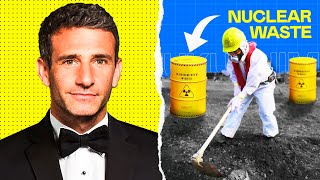
Josh Wolfe of Lux Capital created Kurion to extract radioactive cesium and strontium from nuclear waste, technology that proved critical after Fukushima in 2011. He argues nuclear power is massively undervalued as clean energy and discusses how his firm bets on deep-tech founders through milestone-based funding and interdisciplinary approaches.
Chapters
Going on.
How's it going, Josh? Good to see you. Yeah.
Meet Josh Wolfe, co-founder and managing director at Lux Capital. New York born and bred, Josh doesn't only talk about investing in hard science and tech, he actually does it. Basically, he puts his money where his mouth is.
So this is the Rebels of Science.
For over 2 decades, Josh and his partners have been building a portfolio that really reflects their love of sci-fi.
That's the world I want to live in. I want to make it so. Most people consider that arrogance of the highest order. We consider it inspiring.
He's an autodidact that's completely self-taught. And like one of his favorite biologists, E.O. Wilson, he values consilience, or interdisciplinary knowledge.
I find that the most interesting companies are at these interstices between disciplines.
Josh embodies the importance of the psychological element of success.
I have a chip on my shoulder, and I always say that chips on shoulders put chips in pockets.
This both gave him a desire to prove himself as an investor and likely puts him on the same wavelength as similarly hungry founders. As they say, like attracts like. In fact, Delian Asparouhov, co-founder of Varda Space, happened to just be working out of Lux that day.
Do you know Delian?
Of course I know Delian. What's going on, man? So what are you up to?
Varda is actually a Lux portfolio company, and if you want to learn more about Varda, check out this video we made about space factories. Together.
But the entire premise of your show, right, American Alchemy, it starts whether it's out of a science fiction conception or somebody's inspired by something, and it's a combination of the capital, the talent, which then begets more capital and more talent, and then it becomes very real.
Josh's brain has two speeds: fast and faster.
People say that if history doesn't repeat, it rhymes.
So feel free to play this interview at half speed or drink 20 cups of coffee. Regardless, you should get out a notepad and prepare to be educated, charmed, and inspired by this week's American Alchemist, founder of Lux Capital, Josh Wolfe.
Different parts of the brain have different activities. But you know that, don't you? I mean, people that you grew up with. Maybe you should interview me. The origins of my interest in investing start with having no money. And so grew up Coney Island, Brooklyn, single mom, schoolteacher, and was reasonably intelligent or thought I was reasonably intelligent, particularly compared to people peers who I met in college who were born wealthy, and I resented it. I was jealous of it. I had a chip on my shoulder. And I always say that chips on shoulders put chips in pockets, and it's one of the great character traits I love finding in entrepreneurs. Venture capital, which is something I didn't even know existed really until like, you know, the late '90s, right around the time I was graduating from Cornell. It was the perfect hybridization between science and finance. Science, this endless frontier, brilliant people. It sort of matches my own, you know, undiagnosed ADD of being interested in lots of different things. And venture capital of being able to fund these people and potentially make a fortune. Was the thing that really inspired me. And then when we ultimately started Lux, Latin for light, we were like, okay, you know, where do we focus in a space? Radioactivity we see in the environment from Fukushima is volatile elements that came out as it was melting down.
In 2008, Lux co-founded the company Kurion, named after the Nobel Prize winner Marie Curie. The company sought to tackle a problem previously thought to be unsolvable: nuclear waste cleanup. Curion was one of the first companies to be able to mass extract cesium and strontium from high concentrations of saltwater. In the wake of the 2011 Fukushima nuclear disaster, Curion was uniquely positioned to help in the cleanup. This black swan event took Curion's revenue from $1 million to nearly $200 million in just a few years.
The biggest unsolved problem with nuclear was what do you do with the waste? The really big problem was the waste that you had at the pre- and post-Cold War bomb-making sites. And I never even heard of these things. Most people never heard of Hanford or Savannah River or Idaho National Labs. 25% of the Department of Energy's budget, when you actually read it— and I can assure you it's not scintillating reading— is spent on nuclear waste cleanup. So the DOE is talking about solar and wind and biofuels and a transition from a carbon economy, but most of the money is going to cleanup of nuclear waste. So we started this company. I think we had $3 million in at a $3 million pre-money valuation. Nobody wanted to touch this. In fact, I went to Arno Penzias at NEA, who discovered cosmic background radiation, right? And won the Nobel Prize. And I'm sitting with him, and we brought in this little ball of non-radioactive glass made. And he was like, get this out of here. He was freaking out. It was one of the great moments of my life. Nobody wanted to invest in this thing. And they were like, it's speculative. They wanted solar. They wanted wind, biofuels, electric cars. Nobody wanted nuclear waste. We ended up funding it. And then frankly, we got very lucky when Japan got very unlucky. The tsunami flooded the nuclear power plant, and a hydrogen explosion blew the roof and walls off reactor Nuclear power plants run on super clean water, the kind of water that goes through semiconductor plants. And the fact that we had this means that we were the only game in town to set up this giant engineering system for Fukushima and remove 99% of the radiation from Fukushima.
What's happening with nuclear now? So we have— we do have some portable microreactor companies. There's some companies building larger plants as well. But it feels like somewhat stagnated. And like you said, China seems to be eating our lunch. Obviously, there's the Bill Gates-funded project over there. The super reactor, I don't really know what's going on.
TerraPower, yeah.
TerraPower.
A traveling wave reactor where you can actually take some of the waste and repurpose it to be sort of the next sequence of fuel. There's really only one thing in my mind that's needed for large-scale, zero-carbon, or very low-carbon baseload power, and that is nuclear, and it isn't requiring anything really cutting edge. It's really existing fission plants that we have. So I think it'll probably take another generation realistically until young people start to embrace it as a complete counter to the Neil Youngs and Joni Mitchells of my mom's generation who were like, "No nukes," right, and they were conflating nuclear war with nuclear power, but it changed the zeitgeist that made people anti-nuclear. Yeah. At a time when we should be absolutely pro-nuclear. It needs to be rebranded, and my, my candidate for be elemental power. Yeah. Where you get elements of the sun for solar, elements of the wind for wind, and elements of the earth, which is uranium, to have zero-carbon nuclear power. But it should be rebranded.
Progress in nuclear is incredibly important, and whether global warming is man-made or accelerated by man, it's definitely real. But we should be less obsessed with regressive policies like carbon taxes and carbon capture. Those might work in spots, but they're not going to solve the problem by themselves. In my mind, nuclear is clearly the best renewable energy to solve climate change long-term. Wind and solar are great, but they're volatile, seasonal, and geography-specific on the supply side. Meanwhile, natural gas and fracking only cut carbon emissions, they don't eliminate them. The dangers and downsides of nuclear are completely overstated. The classic example of a nuclear disaster is Chernobyl, but that containment structure is completely outdated, and with the facilities we use today, we could have avoided those 4,000 deaths. Meanwhile, it's very hard to actually attribute any direct deaths to the Fukushima disaster, as horrible as it was. Finally, the dual-use argument, or the idea that our nuclear power plants can somehow be turned into weaponry, is also basically BS. It would take years of lead time for somebody to take plutonium from an energy reactor and create a nuclear weapon, and finding enriched uranium is also incredibly hard. The US is pathetically behind when it comes to nuclear energy compared to countries like Sweden, and Russia.
So I had all these portfolio companies that I wanted to talk about with you. You just showed me one before this interview that was like— blew my mind. It was incredibly exciting. It's called Variant.
Yes, Variant Bio.
Can you talk about Variant Bio?
Well, one of the themes that is running through the entire Luxx portfolio, really since inception, is a love of science fiction that some of us have. We got to thinking about X-Men. And if you've seen the franchise or read the comic books, you've got Professor X. And he puts on Cerebro, which is this helmet. And he's able in a crowd to spot a mutant. And those mutants, of course, ridiculously are shooting lasers out of their eyes and conjuring fire from their fingers, so it's not real. But with 7.5 billion people on Earth, if there's a 1 in a billion chance of some rare phenotype existing, some trait, and instead of shooting lasers and conjuring fire, maybe this is being able to hold your breath underwater for very long periods of time or survive at super high altitudes just like the Nepalese Sherpas do. The problem is most of the people in genetics have really sequenced pale male stale white Europeans.
Mm-hmm.
You look at 23andMe and Roche and Genentech, most of those have been Europeans in the United States. Samples because that's where the money is. But the really interesting outlier traits are in outlier parts of the world, often in island populations where people are very co-sanguineous, they're interrelated.
VariantBio is an incredible company. They're going to completely remote genetically homogeneous societies that have been uncontacted by the rest of the world. They're then finding people with almost mutant phenotypic traits in those populations. Say somebody who has incredible lung capacity or incredible upper body strength. Or they fend off a particular disease. Again, because these communities are genetically homogeneous, it's easy to pinpoint the genes that are responsible for these phenotypic traits. So once we find these sequences, we can create amazing new gene therapies.
If people had very high metabolic rate at night while they were sleeping and they were burning fat because of where they were to stay warm in a very cold environment, that's the kind of thing that might be a druggable target for the third of the country here in the US that's obese. And you can take something from the outlier people in the outlier regions and bring it back to the masses.
That's awesome. All right. Uh, there is $152 billion locked into venture right now. The markets seem a little crazy on the face of it. We were talking earlier though, there might be sort of a silver lining here in that, you know, a lot of the stuff you invest in, and I think you were early on this, is hard tech that, uh, is hard by its very nature. Not only in that it's frontier science, but it's hard to make work. There might be a lot of money out there, but if you invest early, is there a way in which the excess money is actually very positive in terms of making these things work? Because you can get sort of follow-on rounds. Maybe investors are a little less high conviction than you, but you end up with these companies in hard science, frontier science, getting overfunded in a way that de-risks it.
For sure. And these are, you know, cycles in capital markets. So if you think about the cost of capital almost like a tractor beam for the future, Things that were once these, you know, 20-year far-out ideas become these 20-month frenzied projects. So there's a virtue of that. Lots of stuff are getting funded. It doesn't mean necessarily that everything that's getting funded is good. 90% of people are crap, 90% of music, Spotify, Netflix shows, whatever. 90% of startups are crap, just statistically. And so a lot more stuff gets funded. 90% of them are going to fail. They might survive longer because there's FOMO and a lot of capital flying around, but eventually they fail. And the key is the 10% that are gonna go on and change the world. But for sure, in deep tech right now, you are seeing an acceleration of things that might have taken decades, rapidly accelerated, funded today, and then the offshoot of all of that stuff, the detritus from the failure and the combinatorial possibilities of the things that are getting funded, is really inspiring.
Yeah, it's funny, I was talking with Christian Angermayer, and he was saying that he actually thinks we should print as much money as possible. So this is a super contrarian, you know, everybody's worried about inflation, And his reason being, this is all— it's game theoretic. Who's going to print more money, us, China, who else around the world? And then if we can funnel it towards frontier tech, that's really exciting. How do you poke at founders and suss out whether they are full of shit or not? I imagine being from New York, that gives you a special sort of ability to do that. I went to school here. I remember landing and getting hustled by the cabbie on my way to college. I'm like, OK, I'm in New York. So how do you deal with that?
So you write a passage. You know, part of it is a default level of skepticism. Now, the truth is, if everybody at Lux had my level of skepticism, we would be entirely a group of short sellers, basically betting against fads, frauds, and technological obsolescence. And we would have, particularly in the last 5 years, lost a ton of money. So we have a diversity, cognitive diversity, of different opinions and dispositions, which I think serves us well. The way to protect yourself against frauds is just a high degree of skepticism and funding to milestones. I remember I had a friend and they were going to visit Theranos and he said, "What are the things that you would ask when we go to diligence?" And mine was very simple. Does it work? And that's a question that so many people just didn't ask because they assumed it works. When we fund something, we ask the simple question, how much money and how long will it take to prove what? It's almost like anteing in a poker game. You know, what am I going to have to pay and how long will it take to see the next card to know are the odds better or worse than what I hypothesized before. And then I've got this other view sort of rooted in science, which I consider like the first law of thermodynamics: energy is not created or destroyed, it just changes form. Same thing with risk and value. If I can identify very early on the risks— technical risk, product risk, management risk, you know, recruiting risk, competition— every risk that with my time and money as an investor in the company I can kill, a subsequent investor is taking less risk because I've taken it and killed it. and they should demand a lower quantum of return.
And something you said early on there about looking for founders is interesting because it almost feels like, you know, you need an efficient frontier between credentials and a background in hard science and sort of an aggressive kind of, you know, I'm going to raise money and sell my product kind of mentality. Is that tough in a world where PhDs are now sort of chronically neglected and underpaid and, you know, their peer-reviewed papers don't get read, Like, do you look for like PhD dropouts? Like, how do you find that kind of efficient frontier?
Some of them, in fact, yes, they get frustrated, right? They get frustrated by the field. The best PhDs are the ones that reach over into the other guy or girl's field, right? And so a friend of mine, Danny Kahneman, won the Nobel Prize in Economics. He wasn't an economist, he's a psychologist, but he reached over and was like, wait a second, I see interesting things here. So I find that the most interesting companies are at these interstices between disciplines. Somebody that was an expert in AI that is looking at microscopy and slides, you know, in biotech, and the biotech people are like, what are these people doing? That's the domain of pathologists. And this guy's like, no, you know, I can use computer vision to be able to do something that these guys can't. So it's the people that have a little bit of rebel irreverence to reach into the other field, which I think is really valuable.
Do you have any sector theses that you're thinking about right now?
A lot, always. I would broadly say aerospace and defense is one theme. Hardware and software, very important. A related theme on this geopolitical stage is what I would consider the race for prestige. Now, this morning, as, you know, I was reading the New York Times, there was an article about Russia launching the first movie to be filmed in space. Not a documentary, but actually sending actors up to actually film a scene. So the first scene, okay. Now you look at that, you say that's silly or whatever, but it's actually a race for prestige. Now you shift that and you look historically, where were there races for prestige between countries? It was the Olympics, winning gold medals. It was chess and go. It was the export of movies and music and Hollywood and culture. And it was science. It was winning Nobel Prizes. I'm absolutely convinced that the demand for software and hardware at the cutting edge of science, particularly with China and the US, is going to see cutting-edge new microscopes, cutting-edge new software that is enabling productivity in science to win Nobel Prizes. And there's going to be huge demand. Universities, government labs, startups, for the equipment and the software that's gonna fuel that. So that's another big theme. One that's a little bit more micro that has been something that's always on my mind, and I put this out there almost as a broadcast to call for the entrepreneurs. Smell is a sense that we haven't yet been able to capture.
Yeah.
Your most salient memories, for a variety of evolutionary reasons, derive from smell. And whether that is being on a beach in a moment with a loved one and smelling the ocean, whether it's a food or a wine, whether it's the hair of a loved one, whether it's the nostalgia of your grandpa's old baseball cap in the bedroom, That is absolutely something that is a solvable physics problem. Today you would use, you know, very cutting-edge mass spectrometry. It's too big and too expensive, but somebody will figure out how to put this on a solid-state chip where I will be able to go and capture whatever volatile organic compound. Interesting. In the same way I can pull out my phone today and capture the signature of a song using Shazam and be able to play that back. Now, you need to be able to record it, so you have to capture what's that chemical signature, and then you need to be able to play it back, which is a different set of technologies, but I'm absolutely convinced that that is a huge area.
That's pretty cool.
Always looking for the entrepreneur that might be able to do that.
I think the olfactory region is next to the hippocampus, which makes smell this like particularly nostalgic sense. And there's a guy named Luca Turin who thinks—
Yes, the scent, Professor of Scent, Enemy of Scent.
Emperor of Scent.
Emperor of Scent, yeah.
Exactly, who thinks that the nose actually works more like a spectroscope in that it's vibrational frequencies.
Almost like a piano, right?
Exactly. Entrepreneurs out there, if you're listening, Yeah, we want to capture and play smell.
I think it's a really big deal.
Getting more specific on the space front, so you guys have some really interesting bets already. You have Relativity Space, which started with small satellite launchers. Now looks like they might be competing with SpaceX. You have Anduril, of course, which is doing all sorts of interesting things in software and drones. Where else can we look? When it comes to space?
Well, as clichéd as it is, you know, people say that if history doesn't repeat, it rhymes, and I find it useful. Look back in history, and where was there a great revolution of expanse and pioneering and discovery? And it was in the railroads. You had people that were competing to literally lay the tracks. So you had steelmakers and coking and all kinds of novel material inventions to literally lay down steel tracks. So now take those railroads and flip them vertically 150 years later. Now instead of rails, we've got large propulsive rockets that are going straight up to space. The cost is decreasing. You've got reusable rockets. I think it's a beautiful thing, actually. There are two arguably extreme conceptions of how we will evolve space, and they're compatible. One is the Musk vision, which is, to me, a little bit more escapist. Let's get to Mars. We have to get off the planet. You know, it's our ship that might be failing. The other is the Bezos vision, which I'm more partial to, which is, let's take the dull, dirty, dangerous stuff off of Earth and bring it back. And it's sort of Amazon Prime, but, you know, made in space and delivered same day. And that's what I'm quite partial to. Geopolitically, US approaches Russia and says, hey, why don't we team on a lunar base? Russia says, no thanks, we're doing it with China. So the machinations in these leagues in space are forming and reforming. China's got a space station, Russia will have a space station, there will be private space stations. Those space stations will be the equivalent of, just like you saw in the real estate boom with the rise of AWS and Blackstone creating all these local storage and delivery hubs, there will be local and storage delivery hubs up in space. And it's going to be a new frontier and a new, new wild, wild west.
So we have all this capital locked up in private markets. It feels like capital is becoming increasingly commoditized. And where you have your edge is what you were talking about earlier, kind of adding value, but also putting your stuff out there. It feels like we're seeing the rise of like an influencer investor model. Seemed early on that. How do you sort of take advantage of that on a go-forward basis?
Well, there's definitely a signaling aspect, right? We want people to know, like, hey, we're open for business and we want to be your partner of choice. When you think about, you know, classic McLuhan, like, medium is the message, the mediums that have been adopted by venture guys over time, you know, if you go back to the early days in the internet, you had, you know, bloggers, and you had Fred Wilson from Union Square Ventures, you had Chris Dixon. They were early in that medium and they were vocal. Were telling the entrepreneur story, they were giving advice, they became a beacon signal. That became less popular over time, then you had the rise of sort of the Twitterati and people that are on Twitter and you're actively engaging, right? And so there used to be this thing like you would never have access to a John Doerr of Vinod Khosla back in the day. You could sort of look at 2750 Sand Hill Road and you would see the glass and see the fancy cars and maybe you could get access and entrée, but there's a democratization of access and in some sense you can see who I am and what I care about and what the values are. And I think as long as you can develop a reputation that's credible, I mean, we try to be very intellectually honest about like, okay, this is working, this isn't working. I am very critical about people that I think are hucksters and fraudsters and people that are overly promotional. You know, there's people in the crypto world that I think are just like constant pumping and promoting. It just, the key in investing is almost to listen to where the signal isn't. You know, like the curious incident of the dog in the night in the classic Sherlock Holmes tale. It's like, where are people making a lot of money and they're not making noise is always very interesting. Interesting.
Are there any investors that were inspirations for you?
Oh, tons. I mean, you know, across, by the way, not just in venture capital. You know, I looked up to, you know, Don Valentine in venture capital. I look up to Bill Gurley, who's a friend. I think he's both, you know, a towering figure and a towering intellect. The competitiveness of Mike Moritz and Doug Leone at Sequoia. I mean, there's, you know, Peter Thiel, who I just think, in the sort of personification of a contrarian, you know, constantly thinking about, in a way that I love, like, what is the consensus and what's the variant perception. That's in the venture world. In the non-venture world, Buffett and Munger to me were life-changing. Being able to understand people that were in pursuit of being rational capital allocators. Today I would say Bezos has been sort of that embodiment of a rational capital allocator. Somebody that raised $300 million in an IPO and never raised another dollar of capital. It's just extraordinary.
So we're accumulating more and more genetic data. More GWAS data, as it's called, and we understand what phenotypes match to what genotypes, are we gonna see embryo selection anytime soon, or CRISPR, or these things always seem like they're somewhat around the bend, and then they always seem far off as well.
In a sense, I think that these things happen gradually, right? And so there's two things that amaze me, that if you look back 50 years ago, and I think that's always a useful test, right? If you look back 50 years, would you be like amazed by this, right? But if you thought back 50 years, my God, you're going to have like 6 people involved in making a baby, you know, it would have sounded absolutely crazy. Even the idea of a surrogate, that somebody is able to hold a baby that they didn't actually conceive themselves is pretty remarkable. So I think that's something that sort of happens slowly and then all at once where you're like, my God, we've become just completely accustomed. We have 3 children and when you are newly pregnant, which is to say when my wife was newly pregnant, you do genetic tests. And there are some people that make a decision and it's an ethical decision and you get a genetic counselor, but if you come from a Jewish heritage, you might test for Tay-Sachs, things that are gonna be predictive of difficulties for a child. And there are people that say, you know, I'm okay with that, I just wanna bring a life into the world, and that might be a political or religious view. There's other people like, no, I don't want them to suffer, or I don't wanna suffer, and so they might abort a pregnancy because of that. So the ability to do genetic testing with ever finer resolution of what afflictions might be correlated based on genes The body naturally does that with trisomies like Down syndrome and others, but not always, you know, and some get through. And those are beautiful people that live beautiful lives. But there is the ability today because of technology to screen genetically to see if something might be aberrant. And so I think that if we can already do gene selection and you already have, you know, novel ways of conceiving through in vitro and others, that gene editing out certain mutations that might be really harmful are something that people will elect to do. And it will create great societal debates, as it should. You know that in China there are both experiments and activities that they're doing, whether they were taking certain dogs and using CRISPR to genetically modify them to make them these whippet dogs that were like hyper-muscular. And, you know, there's been rumors about attempts to make super soldiers. So it's gonna be a wild west in genetics fraught with all the ethical concerns and considerations that it should.
And the idea of gametogenesis also seems fairly exciting, as opposed to just embryo selection. So you're sort of extracting a cell from maybe the skin or something, you're molecularly rinsing it and turning it into kind of a primordial stem cell-like cell. Then you can synthetically create a gamete and create 1,000 or so variations. That seems fairly interesting.
Not just interesting, I mean totally wild. Literally wild, right? And you are doing something outside of the body. I mean, there's reason that, you know, if you think about it just like a deck of cards, we try to vary the deck of cards and you shuffle it, you know, and each time you mix it and you're doing that against pathogens and threats in nature. And if you identify that there's a pathogen or threat in nature and you were able to actually somehow engineer the gametes and be able to say like, okay, this is gonna be protective against that, you are playing God. But we've been doing that ever since we started the agricultural revolution in helping the kinds of plants we want to grow where we want, when we want.
Last question for you. So we're here in beautiful New York City. Are you long New York City? So it feels like in some ways it's maybe experiencing a renaissance. COVID obviously hit it hard and fast. It's a cosmopolitan city. You had a lot of people traveling in here, and so it spread very quickly initially. What does it mean for the city on a go-forward basis, especially in terms of tech and building tech companies here?
You know, I'm a trustee at the Santa Fe Institute, and there's some incredible research from a guy, Jeff West, there that talks about the scaling of cities and looking at scaling in biological systems and ecosystems. But New York City is one of these cities that has super linear scaling, right? You add a few more people and you get a lot more patents, a lot more business activity, a lot more creativity. And why? Because the kinetic interactions of this kind of stuff. New York City is probably one of the top 5 most vibrant cities in the world. The diversity of people, their interests, their ambitions, the commerce, the trade, the flow of ideas. And, and cities are amalgamations of the infrastructure that we build. Sometimes that fails, you rebuild, and the people that come to it. I am seeing a flood of young people who are ambitious and creative that will repopulate certain neighborhoods, can completely turn them from the old stodgy, you know, upper crust into vibrant young. And this happened in Brooklyn. And, and, you know, first the, the artists come in because it's affordable, and then you get some of the hipsters that follow the artists, and then you get some of the techies, and then you get techies with money, and you get beautiful people, and then rich people want to be around beautiful people and vice versa. And you get this beautiful neighborhood ecosystem. And New York is one of one of the great thriving places that truly is modern metropolis.
How can people hit you up? Say I'm a super talented hard tech entrepreneur, how do I get in touch with Lux?
You can email me, josh@lux.vc. Cool. You'll get to me.
Josh, thanks for doing this. Really appreciate it.
Really appreciate it.
Yeah, it's awesome.
If you enjoyed this video and want more crazy ideas, science, and tech, please hit the like and subscribe button, leave a comment, and tune in next time. I'm Jesse Michaels, and this is American Alchemy.
More from Josh

Winklevoss Twins' Big Miss on Crypto, Top VC Tech Sector Warning, Atlassian's 10% Staff Cut


Josh Wolfe & Brett McGurk – Venture, Geopolitics, and the Next Frontier (EP.476)


How Top Investors See the Future of AI | Chase Coleman, Brad Gerstner, Josh Wolfe at Robin Hood 2025

How the AI Talent War is Rewriting Deals ft. Josh Wolfe, Dan Primack & Dan Grossman


Josh Wolfe on AI and the Breaking of Silicon Valley's Social Contract | Odd Lots

Why Defense Tech Is the Next $100B Venture Opportunity | Josh Wolfe & Terry Monis

