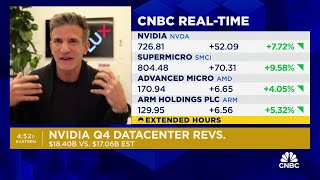
In a conversation with host John, Lux Capital co‑founder Josh Wolfe examines Nvidia’s recent earnings surge and its $1.8 trillion market cap, comparing it to Google’s size and cash flow. Wolfe argues that retail investors are “five years too late” to profit from Nvidia’s AI boom, warning that the current wave of enthusiasm may be a meme‑driven overbuild that will later drive deflationary pressure on AI chips. He links this over‑investment to a broader macro shift: rising interest rates have turned the low‑rate “tractor beam” that once pulled speculative, long‑term projects into a short‑term frenzy, prompting venture capitalists to reconsider where capital should flow. Wolfe suggests the next wave of opportunity lies not in funding futuristic moonshots but in financing the maintenance of existing AI, biotech, defense, and infrastructure assets—particularly the open‑source software stacks that power AI, such as Hugging Face and Together Compute. The discussion frames Nvidia’s dominance as both a catalyst for rapid AI adoption and a cautionary tale about timing, capital allocation, and the sustainability of the AI compute ecosystem.
Chapters
Nvidia shares in the green, beating on both lines, beating on data center revenue. For more on Nvidia and its impact on the AI trade, let's bring in Lux Capital co-founder and managing partner Josh Wolfe. Josh, it's great to have you back on the show on a day where we are seeing Nvidia sort of the, the main player. When you talk about so-called picks and shovels of generative AI, you're seeing them report earnings that are up 769% for income. Year over year for the quarter. It speaks to how quickly and how aggressively AI applications are. I guess the ability for infrastructure for applications is being adopted. Walk me through it.
Well, you know, it's interesting. It was probably 8 years ago I got a preview of NVIDIA becoming the soul of the new machine. We were investors in a company called Zoox. Amazon would buy these guys and I was like, what are these guys training these new machines on for autonomous vehicles? And they said these new NVIDIA chips. That was when NVIDIA was a $15 billion market cap at the time into Intel was $150 billion market cap. You fast forward today, over $1.8 trillion. Just absolutely incredible. I do feel, though, right now you're seeing a flood of retail investors start to get excited about NVIDIA. They're probably 5 years too late. I always say that you want to be today where you should have been 5 years ago. You have a dynamic where $1.8 trillion market cap against Google, roughly $1.8 trillion market cap. They're generating $60 billion of revenue. Remember, Google is generating $60 billion of cash flow. So I would just say it is real. The infrastructure buildout is serious and it is also a time for caution and not to see this as like some crazy meme stock. This is being, in my sense, overbuilt right now, which will be massively deflationary for many of these AI chips.
Interesting. Okay. So when you say 5 years too late, what— especially as a retail investor, I know you're focused on the private markets and VC, venture capital specifically. But we talk about 5 years too late. What would be right on time right now?
You know, it's really interesting and almost a little bit contrarian. Everybody is racing to the future right now. And, you know, it's a, it's a, it's a time when rates have risen for the past 2 years. When rates are rising, it flips the dynamic that we saw for the past 10 years, which is low rates are like a tractor beam for the future. They are pulling far out, fanciful ideas that are maybe 20-year things into these 20-month frenzy projects. Now, with rates rising, a lot of entrepreneurs and a lot of venture capitalists, you have to ask the question, have you learned the lesson of the past few years. I know we're in an election year. I know the White House and the Fed want to create a wealth effect, want to fight inflation. These two things are sort of incompatible. I actually think that the contrarian thing to do right now that people are going to realize 5 years hence is not race to the future to fund space elevators and fusion and all kinds of crazy stuff that we ourselves love to fund. But we like to reduce that gap between science fiction and science fact. Right now, we're obsessed with a theme of maintenance. You think about CapEx, there's two parts of CapEx. There's growth, which everybody's been funding, and maintenance, which nobody's funding because nobody wants to think about the trillions of assets that are there right now that should be fixed. That's in defense, that's in biotech, that's in infrastructure, that's in artificial intelligence, specifically for the open source software systems that need to be maintained by the likes of companies like Hugging Face and Together Compute.
Josh Wolfe, I know a lot of VCs would love to see that this Nvidia thing is overdone because so much of the money that they're giving to these startups is having to be spent on accelerators and compute. But what if Nvidia is actually able to maintain this lead they have and if the nature of the data center has fundamentally changed?
Well, remember what— John, you make a great point. What, what any one company does individually is rational. Facebook building out, Microsoft building out, Google building out, Nvidia building their own clouds, lots of other Providers trying to give you compute access through Nvidia chips. What happens, though, collectively is it's irrational and there has never been a boom where we haven't seen something get overbuilt. So I was a massive bull on Nvidia going back 8+ years ago, and I'm not a bear, but I just think it's a time for caution that what can go on forever will eventually stop. And I do think that this is going to end up being deflationary. I think lots of other companies are looking at how do we take AMD pair it with new languages like Python to take on NVIDIA and CUDA and give people alternatives. So I would be more interested at the moment in AMD over NVIDIA. But I do think NVIDIA's got a pole position. There's going to be a lot of alternatives. Again, you look at something like Together Compute, massive distributed computing, doing it way cheaper.