Tech Investing, Tesla, and the Bubble in Stocks & Venture Capital (w/ Mike Green & Josh Wolfe)
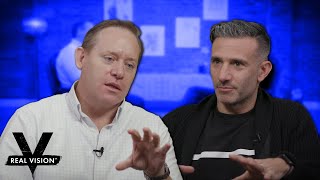
Venture capitalist Josh Wolfe discusses his bets on neural interfaces, robotic surgery, and autonomous vehicles, and why he thinks private markets are overheated. He explains the "half-life of technology intimacy" and warns that passive indexing and non-GAAP metrics are distorting valuations.
Chapters
Oi!
Well, you can tell by the smile on my face, I'm happy to be here. I'm sitting down with one of my best friends, Josh Wolfe. So excited to be back here in New York and chatting with you. Welcome back to Real Vision.
Symmetrical happiness. Always thrilled to be with you.
So every time you come on this show, we get to talk about a new success. Last time, we talked about the magic. You were so excited about Control Labs. I pushed you on the idea that maybe you were falling in love with something. And where's my sales commission?
Man, we got to do these interviews more often. It's been a streak of good luck.
Well, with Control Labs now, you sold it to Facebook. Begrudgingly. Remind people what Control Labs is. Remind me why you're begrudging in this sale. What do you think Facebook wants to do with something like this?
The thesis behind Control Labs, which led to 3 nights of sleepless nights in pursuit of this entrepreneur, Thomas Reardon, and Patrick Kaifasch, his co-founder. Was premised with this intersecting phenomenon that I call these two arrows, one of inevitability and one of the perception of the impossibility. Inevitability is this directional arrow of progress where it doesn't necessarily tell you who the entrepreneur is or what the company is, but there's this inevitable high probability that this is the way that technology is trending. The impossibility is when everybody else in the field, peer VCs, just don't see it. They think, oh, that'll never work. It's impossible. Impossibility ends up dictating low prices or less competition and inevitability raises our confidence and conviction. In this case, the arrow of progress, the inevitable was the idea that something we call the half-life of technology intimacy. It's this buzzword that we coined, but basically, 50 years ago, you had a giant ENIAC computer, you physically went up and pulled some plugs and buttons. First half-life, 25 years ago, you have a personal computer and you're tickling the keys, you're touching the monitor, you're flipping the power switch on the back. 12 and a quarter years ago, the next half-life, you have a laptop physically touching your thighs, becoming a little bit more intimate with you. You trade the mouse for a trackpad. 6 and a quarter years ago, now you've got your phone cradled in your hand, first thing you touch in the morning, last thing you touch at night, separated from your body only by a thin film of fabric. 3 and a half years ago, your iWatch, 24 hours a day on your hand or 18 hours a day. A year and a half ago, AirPods with compute inside for voice recognition. That directional arrow of progress, the inevitability was compute— it was becoming more and more intimate and close to you. We shared that thesis with a lot of people and then we ended up meeting this researcher at one of our other companies, Charles Zooker, who's a PhD neuroscientist. He said, you got to meet this guy, Riordan. Riordan was the inventor of this technology that we use called Internet Explorer when he was at Microsoft as a young guy. He was one of 17 kids, 10 biological, 7 adopted, just insane family situation. Bill Gates taps him, he goes and works at Microsoft for the decade from '90 to 2000. He's also Bill's right-hand guy during the monopoly DOJ trial. Then after making a lot of money and being technologically renowned, found and, and reasonably wealthy, he does what anybody would do in his shoes. He starts another company, uh, OpenWave, which, uh, ends up creating the mobile browser that we all use, and then, uh, goes back to college and gets a degree in classics and Latin, and then spends the next near decade getting a PhD in neuroscience, where the thesis he was working on is this myoelectric response, the idea that you could detect from the surface of your skin the roughly 15,000 neurons that innervate roughly 14 muscles in your hand. Which is important because if I'm typing, my brain is telling my fingers to do something. If I am turning a knob or switch or a lever or doing anything, my brain is subconsciously telling my hand to move. He figured out how you could take that signal, detect it, and map it to the technological devices we use. So instead of having to type on a keyboard, instead of having to type a switch, instead of having to turn a thermostat, I could effectively either do that motion in free space or and this was the crazy part— think about making that motion, and I can control the devices.
So we talked about this last time, and you highlighted that even if we go back and look at the Tom Cruise film—
Minority Report.
—Minority Report, right, where he has this dynamic and he's moving this. He's wearing gloves. He's making the gestures, et cetera. What Thomas Reardon figured out was that that subconscious thought was actually sending a signal that you're then restricting, right? And so the process of learning how to type on Mavis Beacon is actually just your brain sending those signals to your fingers, your fingers then figuring out how to do it, and you're training that interface. Back and forth. Exactly. Right? So, Control Labs basically shortcuts that process, right?
In fact, they had a maddening demo, which we may have talked about, where you try to hit the button before the device knows that you intend to hit the button, and you can't do it. That's amazing. So, it can detect your intention to fire your muscle and move it before you actually move it, which makes sense because if you have 1,000 neurons that are actuating a single muscle, if there's 100 of them, and if you were to do this now and you think about just moving a finger, you get the sensation, this feeling of that finger. It can detect that. I became obsessed with the entrepreneur. I lost sleep in pursuit of the deal for 3 nights. My wife, when she finally met Reardon, was like, you, you're responsible for this household duress. It was an amazing experience, but it was too short. It was too short. It was about a year and a half, almost 2 years, and Facebook made an entry on the company, which we rejected. Zuckerberg came back and made a more persuasive entry. These are founders, some of whom, unlike Reardon, had never made money before. It was very compelling, the amount of capital that Facebook was going to invest into the company on an ongoing basis, as well as the liquidity that people were going to get now. I wish we would have held it longer. I truly think this would have been a $10 billion business instead of something a little under a billion dollars, but it was a great outcome for our investors and a thrill to be part of what I think is going to be a historic technology that we will all be using.
MIKE GREEN: Now, I want to come back to this, but this also brings up another topic that you and I have discussed before, which is basically the concentration of capability inside companies. What we have very clearly seen are companies like Google and Facebook, Apple, Microsoft have become very acquisitive. They have an extraordinarily low cost of capital and have been able to buy these. Do you think for Thomas Reardon, as he thinks about going inside Facebook, that that creates a limitation or that that changes the trajectory of the technology versus his original vision?
I'll give you two answers because I tried the no answer. I tried the moral suasion. I tried— and this was at a time when Zuck was in front of Congress being embastled as a poster child of technological excess and election meddling. I'm trying to make the case, my God, you are going to take a technology that can capture your neural intention and give it to Facebook? You're going to spend the next 2 years in front of congressional committees yourself. I tried emotional suasion with my kids saying, don't sell, sending videos to the board, we don't trust Facebook. I tried financial suasion to do a secondary and capitalize the business. In the end, I think Reardon actually had a very rational view of this. Again, he worked for Bill Gates at Microsoft. When Microsoft was arguably the evil empire. His view was back then, Bill Gates was a lot more powerful and Microsoft was a lot more powerful than Facebook is today. Bill today is considered a president of the world in many ways. He's curing malaria, he's taking on poverty, he's doing big global things in a way that many of our other elected leaders are not. There's no reason that you couldn't imagine a decade hence, as hard as it is, that Zuck, because of Chan Zuckerberg Initiative, might find a cure to Alzheimer's or something and suddenly be in that same position. I think the idea that there's going to be this monopolistic power concentrated, he felt was overblown. The thing that I think was really appealing to him, when you get bit by the bug of taking Internet Explorer from one person to a billion users, the idea that you could take this technology and its ability to let humans express themselves and control the world around them from one person or in our case, a few dozen people to 8 billion people, which is his goal, you want a platform like a Facebook. I think that the world will be better off with this scaling and I think it will unleash like many technologies in almost this moral imperative case to invent so that genius can get unleashed and unlocked, that a lot of genius will get unlocked as people start to use this and discover what they can create with it. Again, I just wish it was— still in my hands for a few more years at a much higher multiple.
I wish it was too, actually, but you didn't try the physical violence approach, which might have been my return. Last time we got together, we had a similar discussion. This time, it was— that time, it was Johnson Johnson acquiring the robotic surgical company, Horace, for just under $6 billion.
Yes, exactly.
I haven't had a robot operate on me yet. Do you keep tabs on how that progress is developing, how that technology is developing and what the next stages are when you exit these vehicles or does the bandwidth that would consume—
We continue to track that because again, the thesis is sound and the idea that the skill of a human in the operating room is the rate limiting factor to be able to scale surgeries, particularly if you are a highly skilled surgeon, the ones that make the most money, they're the most sought after for the most sophisticated procedures. I think that that's going to start to go away and the sophistication of the surgeon will be embedded in the machine. We see that across the history of technology where somebody that has manual dexterity, that has precision, replicability, rather than that being this implicit knowledge of the surgeon through many experiences, why should they not be able to effectively download that into a machine so that that can scale and reach many?
It's interesting. Every time you and I talk, I occasionally get shivers down my back. I'm reminded of a paper by Mark Koyama describing the— innovations that actually led to the creation of the Industrial Revolution. One of those innovations was actually the transition from needlepoint designs and fabric to printed fabric, calico. What that did was that introduced variety into the consumption basket of young women being courted by young men, and then the young men had to enter into the labor force to obtain dollars so that they could actually go buy stuff. Dramatically changed the work habits of the world. When you say something like that, and you highlight that type of technological development, I can only see the number of opportunities that it expands in terms of the capability to lower the costs, increase the ability of people to have the surgeries that they might otherwise not have in the United States, the developing world, et cetera. So really excited to see how that moves forward. My next bet for the one, though, that's going to be acquired is one you just started talking about, which is the Variant Pharma.
JOSH WOLFE: Yeah, this is early. It's consistent with the theme which we follow, which is the decreasing gap between science fiction and science fact. In this case, the inspiration really came from X-Men. Professor X puts on this helmet called Cerebro, and he's able from a crowd of mutants, ridiculously, to spot the one in a million person who can shoot lasers out of their eyes and conjure fire from their fingers. It got us thinking, okay, if there's a one in a billion chance of some super rare phenotype, a trait. Which has a giant base— I'm sure you know those people. 7 people walking around that have extreme high oxygen saturation at high altitudes. They get into an accident, their bones don't break. They have extremely high metabolism. Lots of interesting traits, and you just have to go and find them. Now, the other interesting thing, and here's where there's this arbitrage, is the vast majority of money and effort and research and talent has gone into sequencing pale, male, stale white Europeans, people like us, maybe not the stale part, but very few people have gone to the outer regions of the world, because those people don't have money to find these outlier traits in these outlier regions. I think that there is an absolute genetic goldmine of these people who are quite literally mutants, whose traits— and it's really important because the team here, the 4th or 5th person that they hired was a computational geneticist, but the 2nd and 3rd was a cultural anthropologist and an ethicist, because they want to get benefit sharing and have these people participate in both the economic profits, but also the scientific progress that comes from finding these unique individuals. You will take a minority mutant population and end up helping find cures for the masses. I think it's an area of medicine and genetics that has never been explored. We started a company, fielded a team, they have now gone— it's interesting, we call them at the moment Trex. There's a lot of thought— TREX or something? TREK, like a trek, which even they don't really love that. They killed the idea of a mission, because that has a connotation of exploitation of indigenous. Lots of consideration about that, even just like how do we approach these populations who are rightly skeptical from having been exploited in the past by big companies or explorers or whatever. We don't call them explorations, we don't call them expeditions, so there's a lot of thought into the etymology of— of what we call these things.
Extreme wokeness.
Yeah. But they've done a handful of different partnerships. The ones that have been publicly announced have been with the Māoris in New Zealand who have really interesting metabolic traits, Pakistan, which is a genetic island population in that Pakistan is not an island geographically, but there's a lot of interrelated marriages and cousins marrying cousins. Because of that, you get interesting traits which are likely or more likely to have a monogenic condition, a single gene that codes for a protein that does something. Then they just went to Nepal and were with the Sherpas. It was absolutely stunning. They brought back some video. They have a Nat Geo documentary person that's going around with them, filming their treks. These Sherpas are going up with 100 pounds on their back and they're completely not out of breath and our team is dying. There is a genetic predisposition for that.
You skipped one that actually caught my attention, which is the Samoan population. Yes. Very quickly. From reading about the Variant Pharma website, resistance to diabetes in the Samoan population runs something like 30%. Yes. Right? Abnormally high, yes. And as a result, the statistics was to replicate a Variant Pharma study that required only 10,000 people in Samoa would require roughly 10 million, if I got those numbers correct, in Europe?
Yes, because you already have the traits manifest in the people. And so you're not searching for all this needle in a haystack. You have all the needles.
I mean, it's just absolutely incredible. I don't think people can fully appreciate the revolution that's in front of us from this standpoint. I have a number of friends that are in the biotech space, one of whom is going to join us tonight at drinks after this event. Excellent. But they are highlighting that there's just this extraordinary advances coming in the biotech space as people approach things from a standpoint of how do we change the way we study it? Not necessarily how do we change the tools. The '80s and the '90s were largely about innovations in terms of what are the tools.
Sequencing. Right, exactly.
Now, you're talking about the redesign of the actual process of how do you think about the problem.
Exactly. In fact, the way that we think about it is search is really arguably the first competitive advantage because you're trying to find and identify these populations, some of which they're not publicly disclosing. I'll share one with you, not where it is, but what the traits are. Sequence, which is relatively, as you point out, because the technological curves in this, a commodity. Then you want to go and basically develop, and you're either going to partner with Big Pharma or in some cases, develop your own clinical trials, and that's a lot more money. It's really the search of how do you partner and develop a competitive advantage? Arguably, the most important competitive advantage is trust, with the reputation that you have, how you're contracting with local researchers, how you're treating the local population, how you're prioritizing them, how you're deprioritizing them, if that might be the case, and the legacy you leave. One of the populations, South America, 9 people remain. This is like a tiny group of people who have extremely high metabolic rate that spikes at night. Adaptation to the environment, temperature precipitously drops. They almost have like a heat shock protein that raises their body temperature. Wow. Now, if you think about this, if that proved— and I don't know if it is, but if it proved to be a monogenic condition, the gene makes the protein that raises the body temperature at night, and that was a targetable drug. You're talking about a pill that you take at night. Makes you skinny. I don't know if it makes you skinny, but you're definitely burning fat while you're sleeping. And with the obesity epidemic in the US, would be pretty interesting.
Right. I mean, that really is just fascinating, fascinating. It is my bet for the next one, by the way. I don't know everything in your portfolio, but that is one that strikes me as just an instantaneous winner.
Well, if we keep this pattern going, then the next time we sit down—
I know, we'll have to talk about the sale of Veron Pharma. You'll have been begging them not to sell. One of the other companies you talked about that got away from you, and I think you actually became involved, was Zouk. This is in the self-driving space. There was a big announcement from General Motors, or Drive more accurately, in the past couple of days.
Cruise. Cruise, I'm sorry. Correct.
Can you talk a little about what's going on in that space?
Cruise was actually the one that got away from us. We had offered Kyle $20 million at a $40 million pre-money, so $60 million post, and somebody else did it, another great VC at $80 million. We thought that was double the price that we were, and we were being price disciplined on this. Then we introduced Kyle to GM, and GM bought them nominally for $1 billion, a little bit less, but yeah, so that would have been 11x in 9 months or something. That was a big error of omission in hindsight. That is an amazing team. I think that they are serious. I think that Aurora, which is another competitor, is serious. I think that Zoox is the most serious, obviously biased, we're invested, but we are the only full stack autonomous vehicle driving highway, city, in San Francisco, in Nevada, elsewhere, actually doing Robotaxi rides in Vegas. Tesla, as you know, if you follow me on Twitter at all, that is mostly BS when it comes to Autopilot. It's actually dangerous that this is even on the road. But the level of sophistication that you have on everything from solid-state LiDAR to the software simulation, to being able to navigate double-parked cars, pedestrians, right-hand turn, left-hand turns, multicoordination intersections, it's really complex. It's still going to take a very long time for all of these things to see the light of day. Billions of dollars will be invested. My hand to my heart, I actually think that the first real application of this, which is another interesting phenomenon and trend that I think is going to play into cities in a big way, and it's going to touch everything from Amazon to the smart home, I think you will see self-driving cars first manifest in right-hand turn lanes in certain city districts. Where just like bike lanes, you are making multiple rights and doing a traveling salesman problem, trying to figure out how you navigate from neighborhood to neighborhood, 24 hours a day delivering things, not people, but things. Even Zoox is focused on people and Cruise is focused on people. There are some others that I think are thinking about commerce and goods. Now, if you think about just the trend, again, directional arrow of progress, we are used to our phone as a remote control, you press a button, you get your stuff. Amazon Prime has primed us for 1-hour delivery or 2-hour delivery. You press your button, something comes from a warehouse in New Jersey using New York as an example. There is an autonomous vehicle that runs a route, gets to New York, has a human in there to do the last mile delivery, which eventually might see robots. There are people that are trying to do that, but I think it's too many variable situations coming out of a vehicle into apartment buildings and others that you'll see that, but human will come out like a FedEx delivery person. Then the next thing that they will need in this value chain is access control. I actually think that you're going to see a whole suite of industrial locks and cameras, some of which you're seeing early incarnations of. We have one called Latch Access. Amazon bought a camera company called Ring. There's going to be many others in this space, but the ability to give trusted access to complete strangers to enter your home and treat your cupboard, your medicine cabinet, your fridge, your closets in the same way you might give somebody trusted access to access or deposit a file into a Box or Dropbox or Google Drive. This idea of access control, I think, is this next phase. From pressing a button on your remote control for the thing you want, to an autonomous vehicle delivering it 24 hours a day, to a human entering your home because you've given the trusted access. Again, this is almost like if I would have said 10 years ago, you're going to get in cars with strangers, you'd be like, no way, but today, because you mostly trust the brand, accountability and the choke point of an Uber or Lyft, you get into strangers' cars. I think you're going to be letting strangers into your home to do this last quarter mile of commerce.
I actually very much agree with that vision that we are ultimately moving to an environment in which trust becomes the underlying dynamic. We've talked about this occasionally in the dynamic of crypto or various other ones, that trust is becoming a feature that is embedded into the application layer.
It's actually the one feature that I've joked with Facebook Portal. Is totally absent. I always said that Facebook Portal has got this great design, but it's missing the one feature, which is trust.
Well, my pushback on companies like Uber and Lyft actually has been that they are going to suffer from a first mover disadvantage. They have had to address the issue of how do I transport people by hiring, in quotes, millions of people. The process of shedding those employees, I think, is actually going to be far more difficult than they think. That actually sets up a dynamic in which a company like Zooker and others who has built themselves purposely not to establish an app and get the app installed on the phone, which is actually remarkably easy, although the trust layer becomes an important component of it, but they've cut out the labor component that the separation there was going to create a bunch of social anxiety and potentially lead to far more enforced regulations. We're already seeing this in California, where they're being forced to treat them as employees as compared to contractors.
They're trying to say, look, we are just the layer to match a driver and a rider and we don't want to employ them. Employ or be responsible, but you're right, the regulatory aspect of this is going to apply pressure to labor.
Yeah, I think that's ultimately right. Now, you mentioned this idea that they're going to take things. I understand what you're saying. I wonder if the challenge there is the person who has to be able to take the delivery.
No, I think that there will be a designated— and I've actually seen privately some of the apps that some of these companies have. That are almost like an augmented reality thing that when, let's say, a UPS delivery person or if it was an Amazon Prime delivery person, they look at their phone, they're given a provision code to enter the apartment. It takes a picture so it knows who's there, knows what they've entered with. They enter and they see this augmented reality thing of where they should— it might literally be X marks the spot that they're looking on the phone, put this here, or it might be when they go over the fridge, put this here. They literally use that as a layer, which itself is another interesting thing I want to talk about, but the simulation layer to place things in certain places. It may not be that you're trusting them to come into your bedroom yet, for your bathroom yet, people will trust an Amazon Prime to come in and load their fridge and put away all their groceries. We get FreshDirect delivered on a weekly basis. What do they do? They come into our home, and they lay down all the bags, and then my wife and I and the kids put everything away. There's no reason that I wouldn't pay another $5 during that delivery fee to have them put everything away for us in a consistent, predictable way.
Yeah, that consistent, predictable way is actually a great distinction. We have people who help maintain our home and when they unload the dishwasher, I'm constantly saying, where the hell did you put this? The ability to actually have that enforced in a consistent manner, I completely agree with you.
Radiohead style, everything in its right place.
Everything in its right place, which sounds terrible in a lot of ways. We all see those homes with the— I think the condo stuff is what it's called, Marie Kondo, where everything's labeled and it's got its own specific place.
I think you and I look at that and like, oh my God. That stresses me out.
That would drive me insane. There is a component of predictability that you want to life hack, expend the minimal amount of energy saying, hey, where's the rolling pin today? Totally. Where's the measuring cup? When I think about that question that we started to address in terms of this self-driving capability, and you referred to the Tesla solution as being dangerous, which I share your concerns. The challenge of self-driving, as I understand it, I mean, there certainly is, it is presented, is this idea of miles on the ground. How many miles do you have to travel to solve every possible permutation and permutation? That seems like such a flawed model to me. What's your reaction to that?
I think it's going to be a combination. It's going to be a combination of simulation where you're trying to predict every scenario from a human walking out, 3 humans walking out, old person, young person, ball coming across, horse, dogs, different weather situations, potholes. Why? Because in any model, including what I would argue in human consciousness, you have this prediction, memory prediction framework. The computer basically has a memory based on either simulation or reality of what the thing ought to be. And then it experiences in real time what that reality is and it maps it. If it conforms to what the memory is, then the prediction, there's no surprise. This is the same thing I think that we experience in human consciousness. I see you, I see— if you see my funky shoes, you predict, hey, that's Josh. If you were looking at somebody else and you saw those funky shoes and you, hey, that's Josh, but then it was Steve, you'd be like, oh, surprise. Then you have this emotional salience that updates your prior, updates your model. Computers are the same way and these simulations in the self-driving cars and robots are the same way. There's a prior, whether that is through experience or programming, and the programming could be from simulation. Then there's the actual experience. Then when those map and conform, there's no surprise, you don't have to update the model. If you think about all of the permutations that occur in reality, it's infinitely complex. You're going to need a mix of models that are mapping onto the real world, and then the ability to quickly discern. In Zoox's case, when you watch some of these videos online of the situations that they're able to navigate, in many of the cases, there's no programming of those situations. Having a double-parked car followed by a biker coming out of nowhere and a pedestrian, every one of those things has to be almost consciously recognizing objects and then classifying those objects as humans, as bikes, as cars, as static objects, and then intuiting what an intention might be and making a prediction about that. So it's, it's super complex. It's going to be years of iteration. I do think that these things are still very dangerous. And so the idea of putting cars out on the road And calling them autopilot and giving people this false sense of confidence is super dangerous. It's irresponsible. It's an accounting trick being used to book revenue and pull it forward. But this will happen. We will be in autonomous vehicles.
It's interesting, actually, because what you describe is a very complex system, has features that I think are actually— that overlay with some of the work that I'm doing. I think you know this, but I'm involved in some of my first machine learning projects there's this issue of tractability. Yes. What can actually be programmed? Ironically, the transition to self-driving is the most difficult because you have the unpredictability of human beings that may or may not conform to the laws, that may or may not conform to these components. Balls will always be there, children will always run out into the street, but the car driving itself, somebody double parking and behaving in a manner that's not consistent, having no mechanism to communicate that to you other than the very rudimentary signals that come from brake lights, hazard signals, turn signals, et cetera, that's ultimately going to give way to a much more tractable problem as you have more and more machine-driven vehicles on the road.
Well, especially as you have vehicle-to-vehicle protocols that start to communicate the intentions with each other. Humans have this where if you and I are walking on the sidewalk in New York, and we come into each other, you have that awkward Larry David-like moment where you're You're going left, I'm going right, then we make a mistake and there's the coordination problem. Coordination is a function of both prediction and communication. I do agree with you that you will have all kinds of layers of protocols where self-driving cars and other robot systems, autonomous systems will have this coordination communication protocol.
We tend to take for granted the human's capability to do that. We all have the experience of making eye contact with a pedestrian crossing the crosswalk.
You do a little dance.
even a car driver, right? I mean, it's just— all it requires is that eye contact that allows people to be aware that you've actually seen them. And then you can proceed under conditions, right? It would be the rare assumption that you would make eye contact with a driver, enter the crosswalk, and they would run you over. Exactly. Right. And we are very much programmed. It's built into our capability to understand when somebody has actually seen us, right? So I mean, that flash of recognition of this is a human being, like it's very much built in there. So we tend to take that for granted. Machines don't have that capability yet, or they're developing it as you're highlighting with Zouk. Once they have, then they'll have their own native protocol as well that makes this problem so much easier.
That, by the way, is one of the hallmarks just generally of human intelligence and relevant entirely in markets, which is I know that you know that I know. Then it's how many layers is that? Correct. One of my kids, I think, is very savvy and she knows that I know that she knows that— she's like 4 layers, whereas one of my other kids is like, I know.
Since we're now crossing over to the virtual world, you introduced your Twitter handle. My character is Vizzini from The Princess Bride. I always focus on that element of the game. Inconceivable. Inconceivable, but the most important part for me of that character is actually the iocane powder, where there's a game being played that people are actually not aware of, that he believes he's outsmarting somebody, but he doesn't actually know the game that's being played involves poison in both cups. It's an immunity condition. Exactly. Which brings us to actually a discussion of a game that I've had with a number of people and one of our mutual friends, Mike Mauboussin. We're going to transition to discussing public markets for a second here. Mike has written several books and has talked often about the dynamic of skill development in markets and how markets are becoming more challenging. The alpha degradation that we're seeing in public markets, he attributes to an increase in skill that is being accumulated in the market. I think Michael actually misunderstands the game that's being played. He uses the poker analogy. He says, we saw this online, there was a game of poker, poker moved online, there's an explosion of players. Initially, there were a bunch of patsies that decided that they had been good at their local games, got online, and the pros were able to basically fleece these players and take their money away.
Eventually, you're left with a game in which only pros are playing So, skill level has leveled up and a lot of the variance is more attributed to luck. Correct.
The stock market is the extension of that analogy for him, but I think it's a flawed analogy and I wanted to get your reaction to that. The way I look at it is poker is a fixed game. It's ergodic in nature. We know at every point that the number of cards is going to be unchanged, the probability of a hand is going to be unchanged, the configuration of the river or what you have in your hand can influence your perception of those probabilities. but they ultimately don't change. Stock markets or any form of market for that matter is non-ergodic. We have no knowledge about what the distribution of the possible configurations are in the future. I actually think that he's improperly framing the question. I think he's using an ergodic game to make an analogy to a non-ergodic game in which the idea of skill development really can't exist.
Agree that markets are complex adaptive systems, but there's punctuated periods where there is a game, there's a recognition of how that game is played, and then people level up to that game. Then at some point, they may not be aware that the game is changing, but I think during the period where people understand what the game is, the skill level is rising. The variation between investors is increasingly attributed to luck, but then like you say, the undulating landscape changes and suddenly, the game that you thought you were playing you're no longer playing. You see this all the time. Hedge fund guys before '07 didn't care about macro at all. They were just bottoms-up stock pickers, long-short equity, short what was overvalued, be long what was undervalued. All of a sudden, everybody came, all the quarterly letters of all the top value guys were suddenly talking about macro and they were pledging, oh, well, we didn't— because the game changed, macro mattered. I think that at any given point in time now, you could argue It's people that are getting smart to the structure of the market as you are about passive indexation and inflows and incremental flows and how that is changing the game. I think Michael's point is markets are complex adaptive systems. People can get wise to what the game is. They may not realize that the game has changed, but as long as there's a general agreement about the game, skill level rises and variance is more attributed to luck.
That's fascinating. Insight in terms of the way I've been thinking about it because it resonates with me. A discussion I had recently with a legendary investor from the 2000s, who I'm not going to name, said to me, Mike, I was meant to invest in the 2000s. The game that is being played today, I don't understand. I'm at this point too old and too rich to try to figure it out entirely. It's really interesting to think about it in that context because it becomes a question of are those who have been so successful and accumulated the resources—
DAN TAPIERO: I'm half listening and half thinking about who I think it is and I think I know who I think it is.
Do you think you know what I think I know? Inconceivable. Exactly. So that actually becomes a really interesting question, though, because it then raises the issue of have we allowed that concentration of wealth, have we allowed that to blind ourselves to the potential that the game has completely changed, which is certainly what my research would lead, right, that the market is no longer the market as people think about it. There are exploitable phenomenon, but it requires a complete rethinking of how you approach the problems, right? Phrased in those terms, I completely agree with that. I think that would still lead me to say that it's actually not skill development. That would be a cyclical phenomenon that would show up slightly differently. The tools that were developed for how we manage markets, how we think about them, were largely created in that time period. The assumptions that we make in the use of those tools, things like AlphaBeta, Sharpe, etc., I think are actually improperly suited for the current environment. That brings us then into the general discussion of public markets, which is Let's talk about how you see the world of public markets valuations, and how you think about how that is either influencing or being influenced by the private markets that you primarily participate in.
I just had a dinner with also a very prominent, maybe the most prominent CIO in the endowment world. I asked him, do you see risks about liquidity and illiquidity in both public markets and private markets? In the public markets, is it a function of passive indexation and inflows? Whether it's Fed, algos, momentum, whatever it is, dollar in, buy, everything rising, what happens if there are withdrawals and everything comes down? His view on that was with passive roughly 20% of market structure today. It's about 35%. Okay, but I think you've made the point that something like 80% or 90% of the incremental dollars are going into passive. Far more than 100%. Okay. 90%, he would be worried. I recall then actually raised you as an example. I said I have a smart friend who mathematically has shown actually when it gets around where we are now, 35%, I thought it was lower. That's when you get the structural runaway risk on liquidity side of passive indexation. That was on the public side. On the private side, he has done something interesting, which was he never wants his illiquid portfolio to be more than 50% of the endowment. What he's done because of who he is, is gone to the underlying GPs and said, give me your hand to the heart, Mark. Of what you think this is worth, not the FAS 157 mark based on accounting basis. Historically, when he did this in 2000 and in 2007 or '08, both saving them from substantial drawdowns during the crisis, it was somewhere between 25% and 30% discount to what any given company that ended up exiting in that year proved to exit at. There was a level of conservatism that the managers expressed. Because they valued the relationship with this particular CIO. They were going to be super honest and ethical about what their hand to the heart was because they wanted to continue to be hired as a manager. Today, he says it's between 0% and 10%. Elevated valuations on the private equity side. If you look at the total amount of PE money today—
Just to be clear what you're saying, what they are saying is they see no discount to where they've marked it in the event that they would have to sell under distress type conditions. Correct.
That's astonishing. $1.5 trillion of PE assets are sitting on the sidelines right now. There's an enormous amount of dry powder. Now, if you're a public market investor, maybe that's a positive thing. Well, wait a second.
Again, I want to be clear, when you say PE assets are sitting on the sidelines, this is the cash that has been raised, but not yet deployed. Correct.
By buyout funds and venture funds. Venture is a mouse to the elephant here, but $1.5 trillion globally, $800 billion of that is North America. That's about 2 times the level of what it was 10, 11 years ago, going into even then a PE crisis, 2007, '08, '09. VC itself has raised about $50 billion across 250 funds in each of the last 2 years, which is 4 times what it was 10 years ago. Again, we've talked about this in the past, but the number one thing that is predictive of returns is not the BCG McKinsey, whatever. It's the amount of capital that's flooding in. The amount of capital that's flooding in is undeniably high. You look at some of the surveys for LPs, they will say 80% of them feel unequipped in a downturn, that they're well positioned, but yet two-thirds of them are continuing to increase their allocation to PE notwithstanding the numbers that I just gave you. When there was a downturn and you had this denominator effect, again, 10 years ago, two-thirds of those LPs were not making any new commitments to new funds on the private equity side. They anticipate that they're not quite there, but they can't help but continue to allocate and I think that's setting up a problem. You had public markets to your point, up 32%, 33%.
31% last year.
Denominator effect. If that were to continue, great, everybody's portfolio looks good, you got high marks on these private equity for the other people that are not doing this more conservatively. If the public markets were to decline, you have a denominator effect, what are people going to do with these PE portfolio? There's I think going to be a race for secondaries and liquidity. I think the secondary guys in the next few years are going to be really well poised. They might be sitting on cash for longer than people expect. On the public market side, there's a really interesting thing that Jim Grant had recently shown. PE on the S&P is 21, 22. The PE is, of course, market cap weighted on the S&P 500. If you market cap weight, if you cap weight the E part, instead of just aggregating and averaging as it is, you actually have a 32 times multiple. There's a difference.
The way it's calculated on the public indices is what's called a harmonic median. Effectively, you are going through and it's almost like ignoring the outliers.
Because in each of the cases, aren't you taking a multiple where you're taking the PE of Apple times the weighting of Apple and the PE of GE times the weighting of GE and just basically aggregating that? Not quite.
The details we can walk through another point, but the calculation is actually off of what's called the harmonic median. Effectively, you're going through the 50th percentile type dynamic. But you're 100% right, the other point that I would raise is to say we've never seen a larger gap between GAAP, G-A-A-P, and the quote unquote operating earnings that make up that 21, 22 PE that you're referring to.
MIKE GREEN: Well, and on top of this, you have something like 95% of companies that are now reporting non-GAAP earnings. They're making up funny metrics. Now, we saw this in WeWork on the private side when you had community adjusted EBITDA. Tesla is like ground zero of ridiculous terms. Delivery sales, what does that actually mean? There's a lot of companies that are just using funny language because in a bull market, people are less scrutinizing. I think that that's really ripe situation where you have lots of non-GAAP accounting terms that are signifiers of risk. You have the S&P growing revenue 3%, 4%, 2%, 3%, 4%. Somewhere in that range. Most of the 31—
On a per share basis, slightly higher, but yeah.
Most of the 31%, 32% return over the past year was mostly for multiple expansion because I think you've had—
More than 100%. We had actually flat to slightly negative earnings. For the past 4 quarters.
People are paying higher multiples for lower or negative growth. One interesting thing, and this is a forming hypothesis that is a little bit more wishful thinking from the venture side. If we are at peak earnings, and people have been talking about peak earnings forever, but if we're at peak earnings, and corporates are looking and saying, okay, how do I actually maintain margins at a time where 60% of COGS is labor? I think that there will be an increasing turn to technology. Now, I don't know the timeframe. That's not going to be like, okay, let's quickly implement the system and lay off a bunch of people and maintain our margins again. I do think that some of the things that we're investing in, whether it's metal 3D printing or certain technological systems for efficiency, you have the opportunity for at least margin stability against a situation where revenues are declining, prices are coming down. There's another question about what happens to input costs. A lot of smart people are— and I don't know if you agree with this or not, but weak dollar, long commodities, long gold, higher input prices, smaller margins.
Yeah, not in that camp.
You're in a higher dollar camp?
I tend to think that we're going to have a higher dollar simply because the global system is ultimately set up on a collateral basis and everything we're describing in terms of high valuations and increasing risk is actually touching that collateral dynamic. We're concerned about the risk that the collateral contracts. If the collateral contracts, then the debt actually becomes increasingly due, which means the dollar is under demand. I fall into the higher dollar camp, but—
Do you have a view on margin pressure?
I think the margin pressure is likely to come actually from a couple of different areas, but we've seen unequivocally the margin pressure. We're allowing the system to increasingly run with tight labor. Whether that shows up in wages or not is heavily influenced by the composition. When you have lots of old people, wages don't go up all that much, because they tend not to ask for raises and that tends to conceal the relatively rapid wage gains that we're seeing in the younger generation. There's a couple of good reports I could send you on that stuff.
I do wonder if the wage gains are happening taking into account the amount of new company formation. When you have a flood of capital into any sector, if there's a lot of company formation, those companies are competing with each other for talent, and so wages are rising. I do wonder if some of that capital inflow starts to abate, that you would actually see more people consolidating, more supply of talent going into fewer companies, and wage suppression.
What we're seeing is actually more on the opposite side. The rates— while you're very active in the process of business formation, I actually would suggest that many of the statistics that we receive from the Bureau of Labor Statistics, the BLS, are inflated by the assumptions around business formation. Actually, the data suggests that business formation has fallen dramatically, and not your type of business, but the mom-and-pop shops and the independent contractors, retail, et cetera. That type of business formation has taken an extraordinary hit, that in turn actually weirdly increases the potential for this to behave in a convex fashion, because what you're beginning to see, and you're seeing this very clearly in the data, is as the economy has slowed in this last cycle, we have seen overtime hours decline, we have seen weekly hours decline, which has pressured some of the headline numbers in terms of the average weekly compensation that people are receiving. You're beginning to see this show up in stress in terms of credit cards, et cetera. The early signs of some weakness are there, but the primary dynamic that we're actually seeing is this issue of hoarding of labor. Companies are seeing decreased utilization of their labor, but because at the headline, finding new employees is so hard, they're resisting with every fiber of their being letting go of the employees that they currently have. We haven't yet seen that turn and we may not. It's very hard to know how that plays, but the data would actually suggest it's heading in the opposite direction of the way that your hypothesis— that wages will continue to rise. We are at an inflection point in which that could continue to tighten. That's one of the risks that the Federal Reserve may have created with reinforcing the cycle with the interest rate cuts. Only the future can actually tell us what actually ends up happening.
Demographics. Let me ask you, because I always love your—
No, I'm interviewing you.
Oh, but your answers inform me.
I understand that, but nobody is interested in what I have to say on this topic. We'll talk offline on the demographics. I want to touch, though, on a topic that demographics does influence that you and I both care fairly passionately about, which is politics. Politics and the election that's approaching. You and I have publicly sparred. You have supported Bloomberg as a candidate. He would be among my last choices. I'm interested to hear how you're thinking about it. I'm sure there are some folks—
Mine is very simple. These are debates that I used to get into with Lauren, my wife, that I never really thought the president mattered. I thought that all you needed was a good figurehead who mostly was the better looking person that conveyed all the evolutionary psychology appeals of symmetry and dominance and that kind stuff. I think in this case, I want the candidate, and this is something that Bill Gates, who I serve on a board with, said to my friend, Andrew Sorkin, at a DealBook conference earlier this year, I just want the most professional person. That really resonated with me. I just want the most professional person. The rancor that I see, the debasement of the office that I see with the current individual, maybe I have this false nostalgia of pining for somebody that can set a level of behavior that is presidential, one that I want my kids to look up to and say like, that is the way to behave, that is the way to make decisions, that's the way under pressure or criticism to react. My preference for Bloomberg is really in actually thinking that unlike Trump, he's actually a billionaire, and he can't be bought. And that the appeal that he has is more about legacy than short-term gratification. I find him to be the most professional and the most rational, but tell me your counterthesis.
My counterthesis would be almost saying exactly what you're saying, which is he perceives himself as the most professional, but doesn't perceive himself as a statesman, someone who's meant to represent. You can actually see it in what he is describing as his approach to the central office. He's going to open it up, turn it into a bullpen. He's going to manage it, right? He's going to manage the US economy like he's managed Bloomberg. That unfortunately is not the job of the president, right? And my fear is, is that he very clearly doesn't know that.
Do you think with, uh, the management of New York, which is a vibrant, complex, diverse economy, that he did a bad job?
I don't think that he did a bad job, but I think that he was handed a gift, right? So the inflation that we saw through the 1990s created a revenue stream. We unfortunately are going to run out of time here. We didn't get to talk about China, which you've also become very vocal on. You and I are both involved there.
Let's treat that for another time. I will say to your credit, this was something I was hyper bullish on in the idea that there were two Chinas, an old China and a new China. You would say, Josh, you're wrong, you're missing this. I got to tell you, you changed my mind because I've come to see the evils and the skepticism. There's an idealistic view about what China could be, and there's a realist view of what it is today. I've become much more in your camp. It's a great example of something I've changed my mind on because of you.
To your credit, you absolutely have done that. I'm very excited to see that. My guess is we'll get the same way with Bloomberg. I hope we don't actually see the need for that to happen once he's in office. Josh, as always, such an amazing time spending with you. The time flies by, and we've run out of it now. Look forward to seeing you again, hopefully within a year.
Thank you, Mike. Always good.
Take care, Josh.
More from Josh

Winklevoss Twins' Big Miss on Crypto, Top VC Tech Sector Warning, Atlassian's 10% Staff Cut


Josh Wolfe & Brett McGurk – Venture, Geopolitics, and the Next Frontier (EP.476)


How Top Investors See the Future of AI | Chase Coleman, Brad Gerstner, Josh Wolfe at Robin Hood 2025

How the AI Talent War is Rewriting Deals ft. Josh Wolfe, Dan Primack & Dan Grossman


Josh Wolfe on AI and the Breaking of Silicon Valley's Social Contract | Odd Lots

Why Defense Tech Is the Next $100B Venture Opportunity | Josh Wolfe & Terry Monis

