Venture Capital Gone Mad (w/ Josh Wolfe) | Interview | Real Vision™
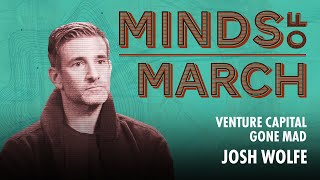
Josh Wolfe explains how venture capital's explosion created a feedback loop: massive growth-equity rounds at billion-dollar valuations convinced investors that any future unicorn would pay off, so they wrote $100 million checks. SoftBank's preferred stakes with 2-3x liquidation preferences often leave earlier investors holding worthless "zombie" shares.
Chapters
Let's think about the nonlinearity for a second. One of the topics you wanted to bring up was this idea of liquidity as a nonlinearity. Yes. Right? And so one of the things that we see within venture capital is that there's been this explosion of liquidity, particularly exceptionally well-funded growth equity. Right? So not the true VC stage 1, Series A type round. Although that obviously has benefited from this dynamic. But the Series E pre-public— here's $1 billion, here's a $20 billion valuation, here's a $100 billion valuation. Talk to me about how you think about this liquidity switch and the impact that that has on your industry and the impact that has on innovation.
Well, it ultimately is going to define all the returns. And if you go back a little bit and say, well, why are we in this situation where, you know, we've called this in the past the minnows and the megas, you have lots of these small firms that are starting up. That are doing the seed checks, and then you have these large players that are writing these $100 million-plus checks. Going back 7 years or so, Andreessen, who I think is a brilliant investor, a brilliant technologist, basically said there's only 10 companies that matter in a given year. And statistically, that's probably true. Now, knowing which 10 is very hard. But he said you just basically want to be in those companies. And I think that was a meme that really went very wide. And people said, OK, well, if you're It doesn't matter if you invest in Facebook at $1 billion or $5 billion or $10 billion, because it would go on to be hundreds of billions. And so does it really matter if we're negotiating here and quibbling over $1 billion or $2 billion? Well, of course it does. But that, I think, induced a lot of growth investors to say, let's just try to speculate on some of these big unicorns. And you got this phenomenon of companies that were pining to signal that they were going to be that next Facebook by attaining a billion-dollar valuation. And then you got a positive feedback effect where people were funding these things. And to get access would write a $100 million check at a $900 million pre, and they would own 10% in a billion-dollar valuation. And the problem for the early-stage investors and their limited partners is they were getting these huge markups. And on paper, it looked phenomenal. And then they would go out and raise their next fund and put it into more illiquid companies. But they weren't necessarily getting liquidity on that billion-dollar company. And you have started to see over the past 3 or 4 years, a lot of these unicorns not go from a billion to $800 million. They've gone from $1 billion or $2 billion—
To zero.
—to zero. Yeah. And so there's this liquidity trap that is natural in markets because people are basically taking massive amounts of capital, which in the venture world, there's a capital structure just like in the traditional public markets. And you have common equity, which sits on the bottom of the stack, and then preferred, and then debt on top. When you have preferred equity of a size that is so large and with it, might have the classic Carl Icahn, you know, your price, my terms. So SoftBank would come in, for example— we can talk a bit about them— and say, sure, we'll give you $200 million, and we want to own 20% at a $1 billion valuation, and we want a 2x or 3x liquidation preference. Now you're talking about a payout where if they actually got sold for $1 billion, SoftBank is not getting 20% of that. They're getting— $60 million. $600 million. And so all the people below the stack, that might be OK because you're really actually getting your percentage of a $400 million distribution in a waterfall. But what if it's only $400 million or $500 million? You're getting nothing. So the presence of SoftBank coming in and basically said, you know what, we're going to do this in a huge way, and combination of Saudi money and others and complex debt structure, started basically becoming in a relatively— not relatively, in an absolutely inefficient market, the top tick price setter. And suddenly, they were writing these large checks, owning very large pieces of companies at extraordinary valuations, setting comps that other people would reference. Well, SoftBank just did that, as though they would fund the other. They would publicly come out and do these Solomonic baby splits, right? We're going to go to California, and we're going to invest in either Lyft or Uber. Fight it out, because we're going to king make one. It's my view that— and this is a borderline tinfoil conspiracy theory— I think that part of what's going on is SoftBank is investing in companies that they know that they will be able to inflate the value of later on. You saw this with WeWork, first investing at around a $10 billion valuation, then $20, basically pricing up the deal themselves. And when you looked at the earning release either a quarter or two ago, most of the profits that SoftBank was able to show on paper were from the write-ups of their equity holdings. So I believe that a lot of the activity is done not just because they think they can make money, although I'm sure that's true, but because they believe that it will serve as collateral against a massively indebted mothership parent company. And so that has absolutely distorted the venture market. And we have warned our companies, unless you and we are getting liquidity in one of these monster rounds, you're basically taking the risk that you're going to be holding zombie shares. And I think that there'll be a rude awakening for a lot of people that that's the case. Now, it has attracted other people who are providing capital as alternatives to SoftBank. And so you have crossover funds. And you have really smart groups. We had Tiger, who has absolutely killed it in a really smart way. Viking and Coatue and others that are writing $100 million-plus checks. They do have the public market savviness and understand what the comps are. They are generally value-add. In the case of Auris, you know, all those groups that came in were, I think, super helpful. But it's a very dangerous phenomenon where you have huge amounts of money coming in at huge valuations on what are still largely unprofitable binary outcomes.
Well, so those companies hit on two separate issues, right? One is, at minimum, in a Minsky-type framework, they're speculative finance, right? They rely on the capital markets remaining liquid. Open in order to cover their costs and service their existing levels of debt. At worst case scenario, they have Ponzi-like aspects, which is they, in order to keep going, they need to keep raising more money. The second component, though, that you're describing when you talk about these types of preference rights is you're creating waterfall characteristics similar to a securitized debt stack. The structure of the payout. The structure of the payout is very different depending upon the underlying outcomes. And pricing that is really quite tricky. It's very unclear that anyone involved is actually making the type of calculated analysis that says, well, I have an option that suddenly has very different components.
I actually think that there is a very sophisticated step. There's 3 steps. The first step is the finger in the air. The second is to the tongue.
And then the third is to put it up. Put it up, yeah. Yeah, it's a highly efficient temperature gauge. I think that's right. And I would largely argue that most of the participants in the venture space are not by experience equipped to do that type of calculation, right? Understanding the option components.
But like, to be fair, you know, Auris, from a $20 million pre to a $5.75 billion exit.
Oh, sure. Pick on something that worked.
I didn't look at a single spreadsheet. Not a single one. We didn't model anything. Right. I mean, it was literally, you know, we're backing a team. They're developing a technology. We think it's going to be relevant to this market. And if you would have told me that it would have been sold for $3 billion, or $8 billion, or $4 billion, or $2 billion, like, we had no conception of what that range could actually be.
So that's traditional venture capital, right? And that's obviously meant as a compliment, right? But when you start making an observation about a historical distribution of payouts, right, and then change your behavior based on that historical distribution of payouts, what you're actually doing is changing the future distribution of payouts. I.e., Marc Andreessen's— observation was correct as it described the history of venture capital. But by choosing to act on it, and act on it as a scale enough agent— and SoftBank obviously is even larger in this context— but by acting on it as a scale agent, you've changed the future distribution. You won't know that until you observe the outcome.
I think you've skewed the probabilities lower, right? I mean, just by definition, the more people that are chasing things, you know, the greater the competition. Now, if you have these layers in the public markets where there were pools of capital that were voracious to be buyers of IPOs, then you would see this flood of IPOs like we saw in the late '90s and early 2000. You don't see that today. Now, for a variety of reasons, the narrative is stay private for longer, control. But I think you're absolutely right that by making the observation that there's a handful of companies that mattered and the price that you paid didn't, it attracted a flood of capital. But that flood of capital, I believe, is going to end up with a lot of donuts.
More from Josh

Winklevoss Twins' Big Miss on Crypto, Top VC Tech Sector Warning, Atlassian's 10% Staff Cut


Josh Wolfe & Brett McGurk – Venture, Geopolitics, and the Next Frontier (EP.476)


How Top Investors See the Future of AI | Chase Coleman, Brad Gerstner, Josh Wolfe at Robin Hood 2025

How the AI Talent War is Rewriting Deals ft. Josh Wolfe, Dan Primack & Dan Grossman


Josh Wolfe on AI and the Breaking of Silicon Valley's Social Contract | Odd Lots

Why Defense Tech Is the Next $100B Venture Opportunity | Josh Wolfe & Terry Monis

