Irresistible Keynote: The Post-Industrial Age, The New Economy For Workers, Companies, and HR teams.
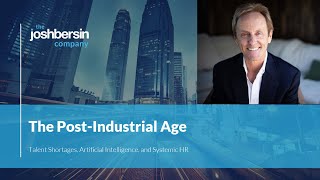
In this 45‑minute keynote, Josh Bersin frames the current era as the "post‑industrial age," a period defined by rapid business transformation, converging industries, and a looming, long‑term talent shortage caused by low fertility rates and accelerated job‑hopping. He argues that traditional, industrial‑age HR models—job‑centric, siloed, and execution‑focused—are obsolete. Instead, organizations must adopt "organizational ingenuity," a systemic, person‑centric approach that aligns talent, skills, and work design to maximize productivity in a world with fewer workers. Bersin introduces the concept of "pace‑setters"—companies that outperform peers by simplifying organization design, building transformation skills, and integrating mobility and systemic HR practices. He outlines how AI, now powerful enough to exceed human brain compute, can amplify productivity by providing super‑charged talent intelligence, generative assistance, and a new HR copilot that leverages the firm’s 50‑60k pages of research. He also highlights the Josh Bersin Academy (JBA) as a capability‑building platform and calls for HR leaders to become full‑stack, solution‑oriented practitioners. Throughout, he weaves historical context—from agrarian to industrial to intelligence ages—data on workforce churn, salary transparency scandals, and industry‑specific case studies (banking, consumer packaged goods, healthcare) to illustrate the urgency of redesigning HR for the post‑industrial economy.
Chapters
Our next speaker needs no introduction, but I'm going to try to do him justice. For more than 20 years, Josh Burson has been at the forefront of the talent market as a researcher, an analyst, and a thought leader. He is a keen observer of talent and business trends,, and his insights drive the responses of some of the leading— world's leading businesses to those trends. For those of us at the Josh Berson Company, he's our founder. He's the author of the 2022 book Irresistible, and he is the driving force behind this conference. It is my distinct honor to welcome to the stage Josh Berson. Thank you. Thank you. Thank you. You know, listening to Bill, I was actually going to be an English major my first 2 years in college. And I'm actually glad I did that because we're going to have to read all this AI stuff and see if it's real or not, right? So critical thinking. So what I'm going to do, hang in there. It's going to take me about 45 minutes, but it's going to be worth it. I'm going to give you a story about the economy, about the job market, about HR, and why we need AI, and what's going on with AI, and the implications of AI. And then at the end, I'm going to show you and tell you a little bit about what we're doing in AI. So, so bear with me. And the concept here is something that I call the post-industrial age. Which I'll explain in a minute. But the real thesis that I'm gonna leave you with, and this is all about the irresistible organization, is something I call organizational ingenuity. And you'll understand what I mean by that when I get going here. So first of all, thank you all for coming. I wanna particularly welcome one particular person here, Roman, who has come all the way from Ukraine to join us from Kiev. Roman was on CNN arming civilian vehicles and doing all sorts of cool stuff. He's going to talk about culture. So if you think you have culture issues, go to his session on Thursday and you can learn a lot about culture. So we're really happy to have him. All the rest of you, I know you all have very busy lives. I know we're getting into the summer. I know it's the summer solstice. By the way, I'm glad it's the summer solstice because we get more hours to think about HR tomorrow than any other day of the year, which I hope you enjoy. So thank you for coming. So the economy— why'd the lights go up all of a sudden, you guys? I'm not going to try to predict the economy, but I'll tell you something that, that certainly I've learned from being involved in the pandemic and talking to most of you. What we basically have experienced since the end of the 2008 financial crisis is kind of a steadily growing economy. And believe it or not, this little tiny blip here is the pandemic. It wasn't that long. It went by pretty fast. And the reason for that, I believe, knocking to most of you, is that your companies and you have learned how to transform faster and faster and faster. And so we're living in a world where businesses are transforming faster and faster and faster. And that sounds good, but actually it's kind of scary. Because what's been happening is what we used to think of as traditional industries— I went to work in the oil industry when I got out of college, then I worked in the tech industry— are all blending together. And as you can see from this chart and many, many examples, virtually every company we talk to is trying to do something to get into some area of business that they're not very familiar with. And they're not doing this because they want to do it. They're doing this because they have to do it. The most recent study we just published last week is in this consumer packaged goods industry. I know a lot of you work in that industry. And that's an industry that used to sell and distribute their products through retailers, through distributors, through intermediaries. Well, the intermediaries are building white box products of their own so So now they have to go direct to consumers. So all of a sudden they're not consumers anymore, they're customers. And they have to build customer-centric systems and customer-centric data. And they've never really had to do that before. And you can see industry by industry, company after company has gone through this. This was the work we did and we continue to do called the Global Workforce Intelligence Project, by the way, which you're gonna learn a lot about during the conference. And what we basically discovered through this work and some work that PWC just announced announced about a month ago is that virtually every company is more worried about transformation than they are about execution. And that sounds weird, but in the PwC CEO Survey, and this was about 2,000 CEOs, roughly 60% of the CEOs said, "I'm spending too much time on execution. I need to spend more time on transformation." But they don't really know how to do that, as I'll show you in a minute. And so that's really what's been going on is businesses are changing and evolving faster and faster and faster. And then there's all sorts of demographic issues around that. Now the workforce, as you all know, is stressed out. I mean, I won't go through all the data on wellbeing and turnover. And you know, during the pandemic, roughly a third of the workforce in the United States changed jobs each year. And 45% of them changed industries to give you a sense of how these industries are converging.. But the research that just came out the last couple of weeks from Gallup showed something a little bit even more interesting is now that employees are getting a little more coming back to work and they're starting to, you know, kind of have a little more face-to-face time with their workers, they feel a little bit more engaged, but they're even more stressed out. So we haven't lost that sense of stress brought on from the pandemic because CEOs have gone back to their employees and said, Hey, you guys need to be more productive. And that means work harder. Which, by the way, as most of you know, is kind of crazy. Productivity is not driven by each individual in the company. Most individuals in your company are already working as hard as they can. It's by organizational design. It's by the organization being more focused. It's teaching people how to work together. It's, it's this whole idea of organizational ingenuity. And that's That's really what I've been learning about the last couple of months. And, and you're facing all the same issues. You know, the funny thing about this chart, I think virtually every company we talk to has all of these issues in the same place going on at the same time. Is it technical skills? Is it frontline skills? Is it first-line leadership? Is it senior leadership? Is it organizational design? Is it well-being? It's all of these things at once. Now, of course, it's great for you guys because HR is now, you know, right in the middle of all the most important business issues we face. But there's a lot of things going on at once. By the way, that's one of the reasons that AI is kind of a good thing coming, which I'll explain in a minute. Okay. Now, in the middle of all of this, which you're all very aware of, I'm sure I'm not telling you anything you don't already know, the unemployment rate has plummeted. Now, it was down at 3.5%, it went up to 3.7%, but it's still basically a 50-year low. And, you know, economists keep talking about the fact that, well, you know, if we can just crank up the interest rates and slow down the economy and create more unemployment, maybe the inflation will go down. As if we can create more unemployment, you know, sort of forcefully to reduce the pressure on wages. I don't think that's going to work and the reason that's not going to work is because of this and most of you are aware of this, but this is all over the press now. In every developed economy, every single one, the US, the UK, Germany, Northern Europe, Japan, China, not India yet, but they'll probably come next, the number of children born and the people and the fertility rate is way, way, way below replacement and it's been that way for a while. And you know what happens when that takes place is 15, 20 years from now when those people go through, when those kids go through school and start entering the workforce, there's not enough of them. And so today, in the last couple of weeks, The Economist has published studies and others that even China, the big economy that we're the most worried about, is going to run out of workers. Because essentially the only way an economy grows is by more workers doing more work or by getting more productivity out of each worker. And that's what's gonna go on is we're gonna be living in a world of talent shortages for a long time to come. And this is a new thing. This is something most of us are not used to. So let me talk about what that means. If you think back, you know, in my, you know, I have to say as an analyst over the years, one of the things I've learned to do is every time something weird happens to you guys or the economy, I try to go back in time and figure out how did this, what led to this. And so let me tell you, give you a sense of kind of how we got to where we are. So in the, you know, in the 1800s, we lived in kind of an agrarian economy. And, you know, there were lots of workers, but it was families and children worked and, you know, the grandparents worked and we all worked. And so there was a certain amount of productivity in the economy, but it was really pretty flat. We really didn't have a lot of things growing.. And then around the early 1900s, late 1800s, we started to have industrial automation in industries. And people started to come together into larger and larger businesses to produce and sell things. And the whole business model behind the industrial age, which most of us— by the way, I grew up in the industrial age and sort of most of the companies I worked for in the early part of my career were modeled this way— was was scalable efficiency. If we do things faster and faster and faster and get more and more and more people to do the same thing over and over and over again, our cost, our marginal cost will go down and we'll sell more and more stuff and we'll make more and more money. This was the automobile industry, this is the oil industry, this is the railroads, this is most of the manu— GE, most of the manufacturers at that point in time. And at that point in time, people didn't move around from company to company very much. If any of you are my age, I know a lot of you are, you remember that when you had to find a job before the internet, you had to type a letter carefully in a typewriter and white out the stuff that was wrong and fix it, stick it in the mail and wait a month to see if somebody read it and you never heard back. So it wasn't easy to change jobs. So most people stayed in the same company and the companies took care of people for for years and years and years, and that's the reason we had all of these retirement plans. I'm still getting retirement from IBM, and I quit IBM 25 years ago. So that was great. And people didn't live that long. They lived into their 60s, maybe into their 70s. And we had, in a sense, a surplus of talent. And the way we designed our job architectures, and most of you know this because you're dealing with this, is we had lots and lots of job descriptions. And the idea was the job is essentially a placeholder for a person and we'll swap people in and out of this job. And if this person doesn't work out, we'll just replace him or her with somebody else. And that was the work, the job of labor. And then we had managers who managed the labor and the managers told the labor what to do, right? It sounds kind of old-fashioned, but believe it or not, many, many, many of the things in HR we live with were built around this model. And along comes sort of the 1960s, 1970s. We start to get computers. We start to get TCP/IP. We get the internet. All of a sudden, information is flowing all over the place. And people say, you know, I don't like working at this big company anymore. Maybe I want to work at another company. And we go to monster.com or we go to CareerBuilder or we go to LinkedIn. Oh, there's a job. I'm just going to apply for it. They get a call back. They go take another job.. And all of a sudden, job hopping wasn't a bad thing, it was a good thing. I remember when I worked at IBM and Exxon in early in my career, you never job hopped. We had a guy at IBM, really good sales guy, he went to work for Crocker Bank. And I swear to God, we thought he had just jumped off a cliff. We thought, why would you ever leave this company to go work for that company? I don't know what happened to him, he probably did real well for himself. But all of a sudden, as you know, job hopping became a positive thing. And people moved around. And you know what happened when they moved around? They took their IP with them. So if you had worked at GE and you learned the GE manufacturing system or the GE way of doing whatever, and you went to work for another company, all of a sudden all of GE's secrets went with you. And these barriers that we had between these industrial companies, these walls or moats they are called, disappeared. And everybody started competing with each other. And so if you remember, the early days of the internet it wasn't clear what was gonna happen, but the rate of competition and the rate of disruption went up and up and up. And a lot of the work we did at Deloitte and a lot of you have done in your companies has been transforming to deal with this digital economy where people are coming and going and they're bringing new ideas all the time and all your good ideas are leaving and you have to get new ideas in. And that's really where we were left. And in this world, People lived longer, so we had, you know, we have a more extended workforce. And we needed a war for skills. And that's where the skills war started. It really started with the war for tech skills. And then we realized that there was actually a war for all sorts of other skills, including soft skills as well. Well, this world is a world of talent scarcity, not a world of abundance. And so those old job architectures, those old, you know, kind of fixed boxes that we put people in, didn't really work. And as most of you know, I mean, a lot of you are doing this, you're simplifying your job architecture, you're making it easier for people to move around inside of the company. And that leads us to where we are today. Where we are today, which I will call the intelligence age for want of a better name, is the world we are now in, in 2023. Shortage of workers, tremendous amount of transparency. You've seen the work on salary transparency. I mean, I don't know if you read the New York Times the other day, I think it was today. A woman who worked for, I think AT&T or someone, was a graphic designer. She was making $75,000 a year. She goes online, she finds out they just posted a job for the same job title as her for $135,000 to $275,000 a year. She gets pissed off, she goes to her boss, she says, I want a raise. Her boss says, no, I don't know what that job is, but you're not getting a raise. She puts it on Twitter. She gets a million followers on Twitter destroying this company's reputation for salary transparency. So that's another one that's new. So we've got all of these changes taking place in this world where more and more information is available faster and faster and faster. And you're gonna have fewer and fewer and fewer people to hire. Okay, so what are we gonna do about it? Enter AI. And I'm not kidding. It sounds odd, but it seems to me that AI came along at just the right time for us. So let me give you a little history on that. So I looked around and I found this really interesting data on true economic productivity. So I mentioned in the beginning that the problem with the low birth rate is that we don't have enough people to work, and so the GDP slows down and shrinks. And that's been going on in Japan now for many, many years. Go to Japan. There's lots of hardworking people, but there aren't enough of them to make the economy grow. So how do we get people to do more, to produce more work per hour, per week, per month of work? Well, if you go back in time, and this chart goes way, way, way to the left, before the industrial age GDP per capita was almost completely flat for hundreds of years. It didn't go up at all. The industrial age, if you think about, look at that part from sort of the 1800s to, you know, before the beginning of the IBM mainframe, it jumped up about, it took 100 years for the GDP per capita to double, 100 years. IBM 701, I worked at IBM in the 1980s, so I remember when these old, you know, mainframes were just coming out. That was actually a transformational change in business. And from the beginning of the computing age to sort of around the age of the iPhone, it took 60 years to double the productivity of GDP per person. And now look at how fast it's going up. It could go up twice again in 10 to 15 years. So AI in a sense is our solution, whether we wanted it or not, to dealing with this labor shortage and redesigning how our companies operate so we can continue to grow, so we can continue to be productive, in a world where there just may not be as many people to hire. And interestingly enough, a lot of the tech companies have learned this. Meta laid off almost 25% of their workers. Salesforce laid off almost 15% of their workers. And they realized we don't need more people. We need productivity out of the people we have. And that is all what this organizational ingenuity is all about, is designing our HR practices around this. So what we're gonna end up in, in the world that I see, and I'm not just future casting here, I'm talking about what I see going on today, is you're going to have an organization where every individual is going to be superpowered by tools, by information, by AI. At the end of the speech, I'm gonna invite you to see the copilot, the AI copilot that we have built for HR. It's gonna be in the demo in the back. And you will see that what we did by pulling together all the years of information we've developed in HR and putting it into an AI system, we can take all of the employees in our company and make them just as bright and intelligent, as informed as every single research analyst. And so we could double or triple our productivity due to AI. And that's the world we're gonna live in. Now, if you remember the story of Superman, I was kind of a kid around the time Superman was, becoming popular. He was really strong and he had all these muscles and he could fly and he could see through things, but he broke a lot of stuff too. Remember that? He kept breaking things when he was young and he was kind of throwing things around and he needed to learn how to control this, this superhuman energy that he had, this power, this strength. That's the same thing here. We're not going to let this stuff get out of control. We need to learn how to use it. We need to learn how to, how to take advantage of it for good and that's That's the debate that's going on in the public domain right now. And that gets to this idea of organizational ingenuity. Now, let me tell you why I came up with this idea. So, one model of AI would be I've got 50,000 people in the company. They're all gonna get AI tools. So, we're gonna get 50,000 times 1.1. We're gonna have, everybody's gonna be more productive and our company's gonna run better. Well, that sounds good, but that's not really what happens, as you know. As more and more productivity grows in the company, the bureaucracy, the discussions, the conversations, the alignment, the performance management gets in the way. So the real key to this new world, this information age, if you buy into this story I'm telling you, is figuring out how to design the whole organization to facilitate and take advantage of these superhuman workers that we will have.. And I don't think that's as hard as you think, but this is all what we do in HR. Now, the reason I came up with this is because I went back and I looked at all of the innovations in HR that you guys have been talking about for the last couple years. And I just wrote down every one I could think of. And you guys, I would imagine that you're trying to do every single one of these things, right? I mean, every one of these things looks like something good. None of them have anything to do with the industrial HR model of the 1920s, right? I mean, these are sort of new things. And that's really what is going on, is the reason that you're being asked or you're coming up with these programs for mobility, for skills-based hiring, we talked about that all morning, for skills taxonomies, for new models of leadership, for online coaching, is because of this new organizational need we have to empower and train and develop and align every single one of our superhuman workers. And that was really the concept of the Irresistible Organization when I wrote that book, is that if every employee can do the best work they can possibly do, you're gonna have a great company for a long, long time to come. And that's, that's really what's been going on. Now, what does it mean for HR? It means that all of those things that I showed you earlier have to connect together. A lot of you have seen this chart. I've talked about it a lot. We're working on it now with the systemic HR model. If you look at the way HR was originally designed, I don't know who, you know, Dave Ulrich gets a lot of credit for this, but I'm sure it came long before him. I think HR was designed as a 1980s IT shop. We've got the guy that does the password resets. We've got the guy that does the backups. We've got the guy that does the uninterruptible power supply. We've got the guy who runs the mainframes. We've got this guy that worries about security. And they're all doing their little thing. They don't talk to each other. And if you call into IT, they say, "Oh, well, that's Joe. You go talk to him." We've got the COE for recruiting. We've got the COE for rewards. We've got the employee experience person who's doing engagement surveys. We've got a diversity head who's over there doing diversity stuff. You know, on and on. And we did that. Because HR was a cost center and we wanted to reduce the cost, right? I mean, nobody— and certainly when I was, you know, entering the workforce in the '70s, I mean, I don't think people thought about HR being a strategic part of the growth part of the company. It was really the operations, the administration, the risk management, and so forth. Well, now we're in a world where we're dealing with these enterprise-wide organizational issues and all these things touch each other. And I don't need to point out what all these things mean. But just this morning, we were in the meeting with a bunch of heads of talent acquisition, and we were talking about the fact that talent acquisition isn't about recruiting anymore. It's about recruiting. It's about identifying the critical skills. It's about looking for people internally. It's about retaining the people we have. It's about talking to the hiring manager and making sure that he or she really does need to hire more people. Maybe they need to reorganize their team, and maybe they don't need to hire so many people. In fact, I was on the phone with the CHRO of LinkedIn last week and they have just merged the talent acquisition and the talent development departments into one group. And we were talking about this systemic HR thing and I talked to her about what we had been seeing. And she said— I said, "What do you expect to get out of this?" And she said, "I don't really know yet, but I want these people to talk to each other so they stop working and doing things in opposite directions. They come together." That's really the big theme you're going to talk about in all the sessions we're having on systemic HR. Now, underneath this is a big, big idea. The old idea, the industrial idea, was that everything in the company revolves around the job. We define the job, we stick it into Workday, we lock it down with a lock and key, we throw away the key, and then we go look for people to fit in that job. And when they don't fit, we get rid of them, we get somebody else into that job.. And that was based on a world of abundant talent, you know, somewhat, you know, fixed jobs, industrial business models, and so forth. And that was really where a lot of HR practices were designed. I mean, we were talking this morning about 9-box grids. I mean, everybody kind of hates 9-box grids, but we don't really know what else to do until we have all these mobility systems working. In the new world, All of this, you know, HR design has to be revolved around the person, developing the person, aligning the person. And the productivity of that person isn't the number of widgets per month, per hour, per, you know, per day that they produce. It's really their ability to operate at the top of their license, their ability to do the best possible work for them, of course, as an individual, and for the company in the role that they've been given. And that may be a limitless growth. I mean, I know in my case as an analyst, I'm more productive every year. And I've been doing this for like 23 years. And every year I come up with something that I didn't think about before that makes me better at my job. And so this is, this is really what systemic HR is all about. And that's a big theme that I want you guys to talk about when you're in these sessions this week. Now, we're gonna talk about the book a little bit later in the week. And, you know, it's funny, I did write this book over a long period of time and I wrote it, you know, thinking about these issues with organizations. This is still the fundamental underlying issue with organizational ingenuity is taking care of people and designing the organization so that everybody can thrive including using the information and the data that they can get from AI. Okay. So how do you do this? Let me give you a couple minutes on what we've learned. So through the work we've done with Eightfold and now with Lightcast and the Global Workforce Intelligence Project, and I wanna give Janet and the research team just enormous recognition for this. They have really done this in an amazing way. We have been studying industry by industry the jobs that are changing, the skills that are changing, the career models that are changing in great detail. And we've gone through industry by industry. We've done 3 industries so far. We've done healthcare, consumer banking, we just finished consumer packaged goods. We're gonna do pharmaceuticals next. And what we basically found is that in all of these companies within that industry, when you look at the things that are changing and the jobs and the skills and so forth that are trending, there are certain companies that are performing at a much higher rate. Not just a little bit higher, a lot higher. And these are companies that are not just outperforming, they're accelerating their outperformance. So they're growing faster and then the next year they're growing even faster than their competitors. So they're distancing themselves. So we looked at all this data, we kept trying to think of a name for them. We boun— you know, bounded around a whole bunch of names. And we eventually decided we were going to call them the Pacesetters. So let me tell you what we learned about the Pacesetters. These are the things that the pacesetters do, and I'm gonna take you through this in just a minute. Number 1, they do look at organization design around simplicity and around productivity. If you talk to healthcare companies, I know we have a lot of healthcare professionals and HR leaders here in the conference, they look at the job, their critical role is the clinical professional, the nurse. They look at the nursing role and they're constantly looking for ways to take away bureaucratic administrative overhead work from the nurse so that the nurse can operate at the top of his or her license and we can get more and more output out of the nurses that we have because it is impossible to hire more nurses. There simply are not enough. That's true in virtually every organization when you have constrained talent. The second is skills. They have certain skills, which I'll show you in a minute, that are different. They have transformation skills. By the way, it's kind of interesting when you look at the skills that are peaking in the pace setters, there are skills like change management, training, organization design. Sounds kind of like HR stuff, doesn't it? Those jobs which a lot of us, you know, probably were told by our peers those are kind of soft little poo-poo kinds of jobs, those are actually the critical jobs that enable these companies to transform faster. I have a friend who works in the insurance industry and he's a, you know, really high-powered sales guy. And he's out there doing deals and he's getting all these contracts signed. And he comes back and he sends the contracts into corporate and it takes them months and months and months to administer these deals. And he's just pulling his hair out. And he said to me, he said to his boss, he said, why don't we get somebody to redesign this? And his boss said, we don't have anybody working on it. We don't have anybody who knows how to do it. So, so that's the second, you know, lesson is that you won't transform yourself unless you have skills in transformation. And by the way, you know, a lot of consulting firms think they're going to do the transformation for you. And I have Andy and, you know, PwC sitting in the front row, but they do that, but they can't maintain it because you have to own the transformation. With you. So these skills are important. The third is mobility and systemic HR. When you look at these companies, they are very good at stitching together pieces and doing what we call falling in love with the problem, not falling in love with the solution. I was at— I'll tell you this little story. I was at a conference. In fact, one of the heads of HR from that company is here. I won't mention his name. And I was doing a session on the academy.. And we had opened it up for Q&A. And I started getting questions. And the first question was, what are the 3 most important practices in onboarding? And I'm thinking, I don't know how to answer that. Depends on the problem you're trying to solve. The next question was, what are the 3 most important practices in diversity? And I kept getting this question. And I basically stopped answering. And I said, you guys, you're asking the wrong question. What is the problem you're trying to solve? Maybe onboarding isn't even the solution. If you don't know what the problem is, onboarding might be the solution. You know, the case study we did on Bank of America, the bank of the consumer branch business of Bank of America, they had high turnover, they had all inconsistencies in bank balances and customer service. They thought it was an onboarding program, but when they dug in, they realized it was much, much more complicated than that. It had to do with where they were sourcing people, how they were aligning people inside the branches, how they were bringing people together into cohorts. How they were supporting people through their entire first year or two journey. And the onboarding was a tiny slice of it. So this is part of this idea of systemic HR, is taking every problem that you hear about or you know about or somebody kind of complains about and digging in and figuring out what it is and then bringing the entire HR-level team of expertise you have to solve it. So let me give you just a couple statistics on these pace setters. So, let's take a look at banking. Now, you know, most consumer banks are competing against fintechs. So, you've got companies like PayPal or Visa. I know Visa is here. Or even Apple taking bank balances away from banks that have, you know, store— you know, they basically have branches and they have employees in the branches and all that customer service and stuff. And they're taking their money away and they're taking their fees away and they're just taking it and moving it. So, how do we compare the brand, the consumer banks to the fintechs? Well, if you look at consumer banks, consumer banks have 45% of their workforce in customer-facing jobs. Fintechs have only 20%. Consumer banks have 30% of their workers in what are called middle office jobs. The middle office jobs are the guys behind the scenes doing spreadsheets to figure out how much interest to pay you and do all the risk management. The fintechs only have 15%. But in IT, the consumer banks have 15% of their employees in IT. The fintechs have 55% of their employees in IT. So, if you're a consumer bank and you're competing against one of these fintechs, they're almost like Martians. I mean, they're not even like you. They're completely different. So, when we went through this, we realized, you know, everybody's got to be aware of this to decide what to do. So, if you break it down now by banking alone, forget the fintechs for a minute, look at the pace setter banks versus the traditional banks. The pace setter banks have 130% more people in IT. At a large bank, that's 3,600 more people. 3,600 more IT people. These are the same kinds of banks. Than the non-paysetter banks. 160% fewer people in the mid-office. So, that's number one. Different people doing different things to be enabled for transformation, to take advantage of digital technology, to learn about technology, to implement it. I mean, even the bank that I do business with, First Republic, which is now part of JPMorgan Chase, had a horrible IT department. I mean, I, I was amazed for all of their customer service how bad the systems were. I almost moved all my stuff to Schwab just so I could find everything, and then they got bought by JPMorgan Chase. So anyway, the second issue on these skills are what skills. So when you look at these pace-setter companies, these transformation skills are much higher. Look at these numbers here. Business systems analyst, 2.9%. 2.5 times as many. IT project manager, product owner, product manager, IT consultant. There's almost twice as many per, you know, by organization size in these organizations. And so again, these pace setter organizations have designed their talent strategies differently. They have higher technology skills. So if you look at the skill set of a traditional bank,, but the skill set of a pace-setter bank, they're not the same. They have different technologies. They have more advanced technologies in these other companies. Now, we just published a very interesting research report right last week that we did with support from Lightcast, and we looked at the talent inflow into banks and the talent inflow out of banks, the tech talent, you know, the IT talent. And what we found is that over the last 5 years, approximately 74,000 people in the United States moved from the technology industry, the tech industry, into the banking industry to do this great technology stuff that has to go on in financial services. During the same period of time, 72,000 people moved out of the banking industry to go back into the technology industry. So, they had virtually no net increase in technology professionals. What does that teach you? Tech people don't want to work in banks. There isn't great stuff to do there. They don't have great technology. They're not working on great projects. And so these trailblazer banks, or what we now call pace setter banks, we renamed them, are able to attract and retain and engage and excite highly skilled people. By the way, that doesn't mean just finding them and recruiting them. That means giving them great work That means bringing them into teams where there's other high-tech people working on exciting projects so they feel that by working for your company, they're going to enhance their career, not just your opportunities. And so big lesson there. This issue of mobility. We have all— we're going to talk a lot about mobility. A lot of you are going to be talking about that. We have a lot of vendors here that work on mobility. So if you look at the high-performing pace-setter banks in mobility, they don't just kind of put together a program for career management, they design jobs that allow people to move from place to place. And this has happened in the healthcare industry too. There was actually a great case study a little bit earlier today on this where in the case of ING, they went out and they looked at all of the product managers. By the way, ING has a lot of product managers. Most banks don't even have product managers. They have program managers, completely different job. They looked at the product manager skills that they have, the product manager skills that are trending up, the product manager skills of their competitors, and then they put together a capability academy for product management. That's another example of what pace setter companies do. And then this idea of systemic HR. Now a lot of you have seen this 4R model. We developed this model through the GWI research. We didn't just dream this up one day when we were thinking about it. We interviewed all the healthcare providers in that, in that study, and we found out that they don't just recruit. They recruit, they retain, they reskill, they redesign. They do all these things together to deal with the critical shortage in healthcare. And by the way, I really think if you talk to some of the healthcare leaders that are in the, in the audience today, they are doing some of the most innovative, creative things in in HR because they have to. They don't have any choice. They've been living in a scarce talent environment a long, a lot longer than many of the rest of you. And so they've learned that they have to adapt this way. So that's a little bit about what we've learned there. By the way, we just did a study, we're in the middle of a study we're doing with Gloat to look at the readiness of companies to adapt and adopt these new practices, these pace setter organizational practices, and it's really low. I mean, look at this number. I mean, these numbers are just like 2 or 3 times lower than I would have expected. The ability to build a broad capability academy, to build career paths, to create a skills taxonomy, to reward people for project work. I mean, there's a lot more stuff that's gonna come out on this. But so we all have to learn how to kind of operate in this post-industrial world because it's new. To all of you and it's new to our organizations. Okay. So, everybody still with me? You guys still here? I know it's late. All right. I told you it was going to be a little bit of a drag here, but I'm going to try to cover a lot. All right. So, what about AI? So, let me spend 10 minutes on AI and then I'll wrap up. So, we, you know, I would say I have probably learned more about AI in the last 3 months than I've ever learned about anything else in my life. Maybe I'm just a quick learner, and I think most of you are going to have to go down this learning curve yourselves. But there's a couple things I want to point out to you about why this is happening. First of all, the power of computers has gone up so fast. If you can read this, a computer has surpassed the computing power of a human brain in 2023. By 2045, Computers will have more computing horsepower than all of the humans in the world. Okay, so we've got all this horsepower and all this data. Data management, which is the core issue behind AI, has also evolved. I used to work for a database company. You know, the old world of sort of relational databases on the left gave birth to multidimensional databases, which are precomputed databases where you can find information faster.. And then in the early days of Google and Facebook, they came up with these parallel databases where you could distribute a database across hundreds and hundreds of computers and get data out very, very fast. You know, when you run a query on Google, you get results back. It's not coming back from one computer, it's coming back from a whole bunch of computers. They have what are called shards, little slices of data that are coming back from all these different systems. And then there was this, you know, cloud, you know, craze to build bigger and bigger data sets and better and better systems. For that. And then we have these AI-based cloud systems. And the reason these systems are possible is because of the compute power, because of the data. If you go back and read and you look at what Geoffrey Hinton, who is really credited as founding the neural network— and by the way, we're going to be introducing a really great research study that you're all going to get a copy of that explains this to you. Actually, we're going to introduce it at the conference. The neural network idea was around for a long time, but it never really worked that well because there wasn't enough horsepower to build the granularity and the number of weights that were needed to really make it fly. But when the computers got faster and faster and faster, all of a sudden the neural networking technology started to work better and better and better, and that's what led us to where we were. Now, the big, you know, sort of architectural difference between AI and regular computers is in a regular computer, the one that we use all the time in our computer laptop or whatever, somebody writes a software program, you use the program, the data from your use of the program is stored, and then you run reports and do analysis on that data. That's what payroll systems do, that's what your financial system does, that's what your ATS does. I mean, it's almost a learning management system. Most of the systems we bought were designed like that. The AI is the opposite of that. What the AI systems do is they look, they start with the data, forget about the transactions or even how it got in there. They don't even know that. And they run and they do models to try to figure out what we can learn from that data based on an outcome or a classification problem we're trying to solves. It's a completely different idea. So these new AI systems, these AI-based systems are able to do things and find things in data that we never could possibly do before. And they use data structures and different data, you know, different data architectures to do that. So it's radically different. In fact, a lot of the, you know, AI pundits basically say this is a whole new computing platform because that's what it is. It's not a new set of features on the old system, it's a completely different system. Now, when I, you know, first started writing about this, and a lot of you guys have seen this chart, I saw these AI systems, you know, in this green layer here as this talent intelligence system that sort of sat in the middle between the employee systems and the backend. Well, they're getting thicker and thicker and thicker. And so if you look at, you know, Eightfold is here and SeekOut is here and Phenom and Beemery and some some of these other companies, they can do things that Workday just cannot do. It is not designed to do the kinds of things that these AI systems do. So this is a very, very fundamental difference. So what we did is I looked at this, and by the way, you're gonna get this paper. And I interviewed, over the last couple months, I interviewed 30 or 35 HR tech vendors, architects, tech founders, and I said, look, you know, what is all this AI stuff? How are people going to make sense of it? And I basically sort of came to the conclusion there were sort of three things. A lot of the technologies we're going to have— we have today— are going to have AI added on to it. So if you take an applicant tracking system that you probably have and you add to it a generative AI tool, you can better write job descriptions, you can better send emails, you know, maybe you can better craft communications in CRM using added-on tools. That's sort of the first category of AI. And you're gonna see that everywhere. So all the vendors in the tech industry are gonna have AI-powered or AI-enabled or something like that. The second category in the middle is the big ERPs. So if you look at Workday, if you look at SAP, if you look at Oracle, they are adding AI capabilities to their transactional systems. And they're doing it as fast as they can. They're not replacing them. They're not building neural nets in their core systems. But they're building stronger and stronger recommendations. And they're getting better and better at it. But they're still fundamentally transactional systems. And then the third ones are, to me, the big disruptive vendors. And these are the software vendors that are basically built on AI from the ground up. And my prediction, and and we'll see how this pans out, is that these guys on the right are gonna really make hay with these guys on the left because they're able to do things that you simply could not do before. And there's a lot of applications of this. It's not just creating a picture or answering a question of something that you asked of a database. All of these different aspects of HR that we do, whether it's a talent marketplace a career path, a capability academy, simplifying the job architecture. These AI systems are good for almost all of this. And, you know, I think what we're gonna be doing over the next year, and you guys are gonna be doing this with us, is we're gonna be helping and watching these vendors learn how to apply AI to more and more of these post-industrial age issues that we have to deal with in this new organization structure that we're trying to build. So anyway, you're gonna get this. I don't remember exactly how we're gonna distribute it, but we're gonna give you all a copy of this before you leave and you get an electronic copy and we'll send it to you in more detail when you get back. All right, final thing I wanna talk about is systemic HR. So as Kathy and Janet and many of us have experienced through the interviews and the conversations we've had with you, when you started throwing all these things that you wanted to do, like skills-based hiring or talent marketplace or capability academy or taxonomy or transparency or pay equity. And we started hearing you guys talk about this stuff. We realized there are two themes here. Number one, these are not things you can copy from someone else, because they're all basically crafts that you have to learn how to do. And the second is they're all interconnected across all the parts of HR. And so the big theme of systemic HR is, and the reason that I chose the word systemic, and it's a little bit of a strange word, but we're sticking with it, is that to me, this is like the human body. If you step on a nail and you get an infection or something's wrong with one of your parts, something goes wrong. You don't have just one thing that happens in your body. A whole bunch of things happen, right? All of your organs come together, the antibodies are created. Your body is an integrated system with all of these interesting, complicated chemical things going on together. That's the idea of what we have to do in HR, is we have to figure out how to move away from this service delivery, low cost, do what the customer says and get back to them as fast as possible with the thing that we just developed because we know that's the right solution and really become a much more solution-oriented, product-oriented, highly skilled organization. And by the way, in order to do this, this thing on the right, you have to have great HR skills. You have to have what we call full-stack HR skills. And when I left Deloitte in 2018 and I kind of went out and wasn't sure what I was going to do. The reason I wanted to build the Academy was because I just sensed this was going on. Is that the reason that HR is not able to be more consultative is because we've trained and aligned and isolated our staff into these independent groups and they just don't know enough about these other domains to work together. So this is really one of the keys to this whole evolution that we're going through.. And we're certainly very much a part of this. Now let me just wrap up with one or two more quick things for us. I, I never stand up here and try to pitch our company, but I want to give you two things I just want to tell you about. The first is the JBA. We started the JBA in 2019. Um, you can see the history here. We built the capability model around it. We launched the community. We now have 25 cohort-based courses in there. During the pandemic, we dropped the price. By the way, I don't know if you know that we dropped the price of the Academy by almost 30%. This week we're raising it back up. I'm sorry to tell you, we're not going to raise it very much. We're taking it back up to where it probably should have been. We've added Andy Bilodeau, who is now running it. Andy's here. We have a full-time person running it. Nihal moved out of research and went into the JBA to put more resources together. We have events, we have new faculty joining, and later this year we're gonna launch a whole new version of the Academy. So I want you to look out for that. We're gonna be doing demos of it in the back and you can see it. And if you're not using the JBA, you really should. It's not very expensive and the utility and the applications and the empowerment you'll get from your teams are just incredible. And there's lots and lots of companies using it. I know a lot of you might have individuals in your organization that use it. I encourage you to use it. Second thing— oh, by the way, if you don't believe me that it's a good idea, we also have research that proves that as capabilities in HR goes up, so does business growth, so does profitability. So if any of you are having a hard time building a business case for better training your HR people, I'll be happy to share this data with you where we can show you that the companies that are growing the fastest have almost 2 to 3 times as many world-class HR people as a percentage than those that are not. So this is a good investment. This isn't just a nice to have. The second thing I want to talk about is RAI. Now, I was going to do a demo of this, but it turned out the screen wasn't big enough. So you're going to be able to see this in the back. So as many of you know, since around 2001 or so when I started doing research, We have developed 50,000, 60,000 pages of research on every possible thing you could do in HR. We've written 500 case studies. We've talked to thousands of vendors. We've written articles. We've started doing podcasts. We have all these materials in the Academy. And you, those of you that are corporate members, you'll call Amy's group or you'll call one of us and you'll say, do you have any research on XYZ, and we'll say, let me call Janet. Who's the analyst that did that? Oh yeah, you know, Stella did that. Stella, would you get on the phone with the client and tell them what you learned? Great. Not a very scalable business model, but it's been great so far. And we've built website after website after website trying to make it easier for you guys to find this stuff, and I'm tired of building all these websites. We're gonna keep working on it. So So I found this very, very intelligent engineer who actually is in the room with us. Daniel Sosbee happens to be a relative of a very good friend, very good friends of my family. And he's a great software engineer. And I said to Daniel, what if we took all this content and we put it into a large language model? And Daniel goes, I can do that. And he did it. So we built the HR Copilot for you.. And what this does, I'm not able to demo it because we can't show it to you on the screen, but it's in the back, is you can go in and you can ask it any question about anything we've done research for and it will answer the question reasonably well, sometimes exceptionally well, and it will point you directly to the research that has that information in it. It is the super search engine education tool, problem solving tool that I've always wanted to build that we couldn't quite figure out how to do in all the web infrastructure. So, so we're going to show you a little bit about how AI works and hopefully empower you to feel unintimidated by this and bring these kinds of tools to your organization. Okay, so that I finished. Thank you all for giving me the opportunity. So I just want to say one more thing. One more thing. We're going to go over the Coliseum. This is not really a conference. This is really an experience. If you look at all the work that Amy's done and Bill and Victoria and all the people that worked on this, this is like a gigantic wedding. We did this for you so you could have a really, really good time. So yes, you're going to learn a lot. Yes, you're going to meet a lot of people. But a lot of this around is really around you having a new experience to open your mind and learn something something new to change your organization and make it better. So thank you for giving me the opportunity to talk to you about this today. Such a pleasure. Well, Amy, I would say Irresistible 2023 is off to a phenomenal start. What does the audience think? Let's hear one more round of applause for our two keynote speakers this evening to launch us, Bill and Josh.
More from Josh





Goodbye Boring Courses, Hello AI Learning | Josh Bersin on the Future of HR and L&D