Episode 129: Your FMIS Is Being Sunset, Now What?
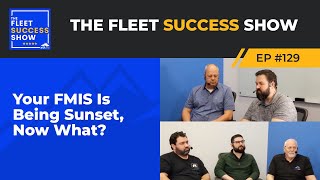
This content was created by Josh Turley. This content was uploaded by Josh Turley. This is a YouTube/podcast episode titled "Episode 129: Your FMIS Is Being Sunset, Now What?" (Fleet Success Show) recorded 2024-02-29. It's an in-person panel discussion led by Josh Turley with co-hosts Steve, Tony, Mark and Griffin about what fleet managers should do when an FMIS vendor sunsets a product — covering urgency, change management, vendor selection, data cleanup/migration, training, and modernizing systems.
Chapters
All right. Welcome back for another episode of the Fleet Success Show. We got a packed house this afternoon. We got all of our Fleet Success Show co-hosts, I feel like, all in one room.
Sweet.
It's a little bit dangerous. Yeah. So, but yeah, we figured, you know, you guys are in town visiting clients and it sounded like an awesome time to get everybody together and talk fleet. I always love doing these in person. It's just a little bit easier. We don't walk over each other as much. It's kind of fun. I think the banter is also a little bit faster. It's kind of, I enjoy that a lot. But today I had a topic, you know, so I noticed one of our competitors recently announced they're sunsetting their product. Earlier this year, I guess it was late last year, we announced that we were splitting some of our product offering and it begged the question is like, you know, for these fleet managers, we talk about what keeps them up at night. We talk about, you know, the ABCs of fleet management. Management and how important it is to have a really solid FMIS. And then boom, all of a sudden your provider tells you that, hey, by the way, we're no longer going to be supporting your products as of a certain date. What do you do? What's your first reaction when your FMIS provider tells you they're no longer going to support your product?
Beep.
Yeah, right?
The alarms go off. Gosh, your alarms go off.
I was going to say that was the sensor kicking in.
Sensor beep, yeah.
Yeah, and I think probably one of the first questions that a lot of people will have is when. Yeah, right. Like, how, how big of an emergency is this? How urgently do I need to move, right? Am I looking to change quickly, right? Um, but what else is going through your mind? And maybe ultimately that we talk about is what, um, what should they be considering? What are some of the steps they should go through, you know, in the first 30 days, 6 months? 12 months. You know, let's say like in one case, uh, one of our competitors, they're, you know, they're sunsetting it summer 2025.
Okay.
Um, and we're, I think we're splitting our two products. So we're not sunsetting our product, but we are decoupling them, uh, by the end of 2024. Right. So that's, it's forcing change, right, for an industry that does not like change.
I, I think that's actually what you hit with my background and education training. The first thing I'm thinking about is gathering all the details What's going on and starting to put a change management plan together. Because that's, it's no different than, I mean, I got this email from Amazon telling me how they're going to build Prime differently. Or, you know, I mean, it's no different than that. You're going to have to cope with change. You know, it's just the way our world moves. It moves quickly, fast. And so you got to get on top of it. You know, you can't panic. You know, you can't regret it. You can't be immutable to it. It's gotta, it's gotta have to happen at some point in time.
Yeah.
You know, I mean, you talked about maybe, you know, searching other competitors.
Yeah.
That's other options that you can do. I mean, that, that's certainly an option. Um, but even then decoupling from one competitor to another, that's a huge change management issue.
Yeah.
Right.
So, yeah.
Well, then that's a, that probably is a great first point, which is figure out how painful is this, you know, like what options do you have? Are they going out of business, right? Or is the product just going away, right? If the product's going away, what's their alternative, right? Is there something you can move to? And how painful is that transition?
It's extremely painful. I've moved from one product to another, right? You know, it's all about retraining people.
It's even within the same company. Yes. Yeah. You know, depending on how bad that migration could be.
I mean, we've seen that even in our own products, you know, with some of the, our peripheral systems changing. It's going to be painful when that happens. Yeah.
So, well, and Josh, I think one of the first questions I would have as a fleet manager is why, why is this happening?
Yeah.
And my second question is, how's this gonna impact me?
Yeah.
You know, what's gonna happen to my data? What's gonna happen to all my history of all these vehicles?
Yeah.
So those are the immediate questions that from a tactical perspective that I would be looking at as a fleet manager. And, and how am I gonna address this? What am I gonna do moving forward?
Yeah, I think, I, I, I think once you kind of get past some of that, cuz I agree those, those are like my intuitive reactions to it and But I do think that once you get past that, starting to think strategically, you know, like with all things in life, you know, every challenge is also an opportunity, you know, and it's, it's a great— I mean, if we're being honest, like most of the fleets we interact with, you know, one of the things I love about our program is we have regular ongoing training. I think it's so important, you know, and talk to a lot of fleet organizations out there. They haven't had training on their FMIS in years and years and years. So, you know, this is just one example of, you know, maybe, maybe you can turn it into an opportunity. I think one of the One of the early things I would do in my change management plan is start to take stock of what features do I use, what features do I not really use, what features are, you know, I just like the bedrock of my existence sort of a thing versus nice-to-haves and nots. Um, and start to almost catalog that a little bit and take an inventory of that. And, and, and it's really a good opportunity to talk to your people too, right? Like, what are you using that maybe I never touch in my role? That is actually so important, you know, you know, those things. And then what's neat is you look up, if you do that diligently, you kind of look up and you almost have created for yourself a needs assessment on what you do need out of software, right? And so, like you said, it's not, it's not just like other things. I mean, if you merge or if there's a reorg and, you know, we've seen that before, right? Now all of a sudden you got to use the other group software or You know, and you see that even within companies, right? They're using two different software. So it's actually probably more common than we realize in the sense, in that sense, right? Where even though in this case we're talking about is getting triggered from a sunset happening.
Yeah.
But as far as in the everyday, that, that, that being forced into a new software is probably happening even more frequently than that, you know? And so, you know, managing that, those are some sort of immediate thoughts.
Another thing you need to do maybe is start taking stock in your personnel that you have. I mean, this could be a multi-generational impact, right? You know, some of the older people, they may not, you know, like the boomers like me, they may not be as up to speed on technology, you know, or things like that. And where you've got people like Griffin, that's, you know, up to the latest technology, that's going to be a different change impact. Yeah. And so you need to understand what your personnel are going to go through when you go through this process, you know. And for me, I like change. So change for me is not a big issue. I change the furniture just so My wife trips on it, you know, that's kind of—
Feng Shui is not in Steve and Kathy's—
So change for me is a non-issue. I just go, okay, well, whatever, we'll get by and make it happen. But there is people that are very resistant to change. And so you have to keep them in mind when you go through this process.
Yeah.
Well, look, if we look at it in a different perspective as well as the reason these products are being sunset or going away eventually is because evolution. I mean, we're evolving. Technology is changing. We're getting better.
Right.
So what a great opportunity for your fleet operation, Mark, like you were talking about. This is a great agent for change. This is a reason to change. This is a reason to push change and implement change with your staff. I mean, we can blame it on our new system. Hey, we're going to look at our processes. We're going to reorient ourselves. We're going to start doing things differently, maybe better, and using the technology to support that.
Yeah. I know one of our largest clients is going through that process and they're saying, you know, we actually never trained our people. And they end up getting trained from somebody who didn't get trained, who didn't get trained from somebody else. It was like 4 generations of not being trained properly. And now it's like, hey, we're going to almost do a clean reset with the new system as we do this migration and use that as an opportunity to improve our practices, make sure that everybody is operating out of the same playbook because we didn't do that the first time we rolled it out.
Right.
But I think I saw that on the NAFA forums too was one of the, uh, the gentlemen down in Florida used as an opportunity to kind of clean up his data, which in and of itself is a massive undertaking. It is.
Yeah.
Uh, but they, because they had to convert from one system to another, maybe we should do this with our customers. We're not doing this to our customers. We're just letting them like say, hey, yes or no. And then we automatically move the data over.
Right.
It's very clean.
But boy, I'd love to clean up the data.
It's so nice. Maybe we're missing an opportunity. It's forcing them to reenter everything again. Yeah. You know, as, as Was the Machiavellian as that might be, right? As medieval as that torture device might be.
Yeah.
Sometimes it's for your own good, a little taste of medicine.
Exactly. Well, I can say with our consulting projects, that's been a big challenge.
Yes.
You know, I mean, that's the constant. Figure out a way to clean and scrub that data before this happens.
Yeah, that's my daily.
I really like the thought that you brought up though about that person's very forward thinking. Yeah. Okay.
Yeah.
We, let's get past our past mistakes and let's do this one right by getting everybody trained correctly.
Yeah.
You know, and we see that a lot throughout all of our clients. You know, people aren't quite trained or somebody turns over, they bring another person in, they get trained by the person that's there that may not know what the system is really like.
For us, that kills me because we offer free training.
Yeah.
Right.
Like there's no excuse other than time.
There really isn't.
I don't know about anybody else, but no, I agree with you. That happens and it perpetuates.
Yes.
And bad practice leads to another bad practice.
Yep.
That's, and that's frankly, that's how the data gets screwed up.
Well, 100%.
Yeah.
Worse is when there's a workaround for something that doesn't need a workaround.
You know, it's like, wait a minute, we already have that.
We open up this dummy work order to charge out parts for us whenever someone needs a part that's not on a vehicle. Oh, there's this thing here called the parts charge out.
How long is that? 35 years.
Exactly.
But, and Griffin, you keep talking about like the data, you know, and as a fleet management analyst, you probably see the data more often than not, and you've probably seen data that's somehow survived from one system to another to another. Like, we've been through 3 system adoptions and yet we can't get this right.
It's a little insane, honestly.
So what would you tell people? Would you tell them to start over? Would you tell them to do the easy cut?
And then it's, it's interesting, you know, I would, you know, start over if you can. That's always the best, honestly, because it forces you to re-review what you have already and then, you know, go with the good and then start over brand new with the stuff that's not so great. And I don't think people realize like how bad their data is. I don't think people are purposely putting in bad data, right? It just kind of happens over time. And, you know, it's easy to lose sight of it because it's not the fire that you're putting out every single day, right?
Yeah. Well, you're not running the reports, you're not being proactive because you're having to be reactive, right?
Right.
Stuff starts slipping.
And yeah, you guys are touching on something though, because it's almost like data hoarding. Would that have been good? You know, it's like, I don't want to delete this 20-year piece of data because I might need it one day, 35 years into the future.
No, someone put it in for some reason, right?
Yeah. You know, so, you know, we talk about it a little bit sometimes, you know, maybe, maybe, you know, get some flat data. This is how much cost I put into the vehicle prior to 1985. Yeah, maybe a little later than that. And just, I agree with you, and be clean, you know, maybe keep some history, but don't be hoarding about it. You don't, you don't, you know, just because the truck is 15 years old doesn't mean you need to know everything to the finest detail, you know, from the day it was born kind of a thing.
Right.
That's the other thing too about changing platforms, changing systems, upgrading systems. New technology cleans data.
Yeah.
You know, it gives you a better opportunity to keep that data more pristine.
Right.
You know, with the automatic spell checks and, you know, duplication checks and all the things that can come.
Formatting.
Yeah. With all the new data, uh, challenges and techniques that are being developed out there.
Right.
So I think that you need to look at it as that opportunity. You know, maybe some of this might fix some of your problems, right?
Yeah.
Yeah.
Going through it.
Yeah.
But in workarounds that you've created, because the systems were too hard to use, because honestly, like you think about our classic platform that was essentially designed in the '70s, written in the '80s, rewritten in the '90s and 2000s, but it was still the same base code, right? And we're finally getting off of that platform and coming out with a whole new technology. Which, you know, Mark, you're kind of heading that process up, but it's become this, well, let's think about the process. And that new technology includes a new way of thinking about how do we skin this cat, right?
Yep.
And we're not necessarily doing things the way that grandpa did them back in the '70s for UPS.
Yep.
Right. When you talk about change, I think that's probably the biggest thing is what's, you know, why are we doing it? A lot of times, you know, it's because that older technology, it's harder to maintain. It's written off of assumptions that aren't true anymore. You know, there's technology assumptions. I know that's one of our biggest things that we look at. There's decisions we made from a just a pure technology standpoint back in the '80s and '90s that we're still living with today, even though the landscape of technology has completely changed and you don't have to do it that way anymore, right? I mean, heck, back when they were writing this software, like relational databases didn't even exist, you know. Or if they did, they were for like super high-end applications.
They took up entire buildings.
And now we've gone past relational and now everything's like, oh, well, it's just however you want to store the data, it just gets stored, right?
Yeah.
Well, I mean, we're on the precipice of quantum computing.
Yeah.
And when that comes out, it's going to be a huge change.
Yeah. Everything will get written again.
I think, you know, you have the opportunity to really get in front of this. I think that's really what you need to do as a fleet person.
Yeah.
Fleet traditionally I would say it's kind of a static industry. At least that's the way it's been treated. But people need to understand that it's fast, fast evolving now. Yeah. It has completely changed overnight. Just during my career in the last 10 years, things have changed a ton, you know? And that's what we call on some of the podcasts we've done before, this perfect storm, you know, that's happening right now. Um, so things are not going to slow down. That's what you have to get in the back of your mind, right?
Technology industry has finally taken aim at the fleet industry kind of sort of thing. And so all of a sudden, we're seeing that evolution. But you guys have made great points, right? It's an opportunity to train folks. It's an opportunity to rethink processes. And another thing is, it's kind of along the lines of the logic we've talked about with EVs, right? Where we say, hey, use this 15 minutes of fame. For years, you haven't had the resources to replace your assets properly. And now all of a sudden, everybody's looking at your fleet and saying, here's money. Go replace the fleet, right? So I think there's a similar opportunity here. Again, when you do that review and you think through, all right, these are the features I like and these are the features you don't like. Well, guess what? I'm sure you would agree with this. Now's the time to tell us. We're always listening and every software company's out there listening. But, you know, if you're one of our competitors' customers and you're going through this right now, boy, speak up, right? Because if they're not listening now, they're never going to listen, you know. So use that, leverage that opportunity to ask for the things you want and the things you'd like to see in the technology. You know, again, I think most technology providers welcome that. They want that. But now's a really good time to kind of leverage your voice in all of that and maybe see the program that you're using evolve into something that fits more your ideal kind of thing.
So when— and that was something I think I made really clear to our customers was, hey, we may not be— this new product may not be your ideal, right? This may not be for you. We may not be for you anymore. Take this as an opportunity to evaluate the partnership as a whole with the company. You know, Steve, you mentioned that changing software providers is a big enough deal. Like, you know, even just going from one platform to another, but now you're going to add in a complexity of it's a whole new relationship if you're going to switch from one company to another.
It's an even bigger step.
It's an even bigger step because of all the relationships and You know, like, is this a company you're comfortable working with? But if you don't buy into their vision, like, take a step back and evaluate. I would tell you one of the biggest things that I think shifted in the last 10 years has been these new upstart other FMIS providers, right? And they're pushing the old stalwarts like us and FASTR and AssetWorks to really revamp and think about things different. Some of us are paying attention and some of us aren't, right? And I won't drop names, but if you're in this transition phase where you're having to pick a new vendor, look at the stuff they're pushing you to. And ask yourself, is this something that was written in 2000 or is it something that was built in the last 5 years? Right? Because one of those things is going to be built for the next 10 to 15 years and one of them is going to have to go through another transition in 5 years. In 5 years' time. Exactly. Right?
Right.
So be thinking about this as an opportunity to move to a more modern, updated platform. You know, and there's companies out there who are marketing themselves as modern fleet management platforms. Compare it. And just see maybe this is an opportunity to really modernize your operations, not just change from one status quo to status quo plus one.
Yeah.
Right. You know, you know, Josh, I, I have a client right now that I'm working with and they've been a classic user for about a decade. Very happy with the system. They know it inside and out. Had no reason to move to our web product. But after we showed it to him, after we let him experience what it looked like and felt like, He is so excited now to move to the new product. He's like, oh my gosh, I can do all of this with this product and I can report on my performance and I can see my dashboards. He's like, sign me up, let's go.
Yeah.
And I think that's some of it is you have to evaluate it. The first reaction, Steve is like, whoa. Yeah. You know, you're moving my cheese.
Right.
I don't care where you're moving it to, if it's a better place or if it's better cheese.
Right.
You moved it. I don't like that. Right. And in a fleet in particular, we—
Well, I think fleet managers have so much on their plate. Yeah. You know, right now. And I think that's the first thing that happens is, oh my gosh, another thing I got to do.
That was actually one of our larger customers said that, like, oh man, like you have no idea. We were already in the middle of a massive growth phase and like this was not on our bingo card for the initiatives we wanted to get done in '24, let alone '25. So, you know, sometimes stuff happens outside of your control. Seize the moment, seize the opportunity, right?
I think it's probably going to be a bigger deal for, say, government clients in the public sector than maybe the corporate sector. I mean, I've worked in both, and when I worked in the corporate sector, if we didn't change every 3 years with some kind of staffing analysis or realignment or, you know, new policies, procedures, new software, whatever, it just happens every 3 years. You know, in the government, they tend to be a little bit more laid back and status quo.
Yeah.
So they don't have to make those decisions. So, but if you're a very high performer in government, then you should welcome it. Yeah. Because that's, that'll set you apart, you know, and in the future when you're doing these kinds of initiatives out there. So, yeah.
And I know part of our plan too, right, is that we're leaving our old products up and operational, you know, with a migration path in the future. But it's been interesting having those conversations. We've had the reactions like you had where it was like, oh man, sign me up. How fast can I move over? And, but we still have some of the older, you know, holdouts, I'll call it. And not even older, you know, actual age-wise, but just, you know, they've been around forever and they don't want to move. They don't want to move right now anyways, right? Thankfully, our clients have that option. I don't think the other competitor has that option. Sometimes you get the choice, sometimes you don't. At some point though, like, they will have to move, right? Like, change is inevitable. It's just a matter of Do you change when you want to or when somebody else wants to?
Yeah.
So I think I was just going to say it's a lot better if you do the change rather than being forced to do it. Yes.
Well, that's the thing too. Like you mentioned, you make a good point about what else folks have going on. And right now fleet folks are dealing with a lot of different things. And it's, you know, honestly, at this point, technology, technology is your tool. You're not technology's tool. It's supposed to work for you. So, you know, when you do those evaluations, you should come up feeling like, this is going to help me tackle those challenges. Yes, it might be a little painful to get to just to start off because that's something new and I'm not used to it, but you really should come out of it feeling like, hey, I'm actually going to be in better position to tackle these other challenges I got going on. And if you don't feel that, well, that goes back to what you said earlier. Maybe it's not the— maybe it's not the right one for you, you know. But, um, I'd like to think that When you consider that so many of the challenges that fleets are facing today are caused by changes in technology, you'd like to imagine that sort of following suit and improving the technology by which you're managing that fleet is going to help you along that path. I mean, I know also, I believe sincerely that the work we're doing with our program is precisely for that reason. We are trying to help solve the problems that fleets are facing today, but also anticipating the problems that fleets are going to have 5 years from now, 10 years from now, 15 years from now, and so forth, and, and already lay the groundwork for helping them solve those issues as well, right?
You know, with the, with the emphasis now on user interface and user experience, it can't help to be better in the long run if you move to that offer, you know, that new system, because the old systems really didn't focus on that type of stuff, right? I think about it.
Well, especially with this training stuff. Yeah.
Is there an experience? I mean, what was that back in the '70s? Yeah. You got what you got, right? Right.
It works.
Shut up. I think it's green screen. No UI about that. Right, exactly.
Yeah.
That's actually a really good point. And it's, and it's going to actually reduce that burden on, in theory, it should reduce that burden on organizations for having to keep up with some of the training standards and all. I mean, that's certainly what we see on the consulting side is, you know, we, every time we go in and we find someone who's not leveraging data properly, almost always it's the system's fault, regardless of the system. And you dig a little deeper, it's, well, when's the last time you took a refresher on how to use this? 38 years ago. Well, yeah, that might be the problem.
You might have found it. It's not your software.
You didn't see that update that came out every 3 months?
Yeah.
So, you know, as we, as we kind of draw to a close here, right, If you have, if you're one of these customers, maybe you're one of our customers, maybe you're one of our competitors' customers, what would be your like last parting advice to them as they're facing this situation?
I would say, let's go see what's out there. Let's compare systems. Let's see what the best fit is for our organization.
Okay.
Steve?
I would just say embrace the change. I mean, that's kind of my first reaction to things. It's just embrace the change and try and move forward with it. That's why I like the comment he says, because it's a change is inevitable. It's going to happen, you know, and the way I embrace change is I just do a lot of due diligence, a lot of research, and I start putting together a plan in my head and I start thinking, okay, I'm here. Now, how am I going to get there? Yeah. You know, and that's kind of the way I operate, you know, and everybody's different. I understand, but that's, that's what I do. I just embrace it, move forward.
Yeah, I think Steve's right. Embrace it. You know, these companies aren't sunsetting, you know, software to a newer version for no reason, right? It's to make those upgrades. It's to make it easier for their clients. So, you know, just embrace it. Go with it.
Yeah, I mean, I'll agree with what my colleagues have said, and I guess I'll add something I said at the start, which is, well, you know, again, different does not mean bad. It just means different, right? So, but I do think it's a good practice. Take stock of the things you need and the things you use and go ahead and be a little proactive in making sure you're covered in those areas. I know for our customers, that's exactly what we're asking them to do right now, right? We're in this major push to make sure that we have everyone's bases covered across the board as much as we reasonably can. And so we want to hear that, right? And I'm sure that, you know, that makes sense. It helps us, but it also makes sense for the customer, for the fleet, right? Because now you know, Again, this is what I need to operate. This is, you know, everything should have kind of like 4 buckets in my mind. It should be like absolutely must have, would really like to have but the world won't end without, would really like not to have but the world won't end with, and cannot have, you know. And those— everything fits into 4 buckets. By the way, that works for software systems, relationships, and all kinds of things.
I broke the fourth wall to make that joke.
You're looking at it, Morgan.
I mean, and it comes down to the confidence you have in your supplier too.
Yeah.
You know, I mean, I mean, obviously we help fleets succeed. We're not going to roll something out that doesn't help fleets succeed. I mean, that's the bottom line, right? Because that would be not only painful for our client, but us as well.
Yes.
So usually when someone rolls something out, it's for a distinct purpose to improve your life.
Right.
That's how you have to embrace that.
Yeah. I think my, uh, my last parting advice, I'm going to echo Tony. You know, this is exactly what I said on stage when we announced our forking, you know, like our decoupling. Um, and you know, and I have to imagine our competitor has a similar mindset, but we're the fleet success company, you know, and, and if you aren't going to be successful using our product, we want you to be successful using somebody else's because as we all know, as consultants, an FMIS is the bedrock of any successful operation.
That's right.
Right. I don't care which one you're using, just use one. Ideally, I think, you know, ours is the best, but there's some really solid ones out there. And use it as an opportunity. If you're going to be forced to change, take back the control and make the change that's exactly the one you need that's right for your organization. And honestly, you'll end up the better for it. So, and maybe, maybe clean up your data while you're doing it.
Yeah, please.
Please. Please. Please.
I'm begging.
Everyone wins on that.
All right.
Uh, well guys, thank you. It's been obviously, you know, I love having you guys in office whenever we can get you. Um, where are you guys headed to next? NTEA. When is that?
Uh, first week of March.
Okay. So it's like right around the corner. Uh, if you guys are heading to NTEA, stop by, say hi to the guys. Um, you know, I think they're going to try to get a, maybe a little live podcast going. We'll see if we can get the technology worked out.
Right.
But at least stop by, say hi, you know, let us know that you're listening to the podcast. They would love to hear it. I'd love to hear it. And until then, see you guys later.
All right.
Thanks.
Thanks for having us.
More from Josh

Episode 227: The Hidden Costs Killing Fleet Operations (It’s NOT What You Think)


Episode 225: Are Certifications Still Worth It? The Truth About ASE, CAFM & Fleet Leadership




Episode 221: The State of Fleet Management: Education, AI, and the Technician Crisis with NAFA’s CEO

Episode 220: Motor Pools Are Back: Right-Size Your Fleet Without Breaking Operations

Episode 219: Stop Guessing at Downtime: Status Strategy for Better Availability #podcast #fleet

Episode 218: Fleet Predictions 2026: AI Hype, Technician Shortages, & the Next Era of Fleet Managers

Episode 217: Why Replacement Planning Solves 95% of Your Problems #podcast #fleetmanagement #fleet