Episode 142: The Truth about EVs Part 2: The Hosts Read the Comments
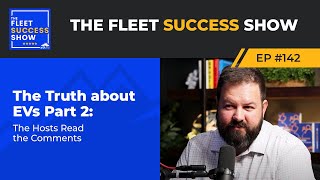
Josh Turley and Mark Canton respond to viewer comments about electric vehicles, addressing home charging permits, range anxiety, towing capacity, and thermal runaway risks. They discuss specific models like the Kia EV9 and F-150 Lightning while weighing EV tradeoffs against gas vehicles.
Chapters
All right. Welcome back for another episode of the Fleet Success Show with your host, Josh Turley. Mark Canton.
Hey, folks.
Good to meet you again. I'm really liking this. This setup works really well. Yeah. So glad you're in person.
Thanks, man. I'm happy to be here.
So a few weeks ago, we launched an episode called The Truth About EVs.
Right.
Originally, it was supposed to be titled Mark Bought an EV. Right?
Right.
Like, what? Yeah, so, but it blew up. Like, it blew up on us. And, you know, it's fun to see it blow up. But it got us thinking about, you know, kind of what else we needed to say in that episode, right? This is, you know, because we took it— it was a consumer-focused episode.
Yep.
You know, first time you've owned an EV. We've been around EVs a lot. A lot. Fleet space. Yeah. But I think we're going to turn this into a series. Right?
I think so. I think that's what the people are asking for, Josh.
I think so. So today we wanted to go through some of the comments, right? And they always tell you when you're on social media, don't read the comments. Well, I tell you what, I read the comments and I don't cry, okay?
Amen.
So we're going to go through— want to read the comments, address a few of them that I think are relevant, make fun of a few of them that are just way out of touch. So sit back, get your popcorn ready. One of the comments I wanted to call out was asking about, you know, more fleet-specific data. And that's— yes, we're going to go into that. Not today.
Right.
But that's going to be part of the series that we do.
That's what we do.
And it won't be good for those listening to the podcast, but those watching, you know, we'll throw up some spreadsheets and have some models. So that'll be one you want to hop over to YouTube and check us out on YouTube for sure. But in the meantime, let's, uh, let's jump to the comments.
Yeah, right, this is gonna be fun.
Let's do a quick recap. Okay, so a couple weeks ago we did this episode, right? You should go watch it. If I was a YouTube professional, I'd be like, click here for this video, right? And maybe our YouTube social media people can like—
yeah, yeah, light up right above his finger there, guys.
Um, of course I could also do the click here to subscribe and click the bell icon, right? Right. Everybody's asking for that. I've never asked for that. Yeah, and then you have to give away something though, right?
For the first 50 subscribers or something like that.
Of course I gotta take this. All right, hold on. I didn't come prepared for this.
All right. You get a free Fleet Success Playbook. How about that?
Oh, absolutely. fleetsuccessplaybook.com and just say, I subscribed and notified. Send me a screenshot. I'll send you a free copy.
There you go.
So to recap, right? You went out and you bought an EV.
Right.
After renting one at the, you know, when you're down here visiting.
Right.
And, you know, at the time you didn't have your home charger installed yet. You were still waiting on an electrician, some permits, things like that. But since then, you've gotten your charging installed. I do. Right? Because you were dealing with a lot of range anxiety.
Yes, I was.
And then, like, your wife drove it and totally surprised you. Yes. You're like, oh, crap.
Yep.
Right? Exactly.
Like, I have to take it in and fill it up. Right, basically.
But what have you learned since that episode aired? Right. So you got the home charger installed. Like, what have you— you know, what have you learned since then?
A lot of it we anticipated. I think we talked about, right? So having that charger in, like, just totally 180 degrees everything about the experience, right? So that, that struggling to find the charger, you know, I remember I mentioned how I went to lunch and one charger was full. And if you did get one, it was slow or it didn't work, whatever. Like that just goes away. Like, I, I never am looking for public charging. I have no need for it. I'm sure if I did one of these long road trips that are eventually I'm going to do here this summer, yeah, you know, that would, that would change a little bit. But it's just, you know, with what's nice about having a true, you know, BEV, battery electric vehicle, with all that range is the public charging thing just kind of goes away, at least for your, your day-to-day use, your around-town use, right? You just charge when you get home, you know, and, and that's fine. So all of that went away. Never have to worry about is the charging station full or any of that. I always have plenty of charge. I think, you know, I think another thing is it's a lot more fun once you have that charger. So I know we talked about that, but like, you know, but, but the whole, well, I better take it easy here because, you know, I wouldn't want— don't want to burn down the battery. Like, you know, at that point we had recorded, I had no idea if the air conditioning worked in that car.
You were just on full eco. Yeah. Yes.
Now I can tell you with certainty it works, and it works very well. So that's pretty cool.
Maybe this range anxiety is a good thing. It keeps everybody just off the throttle a little bit.
A little bit, yeah, definitely. I don't want to do a review of the specific vehicle or not. I mean, there's plenty of that. Even I noticed in our old episode, that's what's populated in my queue beneath it is EV9, is the Kia EV9, family SUV you've been waiting for. You know? It's so funny.
Well, I think that came up in the comments a lot, which is, oh, well, if you just bought a Tesla, you wouldn't have to worry about it. And I think that's absolutely true. The Tesla Supercharger network is definitely a lot more prevalent. The compatibility between it and other cars is a lot better. And obviously, the compatibility with itself is a lot better. But the Kia, you were running into some of those troubles, right? Like matching up the charging infrastructure, making sure it was the right wattage, making sure it had the right capacity. But to your point, Tesla doesn't make a third-row vehicle.
Exactly. I saw some of those comments, and I just was like, well, you're not listening. I mean—
You're an idiot. You just read those, and you're like, you're an idiot.
Yeah, I mean, I needed a three-row SUV. I didn't want to go— to something smaller like, you know, uh, a RAV4 or a CR-V or whatever, something of that size, which Kia has, the EV6, and, you know, that sort of a thing.
So my mom drives the S6.
Yeah. And, uh, and I, you know, obviously I wasn't in the market for, you know, like a Chevy Suburban or something huge, right? But I needed something that, you know, I'm a family of 5. I have my in-laws are in town regularly, as you know, and when they come, they stay for a bit. So I needed that kind of emergency third row seat for when I needed it. And, you know, that, that was a key element of what I was buying for. So listen, I'm a big fan of Elon. I got nothing against Tesla, but they just don't make one much.
Woke virtual signaling. Yeah. You know, I don't know anything about Elon that says virtue signaling, but okay, you do you.
Yeah, yeah, yeah, right, exactly.
Uh, so I want to jump into some of the comments. Sure. These had me just rolling.
Okay.
Um, Right, so, you know, just plug the Level 2 cord into your dryer outlet.
That one made me—
it's like, you know, okay, yes, yeah, just don't use your dryer while you're charging your EV, right? Okay, that actually might be good for demand charges, but you're talking about running— you know, let's hope that your dryer is located next to your EV, right? Otherwise you got to have one hell of an extension cord.
Can you imagine that? Thankfully, some people responded to that comment, I think, right, pretty well. But yeah, and by the way, my dryer's upstairs and no, I'm not pulling my oven out so that I can access my oven charge. I mean, come on.
Like, let's see. You know, just run it through the window. Right. And then, and then run your AC longer while that's running.
Right.
Most of us don't have range anxiety because of planning apps. Look, I don't, I've never used a planning app. You know, my dad used to use one. Like, you remember Rand McNally?
Yeah.
Right. That was like the thing back then.
Yeah.
Was you'd have to have a planning app and plan out your fuel stops because, you know, your Chevy Suburban only got so many miles to the gallon. We had range anxiety back then. This isn't new.
Right, exactly.
It's just new for this generation.
Exactly. It's the way it plays out now.
But it's funny, he's like, "Oh, planning apps make it easy." Yeah. But then somebody else, "The fact that we're even talking about planning apps tells you how far away EVs are from mass adoption." Yeah. There's a couple of these comments, right? It's like, you know, it's too far away. It's a niche case. It's only for certain commuters, which means it'll never be adopted mass market.
Right.
And I read those and I was like, Wow, you're an idiot. You know, and I think the thing is, it's easy to put our heads in the sand. It's easy for us to villainize something because it's been politicized, right? And if we could take the politics out of it, which, you know, was something we push to our customers, is take the politics out of it, look at it from a data perspective.
Exactly.
That's what we're going to be doing in part 3 and part 4 of this. Let's get into the data and let's talk about what it really is. What's the real cost and what is the real economic— you know, not economic, ecological benefit to having an EV because it's not as bad as you think it is, but it's also not as good as you think it is. That's right. Let's be pragmatic about it.
Exactly.
But to say that EVs are never going to catch on, that it's never going to happen, that they're not ready for prime time, you're missing the story.
Well, the cat's already out of the bag on that. They've already caught on. Whether or not they become the predominant type of vehicle, who knows? Is already a critical mass. It's too late. EVs aren't going away, folks.
Yeah.
Sorry. And I'm not Mr., you know, rah-rah, you know.
It is slowing down. Like, Ford just pulled back on their EVs. Sure, sure. Oh, absolutely. Because it's still super expensive to do this, right? Tesla has figured it out. They've got first mover advantage for sure.
Definitely.
I do think you will see Ford and GM get back into the ring.
Sure.
When it's more economical, right? You don't have to depend on government subsidy to make it work. Yeah. Right? But to say that it's not happening or it's not coming, right, man, you may as well try to say that electricity wasn't going to come around in the 1900s.
Yeah, exactly. It's not what you're having right now is a typical early market adoption issues, right? It's, it's going to, they're going to flex and the manufacturers like the, you know, like the big OEMs, they went all in. They said, all we're going to do is, which I think was a mistake. Yeah, of course it was. Right. That was just as silly.
All like, you know, things.
Yeah. All we're going to do is EVs. Well, anyone who's ever been around the automotive industry or the fleet industry said, yeah, right. And sure enough, that correction is now happening. But the other extreme is also silly, folks. Generally speaking, the truth is always going to be in the middle somewhere. And why that's so difficult for people to comprehend and adopt is just sort of beyond me. But that's the way it is.
Well, that's the other piece of this, right? And we tell our fleet customers this too, is EV isn't the end-all, be-all. Right. It's not going to fix all of your problems. You're not going to be able to use it in 100% of your use cases. You probably aren't even going to be able to use it for 80% of your use cases. There's a lot of heavy-duty application that ICE just makes more sense, right? I guess we call them conventionally fueled vehicles.
Yeah, that's what I like to call them.
CFVs.
CFVs, yeah.
Because that also includes hybrids and things like that, right? They're conventionally fueled. The idea, though, is that it's not one size fits all, which is why we're anti-mandate. We don't like seeing mandates like this. We'd rather have a more pragmatic approach. Mandate it where it makes sense, but said I don't like mandates either, but there's a right size and a right application for this. And in this case, it's perfect. Yeah. Because when's the last time you went to the gas station?
Exactly. I have never— I have not been to the gas station. Right.
Even while waiting for your charger.
Even. That's right. Because you don't wait. Yeah, right.
Because you wouldn't be able to fuel it up.
Let's be honest. Exactly. Well, and I think that, you know, that's a good point, right? Like you're not— especially these, some of the medium-duty applications now, right? Like there's just so much variety in that range there. And to your point about mandates, I think one of my frustrations with them is they generally mandate the wrong thing. You know, I need this many vehicles or this percentage of vehicles. Focus on the car. If, if you— if the goal is to reduce carbon, which again, I'm not going to argue about that goal or not, that's right. But if that's the goal, well, make the goal around that. You know, that seems to be much more reasonable and logical, right? So yeah, I'm with you. And listen, folks, you know, again, We'll beat you up if you think EVs are just, you know, but at the same time, we'll also be the ones to tell you zero emission vehicles don't exist. It's a nice story. It's one of my besties.
Honest branding. Yeah, that's all that is, is branding.
It's true, right?
Yeah, because there's no such thing as zero emission right now, right?
They're trying to bake the truth into the term itself, and it's— sorry, that's not real.
No, at least not until we get nuclear fusion going, right? Which I've told you is like, it's— they're making some progress on that. Yeah, I'm, I'm looking forward to that. Yeah, that's happening in my lifetime.
That would be sweet.
Like, if you haven't been paying attention to the news on that front, it's changing.
Those— yeah, yeah, we should do a podcast on it.
It's not going to happen anytime soon.
Right.
But I absolutely believe that's happening in my lifetime.
Yeah.
You know, and that's, that's clean. Like, that is super clean. You don't get the radioactive waste like you do with fission.
Right.
And it's—
which even fission's gotten a bad name, frankly. Again, truth, you know.
So, you know, like you had Three Mile Island and Fukushima and Chernobyl. Okay, those are really bad. You know, but there's dozens, dozens of other nuclear power stations. Never had a problem.
Right.
Right.
And we're ignoring all the advances in the designs and all that.
Totally. You know, it's like, well, that's it. The problem is that it's super expensive, right? Because you do have to maintain it. You do have to make sure it's always working. You got to crew that around the clock, right? It's not the same as running a really dirty coal plant or oil or something like that. Right, right. So, yeah, that's fair. Another one of my favorite comments. You two look like brothers. We are not brothers. We just go to the same barber. So.
I wish I was as tall as Josh. That would help out. But no. Thank you.
I have to call him, he's my brother from another mother.
There we go.
And it helps that we're fairly well in sync and have—
We eat well.
And this is true too. All right. I was hoping to hear more about fleet numbers. Yeah, we're definitely going to do a follow-up, Asesso. We'll get you that.
That's fair. On that one.
Would be great to have a follow-up after he gets home charging, which, yeah, that sounds like a must. If you're going to do an EV, you have to get the home charger. Otherwise, the benefit kind of goes out the window a little bit. Yeah. And like I said, convenience benefit, right?
Exactly. And we said— and I said in that episode, right, like when we advise fleets, the first thing we tell them is you need the infrastructure in place first. I didn't listen to my own advice, which I acknowledge right on that, you know. Absolutely. If you know you're going to buy an EV, do that first. And I don't know if I mentioned this on that video or not, but I think part of the challenge that I— one of the reasons I made that mistake is I was actually going to the dealership and I had plug-in hybrid in my head. Yeah, you know, and I just drove that EV, man. I took that pedal.
Well, but there are plug-in hybrids though. Yeah, instead of running, uh, what do they call it, like parallel versus series? Yeah, right, right, where the engine is not connected to the drivetrain at all and it just charges the battery. Yeah, it kind of like just kind of bowls, right? Yep. Um, and I honestly think that's like the best compromise between an EV and a plug-in hybrid because it truly is— you get all the benefits of electric, but then you have the, you know, basically a range extender with a generator. You ever see like the Ford Lightnings? They got a generator in the back. Yeah. Like, that's essentially all it is.
Actually, Ram— we were at GFX, and Ram announced that they're coming out with a range extender version of the 1500 and the 2500, which does just that. There's an onboard generator. And what's neat about that is they get to— well, neat depends on your perspective. But they get to circumvent a lot of the rules, let's say, around ICE vehicles because— Because it's not an ICE vehicle. It's not an ICE vehicle.
Right. The generator is not attached to the drivetrain.
That's it.
That's really the only difference, right? It's, uh, having a 2005 Dodge Magnum. Well, one, you need to upgrade your truck, right? Like, I love your Magnum because those are pretty cool.
Those are cool trucks.
Those are cool wagons, right? But, uh, my gas gauge trembles in fear. Yeah, I get it. Yeah, but I'm— he's considering a Cybertruck. No, wait.
Yeah, don't go, don't go there.
Don't go there, right? The Cybertruck is a massive PR stunt, right? And, and it just takes— like, if you just use it and play with— like, the stainless steel is terrible, but You know, the fact that you can like cut your fingers off in the trunk, that's not easy to do in a regular car, right? But very easy to do in the Cybertruck 'cause they just, they didn't do a good job with the design. They were going for wow and splash. Yes. And as a PR campaign, as a marketing campaign.
It's brilliant in that regard.
Really, because it's polarizing.
Yeah.
Right?
And a demographic, right? Like it looks, it came out of an '80s sci-fi movie, right?
It's a truck version of a DeLorean, right? Yeah. It's literally like, I think Elon looked at a DeLorean, he's like, make that into a truck. Yeah. Done.
Yeah.
Well, I think every kid, like, that's the version of a truck they drew on their, you know, kindergarten.
Yeah, exactly, exactly.
No, no curves, all angles, right?
So look like the Cylon eyes. If you don't know the reference, Google it.
Yeah, if you— people are so overdramatic and silly. If you like EVs, drive an EV. If you like a gas, drive ICE. What's the point of the back and forth with other people? Uh, we agree, right? Like, there's that. Be pragmatic about it.
Yeah.
And, but I think you have to still have the debate. You have to be willing to be open-minded to other points of view, right?
Right.
And when we hear people that say, oh, EV is save us all, you're an idiot.
Yeah.
EV is the devil, you're an idiot. Yes. Right? Like, let's find the open-minded pragmatic pragmatism. Yeah. Pragmatism. Yeah. Where we can talk about real common world sense, common sense solutions. Yeah, absolutely. We talk a lot about common sense not being as common anymore, but this is true.
Yeah. And it all matters what your goals are, what your needs are, what your desires are. That's going to impact a lot what's best for you and what's best for your fleet.
Did you really have to get a permit? To get your Level 2 installed?
I did.
Yeah. So this guy's like, a permit to install a Level 2 charger in your own garage within sight of the electric panel? Yes.
It made me want to bang my head against the wall. I totally agree with you.
And you're in City of Surprise, right?
City of Surprise. Yeah.
I can't say City of Peoria would be any better, but yeah, that's, that's a thing. Yeah. Uh, welcome to government regulation.
Amen.
The same governments that mandate electric vehicles are also the same ones that want to make sure you're plugging into your electrical panel safely.
Correct.
Um, and you know that you're not gonna end up doing something that some next generation owner owner is going to regret, right? That you're not compromising the integrity of your house.
And it doesn't hurt to— there's a fee.
Yeah, well, because you gotta pay for the per— you know, the inspectors to come out and make sure you did the job right the first time, right?
That's—
yeah, they're going to charge the electrician for his business license. They're going to charge you for the permit. They are charge you for the inspection. It's—
yep, tax on everything, which, you know, again, it's not actually— it's not wrong, but it does feel weird.
I've owned a 2023 Tesla. No problems charging on issue. You know, do you have solar on my home? I do.
Yeah.
And I think that's a great investment.
Yeah.
Out here, one of the things people don't realize, because this is another comment, was, oh, you're in Arizona, you should just have solar. Solar actually is not effective at the temperatures out here. Yeah, we don't realize that, that once the panels get above, I think it's 105 or 107, they lose efficiency. Right, right. Same thing if it gets too cold, right? Which is why they're not good in cold weather states. They'll lose efficiency there too. Yeah. But out here, you know, like we're going to hit 111 this weekend, right? Which, by the way, we're going to hit 111.
Yeah, I know.
James told me, get your family ready for that. But last year, like we had 30 days straight of 115. That's not normal for us, but it happens, right? And so solar, like the, the own— you have to overengineer the capacity of your solar plant generation, right, in order to compensate for that. Yeah, right. Because there will be— and I want to say it's like anywhere from a 10 to 20% degradation in the performance of your solar.
Right. And, you know, the solar panel companies don't admit this, at least not yet. But from what I can tell from doing some reading, I think the panels deteriorate more quickly because of the heat, too. Is that right? Is that something you've heard about?
I have not heard of that.
Okay.
It's possible.
I haven't heard some of the chats.
Chatroom folks are saying, no, it's, you know, well, if you read it on the internet, it's true.
It's got to be.
If you heard it on this podcast, it's absolutely true. For sure. That's why I'm asking you now. Yeah. Yeah, no. You remember when satellite radio was gonna be a huge thing and every car was gonna have satellite radio?
Yes.
Well, it does. Right. My truck came with SiriusXM. Mine was too. So you had to pay for the subscription, but okay. Yeah. Okay, this guy's just an idiot, I guess.
Yeah, I do remember that and I still do.
But so he says, you know, in the same way electric cars are just cars for commuters, the market's very limited. Again, No, that's not true. There's going to be a mass market for this, especially as we get— gain efficiencies in the battery design, especially as we gain efficiencies in charging speeds, charging capacities, electrical grid catching up finally.
Yeah, that's a bit— that's one of the biggest elements, right?
Yeah, it's biggest. Yeah. They're not great for anything other than commuting 30 minutes. Yeah.
Well, that's actually not true. That actually works great if you're buying a plug-in hybrid, right? Then you can get the effects of an EV in your commute. Yeah. And then, you know, have the gas for the longer range. But no, the true BEV, today's BEV— I don't want to be fair.
All of them.
Yeah, exactly.
Because the Leaf is terrible for that.
Right, exactly.
I think that thing's got the range of—
I think it's like 90. Yeah, exactly.
It's nothing.
Right.
So it does depend on— but the EV9, what's your range on your EV9?
They advertise like 314. And I'm finding that, like, if I really go to zero, I can get right around 300 miles.
You know what's amazing about that? I get 300 in my truck.
There you go.
Yeah.
So that's what it's trying to do, right?
Yeah, exactly. Why'd you— I get 8 miles to the gallon in my truck, right? Maybe. Okay, doing something wrong. We're probably having the same amount of fun too.
I'm telling you, man, maybe your next truck's—
although I'm taking your EV9 off-road and it's terrible.
It is.
Suspension is just the worst.
So here's what we got to figure out, because there is a lot of weight on the EVs, right? And that's a big thing. That's one of the things, you know, Steve is very, very nervous about in the sense of people aren't used to driving vehicles that heavy. And some of these EVs are as heavy as Mack trucks and stuff, depending on— so it's a fair concern. Put that aside for a second, though. They do make— you drive an F-150, a version of it. You can decide if you're going to tell the world about the trim that you have.
That's a 5.2-liter V8, supercharged V8. Yeah.
That's absolutely in every way designed to be off-road and just be glorious in that moment.
Well, and unlike most of those trucks, it's actually seen dirt.
Right.
Regularly.
That's a good point. These guys driving around with it.
But like, it's done beaches and jumps and all that stuff too. So like, it's actually gone off-road in Baja.
So here's my question, right? Can we get you an F-150 Lightning? Oh, I'd try that.
Totally.
That's my point. Because then that can be your everyday, right? Then when you do your long trips, you got— right?
You know, the F-150, like the Lightning still though, won't tow.
I know.
That's true. It is the one compromise. So this is something people don't know about the Raptors, though, is they don't tow either.
Yeah, relative to the other trucks.
Because the suspension is so tuned, I think my truck has an 8,700-pound towing capacity with a weight distributing hitch. Without it, it's only 5,000 pounds. So it doesn't tow much.
Yes. Well, relative— again, relative to—
Compared to— Like, an F-150 Tremor, I want to say, is like 10,000 to 12,000 pounds. Yeah, I want to say it's big. So it's 30%. Deep, you know, increase right there.
Yeah.
Uh, if you go F-250, then you're talking, you know, $15,000, $20,000. I want to say the 350s go even further than that, maybe $22,000, $27,000. Right, right. So there's a ton of towing capacity that we're leaving on the floor.
Yeah.
And that all the power in the world, and yet like we can't tow as much. But that Lightning, it'll tow, it has the capacity. It just like, you want to see your ranging sign, you know. I remember talking to, you know, David I'm not going to mention his last name, but one of the Daves that we call him the Daves, and he test drove it, right? And he ended up getting stranded because the F-150 just doesn't have the towing range that you would want with all that torque.
Yep.
Ah, that's the saddest thing about it. Like, they need a range extender in that. They do, just because there's so much potential there and it just doesn't have the range when you start putting load on it.
Yeah, I'm sure a lot of people watching and listening are familiar with TFL, and those guys did a great episode.
Terrific.
You know what they're telling—
yeah, link to that, right? Maybe we'll get like a— what do you call that, like a referral, a partner.
Oh yeah, that'd be neat.
I'm gonna reach out to those guys.
Yeah, there you go.
Why the F do you need a permit for an EVSE? It's like governments are putting deliberate roadblocks in the way of EV adoption. Well, I don't know that it's deliberate in the way of EV adoption. Yeah, they just like putting roadblocks in place.
Yes.
You know, all in the name of safety. Don't get me wrong, they're doing it because they want to make sure people do it right. Right. But yeah, no, I live in Australia. Hey, good day, mate. One of the most overregulated countries in the world. I think we could argue about that, but all right, I'll yield to the point. And all we need is a licensed electrician. See, I would just argue that point right there because of that. Clearly we're more regulated than you are. So toss that shit on the bottom. If you have a house in AZ, I would think solar is almost a no-brainer.
No, I would have thought that too as a New Yorker moving here, but I've learned it's not exactly a no-brainer.
It's definitely— so I'll tell you, in Arizona, you can either lease your solar, right, or you can buy your solar, right? If you're going to be in your house for anything more than I would say 7 years, you buy. If you lease it, you're effectively just swapping out. So our two utility companies are Salt River Power and APS, which I don't know what that stands for. Right. But you're essentially swapping out those utility providers for a solar company, right? Then you just make a monthly payment to them.
Right.
What's nice is it's predictable revenue or a predictable expense.
Right.
But it's not— you're not going to be able to like charge back and get the credits back from, you know, like excess power generation days or anything like that.
Right.
And then obviously we mentioned the temperature issue for some of the charging efficiencies. So go test drive an F-150 Lightning Lariat. So this is the other thing I don't like about the Raptor. They don't put the massaging seats in the truck. Really? Yeah.
I'm surprised about that.
You would figure that this is the premium truck.
Yeah, I would have figured.
The most expensive trim you can buy other than maybe a Shelby Raptor, which is stupid. I'm going to do a whole episode on that. Come on, Ford. Here's what I want. Your consumer is talking. And this is what he would like. He would like the 775-horsepower version of Shelby in Raptor form. Can you do that for me? I would love that.
And you're not alone. I mean, you can read that all over the internet too.
Everybody wants that. If I remember right, That version of the truck uses the 5.0 power plant.
That's right.
And the 5.0 is way better, way more bulletproof than the 5.2 Predator engine. All right. The Coyotes are just bulletproof. So.
And if you're an off-roader, you want bulletproof.
You want bulletproof. You don't want something else that works sensitive.
Yeah, absolutely.
Consider installing your charger in a way that the car and truck is parked outside. Check out China. Lots of EVs burning. I will say that this fear, I think, has been overblown.
That's right.
It is a liability issue. It is to be aware of it.
Yes.
But I would say, you know, otherwise we'd be hearing about a lot more Tesla fires. I mean, heck, in my neighborhood alone, I want to say there's like 25, 30 Teslas and no car fires. Right, right. Like nobody's— nobody's blowing these things up. Yeah. You do need to be careful if they're in an accident.
Yeah.
You know, like I know NFPA, the fire— you know, for those who don't know what NFPA stands for, that's for the Firefighter Association. They basically came out and said, hey, there needs to be a 50-foot radius around that vehicle after a, after a crash. Yeah, because it could just spontaneously combust thanks to something called thermal runaway. Look that up. Yep.
Um, and the nature of those flames are, you know, they spread.
Can't put it out.
Yeah, exactly.
Water and lithium don't get along. Yeah, they just, they're not friends, so don't do it.
And by the way, I have test-driven an F-150 Lightning, so appreciate it.
How does it compare to the Silverado EV?
Um, it was also a Lariat, so I want to say that. And the Silverado that I was in was, I believe, the maxed out.
All right, okay. And so it wasn't a Platinum Lightning?
It was not a Platinum Lightning.
It's still pretty good. It was cool.
It was cool. And it was great. It doesn't have the range.
Okay.
I think it's because it wasn't extended. It was like 220, I want to say, it said it got.
Um, if I'm being honest, are you a Chevy guy or a Ford guy though?
I'm a neither guy. I'm a Toyota guy. So we'll put that out there.
Just stop listening to me.
Yeah. So I will tell you that it doesn't matter. Don't listen to Chevy. I won't lie. The Chevy was, was better. It was, was a lot like driving that big, you know, the double cab, large full-size truck. And it felt like I was driving around a small SUV.
Wasn't your Lightning though? Wasn't that a crew cab?
The Lightning was, was also a crew cab. Yeah, that's what I'm saying.
Like, those are massive and they're massive.
But I'm just saying, like, it's this big huge truck and it handled and the turning radius was—
because it is— it's an Avalanche. Yeah. Which is just a glorified Suburban. That's why it felt like an SUV. It's not a truck.
Wait a minute. First off, let's pause here.
A Suburban is a truck. OK. The old Suburbans were a truck.
Yeah. But even the new ones are. They're built on the 3500 chassis. No.
No. Are you sure? Totally. OK. Yeah.
I'll take your word for it.
Yeah, it depends on the version you get. But they've been wimped out a little bit.
Is that right?
Yeah. Well, so it used to be too, like the H2s, if you remember the Hummer H2s, those were built on the Suburban chassis. Garbage.
Which, by the way, they have an EV version of the Hummer.
See what that looks like?
And the H2. That looks super cool. It looks really cool, but it starts at like $110,000 or something like this.
Why not? Yeah.
Anyway, it was fantabulous to drive. Like, it was— it handled like a— I don't want to say like a sports car, but like a small SUV with that much power, that much space. Ford didn't quite make the cut, but I will tell you, the Ford's little hood trunk thing is a lot bigger and a lot you know, a lot more outlets and cool gadgets.
It's a lot bigger.
Yeah, but cool.
PHEV, not great for fleets.
I disagree with that.
Come on. All right, MNHSTY, I don't know who you are, but I'm just kind of like, we're going to disagree on this one. Yeah. I think plug-in hybrids are great for fleets. In fact, I think they're better for fleets than EV right now.
Yep.
Especially given all the infrastructure challenges you have, it makes EV adoption a lot better. Now they say they're worried, like, if a driver can get reimbursed for gas, they're not going to charge the vehicle. But why wouldn't you?
Yeah, I mean, first off, if you can get reimbursed for gas, why wouldn't you work out a program where you can get reimbursed for charging? Yeah, I mean, so that's confusing to me.
Weird.
Uh, and, and yeah, actually, what, you know, we'll get into this with some of the data, but, uh, in all of the studies we've seen, over 95% of all government assets, for example, and government fleets would basically be an electric vehicle. They would never go to their gas engine if they're in a local government. So no, there's a lot of pros.
That depends too what type of PHEV. Yeah, yeah, yeah. Because if you do, you know, one where it's just a gas generator, they would never use the gas generator. Correct. Right. So they would only fill up if they needed to, but they wouldn't usually need to.
Yeah. From what I could tell, the biggest problem with PHEVs is, is that since the whole world has decided to focus on battery electric vehicles, you know, pure plug-ins, they just don't make as many models of them. They don't make as many of them. Right. And that's the— that's really the biggest knock in my mind against the plug-in hybrids.
Yeah, well, it's because they haven't invested as much in that tech. Exactly. And here you've got, you know, Ford and GM and Stellantis kind of pulling back on it. It's like, no, you guys just redirect. Yeah, redirect and go PHEV instead. And you'll solve the kind of the intermediate problem.
Yep.
You know, it wasn't like all of a sudden, you know, hey, we, you know, we invented electricity or discovered how to do it, right? And, and all of a sudden everybody had electricity, right? It took time, right? And there was stopgaps along the way, right? And they, they were focused and they were strategic about where they had that deployed before it was available to everybody. Yeah.
And I'll do a shameless one here, but, you know, listen, Toyota told the world this in '18 and '19 and '20, you know, when everyone else was announcing, well, all we're going to do is battery electric. They announced, yeah, we're going to do 6-battery electric, but we don't think that the world is ready for that yet. We think hybrids and plug-in hybrids are the way to go, and that's what we're going to double down.
That's how Prius dominated the market for so long.
Yeah, exactly.
They knew what they were doing.
They knew what they were doing. Absolutely.
All right, fine. We can respect your opinion, being a Toyota fan again. I expected an unfair take on EVs, but was pleasantly surprised at this very reasonable assessment. Well, thank you.
Thanks. That means a lot.
Appreciate that. We really do try to be pragmatic about this. We're not— again, where I'm going to keep beating this beat a dead horse. We're not anti-EV, but we're not pro-EV. We're pro-data.
Yep.
Right. And what does the data tell us that we should be looking at and investing in? Uh, we're gonna try stuff out. Yeah. Just, you know, like you went, you took a chance on the EV9. Yeah. Had it not worked out, you would have done something different. Yeah. But at the same time, we need to look at the data, we look at our experiences, and from there we can figure out what's the best solution for this problem. Right. Uh, we're talking about taking a road trip, you know, driving up north here in a couple weeks, and the first thing out of your mouth wasn't like, oh, we'll take the EV. It was, well, I've got the Armada, let's take that instead. Yeah, just in case, because we don't know what the situation is going to be like up there. Um, why is that? Well, it's because our data and our experiences inform that. So we look at it and say, what's the right use for— you know, you don't have two EVs yet, you still have one CFV and one EV, right? Um, so what's the right use? When should I use that vehicle versus this vehicle? And that's Yeah, that's called being pragmatic and not being pigeonholed into one opinion or another.
Exactly.
So yeah, so if you listen to us, like, just know that's how we approach most situations. Unless you say stuff that really is dumb, then you're an idiot.
Yeah. And like, let's, let's pause on that piece though for just a sec. Like, you know, we're going to be traveling with 5 people with luggage, right?
Yeah.
I don't know yet. I don't have the experience. I know that that will impact my range.
Yeah.
I don't know how much.
Do you want to test it?
We can test it. I think we'll make it. There's a supercharger, and I'm sure there's a supercharger, but I'd almost like to do is drive there and drive back and see if we can get away with not charging. But that's risky in a desert. Yeah, we will leave at 100. We'll start at 100%. Yeah, you know, let's go up the mountain and let's just see.
Yeah, I'll make the decision. The good news is you're heading downhill coming home.
Oh, that's right, exactly. So if worst case, we put it in neutral, push, and let it roll.
But I will tell you, coming down the Black Canyon Freeway, I-17, that is one of the craziest downhill sections you've ever gone on. Yeah, maybe not quite as bad as like the Coquihalla up in Canada. Yeah, but I have heard, right, it's the only freeway I've ever known, so I just think it's normal. But I have heard that it's one of the more, uh, interesting drives. It is because it's very twisty. Yeah, it's very fast.
Yes, uh, it's not unheard of because our interstates tend to be, yeah, so nicely banked. And you know, we— people don't appreciate that And if you haven't driven overseas, you don't appreciate how great our interstates really are. But yeah, I think that's true.
See, this guy's smart. One thing not mentioned a lot: most households have 2 or more cards. Most travel as local. Yes, it is. So buy one of each. Good job.
Bingo. Thank you.
Right. Wow. Life is hard for you. You're just being mean. Stop it.
Hey, listen, I wasn't complaining. I was giving you what my honest—
Yeah, right.
Experience was.
He's just jelly.
Yep.
Uh, EVs are great, problem is infrastructure. We need twice as many fast chargers as EVs in existence. We could debate about how many fast chargers we need. Um, I don't even know what the ratio is of gas pumps to conventionally fueled vehicles right now.
It's somewhere near 2 to 1, I can tell you that.
Uh, we definitely do need more, and we need more power. We know that, like, there's no questioning any of that. But we know too, like you just think about in my neighborhood, I just mentioned there's 20, 25 Teslas, right, in our little quarter square mile.
Right.
That's got to put a load on the infrastructure. It's got to be right now. Thankfully, it puts it on at night. But that neighborhood, you know, 10 years ago didn't have that kind of load.
Right. And I think that's probably part of what the permitting is about, too. Right. It's probably a little bit of Hey, can we actually take on that much demand there? And kind of tracking it and just knowing how much demand— I'm sure that's— I would hope— I'm hoping that's part of it, is to be able to track that, right? Because you're right, here, I mean, especially here in Arizona, obviously a lot of people think this way. Yeah, I mean, the, the, the proportion of EVs is, you know, anecdotally significantly higher to my eye than in other parts of the country. We travel a lot and it's true, you know, it's pretty high relatively speaking.
Well, I mean, and Part of that reason too, though, I think, is because power is cheaper here in Arizona. That's true. Right. We have nuclear. Yeah. So those who don't know, like, you know, your EV is actually probably pretty good on the emissions standpoint.
Right.
Because you know where power is coming from. Yeah. And that's something we are going to talk about that in probably part 3 is where you get your power from determines, you know, whether or not you truly have a ZEV. Yeah. Right. A zero emissions vehicle and why that's such a marketing ploy versus actually being fact-based. Because you have no idea where your electricity is coming from. Yeah, right.
We did some research for a client just a couple years ago, and it was amazing. If you're in a cold state, please don't buy EVs. You're absolutely hurting the environment. So there's no question.
Uh, Len Gold says, uh, good discussion except PHEVs are a dead-end waste of money. Oh, I think we have— like, we're gonna have a whole episode just on why PHEVs— yeah, makes sense.
It's so funny.
Yeah, they're just so anti, it's so crazy.
Yeah, but what's interesting about plug-in hybrids is people on both sides of the political aisle hate them. Yeah, it's like the people who want everything to stay the same, it's like that just represents battery, just represents electric, so it's bad, right?
It's worse than before.
Yeah, you know, and then the people who, who only want EVs, you know, it's like you're not good enough, it's not good enough to have a shot. Yeah, obviously you're so soft, right? You know, it's like Poor plug-ins, man. What'd they do to you?
Potential electric car buyers, don't let this man give you a feeling that electric cars give you anxiety. Well, I can't make you feel however you want to feel. You feel however you want to feel. Go see a psychiatrist. Dear goodness.
I hope it'll give you any feelings at all, quite frankly.
I was going to say something. We might have to call HR. Yeah.
Man, that was— that one was pretty interesting.
Just the internet's mean. Uh, the fact that PEBs only make up 1% after more than 10 years of sales makes it clear that most people just don't want them. Stop it. Where were you in the 1800s? That's what I want to know, right? If you were the guy that's like, Model T, that'll never catch on.
Come on. But also, please, for goodness sakes, take a logic class. Yeah, it's not how it works.
Nice reverse EV propaganda piece. This is what I love about the comments too. We were getting hit from both sides. Yeah, all the pro-EV people were like, you're idiots, and all the positive, you know, the anti-EV people, you're idiots. Yeah, you guys are both probably right.
So yes, but at least there's some people in there that kind of got— get it. That's kind of refreshing actually, right?
Uh, just don't talk anything negative about the dangerous, fast, quiet, and fun to drive narrative.
Okay. What we did, we said it, they're fast and they're fun to drive.
Says it's right, indie propaganda.
Yeah, yeah, yeah, good, good stuff. But we didn't harp on the quiet piece. I think we mentioned it. Yeah, it is, it is neat.
Definitely quiet. Yeah, I have a quiet mode in my Raptor. Oh yeah, yeah, it doesn't do anything. In fact, it was the first thing to break on the truck, you know.
But actually, they're so quiet they could actually I'm like thinking out loud here, but like, I know motorcycle guy— I'm not a motorcycle guy, but I have several buddies who are. And one of the things they talk about is they want the bike to be a little loud because some people find some bikes to be obnoxious. Like, I've had that experience, right? But they want it to be a little loud. They want you to know that they're there.
Right, right.
And that's something I've been thinking about lately. Like, there is an element of that. Like, I could roll up right behind you, especially if you're one of these people with your, your nose in your phone and your headphones on. Like, you'd have no idea I was there.
You know, well, so they did that with like transit buses.
Oh, really?
Because the EVs were— they were so quiet coming up to stops and things like that. They had to add noise and like, you know, just little— not sirens, but just alarm noises. You see that Teslas when they reverse. I know the F-150 Lightning is the same thing. Same thing with PowerBoost. Yeah, right. The F-150 PowerBoost. I could get behind that. Again, plug-in hybrid though. Yeah, right. But you go through it basically as they're reversing, you just get that fun little like alien spaceship noise.
Mine has that noise going too. And some of them play Ed Sheeran sounds on the internal speakers for you as you accelerate.
Just for fun.
Yeah. I don't know what I think about that. It seems a little weird, but—
It's because people have a hard time changing. One part of the EV transition many overlook is the battery backup aspect. So this is true. One of our guys, Facundo, actually used to work for a company. They were less concerned about, you know, charging and more about vehicle-to-grid and using your electric vehicle as battery storage. You have all these vehicles, if they're all EVs and they're just sitting on the lot not being used, that's a different problem for fleets. You know, we talk about rightsizing and all that. Yeah, but if you have them there, they effectively are battery storage that you could tap into during peak demand.
Right.
And lower your demand charges. Right. And kind of flatten out the curve for what your, what your EV charges. Yeah, right.
It's pretty amazing.
Overall electrical, right? They call that vehicle-to-grid. This company was Fermata. There's a few of them out there, but they're one of the leading ones that do it. And it is— it's about balancing when you charge that vehicle and then when you're not charging the vehicle, pulling the power out of the battery. And so you're constantly just discharging, recharging the battery and offloading the load on the facility side of it when you need that demand, right? Maybe you're in manufacturing facility, maybe you're in, you know, like an office building. You can actually power your building using the battery storage on the EV. Yeah, pretty neat. I think Ford Lightning has shown that.
Yes.
They show it as more of like an EV response of, oh, your power went out, just plug into your EV generator, right? Plug into the battery on the Lightning.
Yeah.
Which is kind of cool.
It is cool. And there's another sort of side and angle to that, which is, you know, on the work truck, right? And it's— I do think there's an opportunity there, right? Most trades folks, right, and service providers, they're They got welders, they got generators, they got all kinds of things that they're moving around. And, you know, I've seen some folks, some local folks in the area who are using those F-150 Lightnings as the work truck. And the amount of equipment that they're hauling around is just way down. Obviously, it doesn't replace everything.
Right.
And, you know, again, yes, it's going to drain your range. So you're not driving— that's not what it's for. It's to drive to where you're doing the work, get the work done and come back. I think about how many fleet applications are just that. I always talk about the the proverbial plumber's van, right? And you can't measure utilization in miles, that sort of a thing people have heard me say. Like, there are so many great use cases where, man, an EV, and especially if you get that access to that onboard power, would just be phenomenal for that use case, you know?
So yeah, we'll say, you know, like the F-150s, I know, have this— they got the 2.4-kilowatt onboard generator, right? Which is super awesome. But having access to, like, it's just a big battery. Yep. That's pretty cool.
It is.
So especially in emergency situations, you know, we don't know what this is like in Arizona, but if you're dealing with, you know, tornadoes and hurricanes, things like that, it's, it's nice to have. Now you won't be able to charge it after it's done, so have another charging mechanism, right? In the pinch, better than firing up a gas generator. Yeah, you know, uh, what's wrong with you, Mark? It's, it's extremely super simple. See, this guy just doesn't listen. Have it plugged in at home and stop at a charge for 10 to 15 minutes if you're driving far. Wow. Can you feel the anxiety? No. Pay attention, man. Just go back and watch again.
Watch again and repost.
There's no, yeah, no in-home charging yet. He wasn't there. Now that he's there, everything's fine. Here's a Prozac. Get your hands off the keyboard, man. Uh, EV9 is abomination of a car and sums up everything wrong with EVs today. Oh, The size, the weight, the cost. You know what this sounds like? This sounds like— you remember that, uh, the dictator down there in Venezuela, right? And all he would do is just rail against the size of cars in America. Yeah, we were everything wrong with the world, right? Because of just, you know, we drive these big ugly SUVs and he just wants everybody to drive like a smart car, right? Because, you know, that's all you need. And, you know, like, you would get rid of traffic congestion and all this.
Yeah, it's all the garbage.
Yes, all the world's problems.
I mean, while we all know he wants a big American truck, right?
Probably drove a big American truck. Exactly. Once again, a frustrated EV buyer learns the hard way his new expensive toy is a nightmare.
Oh my gosh. Again, not listening.
Pay attention, man. Pay attention. He loves this thing.
He's not going to do it again. Absolutely. And I think I've mentioned in there, and we'll talk about this too in either 3 or 4, we'll get into the costs of it. It's certainly going to cost me more than a hybrid or a plug-in hybrid over its life. There's no doubt over its equivalent. So there's a bit of privilege in there. I'll acknowledge that. Right. But, but would I do it again? I absolutely would do it again.
You don't have to apologize for your privilege, Mark. All right. Well, that was a lot of fun. Yeah. You know, as always, we love hearing from you guys. Love hearing the comments. You know, definitely. If you have any requests for episodes, just email us podcast@rtafleet.com. We're going to keep doing you know, some deep dives on this, right? And obviously, you know, Mark is doing this as a consumer, but we have a lot of data on EVs, on hybrid vehicles. So we're going to dive into that and showcase some of what we've learned.
Yep.
Not just from a consumer standpoint, but now having actually experienced it, they've got a little bit more voice of, you know, expertise to lend to it, right? And things like, you know, why we say get the infrastructure in place before you go buy an EV, right? Living Legendary. He went through exactly that. So, um, yeah, stay tuned for those. And always, we, uh, we love hearing from you guys. And until next time, take care, everybody.
More from Josh

Episode 227: The Hidden Costs Killing Fleet Operations (It’s NOT What You Think)


Episode 225: Are Certifications Still Worth It? The Truth About ASE, CAFM & Fleet Leadership




Episode 221: The State of Fleet Management: Education, AI, and the Technician Crisis with NAFA’s CEO

Episode 220: Motor Pools Are Back: Right-Size Your Fleet Without Breaking Operations

Episode 219: Stop Guessing at Downtime: Status Strategy for Better Availability #podcast #fleet

Episode 218: Fleet Predictions 2026: AI Hype, Technician Shortages, & the Next Era of Fleet Managers

Episode 217: Why Replacement Planning Solves 95% of Your Problems #podcast #fleetmanagement #fleet