Episode 145: 2024 Fleet Challenges & Trends: A Conversation with Tony Yankovich
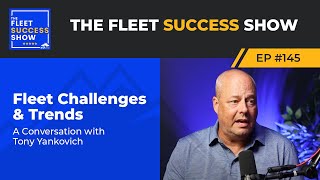
In this episode of the Fleet Success Show, host Josh Turley interviews veteran fleet consultant Tony Yankovich (formerly of Mercury Associates) about the most pressing issues and emerging strategies in North American fleet management for 2024. Yankovich highlights enduring challenges such as technician recruitment and retention, range anxiety, and the ongoing EV transition. He explains how consultants are helping fleets cut costs through rightsizing studies and zero‑based budgeting, which start from a blank slate and justify every vehicle, often uncovering significant savings. Parts inventory management is presented as another low‑hanging fruit: analyzing part turn‑rates, removing obsolete stock, and reclaiming value through vendor credits or auctioning. The conversation moves to space constraints for EV charging and staging, hinting at a future podcast series on EV infrastructure. Staffing shortages are addressed with workload‑based staffing analyses that quantify required technician hours, reinforcing the safety and liability implications of under‑staffed maintenance programs. Yankovich also notes a surge in demand for fleet due‑diligence services in M&A, where consultants perform physical inspections and evaluate maintenance practices to prevent costly post‑acquisition remediation. Finally, he discusses the importance of education—speaking at industry conferences, on‑site training, and the RTA Connect 2024 event—to raise fleet leaders’ expertise. Throughout, the dialogue is conversational, pragmatic, and focused on actionable consulting approaches for fleet efficiency and resilience.
Chapters
All right.
Welcome back for another episode of Fleet Success Show. I'm your host, Josh Turley, joined today by Tony Yankovich. How are you?
Well, thanks, Josh. I'm doing well. It's good to be in the office again this week.
Right. Got you here in studio. Always love having you guys in town. Tony, for those of you guys who, if you haven't listened, haven't been a longtime listener, Used to run Wyandotte County and worked for Mercury Fleet Consultant for 20 years.
Yeah, 19 years I was with Mercury Associates doing fleet consulting.
All right. I'll round up for you every time. So, yeah. So welcome back in studio. And, you know, you guys have been out on the road doing a lot of projects. What are you guys seeing out there lately? What are some of the recent trends in consulting that you've been coming across?
Sure. Well, I think, Josh, you know, some of the same big issues are still there. Technician recruitment, technician retention, range is still a big issue with fleets all across North America, really. So that's still an issue. I think EV transition planning, EV fleet sustainability has been a continued issue and that's not going to go away anytime soon. I think some of the lesser known and almost more interesting things that we're seeing lately is obviously cost reduction opportunities and not just cutting the budget. You know, we're actually looking to go in there and make the operations more efficient. We've seen, my gosh, so much interest in fleet rightsizing studies over the last 12 months. Just about every one of our studies includes some type of analysis on rightsizing and right-typing their fleet, whether it's, you know, a high-level analysis so we can identify whether there is an issue or not, or whether it's a deep dive and really digging into asset-by-asset review to see if these, you know, opportunities to eliminate vehicles in the fleet.
So kind of like a zero-based budget type approach to a fleet, right? Absolutely.
Exactly. And we've done that a couple of times for some organizations where we start with a blank piece of paper and we justify their fleet from zero. Yeah, it's a long and difficult process, but 100% of the time we save fleets quite a bit of money by doing it that way.
It definitely makes a huge difference. You know, it sounds super intensive though. Like I'd almost rather get a colonoscopy than go through a zero-based budget.
It is actually from both sides. It's a lot of work as the consultant on the project, but it's a lot of work on the part of the client as well. But, you know, You know, it's amazing that organizations, whether they're your private company, whether you're construction, whether you're trucking or a government fleet, organizations simply don't realize how much they've changed over the years until you actually start looking at it. And it's like, do we really need this size vehicle anymore? It's like, well, you know, we used to, but we used to use that vehicle to haul this and now we don't do pavement maintenance anymore. You know, we outsource that.
Well, and then what happens though, is that they don't ask themselves that question when it comes time to replace the unit. And so you end up, you know, we call it like this bureaucratic inertia, right? Where it just the status quo maintains itself. Yes. And it's not complacency. You know, you don't want to necessarily assign fault or like a bad motive here, but it becomes easier just to keep replacing it than ask the question of, do we really need this anymore? You know, and it's just more natural.
Absolutely. And the problem is, you know, the fleet organization is a support organization. Yeah. And so they're there to support the customers that rely on them for, you know, fleet maintenance, fleet acquisition services. And so it's— they put the fleet organization in a difficult position if they're the ones having to say, no, no, you don't need that because they rely on them for their support. And so it's really nice to have somebody come in from the outside, take that unbiased third-party look and really get to the bottom of things.
Yeah, well, and then there's no motive, right? It's like you're coming in as a neutral third party. You're just here for what's best for like the city or the county. You give your unbiased opinion and you don't really care who's right.
Right. Exactly.
The data tells you who's right. Right.
Exactly.
So I like that approach to it as well as, no, we really do have to justify every single decision, even if it's, you know, just maintaining what we already have, you know. All right. So doing zero-based budget, some rightsizing, you know, it sounds like people are trying to tighten up, get a little bit more efficient, which I think is always the name of the game in fleet. You've got to figure out how to do more with less.
Right.
What are some other trends and things that you're coming across out there?
You know, one of the areas that we find a lot of opportunity to, to not only save money but actually get some credit is parts management.
Yeah.
So a lot of organizations, when we go in and doing a fleet operations assessment, we'll look at what's the value of parts on the shelf. And so we can tell based on the fleet size and composition, the workload requirements, the AUs, how much they should approximately have on their shelf. And we can tell if by looking at parts turns. You know, if there's a part line item that you haven't used in 12 months, you haven't used in 18 months, do you really need it on the shelf? In a few cases, yes, because it's hard to get. It's hard to find. It's an old vehicle, certainly. But most cases you find out that, you know, it's been on the shelf. We just haven't used it. No one's really taken a look and saying, yeah, hey, we've had zero parts turns in the last 18 months on this thing. Let's send it back to the vendor. You know, maybe you're not going to get money back for it, but you'll at least get credit for it.
Yeah. Well, and even so today, there's those parts that are hard to get a hold of, old vehicles, and we need those today. But I've seen it where those parts then become the ones that haven't turned and you're like, oh no, we definitely need that. And then you're like, wait a minute, didn't we get rid of that vehicle this was for? And you don't even have it on the lot anymore. You know, now you've got a part that doesn't fit any of your assets.
Right.
And so it's— you got to unturn or I guess turn over these unturned rocks. I mean, every one of them. And you can't just assume that, oh no, that's supposed to be there, you know?
Exactly. And that's the value of a great parts clerk or a great parts manager. They identify that and they're looking proactively at that instead of waiting until they trip over that part 10 times in the parts room.
Well, and they do it frequently, right? Right. It's not— it's part of their regular cadence and rhythm is they don't just do that, you know, when they have to. They have a regular like, oh no, every 90 days we're going through and rechecking this stuff.
Yeah.
And looking for slow-moving parts. And we ask the same questions again as, do we still need that? Is it still useful? What's it worth today?
Exactly.
Because we've— and I've seen that where somebody, they actually had almost an entire shelf dedicated to an asset that, you know, wasn't even in their fleet anymore, wasn't on the streets anymore. Right. Is that old?
Right.
And they realized that if they had gotten rid of those parts even just 5 years sooner when, you know, they were getting towards the end of having that type of asset in their fleet, they probably had a few, maybe $20,000, $30,000 of inventory sitting on that shelf.
Absolutely.
And now because they waited 5 years, gone, nothing.
Right. And the other thing, you know, a lot of organizations, you know, you, you phase out vehicles or makes or models. And when you get rid of that last one in the fleet, what we've always told our clients is that go in and look at the parts that are specific to that asset. Anything that you're not going to use on something else, if you can't get credit for it from the vendor, put it in that vehicle and auction it off with the vehicle. You might get a few extra dollars.
Just something to help.
Right.
You know, something's better than nothing.
And if nothing else, it's out of your way.
That's right. If nothing else, then exactly. You don't have to dedicate the space.
Right.
Right. Maybe you can use that space for a new charging station.
Who knows? Exactly.
Definitely. Because that's something— as you guys talk about the big things that you deal with, right? EV transition. Everybody's talking about that right now. But space is at a premium when it comes to the charging infrastructure.
So absolutely, absolutely. And we'll have to do another session on space requirements when it comes to EV maintenance and not only EV maintenance, but EV staging, quarantine staging, charging spaces. That'll be a series of 10 or 12 podcasts.
Mark and I have a whole series running right now, The Truth About EVs. Exactly. That'll feel like one that'll just dovetail right into those.
Right. Right.
Yeah, there's been some, some fun videos going around on that. And now a quick break to talk about the fleet success event of the year, RTA Connect.
Where can you find insightful keynotes from fleet industry experts, live hands-on training classes, and the chance to network with fleet professionals from across the country? Only at the fleet event of the year, RTA Connect 2024. Join us October 7th to 11th in Atlanta, Georgia. And get the tips, tricks, and tools you need to take your fleet to the next level. Visit www.rtafleet.com/connect to learn more.
Well, what else? What are some trends that you're seeing just in the industry in general? Like, I know I talked to a customer recently and I don't know how many others are dealing with this, but they're, they're under the budget crunch. And while they were trying to recruit technicians, now they're getting told, no, you can't, you don't have any budget for technicians. And so They literally, in this case, so sad to hear it. They had two solid technicians they were getting from a dealership and they had to just squash the deal and say, sorry, we can't, we can't bring you over anymore. So they had to rescind the offers and send them back.
And that's troubling. It's troubling for me as a fleet person, as a fleet professional, because you need professional, skilled, experienced technicians to maintain these fleets because You know, these are, these are, you know, very expensive assets, very safety issues with maintaining these vehicles and pieces of equipment. And if you don't have the resources to maintain these vehicles, it really puts a liability on the organization. And actually, Josh, a lot of the things that we're doing lately is doing staffing analysis. So we are helping organizations justify the number of technicians that they need. So we do it through a workload workforce analysis where we will identify the demand hours that are required to maintain the fleet and the maintenance requirements are not going to change. You're either going to do it with in-house staff or you're going to take it and have a vendor do it.
It's one or the other. There's not an in-between. Because if you don't do it, you're now like— then I don't think people make this connection sometimes, but if you aren't doing that regular maintenance, you are now almost— I don't know, maybe it's not criminal in a government's case, but I know in like a trucking company or something like that, you could be held criminally negligent.
Yes.
For, you know, being negligent with the safety of your vehicle because you weren't doing regular inspections, right?
Absolutely. Well, the first thing they will do is come back and look at your maintenance records. Are you doing your PMs?
You know, that are you doing them on time?
Absolutely.
Doing them thoroughly. Do you have checklists to back up your, you know, your assertion that you're doing them?
Exactly. And what kind of qualified and skilled technicians are doing them? You know, do you have just a guy off the street that doesn't have any experience? High school auto shop, right?
Exactly. Absolutely. And I hear this story, right, as he talks about, yeah, we had to turn away. We had 2 technicians coming in the door, which people would kill for right now. And he had to turn them away because the city said no. And then I asked the question of, well, did you also get rid of some vehicles? Because if you had a technician shortage before, now you can't hire those people, then you got rid of some vehicles, right? Because your vehicle-to-technician ratio, we don't use that. We think it's a terrible metric. You know, the baseline still holds true, which is that if you get rid of techs, you need to get rid of some vehicles too, because like you said, right, somebody has to do that work.
Exactly.
Exactly. And I don't think that was the case here, unfortunately.
Right. You know, one of the other things that we've seen a real pickup in interest is due diligence.
Yeah.
So a lot of private equity companies and a lot of investment firms that are looking to invest and acquire companies are starting to turn to us a lot more frequently to have us do the due diligence when it comes to looking at the fleet.
Oh yeah.
So we look at— sometimes we do actual physical inspections of the assets. So we will go out and with our own checklist, we will do a— conduct an onsite physical inspection of the asset. So we look at the interior, look at the exterior, look at the engine compartment. So we will look at the entire vehicle for to determine, you know, what kind of condition is this asset in? Has it been maintained up to, you know, what we call standard? So we're looking at that. But then we're also looking at their maintenance practices because what these companies have found before they want to invest in something like this and make a huge investment is that they want to make sure that the assets are reasonable.
Yes.
You know, we hear stories all the time about someone makes an investment in a company and then they find out they have to go spend millions of dollars to to bring the fleet up to standard. And that's something that they didn't expect. And so we're seeing a lot of interest and a lot of work in that area right now as well.
Yeah, it's a huge part, you know, especially in industries where M&A is a common activity. See it a lot in waste, construction companies, things of that nature. And it is, it's, you know, from a due diligence standpoint, you have to make sure if you're stating and you're buying, you're basically stating a value for those assets. But if it's not been maintained, it's kind of like buying a house, right? You got to go get it appraised. Right. And the fleet is just one asset because it's the buildings and the computers and all the other, you know, the IP that they might own. But fleet for any of these type of agencies is a big piece. Absolutely. I was just talking to somebody the other day. They do a lot of waste roll-up. You know, they'll just roll somebody up and these garbage trucks, if they've got to replace them, you're talking $300,000, $400,000.
Exactly.
That's not a light investment if you just dropped several million on a company. And now you've got to double your investment just to get the fleet back up to speed.
Right. And the lifecycle on a Waste Hauler truck, you know, generally speaking, 6 to 8 years is when you want to replace those. And at $300,000 to $400,000 a pop, that's a significant issue.
Yeah. Well, if you're led to believe that everything's up and operating right, whereas these guys have been squeezing the margins for a few years, you know, that definitely— that can lower the asking price significantly. You know, it's like going through a home inspection and finding, mold in the roof and things like that.
Right.
You know, it either lowers the asking price or you got to do some remediation before you buy the business.
Exactly.
It can have a huge impact. Cool. Well, that's interesting. I hadn't thought about the appraisal piece of consulting, but it makes total sense. So, well, cool. Well, any last parting thoughts or—
You know, the only other one, you know, we do a lot of educational speaking at industry conferences. Oh, yeah. And that's something that we—
And you're very good at that, by the way. I love going to your talks. I don't know about that.
But thank you. So we do that and we really do it. And this is one of the many reasons I love RTA is we're out there to help fleets. And really, I mean, we are helping, trying to help fleets succeed. We do that by trying to educate those people. And more and more in the industry, we're seeing the fleet leaders and leadership of some of these companies and organizations that don't have a lot of fleet experience. So they want to learn as much as possible. So not only are we doing it at these industry conferences, but we're being contacted by companies, organizations, regional industry organizations to come out and do educational sessions for them on site. So we've been conducting a number of those now for organizations all over the country, and it's really, really received very well.
Yeah, I will say that's probably one of my favorite things is getting out on the speaking circuit. Right. And seeing you guys get out there and speak. I know NTA does one. Is basically Fleet Management 101. The group of people coming into that class, like you said, some of them never been exposed to fleet before. So we're really trying to make sure that, you know, we are, we're kind of giving back to the industry in some ways. Yeah, a little bit self-serving if we want to call it that. But we really do try to make sure that, you know, we're getting, we have a lot of amazing people here at this company and having you guys be out there speaking to them and helping fleet managers. You know, Steve and I were just talking, about the project he did out in the Pacific Islands. Oh yeah. And, you know, but just like his advice to young and upcoming fleet managers who are literally staring up the side of a mountain and they don't know where— where's the trailhead even at? How do I go up this thing? How do I go from A to Z? And really, like, what's B? I don't even know what B, C, and D are.
Right.
And I love that we get out there and, you know, you, Tony, you, Mark, you know, Steve, and now Scott joining the crew. Being able to see you guys get out and really help make a difference in a fleet's life, you know, it's pretty special to watch and be a part of.
It is. It's great being a part of an organization that's evolving and moving forward and getting better. So it's an awesome opportunity for us. Yeah. All right.
Well, if any of our listeners, if you find yourself in need of, you know, another opinion or somebody to come in and help, you know, tell your story to your supervisors, if anything we said struck a bell, you're like, oh, I haven't done something like that in a while. I'd love to do that. I will tell you the zero-based budget, you know, essentially, you know, I don't even know what we call it, you know, but basically like a zero-based asset budget. It's very intensive but extremely thorough and you will find savings in there, some massive savings. So if you're interested in doing that, I would highly recommend that you don't try to do it yourself. Bring on the experts who have done this several times. We've got analysts that back them up. And so we can really get down to the data, but love doing right-sizing studies, fleet staffing studies. If you're struggling with any of that, give us a call. That's what we're here for.
So absolutely.
And if you have any questions for our experts, just email them in podcast@rtafleet.com. We'd love to hear them. We'd love to address them, you know, as we get our consultants and, you know, we call them our subject matter experts, get them on the phone, get them on the calls. They'd love to answer your questions anytime. Have them. So, uh, with that, that'll wrap it up for us today. Until next time.
Thanks.
More from Josh

Episode 227: The Hidden Costs Killing Fleet Operations (It’s NOT What You Think)


Episode 225: Are Certifications Still Worth It? The Truth About ASE, CAFM & Fleet Leadership




Episode 221: The State of Fleet Management: Education, AI, and the Technician Crisis with NAFA’s CEO

Episode 220: Motor Pools Are Back: Right-Size Your Fleet Without Breaking Operations

Episode 219: Stop Guessing at Downtime: Status Strategy for Better Availability #podcast #fleet

Episode 218: Fleet Predictions 2026: AI Hype, Technician Shortages, & the Next Era of Fleet Managers

Episode 217: Why Replacement Planning Solves 95% of Your Problems #podcast #fleetmanagement #fleet