Episode 194: Eliminating Dysfunction: Building Trust and Team Health in Fleet Organizations
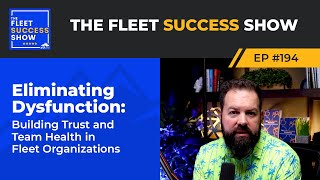
Josh Turley walks through Patrick Lencioni's Five Dysfunctions framework for fixing broken teams. Trust in motives is the foundation to rebuild first. Two exercises work: sharing personal histories to humanize teammates, and a helps-hurts feedback round that demands psychological safety.
Chapters
This is the Fleet Success Show dedicated to helping you and your fleet succeed using the experience of fleet professionals and Hall of Fame fleet legends. The show that explores how the pillars of stakeholder satisfaction, intentional culture, resource efficiency, and risk management all combine to lead your fleet to success. We're glad you're here. Now let's get into the show. Hey, welcome back for another episode of the Fleet Success Show. I'm your host, Josh Turley, running solo today. We just got back from our company planning offsite for the rest of the year. And the thing I wanted to talk to you guys about today was something that was present for me as we went through our sessions. One of the big things that we focused on a lot on day one with our executive team was around team health, right? And so there's a few exercises that we go through to kind of help build out some of that team health and eliminate what I call— it's the, you know, it's not what I call it, it's what Patrick Lencioni calls it, is the 5 dysfunctions of a team. Which we've talked about on this podcast before. If you're not familiar with that work, highly recommend going out and grabbing the book, The Five Dysfunctions of a Team. It's on Audible, you know, grab it on Amazon. Super terrific read. We make every single one of our employees read this book in their first 30 to 60 days. But the premise of it is that every team has dysfunction within it. And the idea is that you want to try your best to eliminate that dysfunction. And so there's exercises you can kind of go through to help drive that out. The most foundational dysfunction of any team is that of trust, right? And not trust as in like, hey, I trust you to get the job done. I trust that you're good at what you do. It's more in trust and alignment, trust and motive, right? That you come in and when you're doing things, that I trust why you're doing them. Like, I trust that your motive is aligned with my motive. You don't have some hidden agenda or some ax to grind or something like that. Right, and so when I notice that teams start getting dysfunctional, it almost always comes back to trust, right? And types of dysfunction that you're gonna see when teams stop having conflict, right, or maybe it gets more personal instead of ideological, that's a sign of mistrust. When teams aren't clear on commitment, well, it's usually a sign that they're not having enough conflict and not getting enough buy-in in the decision. When teams are no longer able to hold each other accountable, also a glaring sign of trust, but also a sign of a lack of commitment, as when I can't hold you accountable because I don't know what you agreed to, or I can't hold you accountable because you get defensive and don't trust my motives as to why I'm holding you accountable. And then any team that's not holding each other accountable is not going to achieve the results that they want, right? So that's kind of the 5 dysfunctions in a nutshell. Each dysfunction leads up to the next dysfunction. So you almost always, always, always have to start with the foundation of building trust in the team. And by building trust, again, we're talking about building trust in each other's motives. So we go through and we really focus on that. We do, Patrick Lencioni, The Table Group, has a team health assessment. So the first half of our day we spend just going through that. There's a, I wanna say it's a 30 or 40 questionnaire that you go through. Takes about 10, 15 minutes. And every team member submits it. And then it walks you through each of your dysfunctions, gives you a score. Anything 4 or above is green, 3 to 4 is yellow, anything less than a 3 is red. So we go through that and you're looking for areas where the team disagrees, where you're really close to, you know, getting into green, or maybe you're close to getting into red. You want to try to focus on those areas and you always start at the bottom and work your way up. But it's amazing to me as we go through those exercises, how many little things flare up that it's like, oh, here's all these past resentments or past issues that we haven't really been talking about, or we thought we had moved past this, but it turns out we actually still have a problem here. Or maybe we didn't realize we had a problem here, but we've got team members that totally disagree on how we're approaching this. It's probably one of my favorite sections in the assessment is it will show you where there's a large disparity between team members. Some team members think that you almost always do this and some team members think that you rarely do this. So it looks for that disparity in responses and says, hey, you should probably talk about these things, right? So we go through that exercise. We do one of the best trust-building exercises is actually talking about your personal histories. So in the personal histories exercise, and this one always gets, you know, a little bit raw, a little bit emotional because of what we're talking about. You go through and you talk about where you were born, where you grew up, how many siblings you had, and what your birth order was. You know, were you the oldest, youngest, middle child, whatever? And then you go through and the last thing that we talk about is like a defining moment that happened in your childhood, right? Something that really changed who you were today. And it depends on how deep the leader goes. Those conversations can be very superficial, especially if this is like the first time the team's ever gotten together. And they can also be very deep and very revealing, right? Depends on how vulnerable the leader wants to be. Because it kind of sets the tone for the rest of the room and like, whoa, like, you The leader went really deep. I'm going to go ahead and be vulnerable too, right? And everybody kind of shares their stories. What's amazing to that, though, is why does this build trust? Well, a lot of that comes down to when were you the most vulnerable? Well, it was when you were a child. And so we always talk about when we were a child, because that shows that vulnerability is what begets trust. It's what breeds connection between peers and between teammates. Is because now I'm not just seeing you as an adversary. Now I'm not just seeing you as a coworker. I'm seeing you as a human being, a human being with past trauma, with past stories, with baggage that you're bringing into a relationship. Uh, we were at an event and we listened to a guy named Jeff— Jefferson Fisher, who's an attorney and basically teaches you how to argue and how to have any conversation, right? Just exactly what to say. And one of the things that he talked about, uh, was this idea that the the person you're talking to isn't the person that's communicating, right? There's a, there's a person behind the mouth. There's a story that's coming through, and you might be talking to, like, the little child version of that person. And so when you're triggering these emotions, you have to remember that there's a story there, that there's a, a history, uh, that you're also talking with at the same time. They're bringing into the connection that you're sharing. Uh, so we do, we do that exercise, and that goes a long way in building out team trust. And because you really do get to see this person as an individual, you get to see them as a human. And now when you have disagreements, you remember back to that time that they shared that really raw, vulnerable story, and you can see past the, the immediate reaction of, man, that's such a terrible person, this person's a jackass, I never want to work with this person again. And you remember that story they told, you're like, okay, he's not a total jackass, like, this is just bad behavior. Let's talk about the behavior, the person's fine. Right? And it really helps build and bridge any gaps between team members. It's not a cure-all. I'm not going to tell you that, oh yeah, do this exercise and you'll never have a fight, you'll never have an argument again. It just helps the repair of those arguments, right? Because you're able to quickly diagnose and recognize that, you know, hey, there's a person over here. And I found that too, like in any— the strength of any relationship is really about the speed of repair, how quickly after you have a breach, can you pull back? And this goes for your marriages too, right? If any of you are married, this is the same thing there. But how quickly after a breach of trust or a breach of, you know, etiquette, whatever, can you pull back and repair the damage of that relationship? And the speed at which you can do that really is the speed of trust, and it's the speed of being able to move forward into a new paradigm. So those are, those are two of the things we go through.
Because no one goes to school for fleet management, chances are you were never formally trained on how to successfully lead a fleet. That's where the Fleet Success Playbook comes in. The Fleet Success Playbook is your guide to building a safe, reliable, and efficient fleet that provides exceptional service. Learn all about the 4 pillars of fleet success: stakeholder satisfaction, intentional culture, resource efficiency, and risk management. Get nearly 100 years of combined advice on common challenges, practical solutions, actionable tips, and real examples from fleet industry experts who have been there and done that. Visit www.fleetsuccessplaybook.com to request your free copy today.
The third one is absolutely my favorite though, and it's the hardest one to get through, uh, especially if you have thin skin. You're not gonna like this one. But we go around the room and we do what we call a helps-hurts exercise. All right. Now, this is dabbled in both accountability as well as in trust. It really teaches you to trust each other as you go through this exercise. What you do is you go around the room, you write everybody's name, and then for each person in the room, you write down the one thing that they do that helps the team more than anything else. All right. What's the one thing they bring to the team that nobody else brings or that's very special to them? Then you write down what's the one thing they do that hurts the team the most, right? What's the one thing they do that's just no good? So you go through this exercise and— oh, and you write down your own name too. I forgot to mention that the leader goes first in this one, just like in personal histories. The leader always goes first. They set the tone and they go around the room and say, okay, here's the thing that I do that I think helps the team the most. And everybody goes around the room singing the person's praises. Oh yeah, this is what you're amazing at. And the leader's feeling all good about themselves and they pat themselves on the back. And then they say, okay, I think this is the thing I do that hurts the team the most. And then they share that. Now, again, the more vulnerable you are, the more real the feedback you'll get, because it shows how just, you know, emotionally intelligent you are. Now, the next piece is the hardest piece, because each one of the other people in that room must feel safe enough to share their true opinions. And you as the leader cannot react, you have to go into like deer mode, right? You can't get defensive, you can't get You can't excuse behavior, you can't try to explain it away, you can't be reactive. You have to just like settle and just receive it, right? And this is the hardest thing. So what I do is I write down what everybody's saying. And if I have a clarifying question, like, what do you mean by that? I don't understand that phrase, or I don't understand that word. Um, did— was there an example of a time that you can think of? Because I'm having a hard time seeing that one. You know, again, you're not trying to be accusatory of like, I don't believe you, you're lying. You're trying to say, help me understand. And you're just trying to get clarity, right? That's all the questions you can ask. You cannot push back, you can't do anything. You go around the room and what I want you to do is you're looking for themes. You're looking for things that are like, oh, common threads between, you know, these 3 people all said the same thing. That's probably a problem, right? And the goal is whether it comes back around to you, the idea is that you find something, one thing that you're gonna work on over the next 3 to 4 months. To try to do better with, right? So like, just transparently, mine is emotional regulation, right? Controlling my reactions in the moment to either bad news, bad data, issues of the team, disagreements, right? Is just settling my nervous system so that I don't engage with my full passion and force. Recognizing that as a CEO, I carry a lot of weight into that room already. And while it's perfectly human to be frustrated as a CEO, I actually have to be a little bit more robotic and a little bit more lethargic in my responses. Just hold it back, pause it, and then be more measured in my responses. And that will help facilitate more psychological safety in the team. But you do that and then the next person goes and you repeat the exercise, right? And so that one is in particular, it's one of the— my favorite exercises. It's also one of the most humbling exercises as a person. You have the greatest opportunity for growth through those exercises. And the stronger the trust element of the team, the better that exercise is going to turn out. The more receptive you are to that feedback as a leader and the quicker you are to enact that feedback, the more trust and credibility you're going to gain with your team, the more they're going to lean into it in the future. Right. The first time through, it's probably going to be very superficial. They don't trust you yet. They're not quite sure. Maybe your team's been together a long time. It won't be a problem. But I will tell you is that every time we go through that exercise and we have a leader, this is their first time through the exercise, it's a little bit intimidating. It's daunting. It's scary. They're nervous about it. And then they get through and they're like, wow, that was so cathartic. It was so therapeutic. I'm really glad, like, you know, that was super helpful feedback. And a lot of times what's interesting as we go through that is there's sometimes there's no surprises, right? Mine's not a surprise. I knew exactly what they were going to say. But there's other times where you can see there's been some pent-up— I'm not going to call it hostility, but issues, right? Some pent-up maybe resentment between team members and something will come through and it'll trigger something. It'll be like, whoa, all right. Like there was some definite energy behind that one. And we go through and then if there's any kind of, again, repair, then we'll try to repair that, fix any issues we have and then come back to it. Right. And afterwards, you know, team members are free to talk about the issues and like, hey, I really want to talk about this thing you said. Because it bothers me that, you know, that I came off that way and I want to just apologize and I want to fix that. Right. So, and that is a great way to build trust, to repair the damage in a relationship, to trust each other's motives. But we go through that. We did that all day on our first day. And I will tell you, we got to the end of that day and we were just emotionally drained, right? There was tears shed. There was some definite raw moments. There was some passion. In debate and you get to the end of the day and you're just emotionally exhausted, like, wow. But it feels so good because you're like, this team is amazing and you just feel totally bonded, like you just went to war in a foxhole, right? And the team really gels together that you're ready for the next couple of days of planning where you're going after it and you're going to go get those, get those objectives, go plan out what's most important, talk about the big sticky issues, It's pretty, pretty incredible to go through those things. So highly recommend if you have not done like an offsite planning meeting, go grab your copy of the Fleet Success Playbook. I outline all of this stuff in that book, how we run our offsites, the agenda we use, some of the exercises to go through to eliminate 5 dysfunctions of a team using things like DISC assessments and whatnot. Even the team health assessment is in there. Go grab yourself a copy of the 5 Dysfunctions of a Team. You know, like that'll run you through all 3 of those exercises as well. And hopefully give you an idea on just how dysfunctional maybe your team is, or where you can shore up and do better. It's one of the things that I'm super passionate about is eliminating dysfunction from within the company, because that is where the organizational health lives, right? Organizational health is all about building healthy teams, creating clarity, overcommunicating clarity, and reinforcing clarity. But it all starts with building a healthy leadership team. Right? If you don't have a healthy leadership team, all the rest of the stuff will never happen and it doesn't matter anyways. So you do the work, you focus on the 5 dysfunctions of a team and really create a cohesive unit. And any team that is strongly aligned cannot be beat. That's just a fact of business and a fact of life. So I put a lot of time and energy into ridding our organization of dysfunction. We were totally dysfunctional when I took over. I will tell you that. And I was probably the most dysfunctional of them all. Probably still am. But you go through this work and it's amazing what happens when you create that alignment within the team, when you create that emotional alignment within the team and they're all healthy and they can have debates and we can hold each other accountable. We get clear on what we're committing to. There's nothing that stops a team like that. So go out, check that out. Again, if you want to read through our playbooks and how we do things like this, you can go grab that at FleetSuccessPlaybook.com. Just fill in your name, we'll send you a free copy. Otherwise, go grab a copy of The Five Dysfunctions of a Team. I'd also recommend The Advantage from Patrick Lencioni because he really explains the entire process once you get through the five dysfunctions. So with that, that's all going to be it for our episode today. I would love to hear any questions, any comments. Have you gone through these exercises before? What some of your favorite parts were? You can email us at podcast@rtafleet.com. We'd love to hear from you. Until next time. We hope you enjoyed the show. If you'd like to help support the podcast, please share it with others. Post about it on LinkedIn or leave a review. Want to learn more about our fleet management software Fleet 360? Check us out at rtafleet.com. If you want to learn more about having your fleet evaluated by our consulting team, go to fleetconsulting.com.
More from Josh

Episode 227: The Hidden Costs Killing Fleet Operations (It’s NOT What You Think)


Episode 225: Are Certifications Still Worth It? The Truth About ASE, CAFM & Fleet Leadership




Episode 221: The State of Fleet Management: Education, AI, and the Technician Crisis with NAFA’s CEO

Episode 220: Motor Pools Are Back: Right-Size Your Fleet Without Breaking Operations

Episode 219: Stop Guessing at Downtime: Status Strategy for Better Availability #podcast #fleet

Episode 218: Fleet Predictions 2026: AI Hype, Technician Shortages, & the Next Era of Fleet Managers

Episode 217: Why Replacement Planning Solves 95% of Your Problems #podcast #fleetmanagement #fleet