Episode 201: From Wrenches to Strategy: Why Fleet Managers Need Out of the Bay #podcast #fleet
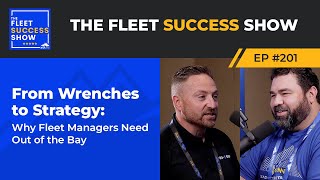
Mark Canton from RTA and Drew Morrow, who runs a small ambulance fleet in Cambridge, MA, discuss how fleet managers can shift from hands-on technician work to strategic leadership. They cover preventive maintenance execution, total cost of ownership, and workforce development challenges in small shops.
Chapters
This is the Fleet Success Show dedicated to helping you and your fleet succeed using the experience of fleet professionals and Hall of Fame fleet legends. The show that explores how the pillars of stakeholder satisfaction, intentional culture, resource efficiency, and risk management all combine to lead your fleet to success. We're glad you're here. Now let's get into the show.
So hi everyone, welcome to another episode of the Fleet Success Show here live from Las Vegas at the Planet Hollywood at our user conference FleetConnect. We are super, super pumped. I think most of you know me. I am the VP of Product and Consulting here at RTA, Mark Canton, and I'm joined by my good friend and colleague Drew Morrow. Drew, tell us a little bit about yourself quick.
My name is Drew Morrow. I've been in fleet since, uh, geez, 1995. I've been working on trucks, whether it's on, off-road, whatever. That's what I do. Graduate of Shawshank Valley Regional Technical High School. I gotta always root, hey Rams, you know, which same thing as Fordham, you know, but and you're taking a gamble on having me as a guest here in Las Vegas. So I love it.
Yeah, Moses loved us 'cause we had Rams everywhere. So Drew, where are you at right now?
So I run a small fleet of private ambulances in Cambridge, Massachusetts. We have 30 Ford vehicles. We run all the same equipment, all manufactured parts. So we have a nice kind of close little-knit group of vehicles that's pretty easy to manage. But really, Tough thing that we have right now is we have 1.5 technicians, me being half, 16 hours a week on the floor, and the one technician is leaving. So yeah, this is gonna be cool.
Well, let's jump right into that then. And then if there's time, I'm gonna ask you a little bit about Connect here. But so that's the, that's the starting point problem of telling your story. You're, you're busy turning wrenches. It's pretty hard to focus on the business, as Josh likes to say, right? You need to focus on the business instead of in the business. And for you, it starts right there. I mean, you literally have to, you're, you're, you're split into two people. And then that doesn't account for all the other fires that you have to put out, uh, you know, by being the fleet manager as well. Right. Yeah.
And I think the thing that I am trying to do is combat the chaos with a nice tight schedule. So I've gone into Outlook calendar and I block out at least 5 hours of Monday, Wednesday, Friday on working on the business with structured things, whether it's procurement plan, working with finance, building my weekly meeting that we have on Wednesdays, and I'm just trying to really block it out. And if somebody says, hey, we gotta talk about safety, it's like, nope, this is my time to talk about safety. I only have a certain window of time to work on the business. I'm in a very structured zone on Monday, Wednesday, Friday, and then Tuesday, Thursday, I let my technician that's on the floor be my boss. So he says, hey, this is what's most critical to work on today. And then if somebody tries to, talk about any leadership things. Nope, I'm a technician today. I'm not doing anything leadership. So got it.
So that's great. So what you're talking about is you don't have a time issue, right? You have a prioritization issue and you've really tackled that beautifully, exactly how we might recommend in the book. You've made it very, very clear what your priorities are and when they are, which always you should review and think about, you know, sometimes. But yeah, that's great. That's great advice for especially for young fleet professionals who are out there. Kind of listening to this, you know, getting really tight on that is super powerful. So let's, let's dive in then here. So you're saying you're having some trouble telling your story. What, what is, what is the, what is the story you're trying to tell, or what portion of the fleet? Give me a little more insight here.
I want the fleet to be as important as providing medical care to the community, to leadership, right? And really in my fleet or in my company, fleet is secondary. As long as there's no trucks broken, they don't really care what's going on. Great example of this issue is scheduling of vehicles. So we know that we run 15 trucks every day. Anything over and above that 15 trucks, the operations team knows about it, but they don't share it with fleet very well. So all of a sudden I'll go to PM a truck and I'll walk to the other side of the house where the trucks are garage and I'll be like, "Hey, I need this truck today." They're like, "Oh no, we have 5 details." And it's like, Well, how come you didn't tell me that? So we've talked about communication and being clear a lot this past few days here at Connect, and there's not a good clear line of communication. And I think with having to prioritize my time as much as I do, I don't want to try to present KPIs that they're just gonna put in the delete box and not pay attention to it, right? So is it through dashboards? Are we gonna talk about availability, right? Just in your last presentation about utilization, that was one of the things that I thought of. Okay, hey, I'm going to ask these guys what's most important about fleet to you and maybe start building my KPIs off of that.
There you go. So that's it. So right in the head, what we talked about and folks have heard us say on the podcast before is understand utilization in terms of what it means for your customer, which are the, you know, sort of the health providers folks, what it means for them in terms of executing on their mission. And if you can translate your sort of your traditional data, you know, whether it's trips or hours or miles into, let's say, value added or execution of that mission, that's going to help you to reframe the conversation to leadership who's really all about the healthcare. And you kind of don't blame them, right? Like, you get it. Yeah, we exist for the healthcare and the truck is a means to that end. And I'm sure you know that that's true for a lot of folks out there. School bus, transit, you know, you could go on and on, right? And yet it may be a means to an end, but darn it, if that means ain't there, the end never happens.
Yeah, right, exactly.
And that's the— that's really the story you want, right? So like, I'm hearing you tell these two portions together about the communication and about your structure, and I'm thinking, well, yeah, right? You, you're on the shop when you're on the shop. You got those days for the communication that you have, and then you walk in and you go in and you go to grab some PMs and nothing's there, right? Like, it's not all that surprising in some circumstances. So I'm curious if you know— do you know how many PMs you couldn't execute because of that lack of communication? Like, is that being tracked somewhere?
Right. I guess that's maybe a KPI, right? When I go to— how many hours a week does the technicians get disrupted by lack of communication or lack of sight to what the real schedule is?
Correct. Because I mean, again, there's a lot of ways to skin these cats, but something— it sounds like something as a shared calendar would solve that problem. And just someone being accountable to make sure that they're filling it out properly would do it. So yeah, I would track how many PMs got missed, uh, how many times were we over, you know, beyond our thresholds, etc., etc., you know, because of it. In the past, you and I have talked a bit, and, and, you know, you've done some great work around the liability that gets created from not doing your PMs, especially in your industry, because when those lights are on It's all your fault, right? So, and, and, and, you know, anyone who's ever been involved with an ambulance corp, you know, I, I did have some time, not nearly your experience, but, you know, out for Fordham, you know, you know that the minute that, you know, there's going to be accidents, lights are on, your fault. And what's the lawyer is going to do? They're going to dig into that maintenance record. First thing they're going to do, right? They're going to dig into the driver and the driver history and the maintenance and the maintenance record, right? Like simultaneously. So Yeah, how can you tell the story there? What is our risk? What is the value of that? You know, in some way, maybe risking out more to reach out more to risk management as well and kind of understanding that I think is key.
But I got to tell like a phone call that I do reverse because risk management is me as well.
Oh, okay. So that's actually plays well into what I was just about to say, which is, if you don't mind me saying, I think the biggest story you need to tell is you need help, man. You need more people.
Yeah. And I think that's one of those things where when you go and ask for different, you know, resources, you know, infinite resources, time and money, what do you prioritize? Is it better, like we talked about in utilization, to prioritize more new vehicles? So now the impact on labor is less because we don't have to be spending as much time on things that are outside of PM. We don't have to spend as much time transporting vehicles to sublet, fenders and stuff like that, or do I try to get an admin or a part-time admin? So I mean, that's like a tough juggle too. And I think the utilization thing to me is just— I mean, the replacement plan is the most important thing. If you can get rid of having to do any of these complicated in-depth repairs that really take my time, right? Because I'm the guy that's going to have to do 90% of the diagnostics. I'm the guy that has the experience. If we can get rid of those by just buying new vehicles and getting rid of vehicles when they have more life left in them, that's going to be the key to success there.
Yes.
But that's maybe what I'm having the hardest time proving because they're just worried about each and every time we buy a truck, it's $250,000 just to get the thing to roll on the road, right? So now you do that times 3, you're almost spending $1 million a year on new accumulated CapEx. And with a small company, that kind of weighs a little bit harder than— and this is part of painting the picture— when the CapEx is low and they don't have those monthly payments and your salary is running right in line with that, it's easier for them to digest than seeing that initial payment of, wow, this invoice just came in for, for a brand new $250,000 truck. Yeah, right.
Yeah. So, um, there's two thoughts on there, and we did talk about them a little bit, but this is, this is the key part of the story you need to tell on that front. Okay, number one, they're not paying $250,000 per truck. They think they are, right? They're paying $250,000 a truck minus what they sell it for.
Well, but then if they don't get rid of it until there's no value left, right? I hear you.
But OK, but let's say they do that.
Right.
When is that?
That's usually— right now, we're at 8 years. And it's 225,000 miles. So I mean, the last time we got rid of trucks, it was— I don't know, maybe we got $16,000 for it or something like that.
Yeah, so I'm not smart enough to do that on my head. So everyone here can laugh at me, and that's fine.
OK, while Mark really deep dives into his calculator, can we say that this is going to be the coolest podcast with the best accents, right? It's the Wicked Pissa Podcast.
Yes, we got New England and New York in the house, right?
And we haven't battled over sports teams yet, but that may come.
It may come. I mean, we don't need to because we all know that the Yankees are the best team on the planet and Tom Brady is the best thing that ever happened to football, except for Eli Manning. Yes, we can, we can agree on that, right?
Uh, thank God for the head catch. I mean, that's all I can say.
No, no, no. Tom was better, but Eli was clutch. That's all I want. Okay, so the thing about it is, and this is just using straight line, it's not using market value. In reality, you're spending about $31,000 a year there on that CapEx, right? And that's if you're going the whole 15 years, it would actually be less, like you said, if you got rid of the vehicle when it still had some value before that M&R. And we just got it. We gotta look at your M&R costs, right? And we gotta make sure, and this is a key, that they're fully burdened. Most folks, when they look at their M&R cost, they're looking at the salaries, like you said, and then it stops there. And it's like, well, what do the supplies cost? And what does the shop cost? And what does the— so forth and so on, right?
I think the most important thing too, when we're talking about fully burdened labor rate and the cost of the vehicle, it's interesting to really dive deep, and especially in our industry, into all of these little tiny incidentals. Your telematics cost, the cost of your— so not only do we have telematics, But we also have a cell service for the modem inside the vehicle that transmits all of the paperwork and stuff. And when you're really looking at these costs, you don't think of those really small incidental costs. But when you talk about it and it's $100 a month on this vehicle, like that adds up over the lifetime of the vehicle.
Yeah, it adds up quickly. But I agree with you. I think the approach I would take is first say, look, the step one is let's replace these things more quickly. There's plenty. I mean, I know I've been away from it for a few years, so last time I was truly heavily involved with you know, an ambulance group was probably 2017. So I want to put that out there. You tell me though, back then there was a tremendous aftermarket for ambulances. There were tons of mom-and-pop places that would buy ambulances, you know, 7 years old, 10 years old.
That's—
that was the case back then. I never ever ever had trouble selling an ambulance. And when I couldn't sell them locally or within the country, I sold them overseas, sometimes for more than I could get them for, uh, sell them for in the States. So I don't know if that's changed, but my experience is there's usually a pretty decent aftermarket.
I think it becomes, and especially since the pandemic where vehicles, again, weren't— you couldn't get vehicles, right?
Yeah, that spiked it up.
And now with cost of new vehicles so high, and it's such a long lead time on vehicles, they've gone real heavily into the remount market, which this is something that we're exploring as well. But finding a good qualified remounter that fits into all of the specifications and is a licensed remounter is even more difficult. And their backlog is even longer than the original manufacturers. And if you don't have that relationship built already, you can't get into remounting either. So I do think that there's avenues, but it's interesting to maybe start looking at maybe some of these auction houses and stuff like that because the mom and pop guy that you used to use, they're now kind of a little, um, flooded in the industry.
Yes.
And they're maybe, the ability for them to be able to pay what you're looking for, maybe even on a newer vehicle, they don't have that cash because they're doing the exporting where they're sending it to off-seas, overseas, and it's a little bit more expensive for them.
Sure, sure. Well, you know, we weren't using— so remind me, the 250s are what? Those are Type 3s?
Yeah, so it's a cutaway. So it's a Type 3. It's a van front and a box on the back. So there's 3 different style ambulances. Type 1 is pickup truck on the front, box on the back. Not a cut chassis. It's separated in between the cab and the box. Type 2 is a van type. So it's a modified van ambulance, whether it's a Transit, a Mercedes, or a Dodge Promaster. And then Type 3 is van cutaway front and then a modular box on the back.
Sure, sure.
And I mean, there's tons of qualified manufacturers out there. Just depends on what you're really looking at. Maybe I should have said licensed manufacturers. There's not a real ton of really great built ambulances, but—
That are also bailment companies who can maybe take yours and resell it, right?
Right, yeah.
I mean, we used to buy all the ambulances ambulances and then have that provider resell it for us as well. And we made a ton. We get rid of them in 5 to 7 years and we put no mileage on it because it was around the local university campus, right? Um, but anyway, the point is it's something to look into. And I agree with you, start, start looking there because if you can get rid of them before you have those problems, but you're going to have to be able to make the case and say, this is my residual value. So there's going to be a little more research on your part. Because you're gonna, you know, it's gonna be dependent on getting decent returns in order for the TCO curve to make sense. Nonetheless, I would present them with options, right? Like, hey, this is the way I'd like to go, okay? But either way, listening to your story, it sounds like you kind of need a mix of both, you know? And, you know, one of the things that I think is like really key is you guys have so much single point of failure.
Yeah.
What, you know, what, what happened? So, so let me just make— I'm listening to your story and I'm like, okay, so if your mechanic's off that day Like, I'm assuming they're entitled to vacation.
Yeah.
Or getting sick.
Right, right.
So now they're off that day and it's your leadership day, so nothing happens that day in the shop. The shop stops. Yeah.
Perfect example, uh, last year I had to have rotator cuff surgery. So I had rotator cuff surgery, this guy was the only person in the shop, and if he got sick, everything had to go sublet. And at that point, it's this emergency to— and you have a little bit of a plan of redundancy, and with different sublet people, you know, you kind of reach out to them beforehand, so it isn't an emergency. But at the same time, you go from a very, you know, qualified in-house repair facility to nothing in the blink of an eye.
Right.
It's unbelievable.
Yeah, exactly. And, and again, like you said, there are, you know, there are outsourced groups out there, but they're hard to find. And depending on what part— I mean, in the Pacific Northwest, for example, we're seeing a lot of counties like band together because it's so hard to find qualified EVT, you know. And, and so they'll have a shop and this county will say, okay, we do ambulances. you know, kind of a thing. And they'll do it for maybe several counties near them, right? That's one thing. That's another thing to explore because outsourcing for you is much, much harder. I remember sending out ambulances, they were built on the— on Ford chassis, and it was like, yeah, we'll touch the chassis. It's like, well, no, no, this is a certified upfit. You're supposed to be able to— it's like, well, yeah, we're not saying you broke the warranty, but we just don't know freaking what to do, right? Yeah, we have no clue.
And especially in ambulance world too, it's not like you can find 5 or 6 6 ambulance dealers within a 50-mile radius. It's your dealer is the one, and that's it. So it's interesting that you go down the avenue of banding together, and this is something that I'm trying to kind of forge better relationships. We're starting a new, um, well, I'm part of the Mass Ambulance Association, so we're starting a new fleet, um, networking committee. And I'm, you know, of course, because I have a loud mouth, I'm the chair of the committee and just trying to build better bonds. But unfortunately, in private EMS, there's too many, too much bravado involved, you know? So if it came down to, hey, could you fix my truck? Or hey, could we do this together? There's not enough of those connections. It was unbelievable. I mean, day one, it was like, oh, what, you know, how many people are here from trucking? And there's 30, 40 people standing up. My buddy's here from trucking. He was like, hey, they said other, you should stand it up. I stood up. I'm like, oh yeah, private EMS. And then actually there's another kid here that is the largest—
By the way, kid is how we speak. He means adult, but we don't have under 18-year-old folks here.
Child labor laws or anything like that. We're doing all right. Largest private ambulance company in the state of Michigan. And I know his boss. We run a relay race each and every year, and he came from Michigan to run the relay race with us once. So you have these connections that we don't even really foster that relationship. And then all of a sudden, bam, we're at, you know, this conference and a guy that I know is here. So I mean, that's a tough thing in private EMS.
It is weird 'cause you guys have this cool, and we're going off topic, I promise we'll bring it back, but you guys have this like, cool camaraderie and cool, like, culture. And it's, it's really very special on the one hand. And on the other hand, like, it's true, like, you get together and you'd rather fight over who has better lights. Yeah. And who— right, you guys fight over your lights.
Yeah. I mean, it's crazy. We were talking about that too, you know, last off-subject thing, but trying to help the manufacturers with backlog in building more, you know, hey, this is your option 1 or option 2 of, like, a cabinet design. And we can't even get together on that to have 1 or 2 options to help the manufacturer speed up and cut back on backlog.
Right. You all want what you want.
Right.
And this is the best way and the right way. Yeah. It, it, it becomes challenging. I'm listening to your story. Obviously I've never dug deep into your data, but I, I gotta tell you my first instinct, and I'm curious to know what Josh and some of the other SMEs definitely pick their brain, but I really think it starts with, with, with you and your team. You know, you are the leader, you are the subject matter expert. You know, you know your business well, you know your assets well, you know your fleet well. Like you're the ideal guy for this, spot in that regard, and yet you're not able to use your, your time and your experience and your expertise strategically nearly enough, right? Nearly enough. So even though my instinct— and I just taught about, hey, you can fix technician issues, you can fix M&R issues by going after replacement— and I totally agree with that, I'm not saying not do that, but if I'm you, I think I spend a little time kind of figuring out, hey, how can I make the case and the justification for Maybe if you— even if you just start with one other tech right there, right? Um, so that you're now only the backup tech, right? You're only turning wrenches maybe when someone's sick or, you know, that sort of a thing, or they need your help, you know, fine. I'm not saying you totally— but you really kind of back— and it's tough. Look, the truth of the matter is this. This is what we see on the consulting side a lot. The smaller the shop, the less efficient it is, right? That's the, that's the plain old truth. Yeah. Do simple math. If you got 10 techs and one's out, out, everybody takes on 10% more work. If you got 2 techs and somebody's out, that person had to take on quite a bit more work, right? So it's tough to be super efficient in a smaller shop. That, that much is, is true. And again, you've seen some of the ways Tony's given, you know, some talk about that. Hey, you know, look at what your, what your labor load is. Look at how much work, uh, needs to be done on those assets. You can do that via EAU. You can look at your historical data in 360. And say, okay, this is how much time we need to build to work order every year. Uh, you know, this is, this is how many mechanics we need, is how much time we are capable of billing when you think about your PTO and those sorts of things. And, and then you can pretty quickly do the math of this is how many techs we need. Now the key with you guys is, I mean, I'm guessing, I'm going to put words in your mouth, but I'm guessing you got to outsource quite a bit.
We actually do a really good job, and without doing the VEU study, I really— and the technician and I had a conversation about this earlier on in the year Hey, you know, I think we could use another guy. And I see totally where you're coming about from, especially with redundancy. But you look at some of these other fleets, I mean, they have 300 vehicles, 400 vehicles, and they have 6 or 8 technicians, right? So that sweet spot of maybe 1 to 21 transporting trucks, it really, I mean, isn't that crazy. I mean, if I had to guess, right, and just off the quick model that Tony had with, the sedan being, you know, 1 VEU or you, I would have to say, what do you think in ambulances, 3, 5 or something like that? Something like that. Right. So I mean, when you really think about it, I'm not sure that we're super far off with the 1 technician, but maybe utilizing the expertise is kind of, you know, where we're struggling. And, you know, the presentation that Mike just made and talking about for every 5 people that leave, only 2 people that are coming in, I'm really trying to, you know, champion this campaign. I've spoke to 4 different high schools just in the area, right? I mean, being in an urban area, I'm sure in New York it was similar. There's not a ton of voc schools like I went to right in the urban areas, but some of these high schools have pretty good automotive programs. So I think really the avenue that I need to try to push down is, hey, can we get one co-op student and then a full-time tech? Because even if I have to kind of train the co-op student, at least I'm not 100% hands-on. If I'm in the garage, Maybe it's only instead of 8 hours twice a week, maybe I'm really only dedicating 4 hours twice a week. And we're building that foundation and really propelling the industry a little bit more by, you know, giving these kids the foundational knowledge to then go someplace else.
Sure, sure. So there's many ways to get from point A to point B, right? And what we're talking about is different options of them. The key is in convincing leadership is it comes down to that math and it comes down to that money. Because the third option I'm going to mention to you is maybe you, you, you, you know, you push harder on, uh, on the outsourcing companies and you get SLAs and you get yourself priorities and you get KPIs and return times and things like that. And you say, you know what, this is what we're going to do. We're going to be a PM shop. We're going to do our PMs, we're going to do our big inspections, and we're going to be a diagnostic shop, maybe, because, you know, you know it better than maybe— and that's it. And anything that's going to take more than a day, we're not letting it sit here and we said we're sending it out. That's another way to skin the cat. But either way, what you definitely can do is look at what is the cost. It might be cheaper that way. It might, it might be cheaper to keep it in-house, in which case you can also use that data as well to justify that other tech. Whatever way you go, I'm pretty convinced from talking to you, we need you to get out of that day-to-day shop, right? Yeah. We need you to be sort of separate from that because the only way for any of those things you're talking about to execute on You need time, right?
Time.
You need time to execute on them. They— and so, and so your company needs you to convince them to take you out, and your mechanic and future mechanics need you, and, and your, and your users, your, your drivers and so forth, they need you to get back. Because for the betterment of the organization, we need someone thinking strategically about how am I going to manage this fleet, how are we going to push efficiency and get better and better and better, right? And right now you, you, you're not really getting to— you're doing that more probably this week that you've gotten to step away from it than you probably do in 3 or 4 weeks, you know, on average when you're back at the shop, you know. And so I'm convinced of that. I got to be honest with you, even without looking at the math, you know, we got to get you in a spot. Again, doesn't mean you never turn a wrench again, but, you know, we got— let's get you into leadership there, right?
And I guess this brings this conversation full circle. We started off on a totally different topic about painting a picture to leadership, and with that struggle and going back to the company needing me in a strategic role, there's nobody else that's doing it, right? And that was the baseline of the conversation in general. There's nobody at the leadership level that's thinking fleet and thinking any type of strategy.
All the more reason they need you to be that person.
Right.
And in your shoes, you might need to maybe call a consultant or someone because you just don't have the time to do it yourself. Doesn't mean you're incapable. It just means someone's gotta come in who's that extra voice that, you know, that, that may help you. It's one option, something to consider. But with that, Drew, we're outta time. Let us know whose accent you like better. Drew's or mine. Also, let us know when we're speaking as quickly as we are from the Northeast, who do you understand better, Drew or I? And also, finally, um, let's agree that the Yankees are the best, uh, sport— sports team in North American history. And with that, thank you for joining me, Drew. It's always a pleasure.
Thank you for giving me the time.
This is great. Let's do it again.
Huge fan from the beginning of the show. I have an autograph draft picture from Steve and Josh, early days. So this is an honor of mine.
I appreciate it. All right, but commit to me, I can have you back on when we have more time.
Definitely.
All right, man.
Thank you.
Awesome.
Great. Have a great one.
Take care, everybody.
Thank you.
We hope you enjoyed the show. If you'd like to help support the podcast, please share it with others, post about it on LinkedIn, or leave a review. Want to learn more about our fleet management software, Fleet 360? Check us out at rtafleet.com. If you want to learn more about having your fleet evaluated by our consulting team, Go to FleetConsulting.com.
More from Josh

Episode 227: The Hidden Costs Killing Fleet Operations (It’s NOT What You Think)


Episode 225: Are Certifications Still Worth It? The Truth About ASE, CAFM & Fleet Leadership




Episode 221: The State of Fleet Management: Education, AI, and the Technician Crisis with NAFA’s CEO

Episode 220: Motor Pools Are Back: Right-Size Your Fleet Without Breaking Operations

Episode 219: Stop Guessing at Downtime: Status Strategy for Better Availability #podcast #fleet

Episode 218: Fleet Predictions 2026: AI Hype, Technician Shortages, & the Next Era of Fleet Managers

Episode 217: Why Replacement Planning Solves 95% of Your Problems #podcast #fleetmanagement #fleet