Episode 203: Fleet Leader AMA: What Top Fleets Do Differently (Live from Connect 2025) #podcast
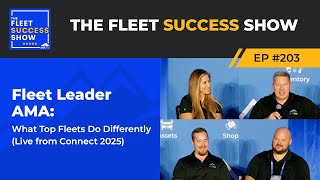
Fleet leaders Jake Johnson, Sarah Burnham, Jesse Ostovich, and Chuck Kramer answer questions about what separates top-performing fleets. They discuss replacement planning, PM compliance, key metrics like availability and turnaround time, and how to build a culture that keeps technicians.
Chapters
Hey, welcome back to the Fleet Success Show. This episode we're doing a panel interview. This is also from RTA Connect 2025 that we just recorded here recently with a panel of some of our other experts that you haven't heard from very often, right? We, we hear from Mark, Steve quite often, but this was with Sarah Burnham and Jesse Ostovich, Jake Johnson, and Chuck Kramer, who were all new members of our team. Subject matter experts, fleet managers in their own right. We thought it would be fun to have them on a panel answering questions from the crowd as well. So we created an episode of the podcast just for that. Hope you enjoy this. Let's go ahead and tune in now and get into the show. This is the Fleet Success Show dedicated to helping you and your fleet succeed using the experience of fleet professionals and Hall of Fame fleet legends. The show that explores how the pillars of stakeholder satisfaction, intentional culture, resource efficiency, and risk management all combine to lead your fleet to success.
We're glad you're here.
Now let's get into the show.
Hi, I'm Sarah Burnham. I've been in fleet management for 27 years. Obviously, I must have started when I was 12. I've worked in the private side, mostly for government fleet. I worked for 17 years, was honored to win public Fleet Manager of the Year in 2023 and was very involved with applying for 100 Best. So I think some of you might have heard of me talk about that earlier this week. I want to encourage everyone to go for that.
Hey, my name is Jesse Ostovich. I've been in the fleet industry for roughly about 10+ years, a little bit over 10 years, anywhere from local government to private fleets and military as well. I was also a customer of RTA before joining the team, so it's been pretty good ride actually.
I'm Chuck Kramer, so I've been in fleet for 34 years. I started off in the Air Force, so I did military thing for 25 years, then I went to the city of Lynchburg for 9 years where at first we did not do the top 100 fleets, but And any of you know Tom Johnson? So Tom Johnson used to tell me, Chuck, you need to apply. Chuck, you need to apply. So anyway, my last 4 years we applied and we're in the top 25 each year with the last 2, number 5, 2 years in a row. So that's really good achievements there. And then Mark Canton said, hey, and actually Josh, hey, why don't you come on over to RTA? So You're on.
Yeah.
Hi.
So Jacob Johnson. I've been in fleet for about 18 years, in the industry for just over 20, mainly on the heavy-duty tractor-trailer commercial side for private and dealership. I was a previous user of RTA for about 3 years prior to coming aboard, and I also completed the Classic to 360 transition with my team. Your turn. And Drew is going to come out swinging.
Tips and tricks for convincing leadership that you need to make adjustments in your fleet replacement plan. Numbers. Data is everything. You know, we're a software company. We're going to tell you data, data, data. Right. But it's true. You can run the numbers 15 different ways and they're all gonna say the same thing. You have to make sure your data is accurate before you do anything. You've seen the replacement planning classes, I'm assuming, you've been here this week. It saves money. And you'll have someone that'll say, well, these are fixed costs or, $12,000 to fix it versus, you know, $60,000 to buy it. You got to show them the long term, show them the charts, show them the graphs, make sure they know about the auctions, right? Because if you replace them on the right schedules, you're going to get 15-25% more than you would selling them later when they fall apart. Definitely data.
Yeah. So to add to that, How do you get that data, right? So you want to make sure we're doing the right things. You want to make sure the systems are set up properly so that you can track that data. You want to make sure technicians are getting their time, the parts, everything getting tracked onto that asset. So it all starts with the setup side, guys. So if you're not set up right, bad data in, bad data out. I'm sure you've heard it your whole life. So you want to make sure we get it set up, make sure we're getting that data in there correctly. And to be able to pull those reports to show those graphs and set them up on your class codes too.
If you don't, if you don't do your replacements via class codes, definitely start.
And it's also about effectively communicating it, right? And we've heard about the word simplify, making it simple too. So if you make it simple and have the visual aids there to effectively communicate the data, it does make it a lot easier projecting that to your leadership.
And I'd also add, don't forget about new technology that comes with new vehicles. You could have newer safety features. How much is that going to save you in accident repairs? Better fuel economy as well. You could figure out how much— what's the fuel economy on a 2025 versus a 2010 or however old your vehicle is. And you can show those numbers to your leadership to show how much money you'll just be saving in things like fuel and safety.
And don't do the remounts.
I got a mic I can bring to you, or you can always walk up to that mic up front.
Either way.
Hi, I'm Wayne from British Columbia, Canada. I'm an advocate for training my staff, getting them up to date.
I get resistance from that from upper management.
My question to you is, how can I send that message to senior leadership that the training of our staff is integral to the success of our fleet?
I get the question, you know, what if they leave?
What if we train them and they leave? And I said, My response to that is, what if we don't and they stay? That brings a bigger problem. So just looking for a message to send upper management. Yeah, I'll kick this one off. So two sides of the coin here. So as far as what if you train them and they, and they leave, right? There's always that possibility. Culture. I will say RTA has created a great culture. If If Josh were to provide me training, I'm not going anywhere. So you want to, you want to start with leadership on that aspect. And then as far as justifying the training, this is probably the opposite of what you should do, but I'm going to recommend it. If your guys aren't trained, send it out, rack up the bills, right? Make them understand because you got to show them in dollar figures. If you guys can't fix it, you got to send it to a third party. You're going to rack up the dialer figures and they're going to go, how can we prevent this? I need the training.
There's also— reach out to your manufacturers. Some of them provide free training. NAPA, particularly if you outsource to NAPA, they actually have a really nice training program. It even includes ASEs. And I would also say that the industry standard is you should at least be having techs trained 40 hours a year. So, you know, when you have the data to say industry standard says this and we're only doing 10, you know, we need to bring us up to industry standards.
Yeah, for sure. Take both of these together, right? You get the OEMs if they're local, and NAPA does really have a really good one. Thousands of online training classes as well as some in-person. You have to take— maybe don't exactly outsource everything, but use those numbers. Say, hey, we could save— right currently we outsource 34% of our fleet. Industry standard is, you know, 15 or below, or 20 below. So the savings that we could have based on $1,000 for training, we could save, you know, $15,000 in outsourcing and things of that nature. But you definitely, definitely want to do that. Also local schools. So if there's trade schools and/or colleges that they'll— they can offer training too. And with your— when you're writing your specifications for, say, dump trucks or excavators or whatever, definitely build the training into the bids.
And to also promote the need for training to your leadership as well, you can also utilize the data from tracking technician efficiency. So, you know, if you use the software to track that based off your estimated repair times versus actuals, then you can find those skill gaps. You can actually use that data to present as well.
And I would add tracking return repairs as well. So if you're having a lot of return repairs and you can show that, that's an excellent metric.
So if you're not tracking labor efficiencies and the other KPIs, then definitely start running those. Come on, David, what you got?
For somebody like us that are diving deep for the first time in all of this realm. To your perspective, what are the 3 metrics or KPIs on the dashboard that you would say are the most crucial to start off with and that would lay the foundation for or groundwork for future success when we start to dive into other KPIs?
Mark Canton. Availability, PM compliance, top 2. You don't want to focus on too many. You want to track as much as you can, but keep your focus narrow. Get it right, broaden it. Narrow, get it right, broaden it. But availability is everything to me and apparently Josh. If you don't, if you can't use your vehicles, then what does any, any other KPI mean? Right. So your vehicle availability, PM compliance, which can drive availability.
I love to track customer service because if your customers aren't happy, that's a big risk to you, especially when people are looking at budgeting and budget cuts and should we outsource fleet? If your customers aren't happy, you're, you're putting yourself in a really bad situation. And luckily, RTI does offer that capability to not only survey your customers, but also your employees as well.
I have to add to the availability and PM compliance too, actually. I was monitoring a lot for the time length of work orders, how long they were open versus shortest to longest as well. It helped me get that benchmark of where I needed to work on when I added all those together, basically. Like, to help me get my starting point.
Turnaround time.
Because no one goes to school for fleet management, chances are you were never formally trained on how to successfully lead a fleet. That's where the Fleet Success Playbook comes in. The Fleet Success Playbook is your guide to building a safe, reliable, and efficient fleet that provides exceptional service. Learn all about the 4 pillars of fleet success: stakeholder satisfaction, intentional culture, resource efficiency, and risk management. Get nearly 100 years of combined advice on common challenges, practical solutions, actionable tips, and real examples from fleet industry experts who have been there and done that. Visit www.fleetsuccessplaybook.com to request your free copy today.
So when you guys had staff and you achieved a minor goal or a major goal, what were your celebrations?
It could have been anywhere from an attaboy to a full-blown party. So what I did at my previous job, we did monthly. So if somebody came in and made, hey, I passed this ASC, you know, it was a big hoorah then as well. You know, hey, everybody, you know, this, that, and the other. But we did a monthly called a First Friday, where we would take 2 to 3 hours at lunch and we would celebrate birthdays, ASCs, whatever other certifications, births, you know, birthdays, work anniversaries. So you could do anything depending on if it's ASCs, give them a pay incentive. But don't forget the good job, do it, Publicly, you know, discipline privately, you know, praise publicly. But don't not. Doesn't really matter what you do, it's just when and how you do it.
Yeah, so for me, I ran several union facilities. So to that note, we were kind of limited on how we could reward. But we found creative ways, whether it was doing a one-on-one lunch. We would take a guy out and treat him to a nice lunch. Lunch or, you know, slip them a gift card or something of that nature. You know, the parties and the lunches in the shop were always great. Everyone appreciated them, but it wasn't like— we tried not to use it as recognition. It was more of a— just a morale-building tool. The recognition we tried to do more on one-on-one at our place, just because if they earned it, they earned it, not the team. Now, if we hit team goals, we would do more of like a cookout. We'd bring in a bunch of meat and just kind of, you know, essentially write off a bunch of labor for the day and just have a good time at the shop. We'd put cornhole in the bays or, you know, play some games or find creative ways to do some safety training with some games so that we were still being productive. But we kind of made it a fun day rather than coming in and doing the same old grind.
Can I say, be careful though, because we did the food as well on the First Fridays. When I got there, I had a 28-inch waist. That's how much.
So I also like to put things in our annual report. So who's got promoted, who received annual— sorry, ASE. Master Tech status. Anybody that's had awards, that's another great way to recognize team players is creating reward programs and recognition programs. There is, I believe it's on our webpage, rtafleet.com, we created a template for an annual report. So you can kind of plug in "Here's some of your key initiatives that you want to share with your team." And I will say that the people that asked for it the most was actually our employees, because they wanted to take that back to their families and show all the work that we did as an organization.
It's definitely all about the food, games, and awards. And one of the things that I actually felt really good about when I was a fleet manager was that I was able to actually convince to build a budget for an annual basis. So that actually I can go out and get like little mini plaques or like little wrenches with their names carved into them and whatnot to be able to show the appreciation. So, and they actually really enjoyed those little trinkets too, just like you said, by being able to come home and show their families and have that passion.
And it doesn't have to be expensive. I went on Amazon and bought these little, you know, everybody gets a trophy trophy and you decorate them with stickers and they love them. They put them on their toolboxes, up on the windows.
Yeah, I will say one thing. I mean, as a technician, a lot of us came up from the shop. What would you have wanted from your leadership? Right? Simple question. What would you want to see from them? We're in a position now to try to accomplish that. So just put yourself in their shoes.
You bring up a great point. We actually created an employee appreciation committee to actually— so they could give input because it's like, why am I the one that's deciding, you know, what we're doing? Let them decide.
Great point. A big one for a lot of people is involve their families. You know, if you do a— off-hours event. Let them bring their spouses, let them bring their kids. This is their life. They spend, they spend more time at work than they do with their families most of the time, as many of us do. So it's important that they feel comfortable to bring their families and participate as well.
What makes a best 100 fleet and how did you get there? And name your top 5 things you had to work on in order to get to that.
Top 100 fleet. It starts right here with RTA. Apart from bribing the judges.
So when I started to apply, first thing I did was download the application, right? Well, little did I know that that application became my guide to running my fleet. It opened my eyes to— and we had a good run of fleet, we really did. But when you get into the application, you say, oh, wait a minute, I never focused on this KPI. And then there's this one and there's this one. And how do we have data if we don't have this? It opened my eyes, our eyes, and we started doing it, right? Everything that was in there, we said, okay, well, we're not going to win anything for this this year because we didn't do it. But we learned and we built on it. And then we did what we did. But the word we, I don't know why I had said I in the beginning, but we was the key. You have to involve everyone. It has to be the same focus, the same goal. Everybody needs to be on the same page. So we built interest, we built excitement, and we got input from everyone. Because no matter if you have 10 people or 100 people in your organization, you as the fleet manager are not going to know all the great things that all 100 or 10 or 100 of those folks did, right? So we started a tracker. We had spreadsheets based on the KPIs and based on the measurements that they looked for in, in the application. And it was open to everyone. It was on a SharePoint, and folks would put in the things that they did. Savings that they had and all that kind of stuff. So the most important thing I could tell you is read the application and live the application. Because even if, even if you don't make it, you're just an, you're an honorable mention or, or you're number one, doesn't matter. You're building upon what you already have. Get the foundation, you build, you figure it out, and you move on.
And don't forget, you're the cheerleader too for the team. You know, ultimately that's what it is, is you're trying to maintain that team environment and accomplish those goals based off that application as a guide, you know.
I'd also say don't— so it is heavily based on metrics and having those metrics, but I wouldn't focus on how good your metrics are. The key is to say, Okay, my availability's, maybe it's at 90 and we wanna be at 95. What are you doing about it? That's what the judges wanna see. And even better if you can say, well, this is, last year it was at 85 and this year's at 90 and then this is what we did to get there. So as long as you can tell your story on what you're doing to be better, that's what they wanna see.
Based on that, well, in conjunction with that, they give you very specific instructions on how to list things. So basically in order. So at the end of one of the sections, you'll have a lot of additional characters that you can elaborate on the above sections. There's very explicit instructions to do it in order of the above sections. Many people don't do that, and they will comment on that if you don't. Once you have applied, no matter where you finish, at the NAF event, see the judges, get their feedback so that you can build and build. And with the— you don't have to be perfect. I once had a sentence in one of mine. I think it was my PM compliance was poop, like literally poop and put a poop emoji in there and everything and explained how we got it better.
So we are PM compliance is poop, as you put it. How would you work on getting your PM compliance better and also turning more around to predictive maintenance versus reactive maintenance? Yes, so I would start by figuring out why. So ask the question why, and that go— that's a true statement for anything that's not up to your standard. Why is it not up to standard? Once you understand why, get a plan in place to make corrective actions, follow through. Check in, make progress, rinse and repeat.
Based on that, do you know why? I mean, so I actually at my previous job started, we actually started tracking two different PM compliances just for what they call it, S&Gs, right? Is it, I'm sorry, shop compliance or fleet compliance? And department compliance. So if the department doesn't bring it in, keeps it out there and we got to steal it or something to that effect, that's the department compliance. And then shop compliance was, was us. So again, start with why. Do we know why it's not? Is it training? Do you need training? Is it parts? Are parts not available? Or the department's not bringing it in. Do you have a quality control? Are you QAing every 3rd or 5th or 10th vehicle coming in and out? But definitely start with, if it's departments, think about putting a fine or a penalty or turn off their fuel card. You know, that'll get them in.
It does come down to communication, like you were saying too. So is it— you have to ask the question why to start off with. But like in my experience, I had an incident where we were out of compliance too, and it was because we were having issues getting the vehicles brought in. We were a large organization. We had multiple different departments. And from then on, though, I went and met with each one of those departments and built a liaison program where we had a fleet liaison in each department where I then scheduled out the PM reports on a monthly basis. And we actually were able We were able to write this into our SOPs then and hold the people accountable to bring those vehicles in based off of those PMs' due. So we were just building that communication and making it stronger and stronger where those liaisons not only were worried about PMs now, they're also starting to ask more questions about their fleet as well. You know, maybe they had further issues or complications that they just needed assistance with. So it started from that and then it even led to more, which was benefit.
And I would add, if it's not just PM compliance, do you need additional training, or are you having part quality issues? Is— are your processes inefficient that's, you know, causing things to, to have to come back because maybe the, the initial problem wasn't communicated well in the first place?
Do you have policies? Right. So I would definitely write it into policy and make sure that all your departments have it and your internal fleet employees know it as well.
Yeah, you definitely want that standard. So that's a good point. And to follow with Jesse, what he was saying, you know, a lot of the compliance that you may see getting departments to actually bring their vehicles in It's important to have that relationship with the department heads. You know, a lot of times we see roadblocks there, right? We see blockers where maybe we don't know who to reach out to or someone changed positions or whatever the case might be. It's important to make sure you maintain a healthy relationship with those department heads to be able to call and kind of BS per se and be, hey, you know, I noticed this truck didn't come over. Man, you know what, I'm sorry, I'm getting it over there today. To where if you're just sending emails to some name on a list, you don't have a relationship there. You're just expecting them to show up. They don't know who you are. They don't care about the vehicle. They got routes to run. So it's important to reach out and build those relationships.
Why don't they bring them to you? So with Government fleet, and then like, I'm private. So with, with government, it sounds like it's a hard time getting those vehicles to you. Obviously they're being used in the field for different things, but why aren't they bringing them to you? Is it because it's taking a long time for them to get the vehicles back? Is it because the spares that they have are inferior to the ones that they have? Can you give me some experiences that you had or how you addressed that?
There has been times historically, like I found when I was working in an organization that historically these, the, you know, whether it's internal, external customers, they would bring the vehicle in, but then something would always be found on top of the PM. But then again though, that led into some more data and research. And the reason why is because they were again, not bringing it in during those actual standard intervals. But, and it all led backwards to communication. Things weren't being communicated, you know, at a point to where then it created a ripple effect to where it just kept delaying the interval or delaying bringing the vehicle in on the interval times for that service. So then it started a trend to where people were worried about their not getting their specific vehicle back and they were gonna be put into a donor vehicle or a vehicle from the motor pool that's missing the center console or something like that as well. So, and then that's what led up to developing that better communication channel to fix that.
Yeah, I would always, I would always mention to our drivers as they come in to leave their vehicle with us, you know, the more often I see it, the less time I need with it. So if you want a quick turnaround, I need to see it more often. I want to make sure that we're putting eyes on it as often as possible so that when I do see it, it's not down for an extended period of time.
So another thing we did, it doesn't really have to do with them being afraid to bring it in, but we used to let them call us with a time. We'd send out a PM list at the beginning of the month. Hey, call to schedule your vehicle. Well, we found out rather quickly that they don't always do that. So we started scheduling for them and from the beginning of the month, They know, hey, I got to get it in here on this day or this day or this day. And it really was successful. But it does come down to communication, communication, communication.
Yeah. And I would add, we would start replacing our— we would rotate our loaner pool fleet with other vehicles to spread kind of that utilization around to make sure that our our loaners weren't the worst of the worst, because that does make a difference. They don't want to get into a brand new vehicle to, you know, go have a missing center console. So yeah, that's something to consider as well.
Yeah, one thing I'll add, intervals change, right? If you follow up with the OE on the equipment that you're running, we see intervals change often with new technology, new oil, you know, so just, just make sure you're following up and making sure you're following the industry standard, what the OE, what the manufacturer's recommendation, you know, just stay within those guidelines to make sure we're not pushing it too far. We're not doing it too early. Doing it too early is going to cost you a ton of money. Doing it too late is going to cost you a ton of money. So you want to be in that sweet spot. Just make sure you're following up. Every so often to make sure you're getting those intervals maintained. So just to ask more about PM compliance, in your experience, have you found that it's a better use of resource and energy to schedule departments in by department or group like vehicles, or just kind of using your, your your triggers on other platforms as the vehicle maintenance comes up? Because one of the things that I'm concerned about is like the way that we do it is, for example, we get Parks, let's schedule in all of your vehicles. Well, if they find more problems with their preventative maintenance, well, now they're down a vehicle. And so I don't know if like it makes me nervous to put a department out of that many vehicles at one time? Yeah. So I would start with— so something I did, I took over a fleet of roughly 1,200 assets and the compliance was poop. It was poop. So what I did, I went through with RTA's tools and I found every PM, when it was last done, very easily to report on. So I pulled that data out. I made sure that they were spread out appropriately. And what I found is that I would have some months that had huge numbers and then I'd have some months that had hardly any PMs being done. So you want to make sure those PMs are tangible, that you can accomplish them. So you want to make sure that each month you're being consistent so that you don't have these huge spikes and pitfalls, per se. So that's one way you can manage that.
Yeah, I would not personally recommend doing a whole department. I mean, it could, you know, if things do come up like you already said, it could shut them down pretty quickly. But definitely, um, uh, forecast it. Take a look and see, you know, can— like, like Jake just said, can I do 43 PMs on Monday? Probably not, right? So definitely spread it around. You have the— all the capabilities in the world, especially in your outfit where you're, you're kind of getting restarted. You have you have time and, and heck, we can work with you on that.
You could also even filter out to age and mileage too, you know, so it gives you kind of an idea of how much utilization the vehicle has been getting on top of the age of the vehicle to kind of help determine turnaround times on the PMs as well. So when you're pre-planning.
Yeah. So if you're doing it by department, another suggestion, if a department has 40 assets, take that, divide it by 12, that's how many you should do a month for that department.
[Speaker] Yeah, and I would definitely prioritize based on, like, if it's a specialty vehicle and you don't have a spare to give them, and what is that specialty piece of equipment used for? And also, be sure to remind your customers that when they go out for vacation, that's not the best time to bring it to Fleet because you have people out as well. So making sure they're bringing vehicles in all throughout the year and not just when they think their people are on vacation, because you have a schedule to manage as well.
In my experience, and they may have a different experience, but in my experience, PM compliance is, it's hard work. We have to put in the work, right? That's why we're fleet professionals. We're in a place to manage that workload. Do your homework again, ask why and find the reason why. Make, make changes to address that reason why. Make progress check-ins, do your check-ins and rinse and repeat. So that's, that's what we do. So it's not a walk in the park, but there are ways to manage it. And, and again, if you need more insight into that, You got Fleet Success Managers, reach out. We'd be happy to help you plan through that. Looks like we got a couple more minutes here if anyone has another question.
Uh-oh, here comes Mark.
Look at that guy move.
If we don't answer this right, we're fired. You all are extremely successful fleet managers. You've done it in the real world. I'm personally very proud to call you colleagues. And I think the answers today have been phenomenal. I'm really, really happy. What have you done? If you could each speak a little bit about how you've gotten here, you know, how did you educate yourself? What are the things you've done to make yourself learn more, to be better, whether it's the nuts and bolts of fleet management or just a better leader or just a better thinker or whatever it may be? How can our audience maybe learn a tip or two from you guys on you know, how you got so smart, how you got so good at what you are.
Investment in myself. That's the, that's the simplest answer I've got. Investment in myself on the off hours. It don't stop, right? Go out, do your research during normal working hours. We're expected to do that job right. But how can you help yourself in the office? By doing the work outside of the office. Go home, do your research, do your planning, come back with that plan and implement it. So invest in yourself, whether that's taking business classes on the weekends, night and weekends, or doing research, or taking Josh up on recommendations for, for books. That one helped me a lot. Read a couple books. That were really effective for me. So yeah, just, just take the time to invest in yourself. It all starts with you. You can't be a great leader if you don't take the time to become that leader.
Yeah, that definitely— for, for me, I always like to learn things, but I was never much of a reader. Josh has turned me into a reader now, but Knowing, admitting to myself that I didn't know everything, and realizing that no matter who the person is, that, you know, doesn't matter who a person is or their position or stature or anything, they probably know something that you don't. And I rarely made a decision as a fleet manager unless I had to. Some decisions you just have to make, right? But I rarely made a decision without consulting my whole team. Hey, what do you think about this? You know, this is on the horizon. We need to do this. How do we get there? So just basically realizing that you can't do it alone. And if you could do it alone, should you do it alone? Because you're making decisions for everybody. And if you make the wrong one, everybody's not going to like it. Right? So admitting that you don't know everything or realizing, whatever, being open to opinions from everyone. And you can take them or leave them, right? But never settling. We always used to, what is it called, continuous improvement. The whole organization, we based our daily grind on continuously getting better.
It is also, again, you know, still about the self-development like they're saying as well, but I also like to say not being afraid to make mistakes as well. You actually learn the most from your own mistakes. And if you're willing to accept that and move forward and keep climbing that ladder after you made those mistakes, you're going to— you're not going to make those same mistakes then again in the future. You still may make more mistakes, but you're going to continue to learn from them. Also, I have to say, you know, networking. Networking is a huge key piece where it's actually helped me get to where I'm at today. And it's actually funny, I actually still network even through my friend groups now. You know, people I hang out with, they know a lot about Fleet as well outside of my occupation. So it's always conversations going on and we're always learning something new on a daily basis.
And fleet people, what does Jacob call them, fleet people? They share, we share. If you don't know something, ask someone. 9.5 out of 10 folks that you talk to will just be like, blah, here it is.
Yeah, so I would add my favorite quote is, "Life begins at the end of your comfort zone." So there might be certain aspects of your job that you're not comfortable with, and more than likely, you're probably avoiding those, doing those things that you're not comfortable with. So challenging yourself to learn about them, connect with the people in this industry. There's so many resources out there. There's free resources. We had, Nicole here with Government Fleet, which is Bobbitt. Not only do they have Government Fleet, but they also have heavy truck subscriptions. They have school bus publications. Any type of fleet out there, they have it. And it's free. Take the time. You owe that to yourself to read and stay current. There's Fleet Success Playbook, the podcasts, endless opportunities, and keep learning. Never stop learning and challenging yourself.
On the government fleet, isn't it FleetShare? FleetShare with all the documents and whatnot. So look that up too.
Don't be afraid to step outside your comfort zone. That's a huge one. It hits home for me.
We hope you enjoyed the show. If you'd like to help support the podcast, please share it with others, post about it on LinkedIn, or leave a review. Want to learn more about our fleet management software Fleet 360? Check us out at rtafleet.com. If you want to learn more about having your fleet evaluated by our consulting team, go to fleetconsulting.com.
More from Josh

Episode 227: The Hidden Costs Killing Fleet Operations (It’s NOT What You Think)


Episode 225: Are Certifications Still Worth It? The Truth About ASE, CAFM & Fleet Leadership




Episode 221: The State of Fleet Management: Education, AI, and the Technician Crisis with NAFA’s CEO

Episode 220: Motor Pools Are Back: Right-Size Your Fleet Without Breaking Operations

Episode 219: Stop Guessing at Downtime: Status Strategy for Better Availability #podcast #fleet

Episode 218: Fleet Predictions 2026: AI Hype, Technician Shortages, & the Next Era of Fleet Managers

Episode 217: Why Replacement Planning Solves 95% of Your Problems #podcast #fleetmanagement #fleet