Episode 207: Inside the Judge's Room: What It Really Takes to Be a NAFA 100 Best Fleet
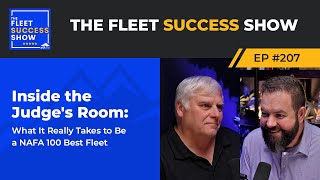
In this episode of the Fleet Success Show, hosts Josh Turley and Scott Rood discuss the NAFA (National Association of Fleet Administrators) 100 Best Fleets judging process. Scott, a six‑year veteran judge, shares anecdotes about odd and humorous applicant submissions, common pitfalls such as missing data, vague essays, and failure to address specific criteria. They explain how judges score consistently, the role of associate judges, and the importance of providing concrete metrics and clear narratives. The hosts emphasize the value of post‑submission application reviews, noting that fleets that seek feedback often improve their rankings. They also touch on emerging trends, including high‑school and trade‑school technician recruitment and the nascent use of AI in applications, which currently receives limited credit. The episode highlights the volunteer nature of the judges, their dedication to helping fleets succeed, and promotes resources like the Fleet Success Playbook, webinars, and the upcoming NAFA booth. Practical advice is offered for prospective applicants: answer all 12 questions thoroughly, back claims with data, avoid vague or overly brief essays, and consider reaching out to judges for a review.
Chapters
This is the Fleet Success Show dedicated to helping you and your fleet succeed using the experience of fleet professionals and Hall of Fame fleet legends. The show that explores how the pillars of stakeholder satisfaction, intentional culture, resource efficiency, and risk management all combine to lead your fleet to success.
We're glad you're here.
Now let's get into the show. All right. Welcome back to the Fleet Success Show with your hosts, Josh Turley, Scott Rood. Nice to have you in from the cold Northwest to the rainy Northwest, right?
Yeah.
It's gotten rather chilly around here.
So actually, it's very nice.
I'm sure it's all relative. That's how you got to tell me. It's all relative. I'm looking at going to Chicago next week and it's like 13 and 2 this weekend. I was like, never mind, I'm not going to complain about our 60-degree weather. Weaklings out here. So we wanted to talk about— it's NAFHA Hunter Best season right now, right? Always kind of coming into the Christmas holiday, applications open up. You've been a judge. How long have you been judging?
6 years now.
Okay. So I've been looking through applications. I know talking to Steve and others, you know, we probably get a couple hundred applications every year. For those who don't know what NAPA 100 Best is, it is the basically NAPA's 100 best public fleets as they go through. And we, we look at all of them. You guys, there's what, 3, 4 judges?
4 judges. And we have associate judges now to help us with tiebreakers. Nice.
Kind of help split the difference.
Yes.
But they look at all, every application that comes through. You answer 12 questions, you submit a form. And Steve, I know we're doing a podcast with him around advice. So for people who are thinking about applying, some tips and tricks on what to do when you are applying. But 6 years of judging, you've probably seen some funny things as you've gone through the process. Just some interesting, like, oh, it's curious that they did that, or this is hilarious. I don't know, like, who this guy is. Maybe they got really good writing style. I would love to hear, like, what are some funny stories that you've had over the years?
Well, some of them— we had one that this person, they just, you know, they fill out the application and there's an essay portion.
Yeah.
And they just kind of run on and on and on, and they kept repeating himself. Every few sentences, he would He would reintroduce the same stuff he kept doing. And he did it throughout the whole essay.
Oh, man.
And so it was like, I just didn't know how to deal with that. There was another one. They filled out the 12 criteria really well. And then we got to the essay, and they wrote one sentence. We should be considered one of the best 100 fleets because we do a great job. And that was it.
That was their closing argument.
That was the closing argument.
You're watching the court, you know, the court drama TV, right? He gets up, he's laid out his perfect case, and then he gets up and he just like whiffs the closing argument.
That's what it was. That's too bad. And then some of them, I mean, they'll give us their KPIs and they'll be ridiculously low and they still miss them. So we see that a lot as well. And it's like, why would you even put that in there? And some of them just, flat out tell us that, yeah, we're just not doing that. We don't have the data. We just can't produce that. So we get that a lot. We get a lot of people that'll just dodge the questions.
Like, I know I don't have a good answer here, and so I'm just going to— Yeah, so they just go on and on.
I'm going to dodge the question. Yeah, they do. I love doing that in interviews, right?
Because there's one section where we ask about their cost. Yeah.
And then they'll sit there and say, yeah, we do this. You know, we have a shop labor rate. We don't mark up for parts. And they never do tell us exactly what that rate is.
Oh, okay.
And then they don't compare them to outside agencies. Had one, it was kind of interesting. They, what they did is they would bring their people in and then they would vote on who's like the technician of the month. And once they did that, then they would close down the shop for the day and they would have a party. Oh, that's good. That was a pretty good one. Going through each of the criteria, there's different stuff that has to be answered. And we get into, what's that other one? Oh, doing it right the first time. They completely miss on that, a lot of them, because what we're looking for is what their comeback rate is. And then they go into a long story on, you know, how they process work orders, you know, how they close out work orders, and they don't actually talk about anything about comebacks. I mean, it's totally missed. And we get a lot of that with the criteria. They just write a story, and sometimes it has nothing to do with the criteria at all.
So you kind of feel like you're reading one of those word problems back in grade school, right? Like, you know, Johnny is driving at 50 miles an hour towards this point. Susie is driving 50 miles an hour towards this point. At what point do they intersect? You're like, I don't know, are they on the same road? So make sure if you're writing your essay responses and your short responses is that you're not writing a word problem with no point.
Exactly. Yeah. You know, we ask for data. You put the data in there. You know, it's interesting. The ones that do put the data in, they'll, you know, they'll put in there, you know, here's our goal, here's how we're meeting it, here's the difference. And then sometimes it's just, you know, they have a goal of, you know, let's say fleet availability. They'll have it like for, like, so let's just say 89% and they're doing it at 85. And then they'll say, well, you know, we just don't have the technicians to keep it, You know, they'll try to justify why they're not meeting the goal. We like seeing that, but give us some good, honest examples of how you overcome that issue. Exactly, right.
What are some things that you try to do as a work—
But they left it short. You know, they just said, we just don't have the technicians.
Yeah.
Okay, what are you doing about that? So we get a lot of those answers.
In the years, like, you know, there's been some— every year the winner gets up and they do their little acceptance speech. You know, I'm sure you've had several post-event conversations, you know, because that's something we encourage people to do is, hey, after the event, if you're not sure how you got your score, come talk to the judges.
Right.
Anything that struck you over the years of like, that was a really weird conversation?
Yeah, I had this one guy, he came in, it was, he was pretty irate. It was like his first time applying and I was doing this application review and he's like, well, I want to know why I didn't make the 100 Best Fleets. And I was like, well, let's take a look. And we got out, we He got his Rubik's Cube out, we looked at it and went through. And then by the end of it, he's like, oh, okay. And it was like your essay, you had 4,000 characters, you used 1,200.
Yeah.
I mean, you didn't tell us anything. And then 2 years ago, the number 2 guy, he came and he was getting an application review. So I turned over to him and I said, hey, what are you doing? You were number 2. Why are you getting an application review? I want to be number one.
Well, his heart's in the right spot.
Yeah, but me and Mike, we do. We sit there at the table and we will do application reviews until we run out of time. So if you want an application review, we'd be happy to do it. We do see anyone who gets an application review, they usually move up in the rankings the next year.
Yeah.
So it really does help.
So that sounds like a great surefire tip. If you've applied and you want to know how to improve your rankings, go talk to the judges.
Correct. Yeah. Yeah. Like I said, me and Mike will sit there and we'll go over—
this is like at NAAFA, the—
this is at NAAFA, the INE.
We've announced it. Come see us in the booth.
And, you know, afterwards, if you want us to jump on a Teams, we'll jump on a Teams with you and do it as well. I've done several Teams application reviews as well. Yeah. And then last week we did our kickoff for 100 Best Fleets. We had our webinar, went great. We had 6— was it? No, we had about 20 people for the commercial. They were on the webinar and we had, I think it was over 80, almost 90 that came on for the public.
Oh, nice.
So very well attended.
Yeah, really good. And that's been something I've been seeing over the years. You know, there's been years where we've had 130 applications and now, you know, I think we're getting 200+ every year. Yeah.
So last year we had— what was it? Public fleet, we were in the 160s.
Okay.
And then for the commercial fleet, we were, you know, another 25, 30. I think there was 35. Yeah. That applied for that. So a lot of applications to read.
That's what I— and you guys have about a month.
We have, yes.
To read through all of them.
Yeah. Because it closes on January 30th and they usually give us the whole month of February to get through them. So we've got 28 days. How generous. 28 days to get through them.
Because no one goes to school for fleet management, chances are you were never formally trained on how to successfully lead a fleet. That's where the Fleet Success Playbook comes in. The Fleet Success Playbook is your guide to building a safe, reliable, and efficient fleet that provides exceptional service. Learn all about the 4 pillars of fleet success: stakeholder satisfaction, intentional culture, resource efficiency, and risk management. Get nearly 100 years of combined advice on common challenges, practical solutions, actionable tips, and real examples from fleet industry experts who have been there and done that. Visit www.fleetsuccessplaybook.com to request your free copy today.
So I have heard rumor that, you know, like every judge has kind of their own personality and their own style as they go through the applications. I've heard the rumor that Scott's a bit of a hardass.
Scott is a hardass. If I don't read it, you don't get credit for it.
Nice.
And but the thing is, if you look at the way we score them, Yes, I judge them harder. But the thing is, it's consistent. Yeah, it's very consistent because we do a lot of— after we get the applications, we grade them. Me, Mike, Steve, and Danny, we get together and we make sure that there's not too much of a gap between the judges.
Yeah.
So yeah, I'm at the lower end.
He's a scrutinizer, right? Yeah.
Well, the thing is, You know, when I was in the military, we used to have, you know, like the Airman of the Quarter. Yeah. NCO of the Quarter. And they always said the same thing. It's like, Scott, you just grade them so hard.
Yeah. It's like the same participation trophy.
No, you're earning it.
You're earning this. We want this to be 100 best fleets, not 100 applied fleets.
Exactly. So the thing is, if I read it, you get credit. Yeah, that's all there is to it.
So make sure you put it in the questions, right? Those 12 questions. Make sure you put it in the essay.
Absolutely. Because that's, you know, I was doing an application review one time and You know, went through it and, you know, you know, we like to see you do this, this. And he goes, well, I'm doing that. And I was like, I didn't read it. If I don't read it, you don't get credit.
Yeah.
And he's like, oh, it wasn't in the application. We went and looked and it was not there.
Yeah. So make sure you're rereading your application and really thinking about, is this telling the story that I want to tell, right?
Exactly. You know, because I try not to assume anything. Yeah. I don't think the other judges do either. They want to read it, but you know, they kind of give them the benefit of the doubt where Scott does not.
If you didn't put it in, it didn't happen, right? I can assume it's happening, but how do I know?
Exactly. Yeah.
Okay. Uh, any, any funny stories as you've, you know, gone through? Just like the— maybe some like the weirdest thing that you've seen written, uh, in any of the applications, or just like something that stuck to you is like, wow, that was unique.
Lately what I've been seeing, it's, it's, uh A lot of fleets, instead of going after qualified technicians, they're actually getting into the high schools and the trade schools.
Okay.
And they're trying to bring them on as interns and start internships and kind of growing their own technicians. What I thought that was a great thing. I like seeing that because, you know, we're very short on technicians these days. Yeah. And so that's— I was very glad to see that since, you know, when I was in high school, I came up through an automotive program and I stay involved with high school automotive programs as well. So I like seeing that. God.
Anybody using AI yet? I mean, obviously we've definitely seen them using AI to submit the application. Are you seeing anybody use AI in their fleet operation?
No, I have not. I've seen them, like I said, like you said, with the applications. And if they don't take the AI and put it into a Word document, it doesn't always show up in our application. So it'll only show like the first part of it if they just copy it from AI and bring it directly in. So we'll only see like the first paragraph and that's it.
And that'll be a disqualification right there, right?
Well, it's— they only get credit for that first paragraph. That's it.
If you didn't write it, it didn't happen.
Exactly.
Yeah, but I'm curious to see over the years, like, you know, this year, next year, which fleets start saying like they're actually leveraging AI in their fleet operations. Yeah, that'll be really good.
Yeah, I'm looking forward to it to see how they're using it because I wasn't really sure and still not completely sure how. Yeah, how it's going to play and how it's going to affect fleet.
Oh, I think people aren't really sure how it's going to affect the world right now.
Understood.
Yeah, but the fleet's definitely on the mind.
But I'm trying to think ahead though. Of course. How is that going to work?
How would I use this? Exactly. How would I do that? Yeah. Well, as always, you know, want to recommend everybody go apply. I think that's like the big piece of advice.
It doesn't cost anything. So, you know, if you're running a good fleet, you know, you need to get credit for what you're doing. So this is one easy way. Fill out the application and get credit.
Yeah. And then share that credit with your team.
Absolutely.
And then honestly, just get some free advice when you get that application in.
Absolutely.
Scott, I want to go through and do an application review with you guys. And the amount of advice you'll get out of that, learning benchmarks, understanding how to apply for the process, because you're going to learn two things. One is how to be a better applicant. Yeah, but two is how to be a better fleet manager.
Absolutely.
Because there's a lot of free advice that comes out of those sessions.
There are. And we track all the matrix. So we have— and go to one of our webinars that we have because we share all the data. Because we'll have, you know, what's your fleet availability, what, you know, what it looks like over the years for 100 best applicants. And we have like 16 of them that we go through and we share that information with anybody that comes on to the webinar and wants to see our data.
Yeah. Well, let me ask this last question. I should have asked Steve this too, but why? Why do you do it? Right. 6 years you've been doing this.
You know, I ask myself every year because I put my—
Every February, right? Because it is a grind.
But, you know, After I get through them, and I'm like, oh my God, this was a tough year. When I get to NAF and I actually see the excitement in the room for 100 Best Fleets, and especially when we get down to the top 5, so much pride comes through me. And it's just like, I'm just so happy for those people. And I'm just glad to be part of the process.
Yeah.
So it's very enjoying or it's very satisfying for me to help these fleets.
Well, there you go. And, you know, part of a big thing of what we do here is helping fleets succeed.
Absolutely. That's what we do.
And that's like the judges don't get paid for this.
We do not.
It is totally volunteer. And honestly, like, it's, you know, I don't know how much time because you guys still have full-time jobs.
We do.
You know, like you guys don't— for Steve and Scott specifically, I know Danny over at NASA works the same.
Right.
They're still working, they're still consulting.
Right. And I do want to thank you, Josh, for giving us the time to actually dedicate to the 100 Best.
I don't think there's been any way you guys could do it otherwise.
So, yeah, that's— no, we appreciate you.
Not much choice in that matter. But it definitely is one of those things that without the time, there's no way we could do this for the industry and they need it. So, no. All right. Well, that's going to do it for this week's episode. As always, thanks for listening. Until next time. We hope you enjoyed the show. If you'd like to help support the podcast, please share it with others, post about it on LinkedIn, or leave a review. Want to learn more about our fleet management software Fleet 360? Check us out at rtafleet.com. If you want to learn more about having your fleet evaluated by our consulting team, go to fleetconsulting.com.
More from Josh

Episode 227: The Hidden Costs Killing Fleet Operations (It’s NOT What You Think)


Episode 225: Are Certifications Still Worth It? The Truth About ASE, CAFM & Fleet Leadership




Episode 221: The State of Fleet Management: Education, AI, and the Technician Crisis with NAFA’s CEO

Episode 220: Motor Pools Are Back: Right-Size Your Fleet Without Breaking Operations

Episode 219: Stop Guessing at Downtime: Status Strategy for Better Availability #podcast #fleet

Episode 218: Fleet Predictions 2026: AI Hype, Technician Shortages, & the Next Era of Fleet Managers

Episode 217: Why Replacement Planning Solves 95% of Your Problems #podcast #fleetmanagement #fleet