Episode 208: Don’t Stop Fighting for Replacement Funds #podcast #fleetmanagement
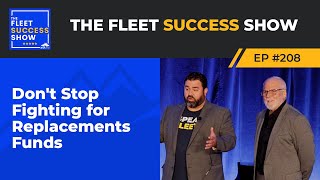
Mark Canton and Steve Salzgiver explain why vehicle replacement programs matter. Backlog above 25% signals crisis; below 15% is manageable. Neglecting replacement drives hidden costs in rentals, overtime, safety liability, and brand damage that dwarf the upfront investment.
Chapters
Welcome back for another episode of the Fleet Success Show, bringing you another episode from RTA Connect 2025. One of our great keynote sessions got a lot of great reviews. It was Mark Canton and Steve Salzgiver sharing the stage and talking about really the hidden costs of not having a good replacement plan in place. Obviously, we can look at the backlog of your replacement plan. We could talk about some of the, the immediate challenges when you look at it, but truly understanding the hidden costs of not following your replacement plan, they dive deep. Into all the nooks and crannies and the secondary effects when you don't replace your vehicles and what happens to your budgets, to your fleet, to your people, the whole nine yards. So enjoy this session. You'll get a lot of words of wisdom from these two experts, former Fleet Management Hall of Famers, just a ton of wisdom coming through from their experiences. Hope you enjoy it. This is the Fleet Success Show dedicated to helping you and your fleet succeed using the experience of fleet professionals and Hall of Fame fleet legends. The show that explores how the pillars of stakeholder satisfaction, intentional culture, resource efficiency, and risk management all combine to lead your fleet to success.
We're glad you're here.
Now let's get into the show.
Thanks, everybody. Thank you all for being here. I really appreciate it. For those of you who don't know, Kevin has two nicknames. One is the Bear and one is the Viking. So make sure you use it as often as possible. And I like Little Bear personally, but— all right. So we wanted to talk to you today about fleet replacement. And most of you have probably heard us talk about it once or twice or many more times before. And why do we want to do that? Well, because we just think it's imperative and we just believe that that message still needs to come across. And many times in Steve's engagements, we'll come across fleet managers who kind of have given up and they've thrown their hands up and said, you know, I don't know what to do. I've given up. I'm not going to keep fighting for this. I'm not getting those funds. And we're here today to implore you to not give up. You have to keep fighting. Fighting for fleet replacement, and hopefully we can make that case for you. But with that, this is Steve. I think you all know him. We call him affectionately the Fleet Whisperer.
A term I actually hated at first, but now I've gotten used to it.
So if you stand close to him in the hallways, you'll hear him do this, fleet, fleet. And that's me, nowhere near deserving to be on stage with this true legend of our industry, but very honored and proud to do it nonetheless. So, all right, so here's a clip real quick from one of our podcasts. See if I can get this to work.
No, no sound.
No sound. But they got it, you know, stop investing in OpEx, you know, stop investing in OpEx, you know, you got to invest in CapEx. It's like the same reason why folks eventually want to buy a home, let's say, instead of continuing to rent, right? Because it pays you back. And it's the same thing here. You know, it's OpEx and CapEx and fleet is a lot like E mc². It's gonna wash out. So the question is, you know, within those assets, to your point earlier. So the question is, where do I get more gains? And if you invest in CapEx, you're gonna fix all those hidden costs. You're gonna fix all those other issues that you're having in your shop. Pretty quickly. Yeah, so check out the podcast if you haven't already. Hopefully you enjoy it. So what are we getting at here, Steve? Do we agree with this principle?
Absolutely.
Yeah. So this is what I want you guys to think to yourselves, right?
Say it's— there's two things I've always told people in fleet over my years. One is a good replacement program, and what couples with that is a chargeback program, right? If you do not have those two, you're always gonna have a fleet that is suboptimal. So be thinking about that as you're managing your fleets. How can I get those two objectives?
Right. So if in your current operation you see replacement as maybe somebody else's issue, maybe it's finance's issue or budgeting, or maybe it's your operating groups, right? We wanna kind of shift that, all right? We want the focus, we really believe this, good fleet replacement equals good fleet management. In the absence of, replacement, a great replacement program, your in general fleet management program is not where it needs to be. Get, get that. Repeat that to yourself. Repeat it to yourself. Repeat until it really gets in and you accept it as true. Many of you are putting out fires all day long trying to manage the fleet maintenance program, and that's a worthy cause and it's important work, but you'll never get to the other side if you don't get on the fleet replacement. So What we have found in our studies is that not only in the absence of a fleet replacement program, you know, is your fleet suboptimal, but oftentimes, you know, the Fleet Whisperer himself has gone into fleets and he's able to mitigate many of the issues that you have that you would think are unrelated by better fleet replacement, right? Absolutely. So I can't get enough techs. Fix your fleet replacement. And people look at me like, huh? What do you mean? Well, because if you're replacing those assets when you ought to be, your maintenance and repair burden goes down and it helps you address the technician shortage.
Low availability.
Low availability.
Can't get all my PMs done. All that relates. Exactly. Replacement.
So oftentimes when they— and we'll talk about this here in a second— folks will, when they have their low availability and they're trying to solve their issues, their first look is at the M&R program. And oftentimes they find a lot to fix, which is great. But sometimes you can't see the forest through the trees, so to speak. And so we wanted to give this example of the rental company, like Enterprise or Hertz. What do they do?
They replace quickly. I'm on the road. I think I've been on the road every week this year consulting, except for maybe 4. But when I get— I rent a lot of cars. You think I want to rent a car that has 75,000 miles on it or 100,000 miles on it? No. If I see a car over 20,000 miles, I'm going, okay, I may find another one here. Why do they do that? What are they trying to avoid? Breakdowns.
Breakdowns, maintenance, correct.
Consistency of maintenance, right? I mean, they don't want to send somebody out after you when you break down.
Not only because you don't want the experience, but they don't want the cost. So when you look at what a rental company's model is, they use their buying power, which granted, many of you don't have that level of buying power, but you do have buying power, serious buying power, much more so than the average retail customer for sure. And what do they do? They use the buying power to get the best discounts they can, and they keep the vehicles just long enough. Maybe they have some by the end of their warranty, and you'll see some at 36,000 miles. There are examples, there are exceptions, specialty vehicles, things like that. But those general sedans and crossover SUVs, they're gone. They literally never deal with a maintenance issue. Never. They do PMs and warranties and accident reimbursements, and that's it.
They save them for the next buyer.
Correct. Now, we're not saying all of you should go out and tomorrow be a rental company, but we want you to understand that concept, right? The further left on the replacement life of that asset, the less effort and burden there is for you on the operating side and the maintenance and repair. So let's dig into that a little bit. Why is that true? Many of you have seen this curve before. If you look at the curve, most of you have seen that curve before, right? The blue line, and they use nice poppy colors 'cause I'm colorblind as a bat, so I can actually see this. So bear with me, right? The blue line represents capital cost. Real quick question here. This is important, important, important, important, something to understand. And it's not a trick question. I'm gonna call on you 'cause I know you. If I buy a $50,000 truck today, what was my capital cost? Nice and loud. $50,000. Raise of hands, how many of you agree $50,000 was the capital cost of a truck that cost $50,000? Yeah, be honest. I know a lot of you wanna raise your hand. It only counts if your elbow goes above the ear. Okay, a lot of you. Who thinks it's something not $50,000? OK, since you're in front, what do you think it is? Nice and loud.
Everything to get it ready for the road.
OK, so everything to get it ready for the road. So upfitting and so forth and so on, registration. How many of you think that that's the capital cost? And I'd say, OK, you're right. And let's say that it costs $50,000 all in to get it ready for the road. If I said that to you, how many of you say the capital cost of that asset is $50,000? Raise your hand. Come on, elbow above the ear. Tell the truth, for goodness' sakes. People, don't make me make you do Simon Says this early in the show. All right, I see some giggles there. Anyone else think it's something different? Yes, nice and loud, please. I don't know why, but it doesn't sound right. Thank you for your honesty. We need more of that. I don't know why, but it doesn't sound right. How many of you think, I don't know why, but it doesn't sound right? How many of you, it doesn't sound right because you know me and you think I'm giving you a trick question? Okay, there's some honesty there. Okay, the answer is— yeah, you know me and I'm giving you a little bit of a trick question. You don't know yet. If I sell that truck next year for $40,000, then my capital cost was $10,000 for one year. Okay, important concept. Put that in your back pocket and keep it. We're going to need it again later. Okay, so we have the capital costs, and so you have to think of it as, okay, in year one the asset depreciates more, right? You bought it for a certain amount and you can sell it for another amount after a year. And that's the depreciation. That's your capital cost in year 1. Same thing happens in year 2. And with age, it depreciates at a slower rate over time. Comfortable with that, everybody? Okay. And generally speaking, while it's never a perfect line for an individual asset, if you take a class of assets and you plot out their M&R costs, It's going to rise over time and grow exponentially later in its life. So that's the big bulk of the operating cost there. Who's fool? Everybody with me so far? And then you get that nice bowl-shaped curve. That's basically the addition of both of those two, total cost of ownership.
The top line, in case you're colorblind.
Top line, because I am colorblind. Thank you. Is everyone with me? OK, super cool. So what we normally talk about up here, and we'll talk about it again later, is, well, the sweet spot for replacing that asset economically is right in between those two lines, right? And we'll talk a little bit more about that in a second. But the point I want to get across to you is, for now, and kind of thinking about this rental concept is, what happens if it's in year 9? Can everyone see that in year 9, the top curve has about the same cost for that class of assets in year 3? Can everyone see that? Everyone know what I'm saying? Some nods. Yeah, okay. So that means the cost of that asset is literally the economic costs are the same in those 2 years, right? But what's different?
Your liability.
Time, liability. I'm hearing some mumblings. Come on, shout it out, be proud. Cost will continue to rise. The costs do continue to rise, yep. But let's just focus on What's the difference between year 3 and 9 if their cost is the same? Asset value. Asset what? Asset value. Asset value, okay. Age of vehicle. Age of vehicle, all true. What's the impact on your operation?
Downtime.
Downtime.
Unpredictability.
Right? The cost on the right is generated by M&R. If your M&R costs are going up, where is the vehicle? In the shop. In the shop. When the capital costs are high on the left, where is the vehicle? On the road. So while the economic costs might be the same on both ends, the hidden costs are not at all the same. What happens if the vehicle's in the shop more? Well, let's talk about that a little bit.
Because no one goes to school for fleet management, chances are you were never formally trained on how to successfully lead a fleet. That's where the Fleet Fleet Success Playbook comes in. The Fleet Success Playbook is your guide to building a safe, reliable, and efficient fleet that provides exceptional service. Learn all about the 4 pillars of fleet success: stakeholder satisfaction, intentional culture, resource efficiency, and risk management. Get nearly 100 years of combined advice on common challenges, practical solutions, actionable tips, and real Examples from fleet industry experts who have been there and done that. Visit www.fleetsuccessplaybook.com to request your free copy today.
So on that left side of the curve, so we have the sweet spot in the middle and we'll talk more about that later, but on that left side of the curve, and this is what those rental companies figured out, I'd rather err on the left than err on the right because I'm getting much better availability And we'll talk more about availability. And not only do I get the vehicle more total time, but of that time I have less unplanned downtime. So I know when I'm not gonna— when I'm gonna have it down. I'm going for my PMs and my wear and that's it. Right? Now think about this. Go talk to your finance people, or if you're a former finance person, talk to them about fixed costs and variable costs and ask them which one they like better. By show of hands, how many of you think they like variable costs better? Exactly, exactly. So sometimes even a slightly more expensive fixed cost is more, more valuable to finance folks and planners than a fluctuating average variable cost. Does that make sense where I'm going? Okay. And of course, if you're replacing those assets more quickly, you're getting the latest safety tech, the latest fuel efficiency, emissions, etc., etc. Right? And on the right, you have a lot more moving parts to keep that vehicle on the road. It's pretty much that simple. Thoughts?
Yep.
All right. So what does that mean? That tells me, well, I might have a replacement planning problem if I have, if I'm really focused on replacement planning and I wanna know how well am I doing today This is kind of what I would look at, all right? If you take all of your replacement vehicles that are past due and you divide them by the total replacement cost of your fleet, you get a backlog. And Steve and the team have found, you know, those ranges there kind of tell you where you're at. If you're below 15%, you're manageable. You can fix it. If you're between 15 and 25, you're struggling, but you have a chance to get through with a great M&R program and you have a chance to address the replacement program. If you're above 25%, you're in dire straits and you need help, call Tony Yankovich. Okay? You really need help. Okay? So what does that mean? You know, in this case, you know, $25 million just made the math real simple there, right? So let's look at this chart. This is availability. Why is availability key? We have beat this up. Steve, why is availability key?
Because if you can't serve your customers, what good are you as a fleet?
Right.
Pretty much that simple.
I say to fleets all the time, I remember going to NAAFA maybe 3 or 4 years ago, and I won't name the name of the fleet, but they were all pumped up because they were, they had just reached 75% availability. And I wanted to put my head in my hands and cry. Imagine if you bought a vehicle for work, right? And out of every 10 days that you're driving to work, you can only use the vehicle 7 times. Would you be happy with that purchase? Who would be happy with that purchase? Okay, good. You're all very smart people. Okay, so availability is key. If the asset's unavailable, you have kind of shot the whole program in the foot. And so Josh actually tweet— he put this out on LinkedIn a couple months back, and we can— maybe we'll repost it later in the week. But this is sort of our follow the breadcrumbs chart to how to address availability. Okay, it's one of two problems: either your replacement stinks or your M&R stinks. Or is not up to par anyway. And guess what? As you can see here, you could go through every single issue on the M&R and you might still conclude, "I gotta go back to asset replacement." So start there, okay? Now I will plug, and I'll put up the info here in a minute, I will plug Tony Yankovich and a couple of others on the fleet management track if you're more interested in sort of following these breadcrumbs on the M&R side, he's got some great info for you on workforce and workload and technician staffing and those sorts of things. So pay attention for those sessions. We're gonna focus a little bit more on the left side here, okay, asset replacement. And these are the metrics that I'm gonna look at to know how am I doing. Now the mother of those is the backlog, which I just showed you, okay. But I might look at what are my weighted average cycles versus my target cycles. How am I doing? If I'm targeting 10 years and I'm hitting 15 all the time, probably have a problem, right? Maybe my life cycles are too long, maybe I don't have good strong analytics, maybe I can't see that relationship we talked about in the previous curve. If those targets are correct, well, then what do I do? I look at that backlog. Is my historic annual spend enough? What do you see?
When we do replacement plans, you see We, when we do replacement plans, it's often always over 25%.
Yeah, exactly, because that's usually why they call us in, typically.
How many have a backlog? Anybody brave enough to answer that question?
Okay, how many of you don't know? Okay, be honest, how many don't know what your backlog is or if you have one?
Don't track it. Okay, all right, how many of you don't know but feel like you have a backlog? Based on your shop work. Okay.
I'm gonna use the floor is falling out of all your trucks. And so you're pretty sure you have a backlog. Okay.
We've seen it all.
All right. And then we get some raised hands. Thank you all for your honesty there. Okay. So what's the idea here is again, we'll share this out with you guys, but it's just meant to be a little bit of a breadcrumb here. If my availability is not right, what are the metrics I'm gonna go look into and dig further into to try to solve that problem? 'Cause availability is everything. Here's those courses I said I would plug. So Scott Conlon is gonna teach some right-sizing. We'll plug him again later. And that one with Tony, Staffing Isn't Politics, It's Math, that will really get into some of those relevant slides there, right? So here's what you need to know, and hopefully this has already been impressed upon you. If availability is low, one of the following must be true. Your fleet is too large. We just talked about it on the curve, remember everybody? If you're on that right side of the curve, that means your vehicles are in the shop all the time, which means what do you do? How do you solve that? How do you make up for the vehicles being in the shop all the time? You get more spares, right? I'm hearing people say it. Or maybe you You do a lot of commercial rental and that expense is too high.
Or you pay people mileage reimbursement.
Correct. There you go. That's one we didn't get in there, but that's the— that's an equivalent. Personally owned vehicle reimbursements, right? Another one is overtime is high because you're double shifting the truck, and so you're keeping people more at night so that they can use that truck to go, go do that work that needs to get done, right? You'll also see this: outsourcing high. Well, I can't get people to stay for overtime, so I'm gonna hire a company to go do the work that I specialize in, right? How many governments have a sanitation department and still are outsourcing sanitation, right? I'm seeing some nods, so. And again, that's not bad if it's a strategic decision. The question is what led you there, right? Okay, and here's my favorite. It's the one that I see most often as a New York City native. The work isn't getting done. OK? Sorry for any people who see that in New York on video. I swear I love you. OK. So what does that mean for your organization? So real simple baby math for those of you who are mathematicians and are gonna get on me on interest and time value of the dollar and all that. You are correct, but I just kinda wanna make the point here. OK? If you need 100 trucks every day and you got 95% availability, you need 5 spares. If trucks are $75,000 each, that's $7.875 million. What if you only have 80% availability, which sounds like a really good number? Well, now you need over another million dollars more in capital cost for your trucks. It's that simple. You need to replace, you need to fight, don't give up fighting for replacement funds. So these are the very common, or some of them we just mentioned, right? Much higher operational costs, much higher of those hidden costs we just talked about when the reliability goes down. But there's others. Steve talked about risk.
Risk. Have any of you been indicted before because one of your vehicles crashed or, God forbid, killed somebody? I have, and it sucks. That's a good, that's a good reason to fight for replacement.
Right. Because the question in litigation is reasonability.
Yeah.
Right?
It is not reasonable not to replace vehicles.
Right.
That simple.
Did you do everything reasonable that a good fleet manager ought to have done to ensure the safety of that fleet? Obviously, that's going to include PMs and oil changes.
Right.
But if you have a vehicle that's nowhere near modern safety technology, Someone's going to ask why.
I've been in some fleets, they have such old vehicles, they didn't have seat belts on them, or no airbags, or all those accoutrements, those amenities that we have nowadays, right? So you get into court, you don't have airbags on a vehicle, what's the judge going to do, right? Especially if you've killed somebody, right?
Nowadays we got the lane stopping and the cameras everywhere and the beeping everywhere. I must be a terrible driver because my car never stops beeping at me. We have this love language. It beeps. I say, "Buh-buh," and it beeps back. It's like R2-D2. But yeah, at least I know I'm doing something wrong. So I guess that's a good thing. And then other technology, fuel efficient. On average over the last 25 years, vehicles of the same class and type have gained at least 1% in fuel efficiency every single year on average. Okay, so if you have a standard sedan, it is significantly more fuel efficient without any alternative fuels than it was, you know, 20 years ago, 25 years ago.
So side note, last week I was at a conference and I got an iPhone and I got a ping on my vehicle. I had a P304 code on my F-150. Who knows what that is? P304.
Got a few.
Yeah, got a few. So this week I'm here at this conference and I got a mechanic working on my car because I can't do it. So I had to outsource for that reason. Those are the things that help you make these decisions, right? Now that to me, a P304, that's simply a spark plug or a coil, usually. So I would have done that on my own. But those are the reasons you do things like that. Now that's the kind of technology we have nowadays. I'm getting pings on my car. I'm not even there.
Your wife was driving, right?
Yeah. Yeah. And that's the reason I told her one day, That's the reason they put these lights on there. We call them idiot lights. So if you ignore that light, what does that make you? Sorry. I know you guys deal with drivers as well. Right.
And then there's an element that I think is usually undervalued, but it's legitimate and it's this reputation and branding. Let's be honest. Like, how many of you guys have driven by a truck, whether it's for a company or government, and the thing is rusting out on the bottom and it looks like it's falling apart. And like, you know, and some of you are laughing. I'm guessing that's you guys.
Sorry.
But what does it do? It does not make you feel confident about the work that's going to get done with that asset or about the care that the people have for that asset. And there's all kinds of studies out there that you can reference that show the drivers and the operators of those vehicles, they don't treat them as well because they see them as lesser than, right? So there's all kinds of values and intrinsic values you need to get. We've talked many times in the past about the economic reality of replacement, and that remains true as ever, and that's a major lever to pull in trying to push for your resources. But dig deeper into these hidden costs by engaging your stakeholders and doing some research and finding out how much are we spending on commercial rental, as an example, right? Or whatever else it may be. So I stole this slide from Tony, and he'll talk about this more at that session I just mentioned. But here's just a simple graph just showing how your fleet assets grow and/or your rental costs grow because of your availability issues. You know, and again, this is just meant to be a sample. This is the kind of thing you do and you show leadership and you say, guys, we need to get this replacement happening. So then the question becomes, well, why do organizations still have old fleets? Well, it's that capital financing is still not well understood. It's that example I gave earlier about how much was the capital cost. 'Cause when you say to your leader, I need a new truck, how much does it cost? 50 grand. How much does it cost to repair it? 12 grand. Oh, repair it. And you wanna bang your head against the wall. But they only see the difference 50 minus 12.
Yep.
But the truth is that, hey, if we keep it another year, that thing's already 162 years old, so it's only going to depreciate another $1,100. Right? And if we go buy another one in year 1, maybe it's going to depreciate $10,000. And it's less than the $12,000 repair to completely replace the hydraulic arms or something like that.
So what's the hidden fleet cost? What is it that we're not calculating here? That you can't articulate to your management? Downtime? How much is downtime? Some figures I've seen are $200 an hour. Should you burden that into these cost models? You should think about it.
Right?
Extra mechanics.
Right. And you can do this work. You can do this work, and if you can't, you can get help. But I know you can. Alright? Again, that idea of the sunk cost, you know, leadership does not understand this. You need to make them understand it. They never will. You know, again, that marginal M&R costs, alright? And so forth and so on. All of these are the kinds of the things we're covering. So how do you do a solid replacement plan? We're gonna go through these quickly, 'cause the idea is not to teach you on a keynote stage here exactly how to do replacement plans. But to expose to you some ideas. We'll pick up the pace and then we'll get to some key elements here at the end because, well, we have to. So first step is you have to have a thorough and complete fleet inventory. And some of you are looking at me and going, duh, right? But you'd be shocked how many folks don't have a complete and thorough inventory, right? They may have a great inventory and it includes things they'll never replace. Maybe it doesn't include things they will replace. Equipment and lawnmowers and things like that. A complete and thorough fleet inventory. Sounds basic, but it's legitimate. You much— you must, must, must, must, must have a good classification system. Okay? Don't have time to get into this. I'll show his details in a second. Scott Rood is doing a Class Coding 101. If you have things that are $100,000 apart in cost in the same class, you're gonna struggle with good replacement planning. If you have things that are 100,000 miles a year apart in utilization, you're gonna struggle with class coding, right? The idea is to find that nice sweet spot of categorizing different asset types together by use case, by cost, by build, et cetera, et cetera. Okay. We have replacement parameters for each. What are replacement parameters? Well, I plan to keep the asset this many years for this many miles, and I plan to get this much value out of it, and so forth and so on. What is interest? What is my cost of money? And so forth and so on. And other items that might be relevant to your funding plan. And then you establish those assumptions. So you might get something that looks like this. This is an example of a real basic classification— excuse me, inventory of folks and how they've been classified. This is using basically the NAFA class code system. And then you have the replacement parameters that Scott took. And it's again basically the NAFA system with some edits and tweaks he made for his own need for that fleet. And you get the idea. This is when I plan to replace the asset. Now you notice in this case he doesn't have any miles or hours. They're blank. It's because he was doing it for a local government. Most local governments, if you get 6,000 miles a year on these things, you're doing great. You're like doing tons. So they weren't relevant in the math, right? The age is the number one factor driving medium and light-duty assets residual values, not utilization. I'll talk more about that on Thursday for those of you—
Depending on who you are too. I was in Hawaii a couple of weeks ago. That fleet on an island, 10 by 10 by 10. I was driving a 2018 4Runner with 29,000 miles on it. Now, in some cases, you'd want to replace that, but it'd probably have 150,000 miles. So your fleet is unique. And you need to be able to dial into your unique utilization of that vehicle.
And that's what we really wanted to call out. So we'll get into this in the picture again. But if you think back to that asset, that lifecycle curve, Right? You can adjust it for financing needs, and I'll bring the curve back up again to show you what I mean, because sensitivity is pretty low, plus or minus a year. If you remember, those lines were between year 5 and like 6.5, 7. So that tells you, you got some wiggle room. If you need to push it out for financing purposes, so be it. If you need to lie to the budget office and tell them you need to do it in 5 years so that it actually happens in 7 years, so be it. The point is you have that wiggle room there. Plus or minus a year is not gonna kill you, but because it's an exponential curve, meaning it grows quickly on the tails, that means as you get into those out years, that change in cost is dramatic, right? So you gotta really stay at that low point, and we'll show that again. Okay, here's the formula for those who are math nerds and want to do the formula like me. Amanda Wilson years ago made me promise to always show the formula, so I am. You can take your picture, but I'm not gonna speak to that. All right? All right. Do you need me to go back? Okay, take your picture. I'm getting a countdown 'cause I'm running outta time here. So if I go late because of your picture, I'm having words. All right, okay. All right, so here we go. Learn a little bit more. I mentioned Scott's 101 and then Scott Conlon, both Scotts, they're doing, he's doing a how to properly do a lifecycle analysis. So again, more opportunity to kind of dig in a little bit here on these features if you like. Here's a sample Griffin Scott, one of our fleet management analysts, lent me. Again, you can see that curve and again you can see it grows much faster on the ends and you know, it just kind of shows the table. There's the sweet spot right there in the middle in year 6. But year 5 and year 7, they ain't killing you. Can folks see that? 7.8 versus 7.7 versus 8. Now what happens from year 7 to 8? Boom, big jump, 8.7. Because of the nature and the shape of that curve. Is everyone with me so far? So you can make your financing match what your needs are here. You can play with that a little bit.
And what you don't see in these curves is the lumpiness.
Yeah.
Because this is all average, right? So if you got vehicles that are catastrophically failing, —this.
Correct. If you, if you map it out dot by dot, yeah, it's gonna be all over the place, and this is the best curve, right? Okay, so what do I want to call out here? Look, this is a small fleet. Hopefully you guys can see in the very first row under number of units, this is a tiny village outside of Chicago. They only had 128 assets in the study. That's it. And look at how much they were gonna save annual Total average annual operating cost savings by optimizing their life cycles, $282,000 for 128-asset fleet. What does that look like for your fleet? In the 500s, in the 1,000s, and so forth. How much money is on the table for you to show people? Let's see, what did I say? I don't even remember. You can't manage costs you can't see. Oh, yeah. That's a good one.
That's a writer downer, folks.
You can't manage costs you can't see. Right. So if you don't have that true visibility on what these costs really are and you're not providing that visibility to the stakeholders, which are both your customers and the other folks out of it, how are they making good judgments? Okay. They can't make good judgments. I'll give you the one that happens extremely commonly. We've talked about replacement, right? Most fleet managers will complain till they're blue in the face how difficult it is, and rightfully so, to get money for replacing assets. Right. Well, think about the way a lifecycle analysis works, right? For those who aren't familiar with it, you're essentially modeling out your costs. Here's your capital costs. They start very high on an annual basis. They get lower and lower because the asset depreciates a little bit less each year than the year before. And then your operating costs, as we've talked about, generally speaking, go up. Okay. If you artificially— I'll use that word, all right? Or let's say you understate your operating costs, which is predominantly your maintenance and repair costs. What you're doing is, is you're changing that cost curve. You're pushing it out. You're making it harder to justify replacing assets in your fleet. Much harder. Because if you're finance or your leadership, you're going to say, no, no, no, it's not really costing me that much to maintain the vehicle. Let's, let's keep it.
Because all you're looking at is the direct cost.
Because all you're looking at is that direct cost. And so you're not getting, you know, you're not, you're not getting true visibility, true transparency on what the cost of the fleet is. And one of the ways I always know when, you know, we do engagement if you hire me after hearing this podcast, you'll be ready for this, you know. But I'll sit down with you, and in our first interview, I'll just ask you, well, what does your fleet cost? And I cannot tell you. Pretty much 99 times out of 100, I get a blank stare. They have no idea. And then they just start pulling numbers out, right, with their you-know-whats. So, so that's, you know, that's a piece. If we want, if we want transparency, if we want visibility so that we can make good data-driven decisions, and of which to The most important data is generally cost-related data, right? You just need this so that you're getting an accurate picture of what the fleet costs. So that's kind of like baseline table stakes, like you, you have to be doing that if you're, if you're doing it right. How many of you know your fleet costs? Langsters? Yep. All right, so that alludes a little bit to cost modeling, which Steve mentioned earlier, but here's the point on that. I wanted to come to that. So this is that same small town in Illinois, right out— not far outside Chicago. This is Griffin Scott's work, by the way. And I wanna point this out to you because I think many of you are doing this. If you see one column, the second from the right shows a $52 labor rate, which is what they were using, and the other one shows what we recommended, which at that time was $135 an hour labor rate. Many of you are intentionally or going along with very low labor rates because you're thinking, "Oh, that makes me look good, makes me look cheaper than the outsourcing folks who have come to take our jobs," right? But you're shooting yourself in the foot. Because the impact of that is this: look at that pluck, that truck, that HD tandem axle at $52 says, "Yeah, replace it every 15 years." At $135, every 11. So what's the point? If you have understated or unreasonably low operating costs that you're tracking, well, it's going to be really hard to do a decent replacement plan because you can't get proper life cycles. It's going to look to leadership like it makes more sense to just keep maintaining this, and that's when you end up with trucks that look like they're falling apart and rusting them to death and that sort of a thing.
How many people have a fully burdened labor rate? Not too many hands. How many have looked at their labor rate? Okay. Yeah, we admonish you to look at that often. Things change. Of course, you need to be competitive with outside services, right? Or you'll create another can of worms. But that's something that's truly important.
Yep. All right. Rapid fire here, folks. So you need assumptions. What is the purchase price inflation going to be? Where does that disposal money go? Is it going back into your purchase or in some general firm, etc., etc.? If you do it right or if we do it for you, you'll get something that looks like this. All right, this tells us by doing some basic math, the math I showed you earlier in the deck, okay, you really just, you just divide what those total replacement costs are by your target years, right, and it's pretty straightforward. So yeah, let's see if we got it right for you right here. So how much money do you need? In that example, the gross replacement cost was $23.6 million and the target replacement cycle is 12.1 years, which is actually pretty long. Well, 23.6 divided by 12.1. How many think you can do that math? Maybe with a calculator. Nobody? Who doesn't think they can do that math with a calculator? Raise your hand, please. Or did I lose you and you all fell asleep? OK, all right, we're here. OK, so that annual replacement requirement for that little fleet was $1.95 million a year. OK? And they were spending, by the way, like maybe $800,000 or something like that. Shooting themselves in the foot. Now if you go out and you map all this stuff together, we don't have time to dive too deeply into this, but if you're interested, pull Steve aside, pull me aside. Pull any of our consultants or analysts aside and we can dig into it. And by the way, we know some of you need the help because Andrew Finch looks at your data for me. Where are you, Andrew? He tells me, so, you know, be honest, it's okay. So does Christy. But anyway, you'll get something like this because it'll show all this backlog of replacement that you need to do. But what did we talk— say earlier about fixed costs versus variable costs? Right? We said finance really likes fixed costs, and we also said that in those replacement cycles, plus or minus a year is not gonna kill you. So you map out what your needs are, that's what this looks like, and then you change it and you say, okay, if I do that plus or minus a year with some reasonableness, can I give something that looks a lot more fixed to finance that maybe they're gonna digest? Right, and then you get this modified plan. And if you compare the first 10 years of that, which one you think finance and budget's gonna be more likely to swallow, the blue or the red? Anybody? Red, thank you. All right, so that's the idea. You can also do things, and we're short on time, but you can also do things like if you're using a reserve fund, how do you map out what your reserve fund needs are? Is it too high? Is it too low? Do we need a cash infusion? That's just a zoom up of the same idea.
How many are hesitant to actually finance vehicles? I was told years ago by a financier that Why do we finance or rent buildings and we buy cars? It's totally the opposite. That's true. You need to buy buildings because they appreciate. You need to finance cars because they depreciate, right? So I think about that and keep that in the back of your mind, right?
Yeah, and we'll get to that a little bit more in a second. So what do you do when you need more money for replacement? Again, you've heard us say this some of this or most of this, you have to be able to tell the story with data. But you also have to have a vision. How do you get stakeholders on your side? It's not good enough for you to ask. You want everyone asking. You want their help. Hey man, what are you spending on rental every year? Hey, what are your— have you done a survey of your drivers? Do they like driving our trucks? Can I do a survey? Right? Go get it, man. Have that vision like Josh talked about. Okay, and go get it and get those stakeholders involved. Make it so that they have a win. Okay? All right. Cash is not always king, as Steve's point is, right? Our experience, and it shocks people because they're like, well, that has to cost more because you pay interest. Well, trust us. We've been doing it a long time, and in the long run, you're going to save a lot of money by going to debt financing. One reason, because you're gonna have much better discipline around replacing those assets on time.
It's a lot easier to get operating costs, isn't it, than capital costs?
Think about that. Pretty much that simple. So Tony gave me a little note, you know, just to kind of point out, maybe you're writing a memo. In that memo, you wanna point out, hey, this is the money. This is what we're seeing, right? Make it real for them. What is the universal language? Money, math and money. So what are some keys to a strong replacement program? We've talked about them. Empirically define the lifecycle. Stop obsessing on what your neighbor's doing. Okay? They might have different utilization, they might have different use cases. Stop obsessing over that. It's nice to know, it's not essential to know. What does your fleet need? Okay? It's not what feels right, it's not politics, do the math or get help to do the math. Okay? You need to have a long-term strategic plan. If you're only looking at next year, you're shooting yourself in the foot, then you gotta do it all over again and you're not giving finance that thing they want, right? Why do they like fixed costs better than variable costs? They can plan. There's another P word I'm thinking of too. Predictability. Right? So if you give them a 20-year plan, Yeah, it's going to change. Yeah, you got to update it. Things are going to change. But boy, they got predictability now. They got something they can work from. Hey, I know that in 10 years I need to get that replacement budget up by $10 million. I got to start working on that now. But if you don't tell them until year 9, they're going to laugh you out of the room. You got no chance. Okay. All right. Another key that we won't get into, but you do need, and this is the one-year part. That disciplined tactical replacement prioritization like the one we give you in 360. And if you're interested in learning a little bit more about that within our system, I'll plug a couple of these. Jesse and Kevin are doing some work with financials and with class coding, and you can take the stuff those other folks are teaching like we talked about and look at how do I do this in the system? What are some best practices in the systems to apply general fleet management practices? All right. And with that, I just want to say to my naysayers and our doubters, na na na na na na na, because I got 25 seconds left on the board. Thank you, everybody.
We hope you enjoyed the show. If you'd like to help support the podcast, please share it with others, post about it on LinkedIn, or leave a review. Want to learn more about our fleet management software Fleet 360? Check us out at rtafleet.com. If you want to learn more about having your fleet evaluated by our consulting team, go to FleetConsulting.com.
More from Josh

Episode 227: The Hidden Costs Killing Fleet Operations (It’s NOT What You Think)


Episode 225: Are Certifications Still Worth It? The Truth About ASE, CAFM & Fleet Leadership




Episode 221: The State of Fleet Management: Education, AI, and the Technician Crisis with NAFA’s CEO

Episode 220: Motor Pools Are Back: Right-Size Your Fleet Without Breaking Operations

Episode 219: Stop Guessing at Downtime: Status Strategy for Better Availability #podcast #fleet

Episode 218: Fleet Predictions 2026: AI Hype, Technician Shortages, & the Next Era of Fleet Managers

Episode 217: Why Replacement Planning Solves 95% of Your Problems #podcast #fleetmanagement #fleet