Episode 214: How Centralizing Fleet Operations Saved a University Thousands #florida #podcast #fleet
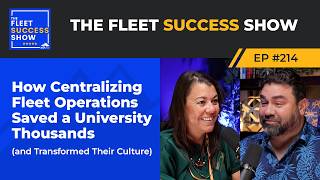
Lindsay Araya, fleet manager at the University of South Florida, found that only 15-20% of the university's 800+ vehicles were being serviced. She built a centralized motor-pool model that lets departments keep their vehicles while the central shop handles maintenance and surplus assets, saving thousands through better asset visibility and reduced duplication.
Chapters
This is the Fleet Success Show dedicated to helping you and your fleet succeed using the experience of fleet professionals and Hall of Fame fleet legends. The show that explores how the pillars of stakeholder satisfaction, intentional culture, resource efficiency, and risk management all combine to lead your fleet to success. We're glad you're here. Now let's get into the show.
I will tell you, I love my conferences. I love some more than others. I love NAFSA, which I'm sure you've heard of for a multitude of reasons. FLAGFA is one of the greatest organizations, regional organizations in the country, if not the greatest. There's an argument to be made. Them and FleetPros kind of battle that out. But NASIF is just awesome.
And I was excited to hear about it yesterday. I don't know if you heard the little story of how I heard about it.
No, please tell me. We were—
I was— this was after all the sessions and whatnot, and I was walking by and I hear a group of people mention it. And I said, what is that? I need to be a member of that organization.
Right.
And so we exchanged numbers with the people that was there in the group. We exchanged numbers and I said, definitely call me, let me know what I can do to help or how I can become a member.
Great. Yeah, you, it would be perfect for what you're talking about because, you know, every, every one has its role, right? Like, I love NTEA, the National Truck Equipment Association. The role there is, man, their floor is unbeatable. I mean, if you want to go learn about new equipment in the industry, that is the place to go. Okay, NAAFA has a great floor, a lot of folks, but that's the one. NAAFA is great for networking, for education, for getting exposure to the whole industry, for, for that working group togetherness that you're talking. Like, there's just nobody who takes the cake on NASIF, right? It's, it's this group. This, generally speaking, you you know, at the workshop every year, 100 to 150 folks. And they are such a great group because they work together. They're tight-knit. Their boards are constantly going. They're sharing ideas. They're sharing policies, samples, you know, hey, how did you handle this when I had to transition EVs and all this other stuff? And just the tight-knitness of it and the collaboration, the camaraderie, you know, I wish every state and every university would be active members. And everyone who gets involved is always happy they did. I've never—
That's awesome. And in the same industry and we speak the same language because we're exposed to the same challenges.
Correct. Yes.
Day in and day out.
Yeah. That's your group. That's your tribe. Yes, absolutely. You got to go find them. They're out there.
Oh, I definitely will.
Absolutely. Yeah. Yeah. Yeah, we do. We do some work with them. I attend every year and it's It's a cool thing. So what brings you in today? Tell us a little bit about your story, if you don't mind.
Yeah. So I'll tell you.
First off, tell us who you are. How about that? Yes, let's do that.
So my name is Lindsay Araya. I am the Fleet Services and Field Program Manager for the University of South Florida. Okay. My career started over 20 years ago, not necessarily in fleet, but something that goes along those lines.
So you fell into it. Sounds familiar.
I did. Yes. So my background is in the collision industry. Yes, I managed different collision shops for different companies.
Sure.
And then I went on to train managers for, during acquisitions. And so I traveled all over the US. I did that. I was very great at it. I loved it. It was one of my favorite jobs.
You sure?
But then COVID happened. Ah, yes.
Heard that one too. Right?
You know, so I went back to basics, and during that time, there was an opportunity to run the mechanic shop at the University of South Florida. Oh, cool. And so a person that had worked with me at the collision industry, in the collision industry, he reached out and said, hey, are you interested in this? And I said, well, I've never worked for a university before, and I know I'm a mechanic. I'm a certified mechanic.
Oh, cool.
Yeah.
So like ASE when you say certified?
ASE and ICAR. Oh, cool. And so bumper to bumper pretty much. And he says, well, I think you'd be great for this. I tried it, got hired, went in and noticed that the shop was actually working at about 15, 20% of capacity. Wow. And I said, what is happening here? Why are we not being as productive as we could be? Exactly. So I started digging in. And I'm a very analytical person. I will go in and I will find out and I will look at all the reports and figure things out. And I don't give up. It's crazy because, you know, people sometimes they'll say, no, you can't do that. And then you're like, okay, well then I guess I'll just do what I do on a day in and day out, right? But I don't. It doesn't stop there. So I started digging in and I went to my supervisor at the time and I said, hey, I realized that we have over 800 assets at the university, but we're only servicing about 15 to 20% of those.
Wow. Why? Right.
Help me understand, because I'm new. And he said, well, the departments are able to either bring their vehicles to you that they decide, or they can send them elsewhere to get serviced. I said, okay, well, if they're sending them elsewhere, where are they going? How do I reach out to them? And at the time he said, well, that's impossible. Impossible is not a common word in my vocabulary. So I said, well, really, there's nothing impossible, but let's talk about it again.
Right.
So it ended there, that conversation did, but not in my mind.
Right.
So I keep on digging and find out that, okay, so who do we reach out to at those departments that can help us get back in our doors. Come to find out that many years ago, things were not very well managed. And so it kind of deterred a lot of the departments from coming to us.
Right.
Okay, how do we change the mentality? What do we do differently? Who do we need to talk to? And so I started talking to different people, got myself involved with the university at different levels, was part of the employee engagement team, talked to employees, talked to leaders, and, got some people back in our doors.
Nice.
Yeah. So we started kind of trending in the right direction, but it still wasn't enough. Now we're about 25%.
Well, let me pause you for a second.
Yes.
What's your motivation? Why do you want to get the whole university coming to your shop?
So, and it's funny you ask because just recently I was having a conversation with another fleet manager And he said, well, I come in, I punch in, I do my job, and I go home. And that's where my responsibilities end. And I said, I have to disagree with you.
Amen. Thank you.
I said, I have to disagree because my responsibilities does not end with my shop. It does not end with the fuel program or even the waste and recycling program that I was managing. My responsibility is with the institution.
Amen.
And I want what's best for that institution. If they are doing great, I am doing great. And I mean, let's face it, job security, right? And I could be doing this anywhere, anywhere, but I want to do it with the people that I have invested in and that I have put passion and I've learned and I've educated myself to make them successful as well. And if I had to say one thing, if I, if I really needed to just focus on one thing that drives me, is motivating and helping people succeed.
Great, that's awesome.
Yeah.
Now there's baked into that, I'd have to imagine there's a core belief that by working through your shop you can better serve the university, right? Of course, the institution, whether it's more efficiently from a cost perspective, better quality, both, you know, that sort of a thing, right? Um, so you had reason to believe that, uh, which, which was, you know, you knew you had more capacity than you were using.
Yes.
And you probably also had some sense of what, what people, you know, what things cost out there outside of the university.
Oh, absolutely.
And that you can do it much cheaper or better. Yes. Is that fair? Okay, I don't want to put words in your mouth. I just want to establish that that's the baseline, because otherwise, why would you work so hard to to bring it all in, right? Okay. All right. So you're at 25%.
So I'm at 25% capacity. And then I went back to, to my supervisor at the time and I said, look, I know we spoke about this. And at the time you told me it was impossible. Why don't we make it possible? Let me come up with the solution. I put some work into it and this is an idea that I have. Again, I got shut down. And said, "Nope, the departments will never give up their budget," because the perception he had was that I was going to take over the fleets for all of the departments at the university. And he said, "Nope, they're not going to give up their budget because the budget depends on how many vehicles, how many assets, what their fleet looks like." Financial territory. Financial, yes. Money. So he said, "No way." No, not, not. It's not going to happen. We will never get their buy-in. I said, okay. I let that go for a little while and focused on other things at the university and in my career. And then we fast forward to this year, the beginning of this year, a big change happened at the university and we changed leaders. So the leadership changed completely. And so I said, now it's my opportunity. Now is my time.
That's great.
So I already had many notes, I had already worked on this, and I had already put together a lot of data. When the new leader came on, I said, I have something that I think you're going to want to see.
Awesome. Now tell me, where is this leadership changing? Is it every level? Is it the top? Is it just your boss? Tell me about what the tides were there.
Well, I can't really say too much because it is a university. Sure.
But enough of it is changing that there was perhaps an opportunity for a new look here.
Yes.
Right. Okay.
Absolutely.
Okay.
So the leader— what I think I can say is the leader that I had at the time moved on to a different company.
Okay.
And then the departments got shifted around, reorganized a little bit.
Okay.
So my department went through to a different person. Got it. And so having had that opportunity to present what I had already kind of discussed, but in a much more detailed way, I knew the approach had to change a little bit too. So I did. And when I presented the initiatives that I had, she loved it.
That's awesome.
She said, I really want to bring this on to higher leadership and get it approved and get it to become a policy for the university. And so I was, I mean, I was beyond myself, as you can imagine. I was so, I was jumping in happiness. And that's how it all started, really. And so now I'm putting the pieces together. Now, one of the things that we are doing is phasing things out because, as many universities can understand, things don't necessarily happen all at once. And so she did ask me to face things in a more approachable way to the departments. So I'm looking to centralize the fleets, but still give every department the opportunity to purchase their own, keep their budgets, keep their vehicles if they have the need for them, or create a motor pool where if you don't have the need for that vehicle and you want to— you don't want to spend the money servicing it and repairing it, give it to us. We will do the work. We will keep the vehicle, but when, when they need it, they can rent that vehicle out from us.
Right.
So that's—
it's a win-win.
Win-win.
Yes. Brilliant.
Because no one goes to school for fleet management, chances are you were never formally trained on how to successfully lead a fleet. That's where the Fleet Success Playbook comes in. The Fleet Success Playbook is your guide to building a safe, reliable, and efficient fleet. That provides exceptional service. Learn all about the 4 pillars of fleet success: stakeholder satisfaction, intentional culture, resource efficiency, and risk management. Get nearly 100 years of combined advice on common challenges, practical solutions, actionable tips, and real examples from fleet industry experts who have been there and done that. Visit www.fleetsuccess.com. Playbook.com to request your free copy today.
Well, that's fascinating. So, so that's cool. So let me, let me give you a little bit, I guess, of some of mine and let's say our team's background on it. And then, you know, we can see where we can commiserate or ask some questions. But as I mentioned to you before we started, you know, well, I think, you know, I think they probably told you I worked in university for 20 years. I was at Fordham University in New York. Go Rams. And I loved it. I will never regret it. As you said, working in a university is very different. Everything in life has trade-offs, but some of the pros, you know, just the community of it, the opportunity for training and education well beyond whatever I thought I would get. And just all the wonderful people that you get to meet at a university. There's something about the campus atmosphere that is difficult to replicate in other settings.
It's a pride thing.
Yeah, you know, I'll always think very, very fondly on it. It's my home. It's my home away from home. And I'm sure you can relate to this, but the hours I was putting in, I might as well have been my home away from home.
Right?
Oh yeah. Yeah, so I just love it. So many great relationships, most, you know, and it was the same similar thing. I shouldn't say same thing, similar thing where, you know, there was a lot of clarity. Now, we didn't have an in-house shop, but what we were learning was, during my time, we were— you can relate to this too— we were constantly trying to squeeze a dollar out of 15 cents. And during this time period, there was a lot of work like on the FMLA Act and minimum wages were going up. So people were costing more and more and the rules were getting stricter and stricter about how many hours you could give people and drivers. Just like you, I fell into it. I was in a transportation department. And I said, holy crap, I got to find a way to make the money work. And I'm not going to save money on people. In fact, that's only going to go up.
Yeah.
So I started to teach myself a bit about fleet, right? How can I make the vehicles and the assets less expensive? And then I went on a voyage to do just that, you know, found better ways, realized our leasing deal was terrible, found better ways to save money there. You know, got hooked up with formal contracts for maintenance programs and things like that instead of doing onesies and twosies with mom-and-pop shops, you know, all of that. And so it grew and we saved a lot of money. And then it was like, well, why can't we do this with the other departments? Right, right. And so that's kind of our story and my story and had great, great people working with me to do it all. But, you know, grew it out.
And, um, now how long ago did you say this was?
I left there in 2017.
Okay. The reason I ask that question is because we're dealing with very similar situations even today.
Yeah.
Yeah. But as I was saying earlier, people are afraid of what they don't know.
Yes.
And so everyone wants to be careful with their money, with their budgets.
That's what it is.
Yeah. And so one of the things that I let people know is I'm going to help you save money. Save money. Right.
That's the idea.
And I'm going to help you utilize your money effectively. Right. Whereas right now many departments don't even know how to look up their budgets and know how much budget they have. Yes. So that was another tricky thing for me because I'm not an accountant.
Right.
But I needed to know.
Yeah. So you're hitting a key— what we believe to be a key fundamental principle of Fleet, right? Fleet as service provider, not as czar. Right. That's what they're scared of. They're scared of the fleet czar. And yes, there will be some policies that have to come into place to make things work well.
Right.
But you're ultimately there to use your expertise to, A, take a load off of them, right? Right. Because oftentimes it's a secretary of a certain department, or, you know, an assistant adjunct professor, or, you know, who's trying to manage this and get it maintained. And then they give the key to somebody, and then it didn't start, and then they're begging for help. And right, you know, so number one, you're taking work off their plate, right?
Absolutely.
And then number two, you know, in the same way I don't want to go debate you know, a multi-time PhD in classical, you know, civilizations on whether or not Greeks, you know, had parties at midnight. I would hope for the same respect in return that I spend my life focusing and learning and educating myself and my people about Fleet.
Yeah.
Please give me that benefit of the doubt. And that's where in lies Fleet often runs into trouble, especially on a university campus. In my experience, I did get into debates. Oh yes, with art professors and philosophy professors and, you know, about, well, when, when the van goes around that circle, you're wasting so much gas. And I remember going out there with a foot and counting it up and then calculating, and yes, but it's also a security requirement, and this is right, you know, because frankly, when you're dealing with extremely educated people who are right 99% of the time, they're going to be used to being right, right? So that's part of the uphill battle I experienced. And at every place we've stopped along the way— and I say we, I've— most of the ones I'm going to name, I did personally, but you know, talking to like our consulting and our analyst group. I mean, we've helped the University of Alabama. He's in Nassif, Tony Johnson. You got to connect with him. He has completely turned that program around. I think we first worked with them in 2018 and it was completely decentralized. And he has slowly but surely centralized everything. And he's doing it in the way we're talking about where he's incentivized people to opt in. Yes. To volunteer in. That's the ultimate way to get it done. And he's done nothing but save the university money. Time and time and time again. And state universities under a similar initiative. University of Wyoming sticks out because they were motor pool driven just like you. And oh my God, the plan we recommended to them sounds like what you just said to me, right? Like, no, no, no. Offer to buy them back their vehicles and then they rent them. Show them how much money they're going to save. They don't have to sit on those assets.
Yeah.
You know, the truth is almost always in the numbers. Look, I don't want to say that centralization consolidation is always right, because if you do that, then you're not being open to analyzing the data. Right. And having an open mind to it. But I will say that when we analyze the data, overwhelmingly, it always seems to come back or almost always seems to come back that there's economies of scale to have happen by centralizing fleet management. It's pretty much an axiom at this point or a theorem that I would argue is certainly within a single campus. And then usually there's some level of functionality that should be centralized university-wide. And then some things that you might want portions of that are, let's say, one-off because you have this satellite campus that's way over here in the state and all the other action is over here. That's fine. The guidelines, they should live within the same guidelines and principles. Right. And we should be working together.
Absolutely.
But yeah, you're going to use a different vendor over there maybe than I'm going to use over here.
And that's perfectly fine. In fact, that's one of the things that I was speaking with the fleet manager for the police unit. For the police department. And I said, look, and they were opposed to anything that was change. And I said, look, I am not here to tell you what to do.
That always is with PD. I'm sorry, guys. Don't hate me. I love my law. I'm telling you. I absolutely love my guys. But there's something about the law guys and gals that they hate change. I know it's not fair to do it in one swoop. It is a generalization. There's exceptions to every rule.
There are exceptions to every rule.
But it's a generalization for a reason.
Well, and the funny thing is I've built a lot of great relationships with the police department and the guys and gals that work there. And they all come to the shop and they all want to bring their vehicles into our shop. Awesome. Which is good.
I mean, that's great.
I have their backup. But there, you know, there are conversations that we still need to have because if you're used to doing something a certain way, change is hard. Change is hard.
Yeah.
But it's inevitable. Inevitable.
Inevitable. Yeah.
Yes.
And so, so like you said, when it's in the best interest of the institution, it's also necessary.
Right.
Right.
Absolutely. And so speaking with this gentleman and I said, look, I am not here to tell you what to do. I am here to help you get where you want to get and be able to have the resources available to you. It's going to be a lot simpler than having to knock on everyone's doors to get where you want to get. I will help you get there. I will put a lot of work into this, but you just got to let me help you.
Right.
And that kind of allowed me to have more conversations.
Sure.
And it's going to be a struggle. And some— and what works for one may not work for the other. We also have to be flexible and understand that and look at it that way.
It's—
I'm not telling you that you're only going to use white cups every single day for every single drink that you're going to have throughout the day. Right. I'm telling you that we're going to get to a good understanding and and work together on this, right? And so, yeah, that, that's definitely it. So it may work differently, right? But at the same time, we're all working together, right?
And the phased approach you're talking about— now, folks who know me have heard me say this before, but I call them tree stumps. Universities tend to have a lot of tree stumps, you know. You just, you're trying to get them out, but you just can't move them, you know. They're there. And so the phased approach is nice because you build momentum. You start with people who want to work with you. Or who are willing to try. Absolutely right. And then, and then again, if you can tell your story with data and you can express your vision, well, now you have proof positive that this is working and it makes it much harder. You know, the tree stumps, you know, sometimes you can get them to move a little bit. You may not, because at universities, tree stumps are deep, deeply, deeply, deeply rooted. It's the— of all the— there are tree stumps in every institution type. But man, for some reason in universities, those roots go like to the lava, man, you know, like to the molten core. And so there are times where you just will not move that tree stump, right? But you'll get a little bit. And eventually when that tree stump says it's time for me to go, usually the next person comes in and says, my hair's on fire. I got this new job. You're telling me you're going to solve this problem for me? Yes. Sign me up. And you're ready for them.
That literally happened already.
Oh, really? To me? Yes.
So —love them to pieces, but they were working kind of way, way separate from the rest of the university. Sure. Just what you just described. The director is getting ready to retire. In fact, I'm coming in right before his retirement is due, and he's saying, we don't work the same way that Tampa does. We're St. Pete. We're not doing it. Right. And we've never done it before. How many times have you heard that? Oh, yeah. Oh, yeah. We do it this way.
We do it right.
Yeah. And so the gentleman that I'm in communications with, he tells his boss, right, the director, he says, listen, things are changing and this is a great program. She, you know, she came down here, she spoke with me about it.
She's— This is going to help us.
It's going to help us and it's going to help me because he's going into that other position. Right. Yeah. So transitioning into the director's position. And so he says, okay, look, That's fine. We're going to do things the way that you've been doing it. I'm going to talk to Lindsey and we're going to figure something out. And he did. He actually drove up to Tampa and sat with me and he told me, he goes, Lindsey, we need to hold off just for a little bit. Right. His retirement party is coming up. I said, wonderful. That's it. That's it. That's my experience to a T. And, you know, great for him. I'm paying, you know, congratulations on your retirement. Yep. And he says, but as soon as I take the seat, I'm gonna send you the data. I'm gonna, I'm gonna send you all the information that we need, and we're gonna get rolling. We're gonna go with this program 100%. Yep. So yeah, there's, there's proof.
Yeah, and it works. The only other thing that's ever worked with those stumps, and it's less frequent, but once in a while you can make the tree stumps into the champion, right? Interesting. And you know, if you're— if, if Glory and recognition is not a motivator for you, but it's more about getting it done, then that can be very, very effective. Right? Look at all the money you saved, Tree Stump Person, by making the brilliant decision to go with this and helping us do it better. Exactly right. And then it's, well, maybe I'm interested. Right? So we've seen that work a few times. Too. But yeah, the key is get that momentum, get everybody in who you can, make it opt-in. You know, that whole czar versus service approach is a big one. It's one we talk about a lot and it's catchy because, you know, there are some fleet organizations out there who are, who are asked to be the czar. Right. And I like to refer to them as more like they're more like fleet governance programs or organizations than they are fleet management. Programs, right? Not that those don't overlap, but you get the idea, right? Yes. And that's actually more challenging because now you're in the position of having to be sort of the judge and the, you know, the law enforcement, the judge and the jury on, okay, this is the policy, I have to make sure you're executing it, and if you don't execute it, I have to do something about it. Versus, you know, kind of what we're talking about, which is, nope, I'm going to help you save your money. I'm going to advise you. It's your decision. It's your money, you know. So that's challenging. I feel for those folks. I know many folks in the industry who— that's what they're chartered to do. But in your situation, you know what I love about that? I'm assuming that you're using some sort of reserve fund or some sort of internal— what's the word I'm looking for? I just lost the word. Anyway, are you charging back for your services? Is that how you're doing it? Yes. So that The money still lives in their budget and you simply just charge back. Your goal is to land that zero. Absolutely.
In fact, I'm giving away right now a lot of that work and a lot of that, those funds that—
to try to get folks in.
We would normally, yes, we would normally charge for everything that we do because we do have to build our own budget as well. And the reason why we have to build those budgets, it all just comes— goes back to the community, right? Right. I'm able to do this now because we had a budget already built up for something similar to this. Okay. It was just not— we didn't have, I guess, the resources or the time to put something like this together. Sure. So, so I'm looking at, okay, this, this bucket of money right here can help us create this, this program right here, right, which will in turn come back to us and then be able to get back to the community.
It's funny because you're even doing it with the hands, but it's the budget, um, What's that game? Shuffle? Yeah, yeah. The Three Card Monte. You know, that's, that's definitely budgets at universities, right?
And that's really how it works.
Yeah, it is. Yeah.
And that's how we can make things happen. Right, right. And that's, that's what's—
Well, that's, well, that's a great moral of that story too, right? So if we're talking to maybe fleet, new fleet professionals or really in any industry, but, you know, before you go asking for stuff, right, first show them that you can do something with the stuff you have. Absolutely. Then go ask for more. Yes. Right. Is that, is that Has that been true in your career?
Oh, yes. Yeah. Without a doubt. So on that point, there were departments that had several vehicles. Let's say just, just as an example, Department A has 10 golf carts, or let's just say 5, just for the sake of speaking. They didn't even know that those existed. They didn't even know where to look for them. They didn't realize that someone somewhere is keeping track of everything that you're purchasing. Right. So here I am and then saying, look, procurement, I spoke with the procurement department and I said, because I'm thinking, who is going to help me reach this goal? And started knocking on doors, asking questions and saying, okay, so where does this start? And it starts by the department having a need. When they have a need, they go to purchasing. And I said, that's who I want to talk to first. Right. And we did. And I— they loved the initiative. In fact, they had submitted initiatives of their own, not with the necessary knowledge and information on the industry. Sure. And so they just, you know, they're trying to figure things out because they know there's a need. Right. So I came to them and I said, look, I know your initiative didn't get approved, but I want to work with you. I'm not here to work against you. Mine did. So let's work together. Director of Procurement absolutely loved it, and I absolutely love her. She's a wonderful person and great to talk to, and her entire department as well. And then she said, how about if everyone that needs to purchase a vehicle, we send them back to you to do a purchasing analysis? Let's put that together. And we did. We sat down, we put everything together.
Like, you'd be the fleet management expert. That's what you do. And by the way, you've help procurement with a little bit of their lift, having folks outside of their expertise having to analyze that. Right. Right. So please continue.
That's the idea. And so, and I even explained, I said, look, I can look to find out how many vehicles they actually have in their fleet. And when I started doing that, they didn't even know that they had vehicles available to them already. Right. And so they're looking to purchase. And I said, okay, hold on before you go on with this purchase. Let's look at what you have. Yeah. And let's look at your budget.
It is sad to say, by the way, I'm sorry to interrupt you, but how many times we've walked into a university and they can't produce a full inventory. They don't even know what they have. So what you're experiencing is, it's, it's not uncommon, but it's because everything's so decentralized.
Right, right. And people, and they don't know what they don't know. It's not their intention.
It's not their fault, right? Yeah. It could have been bought 20 years ago. They get hired, they come into the position, they have no idea. They have no idea. It's in a yard somewhere.
So now we're educating the educators, right? Doesn't that feel good? Yes, it does. I love our professors. They reach out to me. So that's cool. And so sure enough, and I said, well, look, you have 5 golf carts already. Why are you purchasing a 6th one? Right. And they go, well, they don't work. Oh, well, let me help you with that. You know who I am? Not just Fleet Services. We actually just changed our name. We were Vehicle Maintenance. And it was everything was just maintenance.
That's the problem. Yeah. It's amazing what a name can do, right?
Right. Yeah. And so we changed it to Fleet Services. And I said, well, let me help you with that first. Let's tackle those and see what stages those are at.
Yes. Are they— maybe they should get dumped or maybe it's a quick little repair.
Well, and that's the thing, Mark, there is no dumping of anything. Everything is, everything is money. Yeah. And even if those 5 vehicles can now—
Well, right, we can resell them, right? Yeah.
Yeah. On the road, that's okay because we can trade them in. Right. Or we can send them to an auction.
Right, exactly. And that's what I do.
And we do it, you know, policy-driven, but we're going to do it the right way. And now you will be able to get your brand new and shiny golf cart that you need. It's going to help you pay for it. Right, exactly. And so that budget now frees up for services. Right. And inspections of that new golf cart that you're purchasing because I'm also giving them that information upfront. Sure. So it's, it really is helping the university as a whole with just everything that is vehicle related. Yeah.
So some things to hit on here because we're talking about it and, you know, for those listening here, I'll do the little— here are some of the things we often run into, the benefits of centralization, and maybe you're experiencing these already. You just mentioned some, right? Yeah. So, you know, having a pro look at these purchases? Are we— first off, are we getting ripped off on the price? Are we not? As simple as that. But more like you said, you know, how are we allocating these? Are we allocating them properly? Who's doing the analysis around utilization? Do we know if we actually need more? So vehicle— so asset right typing and rights and right sizing, right? You know, this guy's asking for a 3-ton truck. Maybe the work that could be done with a 1-ton truck, right? No one there may be folks in procurement who know, but it's certainly not what they were hired for from an expertise perspective. So it would be unfair to expect that they know, right? Right. Someone needs to know that. You need that gatekeeper who can at least then have that conversation. And in the end, it's their money. But at least we're ensuring that the university is not just burning money because essentially that's what happens, right? So do we need another asset? Are we buying the right type of asset? When should we— are we properly maintaining the— who's tracking if the asset is being properly maintained? Because we all know it's just a matter of time for that one, you know, that kid falls off the back of the golf cart during commencement, gets hit by a car in the parking lot, and it's the big, huge— and I've— that might— no, no, you're sorry for them. That might be too close to home. But those sorts of things, not literally, but, you know, that's what it is. And then the first question is, well, was the asset maintained right? And da da da da. Did the driver get trained right? Who's tracking all of that? Right, right. No one, no one has an answer for any of that. What we find is, okay, even if we want to let you use the outsourced vendor and not the internal shop, do you have a, do you have a service level agreement with them? Are they getting it back to you quickly enough? Are you paying a competitive rate? Was it bid right? You know, are you keeping up your end of the bargain with the PMs and so forth and so on? Fuel. I mean, I have a case, I won't mention the school, but we had essentially two different fleet organizations that are, you know, eyeshot from each other from a building perspective. They both operate their own individual fuel island. And they did not know this. Procurement knew that they both order from the same vendor. So procurement went out and got one contract, but it was treating it— it was like they had two different contracts for two different departments. And so they were ordering them constantly and independently. So they're getting like half-truck deliveries each instead of just coordinating and getting a single delivery, you know, with all those services. You know, like, there's so many opportunities just by letting the left hand know what the right hand is doing. And it's very difficult to accomplish that in the absence of true centralization, some sort of central command hub, you know, who sometimes all you're doing is playing operator, right? Like, let's, let's make sure Johnny's talking to Steve and Susie's talking to Sam, you know. So I mean, what we find is when we go in, if the university has even a little bit of interest, it's usually so much low-hanging fruit. And it sounds like you've tapped into a lot of that and then you just grow it from, you know, from there. Yeah. So yeah, that's, that's cool. It's neat to, it's neat to hear someone sort of doing it on your own, but also kind of like verifying that, you know, what we're seeing out in the industry is kind of what's there.
And I'm doing it. I'm definitely doing it on my own, but I have a lot of friends like, you guys, you're very welcome to help. And hopefully other universities are going to be listening to this and saying, I need to reach out to her. And by all means, I will share my information with anyone that would like to help me out. Sure. You know, and I would never say that I know everything, right? Because I don't, right? I can tell you that.
Good, because that means you're willing to keep learning. Absolutely.
I mean, I had to learn this. I've been with the university for 4 years now, right? I did not come from a fleet background, right?
So first you have to learn fleet, then you have to learn the university, and now you got to put those two together, right?
Right. Yes, exactly. So no, I, I, I, I, you know, as long as I can keep learning. Yep. And, and growing, stay out of the way of the tree stumps. Yeah, try to pull them out. Yep.
All right, I have only one last question for you here because we are getting short on time, but I am fascinated to know this. One of the folks here told me, and I don't know if it's true. Well, first off, let me ask you about how many assets are you— that you are— you do you know that you're managing that are under your purview?
I always say that we have over 800 registered, right, vehicles.
Yeah. I'm going to guess that you're— let's have a playful bet. When it's all said and done, which might take several years. Yes. I'm going to bet you have over 2,000 assets. You might have over 3,000 assets. That's my experience with this stuff. So let's see. Now you're scaring me a little bit. Now, they're not all over-the-road vehicles, right? That includes the little mini excavators and the Kubotas for our— for landscaping.
And yeah, so a lot of this stuff, I mean, and I'm not counting any of the lawn equipment because like I said at the beginning here of the conversation, there's another company that came on to manage several facility operations within USF. So we gave, um, and this may not be the right term, but we gave away, or we gave a lot of the management of the lawnmowers and lawn equipment and, and, um, that to this company. Because that alone would probably put me at well over $1,000.
There you go. Registered. Yeah. And I don't mean the weed whackers. I mean the actual things that you would call a capital asset. Right. And, and that's fine. Outsource it. They're the specialists and that's appropriate sometimes. Yeah, but someone's still got to manage them. Right. And I would argue that's probably— you should be part of that. Let me put it that way. So, but yeah, it's— you're going to, you're going to keep finding them. So that's good. Yes. If you're curious, you know, how many you have there.
We'll come back in a year or two.
But you got to include them. Anything that's a capital asset, that's a fleet asset, I want in the numbers. So we're fair. We're actually having this debate internally right now. Really? Yeah, because I I have some projections based on my past studies. But, you know, what you find is people, well, they tell you what they know. Exactly. But until they've gone digging, to your point earlier, they don't know. Right. But here's the question then. I've heard that a large portion of that is golf course. You've referenced golf course, right? Which is just, you know, for me as a Northeasterner is like, oh, yeah. And it was cool because at Fordham, we, you know, I remember when we had no golf course. Golf carts, and we used to rent them for big events and for other things. By the time I left, I think we had a fleet of like 30 specialized golf carts. They were people movers. There were no golf bags on them, you know. I had 10 passenger golf carts, 8 passenger golf carts. Wow. Yeah, special, special made. But in any event, like, and I actually found it fun managing the golf carts. Yes. So here's the question: how many golf carts do you—
I'm not— no, no, I'm not gonna, I'm not gonna answer that question. I'm actually gonna throw it back at you. Okay. Okay, take a guess of how many golf carts— if we have over 800 registered vehicles, how many golf carts registered in Florida? Yeah, well, registered with the university. With the university. Yeah. So how many do you think we have? Wild guess.
See, this is tricky because like from a normal proportion perspective, I would have probably guessed, you know, 100 or change. But then I put like, oh yeah, in Florida people just drive around in golf carts everywhere. And it makes me think that maybe the number's like insane, like maybe it's more than half. So I'm not really— that's why I'm asking you the question, because I'm fascinated to know. So I'm just going to throw it out. I have 400, 400 golf carts. I'm going to go—
you're just about right. Oh wow. Yes. So yes, you got it. Yes. So a little bit over 400.
Wow. Oh, yeah, that's neat. I don't think golf, you know, like the most major golf courses on the planet don't have anything close to that.
I certainly hope so. It's a lot of maintenance. I mean, that, that is most of the work that we do in our, in our mechanic shop today is golf carts.
Yeah, that's, that's really interesting. Hey, something to think about because a lot of those lawn mowers and stuff, same tech, right? Yeah. Um, oh, that's cool. Well, Listen, this has been a ton of fun. I hope you'll come back on the show and we can, we can do this again.
Thank you for having me. Yeah, this is— yeah, it wasn't planned, but I know it wasn't planned.
For those who are watching, this was totally impromptu. You came to visit us today and we said we were having a good conversation.
Yeah, yeah, this is the tour, right?
You know, we had some good conversation. We said, let's, let's go record it. And so we did.
I could talk about this all day long. And don't even get me started with the fuel program and the waste recycling program. Yeah. So I was actually featured in the National Waste and Recycling Association magazine. Nice. Yeah. And then also in the university employee magazine.
You'll love Tony because that's where he comes out of as well. His whole career was, was, was in waste and recycling. They built one of the best recycling programs.
You guys would just have to put an office in here for me and just work out of here.
We love it. It'll be your second, your remote office.
Yeah, remote office in Phoenix. Well, there you go.
So then it's a date. We'll have you on again. We'll talk about the fuel program. We'll talk about the recycling and other things like that. Yeah, sounds good. All right. Thank you very much. Been an absolute pleasure. Thank you, sir. All right. Take care, folks.
We hope you enjoyed the show. If you'd like to help support the podcast, please share it with others, post about it on LinkedIn, or leave a review. Want to learn more about our fleet management software, Fleet 360? Check us out at rtafleet.com. If you want to learn more about having your fleet evaluated by our consulting team, go to fleetconsulting.com.
More from Josh

Episode 227: The Hidden Costs Killing Fleet Operations (It’s NOT What You Think)


Episode 225: Are Certifications Still Worth It? The Truth About ASE, CAFM & Fleet Leadership




Episode 221: The State of Fleet Management: Education, AI, and the Technician Crisis with NAFA’s CEO

Episode 220: Motor Pools Are Back: Right-Size Your Fleet Without Breaking Operations

Episode 219: Stop Guessing at Downtime: Status Strategy for Better Availability #podcast #fleet

Episode 218: Fleet Predictions 2026: AI Hype, Technician Shortages, & the Next Era of Fleet Managers

Episode 217: Why Replacement Planning Solves 95% of Your Problems #podcast #fleetmanagement #fleet