Episode 215: Fleet Management 101: How to Become a Great Fleet Supervisor
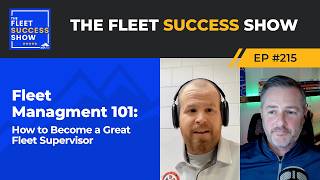
In this episode of the Fleet Success Show, host Facundo Tesara interviews Brendan Hunt, an assistant fleet service and facility manager for Fairfax County Government. The conversation traces Brendan’s path from an auto‑tech student and part‑time mechanic to a Level 1 technician on school buses, then to a Tech 2, and eventually to a supervisory role overseeing training, quality assurance, and facility maintenance across four county shops. Brendan shares personal anecdotes about his education, early jobs, and the lengthy hiring process, highlighting the diverse fleet (over 6,000 vehicles ranging from lawn mowers to tractor‑trailers) and a staff of roughly 250 technicians. The core of the interview focuses on the challenges of moving from hands‑on work to people management: loss of direct metric control, the emotional toll of leadership, the need for listening, buy‑in, and empathy, and the importance of documenting standard operating procedures (SOPs) to preserve knowledge. Brendan also discusses standardizing shop equipment across facilities to streamline repairs, reduce parts inventory, and improve safety. Throughout, he emphasizes continuous improvement, learning from mistakes, and the value of mentorship and communication. The episode concludes with Brendan’s advice for aspiring supervisors: listen, observe, seek buy‑in, and embrace the learning curve.
Chapters
Hey, welcome back to another episode of the Fleet Success Show. I'm Facundo Tesara. Thanks for joining. Today I'm joined by Brendan Hunt, and we talk about his transition from being a technician into a shop supervisor and some lessons along the way that's really important for folks to consider as they transition. Fairfax County, super special to me. Fairfax County, Virginia, because that's where I grew up. So there's a lot of really fun memories touring his shop while I was there a few weeks ago. Hope you enjoy it.
This is the Fleet Success Show dedicated to helping you and your fleet succeed using the experience of fleet professionals and Hall of Fame fleet legends. The show that explores how the pillars of stakeholder satisfaction, intentional culture, resource efficiency, and risk management all combine to lead your fleet to success. We're glad you're here. Now let's get into the show.
Hey, I'm Facundo Tesara, back for another episode. I'm joined here today with Brandon Hunt from Fairfax County, Virginia. I'll talk a little bit about why that's important to me, Fairfax County, Virginia. In a second. But Brendan, you introduce— go ahead and introduce yourself.
I'm Brendan Hunt with Fairfax County Government. I work for Vehicle Services in our fleet management system. I'm one of the assistant fleet service and facility managers.
It's a long title.
It is. It is. Yeah, they just changed it up on us. So that's why I'm like, oh, okay, trying to remember. Yeah, yeah, yeah. So that's— I work for the county. I'm one of 5 at my level, and I'm in charge of our quality assurance program right now where we do all the inspections of all the work being done on our vehicles as well as our training program. So, one of the fun things about fleet.
Cool. All right. So before we jump into the rest of what we're going to be talking about Fairfax County. So what's really cool is, well, really cool to me anyway, is I grew up in Fairfax County. So I spent, so when I moved, a lot of people know this about me, so I guess I didn't say, if this is the first time listening, uh, I did say I'm Facundo, but I didn't say I'm the Fleet Success Ambassador here at RTA. A lot of people know about me is that I moved to the US from Argentina in 1985, and we landed from Argentina, we landed in the DC area and have grew up in Reston, Virginia in Fairfax County. And so I was there until 2012 when I took my first fleet job in the city of Ormond Beach and then kind of never went back to live there, but our, my family and both my wife's family and my wife is from the area as well. You know, we, we spent our entire life there, so we know that area well. And I was telling Brendan, when I went up there and got a tour of a shop and he drove me around to different facilities, I mean, I was reliving my childhood memories of the buses that said Fairfax County and like, man, the bus is here, that means I gotta go to school. And then the, the snowplows coming by and clearing the snow. And I was like, man, I gotta go to school tomorrow. And so it was good memories and, and some bad memories, I guess you could say. So anyway, it was, it was really cool. It was like walking through my, my childhood and then now kind of coming full circle being in Fleet. So anyway, what, what caught my attention with Brendan was kind of his, his, it was his passion that it was fully, you know, he was fully engulfed in that passion of the continuous improvement and building systems for when he's not there. Right. So people have these systems and, you know, he told me several stories and it wasn't an easy road. So I wanted to kind of go back to the beginning, Brennan, of what you started with by telling me your mom, when it was time to go to college, your mom was like, all right, what 4-year college is it gonna be? And then you told me the story. So go ahead and retell that story. Yeah, yeah, yeah.
That, that's, that is literally how it all started for me to get where I am. 'Cause I did auto tech through high school. I went to Robinson High School, which is a local school here. And I did that for 2 years and I fell in love with mechanic, auto mechanics. And, you know, and my mom's like, no, that's great, but you're still gonna go get a 4-year degree. And I was like, okay, fine. So I went to Christopher Newport University for a year and it just wasn't working out for me. It just wasn't, wasn't what I wanted. It wasn't really having a great time there and, you know, having a good time, but not a great time with learning and everything, you know how that goes. But my passion was, my passion was still in fixing vehicles. So I came home the next semester and after my first year there, and I went to, uh, NOVA, Northern Virginia Community College here. I started up their automotive program here. So that way I was still getting a degree. And, you know, I was, but I was doing it in the field I liked and I was able to finish that program in less than a year and a half, which is technically a 2.5-year program for them. So I just, 'cause I was just that engulfed in it. So I just did it. But yeah, that's where I got there. And then I, from there I went, I was working at a private shop and at a Ford dealership at the same time, working at the Ford dealership on the weekends due to the requirements for the NOVA. And then I was also working at my future father-in-law's gas station shop, working there.
That's right.
Yeah. Yeah. So once I, school ended, I ended up with, ended Ford and I stayed with my father-in-law for a while. And then I, at the time we were talking about things and I was like, I was, I was talking about applying for other positions and, you know, he pulled me aside and he's like, look. Business is business. If you leave, hey, I understand, but I want you to understand a few things when you're looking at these jobs. I want you to look, your primary thing has got to be benefits. You know, I was like, okay, so no problem. I looked into that and I was talking to a family friend of ours that worked for Fairfax County DVS at the time, Billy Davis. He actually went to school with my mom and dad. So, we had a conversation and we talked about things and he's like, you know, this, there's a lot of places to work, a lot of different vehicles, all sorts of things to learn, and there's a lot of growth. So, once I applied, I got my interview and took a little bit. The county's a little, was a little slower than it is now. They're much faster now, thankfully. Uh-huh. But yeah, sat around for, I think, 9 months waiting to get a callback. So, and then, you know, that was back in 2007.
How long were you at your working at your father-in-law's shop. It was funny 'cause you were talking about the conversation that you had and it was really, you know, for, again, some of the folks that know me, maybe if you listen to me, listen to the show the first time, I, similar to Brendan, I started at a family-owned mechanic shop. It was owned by my dad, really down the street from where Brendan's shop is. I was in Sterling. I actually had no intention of working in automotive or in the family business. I just needed a part-time job. Grew to love the business and the same conversation that your father-in-law had with you, my father had with me about, you know, no hard feelings if you, you know, if, if you decide to, to do something else, because that was essentially, it was either gonna be, I take over the business and buy some portion of it, and that's my father's retirement, or he sells the entire business and that's his retirement. And so there was these different avenues. And so I had to do a lot of, well, what am I going to do? What's going to be best for him? And then he was kind of like very similar to you. It's like, look, you know, it's a tough industry, especially on the private side, especially when you're running a private shop. There's always a lot of interesting characters that come through, not only for folks that are working there, but for customers. And so no hard feelings. So yeah, so that was a Interesting that he told— where was the gas station?
Alexandria. Yeah. So not too far, but I was there for about 2 years.
You apply for the job at Fairfax County. They take a little bit of time to get back to you.
Mm-hmm.
Then what do you immediately like, boom, I'm in, I'm taking it. Or you're like, I need to think about this.
So at the time when I, when I got the, once I found I got the call and everything else, they were like, I actually jumped right on it because they were like, oh, we're gonna have you start. And they gave me like a month from when I actually was— when I actually started. And I was like, that's— oh, she's— they were like, oh, we want to make sure you have enough time to tell your current employers. Like, no, you're good. Just if I can get into this next one, which was like the next week or next week and a half, whatever. I was like, if you can fit me in that, I'll start then, no problem. Because if I had If I didn't start then, I would've been starting just by myself instead of in a group. So I was like, no, no problem. I'll do that. That, cuz I was like, I guess when they were going down the chain of every reaching out to everyone, they just hadn't got to me yet. And it's like, no problem. Not hurting my feelings. But yeah, so my, told my father-in-law, he's like, awesome. Congratulations. Good luck. He didn't question anything. Didn't ask for a date. He's like, just when do you start on that one? And he's like, I know when you're done.
You mentioned it was a, it was. A friend of your parents that worked at the fleet. What were they doing at the time? Like, so you, how did that conversation go?
Yeah. So it was funny because I'd just about to finish school and my parents were going to their reunion, school, high school reunion. And they ran into their, his, Billy Davis there, their friend. And they were talking about it and he was like, you know, he ought to apply. I got one coming open right now. And you're gonna hire a bunch of people. you know, get in there on that. So that's really how that worked with that one. It was just a luck of the draw and timing.
So the first job was as a technician?
Yeah, a Tech 1, a Tech 1, level 1 technician. So we have multiple different positions here and I was a tech. I came in as a Tech 1. So the only level, level you can come underneath there is an, uh, aid. Which was normally people who are, don't have any experience whatsoever and all that stuff, and they're trying to get in, or they're just outta school and all that stuff, like high school, and they're just trying to get in and like an underfilled type position. So then we go all the way up to our director, right? But our, my friend, my parents' friend, Billy, he was actually a superintendent. So he is, he would be in one level up from where I am currently. Got it.
So, so then So you start, all right, so you start as a tech and you're, was it a, like a light duty, light duty tech or?
No, I actually came in and they put me on school buses. I had never been under a school bus ever in my life.
Oh, interesting. So you were working, obviously if you were working at a, a gas station, you were just doing the regular, you know, things related to a state inspection, fixing those kinds of things, oil changes, and then you got thrown in under a school bus, literally.
Yeah.
Yep.
—And you talk about picking up a vehicle and you're like, you're picking up cars. You're like, okay, it's a little intimidating. Then you pick up this 30,000-pound vehicle that's, you know, 40 feet long. You're like, oh, okay, I gotta get under this. Are we sure about this? So yeah, it was definitely— Yeah. But, you know, I didn't know anything about diesel or anything like that, but I learned it on the job. That was one of the fun things about what I've done here.
So you were doing that.
You got—
I love that you got thrown under the bus immediately. Perfect. Literally. Yeah, literally. And then, so you started doing that and how long were you doing that work before some other opportunities started to open up for you?
I was about 2 and a half years before I got my, got a promotion to a Tech 2. And yeah, that's really where it really was, about 2 and a half years. Yeah. Then I got that promotion. I stayed in the same section. I didn't move shops at that current point. Just, they were At that time we were going through that baby boomer phase-out thing at the county where all these people had come in and they're just mass exodus and they were just trying to hire people and move people around. And I just got lucky. I didn't have to really move around at the time. And then what is it? And I didn't get a, I didn't move up to management level until about 2014. Yeah, it was the year my daughter was born, 2014. So from 2007 to 2014, you know, I was on the floor, I moved around from our bus section at our Newington facility. And then in 2011, I got an opportunity to move over to our Westox location, which is much closer to my house at the time. And, but I got put into our fire section. So I worked on all the fire and rescue equipment and it was, you know, that shop in our sections, when you come to the fire and rescue, it's, you know, everyone's like, oh, they got the, they got easy and all that stuff. It's feast or famine down there. And I loved it. You know, you're, it was always on the point. You're always trying to get something done, trying to help someone out. You know, it, it was a great time down there. Um, that's where I learned quite a bit, especially it gave me the opportunity to learn the stuff to help me move into the next level. At least.
Was that the shop that I was at? The Westox shop? Yeah.
That was, that's what I thought you were getting at. Yep. Yeah.
Okay. All right. So you're there working on that and how long did you say you were there at the Westox shop? as a Tech 2? I'm not sure if you mentioned.
Probably about, I got there in 2011. So, but yeah, so from there I was at Westox for about 3, 4 years. Okay.
And then what the con— that's where the conversation started to move into, to transition into leadership management, whatever you want to call it.
Big change. Big change.
All right. So, so take me down. That whole conversation that you had internally and then the decisions and, you know, walking into that. I remember you told me you walked into that and you were kicking ass and taking names and then you were like, wait a second, I need to pump the brakes.
Yeah. Yeah. That was one of the funny things when I was going for the position and everything else and I was, all the upper management people that I knew and they knew me, they looked at me, it's like, are you sure? Are you ready for this? You sure you got this? I was like, yeah, I mean, I've been the backup here. I've been doing all this all the time. I was like, how much harder could it be? Right? Wrong. Right. Yeah. So I got— I was told, you know, hey, look, this is what I need you to do when you get to this place. And I need you to go in and change things and make, make an impact, you know, and we need to make this known for a difference, you know? So I went in there and I did exactly that. Right. You know, I'm young and didn't know any better, and I just went in there bullheaded and, you know, tried to change things and did it the wrong way. And, you know, there I learned a lot of lessons that first year, probably 2 years I was in there, especially at that location where I was, because I was pretty much by myself when I went into that shop. Um, I had At that, it was a smaller shop, but it was, the impact it had was pretty great. But there is, at the, on my shift at the time, it was, I was the highest ranking person on, on site. So, you know, having to learn and teach myself everything about the systems and everything else that, you know, nonexistent at really at the time for, you know, passed down information or transition time, there was none of that. For me. Um, so I learned on the fly.
One thing that I didn't mention, and I, I don't think you mentioned, was the size of your fleet. And it's extremely diverse. So mention that real quick. Yeah. Yeah. I just, yeah. So tell us a little bit about your fleet before we continue, because I think there's a, that adds a lot of context.
Yeah. Yeah. So our, our fleet consists of over 6,000 units, whether it's a piece of equipment, trailer, car, truck, tractor-trailer, lawn mower, any of that stuff, we have that. And then we have roughly 250 techs at 4 different facilities, and they literally range between an aide up to a Tech 3 in our levels. So, you know, we are 4 shops. We have our Westox shop that does our school buses, our medium-heavy cars, trucks, our snow equipment, all that stuff. And then our house, our fire section. And then we have our Germantown location, which sees the most amount of vehicles just for its size, but they're primarily out of our police units and our car units, light units, right? They do an upfit. They do everything and anything down there, fixing every vehicle. Uplight, upfitting all the police units, whether it's all the way from, literally we get a car, right? And then we put all the decals, the wiring, the lights, the, all the seats, all that stuff gets changed out. Those guys do every bit of it down there. And then we do it also with all our regular Amber Fleet vehicles. Then we have our Auburn facility, which is our heavy facility, which does all tractor trailers and heavy vehicles. Um, you know, like our factory units. Tractor trailers, our solid waste units, our trash trucks, all that stuff gets run through that. And then we have our Newington facility, which is technically our largest facility where they do school buses. They do our light and fire and our motorcycle shop. So they, we have a lot of stuff going on and we literally see everything from, I would say, a lawnmower all the way up to a tractor trailer.
Because no one goes to school for fleet management, chances are you were never formally trained on how to successfully lead a fleet. That's where the Fleet Success Playbook comes in. The Fleet Success Playbook is your guide to building a safe, reliable, and efficient fleet that provides exceptional service. Learn all about the 4 pillars of fleet success: stakeholder satisfaction, intentional culture, resource efficiency, and risk management. Get nearly 100 years of combined advice on common challenges, practical solutions, actionable tips, and real examples from fleet industry experts who have been there and done that. Visit www.fleetsuccessplaybook.com to request your free copy today. So super diverse. One thing, one thing that Brendan didn't say was if anybody needs a lesson on how to build police cars, how to upfit police cars, Fairfax County is a good trip to go to. Not that I ever did it or knew much about it. I took a stab at upfitting our own vehicles while I was in Ormond Beach, and we had a similar kind of operation that you did, but nowhere near the efficiency and had it dialed in the way you did. So anyway, just a little— make sure that if you're looking for a shop to tour and if you're looking to bring upfits in-house, make a trip to Fairfax County.
Absolutely. We'll be happy to help you.
So that was the Squirrel, you know, kind of. Yeah. Forgot to talk about this, but going back to, so, okay, so you're in, you're now a supervisor. You're, you know, they've asked you to come in there and make some changes and you're like, I got this. And you're going around and just, you know, like a bull in a china shop, as they say, and doing all kinds of stuff. And then, uh, so that's where we left off before we, we, we had the squirrel. So, all right. So you're all, so you're doing this. Let's go back to that conversation. Yeah.
So I'm in there trying to make changes and I'm getting a lot of kickback, you know, and it's not kickback from my team, my technicians underneath me. They understood it. They saw what I was doing. They understood the message was going on and they actually enjoyed it because a lot of them understood where I was coming from. And, you know, they were learning and trying to— they wanted to make things a little bit better. The problem was, is the other shift and the upper management at the time didn't have this, didn't understand my message and didn't, weren't told what I was supposed to be doing. And then that on top of it is the way I was going about it was, you know, not the right way. Um, and my wife had to explain it to me eventually. And she, she's like, you get more bees with honey. I was like, okay, understood. And you know, it. Took a lot of fighting and everything else and internal battles. There was a couple times where I was going through the struggle of the transition between the leadership part of my job and not fixing things anymore. You know, it's much easier if I have a problem with a vehicle or something in front of me, I just go fix it, right? I can literally go in there, put my hands on it, fix it. But when you go into a leadership position, no one ever tells you that those things change, how you can't fix the same way. You're, you're dealing with people. Every single person has a different mentality, a different way you can talk to them, a different way they receive messages, different way, you know, they understand what you're saying. And God, it was awful personally for me to learn that the hard way. There was a couple of times where I called my wife and I was like in tears and I was like, I can't do this anymore. I'm going back. This is a mistake. I need to go back on the floor. You know, it's just, this is, this is too hard. I can't do it. I don't want to do it. And, you know, and I had to have a reality check with myself and like, look, this, this is a promotion that you want it and you can make a difference. You have to figure out how to do it. And, you know, talking with her and a few other people and, you know, figured out ways to, all right, well, maybe I need to sit down with everyone at my shop, the upper management and say, hey, this is what I was told to do. And this is what I, would like to do instead of just telling them what I was doing and getting— making them get over it, getting their buy-in, you know, that's a lesson learned now.
So you clearly had a vision of what you wanted to do. The problem was how to go about it because you said something right there that was so critical. And I think kind of one of the underlying things that I'm doing on, you know, kind of this series of Fleet Management 101 which is, you know, either for new fleet professionals or fleet professionals that, you know, have been around for a while, need to touch up on some stuff. But one of the most important things is that as you're transitioning from the shop floor into a managerial role or a supervisor role, you lose that direct impact of the metrics, right? So like you can, you can replace, I don't know, an alternator in 2 hours and book time says 3 and you're awesome. But when you're a supervisor, your job is to motivate that person that can possibly do the job in 2 hours when it's a 3-hour job. But then if he's doing the, you know, the 3-hour job in 5 hours, it's still your fault as the supervisor. Like the buck stops with you. And that's tough. A lot of people just see the money and the writing on the wall. I can make more money. But they forget about that part, which is, it's brutal. And I think you experienced it when you called your wife in tears and you were like, what am I doing?
Yeah. Yeah. Nope. There's, it's been many a times where I've been told, and I still get it every once in a while from my, from my bosses saying, you know, Brendan, not everyone's a Brendan. Not everyone's like you. Not everyone can do the same things you can do at the same pace or at the same ability. You know, it's just, you know, and they're like, there are things that you can't do that they can do better. It's like, you have to understand and accept that and come to an understanding really is what it comes down to. Not really, everyone's like, well, you have to, acceptance of lesser quality. I was like, no, it's not. You have to understand and then motivate and drive them in their own aspect. And it's just like, every person has to learn how each person works. And it was the one thing I took from what I was doing as a mechanic, right, to be able to transition over to the leadership side of it is, okay, are you able to diagnose a problem? Yes. Okay. All right. Now I need to learn how to diagnose a person. Do I, do I, can I read, can I read who they are? Can I read their attitude? Can I read what the information coming in? It's still a learning process this day, but it, my diagnostic side of it helps me determine, okay, my message isn't getting across. Stop and think, what are we doing wrong?
What can we do better? Yeah. And, and one other thing that you mentioned that I, I think kind of along the way as you were learning some of these leadership lessons, you started to figure out as you were moving around, like, hey, I need to document this process because you realized you can do it yourself and you could do it well now. And you, and people started to understand and respect your leadership style and were understanding what you were wanting to do. But then you started realizing as you're moving around from a shop to a shop and you had different shops and you moved around, you were leaving documentation for the process. I think that's huge because there's so many times where I'm not everybody, right? I mean, people, there's a lot of people that can be leaders, right? And there's this one saying, I think it was Jim Collins or something like that, that talks about, he says, it's not about building Um, he says it's not about telling time, it's about building clocks, right? It's about leaving a process in place that when you're no longer there, or when you're out of the country or where you're on vacation, people can be like, oh yeah, yeah, I remember how to do that. But you know, just in case, let's check the, the policy or the procedure out because it is documented. So let's go back and look at that. So talk a little bit about, so you started documenting stuff and, you know, just talk about the little bit of an impact it had. Yeah, no.
So I've, I've worked at all 4 of our shops now and every single section we have. So, I mean, and I've been a manager in almost all the facilities at this current point now. And I've, you know, so I understand how things are going and, you know, one of the things I noticed as a foreman was like, why aren't we all doing the same thing? I was like, I understand each section has different nuances, but why aren't our practices the same? If I have a vehicle coming in, why aren't we doing the same thing there? If I'm filling out something, why aren't we doing it exactly the same? Why is everyone doing something different? It doesn't make sense. How hard is it? It's like, it makes it so much harder to track things and find things. And if no one, no one has the same practices, why, why are we doing things? You know, you know, am I— one of the things I've learned about is SOP, standard operating practices, right? So that was something I started doing at my last position when I was at Germantown, working on a bunch of that stuff and setting that stuff up so that way it was written down and organized for everyone to be able to look at and say, okay, how did we do it before? All right. Not to say that's the perfect way to do it, but it's just the standard way to do it. Now, however you do it after that, that's your choice. But if you were to teach someone coming in, this is how you should teach them. You know, just like when you're inspecting a vehicle, you know, school buses, all that stuff there, the state requires us to look at it, look at a certain number of things. Okay. That's fine. Here's how we look at it. If you, as long as you look at all these points, I really don't care how you do it at that point. This is your timeline. Here you go. But as long as everyone understands that we have a standard practice and it's written down somewhere for someone to follow along in the long run. And so that way, if someone like me who was thrown into a position, like Okay, where, where do I find everything? And there's no one there to talk to. All they got to do is say, oh, here, Brendan, here's the manual, right? The manual for doing things and all that stuff. And you're like, here. And from there you can actually learn something. Yeah, it'd be, it's not, it'd be difficult, but it's not gonna be as difficult as from just learning from getting in trouble.
And you mentioned, you know, not only because I remember you mentioned this, not only the standardization of, you know, practices and procedures and all these different things. But you mentioned, because a lot of times when people think standardization in fleet, they think about standardization of their fleet, but you were running into an interesting situation, which is shop equipment. And people were like, oh, I have, you know, Hunter alignment machine. And then you've got like, you'd go to another shop and be like, where did that come from? Like, you know, and so now training, you have to train for all these different machines. So talk about the standardization of the shop equipment. That was pretty cool.
Yeah, so yeah, like you said, standardization when you work in the fleet industry is, you know, it's huge. Everyone wants to standardize what their fleet is like. So if you want to go like, hey, we're going to be Ford, we're buying only Ford. If you're only buying Chevy, you're only buying Chevy. So I mean, here at the county, we try and standardize, and most our vehicles are Ford, right? We're primarily Ford, but we do have other things because we're so big and we have different needs and we have all sorts of different things. But then they— with this, where I am now, part of what I do is facility maintenance for all the shops. And I'm noticing when I'm coming through here, it's like I got my technicians are out there looking at things and I'm having to learn about all this different equipment at all these different facilities that, you know, when I was a foreman and all that stuff at the time, I didn't really need know much. I just reported to someone and they fixed it and took care of it, right? But now we have something in-house and these guys— so we have to try and hold parts for all this stuff. And then I'm— have like, I have like 6 different lifts I gotta know about just at one shop. And then I got 2, 3 other shops I gotta know about all their different lifts and all that other stuff. And it's like, why don't we have a standard brand? Or why don't we have this? You know, like we're looking at fluid pumps or even a wall fan for, for anything, right? So if I have two guys are working at these four shops and they got to work on something, well, how long is it going to take me to order one fan for each shop? Or can I have one fan in stock that will work at all four shops, you know? And so I've been working on, on the process of standardizing that to help streamline our repair timeline because we have already decreased our repair timeline by doing it in-house with qualified techs and all that because we're not waiting on our vendor to come diagnose it. Okay, send it, wait for the estimate. All right, approve the estimate. All right, and then them to order it, and then once they get the parts, they have to schedule to come back. Well, I just do that right here, right now. My guy's there, he sends me the information, I, I type it up. I get the estimate within 48 hours, roughly. I'm asking for approval and ordering the stuff in a week, and I'm having it here versus waiting a month to get something fixed. So, but if I go to a system, if I get everything streamlined where I get everything in a narrower brand band of product, I can stock stuff, you know, I have, I can have stock on my trucks and in my storage areas. Say, hey, look, we need to get a rear lift post seal on this, on this lift here. All right, go grab one out of the box there. All right, I'll order a replacement. That way you keep them in service right then and there. I don't have to wait for any time there. And that's really what it comes down to.
Yeah, I remember, I think I gave you this example when we were talking about the importance of standardization. So one thing, like, there's one piece of equipment in particular that I can remember through my time as you know, in more, a little bit more directly in the, in the industry is working at my dad's shop. I opened up a body shop. Um, and so it was a frame machine. And so a lot of times when you set up a vehicle, when you put a vehicle on a frame machine, there's immediately, or there was at least at the time, an hour and a half charge because you had to set it up in order to be able to pull it, to make it right. And that pull might take I don't know, let's say that pull takes 20 minutes. You still had to set everything up because if you don't set it up, you're going to pull that car right off the machine. And so you have to basically strap it onto the other side and everything. So just imagine if at one facility you've got one machine that takes, you know, the hour and a half, and then in another machine, another location, you have another machine that takes an hour and a half, but you don't know how to use that machine. So then you have to take 3 hours to figure it out. So that's huge. And there's a lot of fleet folks out there that are not thinking about the standardization of shop equipment.
Yep, everyone wants to get the cheapest thing out there, you know. It's like, hey, we're going to go through a lot of this, I need to get something cheap. I'm like, okay, that's fine, but you understand that just because it's cheap doesn't mean it's going to work the whole time, you know. You got to find that balance between quality and, and cheap, right? And I'm all about getting the lowest price for something, but I'd rather get something that's gonna last a while. Yeah. All right, cool.
So I'm, I'm going to wrap this up a little bit and then ask you for some final thoughts. So kind of, you know, in a little bit of summary of what we went through, some kind of some key points was that, you know, you touched it right at the beginning, was being in control of metrics, uh, is, is much easier when you're on the floor versus when you're in management. When you're in management, of course, there's things that you can do to tweak, but at the end of the day, when you tweak things, it's still up to the person delivering the service, in this case, a technician, to really change the metrics. And so that becomes very difficult, and that's one huge adjustment from shifting. All right, the second one was the standardization of, um, uh, processes and practices for when you're no longer there or you move on to a different position even within the same organization. Then the last one was the standardization of not only fleet assets, the vehicles, and, you know, so you can have the same oil filter on the shelf, but shop equipment, that's huge. And there's a whole— I'm not sure if we touched on this, but there's also a whole underlying safety component there of shop equipment. You mentioned at the beginning lifting a bus, like, I mean, you could be very used to lifting a bus on a particular machine. Then you go to another shop and it's different. Who knows what could happen? So those are the 3 things that I kind of— my takeaway for, for this, for the listeners. What are your final thoughts? Anything to add there?
Yeah, no, I mean, the things I've learned here in my career at Fairfax County has been amazing. Literally starting off on the floor as a Level 1 technician and learning literally from the beginning how to work on a school bus, drive a school bus, you know, you get in a— no one realizes that's not an easy task to drive a big vehicle. Uh, and then learning that stuff. And then now to the point where I've worked my way up through the chain and now I'm in charge of training. The new guys coming in to learn that stuff and learn the new techniques and stuff like that. It's just been, it's every day is a learning curve. And, you know, I said it to you the other day when we were emailing back and forth, sometimes getting a refresher, meeting with someone outside, re-sparks that fire under in you to push yourself a little further each time. Um, and, you know, Moving into this, my position that I am now, and speaking with you and the opportunities that I've been given has been amazing. I wouldn't regret— I don't regret anything. Was it a hard road to get here? Learning? Absolutely. Having to teach myself a bunch of stuff, realizing that I'm a little bullheaded, more bullheaded than I thought I was, you know, and Learning to talk to people and listen to people more or less is really what it comes down to as a supervisor. That transition is not an easy task. You can't do it by yourself. You know, it's the biggest thing I would say is if you're looking to that transition, go for it. Don't stop, but listen, just listen, go in. Listen, observe before making moves. Figure out the big picture. And I could say it all I want, because this is what I was told to do anyways, is go in, listen, observe, and, you know, hey, look, I was told to do something. So guess what? I'm going to do it anyways. I'm not going to wait and listen. So it's always going to be a learning curve. Everything's a lesson. Nothing's ever a bad lesson necessarily. Take the time, learn the stuff. And always, I always try and improve things, um, as a mechanic. The one few things that you don't do, you know this, when you borrow a tool from someone, right, you don't— you only— there's only so many times before you can stop asking, where you're not allowed to ask them for a tool, right? First time, okay, yeah, no problem, I'll borrow it. But hey, guess what? You're going to bring it back to me— I'm going to bring it back to them in the same shape or better than what it was before, right? So if I need to improve something, I'm going to make sure it's the same process, right? If I'm doing something and I see what's going on and I don't like the process, then I'm going to sit back and I'm able, at this level where I am now, able to redo things. Um, you can learn that stuff and redo them and do them a different way to make it a little bit better. And I've also learned that just, just because I think it's better doesn't mean it always is. Getting other people's point of view and their buy-in on things is major when it comes to the fleet aspect, especially in a big organization like this where I'm not the only person on the boat here with me. I'm high enough up, thankfully, where I can push a little of the ideas, right? Because that's what I was always told. If you want to make change, move up, right? Because the only people that make change that really can make the big impact change are the people making the decisions. And that's what I try and do. I try and help improve things and make things a little bit better when I can and just, you know, be the best person I can be when I'm doing it.
All right, Brendan, well, thanks for joining us on the Fleet Success Show. If you're anybody listening, check us out at rtafleet.com or anywhere you listen to your podcasts, you can find us. And with that, thanks very much.
Thank you. We hope you enjoyed the show. If you'd like to help support the podcast, please share it with others, post about it on LinkedIn, or leave a review. Want to learn more about our fleet management software Fleet 360? Check us out at rtafleet.com. If you want to learn more about having your fleet evaluated by our consulting team, go to fleetconsulting.com.
More from Josh

Episode 227: The Hidden Costs Killing Fleet Operations (It’s NOT What You Think)


Episode 225: Are Certifications Still Worth It? The Truth About ASE, CAFM & Fleet Leadership




Episode 221: The State of Fleet Management: Education, AI, and the Technician Crisis with NAFA’s CEO

Episode 220: Motor Pools Are Back: Right-Size Your Fleet Without Breaking Operations

Episode 219: Stop Guessing at Downtime: Status Strategy for Better Availability #podcast #fleet

Episode 218: Fleet Predictions 2026: AI Hype, Technician Shortages, & the Next Era of Fleet Managers

Episode 217: Why Replacement Planning Solves 95% of Your Problems #podcast #fleetmanagement #fleet