49: HRV & Stress Management
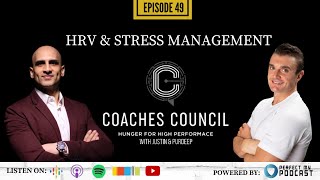
Justin Roethlingshoefer and Pradeep explain how heart rate variability measures stress and its effects on health. They cover why HRV matters for executives and high performers, and how wearable technology and lifestyle changes can help manage stress for better long-term health.
Yeah, stress can be a killer. I know. It's probably the number one thing I hear all the time for people and not just in business, but people in general.
Some type of wearable. So often I see people wake up in the morning and they're like, oh my HRV is this. Or oh my resting heart rate is that. But really have no idea what it means.
People were stressed about not being able to find food, not being able to protect their family, for example. Now people are getting stressed. Of how many people liked my post.
Know that if it's a downward trend in hrv, it has to do something with stress. Welcome to the Coaches Council podcast with Justin and Pradeep where the art and science of athletics and business come together to create real life quality application that creates life changing results through actionable takeaways. As we always say, nothing changes if nothing changes. So let's get started. Welcome back to another week of the Coaches council with Justin and Pradeep. Pradeep, it's always great to see you. How's everything up in Toronto, my man?
It's doing pretty good, man. We're in four week lockdown at this point. Well, actually when this episode is being released I think we'll be out hopefully. So I'm crossing my fingers.
Wouldn't that be nice?
Yeah. How are things down south?
You know what, it's New York City at its finest. So it's things are tight. Stress is high everywhere. Obviously the way that the governor is kind of working with everything, making it hard on a lot of people. So stress levels are high. People have been working real hard to kind of take off on January and do as much as they can. But it's like anything else when you're in a state of unknown, it's constant stress. So there's ways that kind of we need to be better and ways in which we can optimize ourselves no matter what situation we're in. And that's kind of great parlay into what we're going to talk about today, which is stress management and how we can optimize it and how we can really know what's going on in our bodies and use data and metrics and everything else to really circumvent that, to make sure that we're again, ensuring that that stress doesn't take us over and start preventing the high quality work that we can and should be doing.
Yeah, stress can be a killer. I know. It's probably the number one thing I hear all the time from people and not just in business, but just People in general, that it decreases the quality of their life is stress. Life would be a lot easier if we weren't stressed out about the little things. Now if you take a look at how people lived, like 150 years ago, people were stressed about not being able to find food, not being able to protect their family, for example. Now people are getting stressed. Of how many people like my post? So it's a different context in terms of people stress today. Unfortunately, I don't think it's getting any better. I think people's attention spans are getting smaller with technology today and people, everything's about technology. I'm thankful that the world is actually more open. I should say the western world is more open to meditation and mindfulness practices because I think that's helping people ground themselves a little bit and alleviate some of that stress. But I think there's a lot more to it as well. I think our lifestyles are just going down that path more and more towards greater stress. And I don't know about you, Justin, but with the guys I work with, for example, they work very hard to create freedom for themselves, but it seems like they have less freedom, they've created more anxiety because they have bigger businesses, they're making more money, they have greater responsibilities. And I think that's, if I take a look at it, responsibility from my perspective is a big stress for a lot of people, whether that's bills, the size of their organization, the employees that they manage. But there's just a lot that goes on in their head and it's important for them to be able to pull that, pull, pull that out and actually going back to our last episode, be able to recover from that stress.
It's such a great point that you bring up and I want to touch on and really let people know, like physical stress, mental stress, emotional stress, spiritual stress, it doesn't matter what it is. But the body's response to stress is actually the same. Increased heart rate, decreased hrv, increased blood pressure, increased cortisol production, increase, increase or decrease in serotonin and dopamine, which are the happy drugs. All of these things, no matter what it is, if you have added responsibilities at work, if you have money issues, if you're arguing with your wife, if you have more responsibilities on your table, if you do a hard workout, this body doesn't know the difference between any of those stressors. It just sees it as stress and thus it responds accordingly. So without knowing what areas of our life are creating that stress and the effect it's having on Us internally, there's no way for us to start changing any of the habits, any of the thought processes, any of the ways in which we're acting or the systems even that we have to help alleviate that because we just won't know. And so the first thing that we're doing with a lot of our clients and we're really talking about and really trying to put into place is this awareness level around certain metrics that we can start to track and know, yeah, you know what, something's in my life that I need to change so that I can long term continue to do what I want. You talk about being able to produce freedom in your life. Well, if you're only able to maintain your business for six, seven, eight, nine years, that there's, there's a lot more to a working cycle than seven, eight or nine years. I hate to break it to everybody, not everyone's like Jeff Bezos, but at the end of the day, we need to be able to come back for 20, 30, 40, 50 years and be able to really produce for that amount of time. Not to mention that we also want to be alive and well, feeling good, long after those responsibilities of our business are over. So it starts now in maintaining that. And we all have an Apple watch, we all have a Fitbit, we all have a whoop band, we all have an Oura ring, we all have a garment, a polar, some type of wearable that we're tracking things on. And so often I see people wake up in the morning and they're like, oh my HRV is this, or oh my resting heart rate is that, but really have no idea what it means. And so when we talk about hrv, it means heart rate variability. And it's the number one indicator, the number one metric that allows us to know what the internal load of stress is on our body. Now remember we just talked about that our body doesn't know the difference between mental stress, physical stress, emotional stress, or spiritual stress. So if there's any type of stress whatsoever, we are going to wake up with a depressed hrv, a lower number than what we typically would have. Thus that would immediately cause us to think what stress is in my life that I need to start eliminating. And if we start to see that downward trend day after day after day or week after week after week, it starts to make us aware of the stressors in our life that we can create change upon. And the nice thing about HRV is that it's so responsive and so individualized. So your HRV will be different than mine. So you couldn't tell me that your HRV is 87 and I tell you mine is 62 and you'd be like, oh, I have a better HRV than you, I'm less stressed. No, it's completely individualized and that is why it's such an important metric that we know measure over the long term and over the trend. Because I could be trending upwards at a 62, you could be trending downwards at an 85 and I could be in a better position than you are. But we need to know that based upon those stressors and factors that are actually going on.
So you think that. Because what you're talking about reminds me. There's a couple things that just popped up for my, just from hearing you. The first thing is that this reminds me of a time when I was working with an executive that was, you know, I looked at him and I was like, this guy's not the healthiest guy in the world. And he kind of thought that he was doing pretty good. And in his world he didn't think that. Let me put it a different way. He knew inside that he was stressed, but he thought that was just part of what came along with being executive. Like that just comes along with a gig, right? Being that stressed. Yeah, it was just. I think this has become a norm for a lot of people as they think that that amount of stress should come along with a role.
Whether it's not blood pressure of 155 over 100 comes along with the CEO title.
Yeah, and I don't think that's true because it's all a choice at the end of the day, it's a choice. Now, if you like that kind of a lifestyle, if you'd like to live on the edge and have that high blood pressure and not know if you're going to wake up in the morning, that's something different. But I think sometimes just sitting down and having that conversation to say, hey, look, that's not normal. Just because you hang around with other CEOs where they think it's normal, it's not normal, it's not normal for the masses or it's not normal for the healthy. And I think that in itself, just simple awareness to break people out of that pattern and important because everybody is in their own pattern. And you alluded to that aspect of, you know what, your HRV for you is different for the HRV for me. And it's that pattern that we need to identify, you know, is that pattern healthy for us?
Is it working?
For us, but for the guys and gals out there listening, maybe you can explain what HRV actually means.
Absolutely. So HRV is the measure, and it stands for heart rate variability. And it's what it is actually measuring is it's measuring the time difference between your heartbeats. Okay, so say, for example, when you're sleeping, your heart rate gets as low as it ever is going to be during the day because you're supine, you're laying there, you're not doing anything, you're not exerting yourself. And your body's saving energy by bringing your heart rate down to what we call your resting heart rate. Now, that is typically when your HRV is measured at the lowest point, at your deepest stage of sleep. So at the lowest heart rate of the day. And what it's going to take is it's going to extrapolate out 10 beats. So we've all seen on Grey's Anatomy where it goes beep, beep, beep, beep, beep, beep. And so that highest point is called the R wave, and it's measuring the difference in milliseconds between beats. And so once we identify the difference in milliseconds, and typically your numbers are going to be between 20 and 120 somewhere in there. And on a trend line, if your body is more stressed, you will see a lower number versus if your body is less stressed, you will see a higher number. Now, it has an inverse correlation to heart rate. So the higher your resting heart rate is, typically the lower your heart rate variability is, and vice versa, the lower your resting heart rate is, the higher your heart rate variability is. So just by understanding, those two metrics allow us to know that inside there is some type of neurological stress occurring, whether it's mental, physical, emotional, spiritual. That's up to interpretation based upon who you are. But if we don't know what our numbers are, if we have no understanding, if we have no way to apply them to our lives, then, then they're just numbers, they're just metrics. And going back to that person that you were talking about, where it's like, oh, I guess this is just the way that it is. I guess this is, as a CEO, as an executive, as an entrepreneur, this is just what I have to put up with. It's just not true. Because the more that we're aware that something's going on, the more we can exhibit and elicit a change. It's no different than the guy who feels like he's in good health, but he's like just not feeling the best. And it might just be that I've got a cold or something. But all of a sudden he goes to the doctor, finds out he has chronic high blood pressure and he's coming in at 155 over 100. He's like, oh, boy, I guess I better make some changes in my life. I know for a fact my diet's not great. I know I'm not sleeping well. I know I'm not exercising. I know that I don't spend any time doing mindfulness practices. He's all of a sudden gonna make some lifestyle changes. But it came at knowing a blood pressure interval. What if we had a number or a metric that actually gave us a higher quality measure that we could look at daily? Not a bunch of convoluted numbers, but just one number that could help us gauge how we're dealing with the stress in our life, how we're managing the stress in our life, and if there was a way in which we could change our lifestyles slightly, slightly to be able to give us a better result. And that number is hrv.
Yeah, that's pretty phenomenal because a decade ago, the average person couldn't get a hold of that technology. You would have to go in and get checked up. And even then, heart rate variability wasn't very much talked about. You couldn't go into a doctor's office and then talk to you about hrv. And it's not until even the last few years that people actually started to take it really seriously. So, Justin, I'm curious, why has it changed so fast now?
To be honest with you, Pradeep, the sad part about it is if you went and talked to probably 50% of doctors out there and said, hey, my HRV is this. They wouldn't know what you're talking about. They wouldn't know how you're applying this. And so it is still very new age. It's very much at the beginning stages here. But companies such as Whoop companies such as Oura Rings, companies such as Fitbit and Apple Health and Polar and Garmin and a lot of what have been typically these sports science principles are now bringing what we've been doing in Sports Science for 10, 15 years into the regular world because it is so powerful and it doesn't need to be something that's just given for these athletes. I'll give you a perfect example of how HRV was utilized in with a couple of my guys is we were. This was 2000 and 2016 and no 2015 and we were coming back from a Christmas break and it's like a three day break. And as this one in particular player was coming back, we had wearables that we tracked on every guy. Every morning they come in, they do their resting heart rate, we get their HRV and, and we'd give us kind of like a subjective questionnaire, talk about how they were feeling, their energy level, the desire to train, all these types of things. We had force plates measured like power outputs and everything was trending downwards for him. And he goes, yeah, I just don't like feel very great, like my energy is a little bit low. Well, I had been seeing this downward trend for about five or six days. After the third day we talked to the athletic trainer, got him tested, kind of got him, talked about a couple things and nothing was. They couldn't decide what was going on. Well, on the fifth day I said, you know what, like I'm seeing a continual downward trend. There's something deeper happening here. We need to stop what he's doing and we need to get some deeper testing going. Because his numbers were continually going lower with less ice time, less workout time, like trying to back off the load, seeing if it was just stress that was happening on them. I said, there's something else going on. There's something else that is impacting this because off of HRB there's six things that affect it. Nutrition, exercise, stress management, sleep, hydration and immune function. Well, it wasn't the first five. So I said, there's something happening in the immune function of this individual. Well, lo and behold, we kept testing, kept testing. The sixth day, he tests positive for mono. And if we had not utilized this technology and known, hey, I know for a fact something is wrong and we could have just gone off the one metric of HRV because it had that continual downward trend. If we would have known that there was something, if we would not have looked at the data and said, hey, there's something going on here, we need to keep going, keep finding the answer, we probably would have played them. He probably would have again had the opportunity to infect other players through water bottle usage, through being in the locker room, through playing against other players. He could have injured himself because again, he wasn't at his best. So just having this level of consciousness is the same thing that we can do on an everyday level. How do we show up? What stressors do we put ourselves in front of if we have that decreased HRV level, how do we optimize ourself when we know that we're ready to go, hey, we're full, guns a blazing or what? Can we start subtracting from our life to make sure that we have a generalized upward trend in HRV and while still making sure that we're being able to perform at our very best every single day simply based on that one metric and one number.
So if someone comes to you and they. And they, their HRV numbers aren't ideal or they're trending in the wrong direction. For example, what are the steps that you take to figure out what might be happening with this individual?
Yeah, so we always go back to it and we go back to that stress model. We know that if it's a downward trend in hrv, it has to do something with stress. Stress management has to do one of those physical, mental, emotional or spiritual stressors that's happening within the body. Now, there's six things in practice that we talked about that they could be. Could be something on the diet side, the body stressing, trying to digest something that doesn't work for you. It could be on the hydration side. It could be something. It's where you're dehydrated or you're taking in too much alcohol that your body is stressing to produce what it needs to. Our body's made up of 75% water. Our brain, lungs and heart are made up of 85% water. So they're the main things that keep us alive. One percent decrease in hydration. Big issue Three is our sleep. If we're not getting the sleep we need, our body will be under a heightened amount of stress. We've talked about that before. Four is exercise. If there's exercise present in our life, especially like we talked about, I think in last episode about that functional overreaching. If we're in an overreaching stage, that is a high quality sense of stress, but it's temporary. But if it's chronic and ongoing, that'll show us again a depleted HRV that maybe we need to back off. That's a rest day or maybe lack of the intensity. Then fifth is stress management. And this has to do with our lifestyle. Is are you upset with your spouse a lot? Are you fighting with somebody? Do you have stress at work? Do you need to incorporate more of these mindfulness practices into your life? The yoga, the meditation, the journey journaling, the gentle walks, something of that nature to allow the stress to come down primarily before bed. And then lastly, if you're on point with all those, you're like, nope, it's not that. Justin it's not that I've got all those. My diet's great. I'm drinking the right amount of water. I have no alcohol in my system. I'm working out on a perfect balance structure. I'm sleeping really well. I meditate every day. I don't know what it could be. And it comes down to that wildcard, which is immune function. And it means that our body is fighting something off, and thus we need to help it in some way, be it through added vitamin C, vitamin D, tart cherry juice, echinacea, vitamin B12, some type of immune system aiding that can again help bring that back up. And usually that's something that we do on an acute basis, maybe two or three days, until we see that HRV come back up. And then, hey, you know what? That was it. So that is the checklist we usually go through with people when we see that HRV downward trend. But just knowing that we have the awareness of the fluctuations that are happening based on the habits we're producing allow us to be such a greater performer day in and day out, knowing that we're looking after ourselves not only for the short term, but for the long term.
Yeah, I think that's a cool process. I think that's important to pay attention to because we come across this a lot with the guys that we work with because they're high stress. Not only do they have a business that they have to manage, they have employees, they have a family to take care of. They have a relationship on top of that. Then you add kids. That can be a lot. There's a lot of stressors there for the average everyday person. And here's something that's really important for the listeners out there. What they've identified is that, yes, genetics has a part to play in stress. Actually, it's a big part. It's about 50% life circumstances. Here's the interesting part is only 10% of what makes up the actual component of stress or on the opposite side of happiness, which is very small compared to what a lot of people think. They think that, well, I'm stressed out because I have a crappy relationship. I'm stressed out because I have this whole workload. Here's what I want to get at the more important piece. 40% is based on the stuff that Justin is talking about, the behaviors and the habits. How you respond to the stressors is the most important thing that you can do. And so, you know, if you have a stressful relationship, yeah, you can try to make it better, whatever that is. If you have kids that stress you out, and trust me, I know what that's like, because sometimes my kids stress me out, right? Justin and I are in the middle of doing an episode, and my son comes up to me and tells me that my daughter peed her pants because he tickled. And I'm just like, you know, I gotta record this podcast episode. You know, these things can stress you out, but it's how you respond, right? I can choose to sit here and get pissed off and be like, I told you guys to stay quiet, do whatever. I could just laugh it off and continue. I think that's the most important thing. But having a process is important, and the process that Justin, you use, I think is really important because I don't think people ignore science a lot. I think people know that science has a big relevant factor for stress management. But I think a lot of people just underestimate the impact. Like, you're talking about diet, you're talking about hydration, you're talking immune system. All of these things have a significant impact on stress. So imagine, imagine your life if you could reduce your stress by half. Like, what would that do not only for the quality of your life, but for you high performers out there that want to get more stuff done and perform better? Like, how much better could you perform? Yeah, people talk about stress being this concept which incorporates into peak performance. Yes, that's an optimal level of stress, but not for a long period of time. That's an optimal period of time that if you have a certain amount of stress, you can perform better. But if you're continuously stressed over a longer period of time, it's just going to diminish your performance. It's going to diminish your quality of life. And why wouldn't you just take these extra steps to say, okay, you know, maybe I need to hydrate myself more. Maybe I need to have just a slightly better diet, maybe just improve my exercise routine or get better sleep, the things that Justin talks about. Because ultimately, it's the quality of life that you're looking for. I don't think anybody can argue that Justin is. You know, I think everybody that I could talk to could say, yeah, you know, my life could be a little bit less stressed and a little bit happier.
No, you're exactly right, Pradeep. And the thing is, as we look at this, it's really all about making sure that we find out what it is for you. Because all those things that you spoke about, everybody's going to have a different purpose or a different issue or a different stressor that's creating some type of change within them. But it's the awareness around what's going on and the simplicity behind the science that's there. A lot of times people shy away from science like you talked about, because it's complex, because it's invasive, because it doesn't make sense to them, because it's abstract. But with the process in which we've gone through and everything we've talked about, it literally comes down to one thing, one thing only, which is hrv. And once we have an understanding of that hrv, we correlate it to one of those six aspects in our life, and boom, away we go. We can take action, because action without meaning is just a waste of time. But when you actually are pinpointed and have this focus, just like in your business, there's an issue, you want to know exactly what it is, pinpoint it on the bullseye and go at it so that the actions you're taking are purposeful. And away we go.
Yeah. Way to wrap it up, man. I think that's bang on. So you and I have talked about this, and I don't think we've made a formal announcement, but I just thought it'd be important because I think that the work that you're doing is so fundamental that I've, you know, we've talked about us partnering together and incorporating the work that you do with the guys that I work with. And that's how much I believe in this. Because performance is up is key, but fulfillment in life is even more important. And so that's why, you know, Justin and I are partnering up to bring this to a bigger scale, to help more people, to help more executives, to help more CEOs, to help our guys out there not only perform better, but just have a better quality of life and be more fulfilled. And I think this episode is key in that. And I'm going to ask this question again. What quality of life or what would your life look like if you reduced your stress by half? Like that in itself, for me, I'm thinking about that myself, and I'm not a very stressed out guy, but if I even reduce my stress by half, I'd be like, that'd be pretty awesome. But what would your quality of life be like and what would your performance be like? Ultimately, that's what Justin is talking about.
So no matter if it's physical stress, mental stress, spiritual stress, emotional stress, they all have the same outcomes within our body. And there's a way in which we can identify those ones that are hindering us the most, and that is hrv. And by having a better understanding of how this science applies to us and being able to use it in our businesses, in our everyday lives, and help it give us more information to make the quality changes and actions that we need necessary for not only the short term, but the long term is how we are ultimately going to win, not only in business, but in life. Not just for today, but also for tomorrow. So with that, stay hungry, stay humble, and we'll see you next week.
More from Justin




The Ultimate Blueprint for Taking Ownership of Your Health | Unlock Peak Performance

From Bullied & Anorexic to Healed & Purposeful: My Transformation Story (Justin Roethlingshoefer)


Forget "One-Size-Fits-All" Health! Unlock Your Best Self with True Personalization (The OWN IT Show)

Are Blood Tests Enough? Why Cellular Testing Might Be Better | Justin Roethlingshoefer

Your Body's Language: Understanding Stress & HRV| The Power of Ownership - Chapter 3 & 4


Is "normal" really making you sick? Dive into Different with The Power of Ownership:Chapters 1 & 2