54: How to Master Content Creation with David Dang
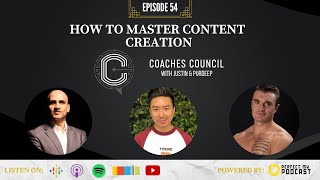
David Dang, founder of Entrepreneurship Facts on Instagram, talks about building an online business through content creation. He's interviewed entrepreneurs like Tony Robbins and Daymond John and shares strategies for audience engagement and leveraging social media influence.
He was saying how he started his business online and turned it from zero to six figures completely off Instagram.
Just go and look at the Amazon reviews. Just go and look at the reviews that people are giving back because they're products that are already out there. They're products that people have voted with their wallet on.
Building a business online is all about building an audience.
Be systematic about the approach because you're talking about measuring, paying attention to and I think a lot of people just try to do it random, they don't see the result.
Welcome to the Coaches Council podcast with Justin and Pradeep, where the art and science of athletics and business come together to create real life quality application that creates life changing results through actionable takeaways. As we always say, nothing changes if nothing changes. So let's get started. Welcome back to another week of the Coaches Council and very unique opportunity here. But we have an awesome Canadian panel today and that must mean that it's going to be a very polite and energetic episode. So, Pradeep, great to see you as always.
What's up man? We should have worn maple leaf shirts or something.
Something to bring the collaborative effort together here. But super excited to introduce our guest today, David Dang, founder and creator of Entrepreneurship Facts on Instagram. And I don't know if any of you guys are Instagrammers out there. I mean, there's a vast number of us out there, but over 2 million followers on his Instagram page, not to mention close to 50,000 on his personal. And it's not easy to grow an Instagram page. But David has done so in a very unique way while also giving himself the opportunity to interview some of the top names in the world, from Tony Robbins to Dean Graziosi to Daymond John to Evan Carmichael. He's just done such an amazing job in creating this brand for himself and really excited to talk to him today and how he's been able to create opportunities. So David, thanks so much for joining us.
Yeah, my pleasure.
So David, can you kind of take us back a little bit? Because being a kid from Winnipeg, minus 40 degrees Celsius on a good winter day. How did it become that a kid from Winnipeg is now interviewing some of the biggest names in the world?
Well, I guess my journey all started when I was in business school. I went to the University of Manitoba studying business, double major in entrepreneurship and marketing. And the only reason I went to business because I wanted to be my own boss, to start my own business and enjoy the freedom of being an entrepreneur, to do what I want without having a boss to tell me what to do. So that was the main reason, the whole reason why I went to business school. Then in my last year of school and right before I graduated, I talked to myself. I'm going to graduate next year and I don't know what business I'm going to start yet. Because the only reason why I went to business school because so that I can start business for myself. But I only have one year left. I'll be graduating in a year, but I don't know what business I'm going to start. And I don't have any money to start business anyway. And I don't feel like I'm ready to start an actual traditional business. So, like Mochis, I went on Google, I searched how to start a business online to explore some possibilities. And I remember I listened to a podcast where the guy, he was saying how he started his business online and he turned it from zero to six figures completely off Instagram. And I thought, okay, this is really cool. Like I could start an online business without like, it doesn't require much investment on my part.
How long ago is that, David?
That was 26, if I'm not wrong. So I, it was around April, April or May of 2016. I graduated in the summer of 2017. So it's around April or May of 2016. Five years ago, not four and a half years ago? Yeah, close to five years ago. Yeah, that was 2016. And then after I listened to the podcast, I taught myself, why don't I try to do something on Instagram? Because the whole thing about building a business online is all about building an audience. Once you have an audience who follow you and who trust your content, they gonna, you can just turn it into a business in any way you want to. You can offer them product or service to solve the problem. And it's, it's this is, there's this counter possibility for you to turn it into a business. So that's how I get started into this Instagram thing. And I didn't even have an Instagram account back then. I heard about it, I never used it. I taught Instagram is mostly for girls to post photos, selfies or you know, travel photos. I never use it. I open my account.
How every social media platform starts. Girls posted half naked photos and guys posted muscly pictures of their abs and away we go.
Yeah, so that's what I, that was my impression of Instagram back then. So I opened my Instagram account for the first time ever on that day, right after I listened to the podcast and yeah, just start from there. At first, I just started posting content that I'm interested in things that I enjoy. And to be honest, I created an Instagram account with the hope that I would be able to turn it into a business years down the road. I didn't plan anything. I didn't plan to make any money with it anytime soon. So that was the only reason why I opened it, is hopefully I could turn it into business. And I do it on the sides just for fun as a hobby. And I started posting content that I was interested in, like motivational calls, business facts, entrepreneurship, things around the things that I'm passionate about, which is entrepreneurship, business and motivational calls. So I just curated content and then share whatever that I like on the page. And then eventually people just start following the account. And yeah, fast forward to now, almost five years later, it went from zero to over 2 million followers now. And, yeah, that's how my journey started. Was that your question? Yeah.
Hey, I got a question then. So what's your secret? What's your secret for someone out there that's listening and saying, hey, look, 2 million Instagram followers, that is huge. What would you say is two or three big points for the listeners out there to follow when it comes to Instagram?
Okay, I can actually sum it up into one secret only. The only reason anybody will follow any account on any social media platform, there's only one reason. Because they like the content that the account is posting and they want to see more of it in the future. That's it. Think about all the accounts that you're following on Instagram or anything like Facebook or YouTube or Twitter, any social media platform out there. Look at all the accounts that you're following. The only reason you are following those accounts is simply because you want to see more content from that account, whether it's from your friends, family, a business account influencer. There's only one reason. Because you like the content that I'm putting out and you want to see more of it in the future. So that's really the big secret. So you can break that down into more step. But the big picture, that's it. Putting out content that your target audience want to see and want to see more of it in the future. That's it.
I think that's brilliant because I think you just summed it up and made it so simple for everybody out there. You know, as business strategists, sometimes we like to complicate things and say, you gotta do this, you gotta do that. But you're so right. It really comes down to giving people what they want. And I think we can easily overlook that and the analogy that I kind of take a look at. And as Canadians, I guess we can kind of make poke fun at this. Except for Justin, because He's in the U.S. but I, you know, we've been, I've been studying the US political system for the last few years because of just from the psychological aspect and the business side. But it just reminds me of what Trump does. He gives people what they want and they want more of it. And that's when people wonder, like, why are people crazy? Why do they keep. It's because that's what people want. So I think your answer to that was not only true, but it's just absolutely brilliant because people will follow the stuff that they or whoever provides them with what they want. It's just so simple.
Yes, of course. I mean, that's the big picture. Of course, you can break down the step to multiple different steps. Like, how do you make people like your content? How do you know what kind of things do they want to see? And how do you get more people to see the things that they want to see, but they don't know where to find it. Right. So there's more step into that. But the bigger picture, really, there's only one reason why people follow anybody on social media. They like the content and want to see more. That's it.
So if you're okay, if you don't mind me asking, then, so how have you turned your Instagram account into a business? Like, what are the economics behind it for you in terms of how you actually profit from it?
There are many different ways to monetize an audience. But again, I can sum this up into one thing. The way to monetize it is to simply you offer them a solution to a problem, a pain point that they have, and they're willing to pay money to get it solved. Like business 101 here, right? Customer have a problem, you offer them a solution, and then a solution that they're willing to pay money for. So now it's all go back to really everything that's summed up both of those things. Understand, it's all about understand your target audience, what problem do they have. So once you know who your target audience is and the people that you want to attract, you know what problem they have, and from there you know what kind of content they want to see. Now it will help you create a content to attract them so that they follow you. To see more of your content. And, and then at the same time, you already know the problem that they're having. You can offer them the solution that they're willing to give you money in exchange for that solution.
It's such a great point, David, because when you talk about those two steps, so create content they like, something that they're going to want more of. And then as you get it out there more often, as you're more prevalent out there, you build that, that authority in the space and ultimately you're creating a solution for a problem or a pain point that they have. And our friend Craig Ballantyne had a great suggestion and trying to create products, and he goes, just go and look at the Amazon reviews. Just go and look at the reviews that people are giving back because they're products that are already out there. They're products that people have voted with their wallet on, and they're telling you what they don't like and what they want better. And that's how you create the best product ever. Now, my question to you is, what metrics or what are you looking at for somebody who's just starting or somebody who's venturing into it? What are you looking at to identify so that you know what people like and what people want more of and what their pain points are? Because a lot of people who are out there know that if you post a picture of your best friend and their dog and you're like, hey, happy birthday, that almost gets more likes or more comments or more engagement than something focused specifically on the business or the pain point of which it's at. So how are you able to tell what people like, what they want more of, and ultimately how they're engaging within your content?
Okay, well, the best way to find out, you just mentioned that earlier, is one way is to look at the Amazon reviews, right? Because they vote with their wallet and letting people know, hey, I'm buying this product, and then they leave reviews on Amazon. So it gives you a lot of feedback. So if we talk about social media or specifically Instagram, and let's talk about content, how do I know what kind of content do people like? So here's the easiest way is to look at your content and look at the number of engagement you get per each post. So if you post something, let's say on average, each of your posts get about 1000 likes, 100 likes. Not everybody has, like, tons of followers. So let's say on average, each of Your posts get 100 likes, and then you post a picture of you and your dog, for example, that one suddenly get 500 likes. That's 5x your average engagement, right? Then your audience is telling you that, hey, I like you posting picture of you and your dog. That's what I like to see. So they voting on that. So now if you want them to keep engaging and come back to look at your content, and then also at the same time attract more people to follow you, because if your target audience is telling you that they like that piece of content, other people who are not yet following you, most likely they're going to like the same thing if they are the same, the similar type of audience. So if you keep posting that, you will get more engagement and at the same time the Instagram algorithm will kind of recognize that, hey, people engage with this account with these type of content a lot. And Instagram gonna push your content to more people. So that's how you figure out what kind of content people like to see through the number like the engagement rate.
Now we're really getting into the marketing obviously behind the Instagram accounts. But what are your thoughts on content fatigue? Because I know there's people out there that say, you know, maybe just putting out too much of the same content. What are your thoughts on that?
Look, it depends. If you worry about your audience get sick of your content, then same thing. Look at the engagement rate. Do they stop engaging with your content? If the engagement rate is declining and you didn't do like, there's nothing wrong with Instagram algorithms, there's no major change and you see a decline in engagement rate, then maybe your audience kind of getting tired of the same type of content you've been putting out, then try something else new. So I guess the whole point of gaming rate is you do half of it. You keep consistently producing the content that they following you for. They expect you to see that type of content, right? And then the other half, you're testing out new content that you enjoy creating and use it putting out. You know that most of them will not get the best engagement because that's not why your target audience are following you for. But it will give you a new, it will allow you to test new content and then eventually you find something else that your audience, they don't even know that they like. But like, hey, this guy prenotes something new. And just like Steve Jobs say, like people, customer, they don't know what they want until they see them, right? So you can keep giving them what they want and expecting from you to keep them engaging. And then at the same time you test out new stuff to get them engaged even more. Yeah, yeah.
What I'm picking up from this is to be systematic about the approach, because you're talking about measuring, paying attention to. And I think a lot of people just try to do it random and they don't see the results. So I'm really glad that you talked about that because I think it just makes it more intentional. So if you want to grow your business, I think there's so many different aspects that have to be intentional, and marketing is definitely one of the most important.
Yeah.
David, I'm really curious because.
You have.
Interviewed, you have spoken with, you have had talks just like this with some of the most prominent people in this space, from Daymond, John Dean Graziosi, Tony Robbins, Evan Carmichael. We've talked a little bit about them. Patrick. Bet, David. And I'm really curious as to. Let's focus on Tony for now. You've spoken to him multiple times and interviewed him multiple times. First off, what did you do or what was your strategy in getting to be able to interview people like this? And then I'm curious, I'm going to ask you what your number one takeaway was from each of those five individuals.
Okay. Well, I haven't interviewed Toy Robin yet. I spoke to him in person and then got invited to a private party with him. But, yeah, I interview Daymond, John, Dean Graziosi, Patrick Bat, David Russell Brunson, and Evan Carmichael. And the only reason why I'm able to connect with those people is because I use leverage. I guess basic business 101 here. I offer them what they want in exchange for the connection. So I just. I have the biggest assets and leverage I have is my audience. And then I just offer that to them for free if they interested, if that's what they want. Of course, not everybody want access to my audience, but if it happened to me that they want to get to reach my audience, then I can leverage that to request for an interview. Yeah, that's pretty much the only reason why I was able to connect with those people.
So talk a little bit more of this. You said a word that's very important and really stands out, which is leverage. And what did you do to create leverage? At what point did you identify that you could have this leverage? And then because I think a lot of times people forget that anybody can have leverage. Small kid like myself from Edmonton, Alberta and Northwest Canada coming down all of a sudden can create leverage in New York City. You yourself, a small kid in Winnipeg, Manitoba. I guarantee you right now Everyone in the United States is looking at a map going, I don't have any idea where Winnipeg is and is bringing up. And has created leverage on Daymond John, has created leverage on Dean Graziosi, has created leverage on Russell Brunson. Go into depth a little bit on what you mean by creating leverage and how you were able to identify that and how you were able to make it clear to those people.
Yep. So it's really go back to very, very basic foundation of business. Understand who your target customer and then you understand what kind of problem or pain point that they have. And then you can create a solution for them. Once you have a solution, you can use that as the leverage for yourself. So for these guys, again, the only leverage, the biggest assets I have is really access to my audience. So I think of it, it's kind of like when somebody who's having a kitchen fire, for example, and you have a fire extinguisher, right. Hey, I have this fire extinguisher. Do you want it or either I can give it to you for free and then I can sell to you 50 bucks, whatever you have to leverage if you have the fire extinguisher at that point. Right. But normally if they just walking on the park, enjoying talking with their friends, busy doing their own stuff, and you're, hey, have this fire extinguisher, can you give me some attention? You don't have any leverage at that point because they don't need that. They don't have that problem that needs to be solved at that moment. So the fire extinguisher not gonna give you any leverage at that moment. Right. So you need it require, you need to identify who that is that you want to connect with and then the problems that you can solve for them. And everyone has a different and unique skill set. And for me, I know that I have my audience as my biggest assets. But those big guys, they also have an audience. They don't need to access my audience all the time. But I know that when they need the most reach is when they launching something, when they launch a book, a product. So even though they have their audience, but they will still want to reach more people. So I know at that moment, that's when have the most leverage to talk to them. Say, hey, I can offer you access to my audience for free if I could potentially interview you to create more content for my audience that's giving them that give me a leverage to talk to them. Otherwise normally they, of course they wouldn't be interested. Right. So really understand who that is you want to connect with, what leverage do you have and when is the right time to get to them. That's really it.
And I think you've just really nailed so many straight up points that are very valuable and they're so simple, it's not like it's rocket science. But you're talking about the timing, when, and being strategic with that. Again, it's just a simple concept that can have massive leverage. And again, it just goes back to the Principles of Business 101, is you got to know the right timing of getting into the market, exiting the market. But I think what you just said is so true because I just launched my book in December and that's. And we were trying to be strategic in terms of timing, reaching out to people. But you're absolutely right. You know, having the other person on the other side, who has an audience that knows this definitely gives them the leverage. So that's, that's a really good point.
Yeah, because the thing, everybody, they only think about themselves. They only think about what is in it for me. So whenever they do something, they only ask for themselves. They never think about the other person. Why should that person do whatever that you want them to do? Like, if you don't have leverage, why should that person, like, unless by chance, if they just happen to be like really nice on that day, something good happened, they want to be kind. Sure. But you don't. Like, you're really wishing, you're kind of buying a lottery, hoping for it to happen because you don't have any control over it. But if you can think a step further, okay, I want this from this person. But now think on the other hand, put yourself and that person choose. Why should that person do anything for you? Unless you have some leverage, like something that that person also want, then really the only thing you're hoping for is based on that person kindness to do something for you for free if you don't have any leverage. Right. So that's something to think about.
You know, I think a lot of that goes down to confidence too, because, you know, at 2 million Instagram followers, that's a massive leverage.
Right?
That's huge. And a lot of people out there, business owners, entrepreneurs, whether it's career people, feel like they don't have leverage.
Right?
They need to hit a certain point to have leverage. But there's also this thing inside where you can create that leverage just by thinking about it.
Right.
Being strategic about it. Like you said, the timing, it doesn't have to be that. You have to have 2 million followers to have leverage. At what point in time did you realize that you had the leverage, or let's just say perceived leverage for you to be able to actually take your, whether it's your following or your business or from monetization to where you wanted it to be and actually grow.
It's really, it's test. Right. If you don't think you have a big enough audience yet, then I guess go back down to understand, really be self aware of what you have and what the other person want. Do you think the other person want what you have? You could have a pretty good guess, but I guess at the end of the day the only way to find out, to try it out. Right. So if you think you have something and you think that that person might want it, try it out and make the offer. Say, hey, I have this thing I would be happy to offer to you for free. Well, don't ask for something in return. Offer it for free first to see if they interested. If they interested, then you know you have something, something to leverage off. Right. But if they say, hey, I'm not interested, then this means that, well, they is not enough leverage for you to ask them for something in.
You've just summed it up so well. And I've got a couple questions for you that kind of going to come at you rapid fire here. But I want to go down the road of the key takeaways because we've got six names on this list that everybody knows and everybody aspires to be. Everybody aspires to be able to sit in a room and talk to them. I'm going to say those six names and I want you to tell us the greatest lesson that you learned from each one of those six in the interviews or in the conversations that you had with them.
Okay. For sure. I tried to recall my memory.
I'm going to bust. All right, so Dean Graziosi.
Being authentic. Yeah. For him, I feel like the biggest lesson I learned from him is really be authentic with your message. Yeah. Like that's, that's something I can. I learned from him. Really. Whatever that you sell or make offer to your audience. When you create content and for example, just be. You have to believe in whatever that is. If you don't truly believe in it, people can see it and you're not going to be able to convince them to, to follow you or to buy your product or service. So that's, that's one thing I. The biggest thing I learned from him. Yeah.
Evan Carmichael.
Evan Carmichael believe. Yes. His like, yeah, his big on belief, everything that's pretty much his. His mission statement to believe in yourself, believe in your mission, and believe in what you do. So that. Yeah, that's. That's one of the things I. That stand out the most to me when I think about him.
Patrick bet David.
Patrick bet David. Confidence. Yeah, the guy is really confident in. In what he. In what he does and. Yeah, confidence.
Russell Brunson.
Russell Brunson, storytelling. He's a great master at storytelling. When you listen to him tell a story, by the end of it, you're gonna give him your money. Honestly. Like, yeah, when I watch his webinar or go to his event, his storytelling skill is just top notch. And if you really engage in the story and listen to it. Yeah, by the end of it, you want to give him your money.
It's amazing what you said, because with what the points of believe being authentic storytelling, they all come together. If you tell your story, if you own your story, if you believe in what you're selling, if you believe in yourself, you trust it. We've all gone towards what we're doing because hopefully it is authentic to us. We believe in it. But quite often we just have to wrap our minds around that concept. And when you tell a story, that's true, real emotional, tied to acting from your heart. Get out of your head and act from your heart. That's what we often like to say. And when you're able to do that, it really connects with people because people want to be connected and be a part of something real, something that tugs at them and something that they can relate to. So I love that. And it's no doubt that that's why Russell's done so well. We got our two big hitters left. Tony Robbins.
Tony Robbins, yeah, he's definitely a big name. The biggest thing I learned from him is definitely growth and contribution. So that's part of his motto. Of the six human needs, like, we need certainty, uncertainties, we also need love, and then feel significant and then growth and contribution. The last two are very important in terms of making to having a fulfilling life and make us happy. We need to constantly grow as a person to whether we want to push our business to the next level, increase our knowledge, our skills, our ability. That's the growth part. And we also would have. We would also want to contribute our skill and talent to the work to make it a better place. So that's the biggest thing I take away from him. Growth and contribution.
I love that. Daymond, John.
Daymond, John. Yeah. Negotiate? Yeah, for everything you do, especially in business, you have to negotiate for what you want. And yeah, one of the things, even before I spoke to him, I watched Shark Tank a lot. And on every single Shark Tank deal that you see he does on the show, he always negotiate. And even. Yeah, when I. He wrote a book like when I helped him promote his new book, Powership, and that book was also all about negotiating. So, yeah, that's the biggest thing that stand out to me when I think about him. Always negotiate in business.
And I want to ask you, because you've got a very unique story that you haven't touched on and it was how you got to finally interview Daymond John. Because your level of persistence, your level of commitment, your level of continually fighting through 10,000 no's is so, I think admirable and something that really will resonate quite heavily. So can you tell that story really quick?
Yeah, I was able to connect to him through a business conference about two years ago. 20. 2019, I think. Yeah. Earlier, the beginning of 2019, I met him at a business conference in Florida. So I flew down there for business conference and he was one of the speaker there. And right after his speech, I was able to kind of see him at the backstage, but there were a lot of people around him. He has security guard kind of like stand around him and then he was going to the elevator to go back to his hotel room or something. So yeah, like lots of people trying to get to him, trying to talk to him. Right. So I knew that if I just try to like ask for a picture or just I wouldn't have a chance because there were way too many people trying to say hi to him. So I thought, okay, what is the most valuable assets that I have to offer him and what problem or what pain point that I might be able to solve for him? So I again go back to the very basic foundation here. Understand who you're talking to and then understand what you have to offer. And then the only way to find out if your offer on the leverage you have is good enough is to ask the person. So yeah, Larry just did a five second pitch to him on the pony as he was walking by and say, hey, yeah, hey Damon, I have five. Back then I had 500,000 followers on Instagram. So hey Damon, have 500,000 followers on Instagram. In the business entrepreneurship niche, I would love to help promote anything you want for free. That was my pitch. I offered for free. I don't need anything in return because all I wanted was connection with him, that was all I wanted. And I make the offer and I guess the offer is enough, sounds appealing enough for him to be interested. And then, yeah, I got the email of his assistant. Then we connect from there. But that wasn't. Yeah, that was the initial connection. But I wasn't able to interview him for another year. Yeah, until. Yeah, over a year after that. Because every time he requests for an interview, he's, of course, he's always busy, has things going on. It's not the right time for him. So as a persistent, keep emailing his team like once a month or so to ask if it's the right time and if there's anything you can help promote for him. And I'd be happy to do it for free. So as I did, yeah, I helped him promote some of his products during that year. And then when he was about to launch his new book, Powership, which I mentioned earlier, then, yeah, I know this is probably the right time. This is like a good time to request for that. So closer to his book launch, I keep, I increase my email rate and say I make the offer more compelling. I add more. So, okay, I would promote this. I would do this, this, this, this. Can I get the interview in the chains and everything is all about him. What isn't it for him? It was never about me. What isn't it for me? Because I always think about, okay, what does he want? What does he need right now? What can I do for him? And I just offer for free. And yeah, that's. That's pretty much how I was able to. Got an interview with him, to talk to him.
And yeah, and it happened. How many times did you have to reach out? How many times did you check back in?
I can't remember.
The key thing there is, it wasn't once.
No.
And.
And I took me over a year.
Correct. And I still remember in your post, David, you said, I got a phone call. It was his assistant, said, can you hop on with Damon? Damon's got 10 minutes this afternoon. And you were like, you didn't even look at your schedule. You're just like, yep, I got it. I can do it. Whatever is there, it doesn't matter.
Because at the end of the day, the only reason why I did it, because I only think about on the other side. I don't think so much about my side. What's in it for me? I live at like, I know there will be good things, but the main thing is, okay, what is in it for him and what is in it for my audience, because I know if I can interview Damon John, it'd be very valuable content for my audience as well. Because at the end of the day, part of my business is to create content that my audience wants to see. Want to see more in the future. Right. So that's why it's okay. Everything I do is I think about the other side. What can I do to offer that person? Because most people in business, all they think about is themselves. How can I make more money? Money, money, money. But really, if you think about, for you to make money, you need to have a product or service that can solve your target customer problem, and they're willing to pay you money for it. So if you cannot solve the problem, you're not going to make any money. So instead of focusing on how to make money, focus on how to solve their problems. If you can do that well, the rest will take care of itself.
It's awesome, David. Absolutely awesome. I can't thank you enough for coming on. It's so much value that you've brought so many tangible takeaways that people can apply right away. And for all listeners out there, it's the level of persistence. It's believing in yourself. It's understanding that no matter how small you feel, you can create leverage that at the end of the day can serve and empower others to allow their gift to grow. And that's how you're able to. To ultimately be the person that can get to that level that you're truly striving for. So with that, guys, stay hungry, stay humble, and we'll see you next week.
More from Justin




The Ultimate Blueprint for Taking Ownership of Your Health | Unlock Peak Performance

From Bullied & Anorexic to Healed & Purposeful: My Transformation Story (Justin Roethlingshoefer)


Forget "One-Size-Fits-All" Health! Unlock Your Best Self with True Personalization (The OWN IT Show)

Are Blood Tests Enough? Why Cellular Testing Might Be Better | Justin Roethlingshoefer

Your Body's Language: Understanding Stress & HRV| The Power of Ownership - Chapter 3 & 4


Is "normal" really making you sick? Dive into Different with The Power of Ownership:Chapters 1 & 2