61: What it Takes to Win 8 Tour De France's with Jeff Spencer
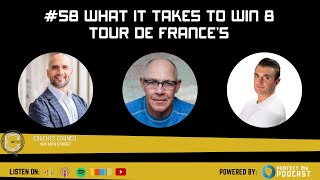
Dr. Jeff Spencer, who coached eight Tour de France winners, says winning is a learned skill built on three things: personal experience, sports science, and health management. He stresses that preparation trains your brain and body to execute under pressure, and that elite performers make decisions based on truth, invest in themselves, and distinguish real warning signals from anxiety.
Chapters
Always the risk of more technology is that we start to invest more confidence in the technology than we do in ourselves. And eventually, at the end of the day, it's up to us to step up and deliver when it counts. You know, winning is a learned skill and I'm going to teach you the skill of winning, which he did and he taught me really well. So I had this kind of tripod of readiness, meaning that if you want to know what it takes to win, I know because I've done it, I've done it at a very high level. Do I understand what it takes to craft a body that can execute those things that have to go right? Yes, I do have the academic training, the experience to do that.
Welcome to the Coach's Council podcast with Justin and Pradeep, where the art and science of athletics and business come together to create real life quality application that creates life changing results through actionable takeaways. As we always say, nothing changes if nothing changes. So let's get started. Welcome back to another week of the Coaches Council and I can't wait to share this next guest with you guys because if there's anybody that knows what taking your game to the next level looks like, what truly creating champions looks like, and what constructing champions looks like, it's Dr. Jeff Spencer. And we're going to hear a little bit about his story. Being an Olympic cyclist, he's not only done it himself, but he's been involved with some of the biggest names in the world, from Tiger woods to Richard Branson to really some of the biggest and iconic brands out there as well. And when you're working with these types of people, you start to find certain traits that elicit themselves repeatedly over and over and over again. And the tangible takeaways that you guys are going to be able to have to drive into your daily life to be able to utilize on a regular basis is going to be so exciting. So without further ado, Dr. Jeff Spencer, thank you so much for joining us today.
Well, thanks, Justin. What an honor and look forward to the conversation.
So tell us a little bit about your passion for this industry. What got you into this space? How did you magnify your career as an Olympic cyclist and then transition it into what you do today?
Well, I think the career actually called me. I've always had a knack for being able to look at a context and decide and to know exactly what the next step is. I don't know why I've always been like that, but certainly that was there. And so over time, being An Olympian has its benefit, because unless you played at the top, you can't exactly go out and study it or interview people that have done it and be it. It's not possible. There's. There's something about being it that gives you that extra dimension of understanding of what it really takes to get from where you are to the top of your game, but also finishing that off by staying there. The other side of this is that I had really good coaching. Two people, specifically were angels that came into my life at very essential and critical times. The first one was my cycling coach, three time Olympian, five time national champion. And he said, jeff, will and talent play a role in this. But, you know, winning is a learned skill, and I'm going to teach you the skill of winning, which he did, and he taught me really well. And I appreciate that, because somehow we just think that if we try hard, if we want it bad enough, it's going to manifest. And I know that that's not true. We're really limited by the assets and the readiness that we do have in our ability to execute that which has to go right to be able to move up and showcase our greatest talents. And my other mentor, I met him when I was 18, and he was 76, and he was a Renaissance man. And he introduced me to the kind of more nuanced side of life. He was truly an artistic genius, and he chose me to be his apprentice while he was crafting his masterpieces in art. I was there to help him out with that. And he taught, actually, during our breaks and at lunch, he would play classical music. He would read to me the great philosophers and the great poets and playwrights of history. And he said, I need to fill you up on this stuff. And I had a capacity for embracing that, which gave me access to a whole other side of myself that was outside of the athletic realm, but it actually made me a much better athlete. And with those two people together, I did become an Olympian. There is a certain science side to me. I like to learn. So I eventually got my master's in sports science from usc, which really taught me the academics of how to craft a body that can push. If you can't push, you're not going to have a great life. And it also taught me how to stay in the game over the long term. Once we understood what it took to perform at our best, it gave us the ability to amass a legacy that we were capable of. And then what was interesting is that when I was working with athletes, that came to me wanting to win gold medals and be highly paid professionals, which I did for many of them. I've helped athletes win over 40 gold medals in the Olympics, world and national championships, and also the Tour de France. People started coming in. The business people came to me as well because they wanted to become their own champions as well. And they knew that the athletic path was a toughening up of them mentally and having the physical assets to stay in the game and push. But the athletes said, how do I not injure myself? How do I get back quickly to extend my career, to then expand my legacy and the quality of life that I live? And the business people were about, hey, look, I don't want to be like my same age counterparts that are all having strokes and heart attacks in their early 40s. How do I not do that? I decided at that point I'd go back to school and get my primary licensure as a healthcare professional to be able to address those two issues that each of they brought to me. So I had this kind of tripod of readiness, meaning that if you want to know what it takes to win, I know because I've done it. I've done it at a very high level. Do I understand what it takes to craft a body that can execute those things that have to go right? Yes, I do have the academic training, the experience to do that. Can you extend careers through better health management and also reducing injury risk and speed recovery between injuries? Hopefully they don't happen. The answer to that is yes as well. So what people recognized in me is that rather than have like 10 different experts that all knew something like 10 slices of the pie and none of those pieces were talking to each other. They could come to me and I could look at their universe. And because of my experience and my training, I could decide how much of what needed to get done to personalize their path forward, to get to where they could go most efficiently. And rather than 10 people, they could get all that for me. So that's how I found my way into the world of the ultimate high levels of people that achieve at the highest level in our era. So that was basically the path. And I been in the High Performance advisory professionally since 1979, so that's going on 50 years. But not only as a participant, but also as a student of the discipline and having worked behind the scenes with some of the most prolific achievers of our time. So I kind of really kind of mastered the craft here of this. And again, you know, people want trust. People want people that are more than just Academics, they want people that have lived the experience and can guide them to the promised land.
I love that because that learned skill of winning. There was one of my friends, Jesse Isler, was told this story and they bought a racehorse together. There's a group of six of them, and Tom Brady was in that group that bought the race with them. And the horse continued to finish second, continued to finish second, continued to finish second. And he was getting ready to go and be put into the qualifications for the Kentucky Derby and some of these other things.
And
the horse had just raced a race against some of the best up and coming horses, like, really tough race. And Jesse calls Tom and goes, Tom finished second again. Really great race today. Amazing. And he yells a curse word and he goes, tom, this was a great race. That, like, he did really well. He goes, listen, until that horse knows what it feels like to win, that's all right. Not gonna be a winner.
Yeah. So. Right.
And that's, that's why I just, I love that story. And it comes back to what you said, is it's a learned skill, is that as soon as you taste winning, as soon as you know what it takes to get there, you're never gonna want to relinquish that. And you're always going to want to feel that again. And anything less than a win just unacceptable. Anything less than a win is just not. Does not bring the same feeling, does not bring the same level of arousal and satisfaction that winning does. And so I love the fact that you bring that up over the course of your career. How have you seen the high performance space change and how has it stayed the same? And clarify that question a little bit, because today and age, high performance has been so commoditized, it's been so commercialized with high performance tea, high performance coffee, high performance bedding, high performance clothing, high performance this, high performance that, and it's everyone, you're just, you're just one product away from being a high performer. But a lot of what I see and a lot of what I teach is it has nothing to do about the commoditization of. It all has to do with intrinsically. And so I'm curious to see your opinion and your take on how has high performance changed from when you were a cyclist and doing it as a performer and then now as a coach.
Well, when I was competing, there was a lot of biohacking going on. The biohacking craze that we see right now is kind of a second generation. Actually, it wasn't the first generation. It's not really the early explorers. I kind of felt that we were doing that when I was competing. So there was a certain romance to it. There was a hunger, there was an initiative to try to find creative ways to find the elusive 1 or 2% that makes a difference. Like at the top, I feel that there was more of a reliance on us as humans at that time. We weren't relying so much on technology. I feel that it's maybe flipped off a little bit. Always the risk of more technology is that we start to invest more confidence in the technology than we do in ourselves. And eventually, at the end of the day, it's up to us to step up and deliver when it counts. And again, to do that with a lot of pressure demands a lot of self control. So to me, we're a human first and an athlete second. So let's make sure that we don't disregard the human side of it and make provisions for our human nature as it relates to supporting or detracting from our performances. And that we don't invest too much at a certain point in our technology. Otherwise, we're empowering our technology to do for us what we should be doing for ourself.
I love that so much. And I'm a big technology guy. A lot of people know that. I utilize a lot of these advancements to be able to bring the information for us to humanize it, to be able to then apply it to each individual, knowing that it takes us away from the generalizations and the averages of which people just throw there so that we can become high performers, which if you think you think of those terms, they're contradictory. You're going to use just the generalized use this drink because it made me. It worked for me. But yet how is that optimizing or how is that making high performance come to life in all of these people who are truly operating at another level? Because we've humanized the information in which we get. And so I love that context of being able to humanize what it is that we need to do and then take that and utilize it for ourselves and have confidence in how we prepare ultimately for how we get to that next level. What was the trait that you've seen in so many of these people that you've worked with? You've worked with people at the elite of the elite level, both on the business side, both at the athletic side? What traits do they have in common? What have you continued to see come back over and over and over again in all of these people?
I haven't thought about this for a while, but I remember one athlete that I was working with. I don't really work exclusively in the athletic world anymore. A lot of it's in business. So I'm kind of spread around everywhere, actually, which I like, by the way, because winning is winning no matter where you are. A guy told me that the worst thing he ever did was to tell his first lie or make his first excuse, because then it became just easier and easier after that. So they're people that are truth driven and they want information to help them make informed choices. And they're not afraid to invest in themselves, meaning that they will find and acquire the best resources and advice that they can find to help them shortcut or understand the processes better to make their own decisions to get to where they want to go and then also stay, stay in the game at that high level. They're not afraid to invest in themselves. They know that they're their own greatest asset. They don't compare themselves against others and try to play other people's games. They look at their assets and they develop those and use those as their life platform. They have a lot of trust in that. You know, also for sure is that they make their decisions out of what they stand to gain, not what they stand to lose. You know, they play a really good mental offensive game that's not reckless, but it's very responsible. They understand that, you know, fear is part of the game. They understand that fear can be your friend. It can inform you that you should be cautious about something. They interpret the difference between reckless fear is something to be overcome and something to be heeded. There's a huge distinction between those two, by the way.
You know, they had a little bit for us. So when you say that there's that big distinction between the two, tear another layer off of that for the audience a little bit to be able to really understand the differences.
I was talking about fear, correct?
Yes.
Yeah. So, yeah, for sure. Like our first biologic response is survival. That's what our body is geared towards. It's survival. Making sure that we live to play another day is kind of its highest priority there. And the fear response that we experience with sweaty palms, dilated pupils, beating heart, mind racing, a million miles an hour. I mean, those are all signs of biologic readiness. You actually should have that if you're going to put in a personal best. If you don't have that, then you're not physically ready to engage it. So we have to first off, interpret it correctly. Fear has two parts to it there's a fear that informs us that something's off, that we need to further investigate it. And if you know what that is, there's just a general apprehension like something is off. And if you feel like something is off and it's not just before you perform, that's performance anxiety. That's a difference. That's a different thing altogether. But if you have this general sensation about I was told to do something, I get it, I'm ready to do it, but there's something that just isn't right. There's kind of an ominous feeling attached to that. Then the champions always pause. They want to know what's behind it. They take that blinking yellow light is a sign that something requires further investigation. So they don't proceed until they investigate it. And if they investigate it thoroughly and they have the right people that are helping them investigate and there's nothing there, well then that warning may have been to say that you just needed to pause and not do it when you thought you were supposed to do it. But now that we've taken a pause, now you can go ahead and do it because now we have the right timing to execute this correctly, to get the biggest win out of it. But if we many people, I mean, there's so much mythology and performance, I mean, it's like, it's pathetic in a sense that so many people's lives and careers have been ruined by taking actions on. They feel that is true, but experientially, when applied, they know that it's not. There's this whole mythology that surrounds that, like if you want it bad enough, it's going to happen. You know, just try harder. You know, you're losing fitness, it means you're losing shape. Well, you're probably actually over trained. You're not interpreting it correctly. So there's all sorts of ways that these things sort of masquerade that could become many things this champion. If they're apprehensive, they stop, they figure it out. They don't move forward until they're clear that it's not a warning sign of pending doom. A lot of people would say this is really classic in the high performance mind over matter space that, you know, fear is the problem. You just need to overcome it by doing whatever it is that you feel fearful about. But I've seen so many times a person does that and it ends in absolute disaster, which is absolutely predictable if you really kind of look at the way things work out. So I'm simply saying that when we have this caution Blinking yellow light. Take heed because it actually may be your friend looking for a better time to execute that may be more favorable to you. That may be a premonition or a warning that disaster is right around the corner, but you don't know it. So let's make sure that you investigate first. Real key thing.
I love that because there's a quote. Rolo May said it, and it's. I'm going to misquote it here, I think, but it's. Human freedom involves our capacity to pause.
Yeah, that's a good one.
Stimulus and response.
Yeah.
And in that pause to choose the response towards which we wish to throw our weight, all in correct passing. To create ourselves based upon this freedom is inseparable from consciousness and self awareness.
Yeah, absolutely. Well said. And so what's ironic about that is that what are we told to do?
Just go.
That's right. Trust your gut, Go with your instinct. And I'm not so sure about that because quite honestly we talked earlier about is that the body's primary reflex is survival. So really survival in critical situations is a split second. It can be faster than we can think. Therefore, if we follow our impulsive response that's faster than we can think, it's probably going to be the wrong thing. Unless it was trained into you to practice the right response to adversity, then that's a different story. But again, when we go back to the classic mantra that I believe is complete mythology. Trust your gut, just take action. How many times have you said something to somebody that was exactly the wrong thing to say, but when you said it, you thought it was just absolutely awesome? So there's a whole other biology here at work that nobody recognizes that gives us evidence of the fact that unless there's a conscious response that's done rather than an instantaneous reflex reaction, it's probably the wrong thing because it's based upon fear, not based upon possibility of gain. And the champions know very well that we need to be very clear about what the distinction is. Otherwise we're putting ourselves in harm's way.
I want to dive into that a little bit because you talked to what the traits were of some of the best people that you've ever worked with. And one that was willingness to invest in themselves. And I've seen the exact same thing. The people who continue to win, the people that you're like, man, you're just winning all the time. You've got a hundred million dollar business, you've got a great family, you, you've just won your Seventh super bowl, whatever it may be, all of a sudden, they're the ones who are continually coming back to the coaches. They're the ones who are continually investing back in themselves to learn more. And it goes back to what we were talking about right here with the pause is because what people see as the end result is they see somebody executing and just taking action and just going and just going and just going. But what they don't see behind the scenes is the amount of time and patience and investment that people have taken in themselves to truly pause and decide what it was that they needed to do in order to find the success in which they're in. So that when they're in these high pressure, high stakes situations, they no longer need to have that lengthy pause to determine what it is. And it looks like a reaction, it looks like, like an impulsive move, but instead it's something that has been drilled and grilled and trained inside of you to become the correct instinctive response because it's something that has been learned.
Yeah, the Champions golden rule, in my opinion, do the homework and the test is easy. So really it's all in the preparation. When it comes time to the execution side of it, you trust your preparation and don't try to think your way through it. Because our neurology, everybody thinks that brain science is everything. It's not everything. It's something, but it's not everything. Your brain can't think fast enough to perform in real time, actually, because impulses move kind of slowly throughout the nerve to inform muscles. And so unless it's trained, that's the only way you can supersede time is through correct training. That's the only way you can execute in real time. Otherwise you can't think your way there because you can't orchestrate and assemble all the processes that have to go right. You can't command it to do it when it counts. It's not possible. So again, you do the homework, you prepare yourself, you execute without talking yourself out of executing and trusting your preparation. That's the secret. You have to be prepared. Because actually you're going to get evidence in your preparation that you're ready. And without evidence, then you're guessing. And if you're guessing, you're apprehensive. If you're apprehensive, you start to lock up. Things become way too mechanical. So again, it's in the preparation. If you can do it in training, you can do it real time unless you get in your own way. And that's another critical side to this is that, again, people don't prepare as well as they should, in my opinion, because again, what's the mythology? Just show up and make it up. Be spontaneous. Be spontaneous leads to the best outcome. No, it doesn't. If you're trained specifically, you trust your preparation and you let your preparation do the work for you after you're prepared. That's a different level of spontaneity than most people construe it to be.
Completely. Completely. I want to shift topics here a little bit more to the business side. And what is the biggest thing that you. What's the biggest problem that people come to you with?
It depends on your level of play. If you're playing, you're just introduced now, you're new to it. People just want more techniques because they think just the next technique is going to get to me, is going to get to get me to where I want to get to. But when you start to become prolific, it's how do I stay in the game, get the height, and how do I maintain my competitive advantage? Because, I mean, it's kind of ironic and hard to maybe digest, but it's a lot easier to get to the top than it is to stay there. Because I completely agree with you. Once you're there, you got the biggest target on your back. So how exactly do we do this? So that, to me, would be the biggest challenge for sure.
So when somebody comes to you, somebody who's continually climbed the mountain, and let's be honest, that mountain for Elon Musk is a massive mountain. That mountain for somebody who's starting a mini race car company like the little toys, is something completely different. But I want to come back to everybody's mountain at this point is theoretically the same because we're all climbing a mountain that seemingly, to me, where I am right now versus where I was two years ago, it's the same mountain. My vantage point is just different. And so when I'm coming and saying to you, okay, Dr. Jeff Spencer, I'm trying to maintain the level in which I'm at. I'm continuing. I want to get better and continue to grow my business. I want to continue to grow myself. I want to be able to continue to develop, what are you going to come back to me and say?
Well, I'm going to say that right now you're at a pivotal life moment for this reason is that once you have success, kind of the way the human nature thinks about it, total mythology, again, predictable mythology, is that now you've got the secret password You've got the secret formula that just needs to be applied perpetually to stay at the level of play that you're at. That's again, total mythology, because the moment that you get there, the rules have changed, you're looking at life differently, people are looking at you differently. So it's a matter of getting beyond our traditions and our histories and the mythology, but to being able to look at the playing field or the sets of circumstances that are currently out there that represent reality in crafting a structure that accommodates whatever that reality is. I mean, one of the reasons why the teams that I was involved in, we won eight Tour de France's, to win one is a miracle, but to win like eight is like unheard of. And that's because every year we looked at the course and the building of the team is a brand new set of phenomena that has to go right specific to the current context. We didn't try to hang onto our histories or our traditions that held us back. So that's first and foremost, and that's very difficult for a human to do because human beings, part of them likes safety and they want to have the formula that they can trust, but it doesn't work like that. You know, to run at the front perpetually, you have to be in a continual state of reinvention and you have to have the same amount of commitment to be able to cultivate and grow the assets necessary to perform at that level. That's why Brady is a freak of nature in a certain sense because of what he's done. But he's a great case study to look at because you're going to look at every year as being different because he was adjusting to the circumstances that were present. He didn't try to hang on to that which worked. And I see this all the time, is that we get too domesticated, we start to be too rigid and we become start to be fearful where in the climb, we're not reckless, but we're not unnecessarily restrictive of unconditional about the efforts that we'll put into it because we're singularly focused on meeting a certain standard of play. But once we get there, then things start to change dramatically. So again, how do we avoid that? Well, you can't do it by yourself because you don't know enough about yourself and you cannot run your blind spots. That's where there needs to be an advisory of some sort that understands the context and understands it, can name it precisely exactly where you are, explicitly detail all of the assets that represent what that is and to be able to put that within the context of what's happening in the environment that we're now find ourselves in and then be able to select the right goal. I mean, there's all sorts of goals. There's big, hairy, audacious goals. There are moonshots, there are smart goals. But as far as I know, the most important goal to have is the right goal. And there's. I actually have a methodology that I use with my clients to determine whether or not it's the right goal. I could care less about the smart goal. I want to know, is this the right goal? And what's the evidence that it is the right goal? And how prepared are you? Because your state of readiness against the right goal tells us an approximate distance in the time it will take to get from where we are to where we want to go. And if we don't control the variables that represent you, that people just want to get there faster. If you run faster without controlling the variables, your risk goes way up. So the likelihood of getting to where you want to go becomes remote, if not impossible. And that's what I would say to anybody.
I love this concept of reinvention and adjustment because we're living in an ever changing world. Something that is something that we look one, two, three months ago, we're in a completely different state. Tomorrow is completely different from when we started this conversation. The world is completely different.
Yeah, truly.
And so what does it take for us to be able to do this? Because you're exactly right. And I want to bring the pandemic into just our thought process for a second. When all of a sudden we started working from home that was seemingly like unsurmountable, like, how are we going to do this? How are we going to get there? Well, we adjusted and we were able to do it in a certain way. Now things are starting to open back up in certain places. People are going back to work. And now that isn't another adjustment. How do you take the constant adjustments that need to happen of another year older, a new child to the family, a new section of the business? Your business grows. You need to eliminate your involvement in certain parts of that business to be able to continue to grow it at a different rate. How do you reinvent yourself or make the adjustments necessary to objectify? Truly. What needs to happen in order for you to succeed?
Well, the first thing is to make sure that you identify the playing field correctly. A lot of people don't do that. They just make assumptions about things based upon what they believe it to be. And if it's not, it's still not. So the accuracy and the ability to get to where you want to go can be severely compromised. So we need to make sure that we strip away all of the illusions that may be there that we may not be aware of. We need to strip those out of the equation so we're really clear about the context. If we're not sure on that, it kind of goes back to the trusted advisor. If you have somebody that can help you define what it is so there's no ambiguity about it, that would be the first thing to do. The next thing to do would be to take inventory of what's one's readiness and current capability based upon their assets. And based upon that, then you would kind of project, okay, what do I need for the future? How far out in the future are we actually going to prepare for? What does that look like? And once you've determined that, there's always a way of determining that accurately for sure, then we start to decide, okay, well then what's the priority of assets that I need to acquire to create that state of readiness to take the trip between where I am and where I want to go? And if you got that and you have oversight over that, so that the pacing is correct, the timing is correct, and the micro adjustments are correct and well timed, not too big of a reach, not too little, then you start to control the steering wheel. And also knowing that you know your plan is an estimation about what you believe the truth to be in the future, and generally when your plan meets reality, then everything changes. So we can't get frustrated at the fact that things have changed because none of us are clairvoyant. I will say that with experience though, that you can kind of take the current context. And history does give us a glimpse of what this is. Because nothing is truly unique that hasn't happened before. We may have not seen it, but, you know, somebody that's older that has experience in these areas could probably much with great accuracy, determine, okay, all this stuff taken as a cohesive whole here, this means that this is our first action step here that we need to do. And then once we get blowback from the reality of this planned meeting reality, then we'll make the next adjustment. So there will be a series of action steps that lead to specific targets based upon the reality that will be modified. And as long as we understand that perfect target, perfect path, first time isn't real. And you don't talk yourself into believing that if it doesn't go right perfectly, then you have a bad plan or you can't do it. I mean, how can anybody expect that? Everybody does for sure. Why? Because we're humans and we all believe the same mythology. We all the same human nature that believes a lot of stuff not to be true, you know, so unless we have a filter that helps us look at the reality of it, then we're playing roulette with our lives and our futures.
I love that whole concept of being able to have somebody on your path with you. And obviously, in the Tour de France, when you're going through a race like that, you have a massive team. You have a whole group of people in which you're working with. Can you tell me, like, I mean, winning one, like you said, is a feat in it itself. Winning eight is, I mean, just absolutely incredible. What. What did you learn over the course of your time and over the course of those eight championships that allowed that to happen?
Well, several things. Number one, it's you select the team that can work together as a cohesive unit. It's not just talent driven. You know, if you're talented but you're a problem, don't apply because you're not going to be accepted. You've got to be able to show up unconditionally and give it everything you've got every day. And your teammates need to know that. They need to trust that you're going to give it your all. Otherwise, don't show up. The other thing is that on the management side of it, rather than a vertical hierarchy where you have too much administration, we had like a horizontal kind of management system. Like, for me, it's like nobody ever asked me, well, what are you doing? You know, I didn't need to prove anything to anybody. They just said, you know what you're doing, just show up and let's get it done. So there weren't these kind of layers of bureaucracy that we had to go through in making decisions, which oftentimes happen. You have administrators making expert judgments against things that they have no expertise in. So we had agility on our side. There was also great leadership in the tactical side of how each stage should be conducted, and then in the heat of battle, how things needed to adjust to the conditions as they really were. In the heat of the race itself, we also had some superior methods and means of naturally supporting recoveries and helping the riders recover mentally from day to day as well. And when I talk about mental recovery, I'm not talking about gratitude journals, affirmations and Positive thinking. I'm talking about a battle hardened mental readiness to step into whatever shows up and know what to do, regardless of what it is. And so there were lots of conversations that I had with the writers about, so we're here, and because we're here, it means this. And because we're here and it means this, this is what we're going to do. And my position is, is that any context given, if you have the perception that's required to see it as it really is, and there's only one best solution to enact at any point in time, if there's four or five options, it means that you're not looking close enough or you don't know with enough intimate detail what the best choices are. And then the other thing I'll say here is that leadership has to demonstrate the ability to perform in a way that they would never ask anybody to do more than they wouldn't have demonstrated the ability to do five times over. You got to be a credible source of leadership. You know, talk is cheap. You're only majored on what you do. And that's one of the reasons why we were so successful. It wasn't, we felt that there was part of the responsibility of playing at that level is that while we're doing our best, that wasn't acceptable. What was acceptable is that we'll find a way, whatever it is, we'll figure it out. And whatever that is, we'll execute it better than anybody else. You know, we'll give ourselves the opportunity to explore everything that's possible, that's workable within the context, and we'll apply those things so that again, we maintain the competitive advantage, which is really what we did.
And it's really that mindset of inevitability of it's not are we going to win? It's no, we're going to win. We just need to find a way.
Well, I think, yeah, yeah, for sure. You have to know that that's possible. For sure, Absolutely.
And being able to have then the systems that drive it, the people.
Yeah, absolutely, 100%, you know, and everybody's got to feel that it's not that we get around each other and try to convince each other. It's like, no, don't worry about this, we'll figure out a way. Don't worry about it. It's the most important thing you can say to anybody. It's like, don't worry, don't worry, we'll figure this out. We just got to figure this out better than anybody else. Everybody's got the same situation here. So don't worry about this. We've done it before. We'll do it again. Anxiety drops, Confidence increases.
I love it. I love it. Dr. Jeff where can everybody find more of your content? Where can people reach out to you? Where can people get in contact with you? Where can people find you?
Great. Well, thanks for that, Justin. Some of the concepts that I've talked about here, I've created my success model. It's called the Goal Achievement Roadmap. If you'd like to get a sneak preview on that, there's a really nice video that I did that you can gain access to by going to www. Beforeyouwin.com b e f o r e y o dash u w I n dot com beforeyouwin.com just go there. And what you'll also get is you'll get a paper that I put together that's called how not to Blow It Just before youe Win. And I see this all the time. You know, a person gets to that place in life where they're just ready for this breakthrough and then they screw it up just like they did the last seven times preceding that. And I want to demystify that for you. So please take the time to go to before you win dot com, put in your address and your email and then you'll get that white paper. And while you're waiting for that to be transferred into your inbox, just, just stick around. Push the link to take you to the video. The Goal Achievement Roadmap. Get introduced to another way of looking at goal achievement. Just also say that goal setting is not goal achievement. You know, goal achievement is its own beast and most people don't know how to achieve goals. So I've demystified that and decoded that and that's where you get that information. However, if you are interested in having a personal conversation about seeing how we might be able to work together in some way, shape or form and you can always go to my personal website, drjeff Spencer.com and there will be an application tab in the upper right hand corner. You can click that. It's not an obligation to anything. If you fill out the application in a way that makes sense to me and there's a resonance there, then I'll get back to you and we'll schedule a call and talk about what it is you want to do and how we might be able to work together.
That sounds awesome. And find out the hidden risks to high performance and achievements.
So that's it, man. That's perfect.
I love it. To truly identify that and come down, we always ask our guests that, come on here. What can our audience do for you?
Well, the best thing that the audience can do for me is to avail yourself of how not to blow it just before you win, because I want you to succeed. I mean, that's why I'm still in the game. I want you to have the life that you're capable of, and you can't just make it up. There's got to be a structure that. So if you go there and you get the white paper, take the time to look at the goal achievement roadmap process. You can go to my Instagram, Dr. Jeff Spencer. I've got videos there that are five to eight minutes that I share kind of all my secret sauce that I use with the high performance that I work with. It's all there. If there's anybody that you believe would gain some benefit for having a conversation with me, please let them know who I am and where I am. I would love to have a conversation with them.
Love it. Guys, it's no different than we preach and talk about all the time, is that winning is a learned skill, success is a learned skill. How to do it, how High performance is a learned skill. And like Dr. Jeff said, when working with all these people, the number one trait a lot of people see is investing in yourself. Taking that time to figure out what those hard questions need to be and speaking to your truth, being able to look into that mirror and say, hey, I've done everything that I can, or, hey, this is where my weakest link lies and where I need to level up. Leadership starts at the top. Leadership's the problem, leadership's the solution. And as we are moving forward in our unique spaces, we know that we have the power to make the changes. Because as soon as we own it, we take the power back. Stay hungry, stay humble, and we'll see you guys next week.
More from Justin




The Ultimate Blueprint for Taking Ownership of Your Health | Unlock Peak Performance

From Bullied & Anorexic to Healed & Purposeful: My Transformation Story (Justin Roethlingshoefer)


Forget "One-Size-Fits-All" Health! Unlock Your Best Self with True Personalization (The OWN IT Show)

Are Blood Tests Enough? Why Cellular Testing Might Be Better | Justin Roethlingshoefer

Your Body's Language: Understanding Stress & HRV| The Power of Ownership - Chapter 3 & 4


Is "normal" really making you sick? Dive into Different with The Power of Ownership:Chapters 1 & 2