Coaches Council Podcast Episode 14: Extraordinary or Out of the Ordinary
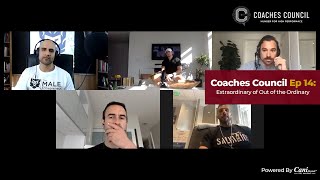
This is a YouTube video titled "Coaches Council Podcast Episode 14: Extraordinary or Out of the Ordinary" published in June 2020. It features a multi-speaker podcast discussion including Justin Roethlingshoefer, Drew Manning, Craig, John, and others. The conversation centers around the concept of what it means to be extraordinary, exploring themes of passion, perseverance, mental toughness, and the iterative nature of achieving difficult goals. Drew Manning shares his experience running 100 miles, while the coaches discuss mindset, accountability, and the psychological traits that contribute to high performance and extraordinary accomplishments.
We take for granted that we can do extraordinary things. We take for granted we can accomplish shit that we put our minds to.
Find your 100 miles. What is your 100 miles?
All the things that we've talked about here are out of the ordinary. I suppose they're not average, let's put it that way. They're not average, but I mean extraordinary. That's just, I guess we all have subjective levels of it, unless there is something, some objective definition.
This is the Coaches Council, made up of six elite coaches dedicated to serving and ending personal struggle for high performers in business, health and relationships. As a collective, we have built and helped build six, seven and eight figure businesses, dominate in multiple industries, coached and played in professional sports leagues and developed some of the strongest and most intimate relationships, both professional and personal. This isn't your average podcast. It's for the hungry, the dedicated, the doers, for those that have a dream and truly want that dream to become reality. People who want to take action, leave their ego at the door and own every level of their life. If that's you, then step into the coach's counsel as we rewrite the truths to living that high performance life. Welcome back. Another week of the Coaches Council all about being extraordinary and all of us listening, all of us here are all extraordinary, are all extraordinary in our own unique ways. And Craig, John and Pradeep, so thankful that you guys are here today and hopping on. We actually get the exclusive interview for Drew Madding coming off his 100 mile run. I don't know if I've run 100 miles in my lifetime, let alone in 24 hours, but for a great cause. But we're talking about extraordinary feats. And Craig, I know you've done a lot of extraordinary things in your life, but what is it that really we need to tap into that allows us the freedom to experiment, to do these things?
What do we need to tap into?
I don't know.
I mean, honestly, you stumped me on this question. I've never thought about this before. I guess I would say that if somebody wants to achieve extraordinary things, they must first have a very good reason for doing it. They can't, you know, get. A lot of people want to do normal things and they can't even follow through on normal things. So what you, if you want to do something extraordinary, you must have a very good reason why you want to accomplish it. Because if you don't have a very good reason why you want to accomplish it, then you're going to drop out as soon as hardships and resistance come against you, whether it's writing a book or whether it's running 100 miles or whether it is losing weight. Because I would be shocked if every single person that started this 100 mile run finished. And I don't somebody's probably dropped out of Drew's race when other people wouldn't have dropped out for the same reason. Right. And so a lot of people start ordinary things. We start extraordinary things just because. And oftentimes we do them because it is we are doing, acting on somebody else's expectations of extraordinary. Or we hear about David Goggins running 100 mile race and we go, okay, well I got to go and do this as if it matters what some other person does. So you need to be true to yourself. And if you're going to do something, anything, then you need to have the right reason. Then once you have the right reason, you need to have the right plan. Best thing to do is figure out who's done it before, how did they do it right and get the right plan in place. And then you need to have the accountability. But at the end of the day, all things are driven from inside and all the external motivation in the world to go and write your first novel or whatever it is, you're going to come up against such excruciating, excruciatingly difficult resistance that unless you are doing it, I wouldn't say for the right reason, but you're doing it for a reason that compels you to like extraordinary. I don't know. Is everybody extraordinary in their own way? I mean, everybody is unordinary in their own way. But is everybody extraordinary in their own way? I mean, I might disagree with the way you open it up. I've written three books. I really don't consider that extraordinary. I really don't consider the fact that anything I've done in my life is extraordinary. Think it's that extraordinary? If everybody's extraordinary, Nothing's extraordinary in my opinion. And so I've done some stuff that is out of the ordinary, maybe that's the definition, I don't know. But I don't find it extraordinary. But I did all the things that I've done because I really, really, really wanted to do them. And then I figured out how to do them. I did a lot of them wrong, but I figured figured out how to do them. And I didn't quit on the things that I finished, obviously, because they mattered so much to me. And that's how I got them done. And that was probably the worst answer on the history of this show, but there you go.
I think it opens up some interesting questions, though, because you. All right, so what A couple of things to touch on. Let's just look at the linguistics. You said you've done things which might be considered outside of the ordinary, which is to say that most people don't do them, but you yourself don't consider them to be extraordinary, which means you don't think they're fantastically special in some way. You're a person who's written three books. The thing about it is, most of what we do, however ordinary or extraordinary, happens iteratively, which is to say that if you're at point A and you were to set a goal to get to Z based on that alone, that goal would be extraordinary. But if you went from A to B and B to C and all the way down the line, going from Y to Z doesn't feel that extraordinary. And so when we hold up people who have done things that seem to be extraordinary, we're only seeing we're comparing them to ourselves, we, the ordinary person, against this thing that they have accomplished. And so when we're talking about someone like Drew Manning, who has just come on the call and he's just run 100 miles, Drew didn't go from where I am right now, which is a person who can't run two miles without stopping to then run 100 miles, that would be extraordinary. Drew is someone who has been an athlete and he is consistently trained. And this was while certainly out of the ordinary and certainly a feat which is worthy of note and very, very difficult. If you look at it in terms of an iterative timeline, it was a logical step that from the point he made, the decision did not seem to be impossible. And to swing back to you, Craig, when you wrote your first book, which is, some would argue, the hardest one, it made sense for you within the timeline of your life and your business and the things you had theretofore accomplished, that you could write a book. You had been creating content for a dozen years. You had all of the people around you who had written books before. And so for you, having written a book and then a second book and a third book, it doesn't feel extraordinary. But for a person who has never written a book, for a person who is not in that situation, having written three books is certainly extraordinary. And so I think it's helpful for all of us to realize that we are judging ordinary versus extraordinary within the context of our own biases. For people like Craig and I who are surrounded by best selling authors, by people like Ryan Holiday, who seems to churn out a book every week. Having written one book is like nothing. Ryan's got 12. So these things, they do happen on a timeline. It's not necessarily linear, but it is iterative. So, Craig, I think the things that you have done are particularly compelling and exciting and noteworthy, and relative to where people think they're starting, they are extraordinary. It is very unusual for someone to say without ever having written a word to say, I'm going to write a best selling book one day, that, that would be extraordinary. But to your point, just to have written 5 million words of content by 2015 and then say, I'm going to write my first book, it's the next logical step. And I think that needs to be considered when we talk about extraordinary things, because for so many of us looking at that goal off in the distance, that mountain, like to climb Everest, don't just show up at base camp and get to the top. You have to train. Everything is a series of steps. And the most extraordinary things are usually a combination of ruthless execution of the basic aspect of a host of very, very ordinary tasks.
So when we're saying that basically accomplishing things, going from everything is seemingly extraordinary until we do it theoretically, is what we're saying in a plan. If you're comparing yourself to other people. So, Drew, as you were going through this, I know you tried this run last year raising money for our rescue, and you finished at 80 miles last year. I think you said, what was it that got you to get back up, go back at it, and ultimately accomplish this? And, and I mean, you're what, six hours out of your race? What was it that you were going through?
Yeah.
Over the course of that 24 hours.
Yeah. Thanks for having me on. And I will be totally honest with you guys. My brain is not as sharp as it normally is. Like I said, I just ran the. I just got done running the race, went home, took a nap for two hours and literally came to a cryotherapy place and get an IV drip. So my brain is not as sharp as it normally is with the lack of sleep. But here's the thing. Yes, I did. So last year when we attempted this the first time around, I kind of, I didn't really know what to expect. A hundred miles for me sounds impossible because I've never ran a half marathon or even a marathon. And so to throw that goal out there, which was inspired by people like David Goggins, who I think everyone has something in their life that they think is, you know, outside that is seems impossible to them. Right. For me 100 miles seems very, very impossible, very impossible. Until I you know read David Goggins book, I'm like, you know what? We all have these self limiting beliefs that keep us from trying anything that seems impossible because we think we're probably going to fail at or that's not for me, that's not like I can't do that. Right. And we think we can't and we believe those lies, we believe those myths and we just stay in our comfort zone for our entire life. So last year was really just kind of thrown in the fire. I didn't really know what I was doing. I took one month to prepare for this thinking okay, yeah, I work out and I think if you average a 14 and a half minute pace. 14 half minute per mile pace, you could finish that in 24 hours. So in theory on paper it looked.
Like it was doable.
I'm like 14 and a half minutes. You could walk that at a fast pace and you just maintain that for 24 hours. How? It doesn't seem that hard. But I was obviously, I was humbled, got 80 miles which I'm still proud of. That's the thing is I didn't, had I not tried 100, I never, I would never would have known that I could do 80 right. If I just would have done a half marathon. Big Alright, 13.1 is my goal. But you know I never would have known I could do way, way more than that. And so last year not achieving it really drove me to want to try harder and train smarter for this. And so I worked with some professionals that helped me. One of them is Iron Cowboy. I don't know if you guys know his story. He's got documentary on Netflix who he did 50 ironmans in 50 days in 50 states which is extraordinary. Like your average person can't even do one Ironman, he did 15 in 50 days. So I brought him on to help me train for it and you know I, I went all out. I'm not a runner at all. I did not grow up running. So for me it seemed way out of my comfort zone. It seemed very impossible to me until I attempted it last year. I'm like, well how far could I get if I actually trained for it? So this year I actually trained for it and I accomplished the feat of doing 100 miles in 24 hours. Which I had doubts during the race. I had those self limiting beliefs telling me you're not going to be able to do this, this is way too hard. And I just kept plugging along and just trying to be smart about how I broke up my, my run slash walking combos to help me maintain a certain pace. Right. I didn't break any records. I didn't, you know, beat Zach Bitter or anything like that though. The guy that just broke the hundred mile record for 100 miles on a treadmill, you know, he averaged like a seven minute pace. That wasn't my goal. My goal was to say, hey, I can do 100 miles in 24 hours. And I actually did it. And what else can I do? What else can I achieve? And so for me, I actually did a live at the end of the, of the run. Telling people, look, a hundred miles isn't something for everyone, obviously. Like that's not something that just everyone can, can just train for and do. But what I said is find your hundred miles. What is your 100 miles? And what is that for you? What does that look like for you? Is it, is it writing a book? Is it, you know, going to the gym every day, you know, five days a week? I don't know. It could be something that seems impossible to someone and for them that's extraordinary. So I think extraordinary is individual. You know, each person has their self limiting beliefs and it's, you know, it's important for us as humans to step outside of that and find what else we can achieve in this life. Because we are amazing beings, we can do amazing things, but sometimes we stay in our comfort zone because we're afraid to take a risk and fail.
I got a question for you. What was the toughest part? Because I can't Even imagine running 100 miles. I don't think I'd ever do that. But what was the toughest part for you in terms of the race?
So there's a big mental aspect to the race. Obviously physically it was demanding. It was 92 degrees here in Utah, very hot. We were in a very sunny area with no shade. So the heat exhaustion was real for sure. And I definitely had my doubts about getting through that. From like noon to 5pm is the hottest part of the day. So the physical exhaustion was definitely there. The hard part was the mental aspect of telling myself, okay, I'm 30 miles in, I have 70 more to go and I have three hours left of the hottest part of the day. Like, how am I going to be able to do this? You know? And that's where some of the doubts would set in. But I just took it one mile At a time and just broke up each mile into a running, walking combination where I can maintain a certain pace to where I didn't get over exhausted. Right. So I think for me, the mental aspect. And then the second thing was at nighttime, pitch black. You know, I had some people come out and help me, but there was times where I was alone in the middle of the night, pitch black, no one else is out there, and I'm just going, going, going, and just waiting for the sun to come up. I was like, if I could just get through the night and see that sun come up, I'll make it through. I'll make it to the end. So getting through the night was. Was one of the toughest parts as well. On top of the heat, you know, the heat of the day in the middle of the day.
So you see this kind of stuff on. On TV sometimes. I like watching Ironmans and stuff like that. So did you at any point pace yourself with anybody else? Or was it kind of like you on. And do others do that? Do they form groups? Or is it kind of every man or woman for themselves?
Yeah. So this wasn't an official race. It was just something that me and my brother decided to do last year, and we decided to do it again this year. So there wasn't like hundreds of people racing. A lot of the races have been canceled because of coronavirus. But basically there were people, friends that came out to support us and they would do like one or two laps with us. Each lap was five miles long. And so we did. We just repeated that same lap 20 times. And so some people will come out and, you know, bike with us. They would just bike with us. Some people would pace us. That definitely helped us get through, you know, a lot of the hard. The hardest parts of the day. Just having some of their kind of distracting us, if you will.
That's pretty amazing because I think that's tough enough when you have a whole bunch of people cheering you on, but to do that with just you and your brother, man, I give you props for that, for sure.
Thank you, guys. Thank you so much. I appreciate that. And sorry I couldn't be on the whole time. You guys had some great topics for today, and I wish I could have been there, but this is one of the hardest things I've ever done in my life physically. And so the recovery part is going to be, you know, pretty brutal. But like I said, I'm in compression boots, IV and then cryotherapy, infrared sauna, everything I can do just to be able to walk normal as soon as.
Possible and then get into a comatose sleep.
Exactly. And make up for those 13, 14,000 calories I burned. So I'll be pigging out tonight for sure.
I love it. Awesome. Drew, thanks so much for popping on with us, my man.
Yeah, yeah. I appreciate you guys. Wish I could be there for the whole thing, but you guys are in good hands with all the other coaches here, so thank you, guys. Have a good weekend.
See you.
Bye.
We'd be remiss if we didn't take this time to thank our sponsors that allow us to reach you each and every week. The coaches council is powered by cannibrands, a lab tested all natural pure hemp cbd company without the presence of thc. They encompass our passion for health, wellness and fitness that we have on the coaches team council. Visit canibrands.com and at checkout, use the promo code coaches20 to enhance your wellness journey. So, guys, I'm really going to lean on this. And I think because when we accomplish things and we just get used to accomplishing things, we get used to accomplishing goals, hitting goals, it becomes something for us where we take for granted that we can do extraordinary things. We take for granted we can accomplish shit that we put our minds to. We take for granted that we have the ability to stick to a plan, to make a plan, to even own a plan that we're really setting forth. And so, just in that aspect, it is extraordinary. We are extraordinary. Every single one of us is extraordinary. It's the fact that goes back to what Craig said at the beginning. Do you have the clarity and the passion for something, or do you not? If you don't have the passion and clarity for something, then you're not going to be able to be extraordinary because you're not going to accomplish a damn thing. But if you do have the passion for something, Whether you've accomplished one thing, five things, or 500 things, you can still be extraordinary even if it's one because you've had a passion. You set a plan and you went.
And you did it.
Craig, before you jump off, I have a question for you. Most of what you've been able to accomplish, you seem to attribute to process rather than to anything extraordinary about yourself. So earlier you said you don't think that everyone is extraordinary. I think that again, linguistically, that has to be true. There has to be a mean. There has to be a baseline average, and there are some people that are above that. Do you believe that there are qualities in a person that seem to indicate a greater ability to accomplish, let's say, extraordinary things that you've seen. Because obviously you are, you work with a lot of high performers and you help people do fairly amazing things. And I wonder if there's stuff that stands out to you as more common.
I don't think that they are within the individual. A person will do extraordinary things when they decide that the need to do something extraordinary is so great. So let's go with the classic.
Kind.
Of myth, the story of the grandma lifting car off child, right? That person has done something extraordinary. Could you. Would you have, you know, 10 years before, you know, picked that woman out and said, you know, the day that woman is an extraordinary person, there's something that. No, I don't think, I don't think that there is something that gives it away. I don't think even then when I see high performing people, because, you know, it's a good question because I coached a lot of people and I have in my head often thought within the first couple of meetings with them, thought, okay, if this person was a stock, I would buy them and I would not be a rich person. If I played that game and decided to pass over some of the people that have gone on to do extraordinary things. You will be surprised to the upside, you'll be surprised to the downside in how people. And you know, obviously some of these people have lots of life left to live and some of them do come back and do extraordinary things after you may have written them off. But I don't think that there is. I think that it's like when I was in the fitness world and had those transformation contests. I would, I would consider it extraordinary when some women would win the female competition and it was the woman who was a single mom of three with a really bad relationship with her ex partner and you would write that person off. And 12 weeks later, the woman who had everything going for her personal trainer and meal delivery and all that stuff dropped out after two weeks. Yet here was this woman who won after 12 weeks. I certainly didn't see it coming. I think I've been more surprised by people who have done pretty darn great things when I never would have expected it as more so than I've been surprised by people who I thought would do great things and haven't done great things yet. So I certainly don't look at me to pick the winners in a race of any kind.
I think that's really. Go ahead, Justin.
Sorry, John. I was going to say, do you think it comes down to a certain level of passion and conviction for whatever it is that you're going for.
I don't know exactly what word I would use to describe it, but at the end of these contests, and I'm using the fitness contest because I've really thought about it more with these people because they had to write this essay of, you know, what changes did I experience in these 12 weeks. And you know, they would get like the cursory physical changes, but then you would get like, here's why I kept with it this time. And you would get the man who said his doctor told him he had to lose X amount of weight, otherwise he wouldn't see his children graduate college. That will spur somebody to do some pretty impressive things if it means a lot to them. For the woman, maybe she was doing it to inspire her children. Maybe she was doing it to get back at somebody. Bedros often talks about the person he sees. So many people successful with a chip on their shoulder. And chip can be defined on your shoulder can be defined in so many ways. But it is that thing that is the thing. I guess you could call it passion. Passion can run both bad and good, I suppose. Certainly a lot of evil things have been done out of passion. And it's just this drive, this internal drive that you will meet some people where you know they are hell bent on success come hell or high water, right? Like Isabel Price, who is a friend of John and I. You just like you had a very, very strong belief in the first call, or at least I did. I had a very strong belief in the very first call you did because you weren't on the call. I had a very strong belief in the very first call. Like, yeah, I'm really, really confident this woman will be successful. And then some other people will feel like this woman's going to do great, she's a hard worker and then she has a mental E brake on. So I guess the people, and this is very a nice analogy for what Drew did. There was times where he wanted to put the brakes on and he had a mental E brake on in that race and he lifted it. And a lot of people go through life with the physical capability, the intellectual capacity, the environment, the supportive environment, the supportive people, they go through and they just never like the last limiting factor is the E break in their head. And for whatever reason, whether it's self doubt or whether it is a circumstance of something that happened to them when they were a kid, it's never being able to be lifted. And it's a shame It's a shame because you see people just always on the verge of not even just greatness, but goodness, and they can never make it. I wish I had the solution, but I mean, that frustrates me so much, John, because it is outside of the mechanical process. And I'm a person who gets really frustrated by when there's something outside of the mechanical process. When you were a kid and your high school girlfriend broke up with you and you couldn't understand why, and that would just leave me tossing and turning, because it's a thing that can't be fixed, whereas everything else in life that I've succeeded with could be fixed. And that's. With the people who have never achieved their greatness has always been a frustration.
Yeah, I understand that. It's really interesting that you talked about the woman who had the trainer and the meal delivery service. This is a person who. There's no adversity, there's no challenge to overcome except the thing that is inside their head. And I've seen so many people with so many advantages in their corner with every conceivable privilege, but there's. Because there's no adversary, no adversity, it's very difficult for them to just start at all. I remember one of my clients back in the day, his father had been the CEO of a massive communications company of Viacom. And then at some point, so this kid was like number three in the birth order of five sons who were just born into like, millions and millions and millions and millions of dollars. Like, you know, when the father retired, he got like a $92 million golden parachute. This kid grew up with so much money, and every single son from the top down, top one went into business, the second one owned his own business. Then there was my. My client who, like, became a teacher. And then they just. They kept getting less motivated. And it was just this interesting thing that, like, you, you know, every conceivable advantage and you can't find a passion, there's nothing to overcome. And it's a type of. Of languishing.
I think that it's also. There's a lack of consequence for failure.
For failure?
Yeah.
For or for giving up? For giving up. There's just, you know, one of. One of the things we hear and this is.
This is going to change if I don't succeed here. And therefore. And that's the same with everything, such as hitting snooze button in the morning. People will often say, come to me with that problem. I say, well, there's just no consequence for you, not there's a consequence of at 5 o' clock in the day you're going to be upset you didn't get anything done or as much done. But that is, it's so far distant in an acute space. And so unless there's a consequence, and I've had people have to do the donate money to something they don't like approach and all of a sudden the consequences became real. Even some people where it's 10 bucks to a friend and they don't want to pay the friend and all of a sudden problem is solved by adding significant consequence and so on. The grander scheme for people that may not achieve things on various levels, there's no consequence.
Right.
And when we apply that to, let's say business and thinking about Isabel, who was. One of my favorite stories is about Isabel who sat with you and did a consulting call and she was thinking about joining your coaching program, your mastermind at the time. And she talked to her business partner Jeff and her husband and was like, it's $10,000, we have no money. I know it's going to help us, let's do it. And like having to come up with that money was such a challenge to overcome that it created the accountability and the buy in.
Right?
You don't invest $10,000. You don't have, if you don't already buy in, if you don't believe that you can achieve this thing. And then you have the other people in the mastermind, and I've coached some of these as well, their business is doing well. The investment is like not insignificant, but it's not this huge. It's not the big problem to overcome. And everything is like, it's going fine. There's nobody they have to convince to let them invest the money. It's just like, yeah, I'm going to do this. And then they half ass. It's so there has to be a challenge, there has to be some accountability. There has to be something there. And for all of the clients we've worked with who have been successful, part of that is the accountability we create. There's emotional buy in to failing because you don't want to let your mentor down. But yeah, in much the same as you, there have been so many people I've seen, I'm like, oh, that kid's gonna make it. And then they do nothing. And then there's other people. I'm like, I don't know if he has it. And then they go on to do great things and I'm not perfect.
On this either. I mean, there's been courses I've bought that I've never finished, and all those types of things. I live in a house built of books I bought on Amazon that I haven't read. I just built a fort around them because there's so many of them that I've bought and never read. And then there's even just some personal challenges. Like one year, actually, John, when we were down seeing Joel Marion at one of his super bowl parties, I think it was just before your book came out. And I was like, I really want to take a personal challenge and join all the people in my physical challenges, so I'm going to learn how to play chess. And that lasted two days of me watching a couple of YouTube things. And I was like, this has no meaning to me. And then I decided, okay, well, what has meaning to me? Well, if I start meditation, it will really help me with. Just in life. I'd overcome my anxiety at that point, but it certainly didn't help. And I quit meditation three times before. And I'm going to make this stick come hell or high water. And so I said, okay, I'm going to do two minutes. And I did two minutes for three days, three minutes for three days, and so on and so forth. And I remember it was January 28th of 2013 that I began meditating for at least five minutes a day. And I have missed probably five days in nearly a decade. But I just took it seriously, and it mattered to me.
And so that we go back to the things that you've done that to you don't seem extraordinary. But in this case, this challenge to start meditating, like, if I had told the two 2011 version of you that between 2013 and 2020, you will have meditated every day except five, that would have seemed extraordinary to you. But you did it iteratively. You started with two minutes and then three minutes, and it. And it mattered to you. There was a real consequence there. And just like Drew tried 8, you know, 100 miles and got 80. So anything that could be considered extraordinary is ultimately a. It's an accumulation of things that stacked one right next to each other seem ordinary. But if you look at the starting point relative to the present point or the end point seem extraordinary.
So I think my whole definition of extraordinary stems from, like, when somebody says extraordinary. In my mind, it is the, you know, there's something bad happening, and it is the woman or man who runs into the danger and saves a life or stop something absolutely horrible from happening to me. That's extraordinary because it is so extraordinary. It's like CNN breaking news, it's raining today. We're now in this culture where when everything's breaking news, nothing is breaking news. And so I guess to me, it's like. Because that person didn't iterate, which was a really good description of you. It's like that person was thrust into a situation with no preparation and somehow performed in a level where this is like real news to me, like, that's extraordinary. And thus all the things that we've talked about here are out of the ordinary. I suppose they're not average. Let's put it that way. They're not average, but I mean, extraordinary. That's just. There's. I guess we all have subjective levels of it. Unless there is something. Some objective definition.
Yeah, no, I think. I think that's so, you know, heroism is ordinary people put into extraordinary circumstances and performing. Right. And so, like, you know, Tom Brady, like going to the super bowl how many times and winning however many times, like he's consistently performing at the best. He's the goat. It's almost, you know, that's. It's extraordinary within the context of every other person in the world. But relative to other people as good as him, it is iterative. So I think that's a really, really good distinction.
Yeah, there's a couple of things that you guys talked about, and I think outside the practical piece, because that's so important. And Craig pulled. He talked about anything outside the practical. He gets frustrated. And here's kind of the. You can say the behavioral pieces or the personality pieces that I see, the psychological pieces for people that go out and actually do some pretty cool things. Again, I like Craig's definition. You know, very few things that we see these days are really extraordinary, but again, it's the situation that you're in. But the first one that I see is basically desire, is having that burning desire to actually get that thing done. And if that person has that, that's the first step. The second one is belief, right? You got to have some kind of belief going into it that you're actually going to be able to accomplish it. Because if you don't have the belief, you're not going to do the things that you need to do or build the skills that you need to. To actually get it done. And then there has to be a level of expectation. So again, this isn't a have to, but this is the. You can say the characteristics that I consistently see in people is that there's an expectation. There's either a self expectation for that person to say I'm going to get it done and I'm going to hold myself accountable, or they've told enough people, for example, and those people are expecting them, that person to get it done. So there's an expectation piece, but there's something above all of that for me that I personally see that I've tried to use in my own life as well. And that's optimism. I think there's been a lot of research done with athletes as well with that. And in terms of the number one characteristic trait when it comes to getting this stuff done or doing extraordinary things really comes down to optimism. If you can't take a cynic and turn that cynic into someone that creates something extraordinary. Personally, from my standpoint, I think it's those optimist people or optimistic people that really get those extraordinary things done. Personally myself. So for me, those are the kinds of things. As you guys were talking, I was trying to piece it all together in terms of the characteristics and the people side. Those are the things that stand out for me.
Yeah, that makes a lot of sense.
No, it makes total sense. And for everybody listening, if it's not extraordinary, what is it that you can go and do set your mind to accomplish that's out of the ordinary.
With that.
That's another week. Gentlemen, thanks so much for joining us everybody. Stay hungry, stay humble and we'll see you next week. Thank you so much for joining, joining us for another week of the coaches council. If it wasn't for you viewers and listeners, we wouldn't have a platform. So again, it's all about you guys and we want to give you a reward just for listening. We want to give you access to each one of our coaches for a little bit deeper, intimate experience. So if you go to coaches-counsel.com coaches-counsel.com subscribe and like to whatever platform you're viewing on, you're going to be entered to have that one on one experience. So be sure to go coaches-counsel.com and really interact with us because we would love to interact with you. Until then, stay safe, stay hungry, stay humble and thanks for listening.
More from Justin




The Ultimate Blueprint for Taking Ownership of Your Health | Unlock Peak Performance

From Bullied & Anorexic to Healed & Purposeful: My Transformation Story (Justin Roethlingshoefer)


Forget "One-Size-Fits-All" Health! Unlock Your Best Self with True Personalization (The OWN IT Show)

Are Blood Tests Enough? Why Cellular Testing Might Be Better | Justin Roethlingshoefer

Your Body's Language: Understanding Stress & HRV| The Power of Ownership - Chapter 3 & 4


Is "normal" really making you sick? Dive into Different with The Power of Ownership:Chapters 1 & 2