Coaches Council Podcast Episode 16: Fit to Fat with Drew Manning
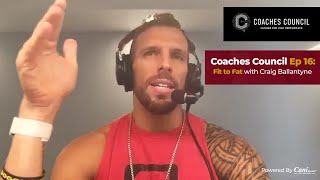
This is a YouTube video titled "Coaches Council Podcast Episode 16: Fit to Fat with Drew Manning" published in June 2020. It features a podcast conversation between hosts of the Coaches Council and Drew Manning, a personal trainer known for his "Fit2Fat2Fit" experiment where he intentionally gained and then lost weight to better understand the struggles of overweight clients. The discussion covers his physical and emotional journey, lessons learned about empathy, identity, addiction to unhealthy food, and personal growth. The episode also touches on mental health, self-worth, and authenticity in the context of fitness and life transformation.
There's a weird light bulb moment. This idea just popped up in my head. What if you got fat on purpose and documented the whole thing for the world to see, to gain a better understanding? I mean, it was so weird because I didn't have a stress reliever like exercise anymore, so my stress reliever became the food. So it's hard to empathize and understand where people are coming from and from. For me, it took me kind of being humbled to gain a bit of understanding and gain some empathy.
This is the Coaches Council, made up of six elite coaches dedicated to serving and ending personal struggle for high performers in business, health and relationships. As a collective, we have built and helped build six, seven and eight figure businesses, dominate in multiple industries, coached and played in professional sports leagues, and developed some of the strongest and most intimate relationships, both professional and personal. This isn't your average podcast. It's for the hungry, the dedicated, the doers, for those that have a dream and truly want that dream to become reality. People who want to take action leave their ego at the door and own every level of their life. If that's you, then step into the coach's counsel as we rewrite the truths to living that high performance woman's life. Welcome back to another week of the Coaches Council. And it's another one on one coach meeting with Mr. Drew Manning, better known as Fit2Fat2Fit. That's how many people know him. But, Drew, we're so happy that you're a part of the coaches council, and I can't tell you how much you've inspired me along my journey and my path, and it's a pleasure to do this with you.
Thanks, brother. Really appreciate it. Honored to be here and really excited to do the one on one thing. It's shake it up a little bit, you know?
Absolutely. No, totally, totally. Now, when people sit back and take a look at what a lot of people will know you for is gaining all that weight. And I know we've talked about this on the show sometimes, but really kind of, I'm so curious as to what went on with you, not just physically over that time, but mentally and your journey and why you did it, what led you to it, and what lessons you learned along the way that you've carried on, more so than just the weight loss, the weight gain, but what has been able to carry with you in your everyday life.
Yeah, that's a good question. So let me tell you a little about my background, which will kind of lead into why I did fit to fit2fit. So I grew up a family of 11 brothers and sisters, and we all played sports. So for me, football and wrestling were the two sports I played from a very young age. So I was always very active, my family was very active. And I never experienced what it was like to be overweight. I was never overweight. You know, one probably because we didn't have a lot of food to feed 11 kids. That's a lot. So our rations were fairly small. But also, I never really struggled with food cravings or addictions, food addictions like that. And so for me, it became easy to be in shape. It was just something that became part of my life. Well, Fast forward to 2009. I got certified as a personal trainer because I knew that health and fitness, they were something that I was always interested in, that I was passionate about from a very young age. I wanted to lift weights and be strong and have muscles from a very young age. And so that kind of came naturally. And the problem I had though was a very black and white mentality of, hey, look, it's super easy to get in shape. Here's what you do. You eat healthy, you exercise, and you'll see results. And I had clients who were mostly overweight the majority of their life. And here I was, someone who had never been overweight a day in my life, trying to help those people who had been overweight, you know, the majority of their lives. And what did I know about being overweight? I didn't know anything other than I thought that was easy to lose weight. Like, hey guys, it's not that hard. Here's your meal plans, here's your workouts. You'd be perfect at it and you'll see results. And they would tell me excuses of like, oh, man, I really tried, but, you know, I gave in. This weekend I had some treats I wasn't supposed to have, or I didn't go to the gym. I was really sore and it was cold outside and whatever it is. And I would get so frustrated, like, why is it so hard? And I had one client that was a ex brother in law who told me, he's like, you know, Drew, you don't understand how hard it is for people like me. For you, it's always been easy. And for me, it's, it's, it's, it's been hard my whole life and you just don't understand how hard it is. And I'm like, you know what, you're right, I get that. And so that kind of get have my wheel spinning in my head. Of like, okay, what can I do as a trainer? What can I do to better understand my clients? And then it was a weird light bulb moment. This idea just popped up in my head. What if you got fat on purpose? And documented the whole thing for the world to see, to gain a better understanding? And it was weird, but it made sense in my mind. And I felt like it was almost a calling to do this. And so there was with this crazy idea. And before you know it, I just kind of, you know, you know, you know, winged it. I didn't really know what I was doing. I didn't have a marketing strategy or media connections or a marketing team to help me with this. It was just me and my ex wife, you know, just trying to document as much as possible and put it out there. And before, you know, it goes viral, now, you know, the details really quick were six months of gaining weight, you know, that was. Those were the rules. No exercise, eat a standard American diet. And the six months of losing weight. And that was the idea in a nutshell. Well, to talk about, like, the lessons I learned, one of them was more so on the mental, emotional side. So one thing you have to understand is your body becomes a part of your identity, whether you are in shape or out of shape. So I was. My identity was Drew the fit guy, Right. That was part of my identity. And so to lose that, to lose my identity in just six months of not being Drew the fit guy anymore, I kind of freaked out. I didn't know who I was. I was, like, very uncomfortable being overweight because I've never been overweight. And I wanted to go up to strangers to explain to them that I wasn't overweight, that this was just an experiment and I was temporarily overweight to do this journey. And they should go to this website to learn more about it and show them my before picture. Like, I wanted to do that so bad because I felt so judged. I felt like people were looking at me and thinking, oh, dude, that guy's overweight. And I couldn't handle that because my identity was based around my body. And so my eyes were opened a lot on this journey of just how much of transformation is mental and emotional for everyone. And I didn't understand that before. I'm like, why do you just lack willpower? Just have more discipline and do it. It's not that hard. We think it's so easy. Because if you've never been overweight, yeah, it kind of comes naturally. Or you have that natural discipline and you've never really Struggled with it. So it's hard to empathize and understand where people are coming from. And for me, it took me kind of being humbled to gain a better understanding and gain some empathy. So those were the biggest lessons that I took away from this was empathy, more respect, and a better understanding for those that struggle. And then also realizing that's more of a mental, emotional struggle than it is just physical. And then the last thing I would say is the emotional connection to food is way more powerful than I think we think, or that we know we think it's simple. You just eat less and you work out. But you wouldn't go up to a drug addict and tell them, hey, what's wrong with you? Do you just stop doing drugs? It's not that hard. Just don't do the drugs and you won't be addicted to them. It's like, well, well, duh. Of course. Like, of course. But you know, the problem with food is that it's legal and it's in our face every single day. It's, it's marketed to us in commercials and TV shows and social media and it's at the grocery store and we make it taste good and smell good and we make it cheaper than real food. And so it's an uphill battle. It's like getting, if heroin and cocaine were sold at the stores, at Walmart and trying to get people off of it, it would be near impossible because it's pushed in their face all the time. That's what it's like with food addiction. So that was a big lesson for me because I tried to switch going from eating the junk food to back to healthy. And I struggled. As a personal trainer, my body fought back to want the high that it had gotten from those foods for the past six months. And so that was really eye opening experience for me too. So those were the lessons. That's my story in a nutshell. Hopefully I didn't take up too much of the time.
No, you're good. I'm curious what you say it was an American typical American diet. What, what did you take in? What was that that you did?
A lot of highly processed foods that were cheap, convenient, and they tasted really, really good. So things like sugary cereal like Cinnamon Toast Crunch, that was like my drug. I had that like twice a day. It was so delicious. Mountain Dew juices, granola bars, chips, cookies, crackers, Spaghettios, Hot Pockets, Mac and cheese, top ramen. All these foods that we've created here in America that like I said, are convenient, they're super convenient. They're marketed to us sometimes as healthy foods, if you think about it. And they taste really, really good. They light up our brain when we put those things in our mouth and that's why it's so hard to get off of them. I know that people like you and I don't really eat those foods, but let's be honest, I mean, 80% of Americans gravitate towards those foods because they're cheaper, they're more convenient, and they taste really, really good. And if you're on a budget, you're trying to feed your family, it's really, really hard to do grass fed beef and, you know, organic fruits and veggies when you could go to the store and buy a box of cereal for a couple bucks and some soda that's cheaper than water and feed your family.
What were the side effects that you noticed from doing that? Because just listening to you list off those things, I immediately get a headache. Yeah, that's the first. I'm like, oh my God, I have enough and I have energy as it is. But I would be climbing on walls and I would be like scratching. I would just be like, oh, wow.
Yeah. The thing though that was surprising to me was at first, dude, my body felt really good in the beginning. I actually didn't notice a huge difference until probably like three, four weeks in. The lethargy started to sit in the lack of conditioning and exercise, you know, because I wasn't exercising. So huffing and puffing, walking up the stairs, the visceral fat around my organs made it harder and harder to breathe. So I remember having to like bend over and tie my shoes, like holding my breath because I've never experienced that before. But people who are overweight, you can't just bend over and tie your shoes or clip your toenails without, without having to hold your breath and then come up for air and then go back down again. All these little tiny things that it took for granted. So it didn't set in until I would say three weeks, four weeks, where it become really, really unhealthy. And then I, you know, I had five months left, but the food actually, I mean, it was so weird because I didn't have a stress reliever, like exercise anymore. So my stress reliever became the food. But then all the food was the thing that was causing me to be more and more lethargic and having lack of energy and more brain fog. But it was also I was becoming dependent on it. So it was like this vicious cycle of like, if I Went three or four hours without food. I was like ravished. I was hangry. I was like, I need something. And the satisfying feeling of drinking a Mountain Dew, eating some chips when you're starving feels so good because it hits you almost instantly. But then with that spike of energy, you get a huge crash. And then after that crash, you're like feeding for some. Something else, something quick, something easy. You're like, oh, I love that quick little high that I get from, you know, Cinnamon Toast Crunch or Mountain Dew or whatever the, whatever the food is. So it makes you feel good, but makes you feel terrible. But it creates this vicious cycle around it. Kind of like drugs where you have this huge high. Then the, the letdown or the comedown is where people get depressed and they, they, they need that fix, they need that high again. So it is almost like a drug addiction and it's a similar cycle.
You say that it was as much as it was physical, it was even, even more emotional and mental. What did you feel in terms of those emotions and at what point did they really start to like, get you?
Yeah, there was a couple moments. One was, I remember I was at a grocery store and I was. Had my grocery cart full of all this unhealthy food, like chips, cookies, crackers, sodas, like all that stuff. And there was these three kind of attractive women behind me in line, and I was overweight. And I was so self conscious about my body at that time, I wanted to say something to them like, hey, what's up ladies? I normally eat broccoli and kale. Like I'm normally a healthy guy. I love that I'm doing this.
At what point was this?
Midway. Probably like midway. So it was noticeable that I was bigger.
And you had gained how much weight by that time?
Probably like 30 to 40 pounds.
And how much body fat? Just so that we have an idea.
So that's a good question. So in total, I gained 76 pounds and I got up to 32% body fat. @ this point in time, I was probably 20, 25% body fat, you know, 50, 40 to 50 pounds overweight. And I remember seeing them kind of look at my shopping cart and then look at me look back at my shop. I felt the judgment in their eyes and whether they were judged me or not, I don't really know. But I wanted so badly to say something to them like, hey, this is not really me. But it didn't say anything. I purposely kept my mouth shut and just let that feeling sink in. And that's where it clicked for me, this is something my clients have to go through on a daily basis. The feeling of being judged all the time, the feeling of people looking at them differently or maybe treating them differently. No one luckily treated me differently. But I feel like it put me in the shoes of my clients and helped me to gain empathy for what they have to go through on a daily basis and the struggle that it is to be overweight and sometimes and be judged in our society where we place so much value on our outward appearance. The second thing was a couple months later, towards the end, My daughter was 2 at the time. And I came home from work because I had a full time job in the medical field. As I was doing this, a lot of people don't know that, but I was working full time in the medical field, doing this kind of on the side. And I came home from work one day exhausted, of course, like I always was. And chafing had become an issue. And that's where your legs and arms rub together and causes irritation. I wasn't prepared for that, so that was super uncomfortable. But I remember my 2 year old daughter, she loved to play this game where I just chased her around the house for like, she could play for hours. And for me, after a couple minutes of chasing her and playing with her, I was so exhausted, I was out of breath. Chafing was super uncomfortable and I had to sit down on the couch to take a break. And she didn't understand what I was doing to myself. She didn't understand like this, why I was doing this. And so she was trying to pull me off the couch, like, daddy, daddy, come play with me. And I had to look her in the eye and say, I'm sorry, I can't, Daddy needs a break. Like I need to sit down. And she, when she realized I wasn't getting back up, she started to cry. And these tears just coming out of her eyes broke my heart because it made me realize in that moment how bad it sucks, how bad that feeling sucks of not being able to play with your own kid or your grandkid because of your health, not so much because of your weight, but because of your health and how bad that must hurt inside for so many millions of people that are overweight even just here in America. And that's where I started realizing this is becoming way more of a mental, emotional journey than physical. And that's like, like I said, where's where I learned the greatest lessons? Like if it were as simple as just eating less than working out. And that's all People had to do, yes, that's a part of the equation. Everyone would be skinny and fit, like, if that's all there was to it. But there's so many emotions involved and so many trauma. There's so much trauma and challenges that have to be overcome and it's not as simple as just eating less and working out. It's, it's, it's simple in theory, but it's not easy to apply.
So as you've now hit this 75 pound gain, you've made your, your, your way up to where you wanted to get to. What was that process like? Getting back down?
So I kind of compare that process to, you know, being on top of this mountain. And most fitness trainers or fitness models and people on Instagram that look really, really good, that are naturally gifted, they're always on top of this mountain of fitness, right? They're all, they're at the top and the clients, the people that are trying to get to the top are at the bottom. And from the top it looks so easy. The path is so clear. You're like, oh, yeah, this is all you do. And it seems so easy because you've never really experienced what it's like to go up. And so for me, what I describe in my book is like, it's coming back down to the bottom of that mountain, starting from ground zero and looking up is a totally different perspective. The view from the bottom is different than the view going up because you don't see, you can't see it as clearly. And that journey up was way harder than I ever imagined it would be. So it was very humbling. Losing the weight. Yes, I lost the weight, but there was struggles along the way where I hit plateaus and there was weeks where I gained weight instead of lost weight and I was doing everything right. So it was a very humbling journey to go back up that mountain and make that climb up. And a lot of lessons were learned, a lot of surprises happened. But eventually I trusted the process and I got there. But by no means was it easy. And I definitely have more respect and more empathy for those that struggle to make that climb. You know, one foot in front of the other, one foot in front of the other, day after day. It's not as simple as some people might think it is. Looking at it from the top, we'd.
Be remiss if we didn't take this time to thank our sponsors that allow us to reach you each and every week. The Coaches council is powered by cannibrands. A lab tested all Natural, pure hemp CBD company without the presence of thc. They encompass our passion for health, wellness and fitness that we have on the coaches council. Visit canibrands.com and at checkout use the promo code coaches20 to enhance your wellness journey. What was the whole journey like coming. As you spoke about coming back up that mountain, how, what setbacks did you have? What was the, what was the process were there. You had said there were weeks that you gained weight, even though that you hadn't obviously planned on that. But what was it like getting away from that food that you were having? And what was it like being able to push towards the quest of being back to where you were?
Yeah, so the first thing that happened was obviously going cold turkey from eating that food, the junk food, to eating healthy again.
Did you go cold turkey or was it a gradual.
I had to go cold turkey because I had six months to lose 75 pounds, which is not easy to do. So I wish I could have, you know, scaled it and just slowly scaled back, but I had to just go, all right, one day, my last meal was a whole box of macaroni and cheese and a whole 2 liter thing of coke. And then the next day, the next day was spinach smoothies and, you know, eggs and chicken and broccoli and like all the foods, you know, you're supposed to eat that are healthy. So what was interesting was those first two weeks were the worst two weeks I've ever experienced in my life because I've never experienced withdrawal symptoms like I did during those two weeks. And what I mean by that is, you know, when someone's addicted to a substance, whether it's food, drugs or alcohol, your body goes through these withdrawal symptoms where it kind of fights against you and says, no, I want this quick high that you've been giving me for the past little while because I've become accustomed to it. And this stuff that you're giving me now, it doesn't make me feel as good. And so it was weird because I was grumpy, I was moody, I had headaches, I had a lack of energy, I was starving all the time. And, you know, here I was, a personal trainer, proponent of living a healthy lifestyle, and yet I was struggling to overcome those cravings of wanting just cinnamon toast crunch or wanting a soda so badly that it was so intense that I didn't realize how intense it was. And this is where I realized how powerful the emotional connection to food is. And, you know, I had so many clients who would tell me when I Give them a meal plan, they would tell me that they messed up or that they gave in. I'm like, why don't you just do it? Stop drinking the soda. It's not that hard. You just don't do it. But what experience did I have? And then here I was, did it on purpose for six months. And for me, I struggled to let go of those addictions. So I can only imagine someone who's been addicted for years or even decades to those foods now trying to make a switch. We think it's just simple and easy. And yes, some people can willpower their way through it, but by no means was it easy. So that was the first eye opening experience along this journey was the first two weeks were hellish. But I will say this, your body does adjust. So if you just stay consistent and you can make it through those first two to three weeks, you have accountability, you have a coach, you have a support system. If you can make it through those first two weeks, it does get easier. Your body does adjust and adapt. And then it starts to enjoy those healthy foods that it didn't have the past six months and you start to feel better. It's not instantaneous, but it takes some time. So that was the, the first big thing. The second thing that was eye opening was going back to the gym. So that was a very humbling experience because, you know, already being very self conscious, being overweight, going back into the gym. We're in an environment where there's a lot of healthy, fit people in there. I felt judged and no one was mean to me. You know, no one said anything rude. But in your mind you feel judged and you feel uncomfortable being the overweight person. And that was a huge mindset shift for me, going back into the gym. And that was really humbling. But like I said, by no means was the journey back to fit easy. There was, like I said, weeks where I had plateaus. And that was another interesting thing because I think a lot of trainers, and I was this way before, think the client's either lying to them, which they could be sometimes, or hey, look, I'm doing everything right, I'm eating the food you told me to eat, I'm doing the workouts, but I'm not seeing the results on the scale. And before I used to think, look, you're obviously doing something wrong because if you did it right, you should be losing weight every single week. And here I was hitting plateaus, gaining weight some weeks, and I was a personal trainer that had the knowledge and the discipline to get in the workouts and eat the healthy food consistently, but yet still struggling with the results on the scale. And that just goes to show how variable those results can be and how it shouldn't be there. We shouldn't place so much value on the scale weight because there was weeks where I didn't lose any weight, but I lost inches. So my body was still changing even though it didn't show up on the scale. There's other forms of measurement, and so all I can say about that is stay consistent. Don't freak out, don't. Don't worry about the results of the scale happening right away. Just fall in love with the process, and the results will eventually take care of themselves over time. But people give up if they two, three, four, five weeks of no change on the scale. They're like, well, why am I putting in all this effort if it's not even showing up on the scale? I'm just gonna go back to eating my old ways where I was happier. At least, you know.
You say something there that goes way back to where you spoke about judgment and our identity.
And.
I can empathize so much with that, because through my journey, I've been the fat kid, I've been the anorexic kid, I've been the athlete. I've been the fit kid. I've been the guy that just got used to a real nice lifestyle and wanted to be the lifestyle guy for a while. College bod. I mean, college bod in my late 20s, after I retired from athletic. But.
But.
And then being the guy that goes and competes in CrossFit games and things like that, where that is your identity, that is who you see yourself as. And the moment you start to change and move away, whether you're an overweight individual or a fit individual, that is who you actually identify yourself with. And for the positive or the negative. So what were skills that you had to use in order to, I guess, de. Intensify that identity and free yourself from that level of judgment?
I think this whole experiment, fit to fit to fit experiment, really helps me realize that I am more than my body because. Because I was a fat version of myself, and I was a fit version of myself, you know, and yet I'm still the same me. The problem is that we attach our body image to our self image. Like our. Like we attach, hey, I'm Drew, the fit guy, or I'm Joe, the overweight guy, whatever it is. And we think that's part of our identity. But your body can change. You can lose an Arm, you can get fat, you can get fit, you can change your body in so many different ways. So your identity shouldn't be based on something that is temporary. Your image, your self image. You need to realize who you really are at the core of your being. And that takes time to develop. Right? Because so many times we go through life almost like domesticated animals. We're kind of figuring out who we are in situations. We're kind of told who to be by parents and coaches and teachers of like, hey, don't act this way, act this way. And you're like, oh, okay, that sounds like a good idea. I don't want to act this way because then I get ridiculed and made fun of. I'm not going to act this way. So we kind of, you know, mold ourselves to our society, our culture. But I would say this experiment really helped mold me to see myself in a, through different lens. That I am more than my body and you are more than your body. And that's how you develop empathy for people that struggle. Instead of just judging someone, you see an overweight person eating a double cheeseburger and some soda and thinking, oh, what's wrong with that lazy person? Why don't they just put that down and eat healthy food? Well, how do you know that person didn't just lose 100 pounds and that's their first cheat meal in over a year and they're celebrating their success. Like, how do you know that? You don't know that you're seeing one frame, one chapter of their life in front of you and judging them based off of that one chapter that you're seeing. You didn't see all the other chapters before or afterwards. And, and so I feel like for me, what helps me get to that point was one, fit to fit to fit helps me, but also self development. These personal development books out there that have really kind of changed my perspective. One, I would say is the Four Agreements is a great book that every human should read. Especially now with what's going on in the world and the riots and things like that. I think it's really important to have empathy for other people and to not judge and not make assumptions and not take things personally. Those are some really important lessons I think that every human should, should understand, especially at this point in time. Brene Brown's books really helped develop some self awareness, letting go of guilt and shame. And then for me, honestly, this sounds really weird, but relieving the religion I grew up in helps me to develop a more personal relationship with myself. Because in my religion or in any religion, if you're devout, you're kind of told who to be. You're kind of told where you fit in and how you think and where you're going and how to behave and what are the rules. But once you leave that system, you got to kind of find your own new system. And that requires some self exploration of like, who am I without my religion, who am I without? You know, everything I've been taught of how to behave and the way I'm supposed to be just came crashing underneath me. Now I'm left to discover who I am when I travel abroad by myself or I go out for a hike in nature by myself, or I meditate by myself. So spending time alone with yourself can really help develop that as well. And it's about raising that level of self awareness. And for some people, you can do that through religion, you can do that through prayer. You can also do that through meditation and gratitude lists and journaling and being alone in nature. I think those are really powerful tools. Tools as well.
I love how it's really created this holistic view of what a lifestyle looks like and really kind of being able to drop the judgment on what other people are doing, but accept people for who they are unapologetically as themselves. And when we can do that and step up to the plate and not judge ourselves first, we have the opportunity then to also not judge others and come in with a certain level of freedom and come in and experience the true love, passion and joy that I wish everybody could feel because it is so empowering and so uplifting and it's an emotional experience going through all of this. It is so much more than just dropping the weight and looking the way that you can. It is about showing up and being the best version of you every day, holistically. And I love that it was a major side effect for this for you. Now, where has this all taken you?
Yeah, that's a good question. For me, it's taken me to a place of more authenticity of who I really am and more vulnerability. Owning my story and embracing vulnerability as a strength. I feel like I'm more of a present human, present parent, present dad. I'm more present in my business and my relationships in my life. So I feel like I'm way less judgmental than I used to be. I have a lot more self love. I grew up kind of hating myself, thinking that was the way to discipline myself more, is if I just hate myself more, then I'll have more discipline, then I'LL be more perfect. That didn't work out, so. So the opposite of that has really worked well for me. Embracing vulnerability as a strength. And so, yeah, I get to show up as the true, authentic version of Drew versus the version that I was told to be, you know, to become. And so it's. It's scary to go down that path. It's scary leaving everything behind that you knew to be true at one point in time and just And. And kind of explore this journey of, okay, who am I without all these things that have been told to be? It's scary, but it's worth it in the end, because, man, living a life that's inauthentic and wearing a mask all the time does not seem freeing to me at all. And I feel like it's hard to be truly happy wearing that mask, pretending all the time. And now it's just. It's. It's scary to put all your shit out there in the open, but it's so much more freeing in the end. And you're a better version of yourself, too. And I feel like if you have a better relationship with yourself, you're gonna have better relationships with people around you. You're gonna be less judgmental, less hateful, less fearful towards others. It starts from within. And that's what I'm seeing is, you know, hurt people. Hurt people. And the continuation of hurt and hate and racism is taught from generation to generation. It's passed on because no one has broken that cycle yet and fixed their own shit, their own trauma, their own challenges. And that hate and that hurt continue to cycle on and pass on to the next generation. So if you want to pass it on to your kids, by all means, feel free to do so. But then just realize that there's going to be continual hurt and hate in this world until someone eventually breaks the cycle. And I feel like, for me, I was able to break that cycle, and I feel like my kids are going to be better off. The next generation is going to be better off if we all can learn how to do that. It's scary. It's hard, it's not easy, but it's worth it. And our kids deserve a better future than we do.
It's about taking that first step to leave a legacy that was better than you found it, and I love that. If you're trying to give somebody that first step, no matter what it is, what would you recommend that first step be?
For me, it would be recognizing that you're worth it, that you're worthy of that. First step that you're worthy of that change. A lot of people don't move forward because they don't feel like they deserve it. They don't feel like they're worthy of it. And so that's the negative self talk has become a part of them for so long that they feel like they don't deserve. That they don't. They don't deserve love. They don't deserve worth of other people, of the love of other people. They feel like they deserve to be punished because that's what they've been taught. That's the way they've been programmed. So the first thing has to do with. To make that step in the right direction is the belief that you are worth it. And if you believe you are worth it, you're going to find ways to prove that to yourself, whether it's through hiring a life coach or a therapist, reading books that maybe, you know in the beginning wouldn't interest you. Like, for example, daring Greatly by Brene Brown. She talks a lot about gold, guilt and shame. And that's hard, and it's hard stuff to learn how to let go of guilt and shame, but it's worth it in the end. So I think if you're first. For me, the thing that kind of motivated me to get to that point was I had to have a belief that I was worthy of trying at least to make a change in my life for my daughters. Right. I had to find a purpose of, okay, why do I want to become a better version of myself? After my. After my divorce and seeing myself as a failure for so long, I knew I owed it to my kids to become the best version of myself. And so I had to find that purpose again. And then once I found that purpose, I realized that I was worthy to continue to fight to better myself. And so I think that's the very first step is belief in oneself that they are worthy.
As much as things change, things ever stay the same. And finding that belief and knowing that you're worth it and being true to yourself and finding that level of authenticity and being able to take that first step and not aim for perfection, but rather for better. It was true in the 1800s, it was true in the 1900s. It's true today. It'll be true 100 years from now. So it's a great advice from the true, authentic version of Drew. And I love that guy. I'm so glad you're a part of the coaches count.
Thanks, brother. Appreciate that, Jeff.
Honestly, it's a pleasure to have you on here. I love it. Our conversations every week.
Thanks, man.
Besides, every Monday when the new episode drops and our in person retreats, once all this craziness goes away, where can people find you?
Yeah, so it's very simple. It's fit to fat to fit with the number two in between. So not fit to, but fit number two, fat to fit. That's all my social media handles my website. Yeah, I try and keep people entertained on social media. I'm currently training for a hundred mile race coming up in a couple weeks. So if you want to support me with that, pray for me as well. I've never really ran in my life, never been a runner except for football practice where we got punished or we had to chase someone down. And that's pretty much it. But I've trained for the past six or seven months to be prepared for this. And I owe that to David Goggins who wrote the book Can't Hurt Me because he made me believe that, okay, maybe I can do some hard things like this. Maybe I can run a hundred miles. I just have told myself for so long, oh, that's not for me. I can't do that. But you don't know until you try. Like, why not try? We only have this one life that we know of. So, yeah. So anyways, that's where you can find me.
I love it, man. I absolutely love it. Like I said, Drew, I love the true authentic version of you and blessed to have you as a friend and contributor to this. So with that good luck, I know you're off for a little travel tomorrow, so safe travels and I can't wait till we get the chat again.
Yes, sir. Be in touch.
Thank you, man. Everybody stay healthy, be sure to stay hungry, stay humble and we'll see you next week. Thank you so much for joining us for another week of the Coaches Council. If it wasn't for you viewers and listeners, we wouldn't have a platform. So again, it's all about you guys and we want to give you a reward just for listening. We want to give you access to each one of our coaches for a little bit deeper intimate experience. So if you go to coaches-counsel.com coaches-counsel.com subscribe and like to whatever platform you're viewing on. You're going to be entered to have that one on one experience. So be sure to go coaches-counsel.com and really interact with us because we would love to interact with with you. Until then, stay safe, stay hungry, stay humble and thanks for listening.
More from Justin




The Ultimate Blueprint for Taking Ownership of Your Health | Unlock Peak Performance

From Bullied & Anorexic to Healed & Purposeful: My Transformation Story (Justin Roethlingshoefer)


Forget "One-Size-Fits-All" Health! Unlock Your Best Self with True Personalization (The OWN IT Show)

Are Blood Tests Enough? Why Cellular Testing Might Be Better | Justin Roethlingshoefer

Your Body's Language: Understanding Stress & HRV| The Power of Ownership - Chapter 3 & 4


Is "normal" really making you sick? Dive into Different with The Power of Ownership:Chapters 1 & 2