Coaches Council Podcast Episode 17: Well, Fit, and Free with Justin Roethlingshoefer
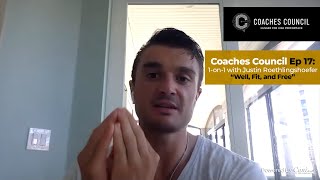
This is a YouTube podcast episode titled "Coaches Council Podcast Episode 17: Well, Fit, and Free with Justin Roethlingshoefer" published in July 2020. The episode features a conversation between host Pradeep Sanga and guest Justin Roethlingshoefer, where Justin shares his personal background, professional journey in sports performance and coaching, struggles with fulfillment, and his current work helping high achievers and everyday people improve their health, wellness, and life balance through data-driven coaching. The discussion covers mindset, fitness, lifestyle changes, and the importance of asking for help to achieve sustainable transformation.
Kind of like you were talking about your quintessential degree that you're getting when you go into school. It has sabotaged or taken away their ability to have that balance in their life. And they're seeking a way, not a way out, but a way to find that balance again. A way to get back into making their health a priority, getting back to make their relationship a priority. Getting back to make joy playing the game. This is the coaches council made up of six elite coaches dedicated to serving and ending personal struggle for high performers in business, health and relationships. As a collective, we have built and helped build six, seven and eight figure businesses, dominate in multiple industries, coached and played in professional sports leagues and developed some of the strongest and most intimate relationships, both professional and personal. This isn't your average podcast. It's for the hungry, the dedicated, the doers, for those that have a dream and truly want that dream to become reality. People who want to take action, leave their ego at the door and own every level of their life. If that's you, then step into the coach's counsel as we rewrite the truths to living that high performance life.
Hey, welcome back to the coaches council. I'm super excited. This is Pradeep Sanga here and I get to be the host today because we are interviewing Justin. So I'm not going to butcher your last name but I'm super excited because I get to hear your story, man, and your background, your expertise. I kind of know it, but I'm excited for the audience to hear this as well. So Justin, welcome to the show.
Thank you, my man. It's interesting hearing it from the other side.
Yeah, I get to play the games here on this one.
That's right, that's right.
For those of you who don't know much about Justin's story, Justin, can you share your background, what you're about because you got some really cool stuff in your background. That's what really impressed me and that's why I decided to join the coaches council was really because of you. So why don't you share a little bit about yourself?
Yeah, absolutely. So grew up not far from where, from the orchard that you grew up on in Edmonton, Alberta and spent the first 17 years of my life there. And to be honest, that's really what built the foundation of who I am, my values, my drive and that blue collar mentality because that's the type of family I grew up in. Hard working, nine to five, mom and dad that were very faith driven people, grew up in a Christian home that to be Honest. If you were to take a picture of the quintessential suburbial home, that's what I grew up in. Two loving parents, a sister with a cross on the door when you walk in, go to church on Sundays, have family dinners every night together. And you worked hard. That's just what we knew. And obviously, being in Canada, grew up playing hockey, and that was in all sports. And the. All sports pretty much took up two months of the year where hockey took up 10, because there was ice around us for 10 months of the year, and that was outdoors, not in the rinks.
So I can ask you then, who was your favorite hockey player growing up?
I mean, growing up, it had. Matt Sundin was a big, big fan. I was a big fan of his. Yeah. Captain of Toronto Maple Leafs for a long time. So it was big Joe Sakic fan, Steve Yzerman. But I mean, definitely Matt Sandin was. Those were top three.
Okay, I gotta ask the obvious. What about, like, Messier?
What about Messier and Gretzky? I mean, I know they were. I don't wanna date myself here, but they had kind of come through and gone in Edmonton by the time I had kinda really kind of grown up and done everything.
Oh, yeah, you're young and I forgot.
Yeah. So they'd kind of already done their thing and kind of moved on. But, yeah, that was kind of my time. If you're looking at an Edmonton oiler from that time, it would have been like Dougie Wade or Jason Arnett or somebody like that. Got it. So, yeah, that's definitely, definitely those guys at that time. But from there I moved out, played junior hockey and was fortunate enough to get a scholarship, went down to the States, play hockey. And at this time, obviously, you're on your own at 17, trying to figure it out, make it happen. You start to fall into the. The culture of what hockey and athletics typically is. And I was searching for myself. I knew I was at the time, I didn't know, but looking back on it, it was very apparent, very obvious. And went to college from there, had a real brief stint, a cup of coffee, if you will, playing a little bit of pro. And then really knew that my calling was in coaching and knew that I loved. I loved seeing other people succeed and seeing their dreams come true more than I enjoyed playing the game. And at that point I knew I needed to do something else instead of prolonging the inevitable and going to Europe or toiling in the Miner somewhere. But. And that was the point that I went and got my master's degree in exercise physiology, minor in psychology. Loved to see the combination of physical and mental come together to seek optimum performance. And that's really what I created everything in my being for. I sacrificed everything in my life. I didn't go home, I think for almost three and a half years just doing different internships, working under mentors, really in enthralling myself in as much as I could in the strength and conditioning and performance space. And at that point I got my first job at Miami University in Ohio as their director of sports performance for the hockey team and had a lot of success there and continued to develop my craft, kind of develop my own way of operating from the mental side and the physical side of players and marrying that together. And then I added in the recovery side and then I added in the data side and I really created this ecosystem that fostered high performance. And I was just so lucky that a lot of the guys that I had at that time went on to the NHL. I think there was about 14 of them and created what I is still operating, which is the Hockey Summit down here in Florida. It's an all inclusive camp that again, I house everybody in this incubator or this ecosystem and teach them everything from mindset to what they are more than an athlete, identifying those values, those talents, those gifts, the vision, the purpose of who they are, while also still focusing on the on ice, off ice recovery aspect, preparing them for the upcoming season. So from there I got an opportunity at the NHL level and went to Anaheim. And before that I had had again some very cool opportunities working with the Washington Capitals and working with the Columbus Blue Jackets. But first full time gig was with Anaheim and Mark Fitzgerald. And going into that I was really starting to have this feeling of when I said I was searching like I was searching like I knew that there was something more. I knew I was meant for more. I knew there was a bigger purpose and I really didn't know what it was at that point. I had just gone through a divorce. I had struggled with opiate use. I was on the outside for everybody else, the picture of success, the picture of accomplishment, and was theoretically living the dream. And at the end of the day I would come home and I was, I was a shell of a man, a shell of a human being. And I knew that I needed to, I knew that I needed to change because it wasn't something that I wanted to continue, it wasn't something that I wanted to keep going on. And in doing that I called that my ultimate failure was success without fulfillment. And Christmas of 2018. So just over a year ago, I ended up getting fired in Anaheim. And it was the biggest blessing that could have ever happened in my life. And I had been in a relationship with a girl for a boat, I don't know, at that point, about a year and a half, two years. And she really challenged the way that I thought and challenged the way that I showed up on a day to day basis. And by understanding that, it challenged me to be better. And it was really the awakening that I needed for me ultimately to step out of this pattern that I was in and the culture that I had found myself in. And. And for the next year, I just had my head down and focused on that personal development. I focused on mentors, I focused on networking outside of strength and conditioning, outside of sports performance, outside of hockey, outside of sports in general, and networking outside of that. And creating these relationships that actually meant so much more for me personally, that brought me out of this small bubble in which I had lived in theoretically my entire life. And the moment that I started to have these more meaningful male figures in my life, it immediately changed the way that I thought. It immediately changed the way that I acted. It immediately changed the person that I wanted to be. And so over the next year and a half, I really was able to reconnect with my parents. I was really able to reconnect and create this flourishing relationship with Elise. And that's what I set forth to truly learn was these different characteristics that changed the way that I was able to impact the world. And it was me stepping away from fitness, it was me stepping away from sports performance, it was me taking a step back from everything that I had put my entire being and education and experience and time into and completely leaving it alone and focusing on what needed to be done and doing very, very intensive work for about a year and a half and coming out on the other side, theoretically not even recognizing the guy that was there before. There was points of him, but it was the man that I wanted to be, the man that I sometimes felt ashamed to be in the locker room or in that space. But now I was able to be truly, unapologetically, authentically me in every situation. And now that's what I have developed within. Own it and within the company Own it. That is what we do is through health, wealth and fit, or health, fitness and wellness. We incubate this ecosystem that goes off of eight pillars, which is wellness, relationships, faith, career, finance, self, care, network and legacy, and incorporate them all together for people to find those key values and get this rhythm that back into their life so that they can start to feel that true passion that they once felt and get that level of fulfillment into their life, no matter what pillar it is and be able to move through that authentically, purposefully and on that mission.
Yeah, that's awesome, man. Because everything that you're talking about is what guys need these days. So what kind of guys do you work with? For those of the listeners out there that are wondering, like, okay, so you've coached these high elite NHL players. Who do you work with now?
Yeah, so it's everyday people. A lot of people are. The vast majority of my clients are business owners. A lot of them are digital nomads. I've got a lot of lawyers, a lot of doctors, a lot of engineers. Their networking outside of their space a priority and truly finding the joy in everyday life again. Enjoying coming home and seeing their kids and seeing their wife and being able to take the vacations that they're looking for and find the true value in life. We'd be remiss if we didn't take this time to thank our sponsors that allow us to reach you each and every week. The Coaches Council is powered by Cannibrands, a lab tested all natural pure hemp CBD company without the presence of thc. They encompass our passion for health, wellness and fitness that we have on the coaches council. Visit cannibrands.com and at checkout use the promo code coaches20 to enhance your wellness to journey.
And so what is that point in time or where do you find guys actually the catalyst for them to actually come to you? Because, you know, you and I talked about in a previous episode that guys can sometimes be challenged and asking for help. But what do they usually come to you for? Is it fitness? Is it mindset? What do you find is the common denominator?
Yeah, obviously being known in the fitness space. That's usually the entry point. And there's four reasons why people typically come to me in listening to people. One is things are not good at home. They've started to, they're nearing a divorce, they are not fulfilled when they go home. They just simply want to stay at the office or want to go hang out with the guys or whatever it might be because they do not want to step foot back in the house. Two is that they've had a health scare, they've gone to the doctor and it's hey, you know what, you need to lose 50 pounds or they have a little bit of a panic attack or they have Some major anxiety going on that manifests itself as like a mini heart attack. So that's one of the big ones that, that I get as well, two or three is if they are about to go on a vacation or they have just really started to get sick of seeing themselves with their shirts off or not being comfortable in that space. Because I talk to people all the time about this is these guys put their suits on, they walk out of the house in the morning and it's like Batman. Batman puts his batsuit on, his cape, his mask, he walks out and that guy's untouchable. That guy's an absolute rock star. He is the picturesque of confidence. He's the picturesque male figure. And that's what the suit is for this individual or the doctor's mask or whatever it is that they are in their profession. And as they walk out in this suit, they have this aura of confidence about them because they know what they're doing so well. But the moment that they have to go to the beach, the moment that they come home and are mowing the lawn and physically know they can't do it, or wearing shorts and T shirts on the weekend, it drops that self esteem, that confidence goes completely out the door and it starts to manifest itself in this insult to the ego that comes out in anger. I call them the five primitive feelings, which are pain, anger, shame, guilt and fear. And the moment that we start to feel those things or see those things, it takes us down into that negative psychosomatic loop that again starts to affect our relationships, starts to affect the networking that we're doing, starts to affect the legacy ultimately that we're leaving, starts to affect our health, our wellness. Everything starts to have this negative downward spiral until we throw that suit back on again. And. And that is why that balance becomes imbalanced so often. And I don't like to call the balance, I like to call it a rhythm. Because there's always different seasons for different things. But that rhythm begets so off kilter because where do you feel comfortable? Where do you feel safe? Where do you feel the best version of you? Well, it's when I'm in that suit, or it's when I'm. And just in that suit is just a metaphor for when you're at work, when you're doing what you do really well. So that's the third area that people really seek me out. And then the fourth one is when they have this goal of just completely restructuring their life. They know that they have. And like I said, that ultimate failure they feel that. And when they feel like they have found that ultimate failure, when they have, they have the three homes, they have the vacation home, they have the family that they've always wanted, they have all of these things, but they're still not happy, they still feel this lack of fulfillment. And we always start, like I said, we always start with those eight pillars and identifying what is that biggest sticking point. And health and fitness, health and wellness, they do play a major role in how we attack that because again, we move the body, we change the chemical makeup in the brain, and we're all of a sudden able to attack this from a completely different angle. And you look at what's so funny too is you look at the habits of these people, the highest performers who usually are very upbeat, are very positive because again, we move the body, we change the chemical makeup in the brain, and we're all of a sudden able to attack this from a completely different angle. And you look at what's so funny too is you look at the habits of these, are very confident in all of these areas, have great relationships, have happy families and are successful. Health, wellness, recovery, self care are usually major, major aspects of their life. And a lot of the people that I work with usually have that neglected. So that's definitely where people usually come from.
Yeah, that's, you know what, you just laid it out so well there. So for these gentlemen, because you're talking about, you know, a lot of these people are professionals, they are high achievers of other aspects of their business. How do they, or how do you help them balance? Because I'm assuming this is a total assumption based on my personal experience, that a lot of them feel like they don't have the time for the other aspects. So how do you help them restructure or set it up so they do.
I love that. So that is the number one question I get asked is I'm so busy, what do I do? And the first thing we do is we do a time audit. We always do a time audit because traditionally what people have thought, to lose weight, to get in a healthy fitness routine, to get in a healthy self care routine, to have quality family time, it requires five, six hours a day. And again, culturally, that is what we have set because we have just these to do lists, there's no purpose behind them. It's okay, we have to, I know we've heard this before, this is Craig's favorite saying is we have the journaling, we have the yoga, we have the meditation, we have the interpretive dance, we have The Macarena, we have the ice tubs, the cold tubs, the contrast tubs. The workout, we haven't even started the workout yet, and you're two and a half hours into your morning routine and you, you haven't even gotten anything done. Where in actuality, if we identify the purpose of what we're trying to do here, we just want to get you to move. We want you to be more mindful. And so my goal with all my clients is it's 30 minutes a day. It's seven days a week, but it's 30 minutes a day. That's it. And we build that in to start. That is where we initially go. And we've created a community where we go live four days a week so that the whole community joins and we're in a zoom call. We've got 50 plus people working out for 30 minutes. And then everything else is through an app that they become accountable to. And they've got varying options of what they're able to do every day. And I brought the data side behind it using the whoop band, where every single one of my clients wears a whoop band. I'm in tune with their data every single day, seeing how they're recovering, how they are, what their strain level is like, both physical and mental, and then how they're sleeping. And we then are able to start adjusting their habits based upon the data that's coming back to us. It's no longer a guess and test. It's no longer, well, how are you feeling today, Sam? Or how are you feeling today, Joe? No, it's quantifiable data that cannot be denied. And you are able to look at it and start correlating it to the habits that you're creating or the habits you're ignoring and how certain things are happening. And I'll give you an example. One of. We started may challenge on May 1st, and we got everybody whoop bands. And this, this was across the board. But we had one in particular client who after the initial baseline was all done, he had for his first five days recovery scores of 27 to 42%. Like he was theoretically in the red for, for all of them. And his sleep was usually around five and a half, six hours. His RPE, or his resting heart rate was elevated. For a male his age, it was about 72. And his heart rate variability, which is individual for each person, that's the sequencing of the beats between the actual beats of the heart was about 65, which again, is low for somebody his age. But, but Again, it's all individual. Well, we started to change his habits. We started to change his drinking. We started to change the way he ate. We started to change. We gave him a nighttime routine. We gave him a morning routine. He worked out. He didn't work out eight times a day. He didn't work out even eight times a week. He managed, and he went from zero. Right? He went from nothing to working out five days a week, 30 minutes a day, journaling what he ate and journaling by just taking a picture and focusing on those nighttime and morning routines. Just going to bed at the same time, waking up at the same time. Well, all of a sudden, 30 days later, he hasn't had a red recovery score. His resting heart rate has gone from that 72 down to 51. And her variability went all the way up to 87. And that's an average. And so the data allowed us to see the positive change in habits he was making otherwise. And this was verbatim from him. He goes, I don't know if I would have continued to make these changes because I was kind of feeling better. But it wasn't until the last week that I was like, oh, my God, I have amazing, boundless energy. And I'm able to continue to go. But it was the data that allowed me, you know what? I'm on the right path. I'm on the right path. And it's this positive reinforcement that all of a sudden he comes up, he goes, I have. I'm in better shape now than I was when I was 30 years old. And he's 45. And he goes, I'm enjoying life more. I'm able to do more things with my kids. We're about to go on a vacation. They're going down to Miami next week. He goes, I'm so excited. He's seen weight come off, he's seen inches come off. He looks better, he feels better, but his mind is better and everything. And now it opens up all the conversations for his relationship, for all of these things. And that's what happens on the coaching calls. But it all stems from building these more effective, these more impactful, and these lifelong changes in the lifestyle. If you can't maintain your diet as a lifestyle, it's going to fail. If you can't maintain your exercise regimen as a lifestyle, it's going to fail. If you can't maintain your business practices or your mindset practices or your relationship practices as a lifestyle, they're going to fail. And so that's what we're able to do. And that's how we really operate.
Yeah, I love that story, man, because that's such a, you could say a perfect example of just the transformation that can happen. I think we just underestimate the impact of energy because if we. You talked about boundless energy. I love that term, because energy is such a foundational component to so many things in our life. If we have that boundless energy, we can have a better relationship. We can have some more playtime with our kids. We can spend more productive time in our business, for example, and we actually think more. We clearly there's more clarity because our brain consumes energy. So that was absolutely brilliant, I think, from that standpoint. And I like how you work the data piece in there because that is important. I do see a lot of trainers, and I've had trainers in the past myself that don't really focus on the data aspect, which is so important. So I love the fact that you actually do that kind of stuff. So what happens when guys actually, you talked about, okay, they feel better, they do whatever. So what happens at that stage for them when they realize, like, is it a moment that they have more self confidence? Is it a moment that they say, wow, you know, what, do they see life a little bit differently? What is a big shift for them that you see when they realize that the changes that they've made now could just dramatically change their life?
The biggest thing I always get is, I wish I would have done this sooner. I wish I would have done it sooner because as we've often spoken about, the reason that people don't take the step sooner is because they're afraid to fail. They're afraid to look goofy. They're afraid to. They're not afraid of the hard work. They're not afraid of the structure. Because I literally hand you the pattern. I hand you everything in your present. And we teach you all of that. But just as I gave that example about the Batman costume, they've never been comfortable in this space. And so often we hear it from men. Well, I can't go to the gym until I have to get shape. I have to get in shape first before I can go to the gym. Or I have to get in shape first before I can start on a program or with a coach, where in actuality, it's the opposite. It's being able to drop that ego, drop that fear, lean into it and understand that it's a process. And I always tell everybody who starts with me is, we're going to set a goal just so that we know what the goal is. And then as soon as we set that goal, I actually grab the paper and we burn it. Because it's not about the goal. It's about the process that's going to get us there. And then what we do is we take the 10 things, the five things, the three things, the two things that need to be done consistently, the process, and that's what we focus on. And that becomes the Did I succeed or did I fail? Because failure is real. If you're going to do anything that is worthwhile, you have to know that you're going to fail. You're not gonna eat the perfect meal every day. And that's actually another thing that I say is I don't want perfection. I want better. So often in the world, we come across as there's only two things. It's either good or bad. But in actuality, there's a whole spectrum in there. There's terrible, there's a little. There's not so good. There's good, there's better, there's best, and then there's perfect. And I hate. Hate's a strong word. I dislike being in that perfect space because it's unrealistic to maintain, but being in the better range, aiming for that 80%, aiming for that 90%, and allowing yourself to live and allowing yourself to use it as a lifestyle. But to nail down those habits that are going to create change and own those, and own that you're not going to be perfect and own that it's a process and own the fact that we have data giving us feedback, we have metrics giving us feedback, we have subjective metrics giving us feedback, and we're tracking all of this and that we're going along in this whole system and that we are going to see results. That is what helps us maintain that continuation of lifelong change.
Ben, you mentioned two points, because I think they're super important points. One is that you don't have to aim for perfection. We see a lot of that on social media. You see guys with either six packs or no packs. And I can relate to that because I'm one of those guys that I have a little bit of a tire around my waist. I'm in good shape, but I've never had, like, the rippling abs. And I don't really have a massive desire because I like to have a couple of drinks on the weekend. I like my chips on the weekend. I eat healthy during the week, but I like to indulge with my kids on the weekend. And so it's part of that lifestyle. Like you said, you have to be able to continue on with that piece. And the second part is, again, coming back to the professionalism that you have. The data aspect, I think this for me is a big piece, is that's why you have a coach. Right. Because I think a lot of people have this feeling like they're overwhelmed in life anyways, how am I going to do it? That's why a coach like Justin is important to have, because you have the knowledge, you have the skills. You're basically just giving them the playbook, the execution, to say, this is what you need to do. So it's just absolutely acting it out. And that's why we talked about on a previous episode, you know, one of the biggest challenges for men is asking for help. Well, this is where you can actually get some wicked results by actually just reaching out and saying, you know what, all you're doing is asking for insight, asking for wisdom, the knowledge and the plan that you talked about. And I think it can get some massive. Well, you've already shown that you can get some massive results from that standpoint. So what's your last point to the audience right now that's listening to this? You got guys on the edge of their seats thinking, yeah, you know what? This is kind of cool. I've been listening to the coaches council podcast. Justin's, you know, one of the guys that I really like. He's talking about getting in shape. But you know what? He's worked with NHL athletes and he works with doctors or he works with this. You know, what would you say to them? What would you say to them to really get them to move? Because that's what you talked about, getting people to move. And I think that's so important.
Yeah. The biggest thing that I would say to those people is to take that first step. If anything that has been said is resonating with you, you don't need to be perfect, but what you need is you need guidance. You need to do exactly like you said. You need to be willing to ask for help. And I'll give this one final example, because my dad is. Is this example where he's always lived a fairly active lifestyle. He has always been the man to provide for our family. He's worked, he's been extremely busy. He's coming up on retirement, and he actually joined the May Challenge. He goes, yeah, you know what? I'll give this a go. And he's never been a professional athlete. He's never been somebody. He hasn't been in sports for 30 years, he really hasn't even worked out. He's an official for baseball and basketball, and that's his exercise. And the moment that he started to adopt this, just five days a week, baseball and basketball, and that's his exercise. A system that gave him data, feedback, a system that allowed him to still live and have a lot of fun and engage in everything that he wanted to do, Be able to have a couple drinks on the weekend, be able to go out for dinner with my mom and the friends that he has and that he engages with, still have that social life. But on day one, come in. And at day 30, having lost 10 pounds, having been down 11 inches across his body, having changed his resting heart rate by 36%, and by being able to then go out and do the basketball games that he was doing on May 1 versus May 30, and go, Justin, I'm in better shape now than I think I've ever been in my life. That right there is your testament. Nobody in this is a professional athlete. I was able to cut my teeth in that space. I was able to reach that level. But like I said, that's where I found my ultimate failure. And it wasn't until I started taking. I truly believe everything happens for a reason. And the reason that I was looking back on this, the reason that I needed to go to the NHL, the reason that I needed to do everything I did on a data side so that I could learn all of these things so well, so that I could then create a system that I could bring to the world and make an impact in a place that truly needed it. I love that.
Matt, that's an awesome point, because every challenge has a learning point, and you take that, and now you're helping people and you're helping guys. If you can do that for your dad, you can pretty much do that for everybody. So there you go, folks. You've listened to Justin's awesome story, and I can say that this is a guy that has total integrity. That's why this coaches council exists. This is the guy that put it together. So with that, stay hungry, stay humble, and we'll see you next time.
Thank you so much for joining us for another week of the coaches Council. If it wasn't for you viewers and listeners, we wouldn't have a platform. So again, it's all about you guys. And we want to give you a reward just for listening. We want to give you access to each one of our coaches for a little bit deeper, intimate experience. So if you go to coaches-counsel.com coaches-counsel.com subscribe and like to whatever platform you're viewing on. You're going to be entered to have that one on one experience. So be sure to go coaches-cell.com and really interact with us because we would love to interact with you. Until then, stay safe, stay hungry, stay humble, and thanks for listening.
More from Justin




The Ultimate Blueprint for Taking Ownership of Your Health | Unlock Peak Performance

From Bullied & Anorexic to Healed & Purposeful: My Transformation Story (Justin Roethlingshoefer)


Forget "One-Size-Fits-All" Health! Unlock Your Best Self with True Personalization (The OWN IT Show)

Are Blood Tests Enough? Why Cellular Testing Might Be Better | Justin Roethlingshoefer

Your Body's Language: Understanding Stress & HRV| The Power of Ownership - Chapter 3 & 4


Is "normal" really making you sick? Dive into Different with The Power of Ownership:Chapters 1 & 2