Coaches Council Podcast Episode 18: Modern Day Masculinity
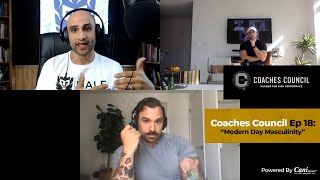
This is a YouTube video titled "Coaches Council Podcast Episode 18: Modern Day Masculinity" recorded in July 2020. It features a conversation among three coaches: John Romanello, Pradeep Sanga, and Justin Roethlingshoefer. The discussion centers on the evolving concept of masculinity, exploring masculine and feminine energies, societal expectations, toxic masculinity, and the challenges men face in modern society. The hosts share personal experiences and insights aimed at helping men navigate identity, relationships, and emotional expression in contemporary culture.
You go back to the ancient vision of a man and it was this warrior, this person that would go out and hunt for the food and kill the tigers.
It'll be two generations of men who are sort of living through the transition of having to eschew these outdated, moated ideas.
A guy's masculine energy is going to kick in and say, I'm going to kill this guy. You need that. You need that to protect your family.
This is the Coaches Council, made up of six elite coaches dedicated to serving and ending personal struggle for high performers in business, health and relationships. As a collective, we have built and helped build six, seven and eight figure businesses, dominate in multiple industries, coached and played in professional sports leagues and developed some of the strongest and most intimate relationships, both professional and personal. This isn't your average podcast. It's for the hungry, the dedicated, the doers, for those that have a dream and truly want that dream to become reality. People who want to take action leave their ego at the door and own every level of their life. If that's you, then step into the coach's counsel as we rewrite the truths to living that high performance. Welcome back to another week of the Coaches Council. We're a lean, mean, fighting machine here this week with coach Pradeep Sanga and John Romanello and myself, Justin Rothingshoeffer. So, fellas, welcome to the show.
Thank you. Always great to be here.
Mustache and all.
I love it. If you're not watching the video, you gotta see the video. You gotta go on the YouTube channel and check it out. John has wicked mustache. It is perfect timing for today's topic. When it comes to masculinity, this guy is awesome. So, John, how are you going to rock that for man?
I committed to two weeks. I committed to two weeks with the Stache. So we are coming up. June 15th will be the day. We're recording this on June 12th. And I committed to having it until June 15th. And I don't know what the morning of June 16th will bring. I haven't decided, but. But it has been. It's a very. It's a specific thing. You're like making a statement when you have a mustache. And it is. It's a weird, it's a weird thing. I definitely feel like I'm pretending to be someone else while I have this. Sometimes it's, you know, depending on how hair is. I'm like, am I a serial killer in London in the 1890s? It's like a jack ripper look. If it's a little thicker, I feel perhaps that I am in Tombstone, Arizona, ready to fight alongside the Earps and Doc Holliday. And then other times I feel perhaps I am going to go down a pipe and save Princess Peach after eating some mushrooms alongside Mario Brothers. So depending on really the mustache, it opens a portal to time travel is really what it is.
I'm calling it right now. We are gonna look back on this in December 2020, and that's gonna be John's Christmas photo. It will last through Christmas.
We'll see. I don't know. I can't. Nope, I will not. I will not predict either way because I am wholly unpredictable. I may wake up and shave it and then I may miss it dearly. We will see. But the mustache is, I think, a good segue into today's topic, which is masculinity in all of its various forms. And we're going to talk about it today in terms of what it means energetically when we talk about masculine versus feminine energy, we're going to talk about it sociologically in terms of what it means with regard to the perception of masculinity. So rather than thinking of that in energetic terms, we can replace masculinity in that context with manhood or manliness, what it means to be a man, to be perceived as such. And we're also going to talk about it personally in terms of what it means to each of us. And then finally, we want to take a look in terms of how we can guide the conversation and be sort of a window into our experience of masculinity, what we think about it philosophically, both for people who do not identify as men and who identify as women in terms of what's going on in our head. But I really want this, and I think I speak for all of us here, when we want this to be a conversation that is helpful for understanding the struggle of trying to navigate the minefield. Masculinity in terms of what it brings with regard to expectation versus action, and how there is often a battle in terms of how you want to act versus how you feel you're supposed to act as a man. The things that have been placed into your head and just embedded there by society over and over and over. And in particular, I want this to be conversation that is helpful to some of our younger listeners. I don't think we have many people who are in their teens listening to this. Most of our younger listeners are going to range from about, you know, younger is a relative term, but for us men in our, in our 30s and 40s it's going to be men 21 to maybe 26 in a really interesting post college, post adolescent time of being in the thrush of coming into their own as self sufficient men. And that is a challenging time to navigate. And I'm very happy to say, I think that most of the guys coming up now who are in that age group, they're more evolved and woke than we were at that time. And so they have a lot of the advantages of having maybe learned from our mistakes and being just growing up in a culture that is more tolerant. So they might not be struggling with some of the things we did, but this conversation is going to be far ranging. We're going to dive into all of the aspects of masculinity and shed a light on the things that we struggled with, the things we still struggle with, things that we have overcome and the way that the idea of masculinity has both propelled us forward and the ways it has held us back. And it's just the three of us here today. I once wrote a book that touched on masculinity and manhood. It was called Man 2.0 Engineering the A Real World Guide to an Unreal Life. It came out in 2013 and was a New York Times bestseller. It was primarily a fitness guide and lifestyle guide for men. And it touched on the idea of becoming the alpha version of yourself and abandoning the outdated idea of becoming the alpha male of a group which is comparative analysis rather than self growth. Justin, of course, has been in the world of athletics since he was old enough to tie on skates when your Canadian is exactly three months old. And he has performed at the highest level. And Pradeep works with men of all types, particularly high performing men. And so he guides men through the various, you know, just labyrinth of, of what it means to be a man in society, both in business and in their personal life. And we are really excited to work with you in this conversation today. So if you are a woman or identify as a woman, if you are on the side of the feminine aspect and are interested, please, please listen and take notes. If you are of an age with us, we hope that we are speaking to your fears and your hopes and your struggles. And if you are a young man who is navigating this for the first time and trying to figure out your place in the world as a man, we really hope or experiences can guide you along and we're just really happy to be here and excited. But thank you Justin for bringing us together today and thank you, Pradeep. For being here, and I'd love to just dive in.
That's great, John. It's such a hard road to navigate, I think. And I go back to what you said growing up in sport, and I've always been that sensitive kid. I've always been that person that people ask me all the time, what's your superpower? And a lot of it stems from empathy. And I have this mother who's an absolute angel, like literally just God placed her here and has the most kind hearted, empathetic, giving person you could have ever imagined. And that is where I really learned a lot of my, I guess, expression of emotion and in sport and the arena that I chose to compete in and ultimately make my life for the past 30 years and until moving out on my own and stepping away from the NHL and working with people outside of sport, I guess you could say it wasn't a friendly place. It wasn't a place that I felt that I could easily express myself. It wasn't a place that I could be open, sensitive and honest. Because you opened yourself for a massive amount of criticism, judgment, bullying, if you will, and ultimately hurt, because it's a business and it's a place that it really doesn't fall there. I think if you're talking about masculinity and you often hear the word, like courage and bravery and all these things, and you go back to the ancient vision of a man, and it was this warrior, this person that would go out and hunt for the food and kill the tigers. And if you. If you were the Spartan days, if you didn't come back on your shield or a winner, don't come back at all. And it's. That's kind of what has still been portrayed to a lot of people, even through sport. And so it took a lot of learning for me to really become comfortable with myself, to own who I was and be okay portraying that empathy and that high level of emotion in all levels of my life, in relationships, in business, and ultimately in sport as well. So it's been so freeing to be able to step into that place and be able to drop the judgment that was there. And I'm curious, Pradeep, as to how many you work with solely men, how many men suffer from that same thing, being able to really articulate themselves and identify with themselves, at what point are they able to truly be who they want to be without hitting that stereotype and that that stereotype is not the way that it has to be?
Yeah. And so I have daily conversations with guys probably three or four guys every single day in terms of their life, their business, their relationships, their financial situation. And here's. I'm going to give my personal take on it is that right now, guys are in a really tough spot as a whole, as a society, because we have this old view of what masculinity is, and then we have this new view. And I don't think either is actually really good. I think there's a blend there. And I think the key is to take a look and feel what feels natural to the person. Because I see a lot of guys that. Because we're talking about emotional, you can say mastery, emotional intelligence. And I do believe that a lot of guys, in order to be successful in life, have to be able to tap into that and have to be able to tap into that deep in order to be extremely successful, to have a successful relationship. But I'm going to come at it from a completely different angle because I see both sides is I was keeping track of this. The business that I get right now, half of it is actually coming from women these days, and half of it is women saying, I need you to work with my husband or my partner or whoever it is, because I need them to step up a little bit. Because we have guys that are confused in terms of what it means and terms of what it means to be a guy. There's guys that want to be a guy, but they can't. They're afraid to show their masculine side now because it's almost a negative to be masculine. So I think there's a balancing that needs to happen from that standpoint. If we take a look at it, masculinity is basically just behavior of males. Right? The male trait. And I think that has evolved over time. In the past, it was a hunter, it was the warrior. We just have to take a look at what that is in today's society. But I can tell you in relationships, and I'll just use myself as an example, and this is something that happens in a lot of relationships is either you get a guy that is super overbearing, that's not able to touch into his emotional feelings and that relationship is not functional, or you get a guy that's not masculine enough for the woman and that woman steps into that masculine figure, and that isn't good either. I think there's a balancing act. I think every person has a natural gauge inside themselves that they need to figure out in terms of how much masculinity. Or we can say masculine energy versus feminine energy. They need to have and how it works for them in their life. Because for me, I grew up in a household where I was actually because of the culture that I'm in, in the Indian culture, there's a little bit of a divide between the men and women because when we would have cultural gatherings, the women would sit in one room and the men would sit in another. So I got to see the difference, the very distinct difference between femininity and feminine energy versus masculine energy. And I actually grew up being more with the women. But I also had very strong figures in the household. My dad was a very masculine man, but he's also very sensitive. My grandfather was in the army for 30 plus years, but he's also very spirit. If I was to say, you know who is there a man out there that has a great balance? From that standpoint, I would have said my grandfather because he just displayed it all. But he's no longer around. But when it comes to masculinity, here's my viewpoint. I think we're in a very, I'm going to say very crucial stage for men because I'm seeing this where a lot of men aren't stepping up into their roles like we're seeing this with the riots right now. A lot of the stuff that's happening is because we have key people, key males in leadership roles that are not stepping up. And I'm not going to say that they are masculine because a masculine male doesn't have that same level of fear, doesn't have that same level of abuse, for example, and plain disregard for people. That's not what the masculine energy is about. The masculine energy is a very protecting energy. It's a very solid energy for people. I think we're lacking that in so many different levels from a leadership standpoint. From that side.
We'D be remiss if we didn't take this time to thank our sponsors that allow us to reach you each and every week. The Coaches Council is powered by Cannibrands, a lab tested, all natural, pure hemp CBD company without the presence of thc. They encompass our passion for health, wellness and fitness that we have on the coaches council. Visit cannibrands.com and at checkout use the promo code coaches20 to enhance your wellness journey.
So I think it's helpful at this point. I'm sorry to cut you off. I think it's helpful for our listeners to kind of understand that Pradeep is blending together both, both conversations and. But I want to help establish for everyone else when we are talking about Masculinity, that word has become really loaded. And so culturally, masculinity tends to encompass the behaviors and the expectations that are associated with men. And we can call that like manhood or manliness when we are talking about energetics. Masculine energy is considered to be proactive, whereas feminine energy is considered to be more reactive or in particular, receptive. And masculine energy can manifest itself and exhibit itself in going out and the doing of things. The hunting, the gathering, the war. And so because they are proactive, because they're act. They're just actually events that you have to go and do. They can't. They don't just happen to you. You have to be proactive about them. They are masculine. Now, that doesn't mean that that war, in and of itself is. Is the domain of men, but that's how these behaviors become associated over time. Whereas when we begin to look at how these. These things play out culturally over time, the. The proactivity of masculine energy gets associated with manhood and manliness. And so work and providing becomes the domain of men. And then you.
You.
That trickles down a few generations and you've got gender roles, whereas. And maintaining a household becomes the domain of women. Whereas if you look at it like cooking is not actually a feminine activity. It requires you to do something, to apply heat to food and cook it. You're feeding your family. That's actually a masculine activity because it is forceful, it's forward as opposed to receptive. And I think certainly when we look at gender roles and these ridiculous ideas of things that men should do versus women should do, cooking, of course, is not a feminine. Like, why, how could you be a person and not know how to feed yourself? That's an. That's a ridiculous notion. Keeping a clean household is not the domain of women. That should be like, just take care of yourself. You're a fucking adult. And so I just want to make the distinction that when we talk about things culturally, it's helpful to use the word manliness because of all these culturally embedded ideas of what it is to be a man and display these characteristics as opposed to masculine or masculine energy, which is just proactive versus receptive energy. And every culture in the world, like more modern Western culture, understood those differences to the extent they gave them different names. The Chinese called them yin and yang. The Indians, there's Kapha and Dosha, I believe. I apologize if I'm getting that wrong. But every culture just had names for the differentiation of energy that was forward versus receptive. And we call that masculine. And Feminine. So we don't have different words for that. And because we don't have different words for that, it gets confusing when we talk about cultural masculinity, which is the idea of being strong, of not showing emotion, and all of these things that have gotten connotatively attached to the idea of manliness. And so culturally, masculinity is all the things that are associated, that are expectations, cultural expectations of how men should behave and conduct themselves and all the things they shouldn't do as well. There's that level of restrictions or expectation. And to Pradeep's point, what you were saying earlier is we are in this interesting time where we have all of these culturally embedded ideas of how men should behave and are allowed to behave, which are now coming into contact with and really contrasting with more modern expectations and limitations of how people can interact with one another. And we see this with the idea of men being very, very proactive to go out and apply interest in or to find a mate. And how now there is this, you know, I think. I think silly idea that everything you do is going to run up against the new social contract, where it is not necessarily. It's certainly not okay to just randomly comment on a person's body or their physique or their face or whatever else. And so this idea that men are in a confus time is accurate because we have a gen. It'll be two generations of men who are sort of living through the transition of having to eschew these outdated moded ideas of masculinity and expectation and requirements and are now having to relearn the things that your grandfather embodied. Empathy, just. Just emotional consciousness, being able to show weakness and that not being or being able to show vulnerability without it being interpreted as weakness. And this is happening in men our age who are culturally more aware. I believe that it's happening at a younger age for the people a generation below us. But to Justin's point, there are subsets of culture where men gather in large groups and the traumas of their forebears, their fathers and grandfathers, and all the cultural aspects just get distilled and really continue to flourish in that environment, which can become toxic. And the idea that being a hockey player, if you aren't allowed to be upset with yourself when you lose, or you're allowed to be upset with yourself and you're not allowed to be sad about it, you're only allowed to be angry because if you're sad, that means you're weak and you get called a pussy. And all these other things, that is a toxic environment where you are, you are spending 30 years among people who, without meaning to, are contributing to emotional repression. And the only thing you're allowed to feel as a man is anger. And so that's cultural masculinity and manliness and that's the stuff that, that's where the transition is. But masculine energy, which is to show up, it is to. Is to go out, to be active and do things that's eternal, that'll always exist within people. And what Pradeep was mentioning is, is the shadow side of that energy, which is very dark. And it is bullying. It is active, but it is bullying instead of protecting, it is taking instead of providing. And that's the aspect of the leadership that we are now seeing that is being protested within the context of this social uprising we are experiencing.
Yeah, I think really good points there. And just to take it deeper. Yeah, just that understanding of the masculine and feminine energy, I think that's important because every human being has both energies. Right. We as, like you said, you know, the universe, there's polar opposite energies. And every human being has masculine and feminine to go a little bit deeper. The masculine energy is very solid, it's very peaceful, it's very still, it's goal driven and so it's very focused, whereas a feminine energy is very flowing, it's very creative. It's about connection. So as a human being, I laugh with the guys that I work with because if we were just strictly masculine, we would be eating our children. And that's not something we typically do. And it's because we have that feminine side. It's because we have that loving side that we're able to connect with other beings. If we were strictly focused in the masculine state or the masculine energy, we would be out there just strictly trying to achieve, achieve, achieve. That's what basically the masculine energy is. Again, just take this deeper because there is a balance between every human being. For a heterosexual man, it's different than a homosexual man. Same thing for females, but it also depends on the situation that you're in in terms of the type of relationship. I'll just give you myself as an example, I'm with a very feminine woman. And so she, for example, does not do well with a guy that really steps more into his feminine energy. And I know because we had those challenges in the past. And so when we have an imbalance, typically the opposite sex or the partner will play a role in terms of trying to rebalance the energy in a relationship. So in Our relationship, for example, when I would step too much into the feminine, she would go more into the masculine. And that's where we get the imbalance. And that wasn't feeling good for her or I. I'm going to state this from this perspective as well, because I have colleagues that work in the relationship space with the younger generation. And so I'm going to tread on this very, you can say mindfully, because I think the next generation is actually very confused or even more confused than our generation because they don't know. What I'm hearing now from my colleagues is that there's a group of women, there's a large sector of women in their 20s and 30s that cannot find guys, or they do not find guy, or cannot find guys that they believe can take care of them or masculine enough to be able to deal with them, because women have a lot more strength now these days as well. And so that's something that we need to address in how we're doing things. But this whole concept of masculine and feminine energy is something very important for every human being to understand within ourselves. And every imbalance that we see comes back to that in some way, shape or form. We just got to get to what our normal, you can say, being is. I see this on a daily basis. I see guys that are reverting more into their feminine state because they're not, you can say, they're not doing well either in their finances or business, especially in today's day and age. Right now, there's a lot of worried guys out there, and that's not a bad thing because a lot of people are losing their businesses, a lot of people have lost a lot of wealth. And so they have to embrace those emotions. They have to say, okay, I'm not at the place that I want to be, but now what do I need to do? Because as now I'm going to talk about masculinity In a traditional relationship, if a woman is with a man that doesn't have that strength, that doesn't bring to the table that solid, you can say that solid, that peacefulness, that strength to say, you know what? It's okay, this is going to happen, I'm going to make it work. I'm going to do whatever it takes to get this done, that's instability for the family. And that's where the woman in a traditional relationship will get scared, that safety is not there, because the feminine energy also requires some safety from the masculine energy. And so these are important concepts to remember. One other thing that I just want to tap into, because I think this is an important conversation, is this concept of gender neutrality. And. And I don't believe in that whatsoever. I don't believe that genders are neutral. Because if you're a man, you know you're a man, you're a male. Right. If you feel like you're a male, you feel like you're a male. If you feel like you're a strong female, you feel like a strong female. That doesn't mean that there's people in between that feel like they're both right. And those people need to be accepted. But there's also this concept of science, and that's why I talk a lot of the neuroscience behind it, because there is a difference in the brain structure between, let's just say the female brain and the male brain. We operate on different hormones. Females operate on estrogen and oxytocin more than men. Men operate more on, you can say, testosterone, vasopressin, for example, mis, cortisol. We have more cortisol. We run more on cortisol as men than females do. So these are important things to remember. Is that from a biological perspective, yes, we are different. And I think, John, you had some really good points there, because I think traditional gender roles, like cooking. Yeah. My mom taught me. She said, you have two hands and a brain. Use them. If you want to cook for yourself, cook for yourself. Right. So I learned that the hard way in terms of those traditional gender roles need to be, you can say challenged. But there's also some things that are women. And, you know, in her strong feminine energy is better at, like, nurturing. Right. Like breastfeeding, for example. So women have breasts for a reason is because they're naturally more connected to that standpoint from their child at that standpoint. Not that men aren't, but there's a stronger bond there. These are just things to pay attention to in society. I think if I'm going to sum it up just from my perspective, you have to find what feels natural to you. If you're not feeling, whether it's from a female perspective or male perspective, like it's working for you, you got to do something different and try things out.
Yeah, I think that's a good point. I'm going to shy away from the gender neutrality thing for a minute and circle back to one of the things you mentioned earlier. I think that if we're looking at relationships, when you're finding and creating partnership, we often talk about compatibility. And I think to your point, one of the things that is Often overlooked is that feeling of energetic compatibility. We look at things like, do we like the same type of music? Do we both want kids, values in some way aligned? And those things are important. But once you are cohabitating with someone and they become the primary person with whom you interact on a daily basis, that energetic compatibility is tremendous. And so to give one small but very granular example of how a person, whether or not they are a man, can be in their feminine energy, just look at food at the end of the day, right? There is one person in a relationship who doesn't care what they eat, right? And when there's always that conver. This is particularly true if you're in a big city, like, oh, what do you want to eat today? The person who's like, we're gonna have Italian. That's the masculine decision. And it's a really just small example of if you are a man, you may have been you and you're growing up in this environment now, you have been firstly conditioned to. There's tons of options in the world. And so you might not immediately be able to make that decision, but you've also been told that you don't want to be overbearing, you don't want to be misogynistic, you don't want to wrest control from a woman. Because we have thankfully entered into a stage of history where I think strong men want strong women. And if there is energetic incompatibility, where for me, naturally, like, I'm. I'll eat whatever, I don't give a fuck, just, yeah, put it in front of me, it's fine. So I just fundamentally, like, don't care about that decision. And then when we talk about dinner with my partner Amanda, she also doesn't care. But the thing that is different is she wants me to. She wants me to make that decision. She wants me to be in my masculine and step up because it's one less thing she needs to think about. And it's just more helpful for her if I say, hey, this is what we're doing for dinner tonight. So in our relationship, and this has been true for quarantine, Amanda doesn't cook, really. So I do all of the cooking. And so that has created a much smoother level of interaction in our relationship because early in the day I have to decide what I'm making for dinner so that I can make sure I have all those ingredients. And I also finish my workday earlier than she does. And so at the end of the day, six or seven o', clock, when she gets off her lap, all for the day, I am putting dinner on the table. I have decided what we're eating, I have prepared it, I am in my masculine making that decision and providing the food, the meat, the kill. So the cooking of it is not at all feminine. It's actually very masculine because I am taking charge of that meal. But if we hadn't come to some consensus about how to monitor that interaction, then every single time I said, oh, I don't care, what do you want to do? And allowed her to make that decision against her own wishes over time, that would erode the energetic feeling of her getting to be in her feminine. She is in her masculine all day, working, building her business. And so at the end of the day, she wants to be in her feminine and be receptive. She doesn't want to make that meal. And so that is the energetic piece of masculine versus feminine. And so the, the difficulty that we find in young men is they have been taught to allow women to be powerful sometimes because we are not taught how to communicate about energetics. That means that they are backing off for making decisions and passing the buck to the woman so that the woman can be powerful and that can contribute to the degradation of that energetic compatibility. And so there's just areas where like even if you don't care as a man step up because the woman on the other or the person, however the partnership is set up, that person wants to be in the receptive feminine energy. And this is something that happens a lot. And we see it happen and to the great demise of the relationship. And it's played out on TV all the time. You see it with Homer Simpson and the King of Queens and Peter Griffin. These are archetypical stereotypes of a man who has simply given up and allows his wife to make all of the decisions for him. And you see it in, obviously it's hyperbole because it's comedy, but you see it play out over and over and over again. Men give up their power. They stop making decisions because they want the wife to be happy, they want the woman to be happy. Like, I don't care. And you seem to. So you obviously can just make the decision and then you'll get the thing that you want, which is what I think I'm supposed to do. But in fact, not caring about things and giving up all of that decision making authority is not being in your masculine, that's retreating, it's being in your feminine. And whether or not you are in a gay relationship or straight relationship, if you're contributing to energetic incompatibility. The degradation of that relationship will shortly follow. And so that's just one example of how masculine and feminine energies can interact with one another in a way that, that doesn't contribute to cohesion in the relationship.
So it really doesn't have anything to do with aggression or overbearing or really being this rah rah type of like grab the meat and tear it off the bone type of guy or get in the face of another guy, but rather being able to communicate, being able to be a leader, being able to step up, being able to own decisions and really create clarity for the people around you. And ultimately you said it a couple times and I said it earlier, but communicate, be able to communicate effectively of what you're actually wanting so that ultimately everybody can be in those energetic states that they need to be to enhance that compatibility for everybody else around.
Yeah, Justin, could I just, can I just add into that? Because you talked about a couple of things there, and I think it's important for people understand too that there is a part of men that is aggressive. Because we have testosterone running through our blood. We have 10 to 20 times more testosterone than women do. So we have 20 to 80 times more tendency to be aggressive than women. And I think this is the challenge because we're taught as guys that it's bad to be aggressive. It's not bad to be aggressive if it's bad to be aggressive, if you're continuing to be aggressive and you're being a Billy and it's hurting someone else. But to have feelings of aggression, to have feelings of, you know, even violence, that is normal. It is normal for men. You just have to understand that it's not appropriate to act out in every single way. For example, if someone attacks our family, guess what? A guy's masculine energy is going to kick in and say, I'm going to kill this guy. You need that. You need that to protect your family, but you don't need that to beat up someone for no reason. Right. Or to show that you're stronger than someone else. So it's okay to have those feelings, but you just have to be able to tap into them and say, is this the right time to actually use them? In a lot of cases it's not. So just because you have those feelings doesn't mean there's something wrong with you either.
Right? And that's those, all of those things are normal. And it's part of our physiological makeup as human beings who have testosterone filled bodies. But just as it is also within our makeup as. As just biological animals to shit outside. We don't do that anymore. As high. As cognitive beings, we. We have to make differentiation between when it is appropriate to leverage certain biological instincts. And that is really kind of what we talk about when we talk about toxic masculinity. Toxic masculinity is not some buzzword created by the left to talk men out of being men. It is the difference between being able to communicate and not. For example, if you push your feelings down, let's say you go to a bar and there's some other man flirting with or hitting on your partner, right? And that makes you feel some type of way. As men, we have been taught that the only thing you're allowed to feel is anger. And then you push it down. You just, you know, you don't want to say anything because you want to look cool. You don't want to, like, let it bother you. And then at some point it does bother you, the anger comes up, and what do you do? You. The thing that that culture has told you is appropriate is to start a fight with this guy. Guy. That's toxic masculinity. Real, like, authentic masculinity is for you to have a conversation with your partner and just say, like, hey, I see this guy flirting with you. It's making me feel some type of way, and I just want to make you aware. I would prefer, you know, whatever your preference, either. Some. Some guys like me. I'm like, that's super cool. Yeah, obviously, you're. You're beautiful. Just like, you know, it's cool. He's got. People are gonna hit on you if he's. If people are hitting on you when I'm there, they're gonna hit on you when I'm not there, and I'm not there all the time. Time for some men, they just want to be like, hey, out of respect for me, I would appreciate it if you didn't engage with people who were doing that. And that's. That's conversation. You allow your partner to be present and be contributing to the decision. That's masculinity. Authentic masculinity. Toxic masculinity is linked to misogyny. If. If masculinity, if masculine energy is about being able to make decisions, then toxic masculinity is the idea that you should make all the decisions, which is a very short step from misogyny and believing we shouldn't make any decisions. And then there has to be some rationale for that, which is women aren't as smart or as capable thing else. And so the toxicity of masculinity always comes from repression of emotion and then the eventual explosion. That will always happen with any type of repression. And so the way that you get over that, the way that you could live off helpful, beautiful, spiritual masculinity, is to be able to figure out what your feelings are and work through them in a productive way. You cannot react purely visceral aggression like an animal, because you are a cognitive being. You have a brain and a heart and you have to use them both. That is what it means not just to, quote, be a man, but to be a functioning human in today's society. And we have been conditioned over time to suppress that. And that's the. You suppress anything long enough, it turns septic. And that's just another word for toxic. And so I just. We can't have a podcast about masculinity without talking, talking about what toxic masculinity really is. And it's doing the thing that men do in the exact wrong way. It's, it's not communicating, it's suppression. It's, it's, it's explosion. When all of these things can be avoided, it doesn't mean not defending your family. It doesn't mean not stepping up. It means trying to be a diplomat before, you know, it's like always try the handshake before the sword. That's just what it means to be a great person, a great man.
No, you brought it back around so well, John. And it all comes back to communication. Communication can solve so many problems in life, from business to relationships to identifying what true masculinity is. And we're going to do another episode that's just solely on communication because it is so powerful and pure and important for us to reel in. So with that, guys, thank you so much for joining us again on the coaches council. Stay hungry, stay humble, and we'll see you next week. Thank you so much for joining us for another week of the coaches Council. If it wasn't for you viewers and listeners, we wouldn't have a platform. So again, it's all about you guys. And we want to give you a reward just for listening. We want to give you access to each one of our coaches for a little bit deeper, intimate experience. So if you go to coaches-counsel.com coaches-counsel.com subscribe and like to whatever platform you're viewing on, you're going to be entered to have that one on one experience. So be sure to go coaches-cell.com and really interact with us because we would love to interact with you. Until then, stay safe, stay hungry, stay humble, and thanks for listening.
More from Justin




The Ultimate Blueprint for Taking Ownership of Your Health | Unlock Peak Performance

From Bullied & Anorexic to Healed & Purposeful: My Transformation Story (Justin Roethlingshoefer)


Forget "One-Size-Fits-All" Health! Unlock Your Best Self with True Personalization (The OWN IT Show)

Are Blood Tests Enough? Why Cellular Testing Might Be Better | Justin Roethlingshoefer

Your Body's Language: Understanding Stress & HRV| The Power of Ownership - Chapter 3 & 4


Is "normal" really making you sick? Dive into Different with The Power of Ownership:Chapters 1 & 2