Coaches Council Podcast Episode 23: Modern Day Entrepreneurship
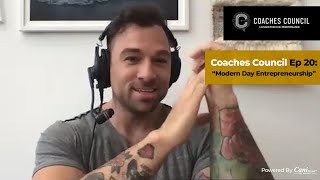
This is a YouTube video titled "Coaches Council Podcast Episode 23: Modern Day Entrepreneurship" featuring a multi-speaker discussion among coaches and entrepreneurs including John Romanello, Craig Ballard, Pradeep Sanga, and Mr. Craig Valentine. The episode, recorded in August 2020, explores the mindset, challenges, and practical advice for modern entrepreneurs, covering topics such as entrepreneurial archetypes, patience, mentorship, business scaling, and aligning business with lifestyle goals. The conversation is a structured podcast format with multiple expert participants sharing insights on entrepreneurship.
If you're gonna go out there, you're gonna build a business, make sure you know what kind of lifestyle you want first.
There is no rule that says that making over a certain level of income qualifies you to run a company, because.
There are a lot of people who have been there and done that. Achieve what you want to achieve, but will give you advice that doesn't match up morals and ethics.
This is the Coaches Council, made up of six elite coaches dedicated to serving and ending personal struggle for high performers in business, health and relationships. As a collective, we have built and helped build six, seven and eight figure businesses, dominate in multiple industries, coached and played in professional sports leagues, and developed some of the strongest and most intimate relationships, both professional and personal. This isn't your average podcast. It's for the hungry, the dedicated, the doers, for those that have a dream and truly want that dream to become reality. People who want to take action leave their ego at the door and own every level of their life. If that's you, then step into the Coach's Council as we rewrite the truths to living that high performance life. Welcome back to another week of the Coaches Council. We got John Romanello, Pradeep Sanga, and Mr. Craig Valentine. Gentlemen, great to see you as always. How we doing? Guns ablazing everywhere. I love it.
Finger guns everywhere. That's how you know that everyone is doing well.
So a lot of things have been coming out lately and especially with things opening back up and viruses coming up and schools looking at what they're doing and Harvard and Princeton obviously just announced that they are 100% online this year and still charging the 50k to get in. And it's caused a lot of entrepreneurs to really go up in arms and kind of speak to their opinions on this. I've heard a lot that the argument that, you know, what is it life or is it school, education that really makes the entrepreneur, or is it that you should just go to school for the jobs that require it? From a lawyer to a doctor to those types of things. So today I really want to touch on what does it take to be that modern day entrepreneur, given that that's what we are by nature, and what type of mindset really is there and what does it take to get over the hump? Because not everybody is set to be an entrepreneur. Not everybody has the gumption or grit to be that entrepreneur. And as John was alluding, to have the patience to really see the fruit of the labors that happen, much as it is to growing a mustache. But John, so what is it that you have seen that really makes that modern day entrepreneur successful?
Oh goodness. I don't know why you're addressing this to me. Firstly, let me just touch on.
Well, you live with a very successful modern day I do entrepreneur. So just tell us what she does, we'll give her 50 grand and then everybody can go home.
Craig is referring to my partner, Amanda Bucci, who is a tremendously successful entrepreneur. And one of the things that she talks about and has been really shifting her business towards this year is a discussion of finding what I would call your true north and what she refers to as your entrepreneurial archetype. And she splits it into four primary categories. Someone who is a teacher, a coach, a creator or an entrepreneur. And I know that that last one sounds a little redundant, so I think, I think that's actually, you know, it stems from a lot of conversations that she and I had where so many people in our industry, in the coaching industry, they, they build their business to a certain level and then they decide that they need to scale and they, they need to, they never ask themselves this question and this was a position I found myself in which was, do I want a big business or do I just want to make more money? And by not asking myself that question, I allowed myself to be led by the nose, by the allure of what it was to be in a certain category of entrepreneur that guys like the Tim Ferrisses and the Gary Vaynerchuk's who were in the pantheon of the modern entrepreneur industry. And what I think it comes down to is you don't necessarily have to do a bunch of shit that you don't like to get stuff that you probably might not want. And for so many people I see, they're really great coaches and they're good at coaching and they're good at getting people into their coaching business. And then they get to a certain point and they're like, well, to make more money, which is maybe what they want, I have to build a bigger business, which means I have to take on a team. And now these people who are coaches and good in this one on one environment find themselves as executives and they are now running a team, they're managing a team and they become CEOs. And that is not something you get good at automatically Just by being a great coach is no rule that says that making over a certain level of income qualifies you to run a company. And running a business and running a company are very, very different. And we see this all the time in Everything from the restaurant industry to the gym industry, somebody is a really good server, they're fantastic at rapport and then all of a sudden they get promoted to manager and you've removed their most potent skill which is serving customers and trusted that they will automatically be able to learn how to manage a staff. Happens in big box gyms. All you take your most successful trainer and make him the personal training manager. And we do this.
John, do you know what that's called in business lingo? Tell me the Peter Principle. Peter Principle I believe is Peter Drucker's shtick, that everybody gets promoted to their level of incompetence.
Yes. And we do this to ourselves. Within the entrepreneurial world where someone like myself, who's a great writer and a good teacher, I really like teaching people. I like really, really expounding on concepts. I don't love chasing clients around. I really don't love the babysitting that goes with coaching. And so I can only if I really want to be successful and not hate my business, I can only work with a very self motivated type of client. And so depending on the type of business you're in, if you know, you really want to decide what is my archetype, do I love coaching? Do I like working one on one? And you have to be, if you want to grow the company, you have to be willing to outsource and delegate. And I think that the vast majority of people who are good in one on one settings, the first hire that they make should not be someone to replace them, it should be someone to guide them. Someone like an online business manager and eventually a CEO. Because this old mantra of you should be working on your business instead of in your business is really only effective if you see yourself as an executive, as the head of a company and not as someone who is really good at generating income by leveraging this one skill set. And I think what the modern entrepreneur needs to do is figure out what is the thing I want to be doing every day. Where are the places that I suck at that I want to grow and will be enjoyable to me versus where am I leaning into my weaknesses and trying to buttress those up? Just because I'm trying to check the list of items that other entrepreneurs say I will need to be good at to get to the thing that I want. So find whatever the true north is. What do you want your company to look like? For me, I like making seven figures a year. I would double it if I could, but not at the expense of my happiness.
So John, how Would you go about figuring out for that modern day entrepreneur what category they fall into? Are they that coach, teacher, creator, entrepreneur, true entrepreneur? And how do you start navigating those waters to be successful ultimately?
Well, the easiest way is to take the entrepreneurial archetype quiz that Amanda has created. So it's very much like a personality quiz, like an MBTI or something like that. But it really, it just hones on like, what are the things that bring you joy and what are the things that feel like they're sucking the life out of you? I can't imagine a world in which I like doing payroll and doing the administrative work that often comes with running a business. But there are people who love doing that, who just like, they're looking to be someone's online administrator. And I see so many people getting caught in the weeds thinking they have to learn this and do this shit and not know really what's going to, how much energy it's taking from them, what the opportunity cost of that is. So at the very outset, ask yourself, what do I want for my business and what do I want from my business? Where do I want it to fit in my life? Then it's not wrong to say I want to not do that much shit and make a lot of money. That is not a wrong thing. So you'd have to focus on building an audience and building a skill set that is highly profitable. But you don't have to then manage a team and do all those things. You might have to hire someone to do that. Just be willing to say, this really feels wrong for me. And if it is an absolutely integral component in the type of business that you want, find someone you trust to do that for you. Because you cannot be happy doing things that make you unhappy. Can't be done.
So you found out you're a coach, you're a teacher, you're a creator, you're an entrepreneur. You've taken the archetype test. You figured it out, Craig, what's your next step?
Why don't we try and actually sell something here that is actually how a business works. I definitely know that you don't need to go to Harvard to become an entrepreneur. Most of the successful people that are entrepreneurs dropped out of Harvard, like Gates and Zuckerberg. What you need to do though is not worry about the little stuff like go and get your LLC or your sole proprietorship. I get a lot of people hung up on that stuff. You need to figure out what problem can you solve for people? What problem can you solve for people? That they will pay you for. Once you have solved that out or figured that out, then you can identify, alright, is this a viable business that I would run? And then you have to pass my quiz, which does not put people into four categories. It's simply a yes or no answer. And the quiz question is. Drumroll, please. The quiz question is, are you willing to continue doing this on the day that your significant other leaves you, your dog gets hit by a car and you get punched in the nuts all in the same day? Because this will happen to you and you will have to wake up and go and run the business. And if you have people working on your team, you will have to be better than them. You can never be below them in terms of performance, energy, commitment to the vision. With all of that stuff, on your worst day, are you willing to show up and do this? And I think John on his worst day is going to be willing to show up and write or at least that is going to bring him some pleasure on his worst day. For me, I am willing to show up and do my coaching on my worst day because I like it. I think that you don't have to be passionate about something in order to turn it into a business, but you need to be passionate about the process or about the idea of providing a service. Like, I have a friend, his name is Matt. Not my name, but his name is Matt Smith. And he runs a company called Royalty Exchange, which helps songwriters. Basically, they can sell their song royalties now for a lump sum. And is Matt passionate about music? Not any more than most people, but he's passionate about solving a problem. And so he runs this business which is he's not in, you know, he doesn't play any instruments, so it's just figuring out. But he figured out what problem he could solve for people. He's passionate about solving problems for people and building teams. And so once you figure and he's willing to do that even through the thick and thin and like most entrepreneurs, he's gone through thick and thin. So figure out a problem to solve, start building a solution, see if people will give you money for the solution. If they won't give you money for the solution, then you either haven't articulated how you can solve somebody's problem well enough or you have come up with something that people are not willing to pay for. John, back in 2009, when we first met, somebody came to me. This is a funny story that John will laugh at and hopefully other people will see how important it is to make sure that you're solving a problem that people care about. Somebody came to me back in 2009 when I was helping other fitness entrepreneurs start their fitness business and they sent me their website and they said, I want your opinion on this. And the website was called Get Fit while ironing, without the ironing. I swear to God, I swear to God that was what it was called. And I said, I don't think this is going to work. And they said, I knew you were going to say that anyways. So they were solving a problem that was not somebody's problem. So they're not going to make sales. But somebody can have a program like a nutrition program or a sales course or an Instagram course, and it could really solve somebody's problem. And people want that problem to be solved, but their sales copy or their sales message is not good enough. If you do all your best and you fix that sales copy and you still can't sell it, then you probably have chosen the wrong business. But those are the things that the basics that you need to do. You need to go and sell something and if people won't buy it, then there's something wrong with your idea and you need to fix it. And you don't have to go to Harvard for that.
Yeah, if I could just add to that. I think that's totally bang on there, Craig, because that's the challenge that I see a lot of entrepreneurs, especially startups, face right now. I'm seeing that quite a bit. So many people are focused on their product and service and not enough on their customers or their market. And I think if someone's going to get into business or someone wants to grow their business, it's important to know your customers inside and out. If you know your customers, I think that's where successful entrepreneurs really become successful, is because they know the market that they want to serve and they know their market very well. And so a lot of people get stuck because they're focused on, okay, I got to make sure my product is perfect, I got to make sure my service is perfect. I can't make it, you know, it's my reputation on the line. I just want to make sure everything's perfect. And they spend so much time on that and they forget that ultimately if you don't have a customer to serve, your product and service doesn't mean anything. So if we take a look at the best people out there, you know, we talk about the Elon Musk's, for example, the Steve Jobs, even the Bill Gates, what were they really good at? And Elon Musk to show this with his. The new Tesla truck that he launched is they're good at marketing. They're able to sell a concept or a principle or solve a person a problem. Conceptually, it's not necessarily having a perfect product or service. So for me that's what really stands out. If someone wants to be successful, wants to go down that business path, I think it's important to just focus on the customers. But you also talked about education versus experience and this is kind of where I'm a little bit biased, you can say, because I kind of come from both worlds. So I've been to six different business schools and I came from the corporate world, so I was in the intrapreneurship world as well. And I can see that there's benefits of both sides because I see a lot of entrepreneurs doing things just out of grit, for example, and they overlook some of the stuff that you can actually implement or learn in actual business school. So I think there's some benefits to both sides here. The other thing that I see is when an entrepreneur goes from one successful business to another, sometimes they use the same principles or strategy, thinking that that next business is going to be the same thing, the same, they're going to be able to build it the same way, they're going to be able to service the customers the same way because they've been successful in the past. That's not necessarily case. That's why I like to do a little bit of research from the academic standpoint because if you take a look at what's actually worked overall for multiple different businesses, you can actually pick and see the commonalities from that standpoint. So I think there's the best of both worlds. I'm not favoring both. I think, you know what, when you go into and you become an entrepreneur, I think you learn things hands on. I think there's a difference between being street smart and book smart. But I think there's definitely benefits but for both.
Now in doing that, the big thing that I think we're pushing here is not that, oh, you just go out and wing it. You don't go to school, you just kind of have your idea and you go for it. But I think mentorship and coaching and investing in something else other than an education, I think that's not. I think that is exactly what we're talking about is going to somebody like yourself, Pradeep or somebody like Craig in that business coaching world or you need to, you've already gone and done that mentorship program. You've been there, you've been able to build a business, but something struggling like Craig talked about, and you go and you hire John to help you write, better to get your copy out there so that people now, it catches their eye, because attention is ultimately what does it. So, Craig, when you're trying to find a mentor, when somebody's getting into this space as an entrepreneur, they see the sexy name and light type of entrepreneurial space that they can get into. What would be the best bet for them to go and try to find a mentor? What are the steps needed so that they can go and be actually happy with the investment they make and not pay some snake oil salesman that leaves them worse for wear than they were before?
There's two ways to answer this question. First of all, if you're a young person and you have not started a business yet, and I say young, I mean, like 16, 18, 20, I mean, even up to 25, and you haven't started a business yet, I would do what I did when I was 12 years old, which was. And I didn't do this on purpose. I got lucky is I went and worked for the best entrepreneur in my hometown. So I got paid $2.85 an hour, which was the going rate back in 1988 or 89. And I was digging ditches for this entrepreneur who took care of his customers like gold. He treated them like gold. He was really great. He worked hard from. He was one of the first guys. He was the first person in. He was the last person to leave. I mean, this guy was like 55, 60 years old and working me into the ground at age 12 or 13. And his father was 90 years old and still coming in and working. But I learned so much about how to treat people, how to market, how to change with the seasons, how to be kind, to team and everything. So if you've got nothing, if you have no business and no money to invest, go get paid to be an apprentice to be a great entrepreneur, particularly if it's in an industry in which you want to stay. I was working at a greenhouse, and I didn't care one iota about the stuff we were selling, so I didn't take advantage of it as much as possible, but that's what I would do.
And you were also 12?
Yeah. Well, I mean, listen, if I lived in a city where there was a great gym, I would have quickly gone and worked at a great gym to learn from a great entrepreneur there. So if you can, that's bonus. But if you can just work. Even if you have to work in a factory or restaurant, I don't care. What if it's run by a great entrepreneur, a great leader, and they're paying you to be there, man, that's the absolute best place to start if you got no scratch. Now, let's say you have a business and you're making 50, 100, 150 quarter million, half a million, a million, 5 million. This is what you do. You find somebody who's been there and done that, achieved what you want to achieve, been there, done that, achieved what you want to achieve. Step one, step two, they share your morals and ethics. Because there are a lot of people who have been there and done that, achieve what you want to achieve, but will give you advice that doesn't match up with your morals and ethics. And I'm not saying that every business entrepreneur, every successful entrepreneur is bad. I'm just saying that everybody has their own morals and ethics and make sure you align yourself with somebody. And if you have bad morals and ethics, then don't be a business owner entrepreneur at all. The third thing is find somebody who has references. Like if they're a business coach and they have people listed on their site, then you should be able to contact those people. You should be able to connect with the entrepreneur, the entrepreneur's employees, and say, I want to connect with this person. I want to ask them more questions about their testimonial on your website. You should be able to do that. You would do that for a plumber, a lawyer, a personal trainer. Why would you not do that for a business coach? And then you should try and have some connection and make sure that you have a rapport with this individual, whether it's going to one of their events, whether it's simply watching some of their content and saying, like, yeah, okay, I see there, you know, like, for me, like, I don't have a lot of female clients because I'm not the type of person who really does well with, like, I'm very blunt in my answers. I am, you know, very aggressive in my marketing. And, you know, that aligns with some women that I call alpha females. They call themselves that too. So I'm not only labeling them. Every time I say you're an alpha female, they go, yeah, I know, totally. And they like it. But I don't have a lot of female clients. I have a lot of male clients who are over 35, who have two young kids and who want to be the next Bedros Coolian. And they read man up and they saw on page 54 and 55 how Bedros described what I did for him. Those are my clients. They respond well to me, respond well to them. And so I make my content for them. And when they have a little interaction with me, they go, yeah, you're the guy for me who's going to call it as I see it. You're going to give it to me straight. You're going to hold me accountable. I want that from you heart centered business woman who's in California, who has something more along the lines of holistic wellness or spiritual stuff. I'm not your guy. I appreciate and I understand your business, but you and I are not going to do very well. I've had clients like that and some of them lasted like a year with me, but not like my five year clients. And I would say to them, you know, go, go and work with my former client Natalie Benson, or go and work with Amanda or Shanda Sumter. You know, go find the right person for you. I'm just not that person. So those four things, the been there, done that, achieve what you want to achieve, shares your morals and ethics, has references and has rapport with you. That's how you find your mentor. And that's what I did when I hired Tom Bonuto in 2006, my first coach, he checked all those boxes and helped me make more money in three days than I had in at least the three months, if not the three years before that.
That's such great advice because I think finding mentors at any point in your entrepreneurial journey is the key to continuing to be able to thrive. Continuing to be able to get new information and be able to push you forward and challenge you and like you said, hold you accountable to those changes you're wanting to make. Now in getting to a lot of steps, whether it's making your first 50k, making your first 500, making your first million, whatever it is, there's a lot of intestinal fortitude that is needed and a lot of patience.
And.
And John, what is it you're so good at? Patients? Because we've seen it in multiple areas, not just in business, but in your facial hair growth as well.
And writing books, I mean, writing books, you gotta be patient and bleed for it. So John definitely shows patience and persistence there too.
Absolutely.
And getting tattoos, I believe you have to have patience for that also.
True. Yes.
You mean you didn't just. Those are.
You don't just rub them on? No, there's like. No, no, it's like, it's like 90 hours of work at this point. What is the specific question?
So the specific question is for people who have what does it take to truly get there? Because hearing entrepreneur, it's sexy. You've got the guys like Grant Cardone, you've got the guys like Gary Vee, we've talked about these guys who have their names in lights, have built it up. It's sexy, it's fun, you're your own boss, it's what everybody wants. But what is truly needed to become successful in any space as an entrepreneur?
Well, you have to be at least reasonably good at what you do. You don't have to be the best. And the best people are often not at the top of the game. I mean, sometimes somebody comes along that is so world changingly good that they are successful simply because of talent and not because of organizing or organizing the other components that I'll get into in a moment. But you often have people who are incredibly skilled and are not, they're not at the top of the game, they're not well known because they don't have their life set up for success or they don't have the. Maybe their personality is not set up for networking in the way some people are just like really abrasive and they just don't work well. Whereas someone like me is, I'm a charmer, I'm a schmoozer and I love people, I love going to events and meeting people. And I will always walk out with a few new friends who I'm willing to run through a wall for and who are willing to do the same for me. And I think in certain areas of what I do, I'm in the, you know, the top percentage of, of my contemporaries. But there are areas where I was able to be like, yeah, I'm like, okay at this. And you can, you don't have to be the best at everything you do. You can have areas of what you do where you are just proficient enough and just to go back to, you know, something we all understand, which is fitness. I was one of the top coaches in the world in fitness, but I'm not a great movement coach. Like I, you know, I just show you what to do and if you can't do it, I'm like, what the fuck is wrong with you? And I have to like progress and regress that. You know, that's why I worked with athletes. I show it to them, they do it. They're freaks of nature. Whereas having to, you know, teach a squat pattern to someone whose body just does not biomechanically, get. It was hard for me, but I can write incredible programs. I was one of the, I believe, one of the best fat loss programmers in my day. And so there are areas where you need to look at, like what, what makes me very successful, where do I excel? And then lean into that, and then sort of understand the things you're not particularly good at. So you have to have an above average level of proficiency at what you do. You have to be willing to build a network in some way, whether you are just naturally charming and there's a charisma and a gravitational field around you, like some people say about Trump, for example, or Bill Clinton, or many of these other people. Other times, for most of us, it's the pay to play model. You have to be willing to invest as much in the network as the education. That's why I stand so strongly in favor of mastermind groups, because you're paying to learn, but you're also walking out with like 15 to 25 new associates, and that's really very valuable. So you have to be willing to build a network in some way. No man is an island, nor is any woman in terms of the patience. You have to be willing to look through all of the aphorisms and the maxims and the cliched, hackneyed expressions that get floated around on Instagram and see them on a deeper level. Like people say success happens outside your comfort zone. And that isn't untrue, but really what it is is everything happens iteratively. Success happens if this is your comfort zone, in this little circle. It doesn't happen 50ft from the edge of that circle. If you jump there immediately, you will be out of your depth, you'll be overwhelmed. And for many people, they will suffer a crushing defeat that will crush their confidence. Success happens iteratively by expanding your comfort zone, you know, by stepping, stepping out of it a foot at a time. And so the patience that develops over time is evidentiary patients, which means that you get out of your comfort zone and you're collecting evidence that nothing bad is happening. And usually something good is happening and that expands that circle. And so you have to be willing to be patient in an active way rather than to be passively patient, which is waiting for opportunities to come, waiting for good things to happen to fall in your lap. You have to be willing to make a series of small steps and over time that moves the needle and it expands your ability to tolerate risk, to tolerate, to just be resilient. And I think that most people Expect entrepreneurship to be terrifying and scary and it is conceptually, but once you're in it day to day, it's not taking a series of massive risks all the time because, because most of those would probably not work out for you. And I learned a lesson in poker, which is that you win a ton of small hands as often as you can to allow you to have the chip buffer to absorb the damage. If you lose a big hand, ideally you'll win the big hand too. The big risks will pay off. But as a poker player, semi professional poker player, for like nine years of my life, having big fluctuations to my chip stack over a single game taught me to just be patient and pick my spots and, you know, having as many little wins as possible to, to be able to gather the evidence that success is a learned habit and that you can win. That's an area that I think most people aren't aware of going in. It's, it's not just taking the big risk and swinging for the fences and home run after home run. You know, if you look at, you know, the sort of moneyball process, it's where can I get the most singles? That will move me toward that goal. So when I see a great opportunity and I want to wind up, wind up and take a big swing, I, even if I miss things, are in a good spot. And I think that having active patience, where you are making small steps and developing your ideas iteratively, that's a type of patience that most people don't recognize and need to cultivate.
We'd be remiss if we didn't take this time to thank our sponsors that allow us to reach you each and every week. The Coach Coaches Council is powered by Cannibrands, a lab tested all natural pure hemp CBD company without the presence of thc. They encompass our passion for health, wellness and fitness that we have on the coaches council. Visit cannibrands.com and at checkout, use the promo code coaches20 to enhance your wellness journey. I've never heard it described that way in terms of active patience and how everything happens iteratively and it's growing your intestinal fortitude, that takes patience and your risk tolerance, that takes patience, not the actual growth of what you're obtaining. And I think that is very eye opening. Pradeep, with a lot of the people that you've worked with, taking John's idea of active patience into consideration, what have you seen from the people you've worked with and even in building your business and stepping into the role that you've gone from working in a major corporation, wanting to be that CEO to now being the coaches of CEOs. How do you take that and apply it to somebody in a real life situation?
So are you referring to the active patients piece?
Correct?
Yeah. That's an interesting question. Because learning patience, that in itself can be a challenge. I don't think everybody has the patience. It depends on the particular individual. Some people, like, I'm extremely patient. My wife's not very patient at all. And so every person has their dynamics. So I don't think you can teach well, I shouldn't say that. I don't think everybody's prone to be in terms of learning patience. I think everybody goes at their own pace ultimately, at the end of the day, because I know there's. I have my counterparts, for example, that are entrepreneurs and they're just go, go, go, go, go.
Right.
And for them, if they. If they're working on something and they're not getting results within a short period of time, they're on to the next thing. So I think it depends as well. I think it's very dependent on the situation. I think it depends on the person and what fits your personality. Some people just don't do good work well with patients. Some people do great with patients. So for me, in terms of what I see is you have to adapt. Your business has to adapt to who you are, or you have to adapt to your business. That's basically the way it is. And that's why I like to work with guys the opposite direction. I ask them, what kind of lifestyle do they want? What kind of, you can say free time do they want? What kind of emotions do they want to have at the end of the day or on a daily basis? Because then you can determine what kind of business does it want. Because some people, you can ask them and they'll say, you know, I don't want to be patient. I want to have like a life where I'm just go, go, go. I'm constantly doing things. So the business has to reflect their end goal. And I think that's why a lot of people get into trouble when it comes to entrepreneurship, because they start building a business that doesn't fit the lifestyle that they want, and then they live their entire lives like that. And I'm actually flabbergasted in terms of how many people actually do that. They'll spend their entire life in that business, and then they can't even retire because they're so used to it. And so people end up getting screwed up. And I might have shared this on this podcast before, but one of my wife works in oncology and she works with dying patients all the time. And one of the most, you can say recent, touching stories that we've had come to our home is that this gentleman had basically cancer. And he said that this cancer was the best thing that happened to him because now he's forced to spend time with his daughter because before he was into his business for his entire life. And now that he's got cancer, he's got no choice but to slow down. So to sum it up, here's my advice. If you're going to go out there, you're going to build a business, make sure you know what kind of lifestyle you want first and then build a business that relates to that lifestyle that will actually give you that lifestyle that you want.
It's worth mentioning, I think, that sometimes you have to learn that lesson the hard way. Right. And the thing that we'd all, if we could, we would all love to caution you, the listener away from building something that you wind up hating. But you might not know until you get there. Like, you know, there's so much in the conversation in the culture of entrepreneurship where you might think that scaling is the answer, and then you get caught up on that. You know that that ad spend treadmill where you just, you think that just around the corner is the thing that's going to break it and make it profitable, and you're spending all your time doing that, or it could be profitable. And then you get to the point where, like Craig or myself, you want to change industries and you might have built some sort of golden prison for yourself where you're in an industry that is paying you so much, but you don't enjoy it anymore. And now you have to seed the ground so that you can make a pivot. And it's one of the reasons that I am constantly telling people to focus on the skills that are universally applicable and transferable to anything. And that includes things like copywriting like mentorship, and I actually mean like being a mentor to someone. The communicative skills that allow you to talk about anything with a level of authority and clarity that even if you decide to make a hard left turn and jump from, you know, fitness to, you know, Craig is doing productivity coaching. There's some shared DNA there. But both Craig and I have, over the time we've, we've been in business made some pretty radical shifts. And focusing on some universal things are helpful. But to pradeep's point, in an ideal world, you would know exactly what you wanted to do. But so much of figuring out the type of life you want is figuring out the type of life you don't. And there's a season for everything, right? Like a lifestyle business that allows you to travel the world and, you know, buy drinks for your friends and do all like that is really exciting when you're 25. And then if you've built a business that is pretty profitable and only requires you to work four hours a day, and now you're a grown man and you have like, a wife and kids, and you're just like, I got to fill my time with other stuff because the people in my life are doing other stuff. You might want to dive into something else. Or to Pradeep's point, having a business that requires your every waking move makes you feel important. And in your late 20s, it gives you purpose and meaning and validation. And then you get to the point where now you have children and you need to step back from that. But doing that reduces revenue. And there is so much fluctuation that's going to happen. These lessons are almost always learned the hard way. And so for so many of you listening, you're going to hear these words and they're going to enter your head and they're going to bang around, and at some point they'll settle somewhere. And they may not change any of the behavior, the decisions. They may not change the path or the trajectory that you're on. But three or four years from now, you'll come back and listen to this, and you're like, that was the thing I needed to do to get to the place where now realize the type of business I want is different than the one I have. And the ROI of that lesson is incalculable. So it's okay. Sometimes you only need to get there by making the wrong turn. It eventually leads you home.
And entrepreneurship is all about taking action. I know Craig always talks about that. Action relieves anxiety. And the more that we can take action, the more that we're going to learn in understanding that, then this I want to go to each one of you guys looking back on yourself as an entrepreneur coming up, and if you could have had one lesson, one lesson that you could take from entering into this ground space as a virgin entrepreneur, what would that lesson be? Pradeep, I'll start with you.
I think for me, it's following my gut. So I think that's if I take a look at from when I started to where I am now. I kind of did a whole bunch of circles as to what John was talking about, but I really came back to what my gut was telling me. So I think there's a powerful, you can say, insight in our unconscious minds in terms of our intuition and our gut. Sometimes we need to follow that because we end up in that path ultimately anyways.
Craig, what about you get the mentor earlier? So I waited three years too long to get one. And this is not self serving. It is absolutely 100% true. And if you can't get the mentor, at least ask for help earlier. Ask for help. Put your ego aside and ask for help.
For me, I think it would have been a recognition of the importance of a really, really long view and understanding. With that long view comes knowledge that whatever is hot will cool. And whatever you're doing that's working now and is generating a lot of income and a lot of revenue, at some point, either that modality or that revenue stream, whatever it is, will cool off. And you really should be building both your business expenses and your life to some extent around. Don't live at the red line as I did in my business for a while and understand that entrepreneurship is a vehicle to wealth. And it might be that it's currently the Tesla of vehicles to wealth, but that doesn't mean that the other vehicles don't have value. And if you are in an entrepreneurial business, if you have started something for yourself and you're generating a lot of revenue, take a look at how some of the wealthiest people in the world have become that wealthy. I don't know the exact statistic, but I know Berkshire Hathaway talks about this a lot. It's some outstandingly high percentage of the world's wealthiest people. If you are in an entrepreneurial business, if you have started something for yourself and you're generating a lot of revenue, take a look at how some of the wealthiest people in the world have become that wealthy. I don't know the exact statistic, but I know Berkshire Hathaway talks about this a lot. It's some outstandingly high percentage of the world's wealthiest people are invested in real estate. So if you're not like at least looking at that, you know, like you don't have to be spending all your money on your house. Investment properties are great if you have an extra 10k to blow at the club. And that is a place want everyone together. I want everyone to get to the point where they can without guilt, just go to the nightclub and just like whenever Whenever nightclubs are a thing again, whatever it is, so just like treat yourself and you know, if it, whether it's that trip to the Galapagos, whether it's blowing it at a nightclub, whether it is, it is, you know, like just balling out at Burning Man. But if you have 10k for that, like try to, try to carve out two every month and throw it in an index fund. You know, whether it's the S and P, you know, all of these things that, that more traditional paths of wealth generation incorporate, do those too. Because right now you are able to generate a lot of money for yourself. But that may change at some point. And I don't say this to be a doomsayer, I say it because it would have been awesome if one of my mentors when I was 27 was like, hey, you know what, like do yourself a favor, just start throwing money like 20k a year into the S and P fund. And I didn't do that until later. And the best time to plant a tree is 20 years ago. And the second best time is today. There are all of these more traditional ways of generating and building and developing long term wealth and assets that entrepreneurs almost by default tend to eschew simply because entrepreneurs like to think of themselves as rebels against the old guard establishment of business. And all the entrepreneurs who are currently like up in arms, like, oh, fuck Harvard, why would you pay 50 grand to get the education that you don't need? Those are often the types of people who are living at the red line because entrepreneurship is their identity and it's rebelling against this older type of wealth generation. I would say really look at the value of those things. If you can invest in the stock market again, the S and P, like over a long enough period of time that will go up, learn about wealth management and detach from the entrepreneur ego that I'll always be able to make more money. Because it is true that you will. You're developing universal skills, but you may not always be able to generate as much money and as little time. And if you're in one of those phases or businesses that is super hot right now, do that, do some of the things that are proven. Maybe don't throw 20k into crypto, hoping that it turns into 100 in the next six months. Turn, you know, put 20k in the S and P, understanding that over the next six years it'll be 28. Do stuff like that and it compounds. And that's, it's a really, really important thing. And before I, before I like, let us get off here, and you get on my soapbox about Harvard and Princeton and just simply say, everything has an roi and we live in a capitalist society, and everything is priced based on the expectation of that roi. The value. Like, keep in mind, when people are still spending 50k for Harvard, they're saving 20k on room and board, because what they're paying for is just the classes and the education, right? So Harvard actually costs close to 77 a year, all told. And they're not spending that money. They're living wherever they're living. Their room and board is not part of it. And they're spending $50,000 a year to be educated at Harvard. But what they're really paying for is, Is the Harvard degree. They're really paying for the ability to graduate and say, I went to Harvard because there is some sort of expected ROI that if you invest $200,000 in a Harvard education, you will get at least $200,000 worth of value, either in direct monetary compensation from jobs that you're able to get specifically because you went to Harvard, or for which you're not necessarily more qualified, but you're more readily considered for those, or you'll be able to earn it back faster. That's what you're paying for when you get a college degree. The ROI of Harvard is saying, you went to Harvard and Harvard at this point, it's a changing. It really, really is a changing industry, education. And the bubble will burst at some point, and this pandemic could be the thing that bursts it. But Harvard is still charging what they're charging because they are still operating with the fundamental and so far accurate belief that people who have Harvard degrees are able to earn more money in a shorter period of time. And that is what the Harvard degree says. Can you take the Harvard syllabus online and get all of that information? Yes, absolutely. But, say, walking into a job interview in a corporate setting and saying, like, I didn't actually, I went to, like, Route 10 tech, but I took the Harvard syllabus and I took all the exams, and in that system, I got a 4.0. I just don't have any way to verify that you currently, in our model, that doesn't work. That may be changing. One of the few things that you know for which I would say I 100% stand behind Trump's actions is his executive order that for government jobs, they're now considering people who have skills rather than purely degrees. That is the first step towards the changing world where the ROI of having a $200,000 degree isn't going to be as explicitly clear. And I just think that if you are surrounded by a lot of entrepreneurs or if you're in the conversation of people who are shitting on the idea of still seeking a $200,000 higher education credential, which is what a degree is, they are not looking at things in terms of roi. And that to me is pretty damning for an entrepreneur to not look at that. There is so much to be said for that degree. You're in the company, you go to Columbia, you walk the same halls as Alexander Hamilton, you go to Princeton, you walk the halls as F. Scott Fitzgerald, you go to Harvard, you walk the same halls as all of the Kennedy brothers. Like, to some people, that matters. And it doesn't just matter to those people, it matters to the people with whom they'll be networking. The Ivy League in particular. If you have, you can't understand that. It's its own thing. So if you're one of those entrepreneurs, like shitting on Harvard and Princeton for still charging what you consider to be an outrageous amount, you are not really understanding the club that having that degree gets you into and the thing that it can do for you. And so I'm saying that not to defend the outrageous price, because I think the moment capitalism, capitalistic principles entered into the pricing of higher education was the exact moment college was going to eventually get too expensive for most people. And I think it's there. And I really do think that needs to come down. So I'm saying this not to defend Harvard, but I'm saying what I want you to do is cultivate the exact skill I just demonstrated, which is the ability to see what everyone else is saying and find what they're missing. And underneath the kernel of all of it is roi. Is the investment in anything worth it. And currently high price masterminds and mentorships, that's really just. That's the educational pedigree we are creating as world builders in the entrepreneurial sector. When somebody has been mentored by Craig Ballard and now you're thinking about working with them, automatically that carries some weight, right? So it's not Craig isn't quite the same as Harvard, but there's a weightiness to the idea of that education that we are projecting onto people and taking from them. And the ROI again of going to a place like Harvard is the weight of that name plus the people you'll meet there who are also going to be in that group of people, just as the ROI of paying $25,000 for a coach or a mastermind is the education itself, the association with that mentor and the weight their name carries and being in the room with other people who are going to go on to do great things. So it's really not that different. Yes, the information is out there and you can get it for free. But a place like Harvard, a degree like Harvard or Princeton, does something that very few, few other things have done in the history of mankind. It's a type of educational aristocracy that you can buy or rent your way into. And yeah, I do believe we're at the point where like, that is going to change. But Harvard as a business model, why would they start discounting it if we haven't seen the evidence that it's no longer going to be worth the investment? That would be stupid. So if you're an entrepreneur and you're shitting on Harvard, shut the actual fuck up. Because you're asking them to change one of the most profitable business models in the world. And that is a dumb thing and proves your incompetence at what you claim to be good at.
I mean, I couldn't have summed it up better. Basically, as an entrepreneur, take a look at where you can get that roi, just like Craig had said, find out what you're selling. Is it sellable? Be around a network that has the ROI of a Harvard, of an Ivy League, that's going to pay off in the long run. Because when people say you want to go fast, go alone, you want to go far, go together, it could not be truer in the state of entrepreneurship. So with that, guys and girls, have a phenomenal week. Stay hungry, stay humble. Thank you so much for joining us for another week of the Coaches Council. If it wasn't for you viewers and listeners, we wouldn't have a platform. So again, it's all about you guys and we want to give you a reward just for listening. We want to give you access to each one of our coaches for a little bit deeper into our experience. So if you go to coaches-counsel.com coaches.com subscribe and like to whatever platform you're viewing on, you're going to be entered to have that one on one experience. So be sure to go coaches-cell.com and really interact with us because we would love to interact with you. Until then, stay safe, stay hungry, stay humble, and thanks for listening.
More from Justin




The Ultimate Blueprint for Taking Ownership of Your Health | Unlock Peak Performance

From Bullied & Anorexic to Healed & Purposeful: My Transformation Story (Justin Roethlingshoefer)


Forget "One-Size-Fits-All" Health! Unlock Your Best Self with True Personalization (The OWN IT Show)

Are Blood Tests Enough? Why Cellular Testing Might Be Better | Justin Roethlingshoefer

Your Body's Language: Understanding Stress & HRV| The Power of Ownership - Chapter 3 & 4


Is "normal" really making you sick? Dive into Different with The Power of Ownership:Chapters 1 & 2