Coaches Council Podcast Episode 30: What It Means to Set Boundaries
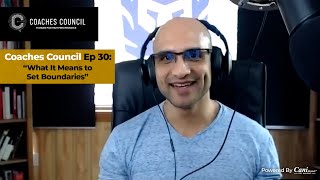
This is a YouTube video titled "Coaches Council Podcast Episode 30: What It Means to Set Boundaries" published in September 2020. The content is a podcast episode featuring a discussion among multiple coaches, including John Pradeep and Craig Ballantyne, about the importance of setting personal and professional boundaries to improve productivity, reduce anxiety, and maintain work-life balance, especially in the context of entrepreneurship and the digital nomad lifestyle. The conversation covers topics such as morning routines, discipline, communication boundaries with clients, and the challenges of working remotely. The episode also includes sponsor mentions and listener engagement invitations. There is no indication that Justin Roethlingshoefer is a participant in this conversation.
Work from the beach, work from home. And then they realized what everyone in quarantine is realizing now. That's actually fucking terrible.
I call those morning routines, the ones that John described, they're perverse forms of procrastination.
It really just comes down to what works for you at the end of the day.
This is the Coaches Council, made up of six elite coaches dedicated to serving and ending personal struggle for high performers in business, health and relationships. As a collective, we have built and helped build six, seven and eight figure businesses, dominate in multiple industries, coached and played in professional sports leagues, and developed some of the strongest and most intimate relationships, both professional and personal. This isn't your average podcast. It's for the hungry, the dedicated, the the doers, for those that have a dream and truly want that dream to become reality. People who want to take action, leave their ego at the door and own every level of their life. If that's you, then step into the coach of council as we rewrite the truths to living that high performance life. Welcome back to another week of the Coaches Council. John Pradeep and Craig, great to see you guys. Four boxes at the top of my screen that I love to see every couple, every couple weeks. Friday heading into today, I hear a lot of people talking about boundaries and you hear about people putting rules on things and wanting to restrict certain diets and putting us in little bubbles and little cages and saying that this is the only way that things can actually work or function. But then you have the other side of the coin where if you're just running rampant, you don't know what's coming, where you're just handling fires as they come up and you feel like you can't get anything done. Craig, I'm going to go to you first because you're the most disciplined man in the world, coined by many different people. And I want you to talk about boundaries and what it takes to set up boundaries, whether it's in your business, whether it's in your life, and how ultimately, by choosing the right ones for you, it can truly set you free in a multitude of different ways, certainly.
So what I struggled with when I had my anxiety attacks in 2006 was I had the ultimate freedom. I was making money on the Internet. I didn't have a boss. I didn't have to be anywhere. I could go out every night if I wanted to. I lived in a big city where it was possible. So I did. Then I would work a lot too, because I had no cutoffs, no boundaries in place. And everybody thinks that they want no boundaries. They want to be able to do whatever they want whenever they want. But that's not how the human brain really operates optimally. We do need these structures, these systems, these rituals, these routines. I had the paradox of freedom. Freedom actually put me in a prison. Whereas when I started implementing more structure into my life, structure actually set me free. The more control I had over my mornings, the more I was able to be free and present with the people that mattered at night. The more that I was able to make time for my health, the more that I was able to make time for hobbies, for reading, for all the things that I wanted to do when I was actually more structured and more disciplined. Paulo Coelho has a really great quote. Discipline and freedom are not mutually exclusive, but mutually dependent. Because without discipline, you sink into chaos. You sink into chaos. And that's what happened to me. Without discipline. So it's very easy for us to internally resist more structure. We've already got all these rules, these regulations, even more rules and regulations today than ever before. But here's the thing. When they are externally imposed upon you, your inner rebellion, inner rebellious side comes out. Nobody wants to be told what to do unless you are telling yourself what to do. That's where you flourish, is when you come up with the rules. And it's very much like the iPhone, right? The iPhone or whatever phone you have. Look at this little thing. This little thing can. I mean, it can FaceTime Tokyo. It can order food. I mean, it can do a lot of things. Like, I don't actually use it for very many things, so I don't have the laundry list, but it can do an incred amount of things because it has an operating system. And when you build an operating system within you, which has structure, rules, regulations, when it works on a system, that's where you become the ultimate version of yourself. And so discipline doesn't mean forgoing all the goodness in your life. No. Instead, you must become the most disciplined version of yourself in order to become the best version of yourself. And that doesn't mean, like, you're not going to ever have an alcoholic drink again. No, what it means is having the discipline to have the right amount of alcohol, to have the right amount of ice cream, when you have ice cream, to have the right amount, the disciplined amount, where you get the maximum pleasure from it. But the least amount of after effects, that's where you are so benefiting from the boundaries and structure in place. And that's what you are looking to do. And when you have that in place you will have more freedom.
It's a great analogy. It's like you said, the ice cream doesn't make you fat. It's the pint of ice cream continually that does.
And you become, you have so much regret and you feel sick to your stomach and you're put in a prison by having the ultimate freedom. Right? So. And they've done all these studies of like where, these weird nutritional studies where they like, they give people a soup bowl and they fill it from underneath to see how much people will eat. And if they have a bigger bowl and a bigger spoon, they'll end up eating more like humans are. You know, they have to have the structure and discipline. Like, I hate going to a buffet, I hate going to tapas restaurants because I don't know how much I'm supposed to eat in those cases. And what happens, you end up overeating and you feel gross, and you feel gross the next day. But if you have the structure of I'm going to order this meal, a moderate sized meal, and when I am done, the meal I am done eating, like that structure is just, it's freedom to me anyways. And also the freedom, you know, the structure in your morning will set you up for freedom in your life. And we need more structure in our mornings right now than ever because of all of the chaos. And I don't know, I have read some articles that children of alcoholics have desired more control in their life because there was so much chaos when they were kids. And that's. My father was an alcoholic and maybe it led me to looking like, okay, I can't control, you know, what type of person he's gonna be at 3 o' clock in the afternoon. So I need to control everything I can control. And that made me into this type of person who sought it and seeks comfort in it. But I can tell you that when I work with entrepreneurs and when I work with people and I give them more control, especially over their mornings, they feel like the weight of the world is taken off them. And yeah, it means like, yeah, they're getting up a little bit earlier than they would on a weekend, or they would if they didn't have a business or they would on vacation. But they feel so much better when they do it just by adding that little bit of structure.
With the rise in freelancers, digital nomads, entrepreneurs that have that freedom to work from anywhere and are their own bosses. What are some things, John, that I know you've been in this space for a long time that You've been able to identify that truly have made your routines and what you do better.
Get a dog. That's number one right there. You can't not have a routine. If you have a dog, you got. Dog has to go for a walk in the morning. That's what time you get up. Dog has to eat. You do that, you, like, can only work for three hours at a clip because then you got to go walk the dog again. Number one thing, have, like, this dog depends on you. So if you're not good at setting boundaries, if you're not gonna. If you can't enforce the early morning rise, or if you can't seem to, like, turn off at night, get yourself a dog. That would be the thing. But, yeah, I think that the whole irony, the vicious irony of the experience of being boundaryless in the entrepreneurial world is that is the lore, right? That's how it's marketed. Like the laptop lifestyle. I make fun of our mutual friend Jason Capital, because this motherfucker took laptop lifestyle marketing to the next level. He has pictures of himself in the pool with the laptop on the. Don't do that. Don't set the laptop near the water. That's a dumb thing to do. But it's this whole idea that, like, you can work from the beach, which is fucking stupid. You should work and then go to the beach. Don't be working at the beach. But one of the insidious things that happens, as Craig can tell you, when you can work from anywhere, you wind up working from everywhere. When you can work anytime, you wind up working all the time because there's no shut off. And you feel like that, you know, in the. In the, you know, rise and grind, hustle porn culture of entrepreneurialism, you feel like that's what you're supposed to do. And so that is reinforced. And setting some really hard or at least firm boundaries for when to stop working is just as important as setting hard ones for when to start working. And what's really crazy is that when you. When you've been in it as long as Craig and I have, you see the pendulum swing. And there's a great quote from the fitness industry, I believe it is from Mike Boyle, who said, people tend to overreact in the short term and underreact in the long term, but in the middle, there's really cool space and people who, in the early phases of the digital nomad, digital marketing space, where people could work online and make money from their laptop, they're like, you know, work from the beach Work from home. And then they realized what everyone in quarantine is realizing now. That's actually fucking terrible. It's bad for you. It's depressing. You have, you. You eliminate the need for socialization. And so then, you know, if you're in a place like New York, it's coffee shops and hotel lobbies, or if you're in other cities, these coworking spaces popped up. And if you look at the login times of, let's say, of co working spaces, what's the big one that had all the financial trouble? We work. We work. Yeah. If you look at the average login time, all of these people who became digital nomads or entrepreneurs or whatever, they're in at nine and out at five. Because not only does that make more sense to have hard start and stop times, they. It's also just better to be working when the rest of the world is working to some extent, because otherwise you got no one to play with, you got no one to hang out with, your board. It's just you and your dog, which is great for me. And so with regard to boundaries, there's really different categories that you could look into, right? There's emotional boundaries, which is a conversation far beyond here in terms of how you allow people to treat you, how you are willing to show up in a conversation or a relationship. There are financial boundaries where you have to be pretty. You have a relationship with money, and you have to set rules for that relationship. And then what we're talking about here are time boundaries. Like what, how much time are you willing to allow people to take from you? Like, if you can work all the time, then if someone wants to have lunch with you for two hours in the middle of the day, it's harder to say no. Whereas if you set rules for yourself, it's much easier to do that. Like, I can give you from this time to this time. And one of the things I think that quarantine is doing for people, I certainly think that it's, it's given people too much freedom. But the, the, the necessity of having zoom meetings every day, at least in our business, has made me like, very more regimented with my schedule than I was before. And that has been very freeing. And it's like I shut off at 6:00'. Clock. That's just done. All to say, it is important to recognize how the boundaries will help you and, and how they'll hurt you. And everyone exists differently in a space of, of regimentation. Craig is really great with having stuff really early in the day. And he has a very specific morning routine. I have a soft morning routine. Like I look at people who have this like 10 bullet point list of things they do. It's like I get up in the morning and I drink my morning concoction, my potion, whatever it is, you know, like my maca and my, you know, green juice and everything else. And then I do 15 minutes of breath work and I do movement and I do somatic shaking. And then I do my morning morning pages and then from there I go into meditate. I'm like, when do you fucking work? At what point do you actually live your life? And I have been in relations with people who had very regimented morning routines and if they missed a piece of it, it was like the whole day was ruined. And at some point structure can become confining. I do really well with a generally, you know, with a general morning routine, which is I get up at the same time every day, I take care of my dog and then I have an hour before I start working to do some shit, whatever that shit is varies day to day. Some days I'm just gonna sit and read. Some days I'm gonna like, okay, I'll go to the gym now instead of later in the day. But I have an hour where it's like some stuff is gonna get done. Even if that stuff is like staring at nothing and just like relaxing. But it's wake up at the same time, do the dog shit that needs to get done. You know, feed, walk, dog, snuggle with dog, and then an hour and then I start work at the same time every day. And that's what works for me as opposed to like that having that free hour filled with the same thing every day. But I think everybody does better when they define those boundaries for themselves. And not everyone's boundaries are going to work the same.
We'd be remiss if we didn't take this time to thank our sponsors that allow us to reach you each and every week. The coaches council is powered by cannibrands, a lab tested all natural pure hemp CBD company without the presence of thc. They encompass our passion for health, wellness and fitness that we have on the coaches council. Visit cannibrands.com and at checkout use the promo code coaches20 to enhance your wellness journey. Understanding that, like you said, everybody's different, everybody's unique, everybody's going to have something that works for them. When somebody's trying to start this, whether they're new to this digital nomad lifestyle, Whether they're new to the entrepreneurial world and they're their boss for the first time. What areas? And Craig, I'm going to come back to you for this. Is there needing to be some type of boundary? Like John said, it doesn't need to be a hard boundary, but what area? Both at the beginning of the day, at the end of the day, can they start to use it as an overall scale and figure out what truly works for them so that they can have that sense of freedom, that sense of loose structure, if you will, and something that's going to help make them more productive and alleviate any anxiety or productivity that maybe is falling under place.
There needs to be in the evening a separation of work life and home life. So there must be. You must draw lines. Okay, at what point do you draw the line at where you will check your email or your notifications for the last time? It needs to be clearly communicated and then you must be held accountable to sticking to it. Otherwise you will fill the vacuum of time with checking more. And so what I did recently was I, because I do this all the time, because it helps me so much is when I want to commit to something, I post it on social media or put it in an email to my 100,000 person list. And I say, recently said at 6pm Pacific Standard Time the phone goes into airplane mode. It just does. And if you catch me then I will pay some type of punishment. If you catch me, I'll give you 20 bucks. Catch me liking something, commenting on something on my phone at that time I made 20 bucks. Great. So now you've like okay, you burned the boats, right? Because you've said it and you committed to it. You can't go back on that. So it's really helpful to have that because again, otherwise if there's no stop time, you can work all the time. I really like the way that John said that in the morning there must be a line in the sand as well. I call those morning routines, the ones that John described. They're perverse forms of procrastination. They really are. There's an actual article on inc.com called the 14 Things Successful People do before Breakfast. And somebody timed it out and it's a four and a half hour morning routine, which is ridiculous. At some point you just have to get to work. You just have to. Otherwise I once had a client who emailed me at 7:30 in the morning, said they've been up since 5, had gotten nothing done and now we're really stressed because they had A busy day ahead of them. Well, yeah, because you didn't have that separation of work and home life and you didn't have a start time, a hard start time, hard end time. And when you put those things in and you put those things down on the calendar first, and then you make your business fit inside the box which you have built, you'll become a more productive person. Just like there's a lot of entrepreneurs who become more productive, more efficient and more successful when they have their first kid, when most people would think it would be otherwise. All of a sudden everything. You know, they're never getting anything done. No, they get more done, they get more better stuff done because they don't have all the time in the world to do it. And that's sounds very paradoxical, but it gets you in alignment with what really matters pretty darn quick. And that's what you need.
Just to piggyback on what you said about. Those are great points, by the way. And yeah, it's like when you, when you have harder boundaries because you have to take care of your kid, there's less time, so you do it. There's a great quote I love from our friend Ben Bruno, who talks about the beauties of procrastination with this. And he says if you wait to the last minute, it'll only take a minute. But really, the less time you have to do something, the more it gets done. So this refers to Parkinson's law, which is the perceived complexity of a task expands or contracts to fill the time you allot it. And when you give yourself all this freedom, you have a lot of time and a lot and less gets done. When. If you have really hard boundaries, then you get it done. But to just simply. This might be helpful for some people who are stuck inside with COVID If you can, if you can figure out a particular space in your, in your home that is just for working, do that even if it's just like at the dining table. This is my office chair. If we have four chairs at the dining table, the one I'm sitting in right now, that's the work chair. And you do not sit in that chair at any other time. You don't sit there when you eat. You sit across from that chair in a different chair. And the only thing you do in that chair is work. Now this is. It's called environment conditioned learning and environment conditioned state. And so when the world is in a lockdown, what I always tell my clients is if you go and work at a coffee shop, the coffee shop where you go to work is your office. That's all you do there. You do not take friends there for coffee. You don't take, you don't go on first dates there. That's the office coffee shop. And it's really important to just create that release of anxiety that when you are at a place that's for work, all you do is work. And when you come home, you don't work. And at the very least, find a room in your house that's just for work. Please do not work in your bed. Don't work in your bedroom. That's for sleeping, that's relaxing, that's for sex. Like, don't, don't bring your computer there. So find a space in your home. If you have a home office, great. Please work from that office. If it's a kitchen table, it's one chair. Make it specific to work and then separate it out from everything else. The more you can have that separation of physical space, the more you will separate that mental space and that will alleviate your anxiety in addition to making you just feel better and more productive.
Yeah, I think that really goes to what you guys were saying there. Just so that it really comes down to productivity. That's the one word that really comes to my mind in terms of boundaries. Trying to get stuff done, living that life that you want to live, it's really being productive with the time that you have. I see this with executives and entrepreneurs all the time. And let me use a specific example, the open door policy, which is great for some companies because it allows you to create that connection and you have people coming in, you can create that conversation. You're building relationships at the workplace, which is important, but what that also does is it kills a lot of productivity. I know a lot of CEOs, I know a lot of executives that are always saying, pradeep, I just don't have time to get stuff done. I'm always putting out fires. And when I ask them what they're doing, a lot of it is they have that open door policy where anybody can just come in and vent or they can go to them and say, hey, look, I need you to help me with this. So that's where people need to have boundaries from that standpoint. It's setting the time aside to get stuff done. Totally agree with what John talked about. In terms of, you know what, it's really demand creates the productivity. You put yourself, you put a certain amount of demand in for a certain period of time, you will get the job done. Not only will you get the job done. But next time you do it, you'll actually get it done better and you'll train yourself to do it in a shorter period of time. So that's important. The other side too, because I laugh, I just joke when you guys talk about that, because I'm one of those guys that has a longer morning routine. And I do, you know, I get up in the morning, I meditate, take my kids, I exercise. Yeah, it takes me like three hours to get that stuff done. But I absolutely love it. Like, that's what gets me driven. That's what gets me going. I'm pumped up. I love what I do. And then I'm super productive through the day. It really just comes down to what works for you at the end of the day. I used to be super, super strict because my grandfather was in the military, so he was the most disciplined man I know. My dad was an ex police officer. We grew up on an orchard. So we had to get up at a certain amount of time, like certain time of day to get the stuff done before the sun came out too hot. Otherwise we wouldn't be able to get some of the work done. So I grew up in that environment and it was great because it taught me discipline. And if you take a look at the word yoga, for example. Yoga is a discipline. It's one of the things that a lot of people have adopted here in the Western society. But the word yoga stems from the Sanskrit word for discipline. It actually means discipline. And the whole concept of discipline coming from the Indian culture is that discipline creates freedom and discipline creates happiness and joy. Because with discipline comes freedom. And from that freedom you create joy. So I think there's a lot of, you can say, benefits of having those boundaries. I actually like to call them parameters because when you have kids, you realize that there are boundaries, but those boundaries are kind of all over the place. Because you can say one thing to your kid one day and then you realize the next day it's like a different context. And then when you try to draw that same boundary, you spend three hours trying to explain. So I've changed my approach a little bit to being more parameter oriented rather than just boundaries. Because I think that helps for me and with my kids. I think there's one other thing too, a little bit.
Pradeep, what do you mean by the difference between parameters and boundaries?
Well, I think the way we take a look at it is we draw a line down the middle and say, okay, if we cross over that line, that's the boundary Right. We can't. But in between there's a zone, what I call it. It's like a zone in the middle somewhere and that you can bounce in between a little bit, right? You can't just cut like, it's just like, okay, I can't have. And I used to do this, you know, I like my drinks. So I was like, okay. So I, I used to drink quite heavily when I was younger. In my twenties now I actually poured in a shot glass. And so I came into this discipline where I'm like, okay, I'm going to have maximum three drinks, right? And I used to do it on an empty stomach, not eat two hours before so I could be like, okay, I don't have to kill myself drinking. And you know what, it's better for the calories. I had the system down, packed, but then I'm like, you know, maybe I feel like having another shot, but I can't do it. You know, that's going to screw me up. That's going to mess me up. But I'm like, pradeep, why don't I just pour half an ounce? What about half an ounce or three quarters of an ounce? So that's why I like to call it, you know, there's that zone there that parameters. So it just, it's a little bit easier to live by. Ultimately, at the end of the day, it really is what is sustainable for you. Because if your boundaries are causing you so much anxiety that you can't sustain it over the period of your life, it's going to hurt you more than it's actually going to help you. So it has to be able to energize you. You have to make sure that it's sustainable and that it doesn't cause you anxiety. Because I see a lot of people that are just so like, I'm a very disciplined person. If you talk to my wife, I'm probably a little bit too disciplined. But I try not to make it so I'm anxious and that I don't have a lot of anxiety around it. Because the moment that I know that I have a lot of anxiety, man, it just takes away the quality of life. I used to have my seven days scheduled out for work, right? Monday to Friday, everything meeting by meeting, scheduled out. And I said, screw that, okay, I'll do that Monday to Friday, Saturday and Sunday, let's just see what happens. I'm not going to schedule anything. I'm just going to play it by year. Whatever happens happens, and I'm going to take it Easy for me. That works. I love it. So I'm super strict Monday to Friday and then weekends, I'm cool. Anything goes. So I think it just depended on your lifestyle, what helps you, what gets you actually pumped up at the end of the day. And so it's very, you can say, I can't even speak today. I'll leave that to John. But it's dependent on you as an individual.
I want to go back to what you talked about there, Pradeep and that kind of open door policy and a lot of the audience being in the coaching mentorship space so often we are just wanting to help people. We are in this space because we have a giving heart, we want to make an impact, we want to see people succeed. And a lot of times we end up setting ourselves up for failure because we don't set the boundaries, we don't set the boundaries with our clients, we don't set the boundaries with our co workers or whoever it may be. And we're just like, yeah, you know what, reach out to us. We're here to support you. And all of a sudden you're getting text messages late at night, you're getting text messages on the weekend, emails and you become unindated with, sorry, unindated with these messages and the feeling of obligation to reach out and help these people. So roam. In setting up a coaching business, I'll open it up to the floor to anybody who wants to take this. But in setting up a business like that, where you are in the service industry, where you are helping people, what is a way right off the bat that you can set it up where you can still be making that impact, you can still be there for your clients, there for your co workers, there for your team, but in a way in which you don't a set yourself up for failure and balance, set the relationship up for disappointment.
Yeah, that's a, that's a really good point. So establishing communication boundaries and expectations parameters upfront is important in any coaching relationship because if you do not have an expectation then you cannot meet the expectation. Which is to say if there isn't some sort of established set of norms, then the other person might be expecting too much or too little. No, it is the case that they could expect too much less and then you over deliver and they're like stars in their eyes. You're the best. Oh my God. Thank you for answering my text right away. You're always so available. This is the best. But then other times like you can't do that and now they're like, I feel like you're blowing me off and you don't want to have that feeling. When I was doing fitness coaching way back in the way back I had, when people signed up, they were told that, like, I do client emails Tuesdays and Fridays from this time to this time, and then Thursdays I have like office hours. And so, like, if you want, if you want to get in, you know, if you want like a quick response, email me Monday night. When I check my email Tuesday morning, it'll be top of the inbox. And so now I think in general, you have to be a little bit more responsive than that just because the industry has changed. But the, the expectation was like, you're not going to hear from me every day. We're not like chatting all the time. We're going to, we're going to do Tuesdays, Fridays, and then if you have something urgent, it's Thursdays. In the business coaching space, there's, you know, like, you know, if you have a Facebook group for your mastermind or something, you have to set the expectation of how often you're in there and what you're going to deliver in there. Are you there all the time? If you see a question, will you answer it or is it like, we're going to do a Q and A once a week? If you don't do that, you are setting people up for disappointment. But mostly you're setting yourself up to over give until you get tired and then under give when it's necessary. Setting boundaries with the amount of energy you are willing to share with people is essential because you need that energy to do other things. It also is. It's actually a gift to your clients. Not being available at all times is a gift to your clients because it helps show them that whatever they think is the end of the world, if that's occurring, whatever fire they're worried about, it's probably not going to burn the world down. And if you're not available to help answer it so that they can, you know, they'll either figure out how to put it out themselves or it will teach them the very valuable lesson that most small fires will eventually burn out on their own. And the next day you email them back and you find it smoldering and they're fine and everything's okay. It just really is important because despite how much you want to serve you, you cannot be serving all the time. And then, most importantly, it'll fuck your shit up. It'll fuck your shit up hard. You won't be able to do your goddamn job. And I'm not going to apologize for the language. And I'm actually going to repeat will fuck your shit up. And I will. Now to move out of that, I will use something a little bit more erudite. And I'll quote Neil Gaiman, who is one of my favorite authors. And he gave a speech, a commencement speech at the University of the Arts in 2012. And he it was a beautiful speech. I highly recommend everyone watch the video. But he specifically said about the problems of success, that one of them is the world conspires against you to keep you from doing the thing that you do because you're successful. He goes on to say, there was a point at which I looked up and realized I had become someone who professionally replied to email and who wrote as a hobby. I started replying to fewer emails and I was relieved to find I was writing much more. End quote. What I take from that is of course service is important. Of course being there for people is important. But the thing you do that makes you special, that makes them want to have you be the person serving them and teaching them, that still requires time, effort and energy. You still have to run that machine. And even if you run a coaching business, coaching is a huge part of what you do, but it's not all of what you do. And if you stop creating content, if you stop working on yourself, if you stop developing or sharpening your theories, your methodologies, your frameworks, and you're just now someone who just does the coaching, you've stopped being an entrepreneur and you've just now you're just a coach. And there's nothing wrong with that, but you have to do the other things. And you cannot allow this feeling of needing to respond to every message or to be there for everyone at all times. You cannot allow that to, to usurp the precious energy that needs to be devoted to growing the rest of your business and also to taking care of your family and your own personal needs and your self development and your dog and your, you know, and you know, keeping up with whatever TV show you watch. That stuff's important too.
Can I just jump onto that? Because those are really good points there, John. I think there's two things that kind of, you know, I think I can extrapolate from that. One is that your clients can actually become very dependent on you and a little bit over dependent because if you're there all the time, they will reach out to you when they can, especially if there's some life changing circumstances or something. That not going right in their life and you become that crutch. That's not what you want to be as a coach. You're there to guide them, give them insight, help them find the way, but you're not there as a crutch 24, 7. So that's important. The second thing, when it comes to service, yeah, it's a service industry like Amazon screwed it up for all of us where it's one click, you can buy it in an instant, you get the package the next day, day. It screwed up all industries, but kind of in a good way. I'm a firm believer that if you're going to do that, and I have a number of clients that are like this, you charge them for that, you put it at your premium package, whatever that is, if you want to be available whenever you need to be available. I do that level of service myself, but I charge them out the yin yang, so they know that they're paying X amount to get access to me during the out of office hours. But they're gonna pay an extra premium and it's gonna be twice, at least twice as much, if not more than what someone normally would pay. So if you're going to do that, then make the money off it and actually enjoy it. Sounds kind of selfish, but it actually works. Because if someone really wants access to you, they'll pay you for it.
That's such a great point, guys, because at the end of the day, we only have so much to give. And just like we can only structure ourselves so much when we have all this freedom around us, it ends up again overwhelming us with how do we get things done and what are we doing with our days. And instead of, like John said so eloquently, when we can work anywhere, we work everywhere. When we can work anytime, we work all the time. And just as much as that, it's being able to set the boundaries up with our clients so that we can give what we truly set out to do. We can make the impact that we truly were meant to do. And so that is why setting those boundaries, being clear on the boundaries, communicating them is so important. So that at the end of the day, we have the drive to show up as our true self with the energy, with the strength, with the power to deliver the messages that we are truly meant to deliver. So, John, with that, let's wrap this puppy up.
Jocko Willink says discipline is freedom. Craig Ballantyne, among other luminaries, have said structure is freedom. And boundaries are really the incarnation of that structure. Of that discipline, setting them is the challenging part. It's easy for all of us to recognize that boundaries will help us. It's easy for everyone listening to this to immediately see how the advice we're giving you can help you and can make your life more organized and allow you to be more productive and less anxious. But the hardest step is to set them first with yourself and then with the people in your life. So if you take nothing else from this, realize that like everything else, the most important things are usually the most difficult. And the most difficult tend to be the most important. So walking away from this podcast today, what you need to do is start thinking, what boundaries am I going to set on my time, on my energy, on my emotions? And then more importantly, how can I communicate those boundaries to the people in my life, not only so they respect them, but more importantly so that I can empower them to help me support myself in maintaining those boundaries.
Thanks again so much for listening, Stay hungry, stay humble and we'll see you next week. Thank you so much for joining, joining us for another week of the coaches council. If it wasn't for you viewers and listeners, we wouldn't have a platform. So again, it's all about you guys.
And we want to give you a.
Reward just for listening. We want to give you access to each one of our coaches for a little bit deeper, intimate experience. So if you go to coaches-counsel.com coaches-counsel.com subscribe and like to whatever platform you're viewing on, you're going to be entered to have that one on one experience. So be sure to go coaches-counsel.com and really interact with us because we would love to interact with you. Until then, stay safe, stay hungry, stay humble, and thanks for listening.
More from Justin




The Ultimate Blueprint for Taking Ownership of Your Health | Unlock Peak Performance

From Bullied & Anorexic to Healed & Purposeful: My Transformation Story (Justin Roethlingshoefer)


Forget "One-Size-Fits-All" Health! Unlock Your Best Self with True Personalization (The OWN IT Show)

Are Blood Tests Enough? Why Cellular Testing Might Be Better | Justin Roethlingshoefer

Your Body's Language: Understanding Stress & HRV| The Power of Ownership - Chapter 3 & 4


Is "normal" really making you sick? Dive into Different with The Power of Ownership:Chapters 1 & 2