Coaches Council Podcast Episode 31: "The Power of Identity" with Todd Herman
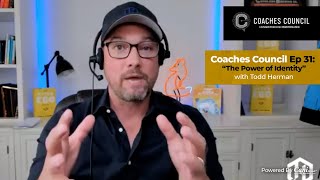
This is a YouTube video titled "Coaches Council Podcast Episode 31: 'The Power of Identity' with Todd Herman" published in September 2020. The content is a podcast episode featuring a conversation between Justin Roethlingshoefer, Todd Herman, John Vibes, and Pradeep. They discuss themes around identity, performance, alter egos, rituals, and how individuals can navigate different roles in life such as entrepreneur, parent, and athlete. The discussion also touches on overcoming limiting beliefs, the importance of environment, and strategies to avoid burnout while maintaining high achievement. Justin Roethlingshoefer is a key participant in this multi-speaker dialogue focused on personal development and high performance coaching.
It is your ability to play with your identity, not getting trapped by a narrative and story of what you think that you are. And because most of us work a good chunk of our day, we flex that muscle. That's a habit of identity. That isn't you. You need to define the fields of play for you, which help you to also know what role needs to show up on those fields.
This is the Coaches Council, made up of six elite coaches dedicated to serving and ending personal struggle for high performers in business, health and relationships. As a collective, we have built and helped build six, seven and eight figure businesses, dominate in multiple industries, coached and played in professional sports leagues, and developed some of the strongest and most intimate relationships, both professional and personal. This isn't your average podcast. It's for the hungry, the dedicated, the doers, for those that have a dream and truly want that dream to become reality. People who want to take action, leave their ego at the door and own every level of their life. If that's you, then step into the coach's counsel as we rewrite the truths to living that high performance life.
Awesome. Awesome.
I'm so excited about this because going back to that story that you told of absolutely transforming the way that somebody shows up in this world, and a lot of what we talk about here with entrepreneurs and high performers and everything from athletes to executives to, to writers, it all comes back to who you are, how you show up and how you perform. Because whether you're getting up on stage to talk to a group of people, whether you're hopping onto a podcast, whether you're going to write a New York Times bestseller, whatever it is, you have to show up as the best version of you in order to do that. And there's so many, what we call coaches and experts out there now that have really kind of confused the masses as to how you show up and what true identity is all about and how you show up and perform. And I'm curious to hear your thoughts, Todd, on what myths are out there that people have heard of or that they've launched, latched onto, and what beliefs those are and ultimately what people can do, the one thing that they can really do to create massive change in their lives immediately.
I always love the question, what's the one thing?
The one thing?
There's only one thing. But I mean, I'll say this. So when I started my sports performance business in 1997, I was 21 years old, and here I'm working with young athletes, as you were back in the day, you know, and that's who I was qualified to work with was like 12, 13, 14, 15 year old, 16 year old kids. But as I progressed through that initial five years, and by the way, when I started out, my, I charged when when someone finally said, hey, would you mind working with my son or daughter on this? I was like, yeah, sure. And again, I wasn't starting a business. This was very. It was an accidental business. I was just really good at kind of teaching people the same mental game stuff that I used in order to get football scholarships. And I was a nationally ranked badminton player, so I was a good athlete. Wasn't good enough to play pro or anything like that, but I was good enough. And then people said, well, hey, would you work with my son or daughter? And I was just like, yeah, great. And they were like, well, how much would you charge? And I said, oh, $75 for three sessions. And that was my price, 75 bucks for three sessions. And I stayed at that price until the year 2000. Three years I stayed that way. Now someone could say, oh, you had money issues or you had self worth issues or something like that. Truly, it was just that I wasn't smart enough to know any different. Like this was back when coaching wasn't a thing, right? And but what it did give me is a lot of reps because when you're that cheap, you're going to get hired. And, and so once I started, but once I started getting to what, the year 2000, and I was like, okay, well, because when I did my taxes on Quicken at the end of each year, my average rate of pay, my hourly rate was $8.56, that's how much I paid myself. Because I was doing as just like it was with you, just in home sessions with a lot of athletes. Okay, so, but I started to get to this place where, all right, I know I'm really good at this, but I know enough to know that I don't know enough. And so I sought mentorship and I reached out to this gentleman, Harvey Dorfman, literally wrote the book, the bible of the industry called Coaching the Mental Game. He's known as the Yoda of baseball. And after some convincing, I went down to North Carolina, where he lived at the time during the baseball off season, and stayed with him for 33 days. Not with him, because one of his first questions when we got on the phone was, you don't want to live with me, kid, do you? And I was like, no, no, no, no, no. I've got an aunt and uncle who live in the Area, I'll go live with them. Which was a lie. The reality was there was a Motel 6 about five miles from his place, and that's where I stayed. It was 28 bucks, 2850 a night, to be exact. And I had no money. I maxed out bank Visa card in order to go down to North Carolina to spend that time with him. But Harvey's the one who opened up the floodgates to sending me a lot more pro athletes. Now here I am working with, you know, now the better of the best. And there was this common theme that started evolving, that the people who are consistently performing at their best were using and saying things like, I've got this Persona that I use. I have this. I knew I've got this performance identity, I've got an alter ego, whatever that they step into when they go on the. On the field. And at first, I didn't clue in that it was an actual thing until the 2004 Olympics. Getting ready for Athens. I was preparing a swimmer for the U.S. olympic team. And it was just the way that she described her Persona. I was like, wait a second. All these dominoes dropped in my head of all these previous clients. And I went back through my Excel spreadsheet that I had of the performance of clients that I tracked, and the ones who use this just were consistently the best. So I was like, okay, now I need to put together a training system. So I interviewed a lot of clients, found their methods, and then just started putting this all, piecing this all together. And that's what I became known for, was the alter ego guy. So going back to your question, if there is the one thing, it is your ability to play with your identity, not getting trapped by a narrative and story of what you think that you are. Because most of what we think that we are typically gets cemented into us at about the age of eight, when the frontal lobe starts to develop. And the great thing about the concept of the alter ego is every single human being on the planet has played with it, because it's a part of the psychological sort of evolution of all of us. Because from the age of one to seven, we are caught in what's called the theta brainwave state. You know, you've got. People might have heard this before. You've got beta, which is like your waking mind. It's when you're, like, reasoning and judging and trying to, like, actively focus in on something. Maybe you got alpha brainwave state. That's when you're really focusing in more deeper levels of focus. Start to go in on the activity that you're engrossed in. And then you got theta brainwave state. The interesting thing about theta brainwave state and the reason that children between the ages of 1 and 7, it's actually 6 months to 7, are most active in that brainwave state is because that's the stage of development for all of us. We need to learn the world around us at a rapid pace. And if we had a conscious mind that was there to judge it and throw it away, it wouldn't be able to seep into our pores like sponge as easily. So theta is there for rapid learning. And creativity that sits there is also where you stop paying attention to a lot of the stuff that's around you. And anyone who's got kids like I do, you yell at them to come to the dinner table and they don't hear you, or you think that they're ignoring you, and that's your story. Reality is they're just so engrossed in play, they're so engrossed in activity that their senses shut off, including their hearing, and they don't hear you. And that's the experience that anyone that's listening experiences. When you're in zone and flow state. Zone and flow state is accessing theta. And the best way to access theta is through playful creativity. And at the end of the day, like, even though in the book I talk about how people have used an alter ego to overcome trauma and difficult things that happened in their life as a way of suspending from their own story and stepping into a new identity just to maybe get through some parts of their day, that was a part of my story. That's what I did. I had such a troubling past that I used the idea of an alter ego to sort of, you know, step outside of this idea of Todd, who was this sort of abused kid, and step into a more powerful version of me so I could still go out and achieve the things I wanted to go and achieve. And so I talk about some of that in the book. At the end of the day, the thing that's most powerful about, you know, the alter ego, when you embrace it, is you're now part of a very, very small community of people who are playing at life in a more playful way. And playfulness I found, you know, 18,000 hours doing one on one work, not counting group stuff with people, that the person who can go into whatever field of player role in their life with an attitude of playfulness unlocks that it's the final little notch on the dial of the safe to get into zone and flow like nothing else. That attitude of playfulness and that's the thing that to your point before, what are some of the mistakes that people make is, you know, the self help world and the spiritual worlds. You know, we use words as a way to create our world. That's the unique thing about human beings. Our words create our world. And a lot of the words that we use in our language without conscious awareness will trap you. We use the word like you. You know, John, you know this so well. You do so much writing on this stuff. You know, we use words like you. Authentic self is a really popular one nowadays. And it's not that I'm going to throw rock at the word itself because the word has value, but words come into cultures and they take on a life of their own and they take on new meaning. And nowadays there's a lot of words that take on a meaning which are simply there to virtue signal to someone else that you're being authentic. A. There's no such thing as an authentic self. There's no such thing because there is no one self. What's. What resides in every single human being is a storehouse of qualities and attributes and traits that are there for you to draw on. And so the most authentic version of you is the version of you that knows how to go down, reach down deep, grab those things and pull them out and you self direct them and into the role or the field of play, whichever one is right for you, like right now, you know, if you don't have, if you haven't picked up yet. I'm a challenger personality type in the way that I show up in my world. And when you take a look at some of the egos I got to work with, there are people who are on the highlight reels of ESPN every single night or they're big executives or entrepreneurs. I need to crack through some of the hard exterior of that external ego to get in behind to the soft inner core so I can help reshape someone's performance. But is that what my kids want when I leave this room? They don't want challenge or dad. They want someone who's playful, who's fun, who's kind, who's, who's. Who's playful with them and creative and all those fun things. And fun as well. And now. But if I'm not careful I can easily and just. This is a major point that whoever's listening needs to pay attention to. Just because you flex the habit muscle of showing up in a certain way in your day. And because most of us work a good chunk of our day, we flex that muscle. That's a habit of identity. That isn't you. And then people wonder why, and they say things like, I can't turn it off when I go home. That's because you haven't identified who's the person who's at home. You haven't tried to actively flex the muscle of the traits of the person that shows up there. And the person who knows how to navigate all these different roles and show up in the way that they want on them is the one who's truly started to master the six inches between the ears. And for me, the alter ego was the fastest way that I could help someone navigate that.
And so how do you help somebody truly tap into what that transition looks like? How do you teach somebody to turn it on when it's stepping home to be the dad, when it's stepping in to be the CEO, stepping in to be the entrepreneur, stepping in to be the athlete? And as we all know, you're dealing with different personalities at work. You have maybe a partner in your business, you maybe have a team that's unruly, hard to deal with. You're running meetings. How do you tap into those different identities that you spoke about? Because that's so interesting that your authentic self that you said it's not one person, it's a multitude of people that needs to show up on different categories based upon who you need to be and the traits that you need to exude at that given time.
Yeah, it's chalk lines. Chalk lines is the answer. So what do I mean by that? Every single athlete that's ever transitioned out of sport and has gotten into the world of business, any pro athlete that's retired, Justin, you. They will all say that if they had their choice between the grind that it is of being an athlete versus the grind of being a business owner, entrepreneur, whatever, we'll all choose for ease the athlete. And so why is that? There's chalk lines, there is a border. There are two goals inside on the field. You know what the game is about. That's what's key. You know what the game is. There's rules, there's defined borders. And so you know what activity and skills you need to be successful out there. You get into the world of business, and it's the chalk lines you need to create because there's so many different ways to do this. Right. And so most people don't know how to design their. Their Business. So going back to the question that you had, I just use that as an example because you need to define the fields of play for you, which help you to also know what role needs to show up on those fields. So I'll give you an example. So I just got done saying that, you know, Todd's in business more of a challenger personality type. I chose that. I'm not trapped by that. I chose that because it helps to serve me in the way that I want with my clientele. But I don't think that that's entirely me, not by any stretch of the imagination. So when I go home, you know, I've got a ritual that I have before I step through the door. And this is the thing that is missing in most people's lives, is rituals. It's actually something that's been, you know, historically lost over time. And I think probably, John, you've probably done a lot of reading around this, and, you know, especially because of our both. Both of our love for Joseph Campbell, ritual was such a huge, important part of understanding the evolutionary process of going from boy to man, from girl to woman. Right? Tribes use rituals to basically signal that there's a new life ahead of you, and you've now left this more juvenile side of you behind, and you're stepping into a new world. And rituals are very different than habits. I think you referenced and said, you know, Todd's. Todd works with high performers. I have this whole pyramid ladder that talks about performance, and there's five levels to performance. There's below average performance, which is where typically the mass of society sits. There's average performance, there's high performance, and then there's a gap. If you think of this like a pyramid, it's actually not connected from the third level to the fourth level. There's actually a space between them. If you were drawing it out. And now you're getting into elite performance and peak performance. So high performance is actually something that a lot of average people try to pursue. But, you know, like, because I work with a certain quality person, you're literally working with elite and peak performers up here. And there's a different set of rules that. Or focuses and paradigms and principles that we work on up there. One of them is rituals. Rituals is basically a routine or a habit with storytelling attached to it. Because human beings, in our brains, we are storytelling beings. And unless you can attach an emotionality to the thing that you're doing, you're losing out on the conviction and a power and a thrust to the action that you're doing that. People who are just doing the habit in the routine have no idea what it really feels like. I was doing a coaching call earlier today with one of my guys in the PGA Tour, and we were talking about this, and I was asking him, like, in that moment when you have this sense, and sense is, like, including all senses, where does it sit within you when you feel like it's taken over your entire body? And he was saying how it centers itself right at a xiphoid process, right at the center of his chest when he's like, it actually feels like there's something there. There's something there. There's a mass that's there that's driving my performance forward. And so going back to I'm going home now, I stand at the threshold of our door, and there's a ritual that I have of shedding the identity of Todd. And there's a whole conversation I have in my head of like, hey, Todd, your job is now done at work. Now we're setting that aside, and the person that's walking through this door is in dad mode now. Now, that's not me talking to myself, by the way. That's me being coached by my alter ego, which is the combination of the inspiration of Mr. Rogers and my own father. Third person narrative is extraordinarily powerful. You know, people talk about affirmations. I can do this. That's actually the weakest form of self talk proven by many, many different studies. A great study that came out of the UK mapped triathletes and marathon runners, and they had one group do first person narrative to help push them through that. You know, that eventual wall that you hit at about the 19th mile or the 20th mile. Then they had another group that did third person narrative. They said things in either you can do it or he or she can do it. And the people that talked to themselves in third person narrative had better performances, had better personal bests than the people who talked in first person. So now Mr. Rogers is talking to me, saying, now you're going into dad mode now. And when I walk on the other side of that door, I talk about in the book the importance of triggers or the importance of totems, artifacts and uniforms. And on the inside of the door, there's a little hook that I have, and it's a colored bracelet that Molly and Sophie made for me, my two oldest daughters. And I put it on, has their initials, MSc, Molly, Sophie, and Charlie. And then it also has my wife's name on it. And then it has the Words only love. And when I put that on, what I'm doing is I'm now pulling on and embodying the traits of my alter egos. And Mr. Rogers and my dad are the. Are the. Are the two that sit there for me. And that's my model for how I want to show up. Now, does that mean that I show up perfectly and flawlessly every single time? Not even close. But if I can be 20% better than if I was without that idea, boy, does that ever help. And then anytime I feel like I'm acting out of alignment for how I want to be as a father for those kids. Now I have Mr. Rogers and my dad sitting there above my shoulders, coaching me through that process. Because the root of the term alter ego comes from Cicero, and it means the other I, or trusted friend within. We all know the power of allies and mentors. I mean, that's what this is right now. You know, a group of people coming together. So we all know how important it is to have allies. But most people don't have allies and mentors between the six inches of their own ears. And that's where you live 24 7.
That's such a great example in terms of being able to truly grab it and harness it on to become different in each point of our lives. And John, how do you utilize that in your writing? Because I know you tapped into a lot of what Todd has been saying with showing up in different ways.
Sure.
So to Todd's point, the use of different narrative perspectives is very powerful. I gave a talk on storytelling and how it has been particularly effective for helping me heal. And part of it is the ability of storytelling, particularly when you tell it from a third person perspective, to foster objectivity. And when you are able to sit objectively, whether you get there through storytelling, through meditation, through talk therapy, through the use of entheogens or plant med, you are able to not dissociate, but to some degree detach from the ego. And it's very important. As Todd mentioned, the term alter ego means other I people. When they hear ego, they often associate that. And as Todd mentioned, this happens with Lena. We are a society that relies on linguistic association and reference to be able to have conversations, because the context of the word transmutes all of these other things aside direct meaning or the denotation. But the word ego doesn't. We don't. We associate it with conceit or arrogance or any of this. It really is just a Latin word for I. But so the more you can separate out from your, you know, your day to day personal identity or ego, the easier it is to give yourself advice. You know, we see this in our businesses all the time. One of the reasons we hire coaches is because somebody else telling us to do it. We're like, okay, I'll do. And we're really good at coaching the exact shit that we need other people to coach us on. And because we have all these embedded biases. So within the context of writing, being able to switch narrative perspective is good, but also narrative tone and narrative voice. As a content creator, I have to embody different roles. I look at these as archetypes to go back to Campbell and Young. And sometimes I am a teacher and the voice is a little bit more authoritative. Other times I'm an older brother or a friend at the bar, and it's friendly and more jocular. Other, it is more scholarly and erudite. And each of these tonal shifts will be suitable to getting my audience into a different headspace that is more suited to be receptive to the gravity of the content. And when I am writing about political stuff, if I want to make it funny, I can make it funny. But sometimes I go into a more scholarly or academic tone. When I am, When I have my copywriter hat on, to use Todd's parlance and the idea of a totem, then it's a different voice I am trying to how not a salesman. But how can I enter the conversation through their door to the extent that I would use the idiomatic phraseology in describing a particular problem that they are more likely to use and therefore have a higher immediacy of relatability or consanguinity, as opposed to when I'm in the teacher role, I will use metaphorical and idiomatic phrasing that feature more authentic to me. Because part of teaching them is here's a different way to look at the problem as opposed to when I'm selling them something I want to show them, I'm seeing the problem from your perspective. And each of these different archetypes, whether it is the teacher, you know, the professor, the copywriter, the friend, the, you know, the concerned older brother, sometimes, you know, the lothario. And I can write in a very, like, seductive way. And, you know, there's. And there's definitely a definitive way that I'm writing more like flirtatious text messages. All of these different voices are influenced by everything from sentence structure to word choice to how I break up the text.
But on that, with you on that, John. So, like, when I first came across your writing a decade ago. Would you say that you kind of spoke through more of a maverick outlaw type voice back then? And then my follow up question to that is, how difficult was it for you to allow yourself to speak through or write through different archetypes? And the reason I asked that question is so many people get so concerned that, yeah, but everyone knows me as this, right? And for me, I talk about in chapter three of the book, that's an example of you being trapped by the outer world, right? Like the motivations and the reasons for you doing things is because you're trying to uphold some sort of image of you that may have worked in the past, but now it doesn't serve you anymore and you have a tough time letting that go. And that just traps you. And what it does is it traps capability, it traps ability, it traps, you know, goals, dreams, hopes, things that you want to go and pursue. So I was just wondering how you navigated that then.
The map, the maverick outlaw, the just sort of, yeah, that, that was more of like the upstart, is this guy too smart to be in this industry? Kind of sort of attitude or voice. That definitely became the thing for which I was known. And it required a certain level of change because after a while, when you enter an industry as the maverick outlaw, the longer you stay there, the more the industry itself begins to reshape around you. And then now you almost become the voice of a contingent. And then the longer you stay there, you're almost like the elder statesman. And the voice was always. The tone of the voice would always change depending on the content and the presentation. Being able to shift from one to the other was not overly difficult. But I think the place, the advantage that I had is, had I been doing this 30 years ago and writing exclusively for, let's say, magazines and essays and newspapers, I think I would have gotten a little bit more locked in because there would have been more consistency of voice. Whereas as a writer in my late 20s, coming of age, and my voice maturing in the context of, of being available to write and having multiple platforms on multiple platforms and having those available to me, there was almost an immediate feeling of the need to shift based on the platform I was writing on. And email always felt a little bit more friendly, social media felt a little bit more funny, and articles always felt a little bit more academic. And so even from the time I first started being more prolific in publishing work, there was an almost automatic thing that happened where the texture of the medium itself lent itself to my Understanding of I can showcase this information differently. And so, you know, I was very lucky that I didn't get, I didn't get trapped into a certain narrative voice. But concomitant was also the fact that I was very aware that because I had developed expertise in the fitness industry and put that forward, I was very, for a long time very careful about how my, how am I going to not trap myself in this box? What can I be doing otherwise to show people something other than fitness so that when the time comes I could step out of this. So it was, I was cognizant of it the entire time.
We'd be remiss if we didn't take this time to thank our sponsors that allow us to reach you each and every week. The Kids Coaches Council is powered by Cannibrands, a lab tested all natural pure hemp CBD company without the presence of thc. They encompass our passion for health, wellness and fitness that we have on the coaches council. Visit cannibrands.com and at checkout use the promo code coaches20 to enhance your wellness journey. John, you said word there that was really interesting is you have this certain level of awareness and a lot of people don't have that level of awareness. A lot of people do something so unconsciously and would have fallen into that certain voice that you were talking about and anything else they would have found as a judgment placed on themselves trying to get out of this position that they were in or something that the external world was putting on them in trying to uphold an image, uphold a voice, if you will. How or what strategies Todd can be put in place or can somebody attack from. To be able to allow themselves the freedom, allow themselves the permission to be able to have those different. Allow themselves to kind of mold a little bit like the example that John gave so that they can continue to excel at very high levels.
Can I just. Sorry, Justin, can I just add on to that question because John mentioned something and Todd, you brought up a good fact in terms of identity because I come across a lot of guys that want to change internally. They have the motivation, they have the drive and I see this quite a bit and I'm interested to know if you see this. They have the internal motivation but there's so many external factors and environmental, you can say, factors that are influencing them to stay within that existing identity. How do you get people to deal with those situations?
This is a great question and it's really, it's, it's easier to change when you are not expected to stay the Same and with without you know, sucking up all the air in the room and but to briefly direct back to the story I told earlier, one of the most healing parts of my experience of being at a sex party was to be surrounded by other people for whom it was not weird to be a sex party and for whom being at a sex party didn't inherently make them a bad person. And so getting involved in that community allowed for that ease for re establishment of my expectations of what these things about me meant and really healed. Whereas historically having been in a, in a more not puritan but it just more you know, typical society, you know, societal construct of like monogamy is compulsory et cetera made me feel shitty about myself. So there's a, there's a great term that is very, very important that everyone should, should just sort of sit with and it's independent social construct. We all find ourselves in or independent social context. We find ourselves in independent social context when we are able to go into a new space without any, the people there having any expectations of who or what we are. The time this, usually the first time this happens to us is when we're young and we go to summer camp and you're not the kid that everybody knows at school from being from the poor family or you're not the kid who like wet his bed at a sleepover in the seventh grade. You're just Todd or you're just Pradeep or you're just Justin or you're just John. And then you get to develop this new identity based purely on how other people are reacting exclusively that they're receiving at that current moment. And then when we go away to college, we get it again. When you join a new team, you get it again. And then when you go back you have, you know, you're supposed to fit into this, back into this old mold of other people's expectations. So the, the both the explanation and the answer are the same to your question Pradeep, which is find a way to get into an independent social context. And it's the exact reason that masterminds are more effective for some people than direct one on one coaching. Because if you're having trouble identifying yourself as an entrepreneur and the people in your life are like don't quit your day job and all the things that are happening, then you are surrounded by 30 other people in a mastermind who have the same level of belief in themselves as they do in you. And it's, you're getting that positive feedback from 30 places. It's much Easier to put yourself in the head space of believing I am an entrepreneur and therefore I will be a successful entrepreneur. You cannot allow yourself to believe you'll be a successful entrepreneur until you can believe that you're an entrepreneur, period. And with all of the people sort of in your regular life fighting against that re identification, it becomes very, very challenging. And so these environments, to use your word, are, are tremendously important. And finding them in these communities is huge. It is the reason that masterminds worked well for me when I first started my business, the reason I work well for other people. And obviously it is the reason that as soon as I entered a community of people who are not judging me and who were supporting me, everything in my life changed. In the biggest area where I was holding myself back and having judgment.
You bring up a really important question because it's actually something that's overlooked, I'd say the most when it comes to performance. I said before in my whole ladder of performance that one of the other critical things beyond ritual that we focus on is environment. People ask all the time, even. Justin, going back to your question about basically how do we make change happen? First place I'll always start is going to be environment. First place, 100% change the environment of someone and something and the environment itself is going to help create the change. And a lot of that is because of association. Your identity has now changed because of association. But I'd like to ask you just a clarifying question around. Do you have a specific example of someone that you're talking about? Like you said, you work with different men. It's always, I think, more meaningful when we kind of jump off of an actual specific example of someone.
Well, I wouldn't say anybody specific, but here's what I find in working with a lot of. Of corporate executives, for example, they have to act and behave a certain way as an executive, and so their identity is built around that particular piece and they're in that environment. And sometimes they're in that environment more than they probably should be. So from that situation, how do I put it, they're also bringing that home as well. And so the other. Actually, I have another question for you as well, Todd, on top of this, because you talked about artifacts, right? Correct me if I'm wrong. Yeah, I think that's really important. One of the things that I see, and I'd love to get your take on it, is this artifact that we have of the smartphone and how we take that with us in many different areas of our identity. For example, corporate executives and they bring that home. Do you find that that keeps them in that existing identity of being that corporate executive? Or rather than going through that ritual and fully trans, you can say transitioning or transforming, they're still tied to that because they're carrying around an artifact that's keeping them in that previous identity 100%.
It's probably the most pervasive artifact that we have nowadays is that thing. And now you can put that thing into a drawer in your desk at work and walk away from it and it gets picked up tomorrow morning at 8 o'. Clock. Although in now the interesting world of work nowadays There is no 9 to 5 anymore. You know, you've got, you've, people have got access to you at all times now in some jobs, in some roles, that's the expectation. And if you want to reap the benefit of the financial that comes out the other side of it, then that's how you're gonna have to live with that and find a way to navigate that yourself. Like I've living in New York City and I've got lots of, whether it's friends or else also clients that are also there. I don't excuse, I'm not going to excuse that away. However, just because your phone gets brought home with you doesn't mean that that same identity gets brought home as well. And it just goes back to what I was saying earlier. Like, yeah, so much of their identity is wrapped up in that corporate woman or corporate man. And then they fall into the trap, like you know, most people do, of thinking that's, that's all that they are. Like entrepreneurs do this the worst. I'm an entrepreneur. So they give themselves a label and that's the only label that they ever act through. The only information that they ever consume is about entrepreneurial stuff. And hey, I'm one of the people who beats the drum. Hard of hustle. But there is a point to it. Even the late, great Clayton Christensen, one of the greatest minds to come through Harvard, he had this great study that they did on essentially toxic levels of achievement. And I've talked about toxic achievement for a long time that people just get on this hamster wheel of, okay, I've got to constantly achieve, achieve, achieve, achieve, achieve, achieve achievements. And it wears you out. And you think that that's what everyone else that's being successful is doing. And that's not the case at all. And then you only act through this achiever archetype all of the time, as opposed to finding out what more are you made of like, you know, and having that, if you can add, if you can have that attitude of curiosity towards yourself of like, what else do I have that I haven't even nurtured? Right. And, and it's actually rule number two in Jordan Peterson's book the twelve Rules, where he talks about, you want to treat yourself as if you're someone worth taking care of. I think that's one of the most fundamental rules of life. If you cannot be the one advocate for yourself, no one else is going to be. And that's why I'm sure you guys have talked about in the past some of the great benefits of plant based medicine and stuff. I'm someone who is benefited from that. I was actually in the largest study on MDMA at Bellevue Hospital in New York with the Maps Institute a few years ago to help me, you know, move through a lot of the trauma that I had gone through as a kid. And you know, and that was finally getting to the point of, you know, no one else can live my life. And I'm really curious. One of the kind, I think probably one of the innate qualities that I've always sort of nurtured. But I'm always really curious about what else, like, what else I can act through. And I think John was highlighting that really well when it comes down to his writing and his different writing styles. Like, a lot of people get trapped in like, oh, I'm only this one type of writer. Like, they show up with content online where all they do is deliver how to information. I can tell you, like, how to information is probably like number five on the ladder of most valuable information that you can put out there. You know, I believe type content is more powerful than how to information. Story is more powerful than how to information. But to your point of the corporate person, I get it. The corporate structure is a tough nut for a lot of people to crack. But I always question, I've worked a lot in the corporate space too. I've always questioned people, is that true? Is that true that that's the only way that you can act? You know, I've been around the boys clubs of brokers and investors in New York and I can tell you there's a lot of guys who succeed that don't play the same game of, you know, pulling their nose up to the line of, you know, white powder sitting on top of the, the bar top. And they succeed just as well just because they don't join the club.
When you go and take a look at these stereotypes in which you just put out There the guys in the financial industry that think they have to follow this suit in order to be successful. What is it that the others have done that have allowed them to pull away from that stereotype and still be successful?
You know, it comes down to, I think one of the. It's like the. It's the chocolate chip cookie rule or the marshmallow test. They're far better at looking into the future of where they're going and what they want, as opposed to the guys who sort of fall very easily prey to the social construct of what they see as others being successful. Typically, the ones that they see that are being successful really aren't even the really successful ones. They haven't even found the ones who are truly the. The top level achievers and they just don't have a popular model. It's, you know, always be mindful of this kind of really good metaphorical rule that if you're standing on the side of the road and you see 97 people walking to the east and three walking to the west, probably jump in line with the group that's going west rather than the ones that are going to the east, because the masses really don't have the full picture view of what they should be doing.
I want to go back to something you talked about before, which was that almost that fault of achievement where we get into this hamster wheel of wanting to be successful. I want to be successful, what are the best doing? And you usually find that right in that middle portion of people that they're on their way, they've gone to New York, they've given up the. The luxuries of life of some other places, from cheap rent to cheaper food, to being able to go out for dinner with your significant other for under 100 bucks a night, and going into this wild jungle of what New York is. And there's this pursuit of hustle, there's this pursuit of greatness. It's a city that doesn't exist in the rest of the world. And in knowing this and this level of hustle, this level of this constant. I need more, I need more, I need more. It leads to that epidemic of what we're seeing in burnout. And how are we able to still have that level of achievement, have that level of determination and grind to get to that higher level, but avoid that burnout, the fallout of the negative aspects that can happen.
I think a good way to look at this is to ask yourself what drives the achievement? Because there is in general, people in the west, but especially men in the west suffer from the universal achievement wound where we are taught to determine the entirety of our perception of our own value based on what we've done, what have we achieved, what accolades and things of that nature. And I think that there is a lot to be gained from achievement, from trying, from ambition. But there comes a point at which it is deleterious to happiness, to health, and we see this be absolutely true at the highest levels. There is a word that I really love, it's bereft, B E R E F T. And it's a hollowness that you get. And this happens with people who place too great a value on the thing at the end. It happens with entrepreneurs, you know, people like, I'll write the best selling book and then I'll be happy. And we talk about this all the time. So because Todd is here and because I so rarely get to speak about this, I will relate this back to the hero's journey. In Christopher Vogler's model of the journey, which is 12 steps instead of Campbell's 17, there is stage nine, which is the reward. And it is when the hero gets the tangible thing after which they are questing. The gold, the guns, the girls, the glory, whatever, it's Excalibur, it's the lightsaber. And it is when some part of the quest, it's the initial attempt to resolve the greater conflict and, and in the acquisition of this thing, there is a moment of achievement and then after that there is silence because it is not really the thing. The prize is not the prize. The prize is being wise enough to realize that it was never the prize and then to redirect. Because the goal of any hero's journey isn't just to get the thing. It's not the treasure, it's what you learn along the way and how that allows you to be the best version of yourself so that you can best serve the world. And your goal should be to improve and figure and learn about yourself. And because we grew up in an achievement based, hyper capitalistic society, that part gets removed. And what happens is we have these people, particularly these men who reach the top of the mountain, whatever mountain they have been taught that they need to climb, and they get there and the view is not what they thought and the feeling is momentary achievement and then utter emptiness. And this is the opportunity to redirect. Unfortunately, because people don't have mentors and coaches or people haven't done a lot of the inner work, what we do is what we've been taught to do. We move the goalposts if it wasn't one New York Times bestseller, it's got to be two. If it wasn't a seven figure launch, if it's not a $1 million launch, it's a $1.5 million launch. If it's not being a VP at the law firm, it's being a partner. And we just, if it's not, if it's not 1.3 million, 5 million a year, and we are taught to simply go for the next bigger thing. And instead when we achieve something great and we have that little voice whispering, what next? And there is that feeling of being bereft. And bereft is the feeling that occurs because you have achieved it. And now you know the thing that was driving you, this need to achieve, now it's gone. You're no longer on a quest, you've completed a quest and in being. Because if the only thing you've been taught to do is to go questing, if the only thing you know how to be is a knight errant in search of the grail, even getting the grail is nothing. Because now you don't know who you are without the struggle, without the quest. And you can't just keep adding new items to the list of things to collect because now you're in a phase of collection instead of connection. So it's your opportunity to redirect and look inside and say, like, okay, well, if this thing, if this promotion, if this apartment, if this person, if this achievement didn't give me the fulfillment that I was looking for, what will? And you have to go inside. And Ryan Holiday wrote a great piece about this where he talks about, he opens with a quote from Oscar Wilde who said, there are two great tragedies in life. The first is getting nothing that you want, and the second is getting everything. And Ryan goes on to talk about how he found out, when he found the moment he found out, I think it was Stillness is the Key was a number one New York Times bestseller. And he was mowing his lawn and he got the email and he had a momentary surgeon and then he put his phone back in his pocket and continued mowing the lawn. And it's a beautiful piece during which he talks about you have to do this inner work. You have to get to this place where the achievement does not matter as much as doing good work, as doing the thing, whatever it is that makes you happy. Another mutual friend of ours, I'm going to drop a lot of names on this Tucker Max. When I interviewed him for my fitness site way Back he, you know, quoted one of the greatest Buddhist proverbs, which is, before enlightenment, chop wood, carry water. After enlightenment, chop wood, carry water. It should be the. It needs to be. It must. If you are to be happy, if you are to be satisfied at any point in your life, it must be the same for victory, it must be the same for achievement. And in his piece, Ryan talked about how, from the outside, operationally, nothing changes. Because if you're committed to doing good work and finding ways to be fulfilled, usually you're still undertaking the same behaviors that you would be taking on the quest for the next achievement. But the reason you're doing them, the impetus behind them, is fundamentally different. And so my position is that ambition is beautiful and achievement is incredible. But. But there will come a point at which you get to a line, and it won't be a finish line, but it'll be some plateau on the mountain where you look over the horizon and you realize that you are not filled. And it is in that moment, you can either move the goalposts or you can look inside. And now you can start to do the work, because otherwise you'll be stuck at stage nine of the hero's journey, and you'll just be looking for more gold, another sword, another treasure chest, and really another dragon to fight to make you feel worthwhile. But the goal is to get to the end. It's to get. Is to return with the elixir. It's to be able to go back to the tribe with the lessons you have learned and be a better, wiser, healthier, and ideally happier person. So achievements go ahead.
Yeah, I was going to say, look with the person who's climbing the mountain. I'm not trying to change the activity of climbing the mountain, like, if that's the proverbial metaphor of achievement, but it's. But it's switching the meaning of what the mountain is. I'm not climbing the mountain so I can get to the top of it for the view or for the thing that's waiting for me. It's there. The purpose of the mountain for me is the mountain is there to help me. It's my choice. It's my way of helping to conquer some part of myself. Yes, right.
The mountain is the goal. The journey is the goal.
Yeah.
Because whatever's at the top is irrelevant, but it's to prove to yourself that you are a person who can get to the top regardless of what's there.
And again, like, I do this, I mean, I step into this world freaking for I'm Coming up on next month is my 23rd, 23 year anniversary of starting the Peak athlete. You know, there's been a lot of other businesses that are since then and, you know, different, you know, ramps that I've gone off on into to work with other types of people. But if you think of it this way, where when I'm doing speeches or when I'm doing trainings and stuff like that for people, if you think of it like if you draw a circle and then just like you've got that pizza pie slice cut out of the circle, think of that pizza pie slice as the mountain. And what you'll notice is the mountain. If the circle, if the pizza pie was on the bottom part of your circle, it looks like there's a mountain that's there. But what it's really driving towards, if the circle is actually you and it's driving towards the core part of you, the mountain is there to help conquer. So you can find out more and more so you can finally get back to that, like, you know, what are all those core capabilities that, you know, I as a human being have within me? And if the only going back to like, all this stuff we talked about and if the only sword that, you know how to say swing is the sword of, you know, professional achievement, you know, you've left a lot of other swords, you know, in the rack because there's another sword there called, you know, being a phenomenal spouse or lover or friend or, you know, parent and all these different things. So you want to, you know, the purpose of these goals that you go after is to help conquer more of yourself. And the reason that a lot of people, I feel in conversations that happen off stage when I speak or, you know, in private communications that people send me on Instagram, DMs and elsewhere, is that most people have chosen very underwhelming mountains. And so they fundamentally feel like the person that they have right now showing up in the world isn't what they're truly made of. And so I just, just think of looking at it from that point of view. And to go back to Joseph Campbell, his most popular quote that he probably has, that is a shortened version of a larger statement. Follow your bliss is the popular one. But that's not actually what he said. What he said was follow your blisters, because in your blisters you'll find your bliss. So pick up the heavy weights, do the hard stuff. Whatever it is that you fear the most, not to use a cliche, is typically the thing you need to go after and stare down and conquer the most. And the more that you can flex that muscle like you're really, really, you're a really hard person to keep down or for someone else to control, someone who's got that much self directed attention and motivation is, you know, truly an inspiring person. That's a book that's fun to read is that type of person who's lived a life that's outweigh guys.
This has been instrumental in, I think, for the listeners out there in truly trying to figure out who they are, how they're showing up in this world, whether you're an athlete, whether you're a business person, whether you're a CEO, executive entrepreneur. But it comes down to fundamentally being able to understand that identity is not one thing. And that identity plays a lot of different roles. And Todd, if you can leave people with something in terms of helping people find out who those identities are and what roles they play, how would they go about that?
Well, I think it's. Where do you spend a lot of your time? I mean, time is the ultimate master, right? And so I spend a lot of my time in the context of being a dad and being a husband and being, being a business owner now, just because that's where I might be currently spending all my time. Where is a part of your life that you've got maybe some consternation. One of my favorite wins that people have sent me from the book has been that they've now finally become an athlete. They built an athlete. Like there's a lady who came up to me at a speech that I gave up in Toronto, excited to connect and she had never worked out a day in her life. She picked up the book and she decided that she was going to hire an athlete within. And she lost 30 pounds in eight weeks. And by the time that her and I had spoken, she was up to 45 pounds. And so she took a look at, at one of the areas of her life that she had avoided for the longest time. And she's like, all right, enough. That isn't what I am. There is an athlete that does live within me and I just haven't nurtured it. And so, you know, that's kind of two ways of finding it. Where do you spend a lot of your time or what's an area of your life are you most frustrated with right now that you're not getting the results that you want? And the third one I could give people is where do you want to start being more playful and having a little bit more fun with the way that you show up, right? Because at the end of the day, like, why the fuck else are we doing this? I mean, I had this own coaching call with myself when it comes to my business. I found myself I wasn't truly having a lot of fun inside of it. A little while ago, I was like, why are you doing this? The great thing about entrepreneurship is you get to design the game, Todd. And there's something in the way that you designed it or the way that you're approaching it right now, or the things that you're doing that aren't allowing you to have much more fun. So let's amp up your identity and find a new way for you to be showing up so you can have more fun with this. Because this is truly where I do spend a lot of my time. And there was just a few things that I was doing that I really didn't enjoy all that much and I had to cut out.
I love it. There's so many nuggets of massive information here that people can take immediate action on. And as always, Rome, wrap it up.
Goodness. This one was far too meandering to be able to put a button on it, but I will do my best. Our identity is so much more than the things we have done or those that have happened to us or the things we know or think we know. It really is. We contain multitudes. And when we begin to undertake practices to cultivate the objectivity necessary to see ourselves in all of the different perspectives and the different embodiments of our internal world, we can slowly bring each of those out and allow them to come out and play in the particular sandbox that is going to be not only most fulfilling for that version, that facet of ourself, but in which that facet of ourself can contribute most readily to the whole. And everything we've talked about today will.
Give you the tool set to do that with that. Guys, stay hungry, stay humble, and we'll see you guys next week. Thank you so much for joining us for another week of the Coaches Council. If it wasn't for you viewers and listeners, we wouldn't have platform. So again, it's all about you guys. And we want to give you a reward just for listening. We want to give you access to each one of our coaches for a little bit deeper intimate experience. So if you go to coaches-counsel.com coaches-council.com subscribe and like to whatever platform you're viewing on, you're going to be entered to have that one on one experience. So be sure to go coaches-cell.com and really interact with us because we would love to interact with you. Until then, stay safe, stay hungry, stay humble, and thanks for listening.
More from Justin




The Ultimate Blueprint for Taking Ownership of Your Health | Unlock Peak Performance

From Bullied & Anorexic to Healed & Purposeful: My Transformation Story (Justin Roethlingshoefer)


Forget "One-Size-Fits-All" Health! Unlock Your Best Self with True Personalization (The OWN IT Show)

Are Blood Tests Enough? Why Cellular Testing Might Be Better | Justin Roethlingshoefer

Your Body's Language: Understanding Stress & HRV| The Power of Ownership - Chapter 3 & 4


Is "normal" really making you sick? Dive into Different with The Power of Ownership:Chapters 1 & 2