Coaches Council Podcast Episode 33: "Out-Consistent Everyone" with Ryan Michler
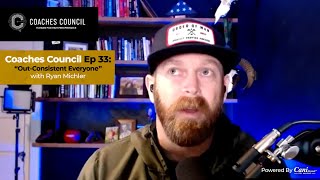
Ryan Michler joins coaches to discuss how consistency builds credibility in business, health, and relationships. They share personal stories about overcoming fear and maintaining discipline as a high performer. The core idea: out-consistent everyone else by showing up when it's hard.
It's not about outworking everybody, but it's about out consistency everybody.
There's a difference between logical thinking and just natural thinking, as maybe Ryan would be putting as a natural man. Where our fears kick in, we are naturally built to fear.
Figure out who you want to be and work your way backwards into what those types of individuals do. Drop the ego, drop the I'm special thing and get your butt to work.
This is the Coaches Council, made up of six elite coaches dedicated to serving and ending personal struggle for high performers in business, health and relationships. As a collective, we have built and helped build six, seven and eight figure businesses, dominate in multiple industries, coached and played in professional sports leagues and developed some of the strongest and most intimate relationships, both professional and personal. This isn't your average podcast. It's for the hungry, the dedicated, the doers, for those that have a dream and truly want that dream to become reality. People who want to take action, leave their ego at the door and own every level of their life. If that's you, then step into the coach's counsel as we rewrite the truths to living that high performance life. Welcome back to another week of the Coaches Council. We've got Pradeep Zanga, as usual, sitting in his new throne back in Toronto, out of the orchards from out west in Canada. How was the trip back, Pradeep?
It was awesome, man. It was tough being away from the kids and the family for three weeks, but it was just great to be back on the orchard, back on the tractor, just hands on, manual physical labor. So I loved it.
I love it, I love it. It didn't put any more hair on your chest though, I see.
I wish it put more hair on my.
Honestly, Honestly. And then we are joined with. I don't know if anybody's heard, but Order of Man's creator, founder Ryan Mickler. And Ryan, I've loved your stuff for a long time and the way that you stand up for the male community and truly show up as a leader. And I think we're gonna get into a lot of what leadership is, what it looks like, how this whole landscape has just been turned upside down, especially in the. I mean, forget the last five or 10 years, but just even in the last year and just the whole mission that you're on.
Glad to see you guys. Thanks for having me on. I'm looking forward to our conversation today.
Absolutely. So, Ryan, can you tell the audience a little bit about Order of Man, how it got started, what the purpose of it is, what the premise is and kind of what drives it on a day to day basis?
Yeah, man. Order of man at its, I guess, most fundamental level is a mission designed to give men the tools and information and conversations and resources they needed to thrive. You know, if they're showing up as fathers, husbands, leaders in their communities, business owners, however they're showing up, I want to give them what they need to thrive. And it was really born from a place of me not having these tools. You know, I started Order of Man almost six years ago now with. With Selfish Pursuits. You know, I needed to have conversations with men who are excelling in business and with their own personal lives and their families. And I had a previous podcast wrapped around my financial planning practice that was, like I said about six years ago, realized I really love the medium of podcasting. I just wanted to talk about something different, something that was more significant and meaningful and impactful in my life. So I started Order of Man as just a hobby, just an activity and interest, something that, you know, was fascinating or interesting to me and quickly realized that we were onto something big here with the growth that we saw almost, I don't want to say overnight, but very, very quickly, very rapidly, which was a testament to the fact that men were experiencing very much the same things I was, which is not really knowing how to do this thing called life, not knowing how to lead our families and our businesses. I didn't have a father figure growing up. A lot of men were going through that. I went through a near divorce with my wife, which was a big catalyst for what we're doing here now. A lot of men resonated with that. So, I mean, really the success that we've received is just because I'm talking about something that men want to talk about. And frankly, there just wasn't an outlet to be able to do it prior to this.
And I think you hit on something right away and you were talking about the success overnight. And I saw a post you put up probably a couple months ago now, and it was actually a screenshot of your downloads of Order of Man podcast.
And.
I wanted to bring it up today because it really talked about if you would have thought Order of Man would have been what it is today, six years ago when you started it, you'd be lying. And that it really took the consistency day in and day out and showing up and performing and just being on that mission, being so convicted to what you were doing and passionate about what you were doing. And it was the consistency that drove that, quote, unquote, overnight success. Everybody's an overnight Success, you could call it, because nobody sees the years of work that go into making something happen. And it's not about outworking everybody, but it's about out consistency. Everybody showing up day in, day out, whether you want to, whether you don't want to, on good days, on bad days, and truly making it a part of your DNA. That consistency is what's going to get you to that next level. Talk a little bit about what that concept of consistency means to you and ultimately what it's done for not only you, but your business.
Yeah. You know, I don't consider myself anything all that unique or all that frankly, interesting or special. You know, a lot of people.
That's why we wanted you on.
Thank you. Thank you. I feel right at home, I guess. No, I mean, I mean, people say that and it certainly strokes the ego, you know, and I feel like we've done things well. I'm not trying to completely dump on everything that we've done. I'm just saying, like, there isn't anything particularly unique about what I do. But that said, and I'll just extract one element of consistency here with what we've done. In order of man, we started in March of 2015. That was the first podcast I did. And initially we did one podcast a week. It was an interview show. And then we grew that to doing two a week and then eventually three a week. Well, I went through a couple of weeks ago and actually looked at how many podcasts as we've done. We're over 600 podcasts at this point. And over the past five and a half years, I have not missed a single podcast, not one ever in five and a half years. There was one day that I almost missed it because I was at an event. It was a week long jiu jitsu event and I was tired and I had just spaced it and I realized I hadn't released the podcast. So my co host for our second show of the week, which is an Ask Mini thing, Kip Sorensen and I run that together. He was at this, this jiu jitsu camp with me and I said, I know it's 11 o' clock at night, but we got to sit down and we got to do a podcast together and we did a 30 or 40 minute podcast. I don't even know that I edited it, but I sent it out and I hit publish right before midnight. That's, that's what you're talking about here. And through the consistency over the past five years, it makes up for any other inadequacies we have, I say quite often is, you know, I don't have the luxury of not being consistent because I'm not all that talented, I'm not all that special, I'm not all that connected or all that wealthy or good looking or whatever it is. I don't have that. So I can replace that and more than make up for that by being hyper consistent and hyper focused. And the beauty of that is that I have a lot of trust and authority and credibility that with the men who listen to what we're doing because they know without a doubt, beyond a shadow of a doubt, unless it was something catastrophic, that they can rely on me showing up in the podcast form every Tuesday, Wednesday and Friday. They can rely on the fact that on Instagram or Facebook or YouTube or wherever we are, that they can rely on me being there and being engaged to the degree that I can. But that consistency has been key for the growth that we've experienced, especially in a saturated market. You know, how many podcasts are out there, how many YouTube channels, how many blogs, how many podcasts, how many of all this? And in order to cut through that noise, it takes a very long time of grinding through it and being hyper consistent about it.
Pradeep, I know that we've talked a lot about consistency within this group for a long time and what caused me to want to go back to this and really, I was listening to a podcast actually a couple weeks ago and they brought up the term out consistent everybody. And it resonated so heavily with me because for those gym goers out there, we often hear just outwork everybody. So it's like going into the gym and trying to lose a bunch of weight and you're going to be that person that's there three, four days or sorry, three, four times a day and really pushing it, like maxing out over the course of a month and then it kind of peters away and goes away. That person may have lost 10, 15, 20 pounds that month. Awesome. That's right on. But you come back and you look at them three, four, five, six, seven months later and it's all gained back up where you've got this 75 year old guy who's just casually on the elliptical every single day, 10 to 11, 10 to 11am you know which elliptical that guy's on because he's showing up day in, day out, day, day in, day out. And guess what? He's probably gonna be there when he's 95, 105, 115 years old, because he's Just consistent day in and day out. And I'm curious, Pradeep, what you see or for our listeners, what aspect of being able to be consistent does it truly come from?
Yeah, no, really good question. And here's my personal take on it. And here's what I typically coach. First one is having complete clarity in terms of what you're looking to achieve. Because if you don't have the clarity, you're not going to be consistent. And so that's why having clear, precise goals or direction is important, because that's the first piece. The second, really, you know, it goes back to the last episode that we did around identity, you know, because you have to have an identity of being someone who's consistent. Because those people, there's people out there that tell themselves that they're not consistent. They tell themselves that they're always late or they're not good at something. And, and well, how are you going to be good at it or how are you going to be consistent if you keep telling yourself you're not that type of person? So you have to believe that you're that type of person to actually be within that realm first. The other piece is seeing results because a lot of people, they get discouraged when they're doing something. They're consistently, let's just say losing weight, for example, or trying to grow your business. If you're working day in and day out trying to grow your business and, and at the end of the month you look and your bank account is negative, well, you're going to say, what was the point of all this consistency? What was the point of all this effort? And so having those small quick wins is important as well. So there's a system around being consistent. I think it really, consistency for me really relates down to discipline. And discipline is important because Jocko Willink talks about it. Basically, discipline equals freedom. I grew up with a military grandfather and he was the most disciplined man I knew. He talked about consistency. He was up at the exact same time, probably within a minute every single morning doing his prayer, for example. He'd be out there doing his walk, he'd come back, he'd have the same routine. So I kind of just learned from him what consistency really meant. So I think having having people around you as well is important because if you're around people who are not consistent don't have that self integrity, you're going to learn that as well. So we learn from other people's behavior. Accountability is another one. So if you have someone that's accountable holding you accountable, that makes sure that you are consistent. That's great. But sometimes as adults, it's tough to have. We got to find the right people that we respect, especially as guys. Ryan, I'd love to get your take on it because, you know, guys want the inherent freedom, right? They want to be able to do what they want to do. But, you know, consistency has to play a part in that. And actually, I have a question for you, Ryan, because you work obviously with a lot of guys, you have a lot of guys listening to your show. Where do you see people, where do you see guys lacking in consistency? And where do you see them actually being really consistent, whether that's a positive or not so positive behavior?
I think, Pradeep, you hit on some really good points. Two that I'd riff on a little bit more just to go in depth to what you said and piggyback on what you said as well. I really like the concept of identity. I hadn't heard it said like that before, but that's actually really powerful. If you think you're a loser, you're going to naturally do things that losers do. If you consider yourself a winner, naturally you're going to do the things that winners do. And winners make good decisions, right? So ultimately, what does it come down to when being consistent, making a decision to be consistent. That's it. Now, I wish it were that easy. You know, you wake up and there's friction and there's resistance and there's other people begging for your time and attention and energy and there's your own tiredness and your own weaker version of yourself, which I call the natural man. But having processes in place is very, very important because discipline, let's not say discipline, let's use the term willpower. We know that willpower is fleeting, right? That you can actually exhaust it throughout the day. So if all you're relying on is your own exertion and your own willpower, and I'm just going to will this to existence, you're actually setting yourself up for failure. So what's even better than willpower? Processes and systems no longer have to rely solely on willpower. Objectives. Done. The other thing that you talked about is results. What a lot of guys struggle with is faulty expectations. So you, you, you guys with being Jim Go, right. And Justin specifically with what I know you're all about, what you do is, let's say you have a gentleman that comes to you and wants some coaching and he's, he's 50 pounds overweight. Well, in the first couple of weeks, he's going to experience some tremendous. I was going to say growth, but weight loss. Right. He's going to experience some tremendous weight loss in the first couple of weeks. I mean, he's almost going to see it overnight. You know, he's going to see the pounds just kind of shedding away. And then we have this law of diminishing returns. And Justin, you hit on this as well. So initially, they're going to be all hyped up and hopped up and excited because they're seeing the results. But what happens when he's down to that last 8 to 10 to 12 pounds, and it's taking. Not weeks now, but it's taking months and months. If he doesn' have somebody in his corner who can accurately illustrate the expectation, it's going to be very, very difficult for that individual to carry on. That's why coaching is so crucial. Both of you guys are coaches in different capacities, it sounds like. But what you do is you communicate to an individual who might not be experiencing the immediate results they thought they would, that they're still doing the right thing, stay on the path. My son came to me the other day and he's on this kick right now of losing weight and getting strong, and he's going through a couple of programs. And he came to me one day and he says, dad, I'm a little heavier than I was yesterday. And he was discouraged. And I said, that's okay, bud. Like, it's really okay. And he's like, yeah, but I'm trying to lose weight. I said, I know you are. And one day it's frustrating. I get it, because you're trying to lose weight, but take a different perspective. All right, Just go back to the drawing board. Do a little better tomorrow. A little better. And within two or three days, he was down a couple more pounds. With his metabolism at his age, that's how it worked. And he felt better about it. But it took a new perspective to see. And that's why Pradeep, I like that so much that you're talking about accountability. That's exactly what this is, is having somebody to help not only hold your feet to the fire, but tell you you're on the right path.
You.
Even though you might not be experiencing the results that you conjured up in your mind that aren't really realistic, we'd.
Be remiss if we didn't take this time to thank our sponsors that allow us to reach you each and every week. The Coaches council is powered by cannibrands. A lab tested all Natural, pure hemp CBD company without the presence of thc. They encompass our passion for health, wellness and fitness that we have on the coaches council. Visit canibrands.com and at checkout, use the promo code coaches20 to enhance your wellness journey. You are exactly right, Ryan. And I want to go back to what you just mentioned and go a little deeper into what you call the natural man.
This serves me all right. There's two versions of myself. There's the lazy, weak, pathetic, cowardly version that wants the results without the effort, that. That wants to take the easy path, that wants to sleep in, that wants to eat all the chips and salsa and do all the things that all of us are tempted to do. And every time that I wake up and every day, I'm faced with thousands and thousands of little choices to become and communicate and entertain that man that I have the potential of becoming the natural man, the lazy, weak version of myself. Or alternatively, I can make a better decision not to eat the chips and salsa, to get out of bed and not hit the snooze button, to communicate effectively with my wife, to do the things that I said I was going to do, to honor my word and uphold my commitments and the things that we know we should be doing. And when you win that battle of choosing this weak guy or this, the potential or the future version of yourself, that it becomes easier, you build more confidence, you get stronger, and it becomes a path that is manageable because you're confident in that and you feel a sense of purpose and meaning and direction because you know you're moving towards a better place than just slipping into who we naturally are.
I love that because a lot of what I go back to a lot of times with a lot of my clients and how I'm speaking with to this, and it might bring a nice analogy to it, is you're building credibility with every choice you make during your day, from the moment that that alarm clock goes off to the moment that you lay that head on that pillow. By the time you want to go to bed at night, every single moment during your day is an opportunity to do one of two things. Either build credibility or lose credibility with yourself. And it's like a bank account if you're continually making credibility deposits every single day. You get up when you're supposed to, you have that smoothie that you had when you were supposed to in the morning, you had a nutritious breakfast, you worked out, you sat down at your desk on time, you were at your meeting on time, you got Your work done and your big work block done. You showed up when you were supposed to for your kid's soccer game. You brought your wife flowers and remembered the anniversary or the birthday or just out of kindness because that's what you wanted to do. And then at night, you're putting your head on your pillow and going to sleep, and you're sleeping by 10 o' clock because that's what you need to do to get up at 5:30 the next morning. That is constant building of that credibility and depositing that money in your bank account. So all of a sudden, when you need to hop on with a client and close them or you have the opportunity to go sit in front of a crowd of thousands and really, truly do what you're meant to do, you have the money, quote, unquote, to be able to withdraw from your confidence.
Exactly.
You've got the capital there to be able to stand up there and say, I've got this. This is me. You're not having to put this facade on. And that's when we can come back to the notion of authenticity. You're being who you are authentically every single day, because there is no state of perfection. It's the imperfection and accepting that you're imperfect, but knowing that you're on the path to where you need to go.
Justin, you know what's interesting with your line of work? This idea and this concept of the natural man is perfect. And here's why. I was having a conversation with Dr. Rob Wolf. I don't know if you guys are familiar with him, Wired to Eat and his latest book, Sacred Cow. And when we were doing a podcast together, he, he said something to me in a way that I'd never heard it before, and it really resonated with me. He says, you know, human beings are hardwired to be fat and lazy. I mean, we really are. If you think about our ancestors, they tried to eat as much calorie dense foods as they possibly could and then move as little as possible in order to stay alive. Well, you know, we've evolved past that. Right. Like, we're not at a point anymore where we need to eat the calories because we're at risk of starving or, or that we have to. We, we've created these sedentary lifestyles now, Right. So we're not obligated to do that, but we're still hardwired to do it that way. So you actually naturally want to eat all the food and you want to move as little as possible naturally. That's what your body is telling you to do. So when you go into the gym or you open up your refrigerator, like, you have to actually make the conscious choice to pull the right foods out of the refrigerator and actually get your butt out of bed and go to the gym, because your body biologically is telling you don't do that. That's putting you at risk and you could die if you do that. We've evolved past that. So we need to train ourselves to be better than this natural version of who we are.
No, it's so true. And I want to pick up on something that you said there, and it's that not wanting to do. It's that maybe that sense of fear, that sense of insecurity, that sense of stepping outside of that comfort zone. Pradeep. I know John always talks about that iterative effect of slowly stepping out of that comfort zone bubble that you're in. You can't go from A to Z overnight, but if you take that step from A to B, B to C, C to D, the next iterative step from Y is to Z. And so if you look back all the way at A, you're like, wow, that's an extraordinary feat. But it was just the next logical step of which was to happen, because why we were uber consistent with taking those small steps out. And so this. I want to go to both you guys for this, but what steps would you say needs to be taken? Or how do you overcome that sense of fear of even taking that first step? Because to be consistent, it starts with starting. That's the key, is you can't be consistent with something. You don't start. And so if that fear is there or that sense of insecurity is there or that sense of unknown is there. Pradeep, what's the first step that you need to take in order to truly move forward in embarking on that journey?
Well, maybe I'm making it a little bit too simple, but it's just doing it. And it really comes down to, but.
What if that, like, so we know that it's just doing it, but what if there's something that's legitimately there, a process, as Ryan talked about, that we could go through, or a series of steps to get over that fear. Because I'm sure you've had clients too, where they're trying to start a business or have to go talk to their teams or address people, and they're just like, I just freeze up. I'm not able to do it. Or I can't consistently be the Man, I need to be for my household, for my family, because I have this innate fear of X. Yeah, I think what you're talking.
So basically I think there's different things. It depends on what the step is. So even within each step there's micro steps. So this is what I do when anytime I'm talking to someone and they commit to something, as Ryan was talking about. When we talk about making a decision is to act immediately because you want to make decisions when you're at a prime state. You want to make decisions when you're at a higher energy state, when you're in an optimistic state, because you're more likely to act as a result as well. So as soon as you make that decision, when you're in that prime state, take an immediate action immediately. So if you want to lose weight, well, call up a personal trainer or book an appointment or whatever it is immediately when you make that decision because you're more likely to execute. And even if that first decision seems too big, you can break that down or that first action seems too big, you can actually break that down into micro actions. So you can break the first step into little steps as well. Here's what I think. I think a lot of people overthink things and that's the challenge is when we let our thinking take control of us, we don't act as much. And we have to understand that we are emotional beings, we are creatures of emotions. So that's why we need to be in a better state more often. And I'm not saying do less thinking, but there's a difference between logical thinking and just natural thinking, as maybe Ryan would be putting as a natural man. Where our fears kick in, we are naturally built to fear. One tactic that I like to use and that I think works very well is visualization. Because if you can visualize yourself doing something, taking that first step, you've already put your brain through that process. You've already built some of those neural connections. If we take a look at it from a neuroscience perspective, so you're already partway there. So that's a simple tip that I can suggest is if you visualize yourself doing it, that can definitely help as well. So, Ryan, I'm going to toss it over to you, man. I'm looking forward to hearing what you got to say.
Yeah, look, I don't know that I would add much to what you said. I think you're dead on with that. The one thing I think of is that we're very ego driven, right? And I think the first step to getting over your fears is realize, and this is going to sound a little counterintuitive as I say this, is that you're not special. Like, you're not special and you're not unique. Because when you. Let's say you wanted to speak in public, or let's take it back a little bit, let's say you want to start a podcast and you don't because you're afraid. I understand that. We all are. You're afraid of what? You're afraid of fear and rejection and ridicule and what happens if you fail. That's all ego driven stuff, right? People are judging you and you're afraid of that because you think highly of yourself, which I think is good, but it sometimes hinders us from growth. So the first thing you need to come to the realization of is that you're not all that unique or special than anybody else. Take, take the most prolific podcaster out there. If we want to use Joe Rogan, for example, or him doing stand up. I mean, he's, he's a comedian, he's a podcaster, he's a UFC announcer. He had to start somewhere. He had the same fears you do. And what's the difference between him and you? He did it. That's it. Like, he dropped the ego and he put himself out there and he subjected himself to judgment and criticism from others and he got to work. That's it. So I think we really ought to be careful of thinking that we're special or our situation is unique, because it really isn't. It really isn't. Everybody who's ever achieved any amount of success has felt and thought the same exact thing that you have. There's nobody out there that's special. They all felt it. They just decided to overcome it. Now, to your point, Pradeep, about the vision stuff, look, it's as simple and I've got, I've got this, my battle planner. I've got a notepad right over here. Every single morning, I write down, and here's what I would suggest as a tactic for people. Who do I want to be today? Who do I want to be today? I want to be a father. I want to be a podcaster. I want to be a writer. Okay, well, podcasters, podcast writers write words. Public speakers speak in public. So who do you want to be? And then start filling in the blanks. I want to be a writer. Well, sitting there pretending or thinking about it isn't, doesn't qualify you as a writer. Writing qualifies you as A writer. And if that's who you want to be, then that's the action you need to take. Figure out who you want to be and work your way backwards into what those types of individuals do. Drop the ego, drop the I'm special thing, and get your butt to work.
Such a good point, because it's quite often not having that direction. It goes back to what Pradeep talked about in having that clarity and having that true idea of where we want to go. And once we figure out where we want to go, we can act in accordance to that. I want to switch gears a little bit here, and it's like, okay, we've started. And myself through my career, on my way to being an athlete, I was cut from numerous teams, was told I wasn't good enough, was too small, would never make it, would continually get traded, contracts that you thought were good to go. You're told, no, you're not worth that, you're worth this. And it's seemingly like, it's amazing if you go through it. I played on six different junior teams, I was at two different colleges, then made my way finally up to my first professional contract, all the way now going up to coaching at the NHL level and then getting fired and making my way through those steps and stages. It's always easy. The guy that's always at the top of the game and just goes from here to here and takes that next iterative step, that's the guy that, hey, he's consistent. He's so good. But it was always pretty simple. But for the 99% of everybody else, there's the gut punches, there's the kicks to the knees, there's being kicked when you're down, there's the continual downward trajectory that seemingly life is giving you challenges over and over and over again. What is it that people can do? No matter what their goals are, no matter what they're doing, they've taken the step, They've owned who they are. They've owned the vision, the mission, and they've taken that first step. And now, for lack of a better word, going back to what we talked about, the willpower is wearing away. The allure of that golden treasure that they were onto has kind of started to come off a little bit, and things have gotten tough. What is it that now is able to keep us consistent day in and day out?
There's a time to be reflective, and there's a time where you shouldn't be reflective. Like, there really is. Like, there's times where you don't need to sit and reflect and think. And there's other times where that's completely appropriate, and you ought to do that. So the other night, I met at Jiu Jitsu. I've been doing Jiu Jitsu for about a year and a half now. And I'm. I'm rolling with this. With this guy who we've trained together quite often, and he's got me in a submission hold, and the next thing I know, I'm waking up from la la land because he patched me out, right? He just. Just choked me out. And I. And I went completely out. I. I came to, he was standing there like, are you okay? And a couple people were looking at me. My coach was laughing at me. And it would be tempting to be reflective right there, right? Like, okay, well, like, what happened? And, oh, do I look stupid? And what do people think of me? And, man, I'm not good at this. Instead, I said, all right, let's go. Go again. And that's the right course of action in those times, is, look, I can be reflective after training is over, but right there, I just got to get myself back in the game. So I get back to rolling with this guy. You rebuild the confidence. You learn from your mistakes, of course, and then you just perform, and that's it. You know, a lot of people talk about men, Men a lot that I deal with. They talk about being down and being depressed. I've never met a man who's anxiously engaged in work, whatever that looks like for him, who is simultaneously feeling bad for himself.
Great.
The only time you feel bad for yourself is when you're alone and it's quiet and you're not doing something, and you have these idle hands. My mom used to say, idle hands are the devil's workshops. Idle minds, same concept. Don't be idle. Don't be reflective. When you're feeling down, don't be reflective. Go to work. And I like what Pradeep was saying. Once you're at work, you're going to move into that higher energy state. Okay, then be reflective, right? Because then you're coming from a position of hope and optimism, not despair and desperation. So if you're down, go to work. When you're up, be reflective. That's what I'd give.
Go ahead, Pradeep, what were you going to say?
Well, I was just going to say, I think that's a brilliant point, Ryan, when you're talking about that. Because when you're in motion, you tend to stay in motion. And when you start to stall, that's when you start worrying. That's when you have a lot of those moments of okay, am I on the right path? You start to test your self confidence and you start to doubt yourself. Like all of these things kick in, but you're so right that action will just create more results or create more action. So if I reflect back on a time when I went through depression when I was university, I instantly, I think within four months gained like 45 pounds. I was in the science program. I had school from 8 till 10 at night. I believe the labs were from Monday to Friday. And then I get dropped off by the bus in front of a McDonald's. And at that time they had $49 McChicken sandwiches and super sized fries on for like 99 cents. So I'd pick up two of each and lo and behold, I gained like this massive weight in a short time period. And I also went into depression.
You're on the Drew Manning diet?
I'm on the Drew Manning diet. Yeah, exactly. It was just crazy, right? And I was like, okay, how do I get myself out of this? And one of the things that I did was really just continue to move, just act, not stay idle, not think too much and just keep myself busy in a way. Not necessarily just random stuff, productive stuff that actually got me out of the slump. So whenever anybody tells me, hey, I'm feeling down or I think I'm depressed, it's like, keep moving, keep being consistent, right? So I love that analogy because yeah, there's times when you can self reflect and just put yourself down even further.
Yeah, it's a nasty cycle if you get into it. I think we've all been there for sure.
And it's so ironic too, guys, because a couple of the people that have reached out specifically have said that they find themselves at the top of their game for a certain period of time and then something negative happens and they have a hard time getting out of it. And that reflection time, you never why? Why stop in hell, right? Keep on moving, keep getting, keep getting out of there. Reflect when things are good. Reflect and be grateful. Reflect and have that sense of gratitude when things are great and just have the awareness that things aren't good. But guess what? Everything comes in cycles. And dropping that sense of ego, that sense of judgment, it's so important. Not even just to, for other people, but on yourself. And to show up with a sense of empathy and a sense of kindness for yourself, knowing that you're perfect exactly how you are, but you're just too damn Good to stay there and that you have to continue to put in work day in and day out. If that mission, if that clarity, if that vision of where you're wanting to go really, truly means that much to you, and if the mission means that much, if the vision is that enticing to you, at the end of the day, consistency is just one small step after the other.
Well, I think the other challenge people have is they wrap up their sense of worth in the result. And I'm not going to tell you the results aren't important. They are. Obviously, you know, I want to show up as a father for my kids and a husband for my wife and a leader of this movement community we're trying to create. So, yeah, results are important, but if I over consume myself with the result, then in a way, I'm placing my sanity, my thought process with. With something that is to some degree out of my control. Right? Like I can't control my kids. I can influence them. I can't control them, I can't control my wife. I can be influential. Same thing with the guys who tune into what we're doing here. So instead of me wrapping up my sense of worth and identity in the results that I produce, I try to be more. More wrapped up in success in the actions that I take. Podcasting, like I talked about earlier, great example. The success is not the number of downloads. The success is that I put out another podcast. I know the download numbers will happen. Those things will take care of themselves. But I pride myself on showing up each and every day regardless of the result. I had an old mentor of mine, one of my very first mentors, he says, do the best you can and let the chips fall where they may. That's it. That's all you can do. Everything the. The externalities are going to happen. It is what it is at this point. And what did you do that puts you in the best place to capitalize and take advantage of opportunities and chances in life? That all comes down to what you do and how you take pride in showing up each day. Not necessarily that end result.
Ryan, I appreciate you so much for coming because it's the movement you're on, the mission. You're on with Order of Man and the influence that you've put out there into not just North America, but worldwide. I know you touch people around the globe and it's so impressive the way in which you show up consistently day in and day out. And you don't just lead by preaching, by talking, but you lead by example. And it's impressive and good luck and continue on the mission.
Thank you very much. I appreciate you guys. Thanks for the opportunity. I hope we shared some value for people.
Absolutely. Without a doubt. And everybody out there. As you guys embark on your mission as a father, as a business person, as a brother, a husband, a spouse, whoever it is that you impact every single day, whatever mission you are on, always remember that it starts with the clear vision first. It starts with that sense of clarity, knowing where you're going, where you want to be, being able to take that first step, be able to do so consistently, be able to not rely on that willpower that will be fleeting at some point, but a deeper sense of meaning that's going to pull you through those high times and low times sense to a time to reflect and a time to take action. And by doing that, day in and day out, from day one to day 5,000, the results will come knowing that you're on the mission that you were meant to be. So stay hungry, stay humble and we'll see you guys next week. Thank you so much for joining us for another week of the coaches calendar council. If it wasn't for you viewers and listeners, we wouldn't have a platform. So again, it's all about you guys and we want to give you a reward just for listening. We want to give you access to each one of our coaches for a little bit deeper, intimate experience. So if you go to coaches-counsel.com coaches.com subscribe and like to whatever platform you're viewing on, you're going to be entering mentored to have that one on one experience. So be sure to go coaches-counsel.com and really interact with us because we would love to interact with you. Until then, stay safe, stay hungry, stay humble and thanks for listening.
More from Justin




The Ultimate Blueprint for Taking Ownership of Your Health | Unlock Peak Performance

From Bullied & Anorexic to Healed & Purposeful: My Transformation Story (Justin Roethlingshoefer)


Forget "One-Size-Fits-All" Health! Unlock Your Best Self with True Personalization (The OWN IT Show)

Are Blood Tests Enough? Why Cellular Testing Might Be Better | Justin Roethlingshoefer

Your Body's Language: Understanding Stress & HRV| The Power of Ownership - Chapter 3 & 4


Is "normal" really making you sick? Dive into Different with The Power of Ownership:Chapters 1 & 2