Coaches Council Podcast Episode 35: "Why Phones Make Us Weak" with James Silvas
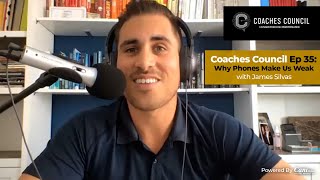
James Silvas joins Justin Roethlingshoefer and Pradeep Sanga to discuss how phones and social media damage mental health and presence. They explore strategies for fighting distraction and building intentional habits that strengthen your mindset instead of weakening it.
We get so caught up in the mundane. I think we, we're so busy and a lot of. I know for me, I used to associate busyness with like a badge of honor. So the more you want to feel, the more okay you have to be with getting the full spectrum. But most people don't want to open themselves up to extreme pain, so they don't open themselves up to extreme pleasure. If you are playing your game, the chances are much, much higher that you're going to win because you're setting the rules and you know the metrics.
This is the Coaches Council, made up of six elite coaches dedicated to serving and ending personal struggle for high performers in business, health and relationships. As a collective, we have built and helped build six, seven and eight figure businesses, dominate in multiple industries, coached and played in professional sports leagues, and developed some of the strongest and most intimate relationships, both professional and personal. This isn't your average podcast. It's for the hungry, the dedicated, the doers, for those that have a dream and truly want that dream to become reality. People who want to take action, leave their ego at the door and own every level of their life. If that's you, then step into the Coach's council as we rewrite the truths to living that high performance life. Welcome back. Welcome to another week of the Coaches Council. We got Pradeep Sanga, as usual, in his hot seat and we have this week, mindset specialist James Silva. James, thank you so much for coming on the show and again dropping some knowledge bombs with us here.
Yeah, absolutely honored to be here. Thank you so much.
So we want to get right into it today, guys. I know we've been chatting a lot about development and where we're going into this fourth quarter in our businesses and our relationships, in our overall life, because 2020 has not been what anybody has thought it would been. But some people have been able to persevere and actually grow and other people have actually fallen off and gone the other direction. And a lot of my career in sports, if you look at was spent getting traded, getting cut, being told I wasn't good enough, wasn't strong enough, wasn't fast enough. There was always something that was wrong with you. And when you live in that world, it's very easy to sometimes continue to just either believe it and absorb it and live that way, or say, no, I'm going to go and I'm going to prove you again and again and again. And it's that mindset that we don't only need in the world of athletics, but in Our personal lives, in our businesses, in anything that we're trying to grow. And so I'm curious, James, as to what you teach your clients or how you what your process looks like in order to develop that pro mindset of accomplishing these things in this world of negativity and average that we live in.
Yeah. Cool. Thank you for that. The interesting thing about the work that I do with mindset is that it's so intangible. It's the invisible. And anytime you're dealing with the invisible, the challenge is how to make it tactical, right? How to bring something that is this nebulous kind of vague understanding into some and demystify that and bring it into something that you can embody, that's something that you can step into. And if you hyphenate mindset, really what you're learning to do is set your mind to respond or to be a certain way. And so what I try to do with all of my clients, ranging from executive to athlete to entrepreneur, is really understand the elements of someone's psyche that help them embody who they are in the moment that they're in. You know, someone may call that presence. Other people may call that just absolute clarity. But I find that when someone understands a few things, when they understand their values, when they understand their definition of success, when they understand their personal philosophy, those three things combined lead to a very intentional, strategic lifestyle. And I find that if those people that have that clarity within those answers questions, they're able to be more present, weather the pressure, and when adversity comes and challenge shows up, they're able to be resourceful enough to find a solution, find a way to get the goal that they've set out to get, and actually live life on their terms rather than being dictated how to live or what they should be doing rather than what they actually want to be doing. So I guess what I would say is you got to get clear on three things. Your values, your definition of success, and your personal philosophy. First and foremost, what do you think.
Holds people back, based on your experience, from even being aware of that kind of stuff?
Yeah, that's a lot, right? We get so caught up in the mundane. I think we're so busy, and a lot of. I know, for me, I used to associate busyness with, like, a badge of honor, you know, like, oh, I'm so busy. It's so good. My calendar is so full. I look at it, and there's no empty spaces. That was a goal of mine at one point. And then I realized how ineffective that was.
You're so right on that, James. Because. And I want to touch on that really quick because it's almost like I call it the suffering Olympics. As business owners as who you don't even need to be a business owner, but you're like, oh, my God, I got four hours of sleep last night and look what I'm doing. And someone will look to you and go, four hours of sleep. Man, I wish I got four hours of sleep. I got four hours of sleep the last three nights. Okay. It's the suffering Olympics. It's who can one up the other person to show that they're better in whatever it is that they're suffering in, where in actuality, it's not like that at all. So go back into what you were saying in terms of that busyness aspect.
Yeah. And to add to what I was saying and to what you just said, the competitive nature that people that are listening have this high performance kind of mindset. It's natural for you to compare. But if you compare with other people and your journey is. Your journey is not going to be the same as the person that you're comparing yourself to. And that's why having clarity in the three things that I mentioned earlier is so important. Because then you know, the game that you're playing, if you are playing someone else's game, you're most likely not going to win. If you are playing your game, the chances are much, much higher that you're going to win because you're setting the rules and you know, the metrics. And so we don't get to that point because of the busyness of our lives, the distractions, the phone, the family, the lack of clarity around, you know, what we want to do and what we stand for and what's important to us. It's much easier to just do what other people suggest or to look around in our environments and not cause too much noise, not be a ruckus, not disrupt things, because then that would draw attention to ourselves. And we don't know how to handle that attention. A lot of people associate tension to doing something wrong or being an outcast or danger. And so I will avoid that attention by going with the status quo. But the only thing you'll be hurting is you and the people around you because you'll be settling for something that isn't your truth. And anytime you do that, your power begins to dwindle because you know you should be doing something and you're not doing it. So you're not living in integrity. And that's the beginning of the downfall of your confidence in who you are and what you can do.
That's such a great point. And you brought up the phone and I don't know if anybody's watched the Social dilemma.
Yeah.
It'S absolutely incredible. And if you haven't watched it, the phone and social media and apps and how we've kind of become. They started off as tools. The humans invented these things and to be tools that would make our lives easier in a certain way. And very quickly and very fast, they started to become the users of us and we lost control. And there was a couple stats that were thrown out. The amount of mental health issues that saw a skyrocket spike and the amount of self harm that created a massive spike and the amount of depression that created a massive spike. And all aligned perfectly. It was wild. It's in the Social Dilemma, if you haven't watched this. But they all align perfectly. In 2010, when the social media, Instagram, Facebook apps became available on your phone and it's literally a mirror image. And I'm curious, James, what your thought is about strategies in order to eliminate the busyness, eliminate the addiction that we have to busyness, but also to the phone, which creates a lot of problems there so that we can start to institute more of that presence, more of that awareness, more of that intellectual silence that you're telling us is really key to creating those being clear on our values. What creates us creates success. And that personal philosophy.
Yeah. So in order to find the answers that we're talking about, one has to sit in either a metaphorical silence or a literal silence. There was a study done by Amy Morin, or Amy Morin, who is the author of thirteen. What is it? Thirteen Reasons why I can't remember what the title of her book was, but Amy Morin. I actually had her on my podcast and she talked about this interesting study about people who were given a choice whether to sit in 15 minutes of silence or to undergo a mild electric shock, like all throughout their body. And 80% of the people who were in that study chose the electric shock over sitting in silence for 15 minutes by themselves. And so what you have is when you have that level of fear of if I actually quiet my mind enough, I might revisit the things that I don't want to look at. I might have to admit that I'm not as good as I think I am. I might have to look at the relationship that I'm in that I don't really want to be in. But it's easier to stay in it than to leave it. And that is not an easy process. And we're wired by nature to avoid pain. And so what we're kind of asking you to do, if you want to search for those answers, is to undergo pain in order to get the clarity necessary for you to weather pain more effectively. If you don't know the meaning of the pain that you're going through, that is very troubling. That's suffer. You suffer in that process. And so you're going to experience pain no matter what happens in your life. Pain of job loss, pain of, you know, relationship not working out, pain of you losing a client. And if you can be the type of person that understands that if I want to be more effective at dealing with pain, I have to be comfortable with sitting in it. And I don't necessarily have to solve all of the world's problems, but I have to sit in it long enough to understand it. And if you don't understand something, you can't change something. If you don't understand yourself, you can't change yourself. And the only way to understand yourself is to sit with yourself, observe, ask questions, reflect, write down what you're thinking, and notice the patterns. Because we're just a series of patterns, series of patterns of thought, of behavior, of doing. And if you can be an observer of all of that, then you can build a trajectory on where you're going to go. And for most people, the trajectory that they're on is not the one that they want to be in, but they don't take the time to say, well, where do I want to go? Where am I? And what's preventing me from doing so? And so there is no way to do it other than just to do it. And to know that through that doing process, you're going to find the clarity that will help you weather the storm. You're going to root into the purpose that will keep you motivated even when everyone else is turning their back on you or support seems to run out the window. You're committed to the process because it means that much to you. And I don't think people have gotten to that level yet.
Yeah, just to add to that, those are really awesome points there, because you're so right. People don't want to sit with that pain. I'll just add a little bit to that, is that they don't want to sit with that discomfort because we're trained from a societal perspective. Now, going back to what we were talking about from smartphones, is that it's become the norm now to be busy. As you were talking about, it's almost a cool thing to be on your phone all the time or be on social media and all this kind of stuff. And it's almost like you're the oddball by saying, guys, put your phone down. Guys, you know, put your phone away. Let's be present. People will start looking at you like you're odd. You know, I've been talking about this for probably about five years now when I first started to get ahold of what was actually happening in the social media aspect, because when I was in certain educational programs, they were actually going out there. And so Facebook, a lot of these social media platforms at that time were actually actively going out and recruiting behavioral scientists. And I remember talking to some of them and they're going after the smartest of the smartest people from MIT and Stanford so that they can create these addictive apps, these addictive platforms. And I think we have to be conscious and be aware to say, okay, this is something that is not healthy for us. It's not healthy for society and. And be able to take that criticism of saying, okay, I'm going to put my phone away. We have this conversation in our household quite a bit. My wife and I were just talking. James and I meditate religiously. I've been doing it for a long time. My wife, yeah, it's just an awesome thing to do. My wife has trouble with it and she's like, you know what? I can't clear my mind. I said, you know what? Meditation. A lot of people look at it as a form of escape, but it has to be part of your overall lifestyle. Because if you have a hectic lifestyle where you're just go, go, go, go, go, you are going to have a tough time meditating because it's like being on crack and then trying not to go on crack. It's just so tough. So it's so important for us to live a mindful lifestyle. Overall, I think is important for me, and I just want to share a personal experience is because I grew up on an orchard and I just got back, I spent the entire month of September in the orchard because we were harvesting our apples. Grew up in a very mindful environment where I'd be out in the orchard 10 hours a day with literally nobody around except for my own thoughts. So going back to what you were saying, I think is so golden. When you sit with your own thoughts, you realize what you're truly made of, where you truly are. And not only that. But what's most important in life because we're just so bombarded by so many other things, so many false expectations. And I think that word that you just said, that one word, integrity, just, you know, hammers at home. So I appreciate you bringing that up.
Yeah, absolutely. And real quick, just to add to that, the phone has become. I heard this. I think they say it in the documentary. They talked about the phone as a digital pacifier. And I was like, oh, my gosh, what a big, beautiful metaphor of, like, anytime someone is uncomfortable or waiting for a friend by themselves at the bar, like, what do you do? You pull out your phone rather than being connected to the environment. And that is a small example of you being able to be mindful enough to say, I don't want to just rely on my phone. Why not connect to the bartender? Or why not just observe the people in the scenery? Like there's many other things to do than just going with what's easy and picking up the phone. And hey, I'm guilty of it too. But. But being mindful of that is a start to changing that behavior a hundred percent.
Yeah. Just to add on to one that. That one last point, because I think it's important to have these conversations, educated conversations about this. I was looking at a phone actually, last couple of days for an ECG monitor and a heart rate monitor. A fitness or. Sorry, not a phone, a watch. And I was doing my research and it was basically tossing it between the Fitbit sense and the new iPhone Apple watch that came out and I was doing the comparison, but I didn't want to get an Apple watch because I don't want a watch that keeps telling me, hey, look, I got a text message, Hey, I got an email and being, you can say, almost teased to be wanting to check it. And so I try to put my phone away as much as I can. Now if I have this watch strapped to me, I'm going to be connected 24 7. So I actually took the cheaper watch, you could say the less fancy watch, because I just wanted that fitness functionality. I don't want the other functionality of being tethered all the time. So I think sometimes we just have to be cautious of that. Be aware that, yeah, technology is great, but it also binds you as well.
Yes, well said. Love that.
Hey, Coaches Council listeners. Coaches Council is partnered with Cannibrands, a trusted sport, fitness and wellness CBD company. And to be honest, I've been using cannisleep all natural CBD oil for probably the last two and a half years. And the spray specifically has been able to help me get a good night's sleep and truly affect the way I show up every single day to optimize. And that's just not my own personal take on it because I track my sleep every day with the whoop band and have been able to see the trends that have happened. My deep REM sleep has improved, my slow wave sleep has improved, my overall recovery has improved. My HRV is on the upward trend. All the things that we are looking for as entrepreneurs and executives to optimize our performance day in, day out. So their products are trusted by professional athletes and coaches just like us on the council alike. So be sure to check out their website@canibrands.com that's C-A-N I V R A N D S.com and use the code coaches20 for 20% off all products. Just like Can I sleep and other CBD solutions to help with pain, inflammation, energy, mental focus and anxiety. Now back to the show. I want to go back to what you were talking about, James, because and Pradeep, you hit it right on the head in terms of that. No one wants to sit in that discomfort when you're at the bar. And that example that you gave, I know we've all been there for sure. You're sitting there and you're waiting for your friends or your family or your girlfriend or your boyfriend, whatever it is you're waiting for, you're sitting there and you're like just like uncomfortable, self conscious and you pull out the pacifier, you pull out the phone and just start playing around on it. Let the time pass instead of, like you said, sitting in your thoughts. And this is a challenge for all of you listeners right now. Next time you feel like you need to pull your phone out without it buzzing, without it beeping, without it vibrating, without it doing anything.
Sit in that.
Feeling that you're having. Why are you having that feeling? Are you uncomfortable with yourself? Are you uncomfortable with the environment? What about it is causing that? And that is the level of intellectual intention that we can operate with to become clear on what James was talking about at the beginning. What are our values? What drives us to success? What's our personal philosophy? What are things that we do naturally just that have become subconscious actions that are helping us avoid that level of discomfort that we may not even know is there. We may not be comfortable spending time on our own. We may not be comfortable in a group setting where we don't know anybody. We may not be Comfortable walking into a gym and not knowing what to do. We may not be, but all of these things just come rushing in. And once we are aware of them, we can create the change that's necessary. We can build up those muscles that have not been activated because we've just thrown a band aid on top of it. We've actually just. It's like a crying baby. Well, let's allow them to self soothe. If they can't self soothe and you just throw a soother in every time, they're going to be 15 years old and they're going to still look for that thing.
Exactly.
And so I think that's just a great example of the intention and a tangible thing that we can do to challenge ourselves mentally.
So real quick to add on that real fast. There's two things that come up for me when you say that I think the intentionality behind the phone is super important because one could argue that connecting with the bartender or asking for a napkin and a pen and writing down something could be equally as relevant as a pacifier than anything else.
But.
But it depends on the intentionality. And Pradeep, what you said about your Apple Watch situation, the reason you made the decision that you did was because of the values that you had set up. Whether you realized it or not, your value for being present and being connected to the environment is the reason why you got the Fitbit over the Apple Watch. But if you didn't have that framework to operate off of, you may have just bought the Apple Watch because everybody has an Apple Watch. You know what I mean? So, like, there's another reason why that's important to keep that level of distinction between I'm choosing this verse, I feel compelled to get this, and I'll just succumb to that. So that's the first point. Second point is, as human beings, we have a need to connect. Like connect to ourselves, connect to somebody, connect to something. And so the cheap way out is to connect through social. But social is interesting because it connects us, but it also disconnects us. So, and that's a whole rabbit hole on its own, but that's interesting to think about. And then being in the environment, you could be connected to the environment as a whole. You can be connected to a person in the environment, you can be connected to yourself, which then through that connection allows for connection to other people. There's many ways to look at it, but you're fighting against a. A human biological need. So the awareness needs to be around your need and desire to connect. You Just got to decide what are you going to connect to that is in resonance with your values. And as long as it's within your values and you're aware that that connection is within your values, then it's fine. But if it's not, then you may be out of alignment or you may be unconscious, and you know that's not the best way to live.
You're exactly right. And one of my clients actually said something that really resonated as you were speaking. And he goes, justin, I am surrounded by people, surrounded by people every single day, but I feel more alone than I ever have. And this is a CEO of a major company, Major company. Everybody knows the company. And all of a sudden I'm hearing this guy that sits in the Ivory tower, has social medias, all these things, they're handled by other people. There's millions of people following this individual. They've got teams upon teams that he's responsible for. But yet, even when he goes, I go home and I feel empty, I feel lost, I feel alone. Talk to that for a little bit about what happens to a person's psyche when we can feel so we can be actually surrounded by people all the time and what it does mentally to us and how to overcome that.
Yeah, I love the imagery of the Ivory tower because it reminds me of when my wife and I went to Italy for our honeymoon and we got to see these ancient thousand year old castles on top of the hill. And I'm like, man, look at that architecture. It's made of bricks. It's lasted this long. It's beautiful. And the more I looked at it, the more this kind of thought came up as to, you know, how high the walls were. These walls were like 10, 20, sometimes 30ft tall. And I'm looking at that, I was like, that's great for protection. But that, that wall, as much as it protects you, it also keeps you imprisoned. You know, like there's nothing that you do. It's power, isn't it? Like everything you do has a, has a consequence. Nothing you do doesn't have a consequence. Right. Everything you do you're gonna pay a price for. And so you got to be willing, you got to say, I'm willing to pay that price for the thing that I want. And not doing anything is paying a price. Even though you may not think someone listening, oh well, I won't just won't do anything. That's a decision, you're going to pay a price for that. Everything you do has a price. And so to the person that is surrounded by people but can't seem to connect. The thing that I think about, what comes up for me is if I was in that position, any lack of connection to somebody else always stems from a lack of connection to self. I can't connect with somebody. If I can't connect with me, I may be under the illusion that I can connect. And it may be a superficial connection, but we crave depth. And if we don't have depth in ourselves, we can't have depth in other people. Like, we can't get to that level because we don't have the awareness and. Or maybe the skill set and. Or the ability to recognize when we are in the depth, you know, which is important, especially as leaders. Like, if you're. If you want to be a leader that creates impact with the people that you serve or the people that you're around, you're gonna have to lead them. But where are you going to lead them to if you haven't led yourself? So what I would offer as a suggestion, not even that this person's asking, but in this example, I would say, where are you not feeling connected with yourself? Maybe you've been ignoring some health problems. Maybe you have. Maybe you don't love what you do anymore, and now you feel the pressure to stay in that position. You know, or maybe. Maybe there you're spending so much time in X, Y and Z spot, and not being with your family, which is what you claim is most important, that takes a toll. And so that comes back to the reflection in the quiet time. You can only make those acknowledgments, and you can only understand what needs to be done. When you take the time to listen to your body, to your mind, to your emotion, to higher calling, whatever it is that you believe, that only comes in the slowing down. It doesn't come in the speed. And so if you really want to go fast, you got to start slow. If you really want to go far, you got to start small.
That's. I mean, it's so key. And when you talk about this depth, how do you get to that depth? How do you create it? How do you find it?
You figure out the words. It's one of the hardest things to explain because everyone's path might be different. But let me start, somebody.
Start. Where would. You're like, God, James, everything you're talking about here, it's resonating with me. I get it. I need to slow down. I need to start somewhere. I need to find out really what makes up me, because I'm not connecting with somebody else. But you know what? Because I haven't connected with myself, I'm not able to do that. I don't have the intellectual intention of being able to do that. I don't have the intentionality, that depth that you talk about in being like a key proponent of that. What action steps could somebody start with even though everybody else's journey is unique to themselves?
Okay. I think one of the prerequisites to that depth is presence. It's the same thing. We talk about flow. Flow is one of the most coveted types of feelings and mind states that we seek. And in order to get to flow, you have to be present. There's. You can't be in flow and be thinking about three or four or five different things. Flow is all about being where you are in the moment as much as everything that you are is in that moment. Well, in order to get to that level of presence, which means get to the depth, I think one has to work through all of the thoughts that come up when you try to be present. And usually what those are are emotional traumas, their insecurities or their fears. And so what I would suggest in order to facilitate more depth is one to have more conversations around those things, either with yourself, with a coach, with a therapist, or with a close friend that you trust that can let out that rawness. Because what happens is we walk around wearing these masks. We front like everything's fine. We pretend that everything's okay most of the time because we want to be accepted. We want to be a part of the tribe. We want to be a part of everything that's going on. So the three things, to reiterate, the three things are the emotional traumas, the insecurities and the fears. That's what comes up most of the time that prevents people from being present. They're thinking about how they look, they're thinking about what they're saying. They're thinking about, am I going to be liked? Am I going to be accepted? Once you work through all of that dialogue, meaning you accept you for you, and you're not needing that external validation from whoever you're speaking to, then you can be present enough to connect with somebody. And through that connection, that authentic, genuine, real, raw connection, that person will feel seen and heard and understood in ways that they don't normally get that right, you're able to provide it through your level of clarity, through self ownership. And that is the beginning recipe for the depth that we're speaking about, because then you're able to Acknowledge the other person, they feel comfortable. They open up about things that might be bothering them or things that they don't necessarily say to everybody as some generic response. And then you start a unique, organic conversation that flows into something that's never been discussed. And now you're stimulated. And now it's been an hour, and you look at your watch like, oh, my God, it's already been an hour, but it only felt like 10 minutes. That's true presence. But you have to work through all the things that come up that interfere with that in order to get to the depth that we're speaking about now.
I mean, it kind of comes full circle into the bar scene that we were kind of. And creating the analogy of is when you're sitting there alone and you're sitting there in whatever it is that you're feeling. And like Pradeep said, it's discomfort. It doesn't feel good. It's not comfy, it's not warm, it's not a place that you want to stay. But by almost. By just seeing it in the background, by. It's like when there's a fire and you can see it in the distance and you just know it's there. It's know it's there. It's creating this anxiety in you, and you get a little closer and it starts to feel hot. Well, instead of just putting the fire out and just avoiding it completely, you're cutting out parts of your life, you're cutting out parts of the experience, parts of the human interaction that you're not able to partake in. And that makes you. It's going to make you feel left out of a lot of things. It's going to have. You miss out on a lot of experiences, miss out on getting to know a lot of people, because you're worried about things that subconsciously are holding you back. And you said something very early on called the trajectory you're on is not where you want to go. And so many people find themselves on that path and it's just one promotion after the next, or it's one house after the other, or one car after the other, or one kid after the other. And they just find themselves on this roller coaster of just being in it when you. What does it take? And I know it kind of goes right in along with what we're talking about here, about intention and focus and presence and sitting in it and creating the depth. But what is it that we can do to kind of hit the brake on that trajectory and say, you know what I'VE created something that I really don't like.
It starts with that conversation that you literally just said. In order for anyone to change long term, there needs to be pain. And if you spend most of your life ignoring pain, then you're never going to change. Pain is what pain is one of the most. And I want to be careful about how I say this, because I'm not saying go seek out pain. But what I am saying is that we all experience pain. And rather than avoiding feeling it because it hurts, leaning in and feeling it is the catalyst for a new life, for a new understanding, for deeper wisdom that helps you make better decisions. And if you're avoiding those hard, uncomfortable situations, then you're not building the skill set that's necessary for you to manage more in the future. And so pain is what we need to learn. We need to understand, we need to be okay with. It's not about creating a lifestyle without pain, because that would be a very boring life. It's about how do I manage the pain, how do I learn from the pain, how do I extract the wisdom that comes only from the pain so that I can help other people navigate it and I can minimize it when I do experience it and not stay so stuck in it for maybe two months, two years, 20 years, and instead maybe it takes a day or it takes a few hours or a few moments. That's emotional mastery. It's being able to feel what's going on, label it, become aware of it, understand a tool that will help you sift through, and then actually take action on the thing that you know you need to do that's based off of your personal philosophy, your values, and the goal that you're setting for yourself. So I think that the trajectory, if you don't like where you're at, first you got to admit that you don't like it, and you got to understand why you don't like it, and you got to make sure that why you don't like it is strong enough for you to do something about it. Because most people will say, I want to make more money, but then it's not painful enough. Or they say, I'm not happy with my relationship, but it's not painful enough. So it isn't until you get to the level where you cannot stand what is going on that you'll actually do something about it. So whether that's some external help from someone like myself or from you guys or from the podcast, it's got to come from this. Like there's no other option but to move forward.
You know, I love what you just said there because I just had a recent conversation with a gentleman yesterday about this, and this happens in business quite a bit is, I call it the zone of indifference, right? You're not doing exceptionally well, but you're not doing poor, where you just, you know, you're in a drastic stage of I got to do something different. That zone of indifference, I say, majority of people live in that state and they just continue to live in that state. And then they, you know, a decade might go by or two decades or whatever it is, and they say, okay, crap, I lived my entire life this way. That is, I think the biggest danger that you can live in is if you're feeling like life is just kind of monotonous, right? You're going through the motions, you're doing the same thing, but you're not feeling that level of, you can say ecstatic joy in life. Because I think that's one thing that we haven't talked about really, is, you know, when Justin, you talked about that person, that gentleman that you were talking about, that is, you know, an executive. He's. He's got everything you could imagine from that standpoint in terms of people around him, but he's still not connecting. You know, the conversation about joy, I think is important because when we feel that joy, it's just an easy. I wouldn't say easy because I don't think it's easy for people to feel joy these days, but it's an easy way to connect with ourselves. It's an easy way to connect with the life that we have. And it's a word I don't think that a lot of people use very often. We talk about happiness a lot, but when we try to define happiness, there's no real way to define it because everybody has a different definition of happiness. Joy for me, is a lot easier to explain. But again, just to recap what I was saying is that zone of indifference is just a nasty place to be because that's when you don't move at all.
Yeah, I agree. And the thing about joy is that it's a very high elevated emotion on the positive spectrum. And if you want to feel joy, you, as a default, have to open yourself up to the equivalent on the quote, unquote, negative side of the spectrum. So the more you want to feel, the more, okay, you have to be with getting the full spectrum. But most people don't want to open themselves up to extreme pain, so they don't open themselves up to extreme pleasure. And so they live in this narrow, confined space that they think they can control, which they can't, but they have the illusion that they can. And they try and, you know, not ruffle the feathers. Right. So that's what I think about when you, when you just said that. And joy is cool because it comes from inner. It's an inner feeling. It's not something that someone can give you, it's something you have to give yourself. And that only comes through the work that you do on yourself. And then that's another thing. And then the last thing is happiness. I think a lot of people say, what's success for you? And they say happiness. And the older I get, the more I realize. I don't know if that's a good definition, because if your only goal is to be happy, well, what happens when a tragedy happens? You're not going to be happy. What happens when you lose a business client? You may not be happy. What happens when your relationship of 20 years ends? That's not happy. And happiness is only momentarily. It's like, it's not. It's fleeting. So for you to set a goal on something that you can't grasp and really hold on to, I don't know if that's beneficial, rather than saying, you know, my goal is to experience all life has to offer, all of the happiness, all of the joy, but I'm also not shutting away the pain and the. And maybe a little bit of the regret and for the. And the sorrow and. And maybe a little bit of the anxiety and the stress, like all of it is what makes a beautiful picture. Imagine a piano only played in major keys and not minor keys. It's the mixture of both of those notes that creates this beautiful masterpiece that we love to listen to.
And I think, I mean the analogy of the spectrum and understanding that reaching out to the little further to the right and a little further to the left continues to broaden that spectrum for you, it goes back to what I mean, Pradeep, we've talked about this so often. The iterative steps that you need to take. We're not talking about, go dive into your deepest, darkest secrets tomorrow and start pulling them out to deal with them. Because you know what? You might get scared it might be too much and you won't be able to handle it. But you know what? Dive into that bag and pull out something that makes you a little bit uncomfortable, but that you can deal with, because as James said, you deal with that little bit of pain on that side. Well, guess what? Now you've just opened up a little bit more joy on the other side. And then after you've stepped out of the circle, go a little bit further, dive into something else. Maybe it's something in your relationship that you haven't been dealing with, or maybe it's something with your wellness or something in your health or something in your business or something with somebody in your network that you haven't leaned into or your faith that's going to open up something bigger on the other side of the spectrum. And that zone of indifference that Pradeep talked about is slowly going to get bigger and bigger and bigger and bigger. And you're going to live life in color. You're gonna live life in that broad spectrum of massive joy. But also understand that there's a little bit of suffering there as well that you're gonna feel. But every single thing, as you talked about at the beginning, is all about intention. Because whether it's great, whether it sucks, whether it's hard, whether it's difficult, everything is just a moment in time and everything passes. This too shall pass. I know that's something we hear all the time, but kind of bringing it full circle is our phones have made it so easy just to. When anything difficult comes. Oh, let's find something happy. Let's just keep scrolling. Let's keep scrolling. Let's not like that. Let's like something else. And it becomes this hit of dopamine that helps us find that happy place that you said, this level of happy. And I love the analogy that you brought. So, James, I mean, I appreciate everything that you've brought forward here. It's just massive, tactical, tangible actions that the listeners can take. And where can everybody find you? Where can everybody kind of reach out to you and be able to connect with you?
Yeah. I just want to add one last thing as a little small exercise, I think in conversations that you have with yourself and with other people, start monitoring how often you actually tell the truth. This can be something so simple, no one else will know if you're telling the truth or not? Only you will. But in your conversation with your mom or with your significant other, with your employees or with your friends, where do you expand or not include information like where are you exaggerating or when are you not being fully honest? And just start that level of awareness. And I think what you'll find is that you may pad things more than you should, or maybe you speak more truth than you thought you did. But either way, I think the awareness around the truth piece will be important. In your level of conviction on who you are and who you show up as. So then as far as, like how you guys can get ahold of me, I'm on Instagram Mostly, so. JamesSilvis I'm sure you guys will link that in the show notes, but aside from that, I have a Facebook, I have YouTube, but I'm not very active there. I'm usually very present on Instagram. Amazing.
James. Well, and again, that last little action step. So simple. Something so simple can have such exponential growth and such exponential changes in our life. So whether you're on a trajectory that you're not happy with, whether you're trying to develop that pro level mindset and finding that you're operating in this zone of indifference, step back and take time, label it, understand it, take action on it so that ultimately you can find the values, the personal philosophy and create the intention so that you can grow to be the person that you truly, truly want to be and can operate with that pro mindset with that. Thanks for listening, stay healthy, stay humble and we'll see you next week. Thank you so much for joining us for another week of the coaches council. If it wasn't for you viewers and listeners, we wouldn't have a platform. So again, it's all about you guys and we want to give you a reward just for listening. We want to give you access to each one of our coaches for a little bit deeper intimate experience. So if you go to coaches-counsel.com coaches-counsel.com subscribe and like to whatever platform you're viewing on, you're going to be entered to have that one on one experience. So be sure to go coaches council.com and really interact with us because we would love to interact with you. Until then, stay safe, stay hungry, stay humble and thanks for listening.
More from Justin




The Ultimate Blueprint for Taking Ownership of Your Health | Unlock Peak Performance

From Bullied & Anorexic to Healed & Purposeful: My Transformation Story (Justin Roethlingshoefer)


Forget "One-Size-Fits-All" Health! Unlock Your Best Self with True Personalization (The OWN IT Show)

Are Blood Tests Enough? Why Cellular Testing Might Be Better | Justin Roethlingshoefer

Your Body's Language: Understanding Stress & HRV| The Power of Ownership - Chapter 3 & 4


Is "normal" really making you sick? Dive into Different with The Power of Ownership:Chapters 1 & 2