Coaches Council Podcast Episode 45: Forget What You Learned with Parmjit Singh
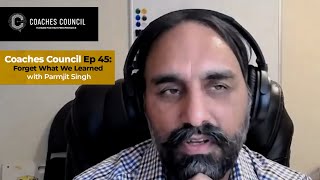
This is a YouTube video titled "Coaches Council Podcast Episode 45: Forget What You Learned with Parmjit Singh" recorded in early January 2021. It features a conversational podcast format with multiple speakers including Justin Roethlingshoefer, Parmjit Singh (a mindfulness and mindset leadership coach), and Pradeep. The discussion centers on mindfulness, mental health, human performance, and the importance of self-awareness, intentional action, and lifelong learning in achieving sustainable success in business, athletics, and personal development. Justin Roethlingshoefer plays a key role as host and contributor throughout the episode.
I suggest people you want to start, start from wherever you are. That's the best place to start. You can alleviate stress or anxiety, but the question is, is it a reasonable or good way to do that? Because people will do and then they will fall back to the same place and then they have to redo it.
This is the Coaches Council, made up of six elite coaches dedicated to serving and ending personal struggle for high performers in business, health and relationships. As a collective, we have built and helped build six, seven and eight figure businesses, dominate in multiple industries, coached and played in professional sports leagues, and developed some of the strongest and most intimate relationships, both professional and personal. This isn't your average podcast. It's for the hungry, the dedicated, the doers, for those that have a dream and truly want that dream to become reality. People who want to take action, leave their ego at the door and own every level of their life. If that's you, then step into the Coach's Counsel as we rewrite the truths to living that high performance life. Welcome back to another week of the Coach's Counsel Council. And Pradeep, great to see you today. How are ya?
Nice to see you again, my friend. Are you back in, where are you now? Are you in Florida? Are you in New York? Where are you?
No, still in New York. Yeah. It's been all around the world, all around the nation. And we simply tend to find ourselves between either the warmth of Florida or the, the family oriented state of New York. So it's back and forth, one choice, but back in New York this week.
I hear I'd rather be in Florida right now.
Amen. Amen. And I'm sure with the snow flying in Toronto or the cold starting to drive down, it's something that you're looking for as well. But very excited about today. I know that we're in a state new year now and we're entering into this place where a lot of us are setting goals, a lot of us are trying to accomplish things that we've set for 2021. We've got the best intentions. It's a new year. It's a new year. New me hashtag. And how do we take action on those things? I know we've been talking a lot leading up through it, all through December about how we can actually drive the momentum in which we create in. Created in the latter part of 2020 and rolling into the first quarter. And we are blessed today to have Paramjit singh with us, PhD, mindfulness and mindset leadership coach at McMaster University. And a lot of his work so far has been through his entire career has been based on the psychological aspect of human performance, both on the athletic side, but then into the entrepreneurial. And it's amazing how the way we think about things, the position in which we place ourselves, changes the outcomes. And it doesn't have to do with just the external results, but also the internal results of how we show up in any given state. And Paramjit's really going to really deep dive into that for you guys today and talk about how we can start to set ourselves up for success prior to actually being able to take that action and respond to the things that happen. So, Paramjit, thank you so much for joining us today.
Thank you, Justin, so much for inviting me here. And thank you, Pradeep. I'm happy to be in this space.
Fantastic. I love it. Parvji, I'd love you to go in. I know we were talking offline here a little bit, but I'd love for you to go into depth and knowing that we're in the new year, we're operating at a new level. People have all these goals, all these aspirations, things they want to accomplish. Where do we start mentally in being able to really drive through and create these goals that are unbreakable, are unshakable, both from a attainment standpoint, but also from a mental mindset standpoint and how.
We show up, I think the easiest and the most effective place to start from is always, as the cliche goes, from wherever you are. You know, that's often said in empirical practices, but also in very spiritual practices that, you know, the best place to start is where you find yourself in that moment. And it does two things. One is that sometimes we don't want to accept where we are because we keep on struggling and struggle, oftenly consume a lot of mental resources and contrainder to what we think, we still cannot change the outcome. So if we can somehow, with the bare consciousness, we start accepting that this is the place and this is the place I start from. You, in fact, get loaded with all the mental resources which you will be otherwise using. Resisting the thing. So 2020 has been monumental in a variety of ways. A lot of good has happened, a lot of bad has happened. And as we actually get into 2021, I think starting from wherever we find each one of us would be the best place to start. But it has to come with this space of what we call non judgment. Because if you start your whatever moment you start, whether you start a month or a year, and you want to judge that last year was bad, then it is going to have that kind of burdensome feel to it. So this is what I personally do and this is what I will, you know, suggest people you want to start, start from wherever you are. That's the best place to start and that could be good place or bad place because nobody knows how those things are going to turn up in the long scheme of things.
When you say starting where you are, the biggest thing I know we talk about all the time is just simply taking action and action leaves anxiety. Everybody starts from somewhere. The first step is always the hardest. But a lot of times that that first step, it's so easy just to say take the first step, start where you are. What does that require? It was so fascinating. You were talking a lot about self love and not judging yourself and allowing yourself to really just be where you are, be present and allow that circumstance of wherever you are. Just to say, this is where I am, this is exactly where I need to be. Reassess what's around you and then take action. Talk about how you get into that state of self compassion.
So one can, you know, if I can piggyback from your thought process. One way to alleviate anxiety stress is to take action. But people take action all the time. That can be reactionary action and you can alleviate stress or anxiety. But the question is, is it a reasonable or good way to do that? Because people will do and then they will fall back to the same place and then they have to redo it. And that's how people get into repetitive behavior. The where I come from as a practitioner is that if you want to see where you are, then you have to sit with yourself. You know, that's where the practice of mindfulness come in. So that whatever action you have to take, it comes from a place of intention, deliberateness. It does not come from a place of reaction. Because if I'm feeling uncomfortable, I can do two things. One is I can quickly take an action which could be very short term based and it will alleviate my tension or anxiety, but it does not actually solve my problem why I'm feeling the way I'm feeling. Or I can take a slightly more deeper path to it that I can sit with my discomfort and, and scaffold it or hold it in a very non judgmental space and see where this discomfort is coming from. Once I become clear about that, then I can chalk out an action plan which is appropriate to alleviation of the discomfort. The difference is very simple, but can be profound in the long Scheme of things. In the first part you can take action and that action comes from a reactionary mechanism, feel uncomfortable. You have to neutralize this discomfort. And whatever action you will take, it will probably actually will mitigate that discomfort. The second one is slightly more drawn out, more profound way of working with yourself. So then you actually work with your body, with your mind, with your thought process. And then you realize that this is what I need to do. So the second part comes from a space of clarity and deliberateness. There's an intention to it. You are not thinking what alleviating the current discomfort temporarily. You are thinking about how I can actually first examine what is going on here. Second, and can I use the knowledge that come from that examination to build up a proper actionable plan. And third, how to take an action which has a long term consequences on the way I feel. So simple as the difference is very small in a way, we are doing same thing in both ways, but only one difference in between those two things is one is very deliberate, non reactive way of taking an action and another one is very reactionary response to discomfort we are feeling.
I think you made some really good points there, Parmji, because there's a great saying that I'm not sure exactly who said it, but it goes to the tone of accept the situation but not the outcome. And that requires what you talked about. It requires you to be able to sit with your feelings, your thoughts and your own internal energy. And I think society is so caught up like we're just such a fast paced society. Everything is based on convenience. Everything is based on let's get the stuff done now, let's get it Amazon packages at your door the next day. That's just a society we live in. It takes a really mindful person or practices to actually be able to do that these days. Because when you're the only person in a social circle or society that's doing that, you become the person out of the norm, right? When your house, you're the outcast. When everybody else is running 100 miles an hour, you're the outcast. And I think that's just where people are these days. And when we tell people to slow down, they are hesitant about it. Because everybody's about results now, right? We gotta go as fast as we can, we gotta get stuff done. Especially in the corporate world, if we take a look at business business, a lot of it is being first to market. A lot of it is about getting out there in front of the your market. Because we know through research that the first, products that are launched typically in industry are the ones that create the reputation, the brand and ultimately lead. Not always long term, but they do lead. But how do we intentionally as a society then, because now we're talking, you know, you talked about as an individual. So here's a person that wants to do this, but they're seeing Everybody else go 100 miles an hour. It's like the person in the right lane, the slow lane. And just by seeing themselves slow down or by noticing that they're slow, that gives them anxiety because everybody else is going faster. Everybody's wondering, am I doing something wrong here? Right? Do you know what I'm talking about? How do you pull people out of that and get them to understand that going slow goes back to that saying, sometimes you got to slow down to speed up.
It's interesting you actually bring that point because yesterday we did the last Roche session and we started talking about that people do this individual works, that I do my individual work, you do your individual work and Justin do, and so many. Everybody actually does something which, which brings some harmony to their thought process. But then we also have to start talking about some pop culture connotation to issues. For example, in our culture. And you have identified some of those things that, you know, being busy is oftenly associated with productivity. Okay, but is it actually really true? Because one can be busy in a lot of things, but totally be unproductive in similar ways.
It's a great point.
Pardon me.
That's a great point. Yeah, really great point.
So we have a lot of. One of the things I have started doing, especially when I do the corporate work, is that after we have done our part, I will say that I want you to invite you to think about some of the pop cultures thing which has become untraged in our language. For example, we looked on upon the idea of doing nothing though doing nothing is your preparation to do something useful. For example, one of the example of doing nothing is sleeping. And as you pointed out in the beginning, we know what sleeping does or its lack does to humans. Their performance, their day to day life, their mental health, their physical health. So we have those kind of pop culture that doing nothing, doing something is always better than doing nothing. But doing nothing could be just a preparation. Sitting with yourself with your own discomfort can be a way to clarify your thought process to come up with the actionable plan for the intention. So doing nothing, productivity, busyness, motivation is another thing. We are almost sold out that more people who come across very motivated tends to do better in performance. And to some extent that's very much true. But then the opposite can also be argued, that people who are a lot more motivated also tends to make a lot more foolish mistakes because they are motivated, not because it comes from a place of intention or it comes from a place of clarity. They are simply so focused on doing things that they are motivated to do things. So they do not actually take a moment to sit with them and just bring that thought process and settle it up and then make an action out of it. So I think. Go ahead.
No, I was just going to say that's such a great point because so often with, and I'm speaking from clientele that we work with on a daily basis is there's a saying that we say we want to treat the source and not the symptoms. Because so often we're just trying to battle off the symptoms. One thing we're feeling, another thing we're feeling, whether it's anxiety, whether it's depression, whether it is fatigue, whether it's muscle soreness, it's what can I do to alleviate that now? What can I do just to get rid of it? Not taking into consideration the long term effects, what solving that problem will cause another problem of. And what we teach our clients is the same thing is we want to get to the root cause and the real source of it. And for a lot of them, it's routine based. You mentioned it, it's sleep and how all of a sudden changing up a sleep routine to get a higher quality sleep at night, that's data driven so that we can understand the base of what's going on. They now wake up in the morning and the anxiety they felt throughout the day because the first three hours of the day wasn't productive. And they thought, I just need to get more done in the morning. And by getting up earlier and getting more done will alleviate this in the afternoon. But instead it just sends them into a bigger tailspin. Treating the source, which is that mental clarity and that recovery aspect of sleeping at a higher quality, a higher frequency allows them to wake up, be more clear, be more focused, get into that flow state in a easier, more transcendent way over the first three hours of the day. So they get more work done, head into the afternoon, they have been more productive, that anxiety feeling has gone away. They're clearer, they're more focused, they're able to exude the talents that they want to at a higher rate in which they're hoping. And that is what we're talking about in treating the source and not the symptoms. But it comes back to what you spoke about, of being intentional and spending time in that discomfort, of why am I feeling this way and what is that true source of what I've been feeling?
Yeah, same. And I think I would add to your thought process that in our society people are comfortable with the discomfort that come from physical stuff we do. For example, if you go running or do you exercise? And people are okay to tolerate that kind of discomfort because they will say that discomfort is part of the skill learning. But they forget that similar kind of engagement with discomfort is required when you're working yourself inside yourself. When you are come, you're, you're facing your own fears, when you're facing your own thought process or negativity or whatever it is. And then they often actually bark at that idea. They think that if I'm actually sitting with myself and I'm feeling uncomfortable, we feel the need to just fidget or move away from it without realizing that I'm actually learning a skill set here so that I can negotiate and navigate my discomfort. And only by navigating through the discomfort, I will develop that sense of clarity. The same way if you work with the weights, there's a discomfort associated with that, but only once you work through the discomfort that the body starts to build in a proper way. So to me as a practitioner, I think the principles are the same. The principles that applied of skill development outside of us are the same. And the same principle applies only when we are working on ourselves is the same. But it does bring us to the question, actually Pradeep asked that what should we do? And I think brings us a couple of things we have to do. We have to work on ourselves, you know, because for example, you can give me all the tools you want, the best validated, empirically tested, data driven tools. But if I do not work on myself, I do not bring my own authenticity to the process. Your tools are going to be only good so far. Ultimately, when we are talking about human performance or leadership or we are talking about anything which requires us to bring our own stamp of uniqueness to it, we have to be in it. And we have to be in it. Not only in a physical sense of term, we have to be in it from a mental standpoint. We have to be in our spiritual standpoint. If you want to be spiritual means some people are not like that and they can leave that out and maybe they can just simply think about the mind itself. That's a very empirical way of testing yourself. So I think there's a Few way, easily actionable things we can do, we can do whatever needs to be done outside, we can do things we need to do inside. Because without a properly trained insight, the outside is always chaotic. It's just like you throw a swimmer who is not trained into the deep water, they are going to do a lot of activity, but that activity is not going to be very useful. They're most likely going to drown because of that activity. And I tend to think a lot of people in fact are like those swimmers who are not trained, but somebody they heard, they actually throw themselves into the deep waters, then they struggle. And from the outside purpose, they are doing all the things that they are flailing around, they are trying to stay afloat, but because they are not skilled, they are most likely going to drown at one point. And people do drown in their own stuff because they somehow have been flailing at the wrong places. And we know that from. It's not my personal opinion. We know that all the data, if you see there's one side of the data for high performing individuals, which is actually they do well in variety of tangible markers, means they have all the good things, which often people aspire, but then they also suffer from the other aspect, the mental health and all sort of things. I think that to me is. I'm using the metaphor as drowning in that context. Yeah.
I think what you're speaking about, Parmji, correct me if I'm wrong, is the act of balancing. Because any extreme you can be challenged with in life and high performers, they do very well in a lot of different situations. But again, they have to learn when to balance, they have to learn when to slow down. And I think Justin can talk about this as well. Athletes especially, they go all out for however many years that they have in, in their sport or their team. Like it's not a long lifespan, right. How what's the average tenure of a pro athlete?
I mean, you're looking depending on the sport, but two to three years.
Yeah, like that's short. That's a lot shorter than I thought.
Yeah.
So for someone to, you know, they're going all out, but what about those athletes that have lasted a lot longer? You know, if we take a look at someone like Chris Chelios, who's obviously, you know, retired and stuff like that, but you know, what was his tenure like these longer guys? Justin, have you been able to figure out why some people are able to stay in a sport longer or perform longer and does it relate to some of the work that Parmji is doing? Out there when it comes to, you know, the mindfulness or what we're talking about in this episode.
Yeah, no, it's a great question. Back in 2012 is the first real experience that I started to get with real, true mindfulness as to how it applied to you as an individual? Because to Paramjit's point, up until that point, it was just people taking different points of different cultures and trying to implement certain action steps, such as yoga, meditation. I put quotes around mindfulness because they really didn't have a really good purpose as to what it meant. But that was the first time that I really got turned on to what mindfulness was for the individual. And that was basically taking a step back and saying, what works for you? What does your game look like? What does your own situation look like to maximize the lifespan of your career? And for both my athletic clients as well as my executive entrepreneurial clients, it's much the point that we do. That's why Elise works alongside me on the mindfulness aspect, is because at that point, again, like Parmjit said, you can have all the tools, you can have all the gadgets, you can have all the this, the techniques, but if you are not able to sit with yourself, if you are not able to understand the difference between your lifestyle and somebody else's lifestyle, or what you need specifically, everything will have an end point. It will stop working for you. It will start leading you down a path that's not sustainable. It will lead you down a road that no longer brings you that level of fulfillment, because you haven't learned at the base of the pyramid what really looks after you. What is it inside of you that takes care of Pradeep, Paramjeev, Justin, Elise, Drew, you name it. Everybody is different. And so we need to make sure that we've encapsulated that there. And the best athletes. Bobby Ryan, the perfect example. The guy's been in the league for 12 years. 12 years he's been playing this game. And it's only because, does he have talent? 100%. But it's because he's been able to sit back and say, what do I need to focus on myself and not do the generalized athlete program? It's no different than some of the other. The CEO of Dick's Sporting Goods, he's sitting there, he's a CEO, just like a bunch of other CEOs that are out there. They've got all these other issues. The. The other entrepreneurs that are out there. Everybody has, maybe has families. Are they split families? Are they together? Do they live in New York City or do they live in Cleveland? That you are going to have different issues that you have to alleviate, different stressors you have to deal with based upon your individual situation. And sitting with those discomforts, sitting with those areas and addressing them head on, knowing that you are different is what creates the longevity and the success long term in each of those individuals. Unique experiences.
Yeah. Misa, if I may add to your thought process here, I think it's the fact that each one of us are different. And if we acknowledge that difference in a kind of a non judgmental space, that is what authenticity to some extent means. Because the way you are, nobody can replicate, means somebody can look alike you at a physical way. They can also do certain things which you can do at physical, but as a person, there's no replicability to you as a person. It's not to you, not to me. And when we acknowledge ourselves, our imperfect dysfunctional self, contraintuitive to as much as it sounds, it actually gives you a power. Or what we call embodied wisdom, which does not come from anywhere, means if you look at the history of healers or people, we remember these people were not perfect people. These were the people who acknowledged the imperfections in them and then worked on what was workable and became comfortable with what was not working well. And I think they were able to heal their demons in that way. And I think there's a value in, especially when I talk to corporate client, is that some of the things we think in our culture has a short term value. And I think we should acknowledge that. And if you want to go that route, please go ahead. If you're following short term values, you will get short term values. But don't complain about the dark side that is going to creep up at you in the long scheme of things, because you're not going to do it for two years, three years. This is your life. And depending on how long you live, these things are going to follow you. Or you can take a slightly harder, bumpy road and just bring yourself into the process that is not going to be as laid out and aesthetically pleasing. It will be slightly messy, but it will be genuine. It will be, you will, you will bring to the table, which is not cognitively possible if you think about only your mind. So bringing that kind of embodied wisdom means. This sounds a very loaded word, that embodied wisdom is where you use your intellectual mind, your talent, your physical body as a kind of a placeholder for that. And then you use yourself as a person, as a decision Maker and action taker. Rather than that, you have to. The brain has to do that.
No, that makes total sense because at the end of the day, it all comes down to us. It all comes down to how we utilize the information that we're given. There's a lot of examples going back to different metaphors, but you can't take a single tool, so you can't take yoga, for example, and try to apply it to every single problem. Because if that's the only tool that you have, well, everything starts to look like. If yoga is a hammer, everything starts to look like a nail. But we need to be able to have a full toolbox that we can start to implement. And you need to know yourself what tools you need to grab to accomplish whatever it is that you are feeling to alleviate those issues. Otherwise, that is what stops the progress long term. That is what prevents us from creating sustainable practices for us to find that level of success. And otherwise it just becomes this stop and go experience of solution, hesitation, solution, hesitation, solution, failure. And we feel like we just get on this cycle that is really never ending.
It's not only what you need to apply, but also when you need to apply means. For example, there's a need for yoga and if you know yourself, you will need that. This is where I need to apply it. And if you know yourself, you will also know this is where I don't need to apply this. This is not the required practice here. I think that kind of nuance has come from the personal embodied experience.
Yeah, I think what you guys mentioned, both of those points are very valid. I think one of the things that I just want to quickly add on to that is that, you know, both of you guys said this is that everybody is unique. Everybody's experience is unique, everybody's background is unique, Everybody's brain is unique to a certain point. So we're going to experience life a little bit differently. We're going to have a little different level of knowledge and every person has to try what's different things to see what's going to work for them. So the three of us are speaking about different tactics or techniques and we all are coaches in some way. We influence people, we're in front of people and we're sharing our thoughts and insight. And I'm the first one to say that. I always tell people, you got to find what works for you because that is the most important thing and the one thing I value the most. Because we're speaking to a very wide audience here. We're speaking to entrepreneurs we're speaking to people that are just starting out. One of the things that has really come up now in the social space, the social influence space, is this concept of entrepreneurship and how entrepreneurship is learned. It is learned, absolutely. But there's also this, and it's openly said, too, that academics isn't the route to success. That in order to be a successful entrepreneur, for example, you got to learn it the hard way. You don't go to school to become an entrepreneur. And so you know what? I can validate that to a certain degree because I've been a lifelong learner in academics, and I'm also an entrepreneur. There are different styles of learning. But here's one thing I appreciate, and that's why I appreciate the work that you do, Justin, and the work that you do, Parmji, is that you base it on stats and research. You base the work that you guys do based on studies, case studies, or whatever studies that might be, which take in a larger population. There's a lot of validity to that. When people talk about academics being old school or whatever that is in the entrepreneurial space, that's not necessarily true because there's a lot of research that goes into the stuff that. That Paramjit is talking about. There's a lot of research that goes into the stuff that Justin is talking about. And where do we get a lot of this research from? We get it from academic institutions. And so the point that I want to make here is that there's a lot of young people growing up saying, I don't need to go to school. Or, you know, that's not the route because we have social influencers saying, you know what? You got to be an entrepreneur. Forget about school. It's not going to teach you anything. I would say that's incorrect because there is a value to academics where you will learn that you don't just take someone's word for it. You take real studies, you take statistics, you take research, and then you for yourself, figure out what works for you. That's just something that came up for me when both you guys were talking. And the thing that just kept on into my. Popped into my mind was both you guys, the work that you do is based a lot on the stats, a lot on the research. So I just want to make that point out there for the listeners is that these gentlemen are sharing information not just based on their own experience, but a lot of the research that they've gotten from academic backgrounds or whatever that is as well.
It's a great point, Pradeep Because a lot of times we sit here and there's so much BS that's just thrown out that's just anecdotal based upon an experience somebody had and or somebody just happened to have a great mentor that learned. But let's also not forget the key word that I just said there. Anybody who has ever done anything. And again, this is anecdotal BS that I'm spewing right now, but anybody who has ever done anything has learned from somebody. So even if it's not a quote unquote formal education, you have still invested time, energy, and potentially money in somebody else to learn their level of expertise, learn what they have spent lifelong time doing, whether it was through their own formal education and you were getting a mentorship education, or whether you are getting some type of education by being associated with that individual or whatever it is. Lifelong learning and application of that learning is so, so important. And we can never poo poo on any type of learning or leveling up or education. Because at the end of the day, yes, creation is good. Yes, going off and experimenting is excellent. That's what pushes this country forward in a multitude of different ways and pushes the world forward in a multitude of different ways. However, if we're looking to be able to build upon it, there's a story, and I love this story. There's a guy named Samuel Pierpont Langley, and he was wanting to build the first plane, and the Wright brothers obviously built the first plane that flew. Well, both of these individuals were trying to create the first plane that flew after the Wright brothers did it. Samuel Pierpont and Laney said, I'm done. I don't want to do it anymore. And left. The best entrepreneurs, the best people, the best people out there are able to take creations that have already been made, learn from the people who have already done it before them, learn from the errors that they have done, and take what those people have created and then make something better. How do we make it better for not only us, but the generations that are coming forward? And it all starts with that level of education, that level of learning, and that level of being willing to step up and level up in a multitude of different ways.
And if you allow me to add to that, I think just piggybacking on both of your ideas, that I think as a culture we have to start incentivizing or reclaiming the value of wisdom. So learning combined with action would actually lead to embodied wisdom. We often have started to think of knowledge as the only thing, but knowledge is Intellectual knowledge most likely has not yet met the experience. So we need that lifelong learning. We need that action. We also need the embodied wisdom. And wisdom is something which in fact allows us to vision things. It allows us to connect the dots. And a bigger picture means one can have a great knowledge. But if that great knowledge is not put in the context of the real life, then it does not lead to wisdom. And oftenly wisdom is when we are able to connect a lot of doubts, where we are able to reconcile different things, different ideas, different action plans and come to something which is actually harmoniously mine, something which is conceptually fit to me. And to me that's actually, I think it's not much in our society, especially with the fact that everything is available these days means people tend to think that if you actually read few things on the computer, you become expert. And that's not a great way to go. You know, there I Even in academia we see a lot of knowledgeable students because knowledge earlier we have to physically go to the libraries and take out a book and read it. Now you don't have to go anywhere. You can just simply type in, pull in all the research on the PubMed or any databases. But that gives us impression that I know something. And I think the value of lifelong learning has to be there combined with all other things.
Such a great point, Parmjit, and it kind of wraps everything into one, is that it starts with knowing who we are, what we need, and learning from those around us, those who have been there before, those who have experience from both the side of academia as well as the side of application. But as we take in that information, be able to learn it, absorb it, understand it and then apply it in the appropriate direction, that ultimately makes the most impact for us. And the only way we can know what makes the most impact for us is by spending time in and on ourselves and truly getting to know who we are at our core. With that, everybody have a spectacular week. Stay hungry, stay humble, and we'll see you next week. Thank you so much for joining us for another week of the Coaches Council. If it wasn't for you viewers and listeners, we wouldn't have a platform. So again, it's all about you guys. And we want to give you a reward just for listening. We want to give you access to each one of our coaches for a little bit deeper intimate experience. So if you go to coaches-counsel.com coaches-counsel.com subscribe and like to whatever platform you're viewing on, you're going to be entered to have that one on one experience. So be sure to go coaches-cell.com and really interact with us because we would love to interact with you. Until then, stay safe, stay hungry, stay humble, and thanks for listening.
More from Justin




The Ultimate Blueprint for Taking Ownership of Your Health | Unlock Peak Performance

From Bullied & Anorexic to Healed & Purposeful: My Transformation Story (Justin Roethlingshoefer)


Forget "One-Size-Fits-All" Health! Unlock Your Best Self with True Personalization (The OWN IT Show)

Are Blood Tests Enough? Why Cellular Testing Might Be Better | Justin Roethlingshoefer

Your Body's Language: Understanding Stress & HRV| The Power of Ownership - Chapter 3 & 4


Is "normal" really making you sick? Dive into Different with The Power of Ownership:Chapters 1 & 2