Coaches Council Video Podcast Episode 24: Does Work-Life Balance Exist?
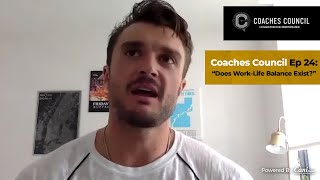
This is a YouTube video podcast titled "Coaches Council Video Podcast Episode 24: Does Work-Life Balance Exist?" published on August 10, 2020. The episode features a discussion among multiple coaches including John Romanello, Pradeep, and Amanda, who explore the concept of work-life balance from the perspective of entrepreneurs and high performers. They share personal experiences, philosophies on balancing work and family life, and strategies for maintaining self-awareness and meaningful relationships while pursuing business success. The conversation is motivational and aimed at helping listeners find their own rhythm and priorities in life.
Okay.
How many hours do you want to have to spend with your family? How many hours do you want to have to be able to spend on yourself? And when people actually break that down, you'll be surprised in terms of how many people don't have the answers to that.
It cost me a lot of family relationships just due to the obsession of wanting to be the best.
If you are interested in greatness, why would the regrets of a bunch of people who didn't do that feel relevant to you?
This is the Coaches Council, made up of six elite coaches dedicated to serving and ending personal struggle for high performers in business, health and relationships. As a collective, we have built and helped build six, seven and eight figure businesses, dominate in multiple industries, coached and played in professional sports leagues, and developed some of the strongest and most intimate relationships, both professional and personal. This isn't your average podcast. It's for the hungry, the dedicated, the doers, for those that have a dream and truly want that dream to become reality. People who want to take action, leave their ego at the door and own every level of their life. If that's you, then step into the coach's counsel as we rewrite the truths to living that high performance woman's life. Welcome back to another week of the Coaches Council. We got John Romanello and Kurt Ypsanga, and this week it's a big one and one that affects every single person out there. I cannot tell you how many times I've heard when I say, ask somebody how they're doing, they're like, well, works great, but home life sucks. Or they'll say the opposite and they'll say, man, home life is awesome, but work is terrible. And so how is it, or does it even exist? Is it just some type of unattainable ideal of finding that work life balance? And is it not a work life balance? That's a good word to describe it. But is it more of a rhythm and some type of magnetical field that is incorporated within those two aspects of life that start to find a way in which they operate together? And how can we do that? Pradeep, I know when we talked on our one on one, we really got into a lot of your life and to understand from the life of a CEO to an entrepreneur to all of these areas, as to that, it really pushed you to the brink in some of these spaces. So when somebody says to you, work life balance, what's the first thing that comes to your mind?
The first thing that comes to my mind is really, what does work life balance mean to that person. And I think it needs to be individualized. I think that's a danger of where we're at today, especially with social media, because we have so many different groups talking. You have the hustling grind group, right? You have that group that's like, okay, you get a hustle, hustle, hustle. That's what life is about. That's what business is about. Then you have another group that's saying, be extremely mindful, don't worry about that. I think it's a constant flux between the two. In some way, shape or form. You have to have some kind of enjoyment out of life. And whatever that work life balance is for you, you got to get around that and you got to figure that out. Everybody is different, Everybody is an individual. That's why for me, when someone says work life balance, I ask them, what does that mean? Okay, how many hours do you want to have to spend with your family? How many hours do you want to have to be able to spend on yourself? And when people actually break that down, you'll be surprised in terms of how many people don't have the answers to that. Because for them, work life balance is just a word, it's just a term. But you have to find out what that actually means. What do you want your life to look like? I can tell you some of the most successful entrepreneurs that I work with, for example, they don't have smartphones. They have their office lines out on a certain number of hours every single day. So if you catch them within that window of opportunity, you catch them. Otherwise they're out there living their life the way they want to live it. Then you have other entrepreneurs that they got their cell phone with them 24 7, right? You can call them at 1 o' clock in the morning or 2 o' clock in the morning, because that's how they want to live their life. So I think it just depends on each individual person. That's why in the last episode we were talking about different learning the hard way. Actually, I just want to share a quick story over the last. You can say two years ago, for a couple of years, I was building a business around, you can say group coaching and mass coaching. Because I want to impact more people. But I realized that there was a danger in that as well because there's only so much you can do. There's only so deep you can go with individuals in a group coaching session. And that's why I pulled back a little bit and went more onto one on one is because I could understand People more. I could clarify the questions more rather than a group coaching because there was a danger in me teaching a generic term, for example, when it came to things like work life balance. And so getting deeper actually allowed that person to express and find out a little bit more about themselves in terms of what they truly want from a work life balance perspective. So here's my personal opinion. I think it is absolutely, you can say, possible to reach a work life balance. I think it totally is doable. I don't think you need to aim for the sky if you don't want to. I think what happens is a lot of people have social pressures put on them to say, you need to be making this much money, you should be traveling the world. You need to have this kind of a house, whatever it is. People want to live a lifestyle that other people want them to live. You got to figure out what kind of lifestyle you want to live. Ultimately. I also believe in the concept of sprints. So anytime I work with someone, I say, you got to sprint it, right? If you're looking to grow your business, you might have to put the next six months in and really dig hard and work your butt off. You might be working seven days a week for what, whatever it is. But then you got to take some time off, otherwise you're going to burn out. Like, for me, right now, I'm in the process of writing my next book. And I know up until Christmas this is going to be my life, right? This is what I'm doing day in and day out. But after that, I got to give my family more time because if I continue to do it past the new year, I'm not only going to burn myself out, but I'm going to be neglecting my kids as well. And you might, you know, you can't see this because you're listening to on this podcast, but my kids are hovering around here trying to get my attention, saying, you know what, Dada? When are you going to be done work? I don't think it's fair because I see a lot of entrepreneurs in this spot because a lot of the times we are, we're looking for achievement, we're looking for success. And we justify it by saying we're trying to provide for our family or we're trying to do good for somebody else. But in that respect, sometimes we lose sight of the people that just need basic attention from us. So, like my kids, for example, is it right for me to say, hey, look, there's all these men that I need to help? There's all these men, I could spend 12, 16, 18, 20 hour, 24 hours a day if I wanted to, to really help men. But is that fair to my children? Is that really fair to two young, impressionable kids that need their father around all the time? Is it fair to my wife? So it just comes down to priorities. It comes down to values. It comes down to what kind of life you want to live. And at the end of the day, what is it that you really want to achieve? My number one purpose in life outside of the work that I do, is raising two healthy children. So I have to have some, you can say, conscious work life balance, because I need to give my kids that time because that's one of my top priorities. So I think every individual needs to understand what that work life balance, what the most important thing is in life, what they want to achieve. And it doesn't have to be something that someone else puts on you. At the end of the day, it's.
Interesting the way that you bring it up, where you say that people that you work with actually have never even given that thought, and they've actually just gone into something with no expectations. And all of a sudden, before you know it, they get on the train, they start going and going and going, and that train has now picked up so much speed that they don't know how to slow it down. They don't know how to redirect it. And if they do redirect the train that's going that fast, what happens? The train comes off the rails. And that's often situations that entrepreneurs and other people find themselves in in different ways. And, John, you've done it so well with being an entrepreneurial family, you and your significant other. Amanda, what is the number one thing? Or you don't even have to give me one thing. But what have you guys been able to do in terms of creating this boundary and.
And.
This system that works so that you both feel that you're having your needs met, but yet you also are able to look after your businesses and grow them at the rate that you feel comfortable and happy with.
Yeah, so that's a great question. I think it's entering the question of work life balance with the frame of what works for Amanda and I is, I think, a little bit it makes the question softer than it should be, because I do want to acknowledge that we are young, unattached people who don't. Well, she's young. I'm old and broken, but we don't have any children. And so in the case of PRADEEP he does have human children who he wants to love and give his attention to, but they also require time and attention and care as humans do. And we're also very fortunate to be with one another and having dated people who are not entrepreneurs who were nine to fivers, explaining the demands of that requires that first to understand the language. And so we're very, very fortunate in that. I suppose it could go the other way and we would, we would both be, we could both be working all the time, but we have a good flow and I think it's simply because both, where we both are with respect to our individual, our individual businesses. When we first started dating, she was in the phase of her business where she was actively trying to scale and they had revenue goals and her team was much larger. And so consequently she worked so much more than she does now and you know, meetings every day and was working, you know, maybe from 9 or 10 in the morning until, until 6 at night every night. And then the stress of that always being on. I was in that phase many years ago and when I was building and scaling, we both realized that for us, and this goes back to our conversation from our previous episode, what works is more of a lifestyle business. And within that we have, you know, a standard like six to eight hour workday where we're doing stu that we care about. And because we are both in that phase, it's very easy for us to flow around one another. There are phases at which like, you know, maybe one of us is running a product launch and it's more of a sprint and so the other one can provide more support and that goes both ways. So it really is easy for us because everything is set up quite well and we've already been through, you know, the, the particular gauntlet of figuring out the type of lifestyle that we want and addressing the things in our businesses that were preventing us from having that, you know, we're both fortunate to make the type of money that allows us to be pretty relaxed. So if I compare that to where I was when I was Amanda's age at 27 years old and I was in this go go, I was always on my check my email 30 times a day. There was, you know, not a person who couldn't get in touch with me 24 7. It was, it was very different. I tend to look at the work life balance question from the perspective of over what length of time. It's very difficult to have work life balance in a 24 hour cycle every day, like all the time. You know, it's just like, it's very difficult to just be like 50, 50 and feel confident in that. If you look at it over a week, most people are like, ok, well I'll work five days and I'll take two days off. That is a type of balance. If you scale it up too much then you have this deferred enjoyment of life that is prototypical of Western culture where you work your ass off all the time and then you retire at 65 and now you get to go live your life and enjoy yourself. I think that somewhere between the 24 hour model and the retire at 65 model is the thing that's going to, you can find some scale and try to establish balance within that in a way that's going to make you happy. And for me, I like chilling. But then when I'm like working on shit, I'm like all in. I will sprint. I will. You know, went back when I was running a lot of product launches. They were, you know, like an entire week where I just didn't sleep and I was up doing the custom, doing all of it. I'm backed off from that now because it's not, I've realized the fact that it's not necessary. But I might work on that product for three months and then run that launch for two weeks and then I'd be working two hours a day for the next two or three months. But if you look at that six month period, that is a type of balance. It's jog, sprint, rest, coast and that is a type of balance and that works very well for me. Other people, they like to just be more, you know, sort of. They work four or five hours a day every day. They don't take days off. It's like, it's like hygiene for them. So I tend to look at it in the, you know, the context of what container are you comfortable trying to establish that balance within? And I tend to like go back to my, you know, my fitness days when I was writing programs and people would say things like, is it possible to lose fat and gain muscle at the same time? And I'd be like, well, what's your definition of at the same time? Is it possible for your body to be building muscle and burning fat at like literally at the same time in a given second or minute? Yeah, it's very, very challenging. It's much easier to look at like, here's a 16 week program. The first eight weeks are going to be focused on fat loss. The next eight weeks are going to be focused on Muscle building within the context of that 16 week program. Yeah, you're going to do both at the same time. So I just really, I try to find that window and decide where, where do I, where does it make sense for me to use as the scale to judge whether or not that work life balance is existing? Because for me it doesn't make sense to like work my ass off and defer my enjoyment and then when I'm 65 and I can't enjoy my life, do that, you know, so I don't, I don't like buy into that rise and grind, you know, hustle porn narrative where if you're not working, life sucks. Like I try to watch at least 12 hours of TV a week because it enriches my life. I love storytelling, I am a storyteller. I love telling stories. I love being told stories. I don't, I don't feel like vegging out in front of the TV is negative. It has no connotation to me. So that circles back to Pradeep's point of view. You need to be clear on your values. You need to be clear what feels good for you and not live your life according to the values or espoused values of other people's expectations of what it means to be what you should be pursuing. The idea of working and just generating tons of income to buy a big house to impress other people is, you know, that's the province of young, ego driven man. I'm not there anymore. I like a comfortable life. The idea of being comfortable constantly working 24,7 so I could talk to other work addicts and explain to them how much harder I'm working like that. I don't need to do that either. So you need to find your true north. You need to find that. And so that'll be like, what do you want your life to look like in it in a given week, year, 10, 5 year period? And then what are the things that you consider, you know, work life balance has to include some assessment of what, what's the life component? We know what the work component is. What's the quality of life component? Pradeep hanging out with his kids. For me it's, it's, you know, I, if I can't carve out five hours of my time to read for pleasure every week, like my, I'm working too much. So whatever it is for you. So again, that goes back to Pradeep's question, you know, his statement in the very, very beginning of the episode where he said people wanted work life balance and he asked, what does that mean to you? And they didn't have an answer. So we know what the work component is. You have to determine what would that quality of life look like? What does the life component need to include? And what can you cut out to allow for more work, if that's necessary. And then what's your rhythm? Is it, you know, jog, sprint, rest? Is it, is it, is it more steady state? And then finally over what length of time? Because that is, you know, balance every day over 24 hour period. Is every minute of your day balanced? No. Most people are thinking of it as like, I want to work eight hours and then be off eight hours, but that might not be feasible. So those are the three big components I would look at.
It's such an important thing to think about because I've been very open through my entire journey that coming from the NHL to the entrepreneur world, and that whole transition was not smooth, that.
It.
Cost me my relationship, my first relationship. It cost me a lot of family relationships just due to the obsession of wanting to be the best, comparing myself to everybody else. And it lived from a sense of insecurity. It lived from a sense of not knowing truly who I was, where I wanted to go, what I wanted to do. And it manifested itself in the way that I took control of what I could, which was how much I was working and forgetting about everybody else.
And.
And at the end of the day, you take a look back at it. And when Elise came into my life, it was okay, I get it now. It was like an aha moment where you figured out what that balance truly meant. From your desire of wanting to spend it with somebody else, but also still get done what you wanted to get done. From that entrepreneurial sense, from that business sense, from that sense of relaxation, what made you happy. Like John, you speak about being able to sit and watch TV and read and be told stories, Pradeep, play with your kids and do the family things that you do that you don't want to miss out on. I think it was a story you told last week, Pradeep, about the one that your wife had told about the oncology patient that they had been diagnosed with cancer and that as a major business owner, that cancer was a gift to him because he was able to finally settle down and slow down and really take a look at the flowers and the things around him and the true gifts that were there. And I was listening to a podcast with Simon Sinek, and he was talking about how he had been in a old folks home. And he had gone through and he had been doing this little case study on his own, and he went and asked every single person in about, I think it was 20 different senior citizen homes about what they would have changed in their life. And the resounding, resounding majority of was that they would have not worried about work so much and focused on the people around you and what truly brought joy and happiness to them, which was their family, which was their kids, which was their friends, and not foregone everything for the sake of the almighty dollar or the sake of the business or the sake to purchase the next big thing. Comparing to the Joneses. And again, Rome, I'll go back to you on this is how do you get somebody to that point if they have not yet seen the darkness or they have not yet been there? How do you. How would you explain that to somebody without them truly experiencing it yet?
So the question is, how do we explain to, let's say, a younger entrepreneur young man who is in that hustle grind sort of mindset, how do we explain to them that they may at the end of their life regret having spent all that time working?
No, no. It's more to the sense of there's a season for everything. We've talked about that there is a season to push and grind. If you want to build an empire, you want to build a business, it's not going to happen overnight, it's not going to fall your lap, it's not going to happen by good mantras and good vibes. It takes hustle, it takes grind, it takes a push. But it doesn't have to. It goes back to even what you talked about last day was how iteratively you're going to grow your intestinal fortitude with. And it all depends on the amount of patience that you have. But coming back to the season in which you are living that at some point there needs to be a sense of balance and what warning signs. And if you're in it and you're in it and you're loving it and that's where you're at. Phenomenal. But what signs around you would be there, and I'll give one of them is for me, it was when Elise came into my life, it was so distinct for me that this is somebody I want to give my time to. That's going to take away from other things that I would previously have given it to versus what I did for the three years prior that cost me my marriage and cost me relationships was because I wasn't willing to do that. And so what are some warning signs or what are things that we can continually do on a day to day basis to reassess where we're at so that we can be the best version of ourselves both at home and in business?
I think that question is much clearer, by the way. So I think that it may be, there is a possibility it may be one of those lessons that you only learn by learning it. And so to your point, you were only able to achieve balance when you met Elise, she served as the catalyst for, for that change, for that shift in your mindset, where it seemed like now there is a reason for me to do, to spend less time and a reason to spend more time, to spend less time on work and more time in the, in the personal aspect. You also mentioned that not doing that very likely cost you your marriage. And it was one of the things, you know, being obsessed with work cost the marriage. I think that it's very likely the case that while I'm certain Elise is dynamite in every sense, it is only having had the negative experience of the loss of the marriage that that wound, now you're aware of what you can lose. And so when Elise comes along, she is getting the benefit of that lesson and you're like, okay, I'm not going to do that again. And so certainly there is something very, very special about Elise. I'm sure there are other women who came along who didn't inspire you in that way. But the ability to make that change and pull away was because you learned the lesson of having lost the marriage. And sometimes that, you know that that loss, whatever it is, that defeat in, of the self, of the ego in some way that creates a new reference point of that, of where their consequences can, can arise in your life from not making the change. And it's, you know, in so many of the, the relationships I have in my life, the people I speak to, especially people have been through the divorce. So much of, you know, there's this thing that like, you go through this relationship where you don't like the person that you were, and then you wind up being the person in your next relationship that would have saved the prior relationship. Right? So the loss of the one thing turns you into the person who could have saved it. And that's just, it's part of life that's very much the hero's journey. And so preventing that, obviously if you're in a marriage, you shouldn't have to lose the marriage and go through a divorce to get to the place where you can Achieve balance in your life. So the things that you want to put in place are check ins with the people in your life. You ask them for their honesty and their trust. So the first person you need to check in with is yourself. Do I feel like I'm showing up in my relate. These are your journal questions, by the way, that I'm going to give you. Do I believe that I am showing up in my life? Like, do I feel I'm showing up in my life the way I want to for the people in my life? And then the next question, because you're always gonna fucking lie to yourself like an asshole. The next question is, would they corroborate that? Would they verify that? Right? Like if they were being really honest, would, you know, would Amanda say that I'm showing up in the way that I should be? And if I'm not, how long has that been going on and how long can it continue? And is there a reason for it? Right, like again, sometimes we sprint, sometimes you're in a bad way. Sometimes you're in a depressive state or whatever and you're just going through the motions and something needs to be fixed. And the people in your life, they have that resilience, that love for you where they can tolerate it. But the next person you check in with is the closest person to you. And I mean that in terms of like proximity, which is the person you live with. Like, am I a fucking asshole right now? Is this the worst? Or like, am I like, how am I doing? And you have to, by the way, you, you have to inculcate that check in when things are going great because you have to build the habit of having the check in and of being honest when it's low stakes. You don't want to wait until you're asking yourself, maybe things are really bad right now because that person doesn't have the practice of having that conversation. So you want to incorporate that when things are very good.
We'd be remiss if we didn't take this time to thank our sponsors that allow us to reach you each and every week. The coaches council is powered by cannibrands, a lab tested all natural pure hemp CBD company without the presence of thc. They encompass our passion for health, wellness and fitness that we have on the coaches council. Visit cannibrands.com and at checkout use the promo code coaches20 to enhance your wellness journey. So it comes back to, it comes back to that self awareness and actually tapping into what self awareness truly means. It's one thing when someone's like, oh, you just need to be more self.
Aware, but you have to develop it. That's a developed characteristic. So it starts with journaling, asking yourself, am I, am I happy right now? Do I like the way life is going? Do I like how much time I'm spending on work versus at home? Am I happy with the way I'm showing up in my business and my relationships? Am I tired all the time? Has my level of enjoyment gone down in the past year? Then you sort of reflect those questions to the people in your life. You start with your intimate partner, the person that you live with. Then you start with the people in your business, like, hey, am I my crushing it for you guys? If you have staff, like, am I, you know, your employees, your people, am I doing a good job? How can I be better? Is there a way, like, I can be 1% better? And the things that I do for you, like as a boss or as a partner, as a business partner for your clients, and then finally you find your pillars, right? And these are like anywhere between three and it could be one. But I like, if you have a group of people, particularly who know each other, like that core group of teammates you have, or best friends, like, you know, it's my four best friends that I've been tight with since I'm 16, before I like, went, before I had any money, before I had the business, the best selling book, like, you know, and I hate to use this example, I just can't think of a better one. But they're the, like the Johnny Drama, the Eric and the Turtle to Vincent Chase and that, you know, so in this, in this ridiculously inappropriate metaphor, I'm Vincent Chase. The entourage, but they're, they're my dudes, right? Like, I. There have been times where I have fucked up in my life and there they were just, they just backed off and let it happen. And they're like, well, we don't want to interfere. And now we've had the conversation on, like, you are empowered. If you see me stepping off the path, if you see me messing up, like, I want you to call me out. You guys have known me longer than anyone. This is, you know, I outlined for them the person I want to be. This is who I want to be in my life. This is who I want to be in my relationships. This is what I want to achieve in my business. I don't just want it to be this cash machine that makes me money. I want it. I want to build something. I want to want it to matter. And so if you see me like focusing too much on the stuff that's just like generating revenue and hiding from myself and not working on my books, need you to call me out. And so I have check ins with them. We have a group text. We talk every week and you know, like every two months I'm just like, hey, I'm like, from what you see, how am I doing? Am I like my, on the path? Those guys are never, they're, you know, they're family. They're never going to leave me and I'm never going to leave them. So they have nothing to lose by telling me, you're fucking it up right now. Because they know that I'm not going to get angry and never speak to them again. They're in for life. So having those pillars, that group of peers, you know, because these are the people who saw me rise from boyhood to manhood and they're, they're, you know, having, having that check in. So I do three check ins, you know, just like, you know, if I'm ever feeling like I'm straying from the path, it's my, it's Amanda. And then, you know, it's the people I work with. I don't have a staff right now. I just have some interns and stuff. And then, and then it's, it's my boys, it's Josh, Evan, Rob and Ross. And just that's how you assess how things are going. But again, you have to know what you want it to look like. You have to know who's the person that you want to be. There's a story that I want to touch on first. I'll let you respond to that and then I'll tell a story and we'll go a little bit deeper with something. But I want to see if you have a response.
No, I think what it comes back to Rome is all the listeners out there, if you've been following along, especially the last few weeks, is as much as we may seem that entrepreneurs are lone wolves, lone soldiers plowing away doing what we need to do to do it successfully, to do it fulfillingly, to do it in a way in which creates happiness. It takes a village. It takes a large amount of people. From what we spoke about last day with your mentors with your network to today about your significant other, the pillar group of people that roam just spoke about your people that you live with. If it's your kids, if it's your spouse, whoever. There is a large amount of people who are Pulling for you, who are helping you, who have been there from when you were growing up and groomed you to be who you are now. And those are the people that are there with you. So you're not at this alone. And to find this work life balance, it does exist. There are seasons for everything. But it takes making sure that your ecosystem is whole and working well so that it's not poison.
Yeah. And you do have to have those people around you. There's one thing I want to touch on because every time I hear something that's repeated all the time and that, you know, I always dive in a little deeper and I want to know more. You mentioned Simon Sinek, and he went to a number of retirement communities, went to 20 retirement communities, and he spoke to people at each one and he said, like, what is your top regret? Right. And it's like spending too much time on work, not enough on the stuff or the people I love. So there's an article that went around a couple of years ago, top five regrets of the dying. I don't know whether it's a true story, but the article espouses that there's a nurse who works in hospice care and, you know, she asks all these dying people, what are your regrets? And the top five regrets are, you know, cared too much about what other people think and spent too much time working and not enough on, you know, what, what really mattered, family, etc. My, you know, again, I'm a data guy. I love data. And my question there is, is this sample size reflective of me? Right? So if as an entrepreneur, as someone who's like, wants to build a legacy, as an author, like, do you, do you think it, like, the end, like, I want, I don't give a shit about what a bunch of nine to five workers say when they're dying. I want to know, like, on his deathbed, like, what is Stephen King gonna be like? I wish I spent more time with my kids and I wrote fewer books or I didn't spend as much time writing. That's what I want to know. Like who, like, if you, if you ask Warren Buffett, if you ask Richard Branson on their deathbeds, are their answers going to be reflective of the, you know, the same sort of sentiment that we get when we, when we poll the general populace? Probably not. And so if you're an entrepreneur, like, firstly, you don't have to change the fucking world. You don't have to be Zuckerberg or Richard Branson or Warren Buffett. You don't even have to be, you know, Tim Ferriss or Gary Vaynerchuk or whatever. But, like, if that's what you're going for, if you're one of those people who's like, shoot your, you know, shoot your shot, like. Or like, you shoot for the moon, you land up above the star. If you are interested in greatness, why would the regrets of a bunch of people who didn't do that feel relevant to you? Right. Because, yeah, I guess if you had a 9 to 5 job you didn't like and you worked your way up the corporate ladder for a company you didn't like, now you're 95 years old and you're done. Of course that fucking sucks. But if you built something and you, like, and you spend all that time working and you're leaving a legacy, did those people feel the same way? And I don't know. I. And this is just a thought experiment, it's a question because I really want to. Yeah. If, like, you spent your whole life trying to, you know, just achieve a slightly higher level of normal, and at the end of it, you're like, oh, it actually wasn't worth it. I wish I would have just. If I was just gonna die with nothing, I would have just wanted to spend the time with my wife. Yeah, that makes sense to me.
I love where you're going with this. And I think what you're doing is you're actually nailing it on the head. What we're talking about here is because those people you just mentioned, the Richard Bransons, the Mark Zuckerbergs, they have found a way. You see it often, especially with Richard Branson, where they have found a way to incorporate their family into everything. And they have found. They have found success, but they have also found the work life balance that is right for them. Going back to what Pradeep talked about at the beginning was identifying for each individual what you are willing to do to invest, to create this empire or this change. And like you said, it doesn't need to be something that changes the world. It doesn't need to be something that is that you're launching a rocket into space. But what is it that you're building as an entrepreneur and what balance are you incorporating of things that truly matter to you? And I think it's identifying what does matter to you. And you are failing in the area of quote, unquote, balance. I like the word rhythm much better if you have taken the time to sit back and truly understand what it is that matters to you and figure out how Those things all fit together.
Precisely. So the thought experiment is just this. If you were to take the five people whose lives and careers you're trying to emulate and envision them on their deathbeds, what would their regrets be? You know, because a bunch of middle managers from middle America who lived middle class lives, their regrets, probably, it's entirely possible they are reflective in that when we're dying, none of it matters to anyone. But I tend to believe people who achieve great things knew going like they were. They geared their entire life to doing that. And maybe, maybe their regrets are different. Like, maybe their regrets are like, ugh, you know, maybe Branson's like, fuck, you know, there was. I had this opportunity to build it, to buy a different island, and it was bigger than Necker Island. And every time I'm in Necker Island, I'm like, yeah, this is dope. But I wish I would have gotten the other one. I could have, like, I, you know, maybe people would have been like, I wish I would have, I would have helped more people. I would have invested in this other thing. I wish I would have invested in electric cars earlier on so that I could change the world faster. Because I, as I'm dying right now, what I would have loved to see is a world without fossil fuel consumption. I don't know. But what I do know is that the story of the fisherman gets passed around a lot. You know, the fisherman who is on the beach and a businessman walks by and sees him and he's like, oh, it's so early. Why are you, why are you here? And why didn't you stay out longer to catch more fish? And the fisherman says, I have enough to support my family's immediate needs and to sell a few. And the businessman asks like, well, what do you do with your time? He's like, well, I sleep. I sleep late. I fish, I play with my children, I take a siesta with my wife, I stroll in the village, I sip wine and play guitar with my friends and I have a full life. And the businessman says to him, like, well, I have a Harvard MBA and I could help you. You should spend more time fishing. And with the proceeds from the fish, you could buy a bigger boat. And with the proceeds from the bigger boat, you could buy several boats, you could have a whole fleet. And instead of selling your fish to a middleman, you could sell directly to a processor and you could have your own cannery and you could control the product, the processing, the distribution. You'd need to leave this small and move to, like, Mexico City, probably, or then LA or New York, where you'd run your own expanding empire. And the fisherman says to him, like, well, how long will all this take? And the businessman says, 15 or 20 years. And then the fisherman asks, well, then what? What do I do then? Well, that's the best part. When the time is right, you announce your IPO and you sell your company and stock to the public, and you become very rich. You make millions. And the fisherman asks, well, then what? Well, then you'd retire. You know, you could move to a small coastal village where you could sleep late, fish a little, play with your kids, take a siesta with your wife, stroll in the village, sip wine, and play guitar with your friends. And so the lesson is that even if he achieved all the success, he would have a life identical to the one that he has now. And so what's the point of chasing all that? That's the moral of that particular parable. But. And for most people who aren't trying to leave a mark on the world, that's totally cool. That's totally accurate. And, you know, I've gotten to the point where, like, I sleep late, I walk my dogs, I make enough, you know, But I am leaving something behind. I write books, and I am. I know that the work I am doing is changing lives. And that's very important to me. That's my true north. Because it is important to me to do something that. To build something that outlives me. And maybe that's entirely ego and that gets stripped away on your deathbed. But I don't think that most entrepreneurs are going to learn from the top five regrets of the dying. Unless all. Unless that information is collected from other entrepreneurs who built things. And at the end of their lives, you know, maybe they're like, ugh, fuck, was Facebook really worth it? Like, if Zuckerberg on his deathbed is like, I wish I would have just not done that, then maybe. So I would say anytime you encounter information like that, always question like, does that actually apply to me? Balance is important. Work, life, balance, home, work. You know, all of the things. For me, I want to leave the world better than I found it. And, you know, that means leaving the people I encounter better than I found them, teaching them in some way. And I can't. To me, it's not. It can't just be my family and friends. It has to be on a broader level. I have to spread a message that is what is important to me. And if at the end of my life, I. It would be very surprising to me if I'm laying in my bed wishing that I had spent less time writing, that I have, that I had left fewer words behind. Because my biggest fear is that I'm going to die with the best word still inside me. And that is what gets me every day to like sit and put my fingers on the keyboard and type and go, you know, just one sentence closer to the next book, to the next thing. Because that's my true north. My true north is that, you know, it's important to me. And find what's important to you.
That's a great way to end Rome. It's find what matters to you, find what truly inspires you and hold on to that, but yet have the check ins and the touch points and the self awareness to be able to continually look back on what you're doing and where you're at so that you don't pick your head up 40, 50, 60, 70 years from now and say, what life is this that I'm living with that everybody? Been another week on the coaches Council. Thank you so much for joining us. Stay hungry, stay humble, we'll see you next week. Thank you so much for joining us for another week of the coaches council. If it wasn't for you viewers and listeners, we wouldn't have a platform. So again, it's all about you guys and we want to give you a reward just for listening. We want to give you access to each one of our coaches for a little bit deeper, intimate experience. So if you go to coaches-counsel.com coaches subscribe and like to whatever platform you're viewing on, you're going to be entered to have that one on one experience. So be sure to go coaches-counsel.com and really interact with us because we would love to interact with you. Until then, stay, stay safe, stay hungry, stay humble and thanks for listening.
More from Justin




The Ultimate Blueprint for Taking Ownership of Your Health | Unlock Peak Performance

From Bullied & Anorexic to Healed & Purposeful: My Transformation Story (Justin Roethlingshoefer)


Forget "One-Size-Fits-All" Health! Unlock Your Best Self with True Personalization (The OWN IT Show)

Are Blood Tests Enough? Why Cellular Testing Might Be Better | Justin Roethlingshoefer

Your Body's Language: Understanding Stress & HRV| The Power of Ownership - Chapter 3 & 4


Is "normal" really making you sick? Dive into Different with The Power of Ownership:Chapters 1 & 2