How to Sleep Better: Mastering the 3-2-1 Rule with Justin Roethlingshoefer || OWN IT #sleep
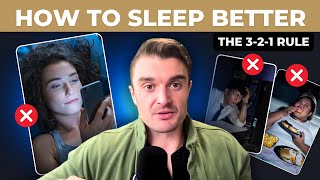
Justin Roethlingshoefer breaks down the 3-2-1 rule for better sleep: stop eating 3 hours before bed, stop work 2 hours before, and stop screens 1 hour before. He covers circadian rhythms, supplements, and routines to actually sleep well.
What does it mean to ultimately get a great night's sleep? Because getting a great night's sleep is very hard for people. We need approximately about seven and a half hours of sleep every single night. So when we think about getting the best quality sleep possible, there's a few things we need to think about. A simple three, two, one rule. So three hours before bed, no more food. Two hours before bed, no more work. And one hour before sleep, no more light. This is the Own it show where we tell stories of how everyday people made ownership theirs. What's up, champions? How are you? Welcome back to the Own It Show. I'm your host, Justin Rothling, chauffeur. And if it is your first time here, welcome to the show. It's so great to have you. Hopefully you were maybe saw it on a social post, maybe you were sent this by somebody who loves you because they're like, hey, I think you can take ownership of your life, but ultimately take ownership of your health so you can realize life at a different capacity. And so here at the Own it Show, we really focus on stories and concepts and habits and behaviors. And how can you take ownership of these people who live in ownership so that you can realize life at a different level. So if anything that's said here today impacts you positively, be sure to share it. Be sure to leave us a review, because that's how we reach more people. But again, interact with us on social media so that we can again hear where we can ultimately lean into you in a bigger way to have the greatest impact. Because at the end of the day, our mission is to redeem the health of the world through educating, equipping, and empowering people to take ownership. Today, a solo episode stuck with me, unfortunately, but we're really diving into a cool concept and the concept that a lot of people have asked me over the course of the last few months, and I've just had this overwhelming feeling whether it was after I was done keynoting, whether it was after I've done running a workshop, whether it was just getting questions through social media. Oh, of what does it mean to ultimately get a great night's sleep? Because getting a great night's sleep is very hard for people. It's one of those things that is almost like the invisible boxer, where it's like, hey, I'm going to do everything in my power, but I'm actually not getting the outcomes that I'm desiring. And when we fight this invisible boxer, we swing so hard. We do so many things. We do what everything's told us in the world. But we haven't really gotten to the underlying cause of why we're not sleeping. We haven't really understood the mechanisms that exist, that if we truly understood these at a better level, it would start to become very apparent that what are we doing in our lives? What actions are we taking? What habits are we engaging in? What things are we just doing that subconsciously we didn't even realize are hindering us from getting that great night's sleep? Because there's nothing better than a good night's sleep. You don't know an answer to something, go get a great night's sleep. You wake up, you figured out the answer in the morning, you're upset with somebody, go get a great night's sleep. You wake up in the morning, doesn't seem so bad anymore, you're not feeling very well yourself, go get a great night's sleep. You wake up in the morning, sleep, feeling a little bit better. And so a great night's sleep not only increases energy, not only increases recovery. And we can get into a lot of the science that we'll get into today, but it's obviously just a cure for a lot of things that ail us in this life. Because without sleep, we start to think differently. Without sleep, we start to be able to recover differently. Without sleep, we don't think as clearly. And that's ultimately what we want to solve. So fasten your seatbelts, grab a pad of paper, grab your phone, because you're going to want to take notes, but we're going to ultimately start dynaping in here. And when it comes to sleep, we have to realize that there's four stages of sleep that we go through on any given night that ultimately provide us with what we call the circadian rhythm. So our circadian rhythm oscillates again throughout the evening, throughout the day, on pretty much 12 hour cycles. Meaning that cortisol and melatonin are constantly changing concentrations in our blood and in our bioavailability to what it is that we're experiencing and what it is that we're exposed to. So when we're sleeping, there's four stages. There is a light sleep stage, there is a slow wave or deep state sleep stage, a REM sleep stage, and then finally a wake cycle. Now, those four stages take approximately 90 minutes to flow through. And all the data will show us that, on average, we as human beings need five full cycles of sleep per night to get the best night's sleep possible. So if you did simple math 90 minute cycles, meaning you need five of them in an evening or a night. We need approximately about seven and a half hours of sleep every single night. Now that's give or take based upon the individual, based upon how high your quality of sleep is. But that's theoretically what we want to try to shoot for seven and a half hours. So we're getting those five cycles. Now. The difference between somebody who has a high quality level of sleep and somebody who has a low quality level of sleep is the amount of time spent in those middle cycles cycles. REM and slow wave or deep sleep. What we should be aiming for and if you have an OURA ring, if you have a whoop band, if you have something that measures sleep really in depthly, those are the two that I highly recommend. You can also look at eight sleep. Their, their heating and cooling matrix also tracks HRV and sleep quality. So those are my big three that have really high quality and highly regulated science as to the quality of sleep that you're looking at. If you go on to get a whoop, go to join whoops.com ownit and we'll be able to get you a free whoop band there. If you want to get an 8 Sleep Aura ring, simply go to oura.com simply go to 8sleep.com and use the code own it. You can get free shipping and heavy discounts there as well. So make sure that you have something that you're tracking this with. However, when you really start to look at the sleep quality component, the time spent in slow wave and deep sleep, along with REM sleep, depending on that's looking at the quality of sleep that you're getting. And what you want to be aiming for is about 50%, 50% of your total sleep time. So if you're sleeping for eight hours a night, or seven and a half hours a night or seven hours a night, you want to be getting three and a half, three, 45 or four hours of quality sleep in those two middle stages. If you're and you start to do the math on this, it's really hard to make up really poor night sleeps because I don't know how many people out there, I know a lot of people that I've come across, they're like Justin, I sleep for seven hours a night, but I wake up exhausted. You look at your sleep quality, it's down in that 25% range. So you're still sleeping for seven hours a night. You're sleeping for the appropriate quantity, but your quality is so low that really all you're getting is about an hour and three quarters of quality sleep per night, when in actuality you should be getting somewhere in that neighborhood of three and a half hours of sleep. And you start to compound that over the course of weeks and months and years. You look at this, and if you're getting 25% less quality sleep every single night, even if it's just, let's call it an hour for easy math on my side, you're getting an hour less a night of quality sleep. Same two people sleeping the same seven hours each and every. Each and every night, but an hour less quality of sleep. That means one hour less a night, seven hours less a week, 30 hours less a month, 365 hours less a year. It is so hard to come back from that, and it's so hard to. And you start to see the negative compounding effects over the course of time. And so the question that I get asked all the time is, how do I get the best night's sleep possible? How do I optimize this? And if you're listening to this episode and you have the opportunity to write this down, go to ownitsleep.com ownitsleep.com and that's where you're really going to find everything that I'm talking about here, in a very beautifully laid out PDF where you can have this tool that's fully available to you, that you can put on your bedside table, you can put in your office, you can share with friends. But ownitsleep.com is where I highly suggest that you go to be able to find a lot of these things I'm about to talk about. So when we think about getting the best quality sleep possible, there's a few things we need to think about. I've talked about this a lot, but a simple three, two, one rule. So, three hours before bed, no more food. Two hours before bed, no more work or heavy mental cognitive thinking exercises. And one hour before sleep, no more blue light. And why do we talk about those things? Well, we have 400 times more melatonin in our gut than is produced by the pineal gland in our brain. And so three hours before bed, if we're eating in a moment, that time window, our body ends up not being able to release as much melatonin from our gut, not actually absorb it and use it. Not to mention that the parasympathetic nervous system or the rest digest and relax nervous system is in competition with digesting the food or getting us into a deep night's Sleep. And so there's probably a lot of you out there who are like, man, I remember when I have late night meals, I just don't sleep as well, or I have really vivid dreams, or I toss and turn or I'm hot throughout the night. These are all examples of how your body is unable to get into deep stages of sleep. Even though you might have the same sleep quantity, but the quality is far less when you're eating late at night. So three hours before bed, no food, two hours before bed, no more work or heavy decision making. Our body doesn't know the difference. Mental, physical, spiritual, emotional stress. And so if you're exposing yourself to that level of thought or that level of principle, your brain is going to continue to keep working to try to find the answers, to find the solutions. It will be turned on and you have a higher cortisol level than is actually necessary later at night, not allowing you to get into those deep stages of sleep. So again, having a cutoff, having a boundary that you truly set that allows you to move forward is going to be able to help you to get into those deep stages of sleep as well. And then lastly is one hour before bed, no more blue light. And we know that when you expose yourself to blue light after sunset, for every 30 minutes of blue light exposure after sunset, it delays melatonin release by about one hour. So again, going back to this, if you've got an hour and a half of blue light exposure after the sun goes down and you're not doing anything about it, what ends up happening is for at least two to three hours, you're not getting the optimal melatonin release. So if you go to bed at 10, you're not actually getting optimal melatonin release until about 12:30 or 1:00 clock in the morning, which we know is later into the evening, all these sleep is going to start to drop and you're not going to get the necessary sleep possible. And so you're going to start to go to bed wired and, and wake up tired. And that is that inverse circadian rhythm that a lot of us find ourselves in. Now a lot of research is coming out that is starting to show the most important thing for sleep quality, the most important thing to get positive high quality stages of sleep, of REM and slow wave is sleep and wake consistency. Very, very simple. Going to bed around the same time, within about 30 minutes, or waking up at the same time within about 30 minutes. And if you can start to regulate when you go to bed and when you wake up, that is going to allow you to get into the deepest, most optimal stages of sleep while also optimizing circadian rhythm. And it doesn't take very long. If you can be consistent with this for about five days, you can actually get into a very positive circadian rhythm. And I've just gone through this myself. I've been traveling a whole ton and changing time zones. And so I needed a reset. And so what I committed to was going to bed and being sleeping somewhere between 9:30 and 10:00 clock at night and then waking up somewhere between 5:30 and 6:00 clock in the morning. And that has been my reset, that has been my focus for the last week and a half. And about day three, there was a massive switch, there was a massive flip for me where I started to wake up at 5:45, 5:50, wide awake, feeling great, feeling energized. And this is the key is when you wake up in the morning, you have a very purposeful and actionable morning routine. Something that I'm not talking about the, the workouts, the saunas, the journaling, the meditation, the, the cold plunging, the interpretive dance, all the things that need to happen over the course of five hours. I'm talking about something very, very purposeful and intentional. I'll talk about that in a second. About how you can maximize a circadian rhythm and cortisol levels first thing in the morning to make sure that this rhythm that you can get into is optimal. But what I found was that my sleep quality started to increase, I started to feel better and it became second nature for me. And so even though if you look at it 10 o', clock, waking up at six, that's an eight hour sleep. That's awesome. Like I feel so great. And many people are like, well, there's no way I can do that. That. So it takes so much discipline. No, it doesn't take discipline. It takes intention. And when I understand the consequences of things that I'm doing, it ultimately allows me to lean in much more purposefully and powerfully. So I want to go to what you do first thing in the morning when you wake up to optimize cortisol levels. So there's four things that we have to think about. Light exposure, temperature, water and air. So first thing in the morning, you want bright, bright lights. Well, at 5:30 in the morning, 6:00 in the morning, the sun hasn't yet come up. So the first thing that I'm doing is I'm going and getting exposed to my red lights. I have Red lights. I flip them on, I get in front of the red lights and I start to soak up that light. Not looking directly into light obviously, but getting the red lights into my eyes indirectly so that it starts waking me up. Hey, time to wake up. Justin's up. Justin's up. The second thing I have over by my red lights is 20 ounces of water with Element or Redmond Relight or any of those three products. I have all three that have sodium, potassium and magnesium in them. And so I'm getting a heavy dosage of sodium, magnesium, potassium first thing in the morning. That allows for my cells to absorb the water so they can actually be properly hydrated because again, I haven't drank water in about eight hours because I've been sleeping. So I'm not starving for food, I'm starving for nutrients, I'm starving for hydration. And we have to realize that that's what we need to do first thing in the morning. So bright lights, 20 ounces of water with some concentrated electrolyte mix that has no sugar. That's the key then. So liquid IV is not an option. Gatorade is not an option. Let's go back to those three products that I spoke about. Element, Redmond, Relight or ath. And then when you go and take a look at. So we've got light water temperature, we want to get exposed to heat, something of heavy heat exposure. That could be a sauna, that could be a hot tub, that could be a hot shower, or that could be getting right into some form of exercise. So one of those four things, so expose yourself to heat. That's where I'm going to go. As soon as I'm done with my red light, even though red light is producing some heat, I'm going to go directly into my sauna and my sauna I'll do for about 10 minutes. So I already had that automatically turn on at 5:30 in the morning. So when I get in at 6:05, it's already fired up, it's already hot, it's already ready to go. That's spend about 10 to 15 minutes in there. What I then do inside goes back to air, which is my breath work, meaning that I'm taking two inhale breaths in, one exhale breath out. So which starts to create a concentration differential of oxygen and carbon dioxide. And this starts to create again this lightheaded but heavily aware and energized feeling. And we can actually start to manipulate that. So those are the four things you want to do first thing in the morning, to wake you up at night, we want to do the opposite. We want to have dim lights, light lights, very dim, low, low lights, up lights from the floor to the lights that start at the floor and come upwards. So up lighting, again, very dim. If you can go candlelight, that's a great thing too. So Elise and I have dimmers on all of our lights, making sure that we're not getting bright lights at night. We often light a lot of candles at night, so if anyone's wanting to send gifts, candles are great. But when we start to really lean into that, that's what allows us again to start realizing, hey, it's downregulation time, it's calming, it's cooling, it's, it's, it's relaxing. Then we want temperature, we want cool. So whether it's a cool shower, whether that's turning the AC down a little bit more, getting a cooler temperature in the house, whether that's getting into a cold plunge and just spending 20, 30, 40 seconds in there, cooling the body temperature down again, again, eight sleep on the bed, on the mattress to allow us to get into those deep stages of sleep. Really, really powerful. Then we talk about water and we want to minimize our water intake so we're not peeing all night. So 20 ounces of water from about 5pm to bedtime, again, making sure that the volume is very low so it doesn't disrupt our sleep. And then lastly, for our breath work, it's the opposite cadence. So it's inhale for one, exhale for two. And that is the same ratio of whether you want to go inhale for six seconds, exercise, exhale for 12, inhale for two seconds, exhale for four, inhale for five seconds, exhale for 10. But that's how you ultimately set up a morning routine and a night routine that's gonna be optimal for you. I didn't tell you what to do, but I gave you frameworks that you can now start, ultimately start to work off of. Now those are some of the things that you can tangibly do. I wanna touch on a couple other things here that I had questions on. And caffeine is number one. So we have to realize that caffeine has a half life in our bodies of anywhere between 8 and 10 hours. Really, really important to understand. A single cup of coffee is somewhere in the neighborhood of 200 milligrams of caffeine. So let's just say you take in 200 milligrams of caffeine at 8am, then you take in another 200 milligrams at noon. Well, that 800, that 200 milligrams of caffeine that was active at 8am is still going to be 100 milligrams of active caffeine at 4pm Then you took in 200 more milligrams of noon. That 200 milligrams is going to be active, some at 100 milligrams milligrams somewhere between 8 and 10pm at night. So even though you didn't drink any more coffee after noon, you're going to have somewhere in the range of 150-200mg active at 8 to 10 o' clock at night. Like, we have to realize that, that the half life, the way that our body metabolizes caffeine is slower in some people. So it's going to be somewhere between eight and 10 hours. The fastest metabolizers we've ever seen, in which Studies show, is six hours. So even at that, you still have 100 milligrams of caffeine active around bedtime. The problem with this is that we have neural receptors in our brain, neuroreceptors in our brain that make adenosine, adenosine as a molecule that binds to our neuroreceptors, that start to tell our body it's time to relax, it's time to downregulate, it's time to get into those deep stages of sleep, it's time to get into the parasympathetic nervous system. But the adenosine molecules and the caffeine molecules look identical to those neuroreceptors. So if caffeine is plugging the neuroreceptor sites, adenosine can't actually bind to it. And so that's why we end up in this tired and wired cycle where we wake up tired, we go to bed wired, because we actually don't have the receptor sites available because of the caffeine we took in, whether that was coffee, whether that was green matcha tea, whether that was an energy drink, whether that was any of these other drinks that have caffeine. So really be attentive to the caffeine that you're taking in and look to see if there's any caffeine that you have, because it's in a lot of different things and it's hidden in a lot of things that we're unaware of. So that's, number one, is understanding that caffeine binds to the adenosine receptor sites and actually Starts to cause an issue. When we think about this, a lot of people are like, well, couldn't I just take melatonin to help me go to sleep? Here's the issue with that, is that melatonin actually floods those sites. And because they don't have a binding site, because adenosine is not available in all of these, that the increase in melatonin concentration just starts to pool in our brain. And so it's not that your body doesn't respond to melatonin, but what happens is when we're sleeping, we wake up in the morning, and we still have so much melatonin just freely floating around that's waiting for the receptor sites to open up, that it feels like we have a melatonin hangover. It feels like we're like, man, I can't shake the cobwebs from my brain. I feel like I'm just in a daze. I feel like I can't get focused. I feel like I can't get going. And that's what it is caused by. Because there's no receptor sites, because the caffeine molecules has taken the place of the adenosine, meaning that actually melatonin can't bind to them and get in there. And then we take a supplement that only continues to flood our brain with melatonin, that only then can actually absorb it early in the morning when we wake up, when we don't want it to be there. So that's why supplementing with melatonin is not. Not a great thing to do, but instead to focus on something called gaba G A B A. And what GABA does is GABA actually opens up those receptor sites in the brain and makes melatonin easier to absorb and utilize. So instead of going for an end product again, remember, it's crazy to me that we're okay supplementing a hormone over the table. And when we're thinking about just going over the counter and grabbing melatonin, if we're putting a hormone into our body, guys, this is. This is incredibly important to understand. But when we go to gaba, GABA stands. It's G A B A. It stands for gamma aminobuty acid. And what it is is it's a neurotransmittal neurotransmitter and a chemical messenger in your brain. And it slows down your brain by blocking specific signals in your nervous system and ultimately helps you get into that calming state. The other thing it does is it actually increases the receptor sites available to adenosine, and thus melatonin so GABA can increase those receptor sites which can also increase the depth of sleep that you're ultimately getting. So that is what you would want to use in terms of supplementation if you're wanting to go that route. Stay away from melatonin, lean into gaba, but again, don't become dependent on it and make sure that you're stacking those things that we were talking about. First off, those are the ways in which we can step forward powerfully. Those are the things that you can do that are really going to help you get the best night's sleep possible. Again, if you want all these in a PDF, go to ownit sleep.com that's where you can find all of these. And then also make sure that you go to the power of ownershipbook.com just have a book coming out in April called the Power of Ownership. Redeem your health, live life by design and break the relentless pursuit of normal. And what we're doing in this book is we really outline so many different ways in which you can take ownership of your health. We dive deep into hrv. We dive deep into the dichotomy of what broken normal is in this world and what a true reason of living different looks like in this world so that we can empower you to take ownership of your health and real life, your God given potential. Because at the end of the day, how we are living, how we are operating, how we are stewarding this thing is dependent on what our outcomes ultimately look like when we dive into sleep. It's a major thing that we can take ownership of just by licking and going back over this. So I'm hopeful that you can leave a review, share this with somebody you love. Because at the end of the day success is different. So we have to help you when you're different. And we'll see you next week.
More from Justin




The Ultimate Blueprint for Taking Ownership of Your Health | Unlock Peak Performance

From Bullied & Anorexic to Healed & Purposeful: My Transformation Story (Justin Roethlingshoefer)


Forget "One-Size-Fits-All" Health! Unlock Your Best Self with True Personalization (The OWN IT Show)

Are Blood Tests Enough? Why Cellular Testing Might Be Better | Justin Roethlingshoefer

Your Body's Language: Understanding Stress & HRV| The Power of Ownership - Chapter 3 & 4


Is "normal" really making you sick? Dive into Different with The Power of Ownership:Chapters 1 & 2