Ownership Is Accountability With Rob Cardenas
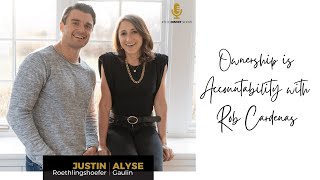
Rob Cardenas, a lawyer and business owner, talks about ownership and accountability. He shares how mentorship and resilience shaped his career, and why taking responsibility for outcomes matters more than making excuses.
This is the Own it show where we tell stories of how everyday people made ownership theirs to create extraordinary success. Back to another week of the Own It Show Coach Conversations. I'm Justin.
And I'm Elise. Welcome to the Own It Show.
And guys, I know we've been going all over the place with a bunch of different audience members lately, and guests that we've been bringing on have just brought massive value to you guys. And I know we've been getting emails and text messages really kind of saying, hey, ask this person this question or ask them this question. How can I level up? How can I network with them? How can I get into their members of the audience space? And guys, if you're new to this show, be sure to like or subscribe. That's the best way in which you can get into every single one of our guest members peripheral spaces and really into their network is by continuing to listen to the content we put out, continuing to follow them on Instagram, social medias, and really diving into things that they're interested in as well. So where you invest your time is where you're going to get the resourcefulness and the kickback as well. But today, if you remember the guy with the crazy hair, the bubbly personality.
Episode one of this past season, episode.
One of season two, Kelly Cardenas, he told a story about his brother and how through his upbringing he was bullied often and that he was really kind of always that odd man out, and that it was his brother who really was that person that brought him in, helped him feel protected and safe, and that we all needed somebody like that in our lives. And who was that and who could you be in your life or who could you be like that for for somebody in your life? And so for us, we needed to go out and find the brother. So that's exactly what we did. We went out and found Rob and brought him onto the show and we are really excited to talk to him today about what he's been able to do, how he's made ownership his, and to really hear about that side of the story and what it was like growing up in the Cardenas family and ultimately finding the success that he has today. So, Rob, it is a pleasure to have you on the show and welcome to Coach Conversations.
Thank you guys so much. This is an honor to be on the show. I mentioned earlier, I am humbled by the experience and not quite sure why somebody would want to chat with me, but having been Kelly's older brother for obviously my life, I often get residual introductions. So I'm appreciative of that. To use a sports analogy, if Kelly were Peyton Manning, I'd be Eli Manning. He's a surefire hall of Famer, and I'm maybe a borderline guy that has experienced some losses and setbacks and adversity and have. I've also tasted a few victories along the way, so thank you.
Looking at it from that lens, how many Super Bowls. I was just about to say, if we're looking at it from that way, they both have super bowl rings, so I'll play Eli any day of the week.
Well, I appreciate that. I. I appreciate that. So. And I'm extremely impressed with both of you and your backgrounds and what you guys have accomplished, both personally and professionally. It's pretty amazing. I just feel very fortunate to live the life that I live and do what I do for a living. And I approach every day with a spirit of gratitude, giving thanks for not only the good, but the challenges that I face and have faced. One of the comments that my brother spoke about on his episode with you guys was he used the phrase dookie or having poop in your life. Right. And that could be fertilizer. And so I've just chosen over the course of my life to focus on the positive and with the understanding that perspective is everything, and our perception can become our reality. And so viewing adversity and challenges as being opportunities to grow, and really, that's what I try to do. Not trying to be necessarily successful, but just trying to be the best version of myself that I possibly can be.
Good for you, Rob, because that's something that I know a lot of people in their lives spend a lifetime trying to attain that type of a mindset. And in my line of work, I call that level five energy. On the energy spectrum, there's seven levels of energy, and levels five, six, and seven are the highest level of energy that you can bring to any sort of situation. And when you. When you look at a situation and even, as you said, adversity or challenges as an opportunity and approach them from a. From a state of gratitude, as you said, that's level five at its finest. I'm curious to understand, because it's not like you woke up one day or maybe you did, but it's highly unlikely that you woke up one day and you're like, you know what? I'm just going to change my mindset, and this is how I'm going to think going forward. Can you tell us a little bit about your process and your story in terms of how you came to live in this type of a mindset?
Yeah, no, that's a great question. And no, it's not something that I was necessarily born with. I think it was just an attitude that was forged over time and our upbringing and our background. And listen, I don't pretend to have it any harder than anyone else. Certainly there were challenges. Maybe not as easy as some, not as difficult as others, but growing up, at times, what we lacked in maybe material possessions or money, what my brother and I experienced in the home life was a lot of love and support. And there were times where the only thing we really had was one another. And so, just over the course of time and growing up, constantly hearing from our parents, everything is going to be okay, right? Like, everything is going to be all right. And the Bob Marley song resonates with me so heavily because it's, you know, don't worry about a thing. Every little thing is going to be all right. And just sort of over time, even when things were really bad or seem dire, they always ended up being okay, right? And so over time, just building that resiliency muscle, that grit muscle of, listen, it might be tough or bad right now, but everything is going to be okay. And so it's just a lifetime of that. A lifetime of sort of challenges and setbacks and getting your teeth kicked in, which individuals like yourself would never get to the point where you're at if you hadn't tasted a ton of failure, right? Like, the. The pathway to success is the willingness to experience failure. And so just over time, building that. That grip muscle, that resiliency muscle, and then just sort of wearing it as a badge of honor, right? Like, I. I'm not. I've never been the smartest guy. I've never been the biggest, the strongest, the toughest. I've never been the best attorney in my profession. But I'm a grinder, man. You're never going to outwork me. And so it's just about getting up every time you get knocked down. And even if it's just taking that step, right? Like, trying to improve every day, every day, getting better and better, and then we don't get to where we're at by ourselves on our own. I have an incredibly supportive and loving wife. I have two beautiful kids who look at me and give me encouragement, and they have this sort of naive, blind faith in their dad, sort of an expectation of success. And that's what we've created in our household. Not an arrogant, you know, cocky sort of approach to life and business and Personal and academics and athletics, but just this expectation of success. Don't be afraid to succeed, don't be afraid to be great. Don't be afraid to be the best version of yourself. And so that's just the way I try to live my life. And I try to surround myself with like minded people, people who are better than me, people who are smarter than me, people who are more driven than me, that can push me. And I try to as best as I can to avoid negative energy, negative people. John Gordon, one of my favorite authors, refers to those people as energy vampires. People who are going to drain your positivity. And so I don't watch a lot of news. I choose what I ingest and digest and I try to control my environment as much as possible. And what I've learned over time as I've gotten much older than both of you is that our time is the most valuable resource. It's a non replenishable resource. And so it has become super, super important to me. And I've gotten really, really good at saying no and I've gotten really, really good at staying focused on the people and the things in my life that are priority items. When my wife and I built our business a little over five years ago, we had our priorities in our life, which is our family and one another and we just. And we decided to build our life and our business around those priorities because again, focusing on the fact that time is fleeting and as my kids have, I blinked and now my kids are teenagers and both of them started high school yesterday. I've recognized how important and precious it is and we don't get the time back.
So I love John Gordon as well. He's an amazing author and something that he talks about. I think the Energy Vampires lives in the Energy Bus is his book that he always refers to. And I think what I'm curious to know even further for you along with all those items and philosophies that you really run your life with is what experience did you have because you haven't always had the success of your law firm, you haven't always had the success of that both you and your brother have seen. And I kind of want to separate you and your brother a little bit and that, that bond that's there and, and look into more of Rob the Individual because as much as it's, it's great to see everybody as a package and sometimes we get lumped in together of. You even started it, I found it really curious that you started off saying that if Kelly's Peyton Manning. I'm Eli. But rather, what truly makes you you, what have you gone through to ultimately become the lawyer that you are today with the law firm that you have today? You're not just a lawyer, you're running an entire firm. This is your place that you are serving people in a certain way with you and your wife as two powerhouses in this space that are truly serving people. So what was it that along your way was your biggest struggle that you've been able to hold on to and truly fuel and fire you to get you into this space?
Yeah, that's a great question. So my brother and I are similar in some regards, but. But diametrically opposite in many. He took a non traditional route of going into hair school and I took a more traditional route of academics. I was the first person in my family to go to college, graduate from college, obviously the first to attend law school. I had no intention of going to law school for any of your listeners or all your listeners out there. I was not a good student. I was a slacker. I loved to play sports and I thought I was going to play sports in college. And once I realized that there weren't too many 5 foot 6, 7 quarterbacks at the collegiate level, I decided I needed to focus my energy elsewhere. But it wasn't really until, to be honest with you, I graduated from high school and I looked around and all of my friends were going off to colleges and going off to live, you know, their, their intended life. And I was left in a small town, kind of by myself. And I looked around and there weren't a whole lot of options for me. I was that kid in high school that the counselor told, your options are go to community college or go into the, go into the military. And so I stopped you there for a second.
Sorry, I don't want to interrupt this story, but you said something that just like hits me so heavy. Where a counselor has the audacity to say to somebody, hey, you've got community college or the military one saying, hey, we're going to put a cap on you and this is the best you'll ever be. But in fact, and you say that you weren't a great student, it's likely because most entrepreneurs aren't great students and they're extremely creative, they're focused on other things. But what was that feeling or what was that thing that clicked when all of a sudden somebody who is in an authoritative role, a role that's helping to shape the lives of millions of kids out there, even today, in that counselor role or that mentorship role? And how important is it to have a mentor or somebody you're looking up to outside of the educational platform?
No, it's incredibly important and I'll touch on that. But to address the first line of questioning, when that was stated to me in high school, I didn't accept it. I didn't believe it. And the reason is to go back further. When I was about eight years old, I was. I've been a Rams fan my whole life. And from the time I was a little kid, I always knew that I was going to grow up and play quarterback for the Rams. That was my dream. When I was a little boy, I used to wear my pat Hayden number 11 jersey to school. I'd carry my football every day to class. And I'll never forget, I was in second grade. And we're sitting in a little circle and our teacher is going around the circle asking each and every one of us what we wanted to do when we grew up. And when she came to me, I answered not I think or I want or I wasn't sheepish about it at all. I was, you know, definitively, I'm going to play quarterback for the Rams. And her response was a mocking laugh and oh, Robbie, you're too small to play football. Well, when I got home that day, I shared that story with my mom and my mom wouldn't allow it. So my mom, I'm assuming, ate that teacher's lunch. But what she said to me was, you can do anything, you can accomplish anything. And so from the time I was very, very little, and that's one of the first real true memories that I have, right? Like we all have like memories of growing up and playing and experiencing things, but an actual really life defining moment in my life. And from that moment on, I just accepted that I didn't need to accept what other people, what other limitations people might place on me. And that if I wanted something bad enough and was willing to put in the work for it, I could accomplish anything. And that was really the way we were raised. So by the time I get to high school and I hear that, it's kind of like I've heard that before. I've been told that my entire life I was too small. I'm too, I'm not smart enough. And it just, I kind of, it's just dismissive to me. It's almost like I, I thrive off of it because it's sort of who I am. It sort of defined me my whole life. So when, when it came time for graduation from high school. I really kind of just bummed around for a year after school and working, I worked a little bit and then I got to the point where I needed to do something and a really, really dear friend of mine convinced me to go to community college. And in fact I'm going to be having dinner with him in two nights. We've been friends for 35 plus years, but he convinced me to go to community college. So I signed up for community college and I was attending community college, working a couple jobs, part time jobs, and I was coaching youth basketball. And a dad of one of the kids that I coached was somebody that I viewed as being incredibly successful. At the time I was 19, 20 year old, very influential young man trying to find my way. And I, and I looked at this gentleman as being success. And for a 19, 20 year old me, success I defined as nice car, fancy home, nice family, right, stable environment, none of the things that I grew up with because the home life wasn't very stable and we didn't have a lot of niceties. But again, we had a lot of love and we had a lot of great foundational things in our life. But he sat me down one evening and this individual who I thought was incredibly successful and I was just finishing my two years of community college, still not figuring out what I, still trying to figure out what I want to do. And he asked me, he is like, son, what do you want to do with your life? And I said, I think I want to coach basketball and teach high school English. And he looked at me and he shook his head and he said, no, son, what do you really want to do? And I was embarrassed, I was a little intimidated and very sheepishly I responded, I said, sir, I don't want to be a lawyer, but I think I want to go to law school. And he was like, well, that's not silly at all, son. I went to law school and I'm not a lawyer. And that was my light bulb moment. So for me that was at that point when I decided I'm going to focus all my energy and efforts into attending law school. I'm not going to try to figure it out, I'm not going to get bogged down by the details. When people would ask me what I'm going to do, I would say I'm going to go to law school. And I did that for two reasons. I did it, number one to hold myself accountable and I also did it to sort of speak things into existence. I'm a big Law of attraction guy. I believe that what we put it put out there into the universe, we get back. You stated on one of your podcasts, Justin, that what is measured grows. I'm kind of paraphrasing, but something like that, what you focus on. Right. And so for me, it was, I'm going to speak this thing into existence like I've done with everything else in my life, and I'm going to hold myself accountable, because the more I talk about it to other people, it's out there. And now when they ask me again down the road, hey, this is my. What are you going to do? They're holding me accountable to that. So I hope that answers your question. I'm not quite sure it did, but completely.
And I think what is really unique and what I want the listeners to really take from that is understanding that the catalyst is often getting exposed to people around you and getting exposed to mentors and people that are uplifting you and people that are. That are truly in positions that you want to be. You mentioned that you saw somebody that you saw as a vision of success, something that you saw as successful. Everybody's going to have a different definition of success. For me, it might mean something. For Elise, it might mean something else. For you, Rob, it might mean something completely different. But if we seek out those people that are in those positions of success, we can learn not what they've done to get there, but simply the systems that they've instilled to create that. And I think that's what we really have to get our head around, is it's not you want to replicate what they've done, but you want to replicate the systems that they've put in place to make those things happen, the habits they've put in place, the people they've put themselves around. One of the clients I was on a call with this morning was just asked to partner in a business with one of the members of Shark Bank. Really, really unique in how this whole thing came about. And he goes, justin, it's amazing how many times the term you are the sum of the average of the five people that you spend the most time with. And when I. This guy that he was asked to partner with had a really hard time in his life, and he stuck by him. He stuck by him. He gave. He helped him out. He helped him in this tough time. He was the mentor to him. Well, all of a sudden, there's an opportunity, and he doesn't forget, and he's now back and he goes from everything he's Lost. He's now gained it back a hundred times.
Right.
Right now I'm at this point where he's reaching out, saying, hey, can you help me with this? Can you be a part of this with me? And so it always comes back to that level of mentorship. And for you on this journey, that first mentor that you had that helped propel you into, say, that light bulb moment for law school for you, who has been another mentor or a series of mentors along the way that have helped you to get to where you are and maybe changed your direction a little bit, but also.
How have you.
Determined how to seek them out?
Yeah. So on the issue of mentorship, excellent point and wonderful topic. And I think it's unfortunate that there are so many people in our lives or the lives of our children or our loved ones, teachers, coaches, who don't understand that incredible opportunity and responsibility they have. And so it's wonderful at this point in my life to be able to mentor individuals, whether it be through a formal internship program or mentorship through the work environment. For me, I have this sort of. I have this acronym for what I believe helps me or has helped me to be successful in life. And the acronym is fight. F I G H T. When I was a kid playing football, I had a coach, Coach Barksdale, who I love and adore, who used to say to us, we were a ragtag group of kids, and he used to say to us, and we were all small and undersized. It's not the. It's not the size of the dog in the fight. It's the size of the fight and the dog. And for years, I mean, I love that man. Like, he would. He would. He would walk the sideline and he would be saying practice and during games. And we were a bunch of these overachievers, right? And I loved it. Up until I was probably in my early 20s, I didn't realize. I thought, you know, Coach Barksdale coined that phrase. I was unaware that it was likely Mark Twain. Right. So. But I adopted that sort of mentality growing up. Kind of what we talked about earlier, that it's not the size of the dog in the fight, it's the fight inside the dog. So for me, the thing that I sort of created for myself, the acronym FIGHT is faith, integrity, grit, hope and thankfulness. So for. In order to be. In order to be successful for me. And success, like you said, is a very, very relative term. I measure my success by how many days I'm in flip flops and board shorts. If I have. If I have a ton of those days, and I view my life as being successful, but it's an extremely relative term. Right? And so what is. What is success for me might not be success for some other person, because I get to define my level of success. So for me, early on, one of my first mentors was one of my coaches, Coach Barksell, who helped kind of reinforce that idea that my mom had planted in me, that seed in me years ago of, you can accomplish anything, you can do anything. And so for me, it's having a lot of faith, faith in the process, faith in yourself, being a person of integrity, being truthful, being honest, honest with yourself and others, being gritty. I joke and say, you know, like, I'm a gritty mfer. Like, again, I'm not the smartest and not the. And not the toughest. I couldn't punch my way out of a wet paper sack, but I'm a gritty dude. Like, I've had my teeth knocked in. And I live by that whole man in the arena, you know, being down, being face down in the dirt and getting back up, having hope. Hope for a better tomorrow, hope for a better future, and then being thankful, like how we started it. So, Coach Barksdale, incredible mentor. My dad. My dad, since I can remember, I get daily accountability emails from my dad. I get text messages from my dad. You are the greatest. Greatest. He's loving and supportive, and he taught me and my brother early on that there's only one business in the world, and that's the people business. And that if you can master the art of people, you can do anything that you want to do. And really, any business comes down to people and just taking good care of people. They're not going to remember necessarily an outcome that you produce, but they're going to remember how you made them feel during the process. So my dad, for me and my kids. My kids are incredible examples of resiliency for me. And I'm inspired by the way they approach their life and their relationships and how they maneuver the world today. So at this point in my life, I'm very thankful to have some very, very positive influences in my life. But I also accept the responsibility that I have to mentor others and give back, because I think our way of growing and becoming the best versions of ourselves is by building other people up. And a leader is not defined by how many followers they have, but how many leaders they create. So I try to create my work environment to be one that's very loving and supporting. I tell people that come in here to the office that I mentor or that intern. You know, you're probably not going to learn a lot about how to be a lawyer, but you're going to learn how to be a good person while being a lawyer. And so that's really the focus of what I do and what we do as an office is taking care of people, serving the needs of others, being a service to other people. And I take the responsibility of mentorship, whether it's my children, my employees, my friends, my loved ones very, very. I take that very, very seriously.
You know, Rob, it's clear that in everything you do, you carry an ownership mindset with you. You talk about being of service to others. You talk about surrounding yourself with those people that build you up and don't tear you down. You talk about the amazing mentors that you've had in your life that have, like your father and your coach that have led you in the right direction and have left you with messages that have stayed with you for a lifetime and have only grown into even bigger messages like fight that you live by every single day. This is one of our favorite questions that our listeners love to hear. We love. If you could tell us in a few words or a phrase, what does the word ownership mean to you?
Ownership to me means accountability, honesty. I think one of the major characteristics of leadership is accountability. Being empathetic and sympathetic to other people and what they're dealing with in life, and owning my role that I play in the outcomes that occur in my life, and that I cannot necessarily control what takes place in my life, but I can own and I can control my reaction or my actions in response to the things that happen. So to me, it's very, very important. It's very, very meaningful and very, very impactful and having the responsibility and taking accountability for not just the good, but also the bad. With me in the way our office is built and our firm is built, I never ask anyone to do anything here that I wouldn't do myself or haven't done myself. We have each other's backs. We are sort of a reverse pyramid structure as opposed to, you know, everything happening great at the top and trickling down to the bottom. And so having that accountability and being, owning my responsibility to others and myself.
In my life, I love it. And so many of our listeners often reach out and seek our guests for mentorship or seek them for assistance. And a part of that ownership mentality that we bring is connecting like minded, quality people together. So, Rob, where could people find you? Where can People interact with you and what would be one of the biggest things that you could bring to somebody reaching out.
So my, I'm on Twitter and Instagram, obcardenasesq and then Facebook. I believe it's Robert Cardenas or Rob Cardenas for me. I love to interact with people, I love to help people. And anybody that was interested in learning about leadership or learning about running a business, you know, it doesn't have to be specific to practicing law or being a personal injury lawyer because here we are at the end of the this process together and we've talked a lot about why and how, but we haven't even touched upon what I do, which is awesome, which is the way I live my life. And that's the, that's the structure of our firm. Simon Sinek, who's another one of my favorite authors, his book Start with why is one of my favorites. And you talk in terms of why you do things, right? What's, what's your passion? What's your why? So for me it's family, it's friends, it's living a purpose driven life and being a servant leader to others. And so those are the types of things that I could offer in terms of like tangible academic information. I'm probably not the best, but if you wanted to be around somebody that would be encouraging and be close to 50 year old bald cheerleader, I'm your guy.
And guys, it's funny that you brought that up because the more that we get into it and the more that we interview and who we bring on the show is it's we never want to get learn about what they do. That's where you go to social medias for, that's where you go to their Instagrams for, that's where you go to their websites for, that's you read their books or whatever. The people that we bring on that have accomplished so much, if it was only about what they did, it's what every other podcast is going to speak to them about. It's what every other editorial or piece of content is going to talk about. But we really want to get to the root of who the person is, what drives them, how have they come to where they've gotten, and I've mentioned it before, is it's what systems have they put in their life, what habits have they become experts in to ultimately get the results that they've yielded? Because we all know, and this is what we talk about success is not normal. And thus we need to be not normal. We can't be in order to create success. And so that's where we're constantly striving for and constantly going for. And listeners, as you guys are listening to Rob, I hope you heard the importance of mentorship, that you heard that it's not just who you are around, but also who you are to those people that you have the opportunity to mentor. Because there's going to be a lot of people that stick on the sidelines and can yell things from the stands or yell things from the box seats or whatever it is. But as Teddy Roosevelt said, it's all about being the man in the arena. There's something about being face down in the dirt, worn out after giving everything that you had and truly being known as a player in the game. And you can't compete with that. You can't question that. So I ask you today as you leave this podcast, whether you're working out, whether you're driving, whether you're in transit somewhere to think about what is your fight? How are you operating within fight? How are you operating within faith, integrity, grit, hope, thankfulness in these areas that you can help yourself level up. Because as we always say, success isn't normal. So be different and own it.
Awesome. Thank you guys so much. And I really appreciate the structure and the way you guys approach it. And I think what you're doing is amazing. Giving people a platform and exposing positive individuals and positive stories.
Right?
It's amazing. Thank you. And I love your shirt. Born Lucky. That's a. I love that shirt.
We loved having you on the podcast.
Thank you guys so much. It was an honor and privilege. I really appreciate your time.
Absolutely.
I appreciate you, Rob.
You guys have a wonderful day.
Sa.
More from Justin




The Ultimate Blueprint for Taking Ownership of Your Health | Unlock Peak Performance

From Bullied & Anorexic to Healed & Purposeful: My Transformation Story (Justin Roethlingshoefer)


Forget "One-Size-Fits-All" Health! Unlock Your Best Self with True Personalization (The OWN IT Show)

Are Blood Tests Enough? Why Cellular Testing Might Be Better | Justin Roethlingshoefer

Your Body's Language: Understanding Stress & HRV| The Power of Ownership - Chapter 3 & 4


Is "normal" really making you sick? Dive into Different with The Power of Ownership:Chapters 1 & 2