Ownership Is Responsibility With Darren Heitner
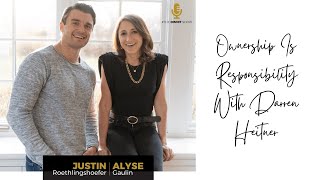
This is a YouTube video titled "Ownership Is Responsibility With Darren Heitner" created in September 2021. It features a conversational interview format with multiple speakers including Justin Roethlingshoefer, Darren Heitner, and Elise. The discussion centers around Darren Heitner's career journey from sports agent to lawyer, his approach to client communication, work-life harmony, and personal values in professional success. Justin Roethlingshoefer plays a key role as a host and interviewer in this multi-speaker dialogue.
This is the Own it show, where we tell stories of how everyday people made ownership theirs to create extraordinary success.
Welcome back to another week of the Own It Show, Coach Conversations. I'm Justin.
I'm Elise. And welcome to the Own It Show.
And if you're watching visually, obviously if you're just listening on the podcast, you won't know, but Elise and I are in two different locations today. Different coaches, but same outcome. So first time we have actually done this when we haven't been together.
It sure is.
So today we've got somebody who, again, has made so many waves in the news as of late. Obviously, a lot of you listeners out there, sports fans, knowing what has happened with the name, image, likeness for NCAA athletes and now able to utilize that as a form of income for themselves. So not just having to hand everything over to the ncaa, but almost using, again, their talent for financial gain before they turn pro. So a huge, huge person in kind of making this happen was our guest today. And Darren has his own law firm that he's really doing some unique things in, and he's appeared on espn, cnbc, CBS News, and a whole bunch of other key platforms, really speaking on sports, business, law topics, IPs, and a whole other wealth of knowledge. But the unique part about what he does is his effectiveness in why he showed up. And that's why we brought him on today because, again, like, we know success is different, and so you have to be different and truly own it to make that level. So, Darren, thank you so much for spending the time with us and really giving your wealth of knowledge to our audience.
Absolutely. Thank you so much for having me.
Darren, I'm so curious. Obviously, you grew up in Florida or you went to Florida, a former gator. And what kind of brought you into this. This realm? What was it that said, hey, I want to be a lawyer, and I want to do things differently? Because most people, when you hear the word lawyer or you need a lawyer, it kind of gives you, like, your butt tensions up a little bit. You get like, this disgusting feeling in your stomach. And for you, it's your. Your true saying is like, I love my lawyer. Like, I love chatting with him. I love being with them. And I'm just so curious as to, like, how that came about.
Yeah, that's a really good question. I think maybe the reason why is because for the longest time, I didn't want to be a lawyer. I went to law school without any thought of becoming a lawyer upon graduation. So I'd have to go back to 2005. Between my sophomore and junior year at the University of Florida, by the way, you said former gator, but once you're a gator, you're always a gator. And it was between my sophomore and junior year that I had an internship at a sports agency in Atlanta, Georgia, and just soaked up that experience. That two to three months was absolutely invaluable, which led me to believe my destiny and my path was to be a sports agent. So I returned to the University of Florida. I had a job at the time. I put it aside to focus specifically on that goal, that mission. And it was in April 2007, when I was about to go into law school, that that I decided to create a sports agency from scratch. Totally unheard of. I don't even know how old. I was in my low 20s at the time, and worked on building up that business throughout the three years of law school, when about half a year, a year after graduation, I actually decided, you know what? Sports agency isn't for me. Maybe practicing law is for me. And I used those connections that I had built up over time in the realm of sports. And instead of burning bridges with my competitors, I actually tried to learn from them and keep a strong relationship with them throughout the years that I was competing with them and thereafter. And that enabled me the opportunity, a very unique opportunity, to get very much involved in sports law at a very early stage of my career. Because once I pivoted from being a sports agent to now practicing full time as a lawyer, I was able to start transferring those competitors into clients. And when I started working with more and more sports agents and they became more and more comfortable with me, who I was, my work product, et cetera, they began to become more comfortable to then send me their own clients. And that's how I built up quite a few athlete clients over time as well, in terms of the way that I treat my profession and my specific practice. And you mentioned the tagline I love my lawyer and how I think you said, people's butts clench.
Oh, yeah, big time.
I mean, that's great, right? And maybe it's not that great, actually, if that's true, but people abhor the thought of even reaching out to lawyers, let alone retaining them and paying their fees and so on and so forth. And what I tried to do from the creation of my law firm, which was roughly four years into practicing, it was in June 2014, is rethink the whole legal profession. There should not be this negative stigma that's so attached to lawyers as a whole. And I think that starts with a few things. Number one, making sure that you never forget that the client's interests always come first. I think lawyers very easily put their own interests or make assumptions about what their client's interest should be and then work toward that goal, when in fact that may not be the actual goal of the client. Another thing that I think and thought was extremely vital is to improve on communication. Lawyers tend to be very slow in responding to clients and also not effective. And they're very limiting. I decided and I knew this was going to have an effect on my personal life. But every client gets my personal email, my phone. They know that they can reach me by call, by text. A lot of clients even DM me, they direct message me on Instagram and on Twitter. While I don't necessarily love that especially it's so hard to keep track of all the communications. It's sort of what I've been selling all along. And obviously results matter most. But I think there's elements of the relationship that are very commonly forgotten or pushed to the side that I wanted to emphasize and it's played very well.
I've got a couple like, this is a two part question because building off what you just talked about, it's so unique how you were able to take a competitive field like the field of sports agency. It's cutthroat. Like one person goes from one side to the other. You're competing for the same players, the pool of people and the pool of talent is only so large. And so I'm curious, number one, as to how you created those relationships and how you built them to be so strong that when that transition happened, you didn't have any issues going to people saying, hey, this is what I'm doing now. This is what I'd love to be able to do for your clients. But then two, you talked about the key points and this will probably go back to what you were talking about, but the key points of communication about how you communicate with your clients. And I firsthand can say when I send you an email asking you about something, it's back within a minute to three if you're eating a meal. And so it's like, it's amazing the way in which you do work and the effectiveness and efficiency of which you do things. So I'd love to understand that because for all of our listeners, no matter what field you're in, being able to make sure that you do have that level of communication, that level of relationship with people around you, you never know when that pivot's coming. So I'm really curious as to how you were able to do that.
Yeah, I'll hit on the first question, which is how was I able to transition from being an agent to a lawyer and then turn a lot of these competitors into clients? And to be quite honest, a lot of it had to do with leverage and what I had created as a brand over time. So going back to 2005, when I mentioned that I was interning at a sports agency and that I went back to my alma mater to continue my studies, but with a focus on sports agency, one thing that I did was I decided to be a little entrepreneurial and create a website that's now called Sports Agent Blog. At the time, I had done research and decided that there was a dearth of information with regard to sports agency, that there seemed to be one publication behind a paywall at the time that was just partially focusing on that world. And maybe one way that I can get my name out there was by writing about the most recent news, interviewing agents, providing my own thoughts and commentary on the sports agent world, which ultimately led to writing for Forbes and Inc. Magazine, and now Outkick and Above the Law, but also allowed me to develop those relationships that were very important and add a level of credibility very early in my career, really before I had done anything in the space, and then also writing about that industry, that lends some power. And I think some agents probably believed it's better to be friends with this guy than be an enemy. And. And that could have been one reason why I started to get some clients and then obviously had to deliver with strong work products so that they felt comfortable continuing to use my services and expand upon what our relationship had been. So utilize your tools, whatever you have in your arsenal, and understand what your leverage is. And why not use that to your advantage. I think the second question that you had basically revolves around, like, how do you do it? How are you so communicative? And what I would say is one, I'm excellent with time management, so I'm an early riser. I wake up very early and I do my best to clear my plate to the best extent possible before I'm off to the gym, which I also know I have to do on a daily basis so that I'm in the right mindset in order to tackle and accomplish my goals. But beyond that, I'm always been an early adopter and try to be up to date with the latest technology. When I'm at the gym, I'm responding to emails as you mentioned I may be eating lunch and maybe I'm doing a call with a client at the same time and I'm multitasking at the same time. You can't see it because you're looking at me. But what I'm looking at are three different screens. One with different types of social media material, another with emails, text messages, and then I've got a phone and another screen. I've got five screens in front of me right now.
The real life Ari Gold.
Except again, not an agent, not anymore at least. But so when I'm at home, work, and I'm in my element, I have all the tools that I need to really make sure that I stay on top of that type of communication. And when I'm on the go, I make it a point to check in as often as possible. I also like to travel. There's an example where I lost out on a significant opportunity with a client because I was in South America at the time, I think hiking a mountain, and I didn't have service for two, three hours. And the nature of my business is if you're not available when needed, as needed, that athlete is going to find a different lawyer. And so that's why I've also found it so important to just be very accessible as many times as possible. But obviously to a certain level, you can't let it completely interfere with your life.
Darren, it's clear that you have been able to master ownership in so many different areas of your life. And, you know, one of the things when I was learning more about you that I noticed is that who Darren is is not just about being a lawyer. It's clear you have an amazing relationship with your wife, you're a good husband, you like to travel, you like all these other things. So I know you are sitting here saying to us, you know, it is really important to be available all the time, but how do you balance life with that as well and show up as not only the best lawyer, but the best husband, the best version of yourself every day?
I didn't pay you to say that. And I hope that my wife now listens to this podcast so she realizes.
I can confirm you did not pay me to say that.
So I don't look at it as a work life balance. I try to always envision it as work life harmony. And as I mentioned before, if I'm at the gym and even though I may be working out with two friends that I'm with every morning, consistently on weekdays, they know I'm looking at my phone, maybe at least half of the time, I oftentimes mix business with pleasure. And so I am appreciative of my wife and others around me who respect the fact that from time to time I have to take a break and I have to spend some time. If I am taking a two week cruise. And my wife and I before COVID we love to cruise and see the world that way. My wife knew in the morning and at night I was probably taking out the computer and tackling emails and, and different types of jobs that I needed to get done personally. So. But I never allow my work and my business to get in front of what I want to accomplish personally. My passions, my pursuits, my desire to travel to. If you follow me on Instagram, you probably see I'm always eating at different restaurants with my wife, who runs an excellent Instagram page called Florida Date Night. And I'm a big family guy, whether it's my parents, my wife's parents, my dog, who I cherish tremendously. And I just think if you have that type of harmony and that mixture, you don't have to parse it out and you're able to accomplish your goals in all areas of life. But priorities are really important and you need to make sure that you emphasize what those priorities are. I mean, for me, health and family come first always. And if I lose a client because of that, I'm okay with that. If a client's not going to understand if there's some medical emergency or I have to do something or my wife's even calling. I mean, my clients know if my wife calls two or three times while I'm on the phone with them, like you're getting put on hold or I'm calling you back. Like there's just, you have to understand what's most important in life. And I think ultimately clients really appreciate that because they understand that if you have values and you stay true to those values, the same is going to be true with regard to the emphasis and work that you put in on their behalf, as well.
So.
So I know that's a long winded answer for what you asked, but in sum, again, I'll reiterate the point. It's work life harmony as opposed to work life balance.
I love that saying that. It's about work life harmony. And it's so true. One of the things that Justin and I talk about so much is we often work six, seven days a week, but we talk about those priorities. First it's actually yourself, then it's your partner, and then it's Those other things that come after. It doesn't mean that your career and your business is not on the priority list. It's absolutely on the priority list. But like you said, when you stick to values and can really show up in alignment with those, that's where ultimately you will end up succeeding. Because if you're in front of a computer all day long and not even letting in all of these other elements, at the end of the day, what's the point anyways, Right?
Right. Why do we work so hard? I mean, intrinsically, I do get a lot of joy from succeeding on behalf of clients. In fact, the most joy I get is not with regard to the money that I make, to be quite honest. It's when a client thanks me and really appreciates the work that I'm doing that my firm's doing. But obviously, we all work because we want to provide safety and security and enjoyment for ourselves and for our families. And if we can't enjoy the fruits of our labor, then what's it all for?
It's so unique too, that you bring up your value system in how you attract and then also retain clients. Because the more that they see you in your element, the more that they see, hey, this guy really does own up to everything that he has to do for himself, for his family, for what he's told me, that's important. And then they actually see it in motion. It's extremely powerful. And again, myself, working, having worked with you before and continuing to work with you, it holds true to that. So for the listeners out there, I think it's extremely important to know where your values fall and where your priority list is so that you're able to act upon that when both going pitching a client and then also once you've got them, it's what allows them to stay in your world for a long period of time.
I appreciate the kind words. You know, I'd add to that, I think being true to yourself and being very honest and upfront with your clients is important too. I mean, don't put on a show or an act for anyone who's watching, I guess, online. I mean, you see me right now like, I will put on a jacket, I will put on a tie when necessary. But oftentimes, I mean, even with meeting potential new clients, I mean, this is what I look like and perhaps even worse, because I want my clients to know that outside of my own personal care, my own health and eating lunch and so on and so forth, I mean, my time throughout the day is committed to that. And that was even true prior to Covid. Like, I never really wanted. The first year that I started my law firm in 2014, I had an office, a traditional office. And for the first week, I probably went in every day. And then it became once a week, and then once a month before. A year afterwards, I just decided to end my lease. And so since 2015, I've really been, quote, unquote, working from home. Although that home has changed over time. And what I've always. The way that I've legitimized it, you know, in 2015, 2016, 2017, it wasn't cool to work from home. Right. Like, everyone, like, you almost felt the pressure of having an office because if you didn't, you weren't legitimate. Meanwhile, I was seeing myself. I can save so much time in traveling and going, you know, office, back to home, home to office, especially rush hour times that I can now appropriate towards actually doing my job. And I do it as effectively, if not more effectively from home. And by the way, while I'm at home, why do I need to put on a suit and tie? Why don't I just be. Why don't I be comfortable? And so even meeting with clients in restaurants, I mean, I just never felt the need to put on this false impression of who they're working with.
You bring up a really unique point there because you're talking about the social pressures of having to go and have an office. And you're not legit. You're not what you. You're not what everybody else in the world thinks you should be. But all of a sudden, now you Covid hits and that's the norm. And so I'm just so impressed how you've been able to live in and be okay in your own skin, be okay who you are, be okay with who Darren Heitner is in. In your essence. And I'm curious as to how you got to that point. Was there a. Was there a catalyst? Was there something that happened? Was there a. An event that.
That.
That exposed you to this type of inner work? Or was it something that you've kind of developed over the course. Just over the course of time?
Yeah, if I'm going to be honest, and I'm going to be. I think it's something that we all need to work on on a daily basis for our entire lives. It's something that I work on every day. And there's a lot to it. Knowing who you are and what drives you, why you do what you do, how you can make modifications to your daily routine, whether you even need a routine. There's small things like years ago, I stopped setting an alarm in the morning. I wake up naturally and I happen to wake up earlier than I did with an alarm. I stopped, I turned my phone on silent years ago. I've never put it back on since because I know that I get very stressed out when I hear that constant ding and when I get phone call and I hear the phone ring and nonstop. I know, and this is something I've worked on my entire life, is understanding what is in your control and what's out of your control and never fretting about things that are out of your control. To the extent that you can control something, make a determination as to whether it's worth your while to spend your time and resources into controlling it. But I would say more than anything, what's most important is doing your best to live a stress free life. And I understand how difficult it is depending on your individual circumstances. Obviously everybody lives with certain issues and constraints, especially ones that the rest of the world isn't aware of. I mean, I've had my own issues and currently deal with certain issues.
More from Justin




The Ultimate Blueprint for Taking Ownership of Your Health | Unlock Peak Performance

From Bullied & Anorexic to Healed & Purposeful: My Transformation Story (Justin Roethlingshoefer)


Forget "One-Size-Fits-All" Health! Unlock Your Best Self with True Personalization (The OWN IT Show)

Are Blood Tests Enough? Why Cellular Testing Might Be Better | Justin Roethlingshoefer

Your Body's Language: Understanding Stress & HRV| The Power of Ownership - Chapter 3 & 4


Is "normal" really making you sick? Dive into Different with The Power of Ownership:Chapters 1 & 2