Harlem Capital Juneteenth: Building Together Event - 6.18.21
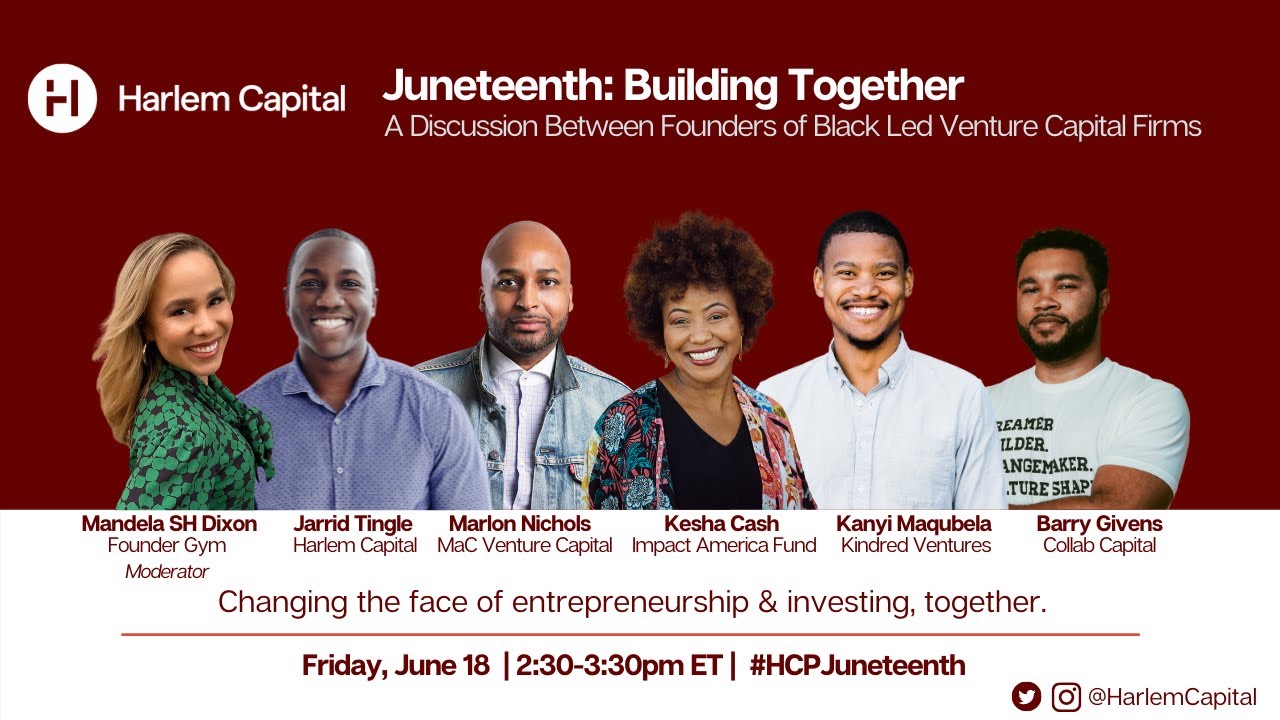
Marlon Nichols argues Black-led venture firms use different strategies and can thrive alongside mainstream funds. He tells founders to build real value and let data attract investors, noting the panelists have distinct networks with little portfolio overlap.
Chapters
All right. Hello, everyone, on June 18th, 2021. I'd like to officially welcome you to Harlem Capital's Juneteenth Building Together panel. My name is Mandela Schumacher-Hodge-Dixon, and I'm going to be the moderator for today's conversation. When I'm not leading a program called Founder Gym, I have the privilege privilege of rubbing elbows with a lot of powerful people in Silicon Valley and all over the country and the world who are making a difference in trying to diversify venture capital. And so today you are going to see an all-star lineup of 5 of the most successful Black-led venture capital firms in the world. And so I really hope you're pulling up a chair, you're putting your phone on no— phone notifications off because you're not going to want to miss any of this. So we're going to talk about the progress that has been made in the venture capital landscape. And we're also going to talk about what's next or what needs to be done. So without any further hesitation, I want to tell you one more thing, which is there's a hashtag. So the hashtag is #HCPJuneteenth. And please take your time to spell Juneteenth right, even though I know Twitter has all sorts of things to fix it and make sure it's trending anyway. It's #HCPJuneteenth, and I'll be shouting out people throughout the event who I see tweeting. So we want to make sure as many people as possible as possible get access to this information. All right, so let's head into the panelists. Drum roll. All right, first up we have Jared Tingle. Jared Tingle is based in New York and he's the co-founder and managing partner of Harlem Capital, $174 million venture capital fund on a mission to change the face of entrepreneurship by investing in 1,000 women and minority founders over the next 20 years. Next on the panel, we have Marlon Nichols, who I've known for a very long time. Marlon is based in Los Angeles. He's the founding managing partner at MAC Venture Capital, $147 million seed stage venture capital firm that invests in visionary founders building the future the world wants to see. Next up, we have Keisha Cash. She is based in SoCal, so not too far from Marlon. Keisha is the general partner of Impact America Fund, a $65 million venture capital firm investing in tech-enabled companies that create economic opportunities for low to moderate income communities of color in America. And then we're gonna head back to my coast, the West Coast. So we have Kanyi, Kanyi Maqubela, I hope I pronounced that right, based in San Francisco. Kanyi is the managing partner at Kindred Ventures, $175 million early-stage venture fund investing in mission-driven technology companies around the world.
World.
And then last but certainly not least, I'm going to go back to the East Coast, over to Atlanta, Georgia, with Barry Gibbons. So Barry is the managing partner of Colab Capital, a $52 million fund focused on investing in and supporting innovative Black-founded startups. Barry's also the managing director of Techstars Cox Social Impact Accelerator. So I told you we did not come to play. This is an all-star lineup, and I'm so honored to be in conversation with them. One thing I want you to know is that your questions will be answered today. So please, if you come up with ideas or things that you want to ask these panelists that maybe I don't get to, jot them down on your notepad or your computer. We're going to take Q&A at the end, so you will be able to put your questions— if you look at the bottom of your Zoom, insert your questions into the chat or the Q&A feature, and I will get to them at the end of the conversation. All right, so let's kick it off. So, um, we really want to hear about venture capital and how you built these $100 million funds, all of that. But first, we want to take it back one chapter before. What were you doing before you became a venture capitalist? Who were you before? Now, we have a lot of you here, so we want you to keep your answers pithy and punchy. So I'm gonna have Kanyi set the tone for this. So Kanyi, quickly, what were you doing before you became a venture capitalist?
I did two things. I was a mediocre entrepreneur once, and I was a terrible entrepreneur once before that. I'm happy to be here.
All right, okay. Entrepreneur and a VC, I love it. All right, what about you, Marlon?
Uh, startup executive and, um, management consultant.
Okay, all right, so like cousins to the VC world. All right, Keisha.
Yeah, I was in investment banking and mergers and acquisitions investment banking analyst. And then, and then I, and then I worked on the ground in Los Angeles with small businesses. So I became a rogue VC and I didn't have any money. So I'm happy to talk about how I did that.
Hey, all right. But you've been looking at dollars and cents for a long time.
For a minute.
Yeah, for a minute. All right, Barry, what about you? What were you doing before?
So I was a founder as well, but more specifically, I was a founder in an undercapitalized you know, community down in Atlanta. And I took money from every type of investor that you could think of. And so I made all the mistakes that you could potentially make, um, that led to me wanting to be the investor that I wish I had when I was coming up as a founder.
Right. And wow, I love that because so much of what we talk about with the best founders are they're scratching their own itch or they're solving their own problems. And I think that's what you're doing with CoLab. So wonderful. And then Jared, what were you doing before Harlem Capital?
So I worked in private equity at a Black-owned firm, and then I also was getting my MBA. So those two things I was doing as you were building the firm.
All right.
All right.
So entrepreneurship, banking, finance, startup roadshows, getting money from everybody. You all have a colored history, but it definitely has led you here. And we're excited because you all are positioned to now deploy capital. So let's jump into how the VC landscape in particular in relation to diversifying venture capital has changed since each of you respectively have entered the industry. So again, I think I said this a while ago, is that Marlon and I go way back, almost like a decade now. And so Marlon, I know you've seen a lot in this industry. You see the waves and the trends. So what is your synthesis of diversity and inclusion in venture capital today?
You know, it's been an evolving, evolving story. You know, our friends like to call it diversity theory because it pops up It gets a lot of attention and then goes away. And, you know, the jury's still out on— we're in the point now where it's still a lot of attention, but the jury's still out on whether or not it's gonna stick around. One thing that I think is very different, though, there are a lot of dollars going into Black and Latinx-led funds. So that's a real change, that's a real shift. Again, jury's still out, like, you know, the next fund, right?
Is that—
are those dollars still going to be there? Or was this a moment in time, a drop in the bucket, and, you know, we go back to the theater? But I'm optimistic. It feels like there's some real progress and/or steps being taken towards progress and some real change happening. But we'll see, you know, there's a lot of money being managed on this panel alone.. And there are several other great Black managers out there managing good chunks of money and investing in Black founders and making an impact. So, you know, jury's out, but I'm optimistic.
All right, all right. I'm optimistic too. As someone who's been in this game 10 years, I've seen a lot also in terms of diversity theater, but I've never seen anything like what's transpired over the last year or so. And even just to have a panel, there is half a billion dollars at a minimum on this panel right now under management. 10 years ago, like if you looked at all of the Black-led venture capital firms, maybe collectively it was $50 million being managed. That's like a 20x growth. And I think again, for so many people who are new to this industry, you may not recognize how much things have grown. It doesn't mean we don't have a long, long way to go still. So Keshia, I also would love to hear your thoughts on this because I know you've seen a lot. Like what do you honestly think about what's happening.
Yeah, and I think, yeah, I mean, I think you hit it on the head. When I closed my first fund, Fund I, in 2016, that was a $10 million fund, and that was a big deal, right? We celebrated that, and it was a big deal, and particularly for our investment thesis. But as I was thinking about this panel and Juneteenth and this day of freedom and thinking about the evolution of this space, You know, I always want to acknowledge someone that inspired me, Angela Benton, when she as a single mom went to Silicon Valley, took up some space in that CNN special that happened in 2012, I believe. That was 2012. And that was the first time that mainstream America was looking at Black entrepreneurship in Silicon Valley. And then out of that, Hank Williams, rest in peace, created Platform and unfortunately passed away in 2015. But that work started happening a long time ago, and I'm just thankful that we can continue to beat on that drum. And then obviously the racial uprisings last year seems to be a tipping point, but we have to keep beating the drum. So progress is happening, and I believe there's more to come.
Awesome. I love it. And I love how you're giving people their flowers. That's so beautiful, calling out Hank and Angela, because there's so many people who did lay the foundation for us to even be here right now, each and every one of us. Like, I'm on the founder training side, you are on the best investing side, but there was people doing this work on the ground even before us. So awesome. All right. Well, you're all venture capitalists, so you know we're going to ask you about trends you're seeing, your thesis, why it is. So give people, you know, some of the insider secrets that you all know. So Barry, I want to kick it to you in Atlanta because I know Colab Capital has a focus on investing in Black founders. So what are some of the interesting trends you're seeing today in the Black community and the market as potential investments?
Yeah, great question. I think one of the most interesting things— I'll say most, uh, for, for us as investors, one thing's really exciting. I'm seeing a lot more Black founders that are technical founders. Um, that's been one of the things, you know, I was a technical founder and I built my company, but that's one of the things that allows founders to get past not being able to get the early capital if they can actually build the product, you know, that they're dreaming of. And so seeing— we're seeing more and more applications from founders that have actually built the thing themselves, and they're coming to capital now for growth and not for actually building the products themselves. And also seeing a lot more Black founders coming out of corporate. It was, you know, many of us are first-time, you know, college graduates, the first time anyone in our family has seen $100 grand a year. You come out with this engineering degree, And then you, people think you're supposed to quit and, you know, go start something from scratch. And so I think now we're building that momentum, and because of panels like this, and I think founders are starting to become more confident that if they do leave that job, there are capital solutions for them outside of that job where they can actually get the, the growth capital they need to be successful. And so those are two things that I love seeing, because what it's leading to is higher quality founders that we can all invest in.. And quite frankly, those higher quality founders lead to all of us being able to raise larger funds the next time because they're really the product, right? They're, they're, they're really what's needed in order for all of us to be successful. And so the higher quality we get coming out for founders, the higher quality that we get as fund managers, the larger funds that we can raise in the future. So I'm definitely loving the trends that we're seeing right now.
Love that. Love that. So you're basically saying the tech, the, the tech, tech powered or tech talent in terms of Black founders is increasing. That pipeline is increasing. And also people who are leaving the corporate world to jump into the startup world is also increasing. And I think you pointed out something so important that I don't think a lot of people talk about is the safety net that you need to really make the jump into entrepreneurship. Financially, psychologically, there's a safety net. And a lot of us haven't had the privilege of having the safety net as our white and Asian peers have. So I think that's a beautiful thing to call out. And Kanyi, Kanyi, I actually want to take that same question to you because you invest in companies around the world. So at Kindred Ventures, what are some of the interesting markets that you are exploring or just trends that you're seeing?
The most important thing to share, I suppose, about that is it used to be that there was one, maybe two big technology trends happening at any given moment. There was the PC, there was internet, there was cloud and mobile happened at the same time, so that was 2. It's usually 1 or 2. Today there are 6, maybe 7. And so what you're starting to realize as a result of that is tech VC-based companies and really, really high-growth companies is no longer limited to a small subset of sectors. It's so, so, so cross-functional. That's the first thing, is you see like 5 or 6 different S-curves of technology adoption that are happening all at once— synthetic bio, food production, supply chain and logistics, financial technology, you name it. The second is that Silicon Valley used to be very geographically constrained. The capital was heavily constrained, and the returns were also very heavily constrained. Now Silicon Valley is a mindset. You'll see it in Lagos, Guadalajara, Singapore, Tokyo in equal measure. And the same is true in the United States. And I think that presents an amazing opportunity for people who don't have to worry about housing prices and in fact can just be building from the comfort of their Zoom homes.
I love it. I love it. So basically, it's like every industry can be in tech industry. Every—
It's all happening, and it's happening everywhere. Call me crazy, but I feel that.
Yes. What I oftentimes say, and the reason I love this industry so much, is because you get a front row seat to the future, right? Like, you're seeing things before the public sees them. And you also are financially benefiting, hopefully, from those things, right?. So that's one of the perks of being in this space. All right, Jared, thank you again for organizing us all here together. We really appreciate it.
Thank you.
So my question— yeah, so clearly I think people know Harlem Capital. You guys have really put yourselves on the map in a very short amount of time. You're focused on investing in women-led companies, minority-led companies. My question for you is there's a lot of founders right now who are listening and who will listen and look at the tweets, all that stuff. What advice do you want to give for founders as to some of the best practices you're seeing for founders who are pitching investors or presenting the value prop to them?
Yes, a couple. The first is why you, right? Like, I think anytime you're trying to get capital from someone, you should have a clear answer to why you. Like, why you at this point in time? Why you with this business? There has to be great fit with what you're doing. My second thing is to really pay attention to your competitive landscape. So it is good just to know, you know, who's big in your industry, what other startups have raised money, just so you sound more knowledgeable. All those things are really important. And you also just have like the benchmarks for what's realistic. You know, some people like valuations have been increasing, you know, $5 million seeds are commonplace, but you should have realistic expectations around where you're at from a traction perspective, where your team is, what industry you're in, and how much you can command. Because if you ask for outlandish things, they're too high or too low, it can really put you at a disadvantage when you're trying to raise capital.
Right. Great advice. And I'm gonna open that up to other people as well. And a friendly reminder for everyone listening in, the hashtag is #HCPJuneteenth. Make sure you're sharing your gems. I'm gonna be shouting out some people I see tweeting. So definitely tag these investors. They love, they love getting love on Twitter. Trust me, you may get a retweet out of them if you're lucky. So Marlon, my question is very similar. You know, right now at Founder Gym, leading one of our largest cohorts, but it's all Black women founders in the cohort. And one of the common questions I get from that audience as well as others is like, how do I present myself to an investor who is not you, Marlon, but is someone who does not look like me, share my identity, my perspective, my value system, see the problems, know the community that I'm trying to serve? How does someone who comes from a totally different worldview than traditional venture capitalists? How do they present themselves and their value proposition to people who may not be you?
Yeah.
Um, before I answer that, um, just to tag on to, to Jared's answer, um, I think a couple more things. Um, one, uh, don't be afraid to talk about the, the risks that are associated with your business. And whatever mitigation strategies you have. And then the other thing is just around, I think you kind of touched on it, why this team, where are the gaps, and how you're gonna get to where you're gonna go. Let's see, I think numbers are universal language, right? Like everyone speaks numbers. So if you can't understand, you know, I guess instinctively, you know, a challenge that's happening in the hood because you didn't grow up that way, right? There are ways to put numbers around that challenge and turn it into an opportunity, right? So I'd say use numbers, right? That you wanna size a problem and, you know, we're investors. So, you know, we understand numbers, we understand outcomes or potential for outcomes. So that's the thing I would say. You know, Keisha and I are in a company together in the beauty space, essentially. And that entrepreneur was trying to convince, you know, white male investors that, you know, there was a significant opportunity, Black beauticians. And, you know, one of the things that he did was he just hosted a field trip. Come with me to Oakland to visit all these salons and let me show you what what the problem is. And then he took it back to the numbers. So, you know, it's just speaking to finding a way to speak to people in a common language.
Yeah, and I'll jump in. That entrepreneur, Deshawn, CEO of Maven, you know, I was gonna use that very, that example. Not only did he take investors on a field trip, and that was in his early sort of seed round raising days, when he raised his Series A round, he was intentional about creating allies around the table that could speak on his behalf, right? And he was also intentional about creating leverage so that he ultimately got the deal that he wanted. So, you know, I would say, look, the beautiful part is that there are— we are out here. There are Black investors that do understand nuances of overlooked markets. There are other investors that understand that. And be smart, right? It's who do you want in your syndicate that truly understands the landscape. When we lead a round, we try to get in there, lead the round and then we take off our investor hat and we're on the side of the— we're completely on the side of the founder saying, hey, let's get this done. And so if I have to call up an investor that may not understand, like, that's what I do. That's my role. So we also act as interpreters and translators in some cases. But what I want to happen is that we can pull together syndicates of investors where founders don't have to overexplain themselves and they can get their money raised sooner than later.
Love that. Love that. And again, this is one of the most popular questions founders have is, how do I, someone who's different, navigate this space as a first, as an only, and do it successfully? Does anyone Anyone else on this panel want to share with the founders listening some tips? Because Marlon was talking about numbers are a universal language. Keisha underscored the importance of what Deshawn at Maven did. Take your investors into the community, let them see the problem, let them touch the product, et cetera. Help bridge that gap of understanding. Is there anything out there? You look like you're unmuted, and then I'll go to Kanyi Maqubela.
Yeah, I was gonna say one important thing, you know, we're typically particularly for minority founders, you know, founders of color, not just Black founders, don't be afraid to be yourself in these meetings. A lot of times we go in there and try to put on a face or put on and sound like who's on the other side. We are specifically built to handle certain problems, and we have certain insights into these problems. And so don't put a face on, like, come in there being your true, um, just original self and show why that is a positive to why you are the only person in the world that can solve this problem. And you're going to turn some people off, but what's going to happen is the more rooms that you get into, the ones that do believe in you are going to really believe in you and get behind you. And so you can't try to please everybody and just be yourself and go find the people that really want to get behind you as the founder that you are, coming from the background that you come from, with these set— special set of skills and expertise that you have based on that background.
Right. And Kanyi, and then Jared, if you wanna add anything else.
Well, I'll say two very quick things. The first is just tactical without, with any sales process, pre-qualify, pre-qualify, pre-qualify. And so before you go into every one of these meetings, know exactly who you're talking to and exactly why they might be interested. And related to that, do them all at once. 'Cause you have 50 people all looking at your company at the same time, no matter what your company is, they are now competing with each other for you.. And so do them all at once. So, so, so important. And the second point, which Barry alluded to, but I'll go even further and say, is VCs are minority investors, as in they don't buy majority stake because your train is already headed to its destination. They're just getting on. And so be inevitable. And part of being inevitable is being essentially yourself. You have to be yourself.
Oh, that was fire. I love that. Why is it so— I, I just need to ask you, why is it so important? I mean, I know, but I want the audience to make sure they know to do all the meetings in the same timeframe, like within a month or 2 months. Why is that so important?
2 structural reasons. The first reason is VCs talk. As you can see, we're talking to each other right now. And if Jared sends me something and says, I passed on this, do you want to see it? Then it's a very different thing than Jared and I are looking at it together at the same time. And relating to that on the second, it's a basic supply and demand. If you concentrate all of the demand, then you're going to be, you know, a supply that a lot of people want to compete for. And so it's going to drive your price, it's going to drive the pace of your process, etc.
Right. Jared?
I love that.
I was going to tag on to one thing you said. I think there's a mindset shift that has to happen for somebody to raise successfully. And one is like, you're not asking for help, you're not asking for charity. You are, you know, getting capital, you're getting financing, but in exchange you're giving an opportunity to get on a train that's really valuable one day. You know, you're giving them that chance for that upside. So I think the more you think about that as a founder, the better off you'll be. You're just in exchange. It's not like someone's just doing something for you. So that, that's my biggest thing. And I think the other thing I was gonna say was that it just is really important to, to be very passionate when you're in these things. You know, no one's gonna believe your vision more than you do. So it's very important to make sure you're shining, you're bringing the hunger, and, you know, people will eventually go with you. And actually, the third thing I wanted to say was that sponsorship is essential in this game. Now, at Harlem Capital, we really don't believe in meritocracy. We think there are so many serendipitous things that make you successful. And so a lot of it's just strategy. If you're able to get people who've been successful in your corner early and have them lend you their credibility, like, oh, this person started a company in this space, or just investors in, use that, use that, use that. 'Cause the earlier you get those people on your corner, the easier it'll be for everyone else to follow on. People are sheep sometimes, and you wanna really make sure you set yourself up for success.
And let me, Mandela, if I may.
Of course you may, Keisha.
Thank you. I wanna ask permission. Thank you. You know, I just wanna double-click on, you know, it's a partnership. And I, we are, I am impressed. Our firm is impressed by founders that understand that when they come to us. And they control their process. So the other day, a company that we're putting our hat in the ring to lead, they actually did— it was kindly done, but it was a reverse pitch. They asked us, what do we think our value add? And so when Mandela has the market change, it's changed because there's enough capital out there for them to do the reverse pitch, which is exactly what we want. We want our Black and brown founders to have options. Control your process. This is your train. We're going to get on it. We're going to add value, want to be rewarded for adding value, but it's your process. Process to control.
Love that.
And I'd say, just to add to that, you know, yes, you want to control your process, but what you don't want to do is you don't want to put in, call them fake milestones, right, or deadlines that aren't based on anything of substance, right? 'Cause you can also get yourself in trouble that way, right? You could say, oh, we're collecting term sheets by Friday. And unless you have a term sheet, and those term sheets don't come in, the conversation's gonna shift. Come Monday, the conversation's gonna shift in a significant way and not in your favor, right? So control your process, but be smart about how you control it and, you know, the deadlines and the targets you're setting and make sure that that, you know, they're based on, they're grounded in something of substance.
Right, because we see through that, right? Like, is it, should I actually, FOMO's real, should I actually have a fear of missing out or are you trying to create the fear of missing out for, and sometimes it works, you know, both the same, but we're, I think Kanyi said, we're all talking, we're figuring it out, we're able to poke holes through it. So control your process to Marlon's point, make it an honest process and be able to meet those milestones in what you're actually throwing out, be able to, you know, stand on top on top of it.
Yeah, all great advice. And I'm sure you all want me to dig into this who are listening, because that you're hearing from people who see thousands upon thousands of pitches every year. And trust me, a lot of investors spend 2.5 seconds on your deck, okay? And so they're looking for specific things, and the, the nuggets they just dropped, I really hope you were paying attention. I'm gonna check real quick because we're gonna head over to Twitter to see who's been tweeting. So Rodney shouted out Barry. He said, I love the nugget you shared, Barry, about being your authentic self. We are built to handle certain situations. Jared talking about, no one is going to believe your vision more than you do. Thank you. And then we have Kanyi being quoted from One Time for the One Time, that's George. He says, be inevitable. All right, so listen, we're paying attention to your tweets. Remember to use the hashtag #HCPJuneteenth. And there's about 12 minutes until we get to your questions. So as you have questions, drop them in the chat. The Harlem Capital team is standing by and grabbing them for me at the end. All right, so go ahead, Jared. Did you want to say something?
Yeah, I was gonna say, Mandela, make sure you get in here too if you have something. I mean, obviously you, you know this more than us with Founder Gym. Oh, I do. Founder. So like, you're on this panel too. If you ever want to, yeah, feel free.
Now I think it's such a privilege for them to hear from you all. And yeah, I, uh, I coach founders on this exact process for a living. But I'll tell you one thing I actually do before every meeting, whether I'm not— whether or not I'm pitching someone for capital I'm pitching someone for a partnership is I actually cyberstalk them. So I use the skills I developed in my youth, right? Developed in my youth. I actually watch their YouTube videos. I read their articles. I go through their Instagram, their Twitter. I know this person before I ever hop on Zoom and speak to them. And the knowing of them is the prequalification that Kanyi was talking about, a level of comfort, a level of confidence, because these may not be the people you go to church with. These may not be the people you brunch with. These may not be the people you're at the family cookout with, right? So it's a different person and you really need to understand their psychology and motivations. So that's just something tactically I do and then I advise founders to do— is do your homework on who these people are, how they talk, what their mannerisms are so you're not caught off guard. Like if you know you're about to talk to a dry-ass VC, blah, blah, blah, blah, blah, like you already know that in advance and you don't have to be caught off guard by their lack of body language that's giving you affirmations. You already know that's who they are. So that's one thing. That's just one of the tips I think that anybody can do. Do your homework.
All right.
So, okay. So we have now 10 minutes until Q&A time. So I'm trying to jump around on my pre-vetted questions. And I want to get to some specific ones because the people on this panel have a plethora of experience. And, you know, Marlon, you actually, as you're a board member on Kauffman and you actually are a fellow at Kauffman and you did a study at Kauffman called Deconstructing the Pipeline Myth and the Case for More Diversity. Diverse fund managers, which we see exemplified here. Marlon, can you share any of the findings that surprised you or anything optimistic that can give us all hope?
I wasn't surprised by anything that we found. It was like more confirmation. Something that Barry mentioned earlier came up, which is he was talking about the fact that there are more engineers. Black engineers that are starting companies, right? And one of the things that we looked at, 'cause we were trying to rule out all of the reasons why Black founders weren't getting money aside from just the industry having racist tendencies. And we weren't able to find any valid reasons for why that was happening other than bias. And so one of the things that we looked at was education.
Levels, right?
And we looked at, you know, I think it was over the course of maybe somewhere like 40 years. And we looked at, you know, how many, you know, high school degrees, how many, or what percent of that demographic had high school degrees, what percent had college degrees, what percent had master's degrees, and et cetera, and what we saw consistently is that for white folks in each of those categories, it was going down significantly, and for Black folks and Latino or Latinx folks, it continued to rise, right, and so what he said was, you know, absolute fact, right, there just are more of us getting these advanced degrees, There are more of us that are qualified to build these companies, but the access to the capital is just not there for whatever reason.
All right. Great, great, great. Well, we hope to see more research from you, Marlon, because you have— you're behind some doors most people aren't. You can see some things. So thank you for sharing that. And then Kanyi, I did mention in your opening intro that your firm, Kindred Ventures, invests in companies around the world. So do you, um, have any gleanings that you're learning about or you're focused on in terms of investing in Black founders around the world?
Racism is global, it turns out, uh, and unfortunately capital exclusion is also global, uh, and tends to parallel, um, quite interestingly with melanin levels. And so So the sad truth of the matter is the types of exclusion we experience here in the United States are reflected in other parts of the world, even in majority Black contexts like Nigeria and South Africa, where we've made some investments. And so what I do think is that the mindset of being able to bring yourself to bear not only as an entrepreneur, but also as an investor, is something that I am trying very hard to protect in myself because game recognize game. And if I don't recognize myself anymore, I won't recognize it in the founder. And so I think that one of the things that, you know, and Marlon helps me with this and Jared helps me with this, is just having a bunch of fellowship and feeling strong as a Black VC to take the type of risk that on some level we're expected to take. So that's one of the things that particularly globally becomes harder because there's less of a co-investor network that you can rely on as easily.
Thanks, Kanyi, appreciate that. And if nobody has noticed, Keisha, Kanyi Maqubela is a beautiful, powerful, empowering Black woman GP on this panel. Flex. So we want to hear your perspective. And again, because you've been in the game a while, I think you said your first fund was $10 million in 2016, and now you're at $65 million, right? You've— I mean, you've— I mean, how many multiples is that? So my question for you is, what do you think about more Black women leading funds and what needs to be done to ensure that happens?
Yeah, I have a lot to say about that, so I'll try to be concise. There's a lot more that needs to be happening. Barry's working with a Black woman, Jewel Burks, who's extraordinary. There are more Black women that are out there that are doing fantastic work. Our AUM is smaller, and so there's work to still get up that curve.
Can you clarify what AUM is for people who may not know?
Yep, absolutely. Our assets under management. 65 million number is my assets under management. So while it's, you know, and all of our funds are growing in size, but we're still, you know, kind of a drop in the bucket. And for Black women and Black female VCs, whether you're independently managing a fund or working at a VC shop, the numbers are particularly low. And in our case, as proud impact investors, we're investing at the intersection of high-growth companies and companies that are particularly interested in creating economic opportunity for low- and moderate-income people. And there are large overlooked market opportunities. And our greatest founders in our portfolio— we're not exclusively investing in Black and brown founders or women, but we over-index. I think 90% of our founders are Black founders. And I think the more women that can come into the marketplace— when you think about the last year, Mandela, you're a mom, and what does it mean to be a mother and what does care look like in this changing marketplace? It's a woman's perspective that will be able to identify the right solutions for us to scale up. And so more women are needed for very different reasons. And in our case, we want more Black women because Black women not only understand the need as a woman, but the need as a Black woman, as a brown woman, as a marginalized woman. And until we have those perspectives around the table, we're going to have these opportunities that are going overlooked. So it's happening. I mentor a lot of women that are getting into the space. I know there's a lot of work being done. And there are more of us coming. And our AUMs will continue to grow.
Love it. Love that so much. So thank you, Keshia, for being a pioneer and an exemplar for so many of us to look to. And I know you do so much mentorship, too. A lot of leaders who are up and coming. So thank you.
You put us on too. You're one of our first advisors. Hey, thank you so much for that.
Right, right. Beautiful.
Happy to do it. Harlem Capital is the truth.
All right, there we go.
Love the love.
All right, so Barry over at Collab Capital, uh, you and your co-founders including Jewel, who just got a shout out, who's amazing, you all are doing venture capital a little differently. Play, right? So you all do something called profit sharing. You have space terms. Can you describe what that is and why you have decided to take that approach?
Yeah, definitely. And just 2 seconds to shout out Black women again. Like, we wouldn't— this fund wouldn't be what it is without Jewel. Like, I don't think I'll ever do anything again in life without a Black woman by my side. Like, just, just fantastic. So kudos to the Black women in the room. Um, and yeah, so for Collab, and we, we do profit sharing, we do the space, but initially we look like a normal fund, right? We invest on a convertible instrument. The one thing we wanted to solve for, and specifically solve for, for Black founders, was what happens when you get the early-stage investment? Only about 30%, industry average, goes on to actually raise a Series A after you raise that Series seed round. That doesn't mean that 70% of businesses are bad businesses. Investors aren't that bad, right? So these, a lot of these early-stage businesses just find out that they're not built for venture capital, meaning that you do not have enough industry growth to go be a unicorn. And that's really all venture capitalists look for. That's how we pay back their, pay back our LPs.
What's a unicorn?
So a unicorn is a company that goes on to be over $1 billion in valuation. Which returns a ton of capital back to the VC fund, which turns a ton of capital back to their LPs. And so traditionally, that's why most funds have went unicorn hunting. But what we figured out was that if you could bring some of that capital down from some of those middle-tier companies, you could actually have a better chance at returning 3, 4, 5x back to your LPs. But no one had invented a tool to take advantage of those middle-tier companies, the companies that can go on to do $10, $15, $20 million in revenue and do it in a profitable, sustainable manner. And those businesses were basically being thrown away. And so as we have an industry where the only place to get capital for innovation is through venture capital because bank loans aren't going to cover it, there was just this really big gap in the financial markets that everyone was just comfortable with letting go to zero. And so instead of, of doing that traditional way, we built an agreement instrument that allows us to still play in deals with everyone else. And as a company realizes that they are on the unicorn path, they hit the right metrics, all the numbers that all the other venture capitalists on the panel had talked about earlier, we jump right in, we convert over like any other early-stage investor that's using a SAFE or convertible note, and we ride that wave and hopefully help those companies become unicorns. But for the companies that can't, that are still good companies, that's when they drop down into— I don't say drop down because you're still a great business, that's when you shift over into our profit share and we then help you become a little more tight with your cash, understand your hiring a little better, make sure that you're going to be sustainable. And this is really important from a community perspective because this is how we build more angels in our community.
The more—
Did, did Barry freeze everyone?
We lost him for a little bit.
Okay.
But he was, he's preaching.
He was just—
Fire!
Eee! Can I briefly react to that, Mandela? Because what he's saying is so interesting and frankly is a little bit poorly understood. Like, small business is the coral reef of a good economy, a healthy economy. And we used to get small business loans from the bank and/or used to be able to start them up in ways that we don't anymore. And there hasn't actually been a way to create digital small businesses and medium-sized businesses with capital sources that make sense. I think he's conducting one of the most interesting experiments.
Awesome.
Sorry about that.
That's okay. You wrap up your last— Barry, I want to let you wrap up your last thought if you want to finish it off with one, a summary sentence for us on what you were saying.
Yeah. And so the only thing I was ending with is we've built a tool that allows us to take advantage of those middle-tier companies and those companies Those companies are important because those create the Jewel Burke Solomons of the world that can go back and then become the next angel investor for the next 20 or 30, because that's what we're missing in the Black community. We are missing a rich angel community that can help funnel deals up to us that have already got that first bit of capital. And so that's what we're looking to do is kind of build that foundation with Collab Capital.
Awesome. Thank you. And then this is gonna be my last question before I get to audience questions. Uh, Tono from the Harlem Capital Team's been sending them to me. So Jared, Jared, And listen, I'm the queen of community. I'm all about community and Harlem Capital, to use Keisha's term, has been double-clicking hard on community and I love to see it. So you all over at Harlem Capital have something called Culture Carry. Can you share a bit about what that is and why you all are focused on it?
Sure. So Culture Carry is one element of our community strategy. You know, we win if everybody else wins and we are very very supportive of trying to be connected with people, even if we don't invest, we're trying to be, you know, we want them to win. So culture carry actually was an idea from Yao, one of our founders at Malomo. And he's like, hey, I really want the portfolio to do well. I don't have a ton of money to angel invest right now, but like, I wanna just have skin in the game because if one of us wins, we all win. We're like, huh, how do we do that? And so we decided for Fund 2 and retroactively in Fund 1 to give all of our founders a small piece of our carry. Way, you know, one of them has an exit, everybody's getting some money back. You know, it's still more symbolic at this point, but I do think it's really good to align incentives, want them to help each other, make customer intros, etc. Uh, but yeah, the other parts of our strategy, we have an angel program, we have an intern program, we have an operator network. So really thinking about all the nodes that are really important to help get funding, help people support each other, and you wanna be plugged into all those things. One, the last thing I'll say is we now do announcements on Fridays of all of the Black and Latinx funding announcements we see, and that number's been increasing wildly. So keep it up, y'all in the audience. We're really excited about what's happening, and capital's going in the right direction. Not as fast as we want, but it's still going in the right direction.
Yes, I love it. And what's cool hearing what you uniquely are testing and experimenting with at Harlem Capital, just coming off of what Barry was saying at Colab Capital, each of these venture capital firms have a thesis, and they're testing different variables as to what is going to work and return the fund or whatever their success metrics may be. And so I really encourage everyone who's listening, if you haven't done your homework yet, which is a theme here, go and visit their websites, really understand what their charter is and what they're up to and how they're different and how they're experimenting and using their opportunity to create a different world they want to see. So I just love what I'm hearing, which is the perfect segue to get to audience questions. So remember everyone, tweet, tweet, tweet. The hashtag is #APF #HCPJuneteenth. I'm going to give a couple shoutouts really quickly. So Frederick just said, Jared, when you said VCs need to shift their mindset from doing favors to opportunity, they put in a scene from a movie. I'll have you, Jared, go over to Twitter and watch that later. Keisha, you got a shoutout for someone named Pulokoba. I hope I'm pronouncing that right. Understand that raising money is a partnership. Control the process. So thank you, everyone, for tweeting, and thanks to the investors for sharing sharing the gems. Let's get to some audience questions. So I'm going to throw a good one out there first. So Renet Sweet said, it would be great to hear about the mistakes you all have made. So many of us are navigating unfamiliar territory. So like Kanyi, I know you're like a two-time entrepreneur, maybe more before you got to be a venture capitalist. So why don't I start with you? What are some of the mistakes you made? And maybe that you're still making today? Maybe humanize yourself a little bit for us.
Gladly humanize myself. So the first mistake I made is the first couple of hires was as an entrepreneur hiring for resume rather than hiring for pace and output. And so one of the really, really important things for a startup that distinguishes it from a small business is that they grow fast, or at least they can. And so optimizing for people that have the hustle and the tenacity, and if they don't have the resume, that's okay. And low-key, maybe that's even better because they're gonna, you know, they're gonna put their pedal to the metal and they're gonna really grind. That's a mistake that I made in my entrepreneurial career. As an investor, one of the mistakes that I made was asking for permission to be myself, and it was a very expensive mistake because when you're inauthentic, you're not good at stuff. When you do you, then all the things that are unique kind of start to shine. And so I finally started to learn how to be myself, and I think that's made me a better investor.
Oh, I love that, Kanyi Maqubela.
Oh, I got—
I had like one of those Oprah moments when she— the aha moments, like, oh my Gosh, that hit me in my heart. Seriously, I'm learning so much about you. Okay, so Marlon, Jared, Keisha, Barry, anyone want to go walk on the vulnerability bridge right now and share some mistakes?
I'm happy to give one real quick. I think when you're getting started out and we were very young, right, we're all, you know, 25, 26 when we started doing angel investing. And I think we got like starstruck when we got in certain rooms, like even I was seeing you, Mandela, you, Marlon, like you freeze up if you, you get in your head too much about who you're meeting. I think you should have some humility and have respect, but at the same time, you should look at people as peers. Like they may be a little bit older than you. They may be more experienced, but ultimately you have value and there's things that you do well. So the sooner you see people on an even playing field, the better you'll do. And the more confident in meetings that will help you get those better outcomes.
Great. Great. All right. So we'll take the next question, which Barry was talking about the pipeline of tech founders is increasing and how that's impacting the quality of the founders building tech businesses. But what do you all think about this no-code movement? And do no-code or low-code businesses, are they venture-backable? And this question is coming from— I want to give them a shout out, I'll find it, I'll give you a shout— uh, I think it's Mark Garand, Mark H. Garand. So Marlon, what do you think about this?
Yeah, I think it depends on the type of business you're building, right? You know, there's certain businesses that it's not about the technology that's gonna make it win, right? I mean, just one popular example right now is Clubhouse, right? You know, the numbers aren't as great as they were, you know, a few months back in terms of user retention and all that stuff, but, you know, they were able to create value billions of dollars worth of value running on someone else's technology, right? That's a real thing. Jury's still out on that particular company, but there are a lot of other industries and sectors where it's about the service that you're providing or the value that you're creating whatever that constituency is. It's not about, you know, technology differentiation. That's not what's going to win the day. So as long as, as long as you can get your margins in place by using someone else's technology and it solves the problem and you get to market quickly and you can, you know, soak up as much of that market as possible, as fast as possible, then yeah, it works.
All right.
Definitely venture back. All right.
Does anyone have a different opinion?
Oh, no. I have a similar opinion, so I'll leave it open for the, the differences first.
All right.
I wanted to add to that and say, you know, we, we invest in both software companies and, and quote unquote tech-enabled, where one may consider that, that being low-tech. Um, a company we're invested in, a company called Care Academy, which is a SaaS company training and compliance clients, the large players and payers that are reaching out to this company now, they're not reaching out asking about the technology per se. They're asking about how are you able to train and, and help small home care agencies retain, you know, the 250,000 direct care workers that have been on your platform. And they've been able to do something that others haven't been able to do from like a small business standpoint, the understanding of the direct care market, because the founder herself, who has a Harvard degree, was also a direct care worker at one point. And so that cultural competency, what we call lived experience, the trust in community, are all variables into the success of a, of a business. That's not solely dependent upon the tech, is the tech, the tech is a, is a tool to get you there. But without those other variables, it's really hard to win the market.
Thanks, Keisha. Appreciate that. So there's a question from Stephanie Smith that's in relation to, should you have a co-founder when you are building a tech startup or tech-enabled startup that's seeking venture capital? Or is it okay to be a solo founder? And I think most of you— it's always interesting when I think about, well, are you in co-founderships, right, at your fund? Most of you are, some of you aren't. And so what's your opinion about solo founders versus co-founderships? And you can raise your hand and then I can call on you so it's a little easier if anyone wants to tackle this one. Marlon?
Oh, and then Kanyi Maqubela. I don't see the raise hand feature on the—
Oh, I meant— sorry, I meant like physically raise your hand. You can raise your hand.
Oh, okay. Yeah, I was like, ah. Yeah, I don't think it matters, honestly. What does matter is the team, right? So, and incentives to stick around. So I think the co-founder title, it's usually, you know, associated with a certain, you know, percentage of ownership in the company, a certain amount of like, I don't know, carrots to keep you around, right? I think that's where that, you know, it traditionally comes from. But whether someone's a co-founder or is, you know, employee number one, whatever, it's more about how complementary the skill sets are and how necessary they are to build this company. Is everyone properly motivated, incentivized to move forward for the long haul? That's more important to me than a co-founder title.
Okay, thanks, Marlon. Kanyi, did you want to add your perspective?
What he said.
What he said. All right. Okay, so the next question, I don't know who said it, but I have it in here, is this founder said, one question I did not know to ask investors as a founder was, what is your target ownership? Can you all talk a little bit about how investors think about financing risk, deal momentum, messy cap tables, etc.? So anyone want to physically raise their hand quickly? Ganyi, you're up first.
I have a strongly held opinion here, which is that VCs have their model and they try and fit the whole universe of startups into their model. But it turns out that starting a company and changing the world is very heterogeneous. Each one is a snowflake. Snowflake. And so it's okay to be resistant to the model of the VC. VC will tell you a seed round is X million to Y million dollars and that you need to sell X percent to them because that's how their math is going to work. That's not necessarily how your math is going to work. Yes, you have to manage the tension between those things, but remember that VCs shouldn't be financializing the startup journey. The startup journey should be getting support from VCs, and so I think it's okay to push back reasonably. Reasonably on that.
Okay, can you— you said a lot of good things. What do you mean by startup, the, the financializing statement? How startups—
I need, I need 10% of a company to make my math work, and I like to write a $1.5 million check. That doesn't mean that you need $1.5 million. It doesn't mean that you need $2 million. Uh, you may need $500K, you may need depending on what you're doing, depending on what your milestones are. So there is a translation you have to do, but don't raise the amount of money that fits the VC model, raise the amount of money that fits the milestones you wanna hit, and then find the VCs that can support that journey is my strong preference because I think that an authentic founder journey is typically a better one.
Mm-hmm. And so how do, how do founders find out that information if it's a right fit between what their milestone needs are and what the venture capitalist goals are?— are financially? How does that— can anyone just answer that question? How do they just ask you?
Yeah, right, um, you, you ask us, but, but also, like, the really smart entrepreneurs, they talk to the other founders that we've worked with in the past, and, and that's the— that's really the best way to get a beat on all aspects of the investor that you're going to be talking to. Talk to the folks that we work with, right? Talk to the companies that are doing great. Talk to the ones that failed and figure out how we were, how we supported them or were we assholes when stuff went wrong. Like all things you need to know, including the model. Kanyi nailed it, but Kanyi nailed it, but, or also I wanted to say that, you know, that 10% marker or whatever it is, 20%, It's the start of a conversation, right? So even, you know, that's our model essentially. We look to get, buy 10% of the company at the seed stage, right? But we've also invested with companies and taken like 8%, right? Because it made sense for what the company was building, the stage that they're in, how much dilution they were comfortable with you know, we're taking at that point in time. A lot of factors that go into it. At the end of the day, what it really comes down to is, do we love this opportunity and this founder? And, you know, is it— are we too far apart, right? So, I mean, you know, they're coming in and they're like, well, we want $40 million valuation or we're looking for $100 million. And, you know, our sweet spot is $15 million and lower. Well, I don't know if we're gonna get there.
Right.
But, you know, you're at, you're at 20 and we're at 15. I'm sure we could figure something out.
Right.
If both sides are motivated to work together.
Yeah. Let me, let me add, I didn't raise my hand. Sorry, Barry. Let me, let me add to that. I trumped you. Let me, let me add to that. And it also depends, you know, we're a firm, we're a small fund. We're not, we're not chasing unicorns. I said if we, if we can, if we, if we get to one, we'll play with it. We're invested in a company. Company that's a unicorn, DuckDuckGo. And what we have in DuckDuckGo is a small investment, and that was strategic for us. And that company will, you know, it'll be worth whatever, however many billions in the future. And so it also matters how big of a company are you building. If you come to us and say, hey, I can build a, you know, the TAM is this, I think I can build a $50 million company, but I only need to raise, you know, $5 million to do it. Okay, those economics us are going to look slightly different than you're trying to build a $500 million, billion-dollar company, you need to raise $50 million to do it. So the economics, the size of the opportunity, the market opportunity, the size of the business that you're building, how long is it going to take you to get there. We, you know, 2x the company in 12 months. And people are like, 2x, that's not venture-like. Well, the IRR, 88% in 12 months, 12 to 14 months, is venture-like. So the time horizons, the IRR, the multiples, you know, all of that weighs in. And I think back to the points of being authentic, what type of business are you trying to build? You don't have to build a billion-dollar business to make money. And that's, you know, that's what Collab is gonna prove out. Like, you can make money by building a $50 million, $25 million business, in some cases, $100 million business. So I just wanna say that because I think we put pressure on ourselves. We hear these Silicon Valley headlines, and there are different ways to structure deals to make money depending on, you know, what the path is.
Shout out to Keisha with the math.
I mean, I was a math major undergrad, I better be able to talk like that.
Now, what's IRR for people who don't know?
The internal rate of return. So it really measures, you know, your return based on the timeline. So if I invest $1 today, and I get my money back, you know, 5 days from now, that's a, that's a better IRR than if I get my money I get my money back 20 days from now, right, just to simplify it. So it's how quickly do I get my money back on that investment, and then the cash multiple is, you know, if I put in $5, do I get 5 times that back at a certain point in time, do I get 2 times that back. And based on the size of the funds, that math changes for, you know, funds that are $4 billion. They have to chase unicorns if they're going to return that $4 billion to investors times 3 times 4, they can't afford to invest in a company company that's only gonna, you know, be $100 million exit. But for us, and we're just new to the game, you know, when our average business size is $100,000 in the Black community on an annual revenue, if we can grow companies and exit at $100 million, we should be doing that all day long.
Yeah, that's why we love seed investing, right? Like, what, what, what Kanyi just described is like later stage investing when you're— when you are chasing those, those unicorns, right? Um, this company is valued at a billion today. I'm just gonna pay up and hopefully it gets to $3 billion, you know, and exit. At the seed stage, what we're really doing is we're partnering with entrepreneurs that are unicorn building, right? So we're trying to find the entrepreneurs that's gonna build a unicorn and help them to do that. And there's way more value creation from seed to A and beyond, right? Versus that's where you get the 10, 20Xs versus, you know, the 2Xs that you'll see at, you know, Series B.
And beyond.
Yes, so this all goes back to even what Connie was saying about matchmaking and make sure your goals match the goals of the investors. And going back to what Jared said at the beginning of the call, this is not philanthropy. This is an investment. This is a financial partnership. There are returns, right? And so you really have to, you really have to balance that as you're just preparing for this potential partnership with the venture capital And so we're actually at the end and I'm gonna give each panelist another opportunity to say one more thing. And I'm going to try to trigger that thinking in that last thought with something Barry said earlier on, just about how impactful each step is to everything. So when more LPs invest in Black fund managers, like the ones, this esteemed panel we have here, right? More capital can flow. Go to Black founders or other underrepresented groups, more solutions can be built for communities who are underserved, problems that are overlooked. It's all so intricately related. So my final question for the panelists to think about and answer is, for the LPs who are listening in right now who may have never written a check to a Black fund manager and are considering it, what would you say to them? And then what would you say to a Black founder who is interested in actually securing venture capital, right? You sit in the middle between these two worlds. What do you wanna say to either side? And so I'm going to start with Jared.
Sure. So to LPs, right? I think the, the big pension funds and the Dow Jones of the world, they have a responsibility to, to diversify their managers, right? Cuz not only are they trying to generate a financial return, they have these very diverse constituencies who need them. And I think the model of like, let's invest into a couple dozen managers, let's put all our money there, it's not helping anyone but those managers really. And it's not going to do anything to change the wealth gap or just get more Black managers in business. So I'm very happy with how the corporations have been stepping up. Hopefully it lasts longer than a year. But like Apple, the PayPal, Bank of Americas of the world who really quickly just started putting money I think almost all the funds on this panel. I wanna see more of that and I wanna see different types of folks, but yeah, it's not as hard as it looks. You just have to take some risk in being willing to sponsor these new managers. And for founders, you know, find us. I think you should really just use the tools. I mean, there's so much more information out there between what you can get on your phone, what you get on your computer, Twitter, podcasts. Information is really easy to get now. So I just encourage you all to spend some time time on social media. It's a great way to learn, but also a great way to distribute what you're doing. You can reach, you know, thousands, millions of people in ways that you couldn't before. So use that.
All right, great. Barry, what do you wanna say quickly to an LP and to a founder? A limited partner? Yeah, yeah.
I'm gonna be real Black with this answer. But name a time where you've given Black people a, a level playing field and we haven't outsized the return profit from that. Whether it's sports, whether it's anything that we've been put on a level playing field with the same resources, we're going to make you money, right? Like, it's, it's, it's been known in every single other industry that has existed since the beginning of time, right? And so this is just one of those other opportunities, and it's up for the people, not just on this panel but all around, to, to take this influx of capital. And over the next 5 to 10 years, we're going to show them what happens when, when we're given this capital. And for founders, I didn't get to say this earlier, so I'm gonna drop it in at this particular point. When it comes to the— when you're going out and you're raising capital, don't be— don't change what you're doing because an investor said something. And I know I'm switching up, Mandela, so I apologize, but I didn't get this out earlier. But as Kanyi was talking, if you go to Kanyi and he says no because he only invests in looking for something, don't switch switch it up to then try to fit what Kanye's saying, because now it's showing that you don't have confidence in what you've already done thus far, and he's probably not going to invest anyway, and you just switched it up for absolutely no reason. But if you were confident, Kanye can maybe call Barry and say, Barry, there's this deal that I saw that doesn't fit me, but they're dope, they're confident, and you should talk to them. So stick to your guns, know what you know, and be yourself.
All right, thank you, Barry. Uh, Kanyi's over here saying church, Barry G. All right, Keisha. Kanyi Maqubela, what do you want to say to an LP and a founder on this call?
Yeah, I mean, yeah, this panel is wonderful and I'm glad it's happening on Free-ish Day. Marlon's shirt is everything. I'm free-ish. We're free-ish. I want one of those. And so, you know, during my fundraising process and journey, I've had LPs tell me if we invest in one Black manager or two Black managers, then that's the universe of Black managers because all of our networks Networks are the same. And I think anyone listening into the— listening to this panel can hear the diversity and how we approach this work, our philosophies about the work. And so I would tell LPs to watch this and rewatch this. This is what diversity looks like within the Black community. We're not monolithic. And to put dollars across the board. So I say that to the LPs and I will tell them that. And then for the founders, For the founders, you know, I would— I'd say hold on to what you know. It's your vision. But also be open to feedback, right, especially with people you trust. Because we do see things. Like if we're investing in a company, we probably saw 10 companies like yours before we've invested in that company, or in your company, or another company. And so be mindful of feedback. You know, one thing that we can't— you know, we choose not to work with are founders that don't want true partnership and exchange of ideas. Ideas. It really is about that collaboration and pulling in feedback and creating that feedback loop.
Wow, powerful. All right, let's keep this powertrain going. Kanyi, then last but not least, Marlon.
To LPs, I'll say fund first-time founders because the data shows they outperform. I'll also say if you're looking for differentiation, we are differentiated in demographic in the very things that have excluded us. And the third thing I'll say is, for anyone who's putting capital behind somebody, look for the hungry ones, and we are so hungry. On the founder side, what I'll say is, stay hungry, but know that VCs say no for a living, so don't take it personal, keep it pushing. And being able to develop a lizard skin and take rejection and continue running the race, because it's a very, very long race, is a sign that you got what it takes.
Oh, all sorts of tweetables wrapped up in that one. Okay, Marlon, take us home.
You know, a lot of it has been— it's all been said. So there's not a whole lot to add. I mean, on the LP side, you know, we are very— we are running very different strategies, just like, you know, all white GPs, you know, successful funds, right? If you can invest in, I don't know, First Round Capital and Floodgate and other seed states and companies led by non-Black folks, there's no reason why you can't have a number of Black GP-led, you know, funds in your portfolio. Portfolio, right? The strategies on this panel, like, we went through it at the beginning, like, we all have different strategies. They're not even remotely close, right? I think, you know, when you look at the portfolio companies, I don't think I have an overlap with Kanyi yet. We will fix that, though. I have one overlap with Keisha and one overlap with Jared so far. We're working on our Asian one, but, you know, they— we got 150 companies in our— in the MAC portfolio, right? So we're— just to put a pin in it, right, we're not all the same. Our networks are not the same. And we do very different things. So see the work, see the strategy, and get past the skin color. So just reiterating that. For the founders, I say the same thing all the time. The best thing that you can do is to build, create value, right? Because that's the one thing that nobody can ever take away from you, right? So you can get your nose, you know, things could be tough, but keep moving forward. And as you start to create that value, investors will see it, the right investor will see it. They will see it and it will get funded. And if they never see it, then you've built something that you don't need funding for and you're off building your dream and running it. So just always continue to build. The data, the numbers, they're going to speak for themselves.
I love it. Love it from each and every one of you. Thank you so much for giving me 9 extra minutes of your time. Thank you for the attendees for tuning in and everyone who shared on Twitter to amplify the messages that were shared today. This was literally a historic, a her-storic event today. And I know it will go down in history as probably one of the panels with the largest amount of capital under management by Black people in the world. All right, and you all were here to experience it. Thank you so much to the Harlem Capital team. My name is Mandela again. I'm the CEO of Founder Gym. And I've had the privilege of working with each and every one of these investors or their firms in helping train up the next generation of underrepresented founders to secure the bag. And I want to remind you that Harlem Capital has a litty lit lit lit newsletter, right? They're all about amplifying wins and giving advice. So make sure that you subscribe to their newsletter. It's harlemcapital.substack.com where you'll be able to subscribe and be informed. And then of course, make sure you follow these panelists, subscribe to their newsletters, hit them up on Twitter, all the good things, and stay in contact because we all go up together. And congratulations to each and every one of you on your wins in raising funds, and let that money pour into the founders' hands. Let it rain, folks. Thank you again, and we'll see you next time. Thank you.
More from Kanyi

Building with Corgi - Kanyi Maqubela in conversation with Nico Laqua & Emily Yuan

Building with Corgi - Kanyi Maqubela in conversation with Nico Laqua & Emily Yuan

Acceleration & Balance The American AI Strategy presented by Kindred Ventures

2026 will be a very important year for venture capital, says Kindred Ventures' Kanyi Maqubela

2026 will be a very important year for venture capital, says Kindred Ventures' Kanyi Maqubela





Beyond Unicorns: Kanyi Maqubela on Identity, Innovation, and the Future of Venture Capital

Beyond Unicorns: Kanyi Maqubela on Identity, Innovation, and the Future of Venture Capital