Investing in Visionary Startups: Insights from Kanyi Maqubela of Kindred Ventures
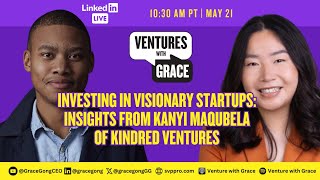
YouTube interview (recorded 2024-05-22) in which Grace (host) talks with Kanyi Maqubela (partner, Kindred Ventures) about his path into startups and venture, why he and Steve started Kindred, and the firm’s core approach: very early-stage, high-touch investing intended to be the investor they would have wanted. Kanyi emphasizes backing founders early (sometimes pre-product), focusing on being helpful (context, hands-on support), and assessing founders by pedigree plus three durable traits: speed (ability to ship), demonstrated shipping history, and resilience. He discusses sector breadth driven by interest (not strict niche), portfolio construction tied to fund size and dealflow, a high-ownership/lead-investor model that limits the number of investments, and fundraising advice for emerging managers (pre-qualify LPs, lean into excellence, give ample time). The transcript also contains brief personal rapid-fire answers (favorite book, influences, where to find him).
Chapters
We are live. Hi Kenny. Welcome to Venture with Grace today.
Hello. Thank you. Happy to be here.
Last year I had your partner Steve on my podcast before and I feel like he is such an incredible person. Obviously he said amazing things about you. So today I would love to hear your perspective on how you guys started building Kindred and your journey enter into the startup inventory ecosystem. So. So to start with the show, I would love for the audience to get to know you a little bit more. You are entrepreneur yourself. Why don't we start with your story into the scene of venture and startup.
Well, I first got involved with software. Oh gosh. In the 90s because a classmate of mine's dad was trying to build a new website and he needed somebody who could help him with that. So HTML and CSS were my first battle with technology and got me a taste for it. But then I forgot about it for about four or five years until I ended up getting to college. And when I got to college, I went to Stanford. I was pulled into the startup ecosystem by some folks at the business school at Stanford who wanted to do a new social networking platform. And they thought that somebody who was an undergrad that had a lot of friends in the largest freshman dorm would be helpful to them. So I kind of got reeled in that way. But I ended up falling in love with startups and technology and the idea of creating something out of nothing and creating movements and creating ecosystems and also using cutting edge tools to solve problems. So that was where I first got into it. And so I worked on a startup right there at a school. And then I worked on another startup after that. And in between, I worked on Obama's campaign in 2008. And I share that because it's really helpful early in your career to have to have a taste for success just so that you know what it's like. And in startups in particular, one of the things that is a little bit different than in the rest of the business world and maybe even the world more broadly, because I don't actually think learning from failure is good. I think there's too many ways to fail at a startup. There's an infinite number of ways you can fail at a startup. I think that learning from success is good and there's a small number of ways, a fixed number of ways that you typically can organize a startup to optimize the chances for success. And so the Obama campaign, even though it was a political startup more than a business startup, ended up being the first billion dollar campaign. We went from zero to A movement in a very, very short amount of time and got to scale. And so I was able to see a lot of what can go right. And that actually ended up shaping my perspective quite a bit. But then after the inauguration, I went and worked on another startup here in San Francisco. And so I realized after about five years in startups that I was a better coach than player. And so I wanted to help other people work through startups and frankly build interesting technology more as an investor and advisor. So that's how I ended up in the VC world.
Amazing. So I hear that like this is like dating back to your podcast interview with Patrick Oschouse. So one of the things that you sat on the podcast was like, I think you were teaching at the Stanford Design school and then you were thinking about like, how do you design thinking your own like career? So like, how I guess like that's how you started like thinking about like building a venture fund. I wonder what were your thinking when you first started thinking about building Kindred with Steve versus like, you know, what were some lessons that you learned at the collaborative fund before you start your own like, or joining us like a funding slash managing partner of your own fund?
Sure. Gosh. I don't advise doing your own fund for, for most people. And the simple reason why is running a fund is not primarily investing. It should be, but it's running a business. And so it's doing all of the operations and the financial structuring and the fundraising and eventually management. And so there's a lot of things that are not simply finding the next great startup and helping that startup grow that are a part of starting a fund. And so the only reason why, in my opinion, you should do it if you want to be in the venture ecosystem is if you have no choice and now have no choice has some nuance to it. Right. So the first part of have no choice is if you can't get a venture job but really want to be in venture, then you might as well start your own. Really have an idea that you're super, super, super committed to putting out into the world and there's no better vehicle to do it than one that you designed for yourself. And so the truth of the matter is with most venture firms, a lot of the ideas for how to run a venture platform, well, exist. You've got the very, very many companies small check model. You've got the very, very, very many companies bigger check model. You've got the highly concentrated with a board director. You've got very, very hands on, you've got very hands off. There's so many different. You've got deep tech, you have software, you have specially specialty of generalists. There's so many different models out there already. And so why does your new model need to exist is I think an important question. And for most venture strategies there isn't a good answer. And so I think that if you're going to start a new fund or try to launch a new brand, you really need to believe that your ideas have to be out in the world. And so in that way, what I learned at my time at my prior firm was that there was a certain set of things that I really wanted to express to the market. There's a certain set of way of investing that I really wanted to do. And that type of investing was shaped by my entrepreneurial experience, it was shaped by my early investing experience. It was shaped also critically by my partnership with Steve. And so it was an investing which started with this principle which is that we wanted to think of help and helping startups not as something that you typically don't do and is an accident of investing, but is in fact a feature like what if you actually can be helpful? What does actually being helpful look like? What does being an actual coach and mentor look like? And so that was our sort of starting kernel and a big part of that kernel was being willing to be very early, very early. And so certainly pre launch, sometimes pre product and sometimes even pre team. And so we've backed a reasonable number of companies that are one person who's thinking about an area and have been working on technology in that area and are just about to take the leap, but would just need a little bit of a boost and we're quite comfortable doing that. So the idea of being helpful by being early I think is a very simple one, but is a nuanced one that I'll just really briefly describe and then I'll stop which is very that if you are at the very beginning of your journey, no matter who you are, even if you've started 10 companies before, all of which were massively successful, you're gonna need help. The earlier you are, the more help you're gonna need. And so coming in very, very early and this is. And so as a result we end up having very experienced multi time founders, second time founders, third time founders, senior executives from well known startups as well as first time founders and know effective ingenues to the, to the startup world, enter our portfolio and we build, you know, what we think are really productive relationships with them. Because we think that at the very, very earliest stages you need help. The second piece is we wanted to be the investor we wish we'd had. And so, you know, Steve and I have both operated startups and worked at the very earliest stages, you know, from zero to one, you know, a couple of times over. And in many cases we really appreciated when an investor that we partnered with had context and depth and was willing to like roll up their sleeves and get into our documents, and not just our financial documents through Excel, but to help us think about some storytelling and help us think about product and help us think about the go to market strategy and the hiring plan and really be a productive thought partner for us. And it's really hard to do that as a VC if you don't have depth, even if you're really, really, really smart, even if you're really, really, really experienced in a given sector, if you're not deep in where that company's at, it's just going to be too hard because you're kind of flying in last minute and you're just kind of flying in from on top and you lack the context. And so we tried to figure out the way to really design the firm to make sure that we always have a lot of context with the companies that we work with. And so in both of these cases we felt like we had to express this on the market. We felt like we had to build a brand that was going to do this and that would really represent kindred spirits. And so that's, we jumped into it. But for most people and in most cases there's a model out there that fits the way you want to invest. And if you want to spend 100% of your time at a VC investing, you should go join somebody who's already built it because that actually helps because you don't have to do all the other stuff in managing the business.
Totally. I wonder. I have couple questions there. So like, one of the things that I thought was like quite interesting about Kindra Portfolio is I feel like you guys are investing in various different like sectors and like since like I feel like in today's age starting a fund or like thinking as an emerging manager, well, I don't think you guys are emerging anymore because since you guys are having like a really big fun as well as like, you know, this is like found three and beyond and kind of thing. So like, I wonder when you first started, how do you think about starting selecting a niche sector or like being a little bit broader towards the ecosystem? So I wonder what was your thinking process there back in time?
So the first part of our thinking was us just talking to each other about where we were interested. And so Steve and I had both spent a lot of time on Marketplaces. So at my prior firm we were thinking about marketplace investing quite a bit, called the Collaborative Fund. And, and Steve, when he was investing Kindred Ventures in the Angel Fund, he was investing in Marketplaces because of his early involvement in Uber. And so naturally we had interest there, but our interest didn't stop there. And I think that this is an important point to zero in on, which is for every investor, you gotta be where you're interested. If you're not investing in an area that you're interested, you're gonna be less effective. And I think a lot about it this way, which is if you're investing in an area where you're interested in, if the investment goes well, you will earn. And if the investment doesn't, you'll still learn. And you want to be able to learn in a way that'll keep you excited about finding the next great thing, keep you excited about going deep into the fundamental technology, getting to the cutting edge, really understanding the primitives and the inputs that make a given technology possible. And so we followed our interest. And I think that that's meant that we've been able to be more authentic about the stuff that we want to do. And we both have lots of interests. We're interested in commerce and fashion and transportation and mobility and food and science and health and finance and communication. We're interested in all sorts of stuff. And so we don't want to limit our investment approach to places where it's sort of structurally optimized, but rather we want to follow our interest. And I think that there's good and bad to this. And so start with the bad, which is that in today's market. And we actually solve this with how we think about our strategy. Being hyper specialized is a natural output of a hyper competitive environment. And so when it becomes very crowded and when it goes from a cottage industry into a mainstream industry, everybody hyper specializes. And that's true throughout the history of industries that have gone mainstream. And so you have to specialize to compete, you have to specialize to win, you have to specialize to persuade. And it oftentimes helps to have specialty depth when you're going to help a founder too. Right. And so by being multi theme and constantly updating our themes and making sure that our themes allow us to sort of move across sectors with interest that can present Some challenges for us, the way we solve that is each one of us will typically have a small number of themes at any given moment time and those themes can evolve and we learn from each other and we sit next to each other every day. And so a lot of that learning is through osmosis and some of it is through the venture equivalent of pair programming where we'll show up on a board call together or we'll dive in on a fundraising deck together. We'll look at a product plan and we'll debate internally before we bring our feedback out to the founder. And then the other part is because we're sort of doing a little bit of each one of us choosing a few themes at a time. That gives us the space to dive in. And this is only possible, and this is key if you have time to do the research. It's absolutely key to be able to just actually read, to read white papers, to keep up with the cutting edge of science, to try technology, actually tinker with things as they're actually being developed. And so the way we solve that is by not trying to see 2,000 pitches per year. Like we don't want to just sit in our room and hear pitches. We want to go out there and go to technology conferences, go to science conferences, we want to read. We actually want to try and reallocate our time so that we can learn. Now the good part of how to be a sort of generalist and be productive is I actually still think that that's where the best founders come from. Mike Moritz from Sequoia, the famous investor, said, said a quote and I'm not going to get it perfectly right, but it was, I don't think about big themes, ventures like bird watching, you don't try to pick out the flock. All of them are different. You want to just try and find a, an unusual rare bird rather than try and assess the whole flock. So you can assess fintech and you can determine it's all moving to digital identity, it's all moving to primitives that will allow for debit and credit to be interchangeable. It's all moving to open finance, it's all moving to as a service, but that doesn't actually tell you anything about which founder to back and it doesn't actually tell you anything about which team to back. And in that case you're just looking for that rare bird. Right. And so we like the fact that our flexibility and open mindedness to sector allows us to chase the rare bird when we see somebody special.
Totally. I, I remember Like I can recall the conversation with Steve back in time. So some of the founder you guys found are maybe people are still working on something at. Or like they're. I, I don't remember if it's like they were quitting or like you guys are or like they are working in something. Essentially it's in stealth mode. Like you may pick a certain talent and then like try to help them to start their own company. And I wonder, I don't want to like butcher anything he said, but I'm just like trying to recall the conversation. So basically the moral of the story is like you guys would pick the talent before they are like an obvious talent. So I wanted to learn more about like in terms of like picking the talent to kind of like build a company. Like helping them to like become like a thought planner to help them build a company, I guess. Like what is the process entail? Like number one is like picking the talent. Like what are the key things that you would look for in that talent? Obviously we could talk about like a maybe strong technical skill plus strong sales skill on the team. What would be like some kind of like key questions that you would ask the person or like trying to figure out internally to decide like which person would be like a strong candidate for you guys to be interested.
You know, sometimes when we're funding people very early, we are uncovering undiscovered talent. But that's not all the time. Sometimes it's a known talent and we're investing in them or we're choosing to partner with them, or we're working with them. Just earlier and there's something about earlier that I think warrants a little bit of explanation, maybe even exploration, which is that a lot of investors think that in the seed, if you haven't yet shipped your product, if you don't already have a few customers, if you're still just developing or if it's still just on a sheet of paper that it's a lot riskier. My working hypothesis is that that's actually not that much riskier. And the way that I always frame it is, is you can spend 30 minutes with me and you can assess pretty quickly whether or not I can find one or two co founders, build something and get a couple of my friends to use it. So once I've done all those things, the risk hasn't changed because you already knew I could do that. That actually isn't the de risking piece. The de risking piece is is the market going to like it? Right. The de risking piece is did you Build the right thing. And you don't know that until you interface the market. Right. And so in the vast majority of products, getting launched is not the difficult thing from a risk standpoint. It's building the right thing and having the market like it. That's the difficult thing. And so when we are funding a founder who has not yet quit their job and is still ideating and we're helping them ideate, we think that the risk oftentimes is not any different. Were just getting in earlier. So in those cases, that can be very known talent. It's just where we sort of have a, a core insight, so to speak, is we see a different risk profile in that founder at that point in time in the rest of the market. But the second part, which is to address your question more directly, is there's pedigree and there's pedigree. And so pedigree is the thing you see on a resume that looks shiny. And I think that there's typically some nuance there that you really have to unpack. So I think that pedigree is actually very relevant and is a very helpful heuristic in assessing whether or not a founder is well positioned to go after the opportunity that they're pitching. But just because you worked at a company that I've heard of for a long time doesn't mean anything about whether or not you actually have the capability. And so what we oftentimes look at is have you had high velocity in your prior work and so have you shipped old stuff? Have you launched products? What have you launched? Have you done it as a side hustle? Have you done it independently or have you done it within a company? Any one of those is an important heuristic. One, two, do you have a demonstrated capacity for moving fast? So I oftentimes think that speed is the only durable advantage that a startup has. None of the features, none of the IP that a startup has is going to be that defensible. But how quickly you can move, how quickly you can ship, how quickly you can learn speed is, I think, the fundamental advantage. And so I really try to assess speed and I try to make. And sometimes you can assess it over the course of a pitch period, even if it's a three or four day pitch period. On Monday, the person says, I'm trying to figure out how to unblock X or Y. On Wednesday, they say, hey, not only have I unblocked it, I'm now trying to figure out a new problem. That person's moving fast, right? And you can feel that and that momentum is a really contagious quality unto itself. And so I look for speed on the pedigree, I look for shipping, I look for speed. And then the final one for me is honestly I look for what I think of as resiliency. And so when you are faced with adversity, do you slow down, do you stop, do you quit, do you give up or do you accelerate? Do you push through? Do you figure out ways to solve it? Are you, you know, are you resourceful in the face of challenging circumstances? And that one actually, interestingly enough, the way that intersects with pedigree is quite different because if you work at a really successful company where everything is going really well and it's gone really well the whole time, you probably haven't that much professional adversity. And so it actually takes us a little bit of extra work to figure out like when the going gets tough and these guys can't figure this thing out, how do we know they're going to break through? And that's where we have to do some extra work. But that's typically the shape of what we're looking for. Now where that lands Grace is sometimes we'll fund somebody who maybe got a GED in high school, didn't go to college and has been working in their respective industry, you know, since they were a teenager. But they have an amazing ability to ship. They've got, you know, genuine sort of bias to speed, they move fast and they're resilient. And so that, that set of things really, you know, can, can endear us to somebody just as much as a person who was a, you know, a senior staff engineer or head of sales at this high flying startup and you know, got an MBA from an Ivy League school and got a CS degree from a, know from a, from Stanford or Berkeley or something like that, like in equal measure. I think that, you know, it can, it can shake out that way. So we try to, we try to really sort of hold the first principles of some of these, of some of these assessment characteristics in front so that we, so that we don't get persuaded by some of the more superficial stuff.
I wonder. So in terms of like building up a portfolio as a fund, previously like we chat about like, you know, you, you mentioned that like, you know, building a fund is essentially starting a company. It's like a lot of it, it's not necessarily investing. You have to actually do a lot of the background work. I feel like one of the major backend work is fundraising essentially. I feel like the cycles probably never stops. Like the LP even have to fundraise. So as a fund, as a managing pattern of a fund, I guess like how do you think about creating an oversubscribed fund? Obviously your fund is like over subscribe and then you guys would pick us are in like LPS at the end. But like before getting there, I guess what would be, I guess like what would be three essential things that you would advise like younger fund managers to, in terms of like thinking about fundraising and then thinking about your unique expertise.
I'm going to answer your question, but I want to reframe it first, which is to say, which is to ask two questions. The first question being what is the goal of fundraising? And the second is how do you nail that goal? And so on. What the goal is of fundraising, it actually I don't think is to have an oversubscribed fund. I think the goal of fundraising is to partner with people who understand what makes you unique, who are going to allow you to be authentic and raise the minimum amount of capital that's going to allow you to deploy your strategy sustainably. And so a lot of really, really, really great funds in their earliest vintages were not oversubscribed or if they were, it took a long time. And so being over subscribed unto itself is, in my opinion, especially in the early days when you're just getting started, not quite the goal. Sometimes that's the outcome, but it's not the goal. Right? And I think that the goal is to find people who will let you run your game and let you run your race and, and to make sure that you have just enough capital to do that, but not more. Oftentimes when somebody raises more than they need, they end up modestly underperforming because every dollar you raise is four to five dollars you need to return. And then on the subject of alignment, if you try to craft a pitch to fit an LP's expectation of how ventures should be done, you'll end up doing it inauthentically. And one of the things that's absolutely true about running a great investment strategy is you have to play in entirely to your strengths. Every single firm, every single investor has weaknesses. And the idea is not to sort of to minimize your weaknesses, but it's to pull all the way down on the lever of your strength. Because if you are really like really, really, really running your race, then you'll run as fast as possible, right? And so given that you know that, reframe to the, to the question you ask, which is, well, how do you nail a fundraise? I think that it's just like any other sales process and the pieces of the sales process that most people get wrong are how important it is to pre qualify. And again, just like in sales, if you are selling the, the greatest thing since sliced bread, but you're selling it to somebody with a gluten allergy, then it doesn't matter if it's sliced bread, that's you're selling it to the wrong person. Right, like, and it's a silly analogy, but the point that I'm making is that a lot of LPs are either going in with a specific business mandate that they're trying to solve with their, with their allocation strategy or have restrictions or constraints that they need to solve for. And so in the case of the constraint, there's a Fair Number of LPs who can't reasonably write smaller check than X. If your fund is going to be 2x, that LP can't invest because they're not going to be half of your fund. Even if your fund is 3x, that LP might not invest. And so when you're pre qualifying, you might want to think like, well, what kind of check does this investor Want to write? 1, 2, what is their business mandate? And so is their business mandate to come into an emerging manager, an early fund, are they excited about that? And is that the type of thing that they have ever done before? And if they haven't, that doesn't mean you can't sell them, it doesn't mean you shouldn't, but it does obviously mean it's lower probability. And so doing a pre qualification in advance, I think is where a lot of people get it wrong. And I think you could spend a full year pre qualifying and coming up with a 100 to 150 LP list that's really curated and we really understand what they're looking for that fits what you have to offer. That would make fundraisers a lot better. Second thing I would say is a lot of LPs talk about differentiation. And they talk about differentiation because when you're seeing 400 funds a year, if you're seeing one every day, they all start to blend together, like, why should I back this one versus that one? They're all the same. And I understand that because if you looked at 20 different fintech startups in a week, they'd all feel similar. But the truth is, differentiation is oftentimes misunderstood because I'm not looking for the one that's totally different from the others. I'm looking for the one that's meaningfully better than the others. And meaningfully better is actually the only real differentiation that you want to solve for. And so a lot of people will end up because they hear differentiation and LPs talk about how so many funds are undifferentiated. They'll try to put things in that are different just because they're different. That's not a good idea. You should put things in that are authentic and that really allow you to run your own race. And you should think about the parts of your pitch, the part of your story, the part of your strategy, the part of your track record that is incredibly impressive, that is that you're most proud of, that is going to jump off the page and lean all the way into that. And the reason why you should lean all the way into that is the LPs are looking for excellence. They're looking for managers that are excellent. And excellent managers will differentiate themselves just through sheer excellence. They won't differentiate themselves necessarily by doing something different than somebody else. They might differentiate themselves just by doing it better than the next person. And if you do something better than everybody and you're the same as them, who cares if you're differentiated? You're going to generate alpha, right? And so I think that that's another reframe that a lot of people, when they go into the LP market get wrong is they try to put different things in just for their own sake instead of focusing on excellence. And then the third and final one is that a lot of people don't give themselves enough time. And when you're fundraising from LPs, you're signing a contract where they're going to have a blind pool of discretionary capital for 12, 14, in some cases up to 15 years that they're going to entrust you with. That's a long relationship. That's not going to be a month and a half long evaluation process. It shouldn't. It's going to be a long evaluation process. They need to figure out who you are. They need to really understand because it's going to be a while before they can see that money back. And they need. So it's going to be extremely trust driven. There aren't metrics that they can use. Yes, there's a track record, but there aren't metrics. So I think you've got to also just give yourself enough time with a fundraise. Even a fundraise that goes fast can take a year, which is very different than a startup, where for a startup, if it Takes you a year to raise. You might be out of money, right? But for a venture firm, that's very normal. And in some cases it can take two years and then to the point of meaningfully better. Just to go into that in a tiny bit more detail, one example of meaningfully better. In fact, I'll use, I'll use my partner Steve, so I can brag about him a little bit. Steve and I both are interested in marketplaces, right? And this is 2000. We had a really, really great marketplace investment in a company that we were able to find the Series B and we were able to help it get to scale and it was acquired for a billion dollars. Steve found one at the seed and it got to even more scale and it was acquired for $5 billion. One of those is meaningfully better, and that's a trite example, but I'll go a level deeper in terms of value added service. For example, I introduced them to three different corporations, two of which actually struck partnerships with them that they were really proud of that were really helpful for their go to market. Steve took them to Europe and walked the factory floor of four of their most impactful potential customers and struck exclusive deals with all four of those. That's just meaningfully better, right? And so I think the point is like, you've got to. So one of those is better on an input. So it's like the work you do and the other one's better in the output. But I think you should lean into the good stuff. Like lean all the way into it and figure out why it was good and why you can do that again. Right? Like, because oftentimes when something good happens with a venture investor, they can't repeat the conditions that created that outcome and so can you. Is there anything in your process that's repeatable and excellent that doesn't mean you're always going to have success, but is it repeatable and excellent and how do you figure out what those are and communicate those really well? That's I think, where meaningfully better starts to show.
I wanted to ask about like, I guess, like there's like two questions. One of them is I would say like when you gave the example of like, for example, you guys would took the founder to basically introducing meaningful clients and partnerships to generate revenue to help the startup generate revenue, right? So one, one of the, I guess, like one of the popular Twitter debate is, well, although I don't use Twitter, I'm not like, I don't have a PhD on Twitter. You're obviously very followed on Twitter. So I feel like I'm under qualified to produce any Twitter related content. But the T there is like people would argue like is a founder actually good enough if they really need like their investors to introduce them to xyz? And the other quick question is like I guess how do you guys like planning on scaling that? Since like I think introducing one company at a time may takes a lot of resources and effort and it seems like the font is a lot bigger than when you guys first started. Like how would you like kind of like execute on a scale?
Very thoughtful question on the first part of the question which is do you really want to help a founder that needs help? I think everybody needs help. Until Mark Zuckerberg got introduced to Microsoft, he didn't have an intro to them. Somebody had to make that intro. Yeah, he doesn't need a lot of help, but he does need help. I think everybody and, and if there's nobody at the 25 person company called Facebook that has the Microsoft relationship, shoot, you know, maybe they can't help. Right. Like, you know, Elon Musk has been a very successful entrepreneur and he needed to figure out a way to get subsidies from the US Government when he was trying to, you know, trying to convince more people to buy electric vehicles. And if he didn't happen to know the people who would be writing the legislation to create those subsidies, he needed help. And yes, he probably had a subsidies policy person at his company who was going to help him with that. But I think the idea of VC doing stuff on behalf of a founder is a sign of founder weakness, is the concept's taken a step too far. So I think that it comes from the right place, which is that founders should be self sufficient and should be able to hire teams to enable them to build great products. That every single organization and company in the history of humanity has had help from people outside of it. And so just because you're a VC doesn't mean you shouldn't, doesn't mean you can't. In fact you totally should because you're a smart, engaged person who's a shareholder just like anybody else. Right? And so, and so while the spirit of that concept and the marketing of that concept does make a measure of sense, which is that, you know, VCs are minority investors because they're not in the business of building businesses, but VCs are active engaged shareholders. And so active engaged shareholders should try to be helpful if they can, of course. And if they're successful at being helpful, they should do it again. Right so that's the first reaction. The second reaction to the second half of the question is every venture model is a little bit different. Some venture models need to scale and some venture models shouldn't scale and ours shouldn't scale. Like we have constraints for a reason. And I think those constraints allow us to stay hyper focused. Those constraints require us to keep our quality bar very high. We can't do 100 companies per fund. We can't do 50 companies per fund. You know, we can't fund every amazing opportunity that we see. We can't jump on every biz dev connection out there. And I think that's good because that means that we have to be hyper focused about being high impact. You have to be hyper focused about bringing in absolutely great quality because we don't, we can't afford to do anything else. So yes, it doesn't scale. And that's a feature, not a bug. I think that's an input on quality rather than, and I think that the, and the irony is, well, that's not what you tell your startups. Totally not what I tell my startups. We have very different businesses. Venture business and startups are not the same. Like the things I tell a startup and the things I do are different. That is fine.
You know, I wonder when it comes to portfolio construction, you mentioned about like, you know, you guys won't do like, you know, a lot of deals per year and how would you think about like a portfolio construction that would suit your skill the best and when it comes to like the size of the fund since it's getting bigger and like, I guess, like how do you think about like the ownership that you're trying to target and then like what would be the, I guess the benefit of keeping it like a certain amount of portfolio and the challenges associated with it?
I'm thinking, because there's so many ways to answer this question. Portfolio construction, what a lot of people will say is your fund size is your fund strategy. And so if you have a billion dollar fund, you can't be a seed stage fund because you'd have to do 5,000 investments to have a big enough portfolio to actually justify. Or you'd have to buy 400% of each company that you invest in or something like that. Right? Like it would be very, very, very hard. You hit a billion dollar fund to be exclusively a seed Investor. But at 400 million you might be able to get away with it. And at 300 million you probably can. And at 50 million it's probably really hard to be a Growth investor. Right. And so these are not fixed walls, but they are more like amoeba walls and you start to get near the end and you know, and things get difficult. But I do agree that your fund size is your strategy, but I don't think it's the only piece. The second piece is your deal flow is your strategy. And I think about this one a lot more lately, which is if you put, if you invested in Facebook at a billion, it would have been a thousand X. It would have been an absolute grand slam home run. And, and, but the truth is, most of the companies that most of the venture investors will see and most of the founders will build are not Facebook. Facebook is a once in a generational talent. But if you have the chance to look at the next Facebook and you don't know, obviously, but you might have some heuristics, like if you see a company that's got unbelievable growth and is the best growth you've ever seen, and then you see another one that's just as amazing, just unbelievably amazing, then with respect to how concentrated you should be or how many yeses you should say, my general instinct is you should bias to more yes, you should say yes more. Because errors of commission, which is, I shouldn't have made this investment, are typically less expensive than errors of omission, which is, oh, I missed the next Facebook. If you put 100k into something and it doesn't work out, you lose 100k. If you don't put 100k into something and it's the next Facebook, you could lose 100k times a thousand, 100k times 10,000. Right? And so I think that if you've got really, really, really amazing companies that you're consistently seeing and you love everything you see and you're keeping your bar very high, you should probably do a few more than whatever your plan was going in. And the same, I think is probably modestly true on the other side. Like if you just can't get excited about stuff, I think it's okay to not force it and to not just try and do them all, because I think your deal flow is your strategy as well. And then on the subject of ownership, ownership is a, is a quirky one. We are a high ownership model ourselves. And there's two reasons why we're a high ownership model. The first reason is because if you buy high ownership, you're the lead investor. And if you're the lead investor, you have the primary relationship with the founder and so your coach, right? You're you're the first call. You're, you're the one that's supposed to show up every day. And we like that. That's just what we want to do. That's our model. Right, but the other reason is if a company is successful, the more that you have of it, the better. But again, that's only if a company is in fact, that's universally true, but that only really is relevant if a company is very successful. If it's unbelievably successful, then it doesn't matter that much how much you have of it. If you have 2% of Uber in the seed round, that's going to return most funds, almost every fund. And so if you have an opportunity to buy 10% of that other company or 2% of Uber at that seed round, you should buy 2% of Uber. And so what does that mean for your ownership? And how you do portfolio construction is actually a little bit more nuanced. Right. So as time has gone on and as I've spent more time in the market, I've become a little bit less dogmatic about how to structure a portfolio because these inputs actually really affect it. Your fund size, the quality of your deal flow. And a good heuristic for that is are you at extremely high conviction every other company that you see and then relating to that, if you're seeing companies that are amazing, rather be in it and be wrong than not be in it and be wrong. Especially because if it ends up being good, darn it, you know, so that's, that's how my thinking has evolved a bit. Like our model is pretty simple because again, we have constraints of just being me and Steve doing the principal investing and because of our strong desire to be a lead investor and to work very, very closely with companies. And so we can't do that many investments and we have to be high ownership to justify the time spent because these things all fit together in a pie. But it's not the only model that makes sense. And as you can see just going through each one of those different permutations, it actually ends up being tons of models that can make sense.
I wanted to talk about like, one of the things that I find fascinating is, you know, since you guys spend a lot of time on research, I guess what does your, how do you structure your time among researching a certain sector, to talking to founder, to maintaining your network? Since like you guys will make these like high impact intro action, I'm sure like the connection doesn't just fly into you. So. And I Wonder and then eventually evaluating, winning and like liquidating the portfolio. Not necessarily like liquidating, but like thinking about how to exit a certain deal. I wonder, can you walk us, walk us through like your day to day process on like managing these like different subsector of things. By the way, I really love like the picture behind you, the dog.
Oh, thank you.
I'm so. Oh, that's not a dog. Oh. Oh, it's a person. I'm so sorry.
I was covering. I was covering. I was covering it so you couldn't see.
I wasn't sure if it's like an animal or like, like, because it. I'm sorry. I'm so sorry. I'm so embarrassed right now.
I literally have no clue what it is.
I just saw the eye. This is so cute. But like, and then I realized in some person on this end, it literally. I have no clue.
I'm sorry.
This is terrible.
No worries. No worries. Well, let me answer, let me answer your question about how we divide our time so we typically will spend the most time with our existing portfolio. And this was true even when we had a very small portfolio. And, and again, there's multiple reasons to do it. The first reason is that's what we like. We just like to be with our founders. We like to learn about how they're operating. We like to be there for them. You know, we like to be a sounding board and somebody who they can bounce ideas off of, debate with, argue with. And we think that that's really constructive and we enjoy it. The second reason is because it allows us to sort of earn our keep. And as I think, I think that working with a founder when that company is moving at a high velocity is the highest impact, single highest impact activity you can do as a venture investor, in my opinion, and not every investor agrees. The reason I think that's such a high impact activity is you learn about what the most cutting edge technologies are because that founder is using them. You help that founder. If you do a good job and you show up in the right way, you earn a reference on the next company that comes through that founder's door. Because founders are constantly talking to each other. So it's great for sourcing deal flow. And you can monitor how well the company is performing, which is important for your LPs. Right? And so it actually allows you to get everything that encapsulates how to, how to do the investing side of your business in one motion. So that's what we do first. Second, we take pitches and we take pitches slightly differently. Than others. So we'll spend a lot of time proactively reaching out to people. And so take pitch doesn't mean that they come in and we just evaluate them and we say yes or yay or nay. But it also means we go out and say, hey, we're kindred ventures. Here's all the companies we've invested in in your area, or here's the things we've been thinking about that are relevant to your go to market. Can we chat? We'd love to tell you more about us and see if there's an intersection point. We love doing that. And then of course there's the inbound stuff. We try to see as much of the inbound stuff as we can, but we don't want to get overwhelmed with it because we really want to be spending time with our existing founders. And we also want to be spending time on the third activity, which is research. And, and that research will sometimes be we're doing diligence on an investment. And so when we're doing diligence on an investment, we will call lots of people. Sometimes we'll call people directly associated with the company. Sometimes we'll call people that are in the sector just to get their point of view about how the sector is changing, how the technology is changing. And then we'll also do research when we are trying to figure out why a sector hasn't worked well or figure out why we haven't seen anything exciting in a given sector. And so we'll sometimes just look be like, well, why isn't there a better wireless power solution out there? What is the state of wireless power today? Let's go look at it, right? And we'll spend, you know, a bunch of time going to go look at it or we'll think to ourselves, why is it that, you know, in generative media, sound, you know, transcription and sound to sound, AI generation is moving at such a faster clip than video. What's hard about video? And then we'll go spend time on video and just understand video or where is value based care happening? We'll go. And so we'll try to have these like provocations or hypotheses or questions that will lead us down rabbit holes. And we try to make those thoughtful and we try to make those provocations actually provocative because hopefully it'll lead us down interesting rabbit holes. We spend a lot of time on that. A lot of firms will spend most of their time taking inbound pitches and then some of their time chasing outbound and then some of their time researching and then some of their time helping maybe in that order, Our order might be a little bit different.
I wonder when it comes to selecting which part not to invest since like I feel like you guys have a very interesting portfolio such as a lot of like a couple of it is hardware which like a lot of people don't touch. And then there is, you guys have like just like a really diverse set of portfolios. Also there's like, you know the consumer brand like Blue Bottle. I know Steve, like it's like Andrew Master and Blue Bottle. And then like I wonder when you guys thinking about like what not to invest, is there like a cut off line for you guys to be like okay, this is something that will kind of like never touch. And then since like I feel like evaluating consumer and evaluating enterprise as companies are like very different games, how do you spend time to fully understand the business model or like how do you kind of like educate yourself on a certain sector quickly? Beside obviously you mentioned about like research.
And all that and choosing what not to invest in. Everybody does it differently, we try not to do it by sector. And there are some sectors where we are less likely, so we're less likely to do pure consumer, consumer packaged goods, consumer products, but we have done them and work. And we are willing, but we're less likely, we're less likely to do so called pure play biotech and so life science investing where you're developing new therapeutics. And so in some of these cases we are again less likely but we are still willing and we're still capable of it. And the reason why we don't want to fully disqualify is if you meet the most compelling founder you've ever met and they're in an area that you'll never touch, what do you do? You invest. Right. And so as a result, like we want to be open minded, we need to be open minded. But those are some sectors that we're sort of just much less likely to do because it's historically harder to generate venture returns on the timescale that's necessary for our business model to work. With respect to how do we learn about sectors. That's part of why both Steve and I have of areas that we spend more time in and those areas that we spend more time in allow us to identify patterns and the structure to a given go to markets. Right. And so in developing consumer hardware, for example, there are certain patterns, there are certain relationships, there's certain structure, there's certain margin requirements, there's certain tariff Requirements these days there's contract manufacturing requirements and relationships that can help you underwrite just the structure of an opportunity quickly versus digital health, where understanding clinics and health insurance payers and providers and providers that take risk has a certain structure to it too. And so we try to divide in that way. So one or the other of us always feels reasonably confident about the basic structure of a given market that we're going to be investing in. And if neither one of us does, then the bar is through the roof of how extraordinary a company needs to be. And we've met some founders that we thought were amazing that we ultimately couldn't get comfortable with because we just didn't know what we didn't know. And if you don't know what you don't know, then it can be hard, and not just hard to pick whether it's going to be successful, but hard to help and hard to earn the right to be a close partner with them and you know, hard on the number of levels. So that's the heuristics that we tend to use.
I wonder. Okay, so here's like a like question I asked like my like previous, one of my previous guests is like let's say if we're running like a 30 day acro size of, let's say our current sector is quantum computing. We want to study quantum computing and then investing in like one unicorn by the end of the month in like a 30 day period. How would you go after like this goal? Like, I guess, like what would you, let's see. So like, would you say like the first, like, let's say separate like the 30 day into like four weeks would, how would you spend like one week on research, one week on like maybe talking to founders, one week on, you know, figuring out the business model when we come like, you know, eventually investing into a particular company.
If we are in an area that we've, that we've never seen before and we have to, we have to dive into an investment quickly enough that we have to make a decision in a couple of weeks. It's quite rare. And part of why that's rare is the way we tend to move through the market. And so we're typically not proactively chasing unless we already have a thesis or at least a point of view. And then on the inbound stuff, we're typically trying to curate our inbound from our existing founders first and foremost and then second from the network right outside that which is people who know us and so they know the stuff we're going to like, so in all likelihood, if it's something that's totally outside of our wheelhouse, we're not even going to see it. But if it does happen to fall into our plate and it happens to look amazing, then what we quickly try to assess is how much time do we really have? Do we have days, weeks, or high number of weeks? And you almost never have more than that. But if we have high number of weeks, then we're going to go to the science. So we have people who work in academia who we reach out to. Right. We have people who have failed startups in those areas that will reach out to to. We will ask for their white papers and send them to the smartest friends on our network. And so we have done that. There's one investment we made last year where it took us three months to diligence it, and we really spent a lot of time wrapping our head around the opportunity. So we're willing to do that, but that can't be our modality the whole time. And so we structure it such that most of the time, when we're encountering a founder or encountering a market, we already have a running start in it.
Thank you. I wonder why. So, like, I saw that climate tech is like one of your focus. Like, I feel like climate tech is extremely popular this year. Why do you feel like there's a rising trend in this particular sector?
Oh, it's so interesting because it is popular and it isn't, and it is a sector and it isn't as well. So the way that it is popular is there's a lot more people talking about climate focus from investing in Europe. There's a lot of ESG interest in the US less so. There's a lot of corporations that are trying to figure out how to be more sustainable and talking about that as part of their goals. And then there's lots of startups that are working on different parts of the climate tech ecosystem. So in that way it's popular, but in another way it's not that popular in the sense that as compared to a couple years ago, some of the ESG motivations in the US have receded. There's less interest now than there was a couple of years ago. Some of the sustainability stories probably peaked a couple of years ago in the US and so in some ways, climate is modestly less popular now than it was before. So it's in the eye of the beholder. On the subject of the sector, it is obviously a sector because you put it as a theme and there's all sorts of things that are clearly climate companies that feel like they're climate companies, but it's also not a sector because climate means the earth's weather. Like what the hell does that even mean? How is that even a sector? And is that hardware? Is that infrastructure? Is that energy, is that supply chains, is that home building, is it construction? It could be applied to so many sectors. And so we actually tend to think of climate more as a lens than as a. More as a lens than as a sector. And so it's a way to think about developing software, developing hardware, building supply chains, creating more efficiency out of supply chains, using AI models to drive weather for the, for the purposes of defense, to drive weather for the purposes of mobility and transportation. Right. Like all of these are, are more technical industries where you can apply climate as a lens. And so when you think of it as a lens, then perhaps it starts to, to be more of a digestible way of approaching it.
I wonder. So like, I'm. I want to be mindful the time so I want to quickly end with like a one minute fire round. By the way, I want to say hi to the audience. Hi, Martin. Hi. LinkedIn USA. So my first question is like, what's your favorite book?
My favorite book is the Brothers Karmas off by Fyodor Dostoevsky.
Who made the biggest impact in your career?
Biggest impact in my career? My parents, unfortunately. Well, very fortunately, but. Very fortunately. But I say unfortunately because there isn't a more fun answer. But honestly, my parents.
Who would you invite to your dinner party?
To my dinner party? How many seats do I have?
It's your party.
Okay. I probably invite Kane and Abel and I just, I just want to talk. They're brothers. They should love each other. Nobody should be killing anybody. The story of Cain and Abel from the, from the, from the Old Testament. It's one of my favorite stories. It's such a compelling and powerful story because it brings up the question of am I my brother's keeper? And you know, and, and so I'd love to hear what drove him to that point, you know, 8,000 years ago or whatever.
Wow. Who May. Who? Well, where, where can we find you outside of work?
Outside of work? You can find me with my family, particularly with my wife and children, usually outside, usually on a sports field and, or in a park. You can find me when I'm solo playing music. I like playing music. Piano, electronic music and. And then you can find me buried in a book somewhere.
That's amazing. Thank you so much, Kai, for coming on the show today.
Thank you. It's really great to see you, Grace. Take care.
Let me quickly end stream.
More from Kanyi

Building with Corgi - Kanyi Maqubela in conversation with Nico Laqua & Emily Yuan

Building with Corgi - Kanyi Maqubela in conversation with Nico Laqua & Emily Yuan

Acceleration & Balance The American AI Strategy presented by Kindred Ventures

2026 will be a very important year for venture capital, says Kindred Ventures' Kanyi Maqubela

2026 will be a very important year for venture capital, says Kindred Ventures' Kanyi Maqubela





Beyond Unicorns: Kanyi Maqubela on Identity, Innovation, and the Future of Venture Capital

Beyond Unicorns: Kanyi Maqubela on Identity, Innovation, and the Future of Venture Capital