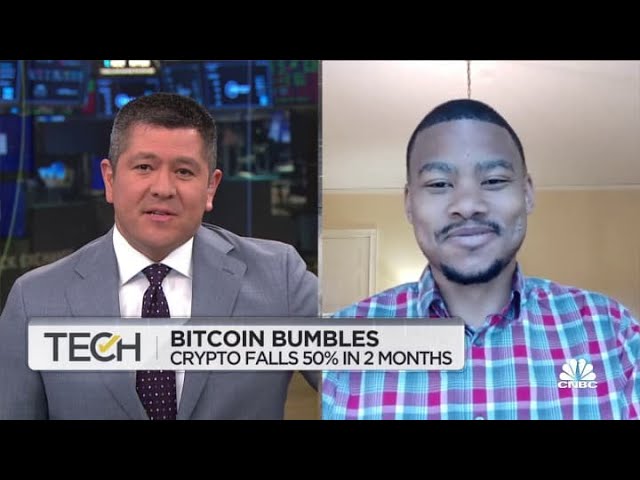
In a TechCheck interview, Kindred Ventures partner Kanyi Maqubela discusses recent cryptocurrency price volatility and why it does not signal a crash. He explains that hash‑rate fluctuations stem from China’s mining crackdown, prompting miners to relocate to more supportive jurisdictions—a normal market adjustment. Maqubela cites CoinShares’ moving‑average analysis (50‑day vs. 200‑day) to argue that there are no structural conditions for a major sell‑off, noting Bitcoin’s 200% YTD gain and Ethereum’s 100% gain. Regarding Coinbase, he describes the exchange as a long‑term “app store” for a broad ecosystem of tokens, emphasizing that price swings are orthogonal to its fundamental use‑case value. He expands on crypto’s expanding utility beyond speculation, including art, lending, and staking, and asserts that lower prices are not inherently negative. When asked about Dogecoin, Maqubela frames its volatility as part of a broader meme‑investing trend driven by retail investors leveraging social media platforms. He cautions against treating meme assets as retirement investments but sees potential for new social‑investing applications. The conversation also touches on macro factors such as easy money, leverage, and recent Fed inflation signals, linking them to heightened risk appetite in both meme stocks and crypto.
Chapters
Kindred Ventures' Kanyi Maqubela is back with us to kick off the hour here on TechCheck. Kanyi, welcome back. Good to see you.
Good to see you again, Carl.
So with your help, we have watched price action in crypto at large and we give it a pretty long leash because we know it's new and we understand it's volatile. Does this price action that we're witnessing this week and especially today, does it mean that the use case has taken a hit?
No, the use case hasn't taken a hit, but there are some things to consider. The first thing to consider is that you're seeing some hash rate volatility coming out of China, but hash rate volatility is relatively normal. And so it's not atypical to see compute, which is ultimately what there's a global market for, for Bitcoin, move to jurisdictions that are the most supportive of it. And so China cracking down on that is actually indicative of Bitcoin actually moving to places from a mining standpoint where there's going to be more support for it first. Second of all, as you think about the price, one of the things I like— actually, CoinShares did an analysis talking about whether there was a predictor of a bear market. And so you want to look at the short-term moving average and if it drops below the long-term moving average, so 50-day, 200-day. And if you're looking at that, you actually see that there's actually not the structural conditions for a major sell-off. After all, Bitcoin is still up 200% year over year. Ethereum is up 6%. 100% year over year. So while you are seeing volatility, which is typical with both of those assets, if you're looking at them on a long enough view, this actually isn't cause for immediate concern. Right.
And when you see technicians now— and I know, I mean, technicians is its own separate thing— but when you look at head and shoulder patterns that sort of telegraph targets in the, say, let's call it $5,000 range, I assume that— is that worrisome from the use case standpoint? And is it worrisome from the Coinbase standpoint, which I know Kindred has some?
Yes, we are holders of Coinbase. And the thing that I should note about Coinbase is Coinbase is a very, very long-term oriented platform that the best way to think about it is it's sort of going to try and become an app store for a lot of these currencies. And a lot of these currencies don't just have speculative value but have use case value, as you pointed to and alluded to. And so with respect to use case, the way that the price moves is sometimes orthogonal to whether or not there's an important use case for it. So I'm actually still long-term bullish on the Coinbase case because they actually want there to be a vibrant app store with a large number of currencies, not just a handful of highly speculative assets. And then secondly, though, as you think about the use cases more generally as a function of price, one of those use cases is speculative value, but it's not the only one. And so what you're increasingly seeing is more and more use cases transacting in art, in lending, in staking, in other systems. And price volatility is more complicated for that. But low prices aren't necessarily bad.
Yeah, Kanyi, I can't believe I'm going to do this, but I'm going to ask you about Dogecoin. Here's why. It's because it has been more volatile than Bitcoin has been. And there's sort of less of an overall kind of blockchain use case around it, less of a sense of intrinsic value there. And I wonder if the, the dive in Doge might indicate something about the markets, or at least the retail investor's appetite for risk. What do you think are the chances that that is or will be somewhat indicative? And then what is the impact on tech, maybe even early-stage tech, if it is?
The way that I think about Doge is actually somewhat separate from crypto and from a use case standpoint. I think the trend and the theme that you're seeing with Doge is the rise of meme investing. And we've been talking about GameStop, AMC, Wendy's, a lot of these names, even in the traditional public markets, which have seen crazy rapid price appreciation and then equally pronounced quick drops. And a lot of that is just indicative of the fact that retail investors are now flexing a muscle, using social media, using Reddit and self-organizing in a way that they have never done before. And that's been happening over the course of the last year. So I think meme investing is in and of itself a trend. I think it's a very challenging trend for somebody who wants to be an investor for the long term, who wants to be a patient investor, a more traditional and established investor. I wouldn't recommend putting your retirement savings, for example, into Dogecoin. But I think that that's the trend that we're speaking to there. And I think that's going to play out actually in new apps that are using social investing as a way to actually get communication and building community and friendship. And social networking might actually have investing categories and aspects to it.
Well, more than anything else, I also wonder how much of what we're seeing in meme stocks, perhaps in Dogecoin, has to do with easy money and easy access to leverage, and whether, you know, the inflation indications by the Fed last week combined with the caution perhaps that's moved into the crypto market with these China headlines might be part of the story.
Yes, but I think that While it may be the case that excess liquidity was the catalyst, it has now awakened the imagination of the population. And so it's now the case that meme investing is clearly here to stay. The extent to which it happens may actually have some correlation with the amount of so-called easy money, but meme investing is now a new category that we all have to understand and grapple with more seriously.