Nvidia's distribution advantages gives it an advantage in A.I. as well: Kindred's Kanyi Maqubela
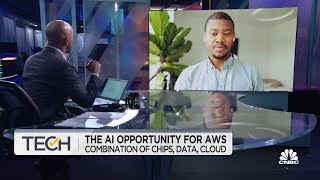
Clip from a CNBC Tech Check special (July 8, 2023) covering three connected topics: (1) Kanyi Maqubela (Kindred Ventures) explains AI-stack competition—chips/infrastructure, foundation models, and applications—arguing Nvidia enjoys a distribution and orchestration advantage rooted in long GPU leadership and widespread use in model training; (2) a panel examines Meta's new Threads app, its explosive early downloads, and the competitive effects on Twitter, TikTok and Instagram plus creator/advertising dynamics; (3) an interview with Amazon's Dave Limp on device strategy, Prime Day expectations, product cuts (Halo) and bets on robotics (Astro), scale-driven cost advantages, and subscription value dynamics.
Chapters
Kanye Machabel, a managing partner at Kindred Ventures, is with us now. Kanye, it's great to see you. So part of what my line is talking about is, hey, we've already got this customer data, we've got these AI tuned chips and we've got a pathway to be able to get that data into the system to train up these models, right? She's arguing they have an advantage. When Microsoft has had the narrative with open AI, might we see a shift here?
It's going to be extremely competitive. First of all, great to see you again, John, but it's going to be extremely competitive because the truth is that there's going to be an open question around whether the models are actually going to be the most important input in driving serving great results, which means at the lowest latency and at the highest quality, whether it's going to be the orchestration which she was just referring to, which is actually figuring out how to get data into these systems and get the data towards from the compute all the way through, or whether it's actually going to be a matter of whether there's a cost advantage, whether it's in simulating or in the compute itself. And every player who has scale is combining in different ways to try and figure out advantages. Microsoft is working very closely, for example, in their Azure cloud with Snowflake to try and figure out how to make the Snowflake data warehouse and the Azure cloud work even more seamlessly. So it's going to be a very, very tough battle. But the truth is at every layer of the stack there are multiple very well funded and very well executing competing players.
Well, let's, let's do this as three layers, right? You got the infrastructure layer at the base, including chips, then you've got the foundation models in the middle and then you've got the applications like Chat, GPT and others on top. Let's start at the base because I talked to Andy Jassy yesterday, he was saying hey, cost performance wise, he was arguing they're going to be better than Nvidia. Even though in video is seeing this massive premium right now, is that possible? And therefore, because if it is, investors need to think about how long In Video maintains that that valuation premium and how long Amazon gets sort of shrugged off as an also ran well, there's.
Two inputs on that. One of the inputs is the underlying, the fundamental underlying technology. And Nvidia, right, frankly does have a 20 year advantage in graphics processing units and they were the ones that invented the category and have perfected the system but there is a second component that I think is really important, which is how those graphic processing units are applied. And so I think that the orchestration and the way that you actually distribute and how you set clusters up, how you run simulations on those clusters, is going to make a big difference. Where I continue to think, at least today, that Nvidia has an advantage default is the fact that so many of the companies that are building foundation models, like an, like an inflection AI, like an open air, are actually still organizing their clusters with Nvidia GPUs. And I think that's going to present a good distribution advantage. It's going to present a strong flywheel in terms of orchestration. That said, there are people who are building processing chips that are in fully vertically integrated solutions like Apple. And so I do think that being fully vertically integrated can also deliver cost advantages. So it's not just a matter of how the technology is designed, but how it's orchestrated in the system. And today, because of Nvidia's distribution advantages, I actually think that they have an advantage in. Andy makes a very good point that they have a distribution advantage. The layer above, which means they're going to be a fierce competitor because investors.
Also have to think about how much of this is priced in one More before we let you go. It seems to me that very often it's the applications that end up driving the story. That certainly happened with chat once people actually got their hands on it and could see what it could do. That sparked all of this talk about investment and, you know, building these new features into various, both consumer and enterprise application. How much do we need to look at who's able to deliver the case studies and the applications on top of their stack to drive developer interest and then economic value and investor returns.
There are two things that I think are the most important and they're intimately related, but they both ultimately have to do with demand. And I think demand is going to be the fundamental generator of commercial value here. The fact that Chatbot became the fastest consumer application to reach 100 million users last year is indicative of the fact that they were able to have an extraordinary amount of demand. The second though, and this is where I think we're going to have to look very closely into how AI continues to integrate and become embedded across so many ecosystems is where there is proprietary data. Right now, so many of these large language models are crawling the web. Once they start crawling proprietary data, their ability to surface more nuanced and more specific and more end user useful, frankly, data is going to make a fundamental difference as well.
All right, thanks for helping investors to understand it. Get a jump on that ahead of the second half. Kanye Machabella from Kindred Ventures. All right, coming up, met as Twitter competitor Threads taking the Internet by storm, becoming the most rapidly downloaded app in history. We're going to dig into the latest competition for consumers attention next.
Welcome back.
Big tech's competing head to head in the second half. Meta's Twitter competitor Threads, which launched Wednesday night, already has 70 million users. That's compared to Twitter's Twitter 238 million daily active users as of last summer. Apple's recently unveiled Vision Pro headset will take on Meta's Oculus in mixed reality. And the explosion of generative AI continues with Microsoft CEO saying earlier this year when it comes to AI powered search, he wants people to know that Microsoft made Google dance. So what could these matchups mean for the leaderboard in Silicon Valley? And what's in store for social media stocks in the second half? Our Julia Boorstin has the latest. Julia?
Well hello John. The second half of the year has been marked by the surprising debut of Metta's Threads, as you mentioned, drawing over 70 million users in its first day and a half. With this Metta showing its ability to leverage Instagram's reach to launch this new text based Twitter alternative. And Twitter, while struggling with outages on his desktop desktop platform and with user blowback to its tweet limits, is showing its concern by threatening Metta with with legal action for launching Threads. Now Meta shares are up about 141% year to date, far outperforming its rivals even as it works to cut costs in its self proclaimed year of efficiency. And also as it readies its next generation Oculus headsets to compete with Apple's Vision Pro. It's still Meta is still likely the one to beat when which which could be the one to beat when it's released next year. Meanwhile, the other players in the space, Google and YouTube owner Alphabet, it's up 35%. Snap is up more than 30% year to date, which is pretty much in line with the NASDAQ's gains this year. While Pinterest shares are up 13%. Now, every single one of these platforms is facing the same key challenge, a contracting advertising market. They're also facing the same opportunity, the ability to use AI to improve advertising, creation, targeting and also measurement. All of these companies are also weighing how to compete for creators, how to use E commerce and how to navigate criticisms about their potentially negative impact on kids and teens and also what they're doing about potential regulation. Now privately held TikTok is of course at the center of the regulatory firestorm and that is a key wild card for the rest of this year whether TikTok will be banned or whether it will be forced by regulators to spin off from its Chinese parent company. So, Donna, a lot of potential changes in the rest of this year, especially coming off the big surprise of Threads.
Yeah. Great set up for us. Julia Boorstin, thank you. Joining us now for a closer look at the broader impact of the Threads debut, Rachel Carton. She is social media consultant for companies like Kaba and West Elm. And Alex Kantrowitz, big technology founder and CNBC contributor. Rachel, are you surprised because Threads is like the polar opposite of the Metaverse, right? I mean, this is like text on a two dimensional screen. It's something that it seems like Facebook, back when it was called, that was resisting doing for a long time when people were saying, why don't you? And now it's growing.
Yeah, I mean, I'm surprised and I'm not surprised. I think that the timing is right and I think that it was a fairly, almost, I guess I would say, low lift sort of addition to Instagram and sort of porting all of their users over there is, I think it's a smart idea and I'm very, very curious to watch it closely.
Alex, I wonder if Mark Zuckerberg's attention shifts away from some other things like the Metaverse, which I know is a long term play, but to this really interesting, somewhat strategic, but also tactical movement which is Threads, because I mean, historically the guy loves growth, he's addicted to growth. And here's something that looks like it's growing both in numbers and engagement off of Facebook matters existing social graph. This is like old school Mark Zuckerberg stuff.
Absolutely. I think his focus is going to need to shift to this area, but maybe not all for good reasons. So let me just put this out there. What Threads is doing is it's building an algorithmic feed of social media content. What does that sound like? It sounds okay, a little bit like Twitter, but a lot like Instagram. And when you view this in context of Meta's big war against TikTok, which is the battle of its life, this could a potentially distract some of its executives away from putting Instagram and Facebook front and center there, but also take some energy away from Instagram in terms of user focus. And once that happens, all of a sudden, Facebook's plan to take on TikTok looks very different. So I think this is an underappreciated risk in this fight.
All right.
Need to look this way.
I mean, there's plenty of investment that, that Metta can afford to shift around. Does it have to go away from Tick Tock competition? Couldn't it come from the metaverse? Couldn't you take like 30% of those resources and say, okay, maybe that's a few years out, let's spend that money on making Threads robust and monetizing it that much sooner?
You could, but the other side of this is the product side, and that's what I'm trying to say, that Threads could eventually be an underappreciated competitor, not just to Twitter, but to Instagram. If this thing starts to take potential growth away from Instagram, potential growth away from reels, potential growth away from every Tick Tock competitor that Facebook has, and ends up diluting the Instagram app. Yet you could eventually have an issue where it doesn't matter how much resources you throw at the thing, you. You end up competing with yourself more than you're competing with others. That's a potential risk. No one's talking about that. And I think that's a very important thing that could end up hamstringing Meta as it tries to get this thing off the ground.
Rachel, what do you think? Is this classic Facebook meta using its existing strength to leverage into another product, which is how they helped grow Instagram on the back of Facebook to begin with? Or is this a potential distraction and are brands going to move from Instagram to threads and spend new money there?
Look, I think it's going to be really interesting. We're in day two right now. It feels chaotic in there. I'm curious, you know, weeks out, how are people using this platform? Are people posting a lot of photos there? Are people posting, you know, downloaded TikToks in there? Or is it really text based? Is it feeling really like status updated? And I'm, I think the proof is going to be in how people end up actually using this platform and not just how they're using it on day two?
So, Rachel, are you telling your clients to jump in now and experiment and sort of stake out their space, or are you telling them to wait because there's so many now different platforms that you could be posting on. Is this one at 70 million? Or maybe it'll be 80 by the end of the show. Is it worth getting into now?
Look, normally with a new platform, I say sit back, wait, grab your handle, and just see what happens this one. And I think this is how I know there was a shift. I was like, let's get in there. You know, Metta leaked, not leaked it, but, you know, announced it to a few brands. So as soon as you logged on, you saw that there was Netflix was already in there, Complex was already in there. There were brands really actively participating. And it almost felt like as a brand, you didn't have that time to wait. You had to get in there, you had to involve yourself. And so that's the first time I've really seen that in a long time. With the new platform, our brands really just jumped right in and we're having a lot of fun in there.
Mr. Beast already has a couple million followers, I think. All right, Rachel, Alex, thanks. Have a great weekend. All right. Coming up, we're going to discuss the latest developments at Amazon with the company's senior VP of devices and services. Do not go anywhere. There's a lot more ahead on this special edition of Tech Check. Coming up, green light for Baba, that stock soaring today on a hefty fine from Chinese regulators. And Ceko, it's the new battle of the C suite with Musk and Zuckerberg promising a cage fight. Is it a new age for the alpha and tech next on cnbc. Welcome back to this special edition of Tech Check, where we're taking a closer look at all things tech and artificial intelligence. Now, stocks closing the day lower with Dow the underperformer of the major averages, the Russell 2000 up 1.2% after yesterday's big drop there. Similar story for the first week of the second half with the dow finishing off almost 2% compared to the S and P and Nasdaq's slimmer losses. The Dow seeing its worst week since early March, topping the NASDAQ this week. EV stocks, Tesla, Lucid Motors, Rivian rounding out the top three with Rivian up almost 50% just this week. Meanwhile, health care and chip stocks finishing the week lower in the NASDAQ 100, AstraZeneca in particular down this week on mixed results from a lung cancer story. Now let's get back to the consumer and the macro. Let's bring in Dave Limp, Amazon senior vice president of devices and services. Dave, I was just out there in your neighborhood yesterday but missed you. So I'm glad that we can talk here. How are you?
I'm great, John. Glad you were here and thanks for bringing the good weather.
Absolutely. It was very nice. So talk to me about you're over devices and services prime day For Amazon is next week. The consumer still seems to be spending but Andy Jassy was telling me there, there's a lot of trading down going on. What do you expect particularly when it comes to Amazon's own devices next week?
Yeah, we obviously have two big days next week, but we started our lead up sales this week and it's off to a good start. You know, but I do agree with Andy that people are looking for value for and you know, one of the things that we've really stood for as you've known for a long time with our devices, is to try to build premium products at non premium prices and then when we can discount them for our best customers, our prime customers on these days, there's just values left and right to be had.
So what are you doing within the supply chain and in the design of products at this, you know, kind of tricky period in the economy to make sure that you deliver that value? You've got scale, so I imagine you've got some advantages versus the competition.
Yeah, you know, we've shipped over half a billion devices that are Alexa enabled to over 200 million Fire TVs. So we're in the good position based, based on our customers demands to be able to build things at scale. And when you do that, you can engineer costs out of your products. And so when you can get a Fire TV stick for under $30, when you can get an Echo for under $30, these are, these are incredible values with, with a lot of technology packed into them, but they're engineered to be that way. And then the scale of the business allows us to deliver those savings and get them on to the consumer.
Talk to me about cuts. You killed Halo, the health line of devices and services. But Astro, that robot that you showed me up there a couple of years ago is still alive. You just did an update in September. It even though that thing's still north of $1500, what are your priorities? Why did you do it that way?
Well, you know, a lot of things, we want to invent a lot of things and I think we do. And, and when you invent something you take, you inherently take risk. And I think the nice thing about this organization, Amazon as a whole is we're willing to take on risk. And, but I think what people forget is when you take on that risk, not everything's going to succeed. I think people assume we have this perfect track record at Amazon, we do have a good track record, but it's not perfect. And Halo is a good example of that. The team invented well, they listened to the customer, they tried to deliver things. There just wasn't enough customers out there that the product resonated with. And that's okay. And when you recognize that you shut it down, you move on and put your bets on other places. And we have lots of those. And I'm confident that we have a lot of successes left to show customers out there. And I believe robotics will be one of that area. You know, I can't imagine a future ten years from now, especially with all we see going on in AI where every household isn't going to have at least one robot. In fact, I think they'll have more than one robot. I certainly want that. House and Astros are our starting point there and I think there'll be more to come.
Do you have any sense that consumers are starting to have paid service fatigue, subscription fatigue versus being willing to buy something and use a service on the back end for free?
I think different products have different business models, you know, and so. But the most important thing I think that often our industry forgets is you can't just have a subscription for subscription's sake. A subscription has to provide real value for the customer. And if you, if you're doing that, and we have really good subscription dynamics in our prime business, we have really good subscription dynamics in our ring business, as an example, then customers see the value and it allows you to price them very affordably and give oversize value within that subscription envelope or umbrella. And, and when you do that, you see, you know, very low churn, very high customer satisfaction. I think it's when you're not putting that customer first and trying to put oversized value into these subscriptions that that fatigue starts happening and you start seeing very high churn, atrophy, non use. And that's not what we want to do as an industry, I don't think.
Well, here's a. For example, give me an update on your philosophy and strategy when it comes to Kindle, which I think of as the original Amazon device. I mean, yeah, we got echoes now and robots and things like that, but it was really about ebooks and Kindle where Amazon first got confident about building out devices. So right now, in this economy where people are trading down, are they still buying Kindles? Is it the paperwhite? How do you demonstrate value in that device?
Yeah, you know the Kindle business a lot. I think a lot of it's because it's just such a brand that customers love. It has been extremely resilient and I think first half of this year we're up double digits.
More from Kanyi

Building with Corgi - Kanyi Maqubela in conversation with Nico Laqua & Emily Yuan

Building with Corgi - Kanyi Maqubela in conversation with Nico Laqua & Emily Yuan

Acceleration & Balance The American AI Strategy presented by Kindred Ventures

2026 will be a very important year for venture capital, says Kindred Ventures' Kanyi Maqubela

2026 will be a very important year for venture capital, says Kindred Ventures' Kanyi Maqubela





Beyond Unicorns: Kanyi Maqubela on Identity, Innovation, and the Future of Venture Capital

Beyond Unicorns: Kanyi Maqubela on Identity, Innovation, and the Future of Venture Capital