Raising money in hazy markets
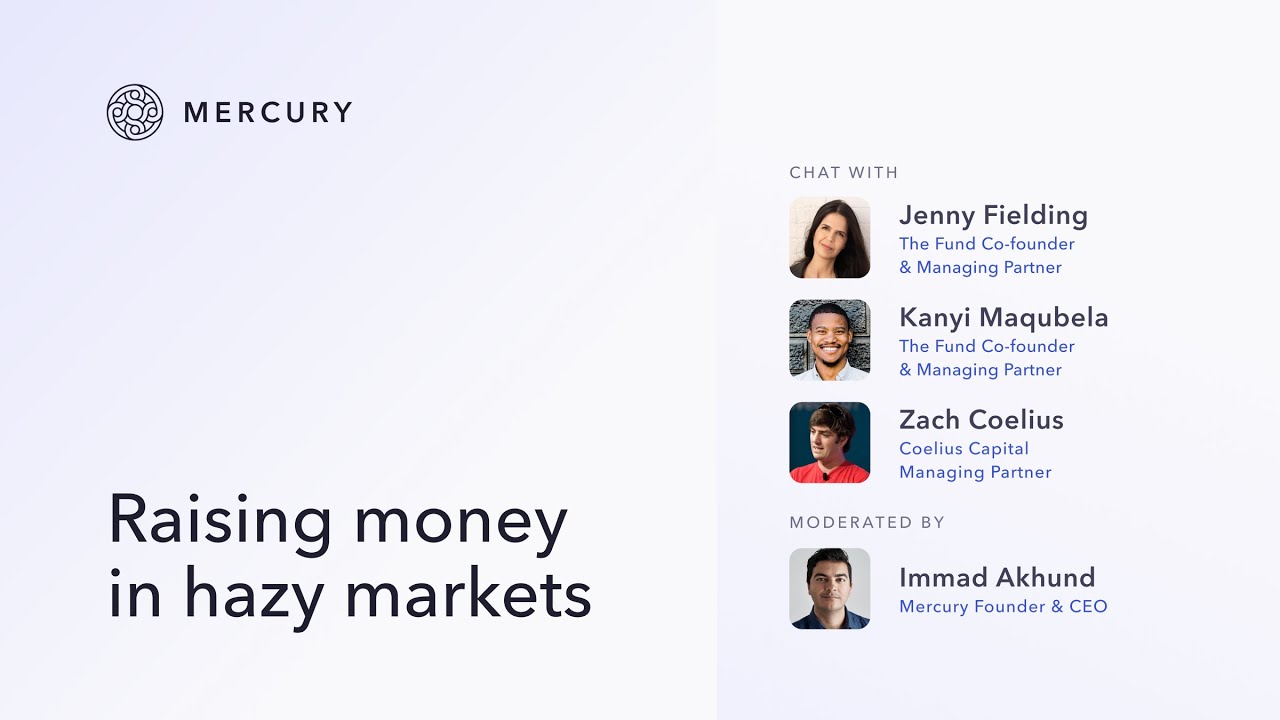
In a Mercury Raise event recorded June 13, 2022, moderator Speaker A convenes a panel of three early‑stage investors—Kanyi Maqubela (Kindred Ventures), Jenny Fielding (The Fund, former Techstars NY), and Zach (Koodius Capital)—to discuss how seed and early‑stage fundraising has changed as capital markets have tightened. The conversation begins with the panelists sharing their emotional reactions to the market: Kanyi expresses empathy for employees caught in the reset and cautious optimism for founders; Jenny echoes empathy but stresses a calmer outlook; Zach adopts a gloomy tone, warning that the easy‑money era is over. They then examine concrete market shifts: multiple‑choice compression at later stages (a $27 M ARR company’s Series B term sheet dropped from a $400 M post‑money to $250 M), and how that ripples down to seed valuations, which are no longer fixed numbers but relative signals tied to downstream expectations. Kanyi explains that seed pricing must align with anticipated Series A/B multiples, while Jenny notes that over‑diluted “party rounds” with many small scout checks can leave founders without a supportive lead investor. The panel highlights “signal risk” – the danger of investors writing non‑core checks at stages where they lack expertise, which can undermine future follow‑on support. They discuss a shift from growth‑at‑all‑costs to capital‑efficiency, emphasizing gross‑margin focus and realistic cash‑burn planning. Advice to founders includes: be flexible on valuation, let the market price risk, construct cap tables with clear, aligned incentives, and consider longer runways (e.g., raising enough cash to survive 12‑24 months). Zach contrasts solo investors (who can act quickly without partnership politics) with fund structures that may falter in downturns. The panel also touches on hard‑tech, climate, and space ventures, noting that deep‑tech often survives via grants and that business models with negative gross margins become vulnerable when capital is expensive. Finally, they debate metrics versus qualitative value, with Zach favoring product/value narratives over early metrics, while Kanyi and Jenny stress understanding market comps and realistic dilution ranges. The discussion ends with practical take‑aways for founders on runway planning, fundraising cadence, and the importance of having investors who will back them through tougher periods.
Chapters
Thank you, uh, for everyone joining, uh, the Mercury Raise event. We're talking about kind of the market right now, especially from the perspective of seed fundraisers and seed investors. We have 3 great panelists. Firstly, Kanyi Maqubela,, from Kindred Ventures, uh, their early stage venture fund. Uh, they've done 50+ investments including Cloudtrucks, Goldfinch, Tala, and many, many more. Uh, then we have Jenny Fielding. Uh, she for many years was a managing director at Techstars New York, I believe, uh, and has $12 billion of like market cap and companies she's invested in. Uh, and now she runs her own fund called The Fund. And then Zach, he is— I don't think he came up with a name for his firm, so it's just Zach. Oh no, Koodius Capital. There you go. And they've done some great investments including Cruise and Mercury and Wunderkind. And Zach was previously also co-founder of a company called Traget. He used to always wear these red shirts everywhere. He was famous for them. All right. Appreciate all of you joining. I think one thing that would be interesting, and I think You know, I made this mistake when I was a founder that I wouldn't like always treat investors like they're humans and they have emotions. So I'd love to hear, you know, as this market has been so volatile, what have your emotions been as you're like observing the market and how has that affected like how you're making decisions as investors?
You know, the main emotion that I feel is is empathy. And I feel sympathy for the employees who haven't vested, who have really high strike prices, the aspiring employees who chose based on their H-1B visa for companies that rescinded their offers, the, you know, the people who have have been counting on the cost structure of the capital markets of the last 5 or so years that has now been dramatically and aggressively reset. It's just a bummer. And it's one of those things where timing is everything and you can't control it, but when you get on the unlucky side of it, it just really stinks. And so I feel, first, a measure of sympathy there. The second thing that I feel though is cautious optimism. And part of why I feel cautious optimism is starting companies, my partner and I always say that starting companies is kind of like deep, deep, deep sea fishing, where like the fish that live down, down, down in the dark parts of the ocean aren't going to rise to the surface for a long time. And so what's happening in the capital markets kind of doesn't matter to the earliest stage startup who's just trying to figure out how to make something work. And if anything, it makes it more interesting for them because so many more different types of fish get exposed. And so I think that those companies who are being built today are going to be so iconic at some point in the future. So sympathy and cautious optimism.
Great answer. Zach or Jenny, you want to take that?
I'll jump in a little bit. You know, what's interesting about this panel, we've all been founders. And so I think, you know, just having that empathy. I sold my first company after the 2008 crisis, and it was a horrible time to try to sell a company. And, you know, I just was really feeling that the other day of like, gosh, I really remember what that's like. So I think it's, you know, a good taste of, you know, just kind of empathy and feeling like, you know, we— many of us were there, you know, in very similar times. And then to Kanyi Maqubela's point, there's a lot of drama about like doom and gloom, which I don't actually really share. I think, you know, it's going to be different than it was a few months ago, was last year. But I think that, you know, just staying the course and staying calm and, you know, hopefully during this talk, like, we'll come up with some, you know, really good tips. But I'm definitely not as, you know, pessimistic or dramatic as many people out there.
I would say I'm probably the— I would probably be the gloomiest member of the panel, um, in that, you know, I, I, in my last company, you know, we started it in '05, so I, I got to see what fundraising was like in the beginning of, you know, the, the what became a nice wonderful period of time, but in the beginning was very, very difficult. And then, uh, we raised our Series A in 2010, so I spent all of 2009 fundraising and I mean, we did over 100 VC pitches, more than a dozen partners meetings. I mean, a huge amount of time talking to investors and it was very painful. And whenever I talk to my entrepreneurs, the teams that I work with, I'm just like, get ready for a world that is so much harder than it has been in the last few years because it was so easy to raise money. Like, I mean, every company was able to raise money in the last few years. And I think I'm trying to stress to people that, like, get ready for what will be very, very— what probably will be a very challenging, challenging few years.
Do you think it's already harder at seed stage or Series A, or it's just like going to get harder? Like, this is just the startup, how hard it gets?
Well, I think it absolutely is harder now. So if you're a Series B or Series C company or later, you've seen an incredible multiple compression. I'll give an example. So a company that I'm an investor in, $27 million ARR, great business, growing rapidly. It'll probably end the year at $55, $60 million in revenue. And a few months ago, we ran an auction to raise the Series B, and a bunch of bidders came in, a bunch of venture firms that you've heard of, and this hedge fund won the auction, and they were going to put in $50 million at a $400 post, so $350 pre. And they signed the term sheet. We went through all the docs, so 2 months of diligence and docs and all the stuff that you go through to raise a Series B. Um, and, uh, day before it's supposed to close, the hedge fund is like, uh, yeah, we're not going to do it. We're going to do it at $250 pre. We want to put in $50 million still. We insist on $50 million still, but instead of $350, we want it to be $250. Um, and I mean, all of us who were insiders were like, no way, that's not gonna happen. Go fuck yourself. Like, we are never going to do business with you again. And, uh, by the way, go be a hedge fund because venture is not for you because we're never going work with you, and no one will, anyone, nor will anyone that knows how you operate. Um, and then, you know, a group of us put together a new term sheet, uh, and now the company is going to get $25 million instead of $50 million, and, uh, everything is going to change for that business, like the hiring plan, uh, the marketing plan, every, every plan they built suddenly had to get pulled back significantly, and because we think that like the next few years could be very challenging, they're gonna make that $25 million last a lot longer than they would've anticipated. So that's like the later stage. And I've seen that over and over and over in my later stage companies I work with, that's happening across the board. And then at the earlier stage, you know—
Can I just jump in? Don't you think that's good in many ways? I mean, obviously that was a challenging moment for that company, but—
I, I don't— look, I'm not saying that necessarily is a bad thing that the markets have kind of renormalized back to a more steady state, but I do think that companies and founders and other investors have been operationalizing in a world where capital was incredibly cheap and we were able to like spend money to grow and we didn't have to worry about losses. And now we have to renormalize back to the way used to be where multiples were much, much lower, probably at least half as high as they were before, and capital was twice as expensive and things were harder. So I think there's a lot of normalization happening, and I'm seeing it also spilling down into the seed rounds that I look at. I mean, I spend all my time in pre-seed and seed, and it's spilled all the way down as far as I can see.
I guess I'm just like, when you talk about the hedge funds, I mean, I'm old enough, I saw this movie before when they all popped in at the last cycle. And then as soon as the markets changed, they were all gone and we didn't see them for a bunch of years. So the fact that as investors and as a community, we kind of forget what happened before is kind of on us, all of us, right? Founders, investors, and whatnot, because we're just going to see it again and again.
So I don't know.
But I wouldn't just blame this on the hedge funds. Someone walking away from a term sheet I think is inappropriate. But I do think the repricing that's happening is happening. It's just they just decided that they didn't want to follow through on their previous obligation, which is not okay. But, but I do think that like the price that they're— they wanted to reprice it at is now the real new price like that. And I think a lot of companies that have raised at high valuations and that have, have cap tables that are built on prices I'll give you an example. So, uh, one of the companies that I invested in were selling to another company, and I got on the phone with the founder and I was like, okay, what's the deal here? And he's like, okay, you can take cash, you can take equity. And I was like, okay, well, what are we looking at? And he's like, well, uh, they did the $3 million in revenue last year, and then the last round was at $350 pre. And I was like, I'm taking cash. Like, but I'm— I like, for the last couple years we were seeing that over and over again. We're like Founders were able to raise money very, very rapidly at incredibly high prices, and now a lot of those cap tables are underwater.
So what is happening at the seed stage? Like, if something was previously like doing $30 million post, is that $15 million now? If something was $20 million, is that $10 million now? Like, how, how do you think the pricing has like changed at seed stage?
Oh, situational. I mean, the thing that Zach was talking about, I think it's the most important to understand in terms of the seed is that seed price is not a thing. How you actually value a company when it doesn't have revenues, when the comps don't exist because it's a brand new category, is all made up. And so what seed really is, is it's actually sort of part of the web of what does my fund need in terms of ownership and how do I price this in such a way that the downstream capital markets will continue to give this company enough capital to get to its stated destination. And so when the downstream market's totally reset, that actually really has to input seed because seed, again, is not an objective place for pricing. Seed is entirely a relative place for pricing. Now, the fact that it's a relative place for pricing though means that in some cases the prices don't change because a founder and a funder happen to think, whatever, I'm okay with this level of dilution and I'm confident that the capital markets downstream are going to continue to reward this. But in other cases, it has to change highly reactively to what's happening downstream. And so what seed investors do, some of them do it intuitively and some of them do it implicitly, but a lot of them do it explicitly is, what is the Series A market? What is the Series B market? What is the Series C market? And if those things all adjust down 30%, 40%, 50%, then we have to. I can't price something at a 50 if the A is going to come in at a 30. I can't price something at a 30 if the A is going to come in at a 30. And the heuristic for that For the audience, might be helpful to think about is a lot of seed investors try and hope like a successful markup for a seed fund is somewhere on the order of 3x or so, maybe up to 4 or 5x the price that you set. And so if I am investing in you at a 20, I'm hoping that you can get a 60 or a 70 at your A. If I'm investing in you at a 30, I'm hoping you can get 100 at your A. And there were Series As happening at 100. Now the Series As are probably going to happen more like where they were happening in some other part of the cycle. When we raised our Series A for my first company in 2007, just not to scare anybody, but just to set some context, it was at a 12.5, right? And so how far down they reset could theoretically be extraordinarily far, which will then have a cascading effect on what the entry is for seed.. But if it were somewhere in, I think AngelList data had said that it was somewhere like the median was somewhere in the 80-ish range sometime in last year. That median is probably somewhere in the 40 range now, optimistically, possibly in the 30. So imagine it being cut in half, then imagine your seed round having to proportionally be cut in half as well.
One thing that's like a little weird to understand, and maybe Jenny, you can opine on this, is like, The number of companies is fixed and the number of seed funds out there is like somewhat fixed. Uh, so like, shouldn't the supply and demand there be basically the same as it was 6 months ago, that there's a limited number of seed stage companies that are valuable and there's still lots of like funds out there? So like, why isn't that pushing up the valuation to be similar to what it was before?
I mean, I think it goes back to Kanyi Maqubela's point of that seed is an emotional number. It's It's how— that's how we price it. It's like, how much do we believe in this founder? And if there's more scarcity, because there's more capital, there's more hedge fund guys coming in at the seed, then just founders have an opportunity to push the prices up. So the thing that I'm a little more worried about is if you raised a big seed round at a healthy valuation and you've got a few years' runway, you might be able to grow into that and really like hit your metrics. I think, you know, what I've been seeing kind of on a practical level is founders that, you know, raised $2 million on $20 million kind of coming back to me and saying— and they realize the $2 million is probably not going to get them to, you know, their A or to their next milestone. And so then, you know, what's going to happen? And so I think that's where a lot of founders are going to get stuck. But if you raised like a $6 million seed and you did it at a healthy valuation and like that can last you 30 months, like, you know, I think you'll probably— and you're a healthy business, like, I think you'll probably be okay to like hit the numbers that you're going to need to hit for an A. It's the ones that kind of didn't raise enough but raised at a really high price that I think are going to get kind of in, in the crack.
So we talked a little bit about valuations. Is there also types of companies that may have got funded 6, 9 months ago that just won't get funded in this market at seed stage?
I mean, where I play at pre-seed, the number of what I consider non-venture fundable companies had just gone up quite a bit, right? So, you know, things that had a lot of services attached to them, you know, things that didn't feel like they were scalable or, you know, felt like niches. I was just seeing more and more of those, and I was passing, but I saw a lot of those get funded. I think as, you know, the rains come in across, you know, pre-seed and seed, those companies will have a lot of challenges. I don't know if the other— if Zach and Kanyi had seen that, but there was just a lot of stuff where I was like, well, that's an interesting business. It doesn't seem like a venture business though. And I was seeing them getting funding. So that might be an interesting pullback that we'll see.
One, the one that I want to mention is, and I agree with that one totally. The one that I want to mention is encapsulated by this phrase, which is our gross margin is stuck, but we'll make it up on volume. That was a theme that characterized a lot of the structure of plenty of the venture-backed companies, venture capital companies, and even large successes over the last 10 years and capital efficiency, the health of your revenue, the value, like your net income, your ability to create margin, your ability to be cash flow positive at the contribution level suddenly is important now. And it used to be growth, period. And the thing is, it's rational. Like when capital is cheaper, you actually should be thinking about the weighing of different inputs on your business differently than when capital is more expensive. So I don't think that it's like a, it's a bad thing or a good thing. It actually is just a sensible thing. And we're in a world where capital was very cheap. And so growth was the thing that was rewarded the most, as it should have been. Whereas when capital was expensive, profitability and efficiency of the capital suddenly becomes substantially more important. So I think that you're going to see a lot more businesses focusing on the efficiency of their capital, which is, is their margin structure really stable? Is their cost structure at a company level such that they can get to profitability and get to contribution as soon as possible? And you're going to hear a lot more of that when you're thinking about venture, which you just weren't hearing a lot of for almost 10 years.
Yeah, one thing that used to kill me is like when people were just so focused on terminal value. They were like, oh, this could be a $10 billion company. I'm like, there's a lot of risks on the way there. Like, you can't just be like, this is the—
there was, there was a time where it was like massive TAM and lion founder and that's gonna be okay. And that, you know, that time was like, what, 9 weeks ago? And we're kind of, we're kind of leaving that assumption as just being okay. It's like, is there a real business that actually works here, or is there a path towards one? Suddenly is more important.
Yeah, but it sounds like all three of you are still actively investing. It's not like, you know, there's no like dry up of capital, at least at the seed stage.
I mean, we have not slowed down at all, actually. I mean, we are benefiting from kind of prices coming down and I'd say deal pace slowing, right? So it's not like you meet a founder and you need to decide in 24 hours. It's like you actually have time to do the proper diligence that we all should have been doing. So I'd say, you know, those are the things. But yeah, we did. And last month I think we wrote 5 checks. So we're actively investing and, you know, we're opportunistic. So yeah, definitely not slowing down.
How would you say your advice to, like, if you, let's say you're talking to a founder who's about to do a seed round, what would you have said? What might they have thought 6 months ago that now you're like, okay, you can't think like that anymore. Like, what are the things that they need to reframe compared to?
I mean, one thing I've had many, many founders that, you know, that said, you know, we're raising, you know, $3 to $5, I should say. And that's actually not in our sweet spot. We do pre-seed, which we define as rounds of like $500K to maybe $2 million. But that's really based on our valuation sensitivity in many ways. And so I had many founders, you know, kind of email me and get connected that were raising $3 to $5. And I, you know, would just be like, hey, I don't want to waste your time. Super interesting, but like, it's just not going to fit our sweet spot. I've had 90% of those founders, you know, let's say in the last 2 months, come back to me and say, you know what, we're actually not raising 5, we're probably going to raise 2. And so I think that's been one of the kind of interesting things. And so you asked for advice. I mean, I think it's a good strategy, right? I think it's fine, right? Go back to people that you maybe weren't in their sweet spot or rethink your model and figure out if you can open your top of the funnel of investors, right? And I mean, as a founder, it's like, you know, you probably have a way that you can figure this out on $2 million in a way you can do it at $5 million. I mean, honestly, it's like maybe people don't want to hear that, but open your funnel and pitch the pre-seed, the seed, the Series A, whatever you need to do. Tell the investor what they want to hear, essentially.
Somebody asked this question in the chat, and I think it's a helpful answer. Sorry, Zach, I'll just jump in quickly, which is, is it a red flag if a founder comes back asking for less? And so one of the things I do think is important to note is that the shape of signaling has changed. And in a world where it's an easy yes and there's a lot of capital, what signal means and how that signal gets propagated is different. For me, if a founder comes back asking for less right now, I actually think that's fine, especially if they've got a strong point of view around why they can do more with less, and especially if they can articulate a way that that money can be used in a productive manner. It used to be the case that there was signal around whether or not the capital markets were going to reward or accept or even understand your model. And if they didn't, when capital was really cheap, that was going to be a challenge for you. But today, I don't think that that signal is the same. There's a different signal though that has also changed that has come back in a stronger way, which is it used to be the case— gosh, and I used to hate it when I was on the other side of the table. Where I would sit down and it was like, who's investing? How much are they investing? How much of their fund are they investing? How far into their fund are they? Why didn't you ask them these questions as part of the diligence process? But now that stuff really matters because it is going to show, are you going to have people at the table who in 6 months, in 9 months, in 12 months, in 15 months are going to step up, are going to draw from their reserves and continue to back you in points of capital market weakness even though you're executing well? How are you going to make sure that you put together a group that's going to capitalize your business properly? That wasn't a question that was as important 6 months ago because if the thing was working, somebody was going to capitalize it, and if it wasn't working, there were bigger problems. But now those nuances actually matter. And so I think it's like the biggest thing for me is construct your cap table really carefully. This has always been important, but now I think it's mission critical to construct your cap table and make sure you understand what the motivations of all the parties are and can communicate that with a high degree of intellectual honesty.
Can I just add an actual example? Because this morning we just turned down a company that we really liked. Founder was raising $2 million and it was going to be a party round and she had $1 million or maybe like $1.2 million from, you know, many funds that wanted to do kind of small checks. And we just looked at each other. We're like, you know, even if the price was right, like this company is not being set up for success. So I think, you know, We'll see what happens with those kind of party rounds where you've got bigger funds that are not writing conviction checks, right? So a bunch of Series A funds were writing $100K checks into this, and I just thought, wow, this is just, as much as I like it, I don't think this company is set up for success. So I think that's just an example of exactly what you said, Kanyi, and I think investors are going to think about that even more.
Sounds like what you're saying is everyone should just delete all the advice for the last 2.5 years and go back to the advice for like 3 to 6 years ago, because this is all the things we used to say to—
Actually, actually, yes. And like, you know, last year, you know, we were all complicit at some level, but it was a bubble. It was just a bubble. And, uh, there was a lot of behavior that just doesn't map to the tried and true universal principles of business building, capital formation, partnership relationship building. And so on some level, the macro advice that I would give is just think about your instincts here. If you're rushing people into a highest bidder auction process with a 24-hour expiration date, that's probably not the right thing to do. And in today's market, you're going to get smoked if you try and do that. Build the relationship, be dead honest, be conservative and optimistic at the same time, and take your time, build in enough time. These are tried and true principles that had gone out the window. So it's sort of like reality's coming back in a good way.
Zach, anything else you have to kind of, uh, kind of convince kind of founders of, like, how the world has changed?
I, I spend a lot of time talking about how when, when capital was cheap, it was easy and fast. Now capital is hard and it's slow, it's expensive, and you need to prepare for— like, like you and I, when we, you know, grew up as entrepreneurs, it was you planned on a 2 to 3 month fundraising period as the CEO, and you had heads down and you, you started planning and scheming and building, and like you did a lot of work to like get to even the starting line. And then even that took a lot of time. And for the last few years, it was like boom, boom, boom, you raise money, you're done. Um, but it, it appears unless the Fed or some other magic genie steps in to save you know, this— it appears that the market has dramatically changed and we're going to go back to the way it used to be.
So someone in the chat asked, what does it mean to set the company up for success? So I think, like, just to clarify what I meant, if you're raising, you know, $750K, $1 million, maybe a little bit more, and you've just got a consortium of angels and small checks and people putting $50K, it's like, it's that— that to me seems okay. And that's, that's been standard. If you're raising like $2, $3 million, $4 million, and you just have people putting small checks in, no one is really going to go to bat for you on the next round. Who's gonna step in when things aren't going great and like you need support, right? Everyone's gonna be like, oh, small check, I'm busy, right? And they're gonna write you off. And so what I meant by that is if you're raising a proper, you know, seed round or $2, $3 million, $4 million round, having someone that has conviction that's going to be supportive, even if they're not a board member, but they're gonna, you know, be someone that you're checking in with that's gonna write another check, all those types of things that's gonna be there for you, um, it's gonna be important, especially in these, like, in these times.
If you do raise a seed round or pre-seed round, what advice would you give those founders, like, you know, straight after the raise? How should they think about burn? How should they think about, like, you know, milestones to their next fundraise? Like, what's, you know, well, how would— how has your advice changed as well and compared to, like, you know, before this kind of crash?
I think the way I tend to think about it is, is you have a risk sort of paradigm calculation about the future. And so when you're raising seed money, if you can get whatever you can get, then get whatever you can get, and just— that's the best you're going to get and be happy with it. But oftentimes you have a little bit of legal room to take more capital. Do I take less capital? Do I plan on raising again quickly? Do I plan on raising again further out down the road? And 12 months ago, to every founder, I was like, take less capital and just get more traction and you're going to be able to raise more capital quickly and easily at a higher price and take less dilution. So you don't need to pile up the capital because it's free. In the last 6 months, that was changing and suddenly it was like, oh shit, capital's going to get expensive again. You need to plan on plan on not being able to raise again quickly, you need to plan on having a longer timeline. So that means 18 months, 24 months if you could get to it. Now, if you have the choice as a seed round, I would say take as much capital as you possibly can. Don't sell more than 30% of your business, which in the old days was normal. Lately, that has not been normal. But You can sell a large amount of your business and take a lot of capital because running out of capital is the worst thing that could ever happen to you. Whereas taking a little bit more dilution is not the end of the world.
And I think we've seen that now. Many founders that we know are kind of going back to previous investors or investors that didn't get an allocation or new people that they meet and saying, yeah, I'd take a little bit more on the previous terms, or maybe a slight step up or something like that. And, you know, we've been talking to our portfolio— we have 200 companies in our portfolio— and we've also been saying, you know, if you have that opportunity with the right people, it's a good opportunity because there are people like me and others that are kind of specifically looking right now to add a little bit more cash to companies that are doing well and want to extend their runway.
So I think that's an opportunity for founders I have a nerdy analogy which hopefully will add some emotion to this. Think about your company like you are an astronaut and you've just left Earth and you're trying to find a habitable planet somewhere in space and cash is oxygen. Okay, seriously. So you can go back to Earth, Or you can preserve and figure out how to get the orbit of other planets, figure out how to get to that black hole and transport into a metaverse, the other kind of metaverse. But cash is oxygen, which means that conserving it, managing it carefully, shallowing your breathing, don't just act as though you're on Earth because you're not. That's what they call default dead. Default dead means you're an astronaut in space. You're eventually going to run out of cash, right? And then— and forget it, right? And so just think about it that way. And I think entrepreneurs hadn't thought about it that way. They thought about it like they were on Earth and they were like running a marathon, in which case cash was oxygen there too, but it was a very different thing than cash is oxygen when you're in outer space.
That's a great analogy. Hopefully they can make it to Mercury. When you mention signal risk, you know, the signal risk used to be something people used to care a lot about. And then I would also say in the last few years, like many people weren't talking about it. Can you touch a little bit more on like, there's lots of different types of signal risk. So like touch about like what you mean by signal risk, what's the worst kinds of signal risk and like what should entrepreneurs like go massively out of their way to avoid right now?
The signal risk that on the way to the last 5 years, a lot of people were worrying about was investors coming into a round that is not in their stage. And particularly downstream investors coming into a round earlier stage than they typically do. So a, like, so T. Rowe Price doing a Series A would be an example of signaling risk. Like, why are they doing a Series A? Yes, they're a good investor in them in a vacuum, but in the context of A. But the most acute one and the most relevant one I think for this audience is Series B and in general lifecycle investors writing non-core checks at seed. And that used to be a big piece of signaling risk because it was sort of like this idea that they were buying an option to look at a company and get to know whether or not it was something they wanted to take a board seat on and really become a lead investor in. And then in the last 5 years or So that signal kind of faded and it suddenly became the case that, oh, so-and-so well-known fund is doing your Series C with a $250K, $500K, $750K check, whatever, right? Suddenly became like no big deal. That's a big deal again. And it's a big deal because again, you want to make sure that you understand whether or not you're going to get more cash from your investors. You want to understand if you've packed enough tanks of oxygen on your journey. And part of that tank is the reserve that these funds are gonna deploy on your behalf, and they'll only deploy it if it's a core check. And so you wanna make sure that people, when they're investing in you, are aligning their personal interests professionally with your fund, or sorry, with your company's performance.
I guess that can be like a little hard and maybe contradicts Jenny's earlier advice, which is like, hey, open up the funnel, go talk to as many people as possible. So is this more of an issue if you happen to have multiple term sheets and you're picking, Or should you just go like, "Hey, I'm doing a seed.
I'm not gonna go talk to any Series A investors." No, well, for clarity, I was saying open up the funnel, 'cause maybe you can get one of those folks in to lead. Back to my early point of the party round, I think that's also where this comes in, is like, if you've got all these $50K scout checks from every investor on Sand Hill Road and none of them are gonna step up for the next round, that kind of sucks, 'cause no one's supporting you. To take it one step further to what Kanyi was saying is not only suck, but it's, you know, then the investors— I mean, I've been screaming about this for a long time, even in the last few years, and everyone was telling me that I'm really outdated and like I kind of don't know what I'm talking about because everyone is doing scout checks and all the like. And I was like, okay, but I mean, that'd be the first question that I would ask even in good times, um, you know, well, they put a $200K non-core check in their Series A fund, like, why aren't they interested in this in this round, at least it's going to be a question. Maybe it didn't matter in the last 2 years, but I think that's more of a risk now. So that's kind of my point.
I think the big issue is that for the last few years, every company got funded and refunded and refunded and refunded. So I've invested in about 60 companies, seed and pre-seed, over the last 8 years, and I've only had one bankruptcy out of those 60 companies. And that's not because I'm good, it's because there's so much capital, there was so much capital funding these businesses that the following capital just kept coming and they were able to keep raising and keep raising and keep raising. And I, I think a lot of entrepreneurs haven't been through what a down cycle looks like, like you and I went through in 2008 or back in 2000, you know, 2, 3, and 4. Like, they don't know what it's like to go talk to hundreds of investors and get 100 nos. But that is actually much more normal than what we've seen over the last couple years where money was free. And so having a, a capital base of investors who can support you in an environment where capital is hard because they're insiders, they know, they can see the business is doing relatively well and they can say, "Oh, okay, we're just going through a tough spot. Here's more money," versus a bunch of people without the checkbook to back up and write that hard check when there's a lot of unknowns and nobody wants to fund the business. That becomes incredibly powerful and is super important. So if you have the ability to avoid the tourists and avoid the later-stage venture firms just throwing in random cash into your fund and avoid scouts. You're in a much better place if you have the ability to do that. If you don't, you might find it very challenging the next couple years.
What do you think is going to happen with kind of the solo plus? Like, that was an interesting kind of— I guess Zach might have counted as a solo capitalist as well, so I don't know.
Yeah, I mean, I don't think the solo thing really matters. I mean, I have $100 million in new capital to put to work. So I'm bigger than a lot of venture funds. Me being solo doesn't change the game, but you have to say, how much capital do you have? How do you think about reserves? How do you think about follow-ons? How do you think about supporting your companies when they go through tough spots? And I'll tell you what I think, that's my approach, and you're going to talk to the other people and they're going to tell you their approach. But I don't think the solo really has anything to do with it. It. In fact, I think solos do better than most firms in a down market because the problem is that it's easy as a group to get together and invest capital when everything is going up. Everyone's like, woohoo, let's go, more capital. It's when things start going down and you start to have losses that the recriminations start happening, when people start feeling bad about their position relative to others and they're and you start to get the real nasty group dynamics that are often really poisonous in those partnerships and especially in VC funds. Whereas a solo, look, it's me, I make a decision, I have my capital and I don't have to worry about that. So if I was an entrepreneur, I'd rather have deep-pocketed solo investors on my team versus— and if I had a partnership in my team, I would want my partner to be the senior partner. I would want want them to be the boss of the partnership rather than a junior partner going into what could be a downturn.
That is game right there. That's such an important point is so many venture investors are actually senators who have a bunch of constituents that they're trying to balance and are trying to figure out how to get reelection, which means get invited into the next fund. And so they actually are acting more like senators than they're actually acting like high conviction risk allocators. And so Zach makes a brilliant point there. The other thing I'll say about solo, which I think was a symptom of the last couple of years and is not so much a solo thing because there were plenty of partnerships who were doing it too, was the idea of, I'm just going to write you a check and then I'll see you later, or I'm going to write you a check because it's my cocktail party chip, or I'm going to write you a check because it's what all the cool kids are doing, or I'm going to write you a check because insert anything, but because it's my job and I'm working really hard to allocate risk and to help build companies and to show up for them in difficult times. And whether you're an individual doing that or you're part of a firm doing that, there have been both types of that activity. So I think the latter type of that activity, which is sometimes tourists, but is oftentimes people who are in our community and are active in our community, is the type that's gonna fall by the wayside the fastest because this isn't gonna be fun cocktail party conversation anymore. It's gonna be, Have you made any extremely hard decisions that you were totally insecure about? And that's the thing that is actually gonna be making, you know, separating the wheat from the chaff as investors. It was gonna be really important for entrepreneurs and that's just not as fun to talk about, right? I think that's where there's gonna be a big change in a way that's ultimately healthy for the ecosystem.
What do you, I don't know if you all do kind of climate or hard tech or space or any of that, that, like, what happens to those companies? Because, you know, often they have revenue like 5 years in the future or something like that. Uh, yeah, they're gonna get funded in this environment, or is it kind of— yeah, I guess 5 years ago they didn't used to get funded.
Yeah, I mean, I, I've invested in, in some of those spaces, and I think what's good is most of those founders are used to being quite scrappy anyway. I mean, maybe it was a little easier the last few years, um, but hard tech specifically A lot of them come out of universities, they're able to get grants and other types of support that actually won't go away. And so maybe as of late, it's been easier to get external capital, but I do think there's a lot of government money available, as well as kind of university available to some of the deeper tech. So kind of retreating to how it was, but I feel like there's an ecosystem to support a lot of those companies.
Companies.
October of 20—
no, go ahead, Zach, please.
I would, I would say on the other side of that, like, you can look at capital as a curve, and for the last few years it's been functionally as cheap as it has ever been in our lifetimes and even longer. It's never been so cheap, and it, it's on its way to becoming significantly more expensive. And if the Fed is not successful, it will become incredibly expensive. And so if you— and you could plot against that curve businesses that are viable depending on how expensive or cheap the capital is. And so you, you can look at like an eBay or Google or a software 90% gross margin SaaS business— that business will work no matter where you are on the curve. It may grow slower because of that free capital, but the business is viable all the way until— capital could be 30%, 40% interest rates and it would still be successful. And on the other end of the curve, you have incredible beautiful businesses that are really challenging when capital's expensive. So if you're doing negative gross margin delivery, 3, uh, you might be in a really tough spot, uh, if you're investing on a very long time horizon and it's incredibly capital intensive. You might be in a tough spot if, like, and just keep going down that curve. And the thing is, is that, like, if you're a founder in that spot, you have to be very realistic about the fact that capital, when it becomes expensive, makes some business models no longer functional. And, um, you're gonna have to make some hard choices as a result.
I want to share a few quick anecdotes. Um, there's a company that was started in March of 2002, uh, so about 9 months before, uh, the, the absolute nadir of the dot-com bust. Uh, it was a, it was a, a deep tech company. There was a company started in, um In early 2010, right after the global financial crisis, and the latter of those was a biotech company called ModeRNA, you know it as Moderna, and the former of those was a space company called SpaceX. So like, it's going to be okay. If you are a great founder and you again recognize that capital is a tool and sometimes that tool is more accessible than other times, sometimes that tool is more expensive than other times, and you have access to capital, whether it's personally, by your investors, via how you're creating value in the market and articulating that, you're going to be fine. But you just have to be hyper-realistic about it. Like, if somebody can build the best space company in history right after the dot-com bust, then you can— then you can do your thing, you know. If somebody can— please go ahead.
Elon funded SpaceX for the years, I think 3, totally 4 years, fully out of his pocket. And he didn't do that because he wanted to own the whole business. He did that because capital was so—
because nobody else would. Nobody else would. There was no other way.
Plus, he was Elon Musk, so they almost went bankrupt because capital was still very expensive, uh, until basically like almost the end of the cycle when he was able to raise the first capital. So it's— if you're rich like Elon, you can do crazy shit.
And even Moderna until almost 2 years ago, it was not that exciting of a company. And they had a number of near-death experiences. And so Zach is right. And part of the point of reality is if you're trying to play the odds, then there are places where the odds are so heavily stacked against you that it's borderline unreasonable., but if you're driven by conviction, you feel like you have to do something and you're really psyched about it, understand what the reality is and play that reality to the absolute best of your abilities. Right. And so if you're trying to figure out what company to start, then probably don't start a negative gross margin company when capital is expensive. But if you have to start your space company today, then God help you, please find an Elon as soon as you can.
Right. How do people approach that valuation conversation now? Like, you know, When things are stable, it's easier to go like, oh, this is my valuation because this is what other people have done. Right now, do people start really high and then work upwards? How does one go about approaching that valuation question?
I've always felt like it's my job as an investor to price risk. I don't think that's the founder's job. And I think the founder's job is to build a company and decide whether or not they like my price. And so if I'm a founder, I think about how much money I need to get to the milestones that I want to get to, to unlock more capital. I think about how to do that with enough buffer, and I go to the market and I ask for that, and I'll get the price that I get. If I don't like that price, I say no. But I don't think that as a founder, I should say I'm raising on a 20 because you don't know what you're raising on. You have no idea.
I don't know if that's—
You're going to find out later.
I don't know if that's fair, Kanyi, because like, as Jenny said, like, and this always happens to me when I do a fundraiser, I'm like, okay, you know, if I have to, I can do this cockroach mode, I'll raise $500K. Or if you give me $5 million, I'll go frickin, like, hire 10 people. And, you know, do this thing.
That's what Kanyi is saying, because he's saying let the market determine that, right? I mean, and I don't like when a founder— I always coach founders, don't put your valuation in the deck, like literally have a conversation with the, you know, with the investors and the market will price it. Right.
But the problem is like when Kanyi says like, think about how much money you need, like effectively what that's actually saying is like, I need to own 10, 15%. So if you say you need $2 million, then you're pricing this thing at $15 million, right? That's like actually a price being thrown out there, unless you come in and say, I can make it work between $500K and $5 million, which I think generally investors wouldn't like that. So there is like a pricing built into that. And like, I'm just wondering—
There's a range, right? There's an order of magnitude. Like, I don't expect when somebody says they're raising 2, that they're hoping for somewhere between a $5 million and a $500 million. Like, there is a bound, like there are bounds to it, but those bounds are going to depend end. And to Zach's point, like, if you're starting a new rocket company and you're raising $2 million, it's going to be a different price than if you're starting a very capital-efficient enterprise SaaS company. And it's going to be very different if it's the first time you've ever been in business before versus if you've already built a rocket company, or if you have, or if you built, you know, if you built X.com and happen to have a lot of personal capital as well, right? Like, there's so many of these factors that play into to it. And so I think the salient point that I'm trying to make is be flexible and focus on the cash that you want to achieve the milestone and recognize that there's somewhere up to 30-ish percent that you might have to sell to get that cash.
And I would just add that, you know, it's important to kind of know your market comps, and that might be geographic-focused, and it might be, you know, your background. I mean, at the early stage where I play, but, you know, I've had some founders kind of come up with some, punchy prices. And what I've actually been thinking is like, well, that's just not market now, right? And so I do think it's important that you kind of understand the circumstances and figure out how to play in the market that we're in.
The advice I give to all the founders that I work with is you should just ask. You should, you should just say, hey, this is where we are. This is what our revenue is. This is what our traction is. This is what our team is. This is where we are. What do you think a reasonable range of valuation is for where we are? And what you'll find is, is that at least for me, and I think for most investors who are in my position, it's in our best interest to tell you the truth there because you're going to talk to a lot of people. And if we don't tell you the truth, you're going to quickly identify that we're idiots and you're never going to work with us. And if we do tell you the truth, we say, "Okay, well, here's what I think the business is worth relative to what you're seeing in the market, and here's why I think that, and here's how you can think about that dynamic." If I have the ability or the other investors have the ability to help you understand the market better in that moment, moment, then you're going to want to come back and work with us. You're gonna be like, oh, that guy was useful, he wasn't a complete idiot, like, I should work with him, or she, she's amazing, I want to go work with her. And so like, we have an incredible interest to be helpful and be useful as a, as a source of market information and knowledge about what we're seeing all day long. And we see a lot of deals every day, and we see a lot of prices every day. And like, we're pretty close, we're very close to the metal in that dynamic.. And so if you're an early stage or any stage founder and you're going through a fundraising process and you're trying to figure out where you think the business should be at, just start asking questions and you'll find pretty quickly you're gonna— the market will help you understand that dynamic very rapidly.
I know this is always tricky, but I'll ask you anyway since you're kind of somewhat volunteering it. But like, what are good metrics that get you you a seed round nowadays? Like, you know, like if you're trying to raise, let's say it's not pre-seed, it's like a solid $2 to $3 million seed round. Like what are the kind of things you would expect? I don't know, from a SaaS company or from like, you know, what other, whatever other companies you think you have benchmarks for?
I'm not a metrics-based investor. In fact, I'm an anti-metrics-based investor because at the point that the metrics start to show up, then there's a lot of investors who are much smarter than I am who've built models and they think deeply about how to basically benchmark you against other businesses that are relatively similar based on the benchmarks that you have and the metrics that you have. So I don't think about it that way. The way I think about it is it's about value. So you can think about any startup basically has— it has sort of qualitative value and quantitative value. And you can think about qualitative value as like the enunciation of value to the end customer. Hey, I'm going to create a bank that's the easiest bank you've ever worked with, that's built software first, that is intentional about basically giving you access to all your data and giving you programmatic access to everything that we do from the ground up. That's qualitative value. So like, that's why I invested in Mercury because it's like, that's like, oh my God, I want that. That fucking would like, hey, I want to push a button and have a car show up at my door.
Door.
That's Uber. Oh my God, I want that. Like, uh, I, I, there's a phone that you can basically have a video conference with people halfway across the world. Oh my God, I want that. Like, that's qualitative value. And then quantitative value is like, okay, we built this bank and now we have X number of customers being added every day, X number. And at that point, that's, that's when I think of a proper Series A starting to happen, because then they can evaluate you off of your sort of month-over-month growth rates and your NPS score and your NRR and all those other things. But before that, it's very much qualitative, at least from my personal position.
You guys agree? I mean, if it is qualitative, then how do you come up with the valuation? Or are we really just all like kind of sheep and following around?
Like, what if you're It feels like—
but valuations are just relative to the market, right? So like, if I saw 10 people like you that had your experience, that had your background, and were building really powerful ideas in the same week, I would value much lower. If I saw one of you a year, which is generally what I see, maybe two a year, I value you much higher. Uh, if you're having trouble raising money money and, uh, I get to take my time, and like, you're clearly, you know, it's a hard market, I get to pay less. And if I have to decide tomorrow because there's 20 other VCs lined up at your door with suitcases full of cash, I have to pay more. It's just what the market is, the market demand is for, for, for that rare thing. But it's still a rare qualitative thing.
Let's say you're a founder right now And yeah, this is, I'm actually taking questions off the Q&A here, but I'm rephrasing them. Like you've raised $350K, so you have a bit of money, you still haven't found product market fit. Like what kind of runway should you aim for? Like, is that the right way to think about it? Or should you go like, yeah, I'm just gonna try to last forever on this money. Like how should you think about that? Like relatively small, like pre-seed kind of investment.
If you can last forever and enjoy it, the way it— last forever. 100%, full stop, end of story. Uh, so maybe the tack of the question is if you can last for a long time. Again, depending on what long time means, last for a long time. But if you are inevitably going to go bankrupt on your current trajectory, uh, then you need to figure out how to either change that trajectory so that you can raise more money or— and somebody else asked a similar question, which is like, if everybody is advising you to cut costs and if everybody's advising you to extend burn and to stretch your cash, how do you invest in growth? Because growth takes cash presumably and growth takes investment. And it's in the same way that you won't hire any random person off the street, you want to hire the best one. And And when you see a person that you could potentially hire, you have to make a judgment call. Well, is this the person that I should hire or should I wait? The same is true for a spending decision. Is this the type of spending decision that's going to be sufficiently accretive to my business model? Is this the type of spending decision that's going to help my experimentation accelerate just a little bit faster? Because you have to figure out how to accelerate to a point where you can change your trajectory out of bankruptcy. You're like racing to change your trajectory out of bankruptcy before you run out of cash. And sometimes that's gonna take 3 months, sometimes that's gonna take 3 years, but that's what you're constantly making the calculus of. And for every company it's different, but who has those hands on the dials and has that nuance is actually one of my favorite heuristics for what makes a founder effective. And so there are founders in our portfolio today who are hiring, who are actively hiring, and they're hiring because the cost of persuading a developer to leave Facebook or Amazon or Netflix just got way cheaper. Cheaper, and they know that if they hire those 2 people, they're going to be able to accelerate their way out of that bankruptcy trajectory that much faster. And there are others who have frozen hiring because they're like, if we hire another person right now, then we're just going to spend and we're not going to actually change that trajectory. And you have to make that judgment call yourself.
I mean, I would just say on a, like, a practical level, if you raise $350K, I just had a founder that I had backed, and $350K wasn't really enough to get them where they needed to go. And so I told them, you know, go back to your existing investors and we'll help you find some other ones and just raise a little bit more. Again, starting to get some interesting data, but like definitely not product market fit and couldn't, I believe, raise a proper like $3 million seed. So let's just like get the business capitalized, maybe raise another $300K, just amongst angels and people that are already on the cap table to extend the runway at least another 24 months in kind of that really lean mode to give the company some time. I believe this company is gonna be a great company. It just was undercapitalized.
There's so many other good questions here that like there's just no way to get to all of them. So I will answer this one other question. I think it is important to still think about a startup as a growth company, like otherwise you're not a startup. So, and I think it's fine to like run a profitable company, but you need to grow. So I think like, isn't a question of like, oh, I've extended my runway like 3 years, but like now I'm not growing at all. Like that's not really a startup anymore. Then you need to stop extending your runway and become like like a profitable company because that's what you are at that point. So that is something to consider, like how you can still be a high-growth company in like this kind of like efficient manner. But yeah, this is great. Like really enjoyed this conversation. Really appreciate your time, Kanyi, Jenny, and Zach. We're gonna follow up with everyone's Twitter accounts here and we're also gonna gonna send an email with the recording for anyone that missed parts of this. Uh, one question that came up a few times, uh, yeah, if you are interested in kind of non-VC funding, uh, Mercury has this thing called Mercury Capital Guide that you can find, uh, both online and as part of the product, which has like links out to like SaaS financing and venture debt and things like that, which, you know, might be useful to you, um, to extend your runway as well. Uh, but yes, thanks a lot, Zach, Jenny, and Kanyi. This was really awesome. Uh, yeah, I'm sure you'll continue having these conversations in real life, but you can maybe point them to the video. Thanks everyone for joining.
Good luck.
More from Kanyi

Building with Corgi - Kanyi Maqubela in conversation with Nico Laqua & Emily Yuan

Building with Corgi - Kanyi Maqubela in conversation with Nico Laqua & Emily Yuan

Acceleration & Balance The American AI Strategy presented by Kindred Ventures

2026 will be a very important year for venture capital, says Kindred Ventures' Kanyi Maqubela

2026 will be a very important year for venture capital, says Kindred Ventures' Kanyi Maqubela





Beyond Unicorns: Kanyi Maqubela on Identity, Innovation, and the Future of Venture Capital

Beyond Unicorns: Kanyi Maqubela on Identity, Innovation, and the Future of Venture Capital