The Future of VC w/Steph Palmeri, Kanyi Maqubela, Amit Kumar, Adeyemi Ajao, Renata Quintini
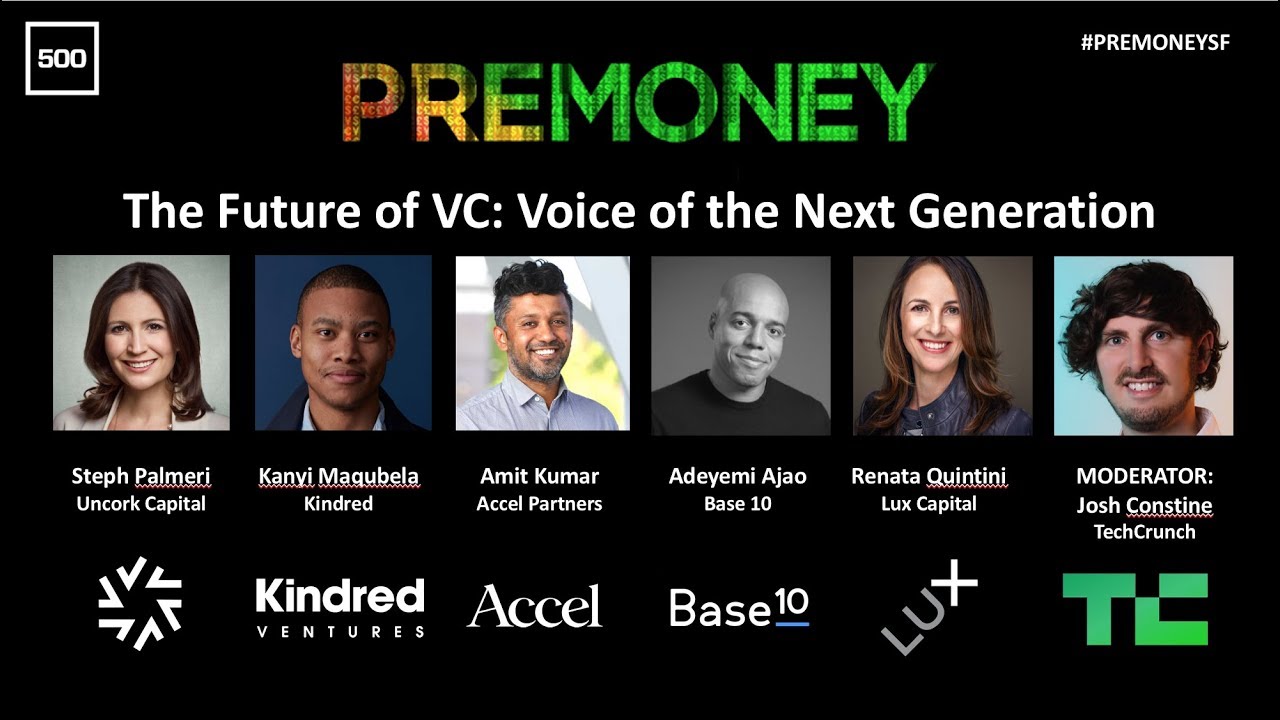
In a TechCrunch‑hosted panel titled “The Future of VC,” moderator Josh Constine brings together five early‑stage investors—Adéyemi‑Ayale (Base10), Amit Kumar (Accel), Kanyi Maqubela (Kindred/Uncork Capital), Renata Contini (Lux Capital) and a representative from Kindred Ventures—to discuss how the next generation of venture capital differs from the previous era. The conversation covers each firm’s identity and thesis (Base10’s focus on “automation for the real economy,” Accel’s thesis‑driven, long‑lived partnership model, Uncork’s micro‑VC seed leadership, Lux’s “rebels of science,” and Kindred’s emphasis on emerging founders). A recurring theme is that diversity is both a moral and a financial imperative, influencing fund composition and deal‑sourcing methods. Panelists contrast network‑based sourcing with cold‑email outreach, conviction‑driven versus consensus‑driven investment decisions, and the move toward lean, partner‑centric operations rather than large service‑heavy platforms. They identify emerging opportunity areas—unsexy real‑economy sectors (waste, agriculture, construction), vertical SaaS for niche industries, food‑system innovation, future‑of‑work dynamics, higher‑education disruption, and blockchain (both over‑hyped and under‑explored). The group debates how to assess moats against big‑tech incumbents, the responsibility of VCs to foster ethical, transparent founder relationships (e.g., “startup kata”), and the current capital environment, noting a surplus of capital, potential bubble dynamics, and the existential question of whether more funds are needed. Throughout, the panel balances optimism about new niches with caution about noise, platform risk, and talent challenges.
Chapters
Hey everybody, I'm Josh Constine from TechCrunch. Thank you guys so much for coming out this morning. We're gonna be talking about the next generation of venture capital. I think we're all hoping that VC doesn't necessarily just recreate the power structures of old, but opens opportunities for new investors, new startups, new experiences for consumers. And the panel we've, uh, selected today has really taken a new tack on how to invest, how to create their own firm, and how to help those startups after they've given them the money. And so I'm excited to get to talk to you guys a little bit about what makes your firms different, what you see as the new way to get things done in venture capital, and where the future of VC is going. So why don't we just go through? I'd love to hear a little bit about each of you guys' funds and what is it that can— or what is it that makes up your firm's identity and contrasts it with the last generation of funds? Adé, you want to start?
Thanks a lot, Josh. Hi, I'm Adé. Adéyemi-Ayale. Our firm is Base10 and our tagline is automation for the real economy. Basically, what we're focused on is companies that are solving problems for the 99%. And what we mean with that is that we like industries that are old school, that are unsexy, and that are big problems that are used by everyone every day. So things like waste management, agriculture, construction. And what we think is that there's already a lot of people in venture capital in this room focusing on AI, so we are a little bit the anti-unsexy AI.
I think we've all seen a few too many pitch decks with AI just crammed in at the last minute. But luckily that's all just says blockchain now. So it's clearly solved the problem.
My name is Amit Kumar.
I'm a partner at Accel. So I think I might be considered part of the old generation, to be honest.
Yeah, you're the bad guy on this panel.
That's okay. Someone's got to be the bad guy. Accel, I think a couple of things about Accel unique is especially in that era, a lot of the funds were being named after the names of the founders. Excel isn't Patterson Schwartz or Schwartz Patterson, it's Excel. And so it was built kind of from the ground up with the idea that it would long outlive the founders and transition through generations of partners. The other thing is we're very thesis-driven, and so whenever there are new categories, whether it's AI, whether it's blockchain, you know, we, we work hard to kind of develop an independent perspective and then invest behind that.
Hi, I'm Kanyi Maqubela, partner at Uncork Capital. Many of you may know from my former name, we were previously Softalk VC. So we're a We generally spend the day here in the Bay Area, San Francisco and down south in Palo Alto. What I would consider us to be is what we— well, actually, we're the original micro VC firm. So we were really that first wave, that first generation of the seed fund managers and professional seed funds that you see today. I think one of the things that differentiates us from the pack is the history we have leading seed deals and having conviction to write the lead check and support the companies, taking board seats, working with companies from the beginning of the investments all the way through to IPOs.
And yeah, we've done over 200 deals.
Hi everyone, good morning. My name is Renata Contini. I'm a partner at Lux Capital.
We're an early-stage venture fund, and we like to back the rebels of science.
We really are investing in companies creating the future.
It comes out of sci-fi books. It's fully autonomous robotic vehicles to surgical robotics platforms to microsatellites, and you name it. It's really people that were born to do this and they won't stop until they find a cure or they make something really meaningful happen. We like to say that we believe before others understand and we're willing to come in early. We'll sometimes help put founders together to really take that idea and that science into reality. It's a fantastic, really gratifying work and we've been investing in Frontier for 18 years. Right now, a lot of people kind of see the value in it. We've always been believers for a very long time, and I think that that sets us aside.
Hi, I'm Kanyi Maqubela, and I'm one of the managing partners of Kindred Ventures. Kindred Ventures is an early-stage fund. We're the, I think, the youngest of the pack here, and we are of the newest generation of micro VC. The things that we think make us different, the first and probably most important one is we're really interested in emerging founders with an emphasis focus on emerging. And so we like backing people whose co-founder hasn't quit their job yet. We like backing people where they're still early in their idea formation. We like backing people and being, if I may, kindred spirits with them in the formation process. And we've been doing that now over the last year. We've got about a dozen deals, generalists, but we're really the first check, which is a sort of special territory lots of people like to operate in. We're kind of obsessive about being in that place.
Awesome. So one thing I think ties all of your guys' funds together is this idea that improving diversity isn't just good-hearted, but that it's good business. And I think that's still something not everyone has quite grappled with, that this isn't about just expanding opportunities to more people. This is about making more money. This is about finding perspectives for people who don't— haven't had products built for them yet. So I'd love to hear a little bit about how you guys build that into both your fund structure, but also into how you pick startups and how you find a diverse pool of potential startups to choose from?
So I think, you know, at Lux we are 9 partners, and you look at the makeup of everyone, you're gonna have, you know, double Es, you're gonna have biomedical PhDs, you're gonna have, you know, chemists. I'm a lawyer by training, I've been in VC for 10 years. We have a journalist, and, you know, the startups that we invest in, they're taking 2 or more disciplines together and they play in the mashups, right? So the robotic surgical platform company that's out in the world is called Auris. They have a surgical platform called Monarch. If you're just a straight-up medical device company, all the, you know, the computer vision, the advancements in laser technology, all that stuff's going to sound weird to you. And if you're straight-up just tech investor, the FDA regulation is going to scare you. So we are bringing those diverse backgrounds and we're seeing combining them actually creates something really big and innovative together. And if you're just with that one mindset, you're gonna miss opportunities. So we're diverse by design and it's not just gender, it's really experiences because the companies we back, they are the mashup.
So I think we know that a lot of you guys have gotten diverse partnerships, but we'd love to hear a little bit more about how do you make sure that the pool of applicants that you have is wide enough to be able to encompass both a broad sense of ideas but also broad set of founders?
You mean applicants as in portfolio companies?
Yeah, as in companies you're considering funding.
Um, you know, look, I mean, each fund has their own specific approach to deal sourcing, right? And a lot of our approach at Uncorked is reliant on a network making introductions, and that's because there's an awful lot of volume and you need to have some way to filter it down. And I think as we've thought, you know, historically, even as we thought about expand— as we've expanded and added members to our team, it has been thinking about diversity of networks. It —doesn't do me a lot of good to add another person to my team that not just looks like me, but also has the same resume and education background as myself, because the reality is there's gonna be an awful lot of network overlap. And so the less network overlap you have on a team, the more likely you are to have a diverse flow of deals. Now, I can't take credit for the fact that we have a ton of female founders at Uncorked. In fact, my partner Jeff was investing in women well before I joined the firm. But I do think there's something to be said for when a female founder comes in to the firm that she sees a woman on the team. She sees a woman decision maker on the team. And I think that helps. The same thing goes for as we invest in founders that, again, don't necessarily look like my partners or I, that's a strong signal, I think, to the market that we're people that maybe do have an understanding of what it's like to be a little different in the industry, but also that founder can help us meet founders that, again, are in his or her networks that maybe are more diverse than ours.
Another one question that's arisen around network-based portfolio discovery is that sometimes you just end up with a lot of people that kind of look like your partners already. And people who become VC partners have a certain pedigree frequently. And so if you look for people who are in your network, you may actually be excluding people. Have any of you guys tried to sort of avoid that approach or taken a different tack on it?
I have. I will respond to cold emails every day. And in fact, I take great pleasure in it. And part of why I do, even understanding frankly that it's too broad of a set of inbound emails to be able to properly parse it, but it's something that it's a good exercise for me to constantly be thinking outside of my comfort zone and thinking outside of my natural stride. So frankly, even not necessarily in a deal selection, but just in terms of my own sharpness, it's very helpful to get a better sort of natural understanding of what's out in the market. But one thing I think that's also worth noting outside of the network sort of inaccessibility is just the structural piece. And so when somebody, even though we all, not just on this stage, but in venture, like to say that we're independent thinkers and we're gonna make the first decision, we all collectively think of what makes somebody ex ante fundable. And if somebody's fundable, it's going to make it easier to fund them. And so I'm actually interested in people that aren't fundable and why, because I think there's an opportunity to make someone fundable and then you get the benefit of that, right? And so I think that that means that going to people who break the pattern in terms of co-founder makeup, in terms of having quit their job, in terms of action and progress with their product, as well as in terms of diversity, can be a sort of structural hack for getting access to stuff that's a little bit different.
Yeah, and to piggyback on that from a structural point of view, one thing that I really admire about Accel is we're very conviction-driven, not consensus-driven. So we don't have a process where there's like a vote, you know, we do a vote after the partner meeting. It's really each individual partner is entitled to fund any project that they want. And the partnership meeting is really more a mechanism to gather feedback and to hear what your partners think. But if you believe in a founder and you believe in an idea, you— just by being at Accel, you can go fund that. And so, I think if you do a voting structure, you end up reverting back to the mean about, you know, what the stereotypes are, what a founder looks like, or what a great idea is, or who's fundable. But if you kind of distribute out the decision-making power, you're more likely to find outliers. And some of our biggest successes were very unpopular in the partner meeting. But ended up doing really well for us.
In our case, we actually don't get most of our deal flow from network. We cold email most people. So like Accel, we are very thesis-driven and we'll pick an industry, let's say trucking, and we'll go and reach out to 300 trucking companies, which most of them will not be in the Bay Area. So in fact, it has happened with, in trucking, with one of our founders that when we called her in Atlanta, she was like, Wait, you guys are what? A venture capital firm? Like, why are you calling me? And we basically had to like prove to her that we actually had an honest interest in tracking.
The fact that VCs have to like explain why they want to give somebody money, probably a sign that Silicon Valley has an image issue.
Yeah, no, we saw it as a very, very positive side. And in fact, we want to do a lot more on that. So we're trying to like show up and call like weird places. And we think that that will definitely be non-consensus.
So we've also seen this big change in what I'm seeing in the formation of younger funds, which is taking rather, taking a leaner approach with a few highly engaged partners rather than a massive service-based firm with a big recruiting or engineering or design division. What's your strategy here and why do you think we're seeing that shift towards these leaner partnerships?
Just speaking as the newest kid on the block, part of why we think about the value of being lean is we think you have to, eat what you kill as a partner. And it's really important that you're not outsourcing aspects of your service to the entrepreneur because so much of the best service to the entrepreneur is a matter of trust and is a matter of relationship. And if you're not in a position of building that trust and building that relationship, then all of the other things around recruiting, around hiring, around product development and so forth are actually harder to accomplish. And so we become much more efficient when we keep it at the one-to-one level.
Plus, I mean, if you give away that relationship, you're sort of seeding that opportunity that's what's gonna get you into that next round as well. And if that associate you offload that relationship to just moves to another fund, maybe that investment goes with it too. What about you guys? Are you guys taking a more, a leaner approach or, you know, how, how has Accel dealt with this? Like what's your guys' approach given the changes in the industry over the last few years?
Yeah, so look, I mean, I would, I would just say that there's multiple ways to skin a cat and there's nothing wrong with like the Andreessen model. You know, I think that they've been very successful with it and I've I'm sure if you ask their founders, they're going to say they're very happy with the service that they've received. Our perspective is kind of stick to our knitting, and so we, we don't have any associates on the, on the venture side. And so, you know, it's, it's partners going out and meeting founders and going to events. And, you know, we think that's the best way to practice the business and keep it lean. We do have, you know, a talent partner who helps our companies, you know, recruit for the executive stage. But, you know, Accel tries to help companies through all stages of gestation, and so are we gonna help you find engineer number 14? In general, probably not me specifically, 'cause I was an engineering leader at Twitter. Yeah, I actually know a lot of engineers, so I can help you with that, but our talent— That's a nice plug. Yeah, well, our talent partner will help you find a great VP of marketing, or they'll help you find a great VP of engineering, and that's a value-added service that we think is valuable, but I think we've just made the trade-off between having having a dedicated resource around that versus having a whole department and division, uh, as, as the, the right one for us.
I think there's also just a simple, like, assets under management question too, right? I mean, if you're starting a first-time fund and you've got, you know, $30 million, you actually don't have a ton of management fee to go around to have a huge staff. You know, as I think about Uncorked and how we've expanded, we're still very lean. We're still just 3 partners, and that's the entire investment team. But, you know, we've got, we've got, we've got a small, um, supporting staff. And, you know, over time, will we potentially add someone who's focused focused on, you know, talent or on marketing. It's very possible we could in the future. Um, but again, you know, it's sort of— you're growing as your assets under management grow too. So I think there's a practicality to how firms choose to structure themselves. Um, and I think that's, I think that's also an important thing to think about because firms, you know, may start in a certain place and then learn like, how do I give the partners the most, um, bang for their buck in terms of their time too, right? So it's, that's, it's an evolution.
Well, but I think the wrong concept is to think that you cannot add value in the lean way, right? And it's really about figuring out what is consistent with your strategy, what are the things that you can bring to the table that are differentiated, and then there's no reason why you can't vet who are the top recruiters in the market and who's done a great job and how to negotiate with them and how you should think about it and what's the right time to bring somebody like that in, and here's a list, right? You don't need to have a talent partner per se to be able to help that out. Like Amit said, there are many ways to skin the cat.
So between there being more seed funds, PE and hedge funds, all of these angels, I'm gonna ask you guys a kind of existential question. Do we really need more funds?
We— hesitation. I want to go first because I have a strong point of view. Asking VCs, I think the answer is maybe. Asking LPs, the answer is probably uh. But asking entrepreneurs, the answer is heck yes. And if what's good for entrepreneurs is good for the market, so it's not actually complicated in my judgment.
So good for the ecosystem even if you guys are all like battling out for those skim returns. Yes. Let's go. This is just a show. A Thunderdome for our own benefit. Thank you guys, we really appreciate it.
I think in general one of the reasons, you know, because we did have to ask this past year when we were fundraising, answer the question, so why does the world need another VC firm? And we're like, well, we think the world needs another VC firm if we are like looking to invest in things that are not being invested on right now. So if you are finding companies that are so new that they're actually alien to the idea of venture capital, in general, we believe that we're doing a good thing.
Yeah, it seems like there's still plenty of these unexplored pockets of opportunity out there. So I wanted to ask a little bit about that. Like, how are you guys— what do you guys see as these next big opportunities? Maybe first, actually, you can give us the opposite. What is the opportunity that you guys are just seeing way too much of, you're getting thrown at you all the time, and you're saying, like, hey, I think this market's either kind of tapped out, the talent is fragmented, or for some reason you guys are staying away?
I think that in general for the most companies that are just sort of execution focused, I think the competitive advantage lasts for a very, very short period of time. It's basically, okay, I have an idea, I see a market, and I'm the first to market. That first mover is just shrinking because in some cases it's just becoming a who can suck the oxygen first of talent and capital, and all of a sudden It's a different war. But in the things that we invest in at Lux, I mean, we invest in IP-heavy companies. It's people that have been in the lab kind of doing this for a long time, and it's probably, you know, a handful of folks in the world that could kind of figure it out. You're actually battling, is this possible or will that be doable and in what timeframe, rather than should I worry about competition. So luckily that's not a world that we play in too much today.
But so you guys are funding, say, the, like, the Spin or the Bird of Latin America or South America. You guys are seizing on these opportunities and saying, hey, somebody else is gonna execute this faster than these American companies are gonna expand there. You know, tell me about that as an opportunity. You think that's something that's growing in opportunity or shrinking?
So I guess I can take that one, given that we have invested in the Lime of both Brazil and Mexico. And given that I personally started a company that is one of the largest competitors of Uber in Latin America, so the biased answer will be yes, that is a great opportunity. And the reason for that will be that if something a number of Silicon Valley-based companies have proven over the years is that that lack of international diversity has made it harder for them to understand local intrinsicalities of doing business at the regulatory level, at the business culture level, at the hiring level. And that has translated in local companies having a huge competitive advantage, particularly in heavily regulated industries like this one.
I think the most overrated, noisiest market right now is blockchain. And I think the most underrated market right now is blockchain.
And how many protocol investments for you? A few, yeah.
And I think it's maybe a category error to assume that just because there's a lot of noise doesn't mean there's a lot of signal. And there are some cases where it's just the magnitude of both is extreme. And I think that we're currently in an environment where there's extraordinary, fascinating underlying technology and application layer really interesting protocols and layer 2 and layer 3 and all the way up solutions that are being built on blockchains, as well as a dizzying and painful amount of noise. And so you have to find a way to build a whole new system and a way of sort of processing that information given that dynamic.
All those buzzwords are Kanyi's signal that yes, you should talk to him about blockchain. He indeed understands. Ding ding ding. But one thing we've seen in the bigger tech world is this like is what's happening with copying. It's happening fast. Stories with Snapchat's— now Snapchat has 188 million users and is shrinking. Facebook has a billion users on Stories. That copying can go really well and really fast, but the kind of question is, does talent wake up each day and want to rebuild something somebody else has already built? Is there some kind of intellectual dishonesty about just building a company that already exists in another market And do you guys feel any, like, pangs of, like, this isn't as cool or this isn't as inspiring when you're doing that versus funding, say, like, a first-run company with really original IP, like Lux was talking about?
I mean, I can take that.
I think it's just like, we're getting the money.
No, I think it's less about money. I think it's about value creation. You know, if you're providing a short-term mobility solution to Latin American cities, like, I think that's a really exciting mission, and I'd be really proud to work on that. And, you know, I think we've overglamorized the concept of, I have to, you know, wake up in the morning and have the brilliant idea in the shower and go execute that. But there's a lot of honor in just executing, creating a huge business, you know. And I think this goes back to how we overglamorize founders, but we underglamorize people who join those missions, right? Like the co-founder, the first engineer, like, that's a great place to be, and that's what's exciting about Silicon Valley to me. Is that the huge kind of aggregations of talent. And so I think it's fine to take an idea that someone else has had and to morph it, to evolve it, to adapt it to a different geo. You know, when Facebook or Instagram copied stories, like, you know, I don't think they were complaining that other people copied newsfeed. Like, every product in the world had newsfeed. LinkedIn has a newsfeed, you know. That's just how our innovation cycle works, you know, is that someone comes up with something It's evolved, it's transformed, it's mutated, and sometimes it comes something even better.
And I mean, to add to that, right, there was already MySpace, there were already Orkut before Facebook came out, right? Same thing for Google. There were already other search engines, and sometimes a founder will stumble onto something that they think is meaningful and game-changing, and they can't let it go, right? So you can't fight that energy. I also think, you know, you brought up the talent point.
I think the bigger talent question and bigger talent issue here right now is is not do people want to work on a copycat company, because I actually, I don't think that's the problem. I think the bigger problem that, you know, frankly, I see our portfolio facing, um, and, and founders in this market in particular facing is, you know, there's a lot of very relatively stable large platform companies that have created a lot of value here. And so actually taking talent out of the, the comfort of being part of that environment and taking the risk of, of joining a very early stage company is really hard. And, you know, one of the fundamental shifts I've seen our firm go through in the call it 18 to 24 months is a much more open mind when it comes to investing in teams from day one that may be distributed, whereas that may have, may have seemed to be very challenging. We now are starting to look at that as more of value creation and an opportunity for money to last longer, for, for the ability to scale a team faster and access unique talent that, that otherwise may be very challenging to takes access in this particular market.
Speaking of the influence of big tech, I wanted to ask, how do you guys assess whether a startup has an idea that this is different enough or revolutionary enough that it's really going to have a chance to disrupt one of these incumbents versus, oh, this either has a ton of platform risk because you're building on top of these incumbents, or you're just sort of squarely in the middle of their roadmap and you're going to get steamrolled? How do you guys make those assessments? And how is the depth of the resources of big tech, the success it's had with copying, how does that change your investment thesis around early-stage companies?
One answer for us is we think about the moat that the company's aiming for and whether that moat has some sort of a proprietary angle that they can take advantage of. So for example, in the context of data, if you are gathering certain health data or certain financial data, Facebook, Amazon, and Google don't have that data. In fact, there are regulatory walls protecting them from that data, so you can pave your own cow path in that way. So we think about those moats, and then we also think about, frankly, just the pace of execution for the team, because even though we are in a fast-follow environment, which can be scary, if a team is iterating at the very earliest stage fast enough, it's our judgment that they're gonna create value, and that value is gonna drive returns for us.
Personally, have you looked at a startup in the crypto or blockchain space and said, you guys are just gonna get run over by Coinbase, like this is not something that's viable.
Very frequently, and if not Coinbase, then somebody who's not oriented in crypto or in blockchain at all. And so one of the things about there being a lot of noise is people, in the same way that in the internet it was like, let's put a newspaper on the internet, that's got to be a great business model, not realizing that it was actually social media and social networking that was going to find its way back to eating many newspapers, and so in the same way that blockchain, I'm just gonna put X onto the blockchain, is in my judgment oftentimes an incorrect approach, and the incumbent who's not on a blockchain is better served for the solution.
Speaking of companies being either outcompeted or things just not quite going right, we've seen this fallout of the very frothy funding climate from a few years ago. Big startups like Sprig or Telltale Games and Airware most recently are suddenly going out of business. Where do you guys think we are in that bubble burst cycle?
I think from a supply of capital, the bubble is just, you know, increasing size, right? If you look at where interest rates are, and I mean, demand for investing in venture capital funds or tech exposure just keeps on rising. So I think from a— I mean, it's never been a better time to be an entrepreneur from like perspective of starting company and finding capital, where I think, you know, companies should really start thinking more about is what's the route that I want to take and what's right for my business? Because the chances for misalignment are only increasing, right? And the bigger the funds get, the more they only need you to be the home run that will be, you know, a fund returner for them. And all of a sudden you are a single path potential, and all of a sudden, you know, you reach you really need to amass more capital to kind of go all the way or go home. And then, and so really what's right for your business, um, is the, is the most important thing. But supply of capital has never been—
Do you ever have to dissuade companies from taking more money? Do you have to say like, I know that you're asking me for the Series B or the Series C now, but that's not, it's not right, or like there's a different path where you guys will have a lot less risk if you take less money?
I mean, we have this conversation all the time because it's always a trade-off of of how much money you get is a piece of the company that you're selling, right? And you're always thinking about not this round, but what's the next round and the round after gonna be? And if you put your hurdle too high on the valuation or eating too much capital, all of a sudden you may lose the scrappy muscles that you had or you really put yourself in a go too fast, spend too much that you can't unwind. So we have this conversation all the time about what's right for the where the market is and what are the hurdles that need to be met for the next round and the round after.
I mean, I think the media kind of over-rotates whenever there's one of these big crashes and it's like, oh, how did this get funded or what happened? And certainly that's an individual failure and we can do a postmortem on why that particular company failed, but I actually think if we're not seeing some of those failures that maybe we're not investing in bold enough ideas, right? Like, not everything works. Venture capital doesn't have 100% hit rate. And to be honest, a lot of failures are kind of dressed up as acquihires or tucked into a portfolio company and whatnot. And so I think it's actually not the end of the world when a company fails, you know. And certainly that's not to take away from decisions or, you know, that could have been done differently or mistakes that were made, funding rounds that maybe shouldn't have happened. But, you know, that's— it's venture capital.
I think the question now though will be like, is there just a surplus of capital? And then again, these these much larger checks coming out of these mega funds that delay the failure and cause the compounding effect of the failure to be a lot larger. And, you know, we're kind of— we'll have to see how that plays out. But I do think that's— the reality is there's a lot of capital out there. And so, you know, to a certain extent, capital can be plugged in to ease the pain and to plug some of the holes, at least for a period of time.
One thing I've been really inspired by recently is that I feel like this next generation of VCs is just closer to the customer, closer to the founder, and really just feels more empathetic to me. I want to hear a little bit about what can we do to make sure that empathy is passed on to the founders of these companies and applied to their customers, and how do we make sure that these companies are actually being built responsibly so we don't have some of these big implosions over, you know, ethical issues, whether that's Zenefits or, you know, basic fraud like Theranos. How do we make sure that these companies are actually being responsible, and what are you guys doing to make sure that happens?
So I think one of the key things, and this was mentioned in the talk before, is transparency and vulnerability on the part of the investor. So I try to begin almost every founder meeting talking about everything that has gone wrong for me as a CEO, which is a lot of things actually. And that way I think you set up an environment in which a founder is comfortable being like, actually, I'm not crushing it, and here are 17 problems I have. And I'm like, man, I've done a lot worse than you. Let me tell you about this.
I washed my Patagonia vest in hot water and it shrunk. It's been a terrible day as a VC.
It's time for new vests on stage, I'm just saying.
What about you, Ana? What are you guys thinking about making sure these companies companies are responsible.
Yeah, this is something that I care a lot about, and I actually been writing a bit about this. And, um, I, I do think that we do have a responsibility, and I think tech has never been more pervasive and incredible. And I think the, the future value of tech will only be as powerful if people are able to trust it and understand it. Um, so I've been writing about something that I call startup kata. Um, you know, these— I came up with these 7 things that go around culture and not having biases and designing with empathy and understanding and respecting regulation, things that I think are principles that if you understand early and you embrace early, you're gonna have better foundations and stronger foundations to kind of grow in a more sustainable way. So the way that I do it, I actually get together offline with our CEOs and we talk about it and we talk about setting expectations, how it is on the day-to-day and how people are actually kind of making trade-offs on the decisions that they're implementing and for them to understand and them to share experiences about really how are better processes and because it's a value that they want to have. So I think first of all is to share that that's a value that I have as well and something that I'm very much willing to be a part of and empower and just give them the forum to practice those things and really make them true.
So maybe finally, I'd love to just hear a little bit about what you guys think of as the next big opportunities, specifically more subtopics, sub-verticals, not just blockchain. Yeah, I know, Kanyi, I know you think it's big, but what specifically in those spaces you think are hot opportunities, either for potential investors out there or for founders wondering what they should start next? I guess you guys would go and be founders if you really knew the answer to this question.
So I can throw one. One of the things we have been spending a lot of time on is vertical SaaS for sectors, again, unsexy, so like long care or telecare or railroads, where you actually give the software away for free and monetize only on payments. And I think Shopify kind of like opened the door to that. But there are a lot of other unsexy verticals where that will become true.
Great. I mean, a segment that I think it's very, very fertile and we're only really scratching the surface is the whole food ecosystem. All the way of thinking that the supply chain and the production of food and just make sure that we have better yields and we make more of the natural resources that we have with less waste, to how can we actually have better quality, better food for you, even using synthetic biology and other methods. So I'm very interested in that whole ecosystem.
I spend a lot of time thinking about, and it's a broad category again, future of work though, and how our commitment to our employees and the idea that a lot of Americans over time will not be employees and what it means to be a participant in the workforce as the demographic of our country is changing, as the nature of work is changing. And then I think there's many, many opportunities there. It's a crowded space, but I think there's actually a lot of potential.
To actually riff on Steph's, I think there is a bubble in this country, and it's the higher education bubble. And that bubble will burst. It's an incontrovertible fact. And when it does, the issue we currently already have around training and retraining and workforce preparedness is only going to magnify. And so, somebody anybody who can find ways to create productive and work-oriented solutions for that is gonna be making a lot of money.
Well, especially when you consider what's happening on the automation side of the intelligence across many industries, right? That's gonna accelerate. Great.
So to recap some of the awesome insights that you guys gave us, really there are easy ways that you can expand who you're investing in. And that might mean just taking cold emails to get that exercise of seeing new ideas, trying to find partners with less network overlap so you can get to those weak ties on the edges of your guys' graphs. And finding people who aren't necessarily already fundable, figuring out why and helping them get to that, that right space. Using conviction instead of consensus. So if somebody has a real gut feeling about something, it doesn't have to look like the mat— the pattern that everyone's matching to already. And looking at specific theses, going out and reaching out to those companies rather than just waiting for the ones who already have those ins to the venture capital industry to come to you. In terms of the partnerships, you know, we're seeing these leaner partnerships in part just because these younger funds have less assets under management to do these big services, but at the same time, the, the real opportunity here is to use those leaner partnerships to drive real trust with the partners, to develop those relationships so you can do those follow-ons and not give away that relationship to an associate or just some service arm that might not always be connected to the partnership. But at the end of the day, these— do we need more funds? Do we need more VCs? Maybe. Do LPs want more funds? Also not clear. But the entrepreneurs, like you said, hell yeah, they want more funding. There's lots of great ideas out there that are going unfunded right now. And sometimes there's not always that same first mover advantage that there used to be, that, you know, just being execution first doesn't always work. You need a defensible moat. You need something that's proprietary. But that said, we shouldn't overglamorize the idea. Copycats can truly add value and bring crucial services to other parts of the world that truly deserve them. And while there are big companies who are gonna use their massive resources to recruit that talent away, there are people who don't want to just be pixel pushers, who don't want to just work on some tiny part of a tiny feature, even if it affects a lot of people. They want to see the real impact of their work. So, you know, while the, the bigger funds might need bigger assets and raise bigger rounds, uh, and some of them, sometimes those startups can lose their scrappy attitude, uh, when they're given all that funding. Just because there are big flameouts doesn't mean that these are the bad ideas. Sometimes you have to have those big flameouts to know that you're investing in companies that truly have a chance at changing the world. And if you want those companies to change the world, you need to treat them right and show them that you're vulnerable too, that they're not always gonna be crushing it, that it's okay to have tough days. Uh, and so whether you're looking at unvertical or unsexy verticals in SaaS or food supply and production, the future of work, the higher education bubble. I think it really is a matter of saying, hey, we are in this with you. This is not something that's just about the business. This is about an empathic relationship between you, me, and the customers that we're trying to serve. So if we, if you guys can go out there and make sure that these people realize they don't always have to have the answers, that they can come and ask for help, they're going to be the ones that really help the world and help their customers. So thank you guys so much for coming and talking with us. Thank you guys for watching, and thank you, 500 Startups.
More from Kanyi

Building with Corgi - Kanyi Maqubela in conversation with Nico Laqua & Emily Yuan

Building with Corgi - Kanyi Maqubela in conversation with Nico Laqua & Emily Yuan

Acceleration & Balance The American AI Strategy presented by Kindred Ventures

2026 will be a very important year for venture capital, says Kindred Ventures' Kanyi Maqubela

2026 will be a very important year for venture capital, says Kindred Ventures' Kanyi Maqubela





Beyond Unicorns: Kanyi Maqubela on Identity, Innovation, and the Future of Venture Capital

Beyond Unicorns: Kanyi Maqubela on Identity, Innovation, and the Future of Venture Capital