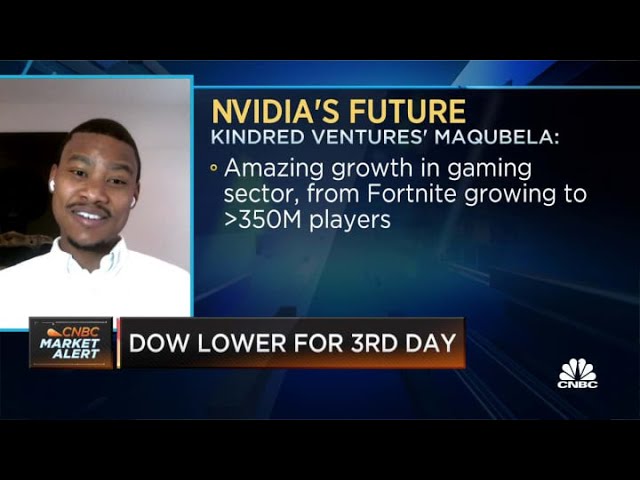
In a CNBC interview, venture capital investor Kanyi Maqubela discusses how the unprecedented uncertainty of 2020—driven by the pandemic and political transitions—has not dampened market liquidity or growth in several secular tech sectors. He highlights the resilient and accelerated expansion of data centers, gaming, and e‑commerce, noting that e‑commerce grew 40% QoQ in early 2020 yet still represents only 16% of total retail sales, indicating substantial upside. Public‑cloud and data‑center services are projected to grow another 30% next year, underscoring long‑term trends that outpace short‑term market fluctuations. Maqubela also addresses the current IPO environment, referencing Max Levchin’s comments on valuation thresholds and volatility, and explains how SPAC activity and abundant liquidity have opened a window for tech companies to go public after years of private capital accumulation. The conversation frames these trends as opportunities for investors to target companies that benefit from both stay‑at‑home and post‑pandemic growth dynamics.
Chapters
I wonder just broadly how you're thinking about positioning. We got all kinds of crosscurrents regarding the presidential transition, states locking down, but the promise of the vaccine. Where do you think sentiment needs to be at the moment?
One of the most interesting things about this year, Carl, is that historically the market has hated more than anything else uncertainty. And this has been an extraordinarily uncertain year. But with continued and robust growth. And so I think you're seeing right now is even though we're in the midst of a lot of uncertainty because of the pandemic and a fair amount because of the political situation, there's still just so much liquidity in the market and there's still such a large transformation that's happening in so many consumer sectors. And so what I'm interested in is what's happening with data centers, what's happening with gaming, what's happening with e-commerce, because all those things continue to show extremely resilient growth even in the midst of this uncertainty. All right.
So it's not necessarily— and you've, in your view, it doesn't need to be a reopening trade, a stay-at-home trade, that there's a Venn diagram, I guess, of names that will ride both trends and then, you know, best case, look forward to growth post-pandemic in general.
Absolutely. And as you mentioned earlier, Disney isn't a strict reopening trade, for example. But if you look at some companies that what you're seeing is what happened with COVID is there's actually been an acceleration of a number of trends that were pre-COVID. And so, for example, in e-commerce. E-commerce grew 40% quarter over quarter from Q1 to Q2 of this year, but we're still only 16% as compared to retail sales. And so e-commerce itself is still so early and you're seeing a ton of upside. And the same is true in data centers and the public cloud. Forrester predicts it's going to grow another 30% next year. And so these are actually secular trends that have actually been happening irrespective of COVID and they've only been accelerated. And so I'm quite interested in the shift where you're seeing a move towards some of these large aggregators in, for example, e-commerce. Commerce and a growing long tail of small businesses that are selling digitally. And these types of trends are something that are very resilient even to short-term market forces like what you're trying to assess today.
Hey, Kanyi Maqubela, good morning. It's John. You know, speaking of trends accelerated by COVID, how about exits? Whether you're talking about M&A or you're talking about IPOs or now you're talking about S-1s, we got one from a firm that's Max Levchin's latest startup. Take a listen to what he said earlier in the year about the prospect of going public. Public?
You know, company is 8 years old. At some point, your investors start making hints and elbow gestures. So at some point, yes, I'm not in a huge hurry. But I think the biggest curse Silicon Valley company or any technology company can do to itself is go public at a valuation that's somewhere between $2 and $5 billion. Once you clear that, your stock becomes a little bit more stable. But the volatility you take on as a $2 billion stock, $1 billion stock, you know, wake up the next morning and you're suddenly half your valuation. So the volatility is probably the primary reason companies like mine are hesitating.
I don't know if he feels affirmation that he's going to get a valuation above $5 billion, but even if he wasn't in a hurry, he seems to be getting there pretty quickly, right?
Absolutely. And he makes a really good point about the fact that he's not in a rush. And that's something that's important to note about this window of IPO that seemed to have been open over the last year. So many companies took so much private capital, particularly in the technology sector over the last 10 years, and they were sort of waiting to push IPOs further and further and further. And a lot of that pressure has been released, part of it because of SPACs, part of it because of the liquidity coming from the macro, and part of it because there's been consumer adoption of so many of these services over the course of the COVID period. So I actually agree with him, and I think this is a great opportunity to be, to be going into the public markets.
Shepard Smith here. Thanks for watching CNBC on YouTube.