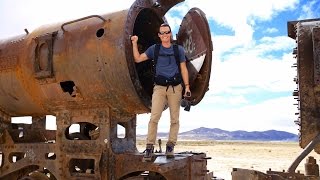
This YouTube travel vlog (Kara & Nate Buchanan) documents a one-day Uyuni, Bolivia trip: early pickup and short flight (~50 minutes) to the high-altitude airport (≈4100 m), meeting local guide Carlos, and visiting the Train Cemetery (Cemeterio de Trenes). The hosts then visit Colchani town to observe salt processing—salt arrives wet from the flats, is dried in heaters (about 200 kg batches for ~30 minutes) and packaged by hand—and shop a souvenir market (alpaca sweater purchased for about $10). The vlog emphasizes the salt flats' mirror effect, local production methods (salt bricks, tola fuel), and on-the-ground travel details (rubber boots, itinerary).
Questions this video answers
4100M
50 minutes
About 200 kilos per batch, dried for 30 minutes
Approximately $10
Chapters
Sam.
We got picked up at 5:30am this morning by a private driver because today starts our salt flats adventure with Kyoto travel.
So this morning we are flying to Yanui which is the jumping off point for the salt flats. And our driver on the way here told us that it's recently rained which means they should have the awesome mirror effect.
It's basically the whole reason why we came to Bolivia.
We'll be capturing it soon, but if you can't wait, you should just google it because it's amazing.
I think we're boarding now. We're the first ones on the plane.
Fun fact. This is the highest international airport in the world.
4100M.
Thought I was feeling a little winded on our walk to the gate.
Our flight time to Hoya Andina airport.
Will be 50 minutes.
Sam.
We made it to Uyuni Sounds your next step.
That's us.
Good morning.
Welcome. Thank you very much.
My name is Carlos.
So we just got picked up at the airport by our guy Carlos. The views of the flight coming in were like absolutely incredible. The mirror effect on the salt flats, it was nuts. I'm so excited to be here.
Here's our driver Hugo. And this is going to be our car.
Perfect.
And this car is for my colleague Silke. She's our coordinator for this.
Good morning.
Welcome.
Thank you. And this is your program. More bags are presents for you. Some things you might need that maybe you didn't bring.
Thank you so much.
So Swee, we got a little gift. He told us it's probably things that we forgot that we'll need for the soft lights. Water.
I don't know what these are for.
Today is already jam packed with adventures. We are just getting right into it. We have our itinerary and our first stop is the Cemeterio de Trenis. It's a train cemetery. It was like a 15 minute drive over here. It is so awesome. Asked for black coffee on the plane and I got black coffee with lots of sugar. So I'm ready to go.
Do trains still run through this area?
Yeah, this railroad is still being used. It's the same one that goes all the way to Chile. Anything that would have been lighter enough to be taken has already been taken. And everything that is still here it's just because it's too heavy.
Basically the reason these are here is there's a railroad track from Bolivia to the Atacama desert in Chile where we were a few weeks ago and they needed it to export goods to the coast. Then they upgraded all of the Trades from steam engines to diesel engine. And they just left all of these steam engines here. So now we get to play on them.
They used to have steps, but also those were taken.
Oh, baby.
Oh, baby. Our trip is off to a great start. So far. We could stay here and take pictures forever. But now we're going on to our next activity.
And nobody heard from Philly Blackthorn again? Nope.
So we just learned that there was a mine here that had like 19,000 workers. All of their salaries were being carried on a train a long time ago. And Butch Cassidy and the Sundance Kid robbed the train for the equivalent of like over a hundred million dollars in today's money. And this is like the train that they robbed. Did I nail it?
Nailed it.
Too cool.
That is crazy, Sam.
So this is the town of Kolchani. And it's the only town that has the permission from the government to take out the non metal minerals from the salt plants. And that's of course, the salt. So we're going to visit a process factory here where they prepare the salt for our national market. And then we're going to visit also this souvenirs market where they make stuff for the tourists, mostly made of alpaca. That is the most common animal around here.
Another particularity about this town and this region is that it's the only region where this construction material works. These are salt bricks. Why this? Why they only work here? It's because in this region, it only rains for two weeks over the year. So for example, in my city in Sucre, where it rains over 100 days during the year, all of this would be melting less than one month.
So these bricks are made out of salt and the mortar is also made out of salt. It's just mind blowing. It feels really sturdy.
In the region because we are so high, we don't have forests. So the only fuel for this process is this bush that is called tola. You can see it growing all around the roads. And they use it for these ovens. These ovens are the heaters for a plate inside the factory to dry out the salt. This is the way the salt comes from the salt flats. And as you can feel it, this salt is wet. Because the salt flats, not only during the rainy season but all year, are always wet. They are floating on water. So that's where all the humidity comes from. So the main part of the process, or the hardest part of the process to get the salt into our tables is actually to dry it out.
This is the heater where they bring about 200 kilos of salt each time. And then during 30 minutes, they dry it out with the heat under. During this 30 minutes, they have to constantly be moving the salt around with shovels so it doesn't burn. So these bags have already the size for the weight? They don't weight it. It's just an approximation. But the salt is so cheap, it doesn't matter if some bags have a few more or a few less.
Wow.
So that's the packaging. All manual, handcrafted, sealed with fire.
Juan just packaged this salt in about two seconds. He used fire to seal it and then used his hand to push it together. Super cool.
So this is the other business in this town. Souvenirs for tourists. The most common animal around this region is alpaca. So this is one of the few places where you can be sure that you are actually getting alpaca, because in some other places, they trick you. They mix the alpaca with llama.
I've never wanted a souvenir so bad. This is the softest animal I've ever felt.
I love it. I would sleep with it every night. Please me.
I don't think that's gonna fit in your bag.
It's a rare day on Kara and Nate. I bought a sweater. The best part about it is it's made out of alpaca. It was only $10, and we didn't even have to bargain. It doesn't have a tag anywhere. And so it's just. You don't know which way is the front, because she made it. I'll be much warmer than the salt flats now.
So we're just now leaving the market, and we are about to go to the salt flats for the first time. We were given some big rubber boots because apparently it's really wet. But it's not even lunchtime yet, and we've already had a huge day.
That is a big hole.
I'm okay.
Everything seems to still be working.
Singular. Who is your hat?
So these salt bricks are quite a good construction. Very cheap material.