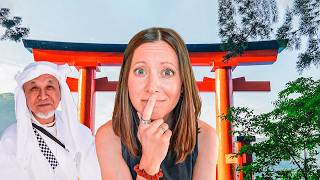
Nate and Kara Buchanan spend 24 hours living with Japanese monks in two settings: a mountain pilgrimage with Yamabushi and a seaside Buddhist temple. The video documents morning blessings, dressing in traditional white pilgrimage robes, a challenging frozen hike up thousands of steps to a shrine and ancient pagoda, tasting Shin-yori cuisine preserved using centuries-old techniques, participating in Zen meditation and daily prayer ceremonies, staying overnight in temple lodging, and reflecting on cultural and spiritual insights. The transcript includes a mid-video sponsor read for Surfshark VPN.
Chapters
Foreign.
We love everything about this country. The organized chaos of Tokyo, the super fast trains, the delicious food, the kind locals, the unique accommodations, the skiing. But up until this point, we've pretty much only experienced the modern side of Japan. There's so much history and culture here that we've left completely undiscovered. Which is why we're going to spend the next 24 hours deep in the Japanese Japanese countryside, living with monks. I think we just taught you, Nika, a high five. So join us as we climb a sacred mountain, eat food prepared from 1400 year old recipes, attempt meditation, sleep in temples, and go far beyond our comfort zone as we immerse ourselves in the daily lives of two different groups of Japanese monks.
Good morning. From somewhere deep in the mountains of Japan. Last night we stayed at a traditional pilgrim's lodge. We slept on the floor on the mats, which are surprisingly comfortable. But at some point last night the heater went out and it is absolutely freezing this morning. It is 6:30 in the morning. And before either of us have coffee, we're about to head downstairs to receive a blessing from the monk. Before we begin our big journey today.
You'Re probably wondering who the monk is and what the big journey today is going to be. Don't worry, I'll explain. The monk is this man and he is a Yamabushi priest. Never heard of Yamabushi, Neither had we. And that's why we're here. But before we move on, please take just a second with me to enjoy watching how uncomfortable Nate is right now. This is the traditional way to sit on the ground during prayer, but he literally cannot handle the pain. Thankfully they allowed us to sit cross legged instead.
Dead.
Okay, so Yamabushi, it literally translates to one who prostrates himself on the mountain. In other words, they worship nature. And the prayer ceremony this morning is for us to have safe travels on this pilgrimage we're about to embark on.
Oh, and you're probably wondering who this guy is. Meet Derek. He's our guide, translator, and owner of the local tour company we booked this trip with. Basically, he's the only reason we have any idea what's going on. And we're just following his lead here, like when we should bow and when to clap.
We've been up for an hour and we are finally getting some coffee. I might not be cut out for this monk life.
We're being served a traditional Yamabushi breakfast, but more on the food later. All you need to know now is that it's meant to give US strength for the journey ahead.
So we're about to get dressed to go into the mountains.
Traditionally, the Yamabushi wear this white outfit for their pilgrimage. These clothes are very similar to what they bury the dead in, because this journey into the sacred mountains symbolizes a metaphorical death and rebirth. There are a lot of confusing pieces to this outfit, but thankfully the priest was happy to help. And in case you're wondering, yes, these are supposed to look like rabbit ears. So now that we look the part.
He keeps a good pace.
As we passed under the Torii gate, we entered the sacred mountains. Meet our new guide, Utica. He might be the happiest person I've ever met. He had this adorable smile on his face the entire day and I love him. Pilgrims from all over Japan come here to complete this sacred hike to the shrine that sits on top of the mountain. So our guide Yutica is wearing a bell and I thought it was something spiritual, so I asked what it was for. It's for bears to scare away. The bears apparently. Definitely adds a little excitement to this hike.
The hike is off to a very treacherous start. The trail is pure ice. Our Yamabushi guide was telling us that he's never actually hiked to the top during winter. So this is a new adventure for all of us.
I feel like there's extra pressure not to fall because I'm wearing white from head to toe.
So the Yamabuchi, they worship nature and the mountain. So by entering this forest and by climbing this mountain, they believe that we're immersing ourselves in a very holy place. And it is pretty incredible to be surrounded by these giant cedar trees, some of which they say are over a thousand years old.
Hidden deep in the mountains is this five story pagota that's considered to be a national treasure of Japan. The original structure was built over thousand years ago. And the craziest part is that they didn't use any nails in the construction. Each piece was cut perfectly to size to fit together like a giant Jenga game. So we each pushed on the loosest piece. Just kidding.
So we've just started the first of 2000, 446 steps to get to the shrine on top of the mountain. But the steps are completely frozen over. So technically we're on the steps right now, but you can't even see him.
Our guide is 67 years old and he is leading the pack. We're all doing our best just to keep up. He's waiting on us.
Don't worry about us. Back Here.
This is so intense.
Health. If you use your hands.
This.
This really does feel like a pilgrimage. There's some religions where people have to crawl to the top of mountains to, like, show respect for the God that's on top. But we're just crawling because that's the only way we can get up.
Got it.
Do we get to slide back down?
Nice work. High five. No.
At this point, Nate thought he had committed a major cultural faux pas. Are high fives disrespectful? Do monks not touch other people? Did he just ruin our relationship with the world's happiest man?
High five. Don't leave me hanging.
Hi.
I think we just taught Yunika a high five.
Japanese people don't really do that much. Oh, that just made my day teaching people around the world. High fives. High five.
High five. Like this.
Thank you for guiding us. One more high five.
Don't you wish that your Internet browsing experience could be as peaceful as the lives of these monks? Instead, you have to worry about hackers and cybercrime and someone stealing your identity when you go online. It's all very stressful, but with Surfshark vpn, you don't have to worry about any of that. If you've never heard of a VPN before, it stands for Virtual Private Network and it encrypts all your data set between the computer and the Internet Internet so that no one can steal your sensitive information. That way you can relax when you're online, kind of like the monks. What makes a VPN really fun is that it can also be used to unlock content that isn't available in your area, giving you access to a completely new content library. Let's say you're in Japan and you want to watch your favorite TV show. You go on Netflix. It's not there. It's super easy just to change the virtual location of your computer. Then, boom, there's your favorite show. Boom. Yes. In all seriousness, we've been using Surfshark for over three years now, and we truly believe that it's the best VPN on the Internet because you can use this one account for unlimited devices. If you want to try Surf Shark, you can use our code, Cara and nate to get 83% off plus three extra months for free. And there's a 30 day money back guarantee, so there is no risk to try it out. To get started, just click the link in the description below.
Once we arrived at the shrine, we went straight to the kitchen, where we got to meet the chef in charge of preparing the 1,400-year-old cuisine for the monks who live there. This cuisine is called Shin yori and it's unlike anything else we've tried in Japan. It's all made from wild local vegetables that grow in these holy mountains we just found climbed. However, you saw how frozen the mountains are right now, so you might be wondering how we are eating local produce in the winter time. This small building behind the temple is where they store the vegetables all winter long using the same preservation techniques that were used for hundreds of years before refrigerators were a thing. Look at where we're having our lunch.
I'm not really sure what I expected to find on the top of the mountain, but I think it was just like very small building. There's an entire complex up here.
This looks absolutely incredible.
It is delicious.
Cheers.
I feel like I have hair and it's gonna get my food. I am for sure getting food on this white robe.
We managed to keep it pretty clean on our height. Yeah.
Delicious.
So even if you're not motivated to come to the top of this mountain for spiritual reasons, it's worth coming just for the food.
After lunch, we explored the temple grounds. And then we found the confluence where thousand year old traditions meet modern Japan.
No way.
Oh my gosh. Of all the places, they have two vending machines up here. In case you missed our first episode of this series, Japan has enough vending machines that you could stretch them if you lined them up all the way from the country of Japan to Hawaii, because they even have them on top of mountains in a 300 year old building.
But this is the first one that we've ever seen that serves beer.
We resisted the temptation for a beer break because we still had a treacherous hike back down the mountain.
We are no longer Yamabushi. Oh, that was quite tight.
And turns out not only are high five is appropriate, but you can also hug.
From here, we're going to the beach to stay at a temple with Buddhist monks. We do not wear the robes, so we don't want to show up with bunny ears.
This is our home for the night, and I think we have the best view of the whole place.
That was great. So we just met a few of the monks and I love it here already. They're all so like lively and energetic and I don't know, I think it's gonna be a good time. We're gonna do some meditation soon. But before we do, let me show you around our room. Pretty, pretty simple setup. We have this whole room to ourselves, this little dining room. Table with pillows to sit on. We left us a snack with some tea. We have a television in this one that's kind of fun. We have a heater. So where to hang our clothes? Oh my gosh, there's even WI fi. And our robes are on top of our bedding. So when it's time to go to sleep, we'll pull these beds out and we'll sleep on the floor, which we're getting pretty good at. Okay, so one of the monks who I already love, just wrote out a little schedule for us for the evening. Basically we're going to go around and explore the temple until 5:30. Then from 5:30 to 6, 6:30 they're kicking all the guys out of the bath so I can take one cuz there's only one and you just have to take.
Then at 7:30 we're going to have dinner. And then he said we must be in bed by nine because tomorrow's going to be an early one. Let's go explore.
Turns out this temple where we're staying is over a thousand years old and it's dedicated to the worship of the gods of the ocean. So fishermen and sailors from all over Japan come here to pray for safe passage and a bountiful harvest.
Okay, so I'm really excited and a little nervous. Neither one of us have ever done more than five or ten minutes of meditation in our entire lives. And we've just been invited to join the monks for an hour long meditation. Anytime I've tried to meditate in the past, it's been like one of those apps on your phone, like a guided meditation. So I'm not really sure what's about to happen.
First, our Zen meditation teacher met us at our room. He explained the correct position to hold our hands. Annie told us that the meditation actually starts now as we walk. I'm really nervous. Maybe that means I need to meditate. We did our best to follow his lead as we awkwardly made our way to the meditation room. And I don't mean awkward in a bad way. In this moment, we were just really outside our comfort zone, but not physically like we usually are.
This is absolutely insane.
It was more like we were just nervous that we were going to do something wrong or disrespectful. Respectful because we had no idea what we were doing and the language barrier didn't help. At the same time, we were trying to fully embrace this experience that we signed up for. Since we've never done this before, our teacher walked us through the basics, which involved fluffing the pillow, taking our shoes off in a specific way, and once again, to Nate's discomfort, the proper way to position our legs.
Then we proceeded to ask a million more questions, like, what should we think about? What do we do with our hands? Do we keep our eyes open or shut? How do you breathe?
And finally, it was time to begin our meditation. Those three bells signified the start of our 60 minutes.
Before today. My misconception about meditation was that you should be thinking about nothing. But our teacher told us that it's actually about having your mind open and free, allowing your thoughts to flow in and back out. Not necessarily thinking, but more about being conscious of your thoughts without holding on to or fixating on them.
So we had both really psyched ourselves up for an hour long meditation. I sat down. I got as comfortable as possible.
I was feeling so good.
We slowed our breathing down, and the next thing I knew, he was hitting the bell once, which symbolized that the meditation was over. And it felt like it had been two minutes.
I could not believe it was over. Like, did we just become professional meditation? Literally stared at the wall and thought about nothing for an hour.
Turns out we meditated for 14 minutes.
There was a little miscommunication, so the.
Monk came and got us from our room. He took us downstairs, we asked 45 minutes of questions, and then there was 14 minutes left to meditate. So it was an hour long process from start to finish.
I mean, still, 14 minutes is 14 minutes longer than I usually meditate. So it was still a cool experience.
Now we're about to go take a bath. I don't think guys and girls normally go in together, but they said we could, so.
You also have to get in naked.
Dinner was served in our own private dining room. We had asked to spend the day living like the monks, but we were obviously getting some preferential treatment here. The food was amazing, and the temple even had its own brand of sake, which they had left for us to enjoy.
Ah, bedtime.
It's weird that this almost feels normal to me at this point. This is our third time sleeping on a bed like this, and I finally figured out the system. Oh, this pillow is extra beanie.
My pillow.
It'S made of beads. It's like a bean bag.
So far, everything about staying at the temple has been super comfortable and probably more luxurious than I expected. But this pillow is made of beans and there's like tissue paper on top of it. Oh, I remember that.
Off.
Oh, I think this is what sanitizes you from everyone else's.
I Thought it was like a sanitized. No, like this is clean. It's okay.
No, I think they don't wash them.
And that no smells clean.
Oh, it's double matted.
All right.
The temple is luxurious. Roll out your bed. I have a confession. Or maybe it's just something to say. It felt really weird eating dinner with no underwear on.
Did it not?
Yeah, it kind of did.
What a day.
What a day. I'm so tired.
Okay. Oh, this is convenient.
I wonder how long they're gonna ring.
I don't know what he said, but I think he said come downstairs for prayer. Right on time.
For some reason, I love the contrast of buying coffee out of a vending machine and then going to a prayer ceremony that's probably happened the same way for hundreds of years. It's like modern technology meets hundred year old traditions.
It.
This morning, prayer is the first of six ceremonies that the monks hold every single day. And for it only being five in the morning, it was definitely a lot more lively than we were expecting.
The most unique part of the ceremony was the reading of the scrolls. They flipped through every word of every scroll in this elaborate motion and it was mesmerizing.
Thank you for joining us on this very different adventure. As you could probably tell, this was pretty outside of our comfort zone. Growing up Christian in the Bible belt of the United States, sitting through prayer ceremonies in Japanese monasteries is never a place we thought we would find ourselves. But religion plays such a big role in so many cultures. And I think if you want to gain a deeper understanding of a culture, understanding the religion is an important piece of the puzzle. So we're super grateful to the monks for inviting us into their lives and letting us share their traditions and customs here with you. Join us next week for the final video in this Japan series. It was definitely one of our most memorable experiences from the trip.
Kara, I left for two seconds.
Oh, thanks, Robo.










