4 MINUTES IN NORTH KOREA | DMZ Full Experience
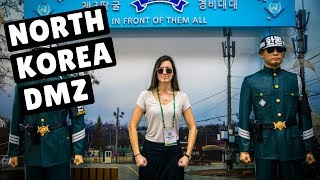
YouTube travel vlog by Nate and Kara Buchanan documenting a guided tour of the Korean Demilitarized Zone (DMZ) from the South Korean side. The video covers the Joint Security Area (conference room straddling the border), Freedom House, the last South Korean train station, the Dora Observatory (propaganda village, large flagpoles, loudspeaker propaganda), the Third Infiltration Tunnel, and the creators' reflections on seeing North Korea from South Korea. The tone is travel-observational with moments of seriousness about the geopolitical reality.
Questions this video answers
June 25, 1950.
About 4 kilometers wide (2 km controlled by South Korea, 2 km by North Korea).
500 won for two minutes.
160 meters tall.
Four tunnels discovered (first in 1974, most recent in 1990).
Chapters
Standing in North Korea right now.
Today is day five here in Seoul, South Korea. And before we got to Seoul, we had a very long to do list of things that we wanted to do. And this was probably at the very top of mind. Today we are visiting the demilitarized zone between north and south in South Korea.
Today we're partnering with Corridor Tours because you cannot go to this area on your own. You have to book a tour since it's a military zone. So we're on our way to meet up now and we have a two hour drive to the dnc.
Let's go.
Please show me your military ID and passport again. This is really important before entering the joint security areas.
So we've just arrived at the joint security area. We met up. Hope we're getting left.
Then his youngest son and our best friend to the North, Kim Jong Un then succeeded him in power. This being the second ever father son succession to take place in a communist country and mark the third generation of Kim family to rule over communist North Korea.
We just arrived at the jsa. We had to leave all of our bags on the bus, but we could take our cameras. We got a slideshow briefing from a military officer from the US and now we're about to get on two new buses to go to the demilitarized zone, the dmz. So at this point things got really serious really quickly. We get on the new bus with this US army soldier and he became our tour guide for the next couple of hours through the dmz.
So the dmz, for those of you who don't know, is basically like a four kilometer stretch of land that runs all the way across the border of north and South Korea. And at this point, South Korea basically owns the 2km to the south and North Korea owns the 2km to the north. And there's a line down the middle that divides the two countries. So the whole drive was only like five minutes. But we saw a ton as we were driving through the dmz. And as soon as we got to the Freedom House, we had to pile off the bus, get in two single file lines and at that point they told us, don't do anything dumb.
He told us, don't wave, don't point, don't make any gestures, verbally or non verbally to North Korea because you're being watched heavily.
They also had a dress code to be able to go on the tour. So he had to wear closed toed shoes, long pants. I wore a collared shirt because I was nervous I'd get Kicked out if I wore a T shirt, but that really wouldn't have been a problem. But basically, like, they just didn't want you looking trashy or, like, have any slogans on your shirt that may offend North Korea or that could be used as propaganda.
They said the guards would take pictures of you and use them as propaganda in North Korea. So, yeah, we dressed up nicely.
So we walked through the Freedom House in our two single file lines into this conference room that sits. Sits on the border of north and South Korea. So we are currently inside of the conference room. This conference room in the middle, this table behind me, is dividing north and South Korea. So we are currently still in South Korea, but there are three microphones on the table, and that's basically the line. So as soon as we step past that table, we will be in communist North Korea. And if you look out the window, you can actually see a line that divides the two countries. Crazy. Let's go to North Korea.
Standing in North Korea right now. So it got a little hectic in there. As soon as we got in there, our guy was kind of telling us what was going on, what the room was used for. And then he said, okay, everybody can take out your camera and take pictures for the next four minutes. And then you're putting them away, and we have to leave.
We have an entire bus full of people in this one tiny conference room all trying to get there, like, one shot. Everybody's lining up to take pictures with the guards because they told us that we could. That seemed kind of weird.
This is insane. We can also take pictures with the guards. They all wear sunglasses.
Because it looks scary.
So there were two guards. One was stationed by the conference table, and the other was stationed on the back side of the room, which was technically the North Korean half of the room. And there was a door behind him. And they basically said, if you go out that door, you're in North Korea, and there's nothing with can do for you. I'm pretty sure the guy wouldn't have let you through the door, but, like, that was just kind of crazy. So after our four minutes were up, we had to leave the conference room and then come back in front of the Freedom House, where we had four more minutes to stand and look at Conference Road, which is these four buildings. Some of them are gray, and some of them are blue. The gray buildings belong to North Korea, and the blue buildings belong to South Korea.
There are two guards that stand on their main building in North Korea, and the guards in South Korea have nicknamed.
Them, the soldier that we refer to as Bob, he usually bobs in and out from those pillars to maybe get a glass of water or fix his uniform because he stands there for 14 hours every single day.
There he is.
Like, obviously they've never communicated with these guys before, and so they just, like, they've given him nicknames, and they talk about them like they're their friends because they have to sit there and stare at him. Oh, I can lift it up higher.
All right, ladies and gentlemen, we have about one more minute for all photography.
Okay, ladies and gentlemen, please refrain from taking any further photographs and form two single file lines facing to your left, just like middle school.
Line leader. That was just the first part of our tour. After this, things get more relaxed. We get further away from the border, so we're actually able to film some more. So after this, the rest of the vlog is back to normal, almost.
So for the second stop of our tour, we have come to a train station, which is the last train station in South Korea. So if you were to go one more stop, you would be in North Korea. Obviously, you can't do that now. You used to be able to. And now there's some type of reunification efforts, as I understand it. So they're hoping that one day they will combine the track again and people will be able to travel from north to South Korea and vice versa. Obviously, there's a lot that has to happen before this railroad's ever connected again.
So this is pretty crazy. This red line right here is the Trans Siberian, which we just finished riding last week. We ended in Vladivostok. Had this Trans Korean railroad been open, we would have been able to ride all the way from Vladivostok down to Seoul, South Korea, where we currently are now. One day, if they open it back up, we have to redo the entire Trans Siberian, and it's all.
Oh, listen to that. Hi, everyone.
You are listening to K pop music now.
Okay, so now we're at the Dora Observatory, which is this place where they have all these super high powered binoculars. You can pay 500 won and look through them for two minutes. I want to see a person walking through the field.
So there's a lot of things that you can see through the binoculars on the observation deck. Probably the most interesting is the propaganda village. I'm not exactly sure how far away it is from where we are right now, but from what we've been told, the village is just completely empty and all of the buildings are shells. They say most of the windows and doors are painted on. There's some buildings that do actually have windows. And they say that you can tell there's no floors inside of the building because you can see the lights inside get dimmer as they go down. And there's a flagpole over there that's 160 meters tall. It used to be a lot smaller. And then South Korea built a flagpole that was 100 meters tall. And so they couldn't be outdone, so they built another flagpole that was much higher. Also, they're playing some kind of like South Korean kids K pop music and messages of capitalism and love is what we've been told from the South Korean side over this loudspeaker so that I guess potential North Korean defectors can hear it. And then at the same time, the North Koreans are playing their propaganda music, which sounds like opera, but we actually can't hear it from here because the South Korean stuff is so loud. So we just arrived at our last stop, which is the third infantry tunnel. These are tunnels that the North Koreans have actually dug underneath the demilitarized zone with intentions of infiltrating South Korea and doing a surprise attack. I'm not exactly sure what the rest of the history is. I think that's what we're about to go find out. We're going to watch a short movie and then go check out the tunnels.
On June 25, 1950, the invasion of South Korea by the north began with earth shattering sounds of artillery.
So in the movie, we learned there's actually been four tunnels that have been discovered. The first One was in 1974, and the most recent was in 1990. And they said that there's probably way more that they haven't discovered yet.
Pretty terrifying.
And they were dug all the way into South Korea. And the third tunnel that we're about to go see now was big enough to bring 30,000 soldiers an hour through. So this is no little tunnel.
Here we go. Unfortunately, there's no filming in the tunnel, so we're going to have to just tell you about it again.
That was totally nuts. The tunnel is 73 meters below ground. The walls were crazy. You can see spots where the dynamite was. You could also see this blackness, this on the rocks down there, which I think is granite. But when the North Koreans got caught, when they found their tunnel, their excuse was that they were mining coal and they had put this black on the wall to make it look like it was coal. Just crazy. And I can't believe that we were down.
So we just got back to our Airbnb. And we have a few final thoughts about our day at North Korea before today.
And for a while, North Korea has been on my bucket list of places I wanted to go. But care has always been very against it, which is understandable. And I'm not going to try to justify why I wanted to visit North Korea, but as of September 2017, US citizens can no longer go to North Korea. And so this was essentially as close as we could possibly get, which I'm.
Glad that we experienced it this way from South Korea and not as a tourist going into North Korea, because if we'd have done a tour that way, they would have fed us the same propaganda.
There was a guy who was on our tour who had been to the North Korean side and essentially done the same tour. And we were kind of comparing what he learned on both, which was very little on the North Korean side and a lot on the South Korean side.
And our tour guide said, ask me anything. What do you want to know? Ask me anything. And of course, there are a few questions that he couldn't answer because he wasn't allowed to. But the guy who had been in North Korea said they told him, don't ask any questions.
We played tourist all day in a situation that's very serious and sad, especially for those north of the border. And I don't know, I just didn't want this vlog to come across as us just like gallop banting around. Yeah. Being entertained by other people's sadness and misery. But we travel to, like, learn about the world, to experience new things, and today was a chance to do that and hopefully witness with our own eyes what will be history one day after the two Koreas unify again.
Yeah, I am really glad we went. Hearing the news and hearing all the negative things about North Korea, it's really easy to just think like, oh, that's crazy. But like being on that lookout mountain today and looking at the people in their country through the binoculars like they're real people. It was just a really eye opening experience.










