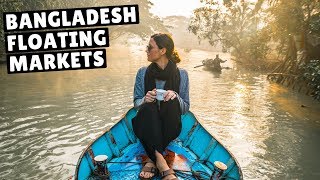
Nate and Kara Buchanan’s travel vlog documenting a daytrip outside Barashal, Bangladesh. They travel overnight from Dhaka on a century-old paddle steamer, take early-morning tuk-tuks to a nearby floating produce market, explore riverside villages (breakfast, blacksmith, puffed rice production), visit the largest timber market, and reflect on local labor and daily life. The video emphasizes the region’s natural beauty, authenticity, and the contrast between visitors and locals.
Chapters
I feel like this morning I've just been having one of those outer body experiences where I'm like how in life did I get here?
We're Karen Nate and we're currently exploring our 97th country of Bangladesh.
After a couple days in the chaotic capital city of Dhaka last night we jumped on a hundred year old paddle steeper and rode south overnight to the port city of Barashal.
It is 5.30am and we are about to go for an hour ride in one of these tuk tuks.
Good morning.
Trying to stay warm. I did not think we would ever be cold on this trip.
You excited about this?
I think we can stop at Starbucks.
The reason we're up so early is because we are heading about an hour outside of town to a floating market. And we've heard all the action happen between sunrise and lunchtime.
From here we get in the boat.
Thank goodness we're here. I feel like the boat will be warmer.
Bye.
Bye.
We are experiencing a totally different side of Bangladesh right now. It is insanely beautiful out here and it just feels so wild and untouched. We're driving through this forest with all these local villages on the side. People are standing outside brushing their teeth in the river. The Sunri. One of the most beautiful places we've ever been.
Was it worth the early morning wake up call?
Yes.
I feel like the more you travel, the more you want to intentionally seek out places that are like just super authentic. And that's what we found today.
You can see it on the local spaces too. When we drive by, they all stop what they're doing and they're like who are these orders?
It's fun when you feel like you can provide some entertainment. Back.
We have just arrived at the floating produce market. And this has to be one of the most picturesque places I've ever been in my entire life.
I see coconuts, oranges, some kind of root vegetable that I've never seen before. Bananas, greens, grapefruits.
Spot some breakfast.
This is a good.
Thank you. Amun. What's the name of the market?
This is.
Floating Market.
We draw a lot of attention to ourselves just being here in general. But when Nate is flying, the drone just brings it to a whole new level. Hello.
All right.
How do you eat? From the top. Okay.
Mamun just went and got us a piece of fresh sugar cane. Just taught me how to enjoy it.
I'm not as good at it as he is.
Graceful. How are you? Good. How are you? We've just stopped at this little riverside village for breakfast. At this Family run restaurant where lady is making bread by hand at the front. So we watched her, like, take the dough, roll it out, throw it on the pan, and cook it right in front of us. So it's super fresh. It's like chapati with some eggs. Did I assume we got from right down the road more bread? A crowd formed around this building as soon as we walked in. I love it. This village is so different than the city. It feels so strange just walking in the middle of the road and not dodging motorcycles and tuk tuks.
There's still a lot of hustle and bustle. Much calmer, much less scary. Everyone's just as friendly. There are some bicycles back on the boat.
These bridges are too cool. I feel like this morning I've just been having one of those, like, outer body experiences where I'm like, how in life did I get here on a river that I have no clue what the name of it is? Somewhere in the middle of a town in Bangladesh. And I say that in the best possible way. I never thought my life would end up this cool.
This is rice that's being dried with salt, and it goes in this machine. It feels, like, spongy. Wow.
It's coffee rice.
It's literally just flying out of the machine and hitting the wall and has this hu mountain of this on the ground.
We had no clue what we were getting ourselves into. We just pulled over at this little house on the side of the river. So after the rice is mixed with salt, they pour it into this big drying machine. Then from there, a guy carries it to the frying machine. It dries and becomes puffed in the frying machine. It gets spun in this cylindrical net and then shot across the room to give you the final product.
I'm gonna try to catch some.
Just open your mouth.
Ouch.
Open your mouth.
It's coming out so hard. It hurt my hand. It tastes like roasted Krispie treats.
They are making knives like this by hand. I am so impressed. It is an insane process. The guy is hitting as hard as he can with this hammer and hitting this tiny piece of metal every time.
This is what happens every time we stop somewhere. No one was at this shop. And now they have an audience. Not saying anything, just standing, watching. I don't mind.
We're just taking turns observing each other's lives. It's a fair trade.
Nate, you are so right. Like, that just changed my perspective so much. I don't mind when people gather around and stare at us, but, like, we. That's what we've been doing. We were gathering around blacksmith, and all the people here are probably like, why do they care about this, like, knife making stuff? Like, that's so normal to them, but to us, it's like, wow.
It's just completely different from what you see every day.
Yeah. And then we're standing here, like, who knows how many people like us, they've seen. And we're holding interesting things. Like, of course it. We're doing the same thing.
You go first. I need to hold your hand.
We have just stopped at the largest timber market in Bangladesh. Apparently, majority of this timber goes towards making boats and going to sawmills. The guys working here are so strong. They're all carrying these giant logs. And a bunch of boats are coming and buying them and taking them to where they need to go. But right now, they're all just laid out on the bank.
It's crazy, the hard work.
700 taka every day they get for.
12 hours, 10 hours minimum. He said that because these guys are well trained, they're able to make like eight or nine dollars a day doing incredibly hard labor.
And he said that was good money.
I feel like we've been running around going, wow, this is so interesting. We're getting to see this. But the reality is these people live a very hard life.
They work really, really hard and honest.
Like, just to be completely transparent. It's one of those things that's just, like, hard to think deeply about. This camera that we're talking into right now. Costs more than they'll make in one or two years doing this type of hard labor.
And they're so happy.
I feel like at some point we'll slow down and all of this will, like, sink in and something will. I don't know what I'm trying to say.
And I'm giving it to you.
That's comforting.
Not doing very good. So this town's a little busier than the last village we were in. In case you were wondering where you go to the bathroom on a day like today.
We have come to a hospital to use the bathroom, which is just a simple tile room with classic squatty puppy. No toilet paper, Just some water and a bucket. Good thing I travel with my own these days.
Definitely meets oakshare regulations.
You would never guess how old this guy is.
My Bangladesh.
40, right?
Bangladesh.
He told me he was 40 and he's carrying an entire tree.