CUBA! Here's What Surprised Us Most: Safety, Food, Money, Cigars, Cars
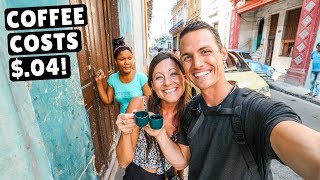
Kara and Nate Buchanan share what caught them off guard in Cuba: doctors earn less than tourism workers, people wear white for religious reasons, the streets are filled with 1950s American cars, and pizza gets folded like a taco. They also explain the two-currency system and why Wi‑Fi cards only last an hour.
Questions this video answers
$80 per month.
One card equals one hour of Internet.
CUP (Cuban peso) and CUC (tourist convertible peso).
4 cents.
Chapters
It is our last day in Cuba, and we by no means claim to be experts on this crazy, unique, complicated, beautiful country, but we have learned a lot.
So in today's video, as we spend our last day here wandering around Havana, we want to share with you all the things that have surprised us most about this country.
When we originally came to Cuba, we came here with a lot of myths, misconceptions, and one of the biggest ones for me was how prevalent the cigar culture was here. I expected to show up in the country and everybody was going to be walking around smoking cigars, but it turns out that's not the case, at least anymore. And that's because we learned from one of our guides that most of the locals here actually consider cigars a luxury. So unless somebody is actually working in the tobacco industry and they can get them at a very reduced price, you're not going to see a lot of locals walking around smoking cigars. It turns out it's mainly for the tourists.
When I pictured the style in Cuba, I've always pictured fedoras and white clothes. And it turns out it's true. There are a ton of people wearing the traditional fedoras and a lot of people wearing white clothes, too. But it's not what you think. The white clothes actually stem back to a religion called Afro Cuban, which is the most prevalent religion to this day in Cuba. And when you're entering into it for the very first year, you have to wear all white. So that's why a lot of tourists, when they come here, think that white is just the style and feel like they need to wear white pants.
They sell you cocktails on the street, and you can just walk around with.
Them, and they're super cheap.
So everyone knows that Cuba is full of these really old, cool American cars. But what most people don't realize is that for every old American car, there's one of these old Russian cars. I had no idea these were here. I think they're just not as well known because the other cars are much more popular on Instagram.
Cuban spend a lot of time waiting in line. Whether you're waiting in line for a WI FI card like we are now, or whether you're going to the bank or a store. For some reason, they only let a few people into each location at once. And so there ends up being this really long line outside of many of the stores. Even though it looks like a big jumbled mess behind me, it actually turns out that there's a really good system. So we've learned that when Somebody new walks up to get in the line, they ask who's last. And if you're last, you're supposed to raise your hand so that everybody kind of knows where they stand in line. That way you don't have to wait in this perfectly little single file line. Everybody can just kind of hang out where they're comfortable, but everybody knows exactly where they stand.
Let's talk about Cuban food. We have learned so much about the food culture here in Cuba because we went on a food tour and when we first got here, it seemed like every other restaurant was an Italian restaurant. And we were so confused about why that is. Turns out Italian ingredients, particular Italian food is very accessible here and very affordable. There's pizza and pasta everywhere, which we love. Street pizza has got to be our favorite that we've had here so far. And they fold it like a taco.
So if you came to Cuba and you only ate at the touristy restaurants, you would probably leave thinking that the food here is really expensive. You just have to know where to go, where the locals eat. Like this place where you can get a coffee for 4 cents from a lady's window of her house. And it's really good.
One of the most mind blowing things that we've learned since being in Cuba is that Cuban sandwiches aren't Cuban. Apparently Cuban Americans are actually the ones that created the Cuban sandwich. But so many people have come here looking for a Cuban sandwich that the Cubans have actually started serving it in some places.
Before we came to Cuba, I had heard that doctors here make less than $100 per month. And I had such a hard time believing that until we stayed with our first host, whose brother was a neurosurge. And when I ask him, his brother makes $80 per month. That's it. And it's amazing to me that anyone here in Cuba is still motivated to.
Become a doctor after being here for a week. From what we've observed, the people who work in the tourism industry are the most well off, which means a lot of them are way overqualified for what they're doing. For example, our host in Vinales was a physics professor, but made more money opening up his home to tourists than teaching. Then the guy who showed us around the coffee plantation was a computer SC engineer. But I think the craziest thing of all is that you can make more money driving a taxi than being a neurosurgeon in Cuba.
One thing that is super unique to Cuba, I don't think we've experienced it anywhere else in the world is that they actually have two different currencies. They have the local Cuban peso, and then they have the tourist money. This is cup, this is cuc. I thought before we came that I was going to need to get my hands on the local pesos and I was going to be able to save all kinds of money with it. But it turns out they're pretty much used interchangeably here. The locals are using the tourist money just as much as we are, so you don't have to worry about getting your hands on the local pesos. It might save you a little bit of money in street food, but for the most part, if you're using the tourist money, you're not going to be ripped off.
Okay, I know this is a little weird, but when we were planning this trip, we read that there was like, no toilet paper in Cuba. Bring your own toilet paper. And I've been carrying it around, but there's been toilet paper everywhere. We haven't been without it a single time. Some places you do have to pay for it, like a few cents, but there has not been a single bathroom without toilet paper in it. So don't worry, you don't have to bring your own toilet paper.
When we very first stepped foot in Cuba, one of the first things that we noticed is how many people were just outside. Kids were playing outside in the yard. People were sitting on the side of the road just having conversations with each other. When we would go into a restaurant, ooh, that's really loud. People would be having conversations and not sitting on their phone. And that is because WI fi in Cuba is pretty new and very restrictive. If you want to get connected to WI fi, you have to wait in a really long line and get one of these cards. One card equals one hour of Internet. But you can only use them in certain WI FI zones, such as these WI fi parks. They're very easy to spot. There are lots throughout the city. And it's just a bunch of people sitting on benches, nose down in their phone, making the most of the WI fi that they paid for. And we had heard before we came to Cuba that it wasn't even worth spending the time to get one of these because the WI fi was really slow. You couldn't even do anything. But we have not found that to be the case at all. We think it's actually pretty fast. We even watch a YouTube video.
Being without Internet for a whole week has been the craziest experience for us. We bought WI fi cards like twice to check in on some things, but for the most part, we have been Internet free and it has been so interesting.
It's led to some very unique conversations. Like the other night over dinner, I found myself explaining to Kara House sugar cane turns into sugar.
Things that we never would have talked about before. Like, we both just paused after that conversation. We were like, how did we get here?
You get to places and conversations that you can only get to if you aren't able to, like, look down at your phone and do something more interesting.
There are definitely pros and cons to it. It's been fun, like trying to figure out how to get places without maps that we heavily rely on. But there are other times where we're wondering something and we're like, gosh, if we could just google it, we wouldn't have to wonder anymore.
Or like, fact check ourselves for these videos. I'm pretty sure I'm saying this right. Normally I'd look at the Internet and.
Make sure it's a fun change of face.
We typically don't take our expensive camera gear out at night because we don't feel like that's a very wise thing to do in any big city in the world. But that's another thing that's really surprised us about Havana is just how safe everyone's told us that it is from reading stuff on the Internet and from talking to our host. Apparently the city is super safe even at night. Our host told us it was no problem to take our camera out, but it just feels so wrong. Like, honestly, the streets here at night look sketchy. It feels like a place that should be unsafe. And so when we're toting our gear around, I'm still feeling like a little uncomfortable. Don't take this as a direct recommendation of flaunting all of your expensive stuff while you're in Cuba, but it's just interesting to note and so far nothing's happened to make us feel insane.
Our time in Cuba is officially coming to an end. This has been such a an eye opening trip for the both of us. We haven't even scratched the surface of everything we've learned since we've been here. But we hope you enjoyed this different style of video. There's so much more to see and do in Cuba. We're very sad to be leaving, but tomorrow we're going to.
Oh, it says it on here somewhere.
Sorry, I wasn't ready. I'm not ready again. Tell me when you're doing it.
Wow.










