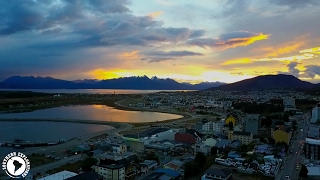
A travel-vlog style YouTube transcript of Nate Buchanan and companions exploring Tierra del Fuego National Park from Ushuaia. The group paddles and hikes through lakes, rivers and the Beagle Channel, guided by Ana, while the transcript intersperses historical context (name origin from 1500s, Ushuaia’s past as a penal colony), natural-history notes (kelp ecosystems, sightings of condors and a sea lion), local flavors (calafate berry), and brief practicalities (train stop, lunch). The narration emphasizes the remoteness (southernmost city, ~1,000 km from the Antarctic Peninsula) and scenic significance of the region.
Questions this video answers
Ana
Beagle Channel
About 1,000 kilometers
In the 1500s
Ushuaia
Chapters
It is our first day of adventures with Southern explorations. And it is not a travel day.
Today we are going hiking and kayaking in the Tierra del Fuego National Park. Supposed to have, like, some of Patagonia's most iconic views.
Just a little update. Recap. We are in Ushuaia, the southernmost city in the world. We could basically swim to Antarctica. A driver's here to pick us up.
We have picked up everyone from their hotel and we are driving through the mountains to the national park. And it's already gotten so beautiful. And we've learned so much from our tour guide, Ana. She told us about the name of the national park, which is Tierra del Fuego. And it comes from way back in the 1500s. There were Indian, like, native people living here. And when the explorers were, like, driving their boat around the island, they. They were like, making smoke. So they originally named it the Land.
Of Smoke, but then that wasn't scary enough because they wanted to make sure they scared, like, the other countries away from going. So they named it Tierra del Fuego, which means the Land of fire.
And Patagonia is named after a monster.
They basically just named it, trying to keep other people, monsters and fire away from this region so they could have it all to themselves. And now we stopped at a train station. Ushuaia used to be a penal colony where they sent, like, the worst criminals in all of Argentina. And they made them ride this train behind us every day to go cut wood to warm the prison, otherwise they would freeze to death.
It's actually electric now and very touristic, but they still put steam on it.
We're not actually going on this tour. We're just making a quick stop because our guide told us it was really touristy. She's just letting us take a few pictures. Alright, we gotta get back on the bus.
Sam.
Ready to go? How awesome is this lake? I can't stop taking pictures of it.
Gracias.
So we're gonna canoe. We're gonna begin in this lake and we're gonna go down a river that's going that way. If we go like this, we will not go far, Right? If we go like this, we will arrive to La Pattaya Bay. All right. Even to Cape Horn or Antarctica.
We just paddled down the lake and then took our boat over the road right here. Now we're getting back in in the.
We've just entered the Beagle Channel, AKA there's a lot of waves now.
We just finished kayaking, worked up a big appetite for lunch, was Absolutely beautiful. Even saw some condors and a sea lion in the river. It was awesome.
All right, guys, now we're going to stop at a place that we have for lunch. So if you want to leave things here in the bus, it's fine.
Lunch was so good. I thought we were gonna have, like, ham sandwiches. And we had a delicious lunch.
This first part of the hike is gonna be going uphill, little by little, and then once we get uphill, we're gonna go downhill all the way to the Beag.
Oh, such a nice smell. I know.
I do love that smell too. Isn't that weird?
This is officially my favorite hike ever. She brought coffee with a view.
While we were kayaking, we kept seeing these huge kelp leaves. And we just learned that these are basically the roots of the kelp leaves. And a bunch of little things live in here. And then other things come to find the things that live in here. And then bigger things come to eat the things that are looking to live in here. So these are really important for the Beagle Channel. Pretty fascinating.
Getting closer and closer. Actually, I'm showing here Moscow. So you have an idea of how south we are in latitude compared to the north hemisphere. So we are about the same latitude south as Moscow is north. We are about a thousand kilometers away from the Antarctic Peninsula. Yamanas lived here in the south along the Beagle Channel. They used to ride along in canoes along the Beagle to hunt the sea lion, to fish, to go catch food.
We are back down at the Beagle Channel again, and we are about to eat some nature. This is a calafate, which is also the name of a city. Apparently the city was named after the fruit. It was a blueberry. It was delicious. Very earthy tasting blueberry.
We just finished our hike. Now we're about to get back in the van. It has been the best day. The weather's been perfect. Our guide on it said it was a very special day. It's not usually this perfect all day long. I can stay out here forever.
Officially the coolest post office in the world. It is the southernmost post office right at the end of the earth, unless there's one in Antarctica. I don't know if you can mail stuff to Antarctica.