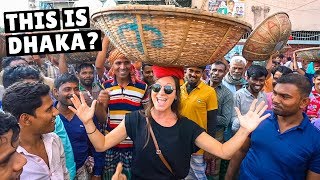
This is a transcript of a YouTube travel-vlog episode by Kara and Nate Buchanan titled "FIRST IMPRESSIONS OF BANGLADESH (most densely populated city in the world)" (Dec 15, 2019). The hosts arrive in Dhaka (their 97th country) and, guided by Mamun, visit early-morning flower and fish wholesale markets, the large Karwan Bazaar, rickshaw workshops, and the old city. The transcript records sensory impressions (crowds, smells, colors), local economic details (onion price spike after India stopped exports; daily wages and rickshaw rental rates in taka), cultural notes (decorated rickshaws, people atop trains mentioned), and ends as they board a century-old ship for an overnight journey.
Questions this video answers
Their 97th country.
Only open till 8am every single morning.
The price has increased 10x.
About 50 cents per basket.
About 1000 to 1200 taka per day.
Chapters
We're Karen Nate. After traveling the world for four years, we're getting close to reaching our goal of visiting 100 countries. Yesterday we arrived in our 97th country of Bangladesh, where we were picked up by our local guide, Mamun. With only a couple hours of daylight left, we hit the streets to get a taste of the city, both literally and figuratively.
This morning we were up way too early to meet back up with Mamun, who is going to take us to two of the early morning markets that happen here in Dhaka.
The guy just drove up. We think he said the name of our guide and we got the car.
Hello, beautiful. How are you?
Good.
Thank you.
What is your name?
We are at our first stop of the day, the flower wholesale market. It's only open till 8am every single morning. It's so beautiful and it smells fantastic. What are these called? What's the name? Everyone is so friendly. Hello.
How are you?
That was a great way to start the day. So many smiles.
I could have stayed there for hours just watching the cast. But there's one more market we have to get to before it closes.
Nice to meet you. Those guys are enjoying their job. Seriously, some of the friendliest people we've ever met.
We have arrived.
I don't think we said, but you can probably guess. We're at the fish market. So this is the main wholesale market in one of the most densely populated cities in the entire world. So all the fish being purchased here is like for restaurants or even to be taken out to store smaller local markets around town.
This is crazy.
Where are they from? I'm from where?
Without a doubt the craziest market we've ever been in.
Making a break for it.
We're getting out of here.
Wow.
It's incredible what some of these people can carry on their heads. Never seen anything like this before.
So we've walked right around the corner to the Karwan bazaar and this is the largest market in the entire city. Looks like it's mostly produce.
So many eyes on us right now. This is beautiful too. So many colors.
Wow.
Main trading center for vegetables, fish and other all things from here delivered throughout the country.
So Mamu was just explaining to us that India quit exporting onions to Bangladesh and the price has increased 10x and so they're pretty much boycotting eating onions. One, they're too expensive. But even the prime minister has kind of called for a boycott of not eating onions also. This is what happens anytime we stop for a few seconds.
We've seen at least a million people today. But so far we haven't seen any other westerners who are a little bit of a novelty. I.
So they get paid about 50 cents for every basket that they transport from inside the market outside to whoever purchased the vegetables, fruits, whatever the produce.
Is in a day.
I don't know.
Like 6am to 11 second income, 1000 taka to 1200 taka. But this is very hard work. It's not easy because heavy.
I'm pretty sure I just gave that guy his first high five ever. I didn't realize that that wasn't a worldwide thing.
High five.
High five.
Like high five.
Like this actually it's not covered, but.
We just, we're introducing the high five to bangled that it's happening. High five.
This room is only potatoes, hair everywhere, stacked to the ceiling.
It's very warm and hard to breathe. In the potato room. It's probably just all the dust from the dirt on the potatoes, I guess. Oh wow.
Getting out of here.
What a morning. If we didn't do anything else, it's ever go to these three markets. Bangladesh was totally worth the trip.
Totally. I mean we had the same conversation like 500 times. But it never go like, hello, what country, how are you?
You just can't appreciate how massive that market and how chaotic it is without just standing in the middle of it.
There's nothing like it. The energy there is just insane.
Okay, so I lied when I said we could leave now. The thing I actually wanted to see most in this country was people on top of trains. Before we came here, that was the only picture I had seen of Bangladesh. That and entire. So we've come to the main train station.
It's not looking very crowded.
Are you going on the train?
Unfortunately. I guess today's considered a quiet day at the train station because everybody was inside of the trains. But Mamun said he has some pictures.
One of the most popular forms of transportation here in Dhaka are these three wheeled rickshaws. And what's really cool is we haven't seen any two rickshaws that look exactly alike yet. They're all so unique and every single one has this beautiful artwork on it. And they're all decorated with flowers and paintings. So we've just come to this slum village by the railway where they actually build these rickshaws. It's a very labor intensive process and really cool to see.
So one of the interesting things we've learned since being here is most of the people who drive the rickshaws don't actually own them. They come from Smaller villages outside of the city just to earn a little money for the day. And they actually rent the rickshaws. He said they rent them for around 300 taco per day and they can make up to 1000. So coming into the city renting a rickshaw, all to make eight or nine dollars in a day. Hard to imagine this life.
This is a ride.
We have made our way into the old city. The number of rickshaws have multiplied. Apparently there aren't. That was a van. But we were told cars aren't allowed in this area. So we're taking a rickshaw to the market.
I can't believe we're doing this.
It was scary enough riding in a car.
I've seen so many of these things almost get hit by a car. Now we're on one.
This really is the way that everybody gets around here. I feel like most places where you go where you ride in these, they're just kept as like a tourist attraction here. It's how everyone's getting around.
And they're so pretty, no shocks.
So we've just come upstairs above one of the shops and they just have a little makeshift factory up here where they're assembling a bunch of flip flops. One guy's screen printing, the next guy's punching the holes to put the thong through and then the other guys packing them up and putting them in the bag. And then I guess they'll go down on the street to be sold. Normally we prefer to travel independently, but this is one of the really cool things about being with a local is getting to, to come up and see to see stuff like this. Because we would have never just just gone up a random stairwell.
I am never going to look at a pair of flip flops the same for the rest of my life. When I buy flip flops I'm going to think of these guys working so hard in this little hot room, hunched over making them from scratch. Really makes you appreciate the things that we have. They're so quick.
Before we went up to that shop we were just walking by all these shops selling all of this stuff that just kind of looks like plastic junk. But now you know it was at least assembled by hand by somebody. So you have a little bit better appreciation for all of this stuff.
I feel like I haven't been this wide eyed walking around a place in so long. You kind of get used to some of this stuff when you travel a lot. But this.
It'S a human traffic jam.
It really is.
I think he's done that A few times the floor.
So just to give this some perspective, India is probably the craziest place we've ever been in terms of just being completely packed with people. And Bangladesh is three times more densely populated than India.
Wow.
The most prominent Mughal monuments in Dhaka City.
This place is such an oasis in the middle of Dhaka. So green and there are flowers, birds are chirping. And there are just a bunch of local families and kids just hanging out in the grass. Probably the most historical monument in the whole city. And we are still the only westerners here.
We are heading down to the riverport for sunset and we just got out of the car because he said it's faster if we walk. Hello.
It is rush hour.
This is crazy.
Nice. Wow. What a view. We've just come up to the top of a mosque to get this incredible view of the sunset over the river all the way.
Wow.
This has to be the best view in the city. This is incredible.
And it costs 500 taka to go inside the pink palace. But if you come up here, have a great view for free.
Today has been a huge pay so eye opening. But it's not even close to being over yet.
We are about to get on a ship that is over a hundred years old to ride overnight to a city in the south. So before this turns into an hour long documentary on Bangladesh, we're going to end this video here. The boat ride will be in the next one.
Here we go.
I can't do it. I need the little hat that they wear.
It's a video.
Thank you.
I did not realize how many times I expressed myself with words like wow or oh my gosh until we came here. Because every time I walk to some I'll say wow and they all say wow like just like I do. And it is cracking me up. So it seems like this market is. It just has sunshine. Really gotta watch your toes. Look at all those potatoes.
Oh, it feels like sand. There's sand in there. Cement must have been heavy.
Pretty much locals at this point, we've been here for a day. No matter how long you're here, I don't see how you can ever get used to this. Hello.