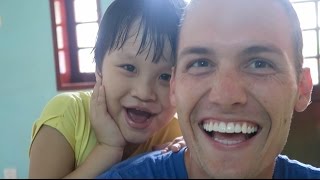
This YouTube video ("Helping the Deaf in Vietnam") documents Nate and Kara Buchanan visiting a deaf education center in Da Nang run by Jeff and Nancy. The video explains the center's origin, its programs (Little Stars for ages 2–5, Rising Stars for older out-of-school children, tutoring, outreach and sign-language classes), and individual vignettes showing dramatic language gains for children and adults who previously had no formal education or communication. The clip closes with a brief informal food segment where the hosts try local dishes including jellyfish. The center faces transportation and access challenges; two of Vietnam's 18 deaf college graduates work at the center.
Questions this video answers
Children between 2 and 5 years old.
School-age children often around 10–11 years old (out-of-school).
A 26-year-old man who had never been to school.
18 deaf graduates have graduated from college in Vietnam (historical count mentioned).
Chapters
This morning we're going to meet up with Jeff and Nancy, the people that we've been hanging out with for the past few days, to see the center that they started here for the deaf.
We're gonna let them explain it because I'm sure that they're gonna do a much better job than.
When we came. Originally, we came to join another project that was already here in Da Nang and working with deaf people. And I think pretty much from the first summer we were here, we started noticing just the educational situation of deaf people in this city. But then from what we heard in the whole central region, and really, there are a lot of challenges for deaf people throughout the country, education wise. But because we were both teachers, that kind of struck a chord with us. And so we kind of started dreaming about that and what that might look like, what we might be able to do. And so about three years after we got here, a little bit longer, we ended up opening the center. And really our goal here is to make sign language available, and we not American Sign Language. I should say that because some people think that sign language is universal. But most countries have their own sign language. And as is the case here in Vietnam, there's more than one sign language.
When we opened the center, we wanted to make sign language accessible because we meet deaf people. You know, we'll meet deaf adults who they haven't been to school, they can't read, they can't write, they can't speak, and they can't sign. And so it's like they. This isn't the case across the board by any means, but there are people out there that they've grown up just in isolation within their own homes, within their communities, not able to communicate with anybody. So our vision is really to make sign language accessible to deaf people and to have people that were qualified signers that could teach.
We have several programs that we do here. One program is a Monday through Friday for. We call it the Little Stars class. And it's for kids that are between 2 and 5 years old, and they come all day. These kids have never been to school before, so they're learning sign language, they're learning Vietnamese language, they're learning math, and that's done through games and a lot of different activities. We have a Rising Stars program, and these are kids who are school age, but for some reason they're not in school. So they're 10, 11 years old. And usually when they come to us, they've had no sign language whatsoever. So we're kind of starting fresh with Them. We also do sign language classes. Our deaf teachers go to the local schools and they teach the students and the teachers sign language. And then we have sign language classes here for hearing and deaf people as well that we do on site.
So we also have a tutoring program. So if there are deaf kids out in the community that don't come here Monday through Friday, but maybe they need extra help with school subjects or other skills, they can come here for tutoring. And then we have deaf topic night. If you hear a dog, that's the norm here.
So sorry about that.
About a year ago, a nine year old girl came in with her dad and she had never been to school and they were trying to find out if she could come here. They live 45 minutes away.
Transportation was not an option. But this year we got back in touch with the family and was trying to figure out a way how she could make it here. And one of our staff, one of our teachers agreed that she would kind of help with that transition and bringing her here. So we went out and met the family again and she was able to start coming. So she's 10 years old, never been to school, can't read, can't write. And as soon as she started coming, she came on a Monday and by that Friday she was already starting to pick up some signs of communication. And her mom was thrilled when she picked her up and was commenting on how she'd never been able to communicate with her daughter before. And now she was kind of having that opportunity.
Another little girl that comes, she's also 10 years old and she has cerebral palsy. And because that also affects her walking, it made it difficult for her to get around and she was not able to go to the local school. And one of our staff members met her in a neighborhood, met her family, introduced us and she started coming. And it's just been really amazing to see one, how much her language has developed. But also it's given, it's given her a place to go and a place to learn because she didn't have any other options. I think her mom, you know, periodically in her parent meeting she'll bring up, so what's gonna happen? Like, kind of like, do we have a plan for her long term? Because if we're not, there is no plan. And so yeah, it's just been really neat to see her have this opportunity and also to see a family, to see her parents get involved and siblings and trying, their, the whole family trying to communicate with her. And I don't know, there's a Lot more kids like that out there. So.
Two weeks ago, we had a dad come in with his. With his son who was 26. And again, the same story. He had never been to school, and there are schools here, but he's outside of the city about 45 minutes to an hour away. So for those kids, it's more difficult to find ways into the city to go to school. And he had kind of grown up, just not have that opportunity. And so he found out about our center and came here. And again, he's only been going to class about two weeks, but he's already learning science. He now knows his own name. He knows the names of the teachers, and he's starting to learn more and more each day.
We think about the adults that are in that situation that have gotten to their 20s or 30s or older and have had no language, no way to communicate.
We want to make sign language accessible for them, but also go back to where it starts as early as possible. As soon as a child is identified, if they can have access to language, then that can prevent growing up to be 20 or 30 with no language.
And the key. The reason why we were able to do this is because in the history of Vietnam, there's only been 18 deaf graduates that graduated from college here.
And.
We have two of those employed here. So that has been really beneficial for everyone kind of in the central area of Vietnam to be exposed to their quality, high level of education. There's a lot of kids that we've met, and we're trying to serve, and there's a lot more out there. So we're trying to find transportation is kind of one of our biggest needs to be able to better serve them.
We had such a great day with Jeff and Nancy today.
The thing that stuck out to me most about going to the center was that the people that they're teaching there literally have never had a chance to communicate with anybody their entire lives. Some of them could be five. And some people have gone as long as 25 years without being able to communicate at all with anybody else in the world. So if you want to learn more about their organization or figure out how you can help support them, we're gonna put Jeff's email down below. Well, now that this is, like, coming out of my mouth, I just realized that I haven't, like, really okayed this with Jeff. So we're gonna put some way for you to contact Jeff and Nancy down below. And if you're interested in learning more, you can use whatever there.
I think we found it.
Nate. Why don't you tell us what you just ordered?
You chose to go the safe route with the chicken and shrimp. Is that what you got? Pork and shrimp with the pork and shrimp. And I ordered the interesting thing on the menu, which was jellyfish. Not only do I have no clue what ne quang is, but I got it with jellyfish.
I wonder what we do with these.
Thank you.
This looks interesting.
It's looking a little slimy.
You don't look overly enthusiastic.
Mine's not like anything crazy.
It's not like jellyfish or something. That is a honking piece of jellyfish.
Oh, it's crunchy.
What?
What? It's not bad.
I have to try it.
The, like, the texture so jelly, but it's not. It's crunchy.
There's no way that that jelly is crunchy.
Okay.
Yes.
Okay. Okay, okay.
What is delicious? Delicious. Like m delicious.
Now what? No, no.
No, no, no.
No.
Bye, bye, bye, bye, bye, bye. Yes. Time for sleep.
Kara. Before coffee, Cara. After coffee.
Friday.
Daily program. That oyster.
Are you making a joke? Are you doing that on purpose?
I don't know what I just did.
You just heard. I did hear a hug coming.
Okay. No.
This is Kara's. I just saw a huge rat run across the road face. That is one thing here, like, laying food on the table, touching food with your hands.